Get in Touch with Taiguo


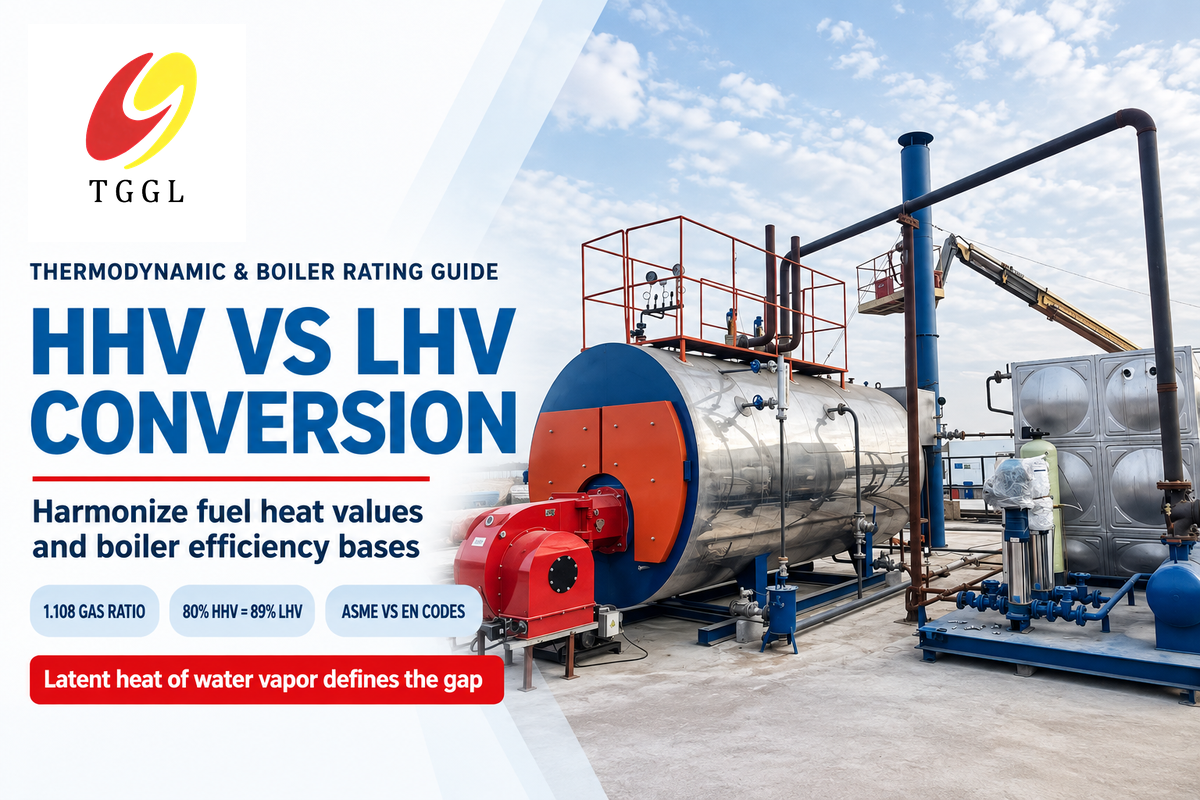
With regard to HHV vs LHV for pipeline natural gas, Higher Heating Value (HHV) is about 10% higher than Lower Heating Value (LHV). This difference correlates to the Clarke Energy natural gas conversion ratio, HHV ≈ 1.108 × LHV (LHV ÷ HHV = 0.9025). HHV measures the total heat released when a fuel burns completely and the water vapor produced condenses to a liquid state. LHV accounts for the latent heat of vaporization, since that water remains in a vapor state at the end of the combustion process.
Core thermodynamic equation: LHV = HHV − 2.442 × (8.936 × H + M) in MJ/kg at 25 °C.
Boiler efficiency basis conversion: ηHHV = ηLHV × (LHV ÷ HHV) = ηLHV ÷ 1.108.
Natural gas benchmark: Per ADGEfficiency’s boiler efficiency table, an 80% HHV efficiency rating equals an 89% LHV efficiency rating on the exact same steam boiler.
Comparing boiler proposals without harmonizing their heating value basis distorts fuel consumption and operating expense models. This document provides the exact conversion equations, multi-fuel benchmark tables, regional test-code mappings, and a procurement normalization worksheet.
What Is the Difference Between HHV and LHV?
For pipeline natural gas, Clarke Energy’s onsite power analysis shows it follows the ratio HHV ≈ 1.108 x LHV. On the other hand, the U.S. EPA Catalog of CHP Technologies Appendix A cites a boiler baseline of 80% on an HHV basis.
When any hydrocarbon or biofuel burns inside a combustion chamber, fuel hydrogen combines with oxygen and produces water. That reaction absorbs thermal energy as enthalpy of vaporization. As the U.S. Department of Energy Steam Tip Sheet #15 states, commercial fuel is sold on a gross or higher heating value basis. When water stays as vapor at the end of combustion, the available heat is reduced by the latent heat of vaporization of water.
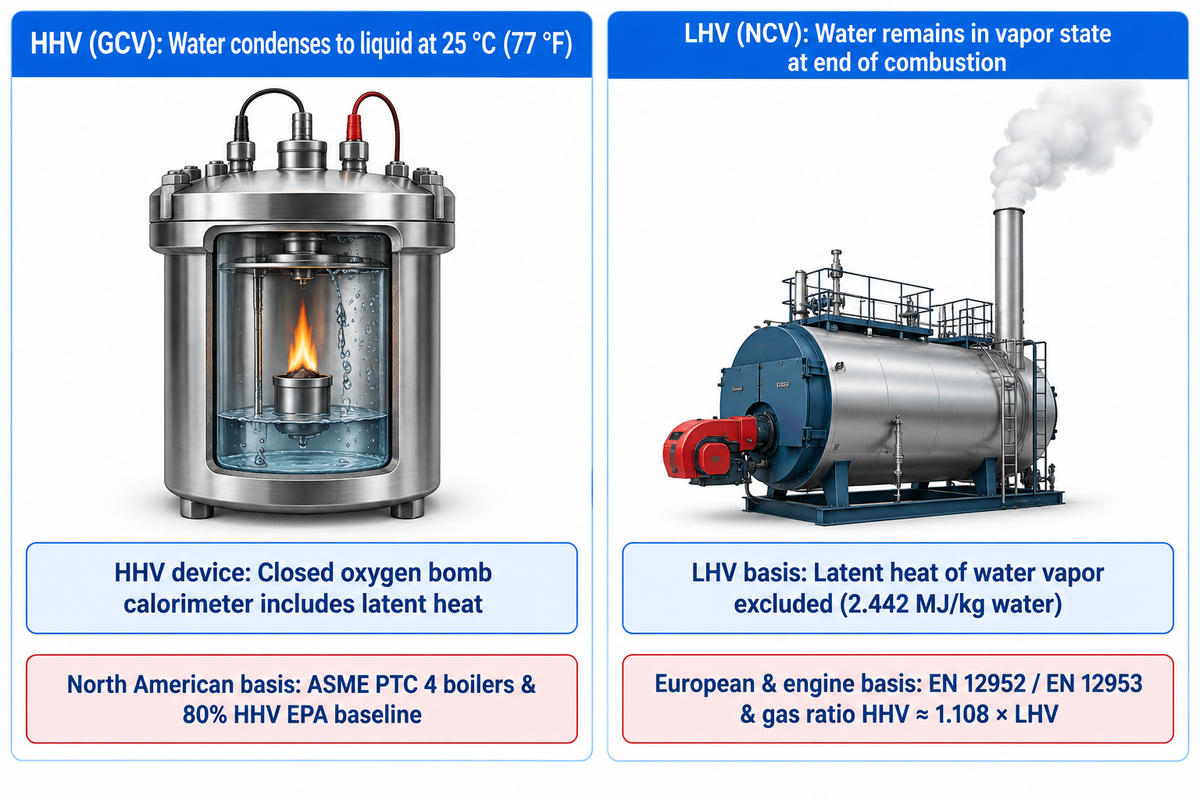
There are two distinct physical divisions. First, there’s laboratory testing. The U.S. Department of Energy Fuels Glossary discusses the measurement of HHV using a closed bomb calorimeter. The vessel cools all products of combustion back to 25 °C (77 °F), which forces the apparatus to condense the water vapor. HHV is measured with respect to liquid water at 25 °C (77 °F). It’s in a liquid state. On the other hand, a standard industrial steam boiler discharges exhaust gases through an open stack above the condensation threshold. That latent heat escapes up the flue. It’s recovered only if a condensing heat exchanger cools the exhaust below its dew point.
| Parameter | Higher Heating Value (HHV) | Lower Heating Value (LHV) |
|---|---|---|
| ISO & European synonym | Gross Calorific Value (GCV) / High Heat Value | Net Calorific Value (NCV) / Lower Calorific Value |
| Water state after combustion | Liquid state after combustion at 25 °C (77 °F) | Vapor state at the end of the process |
| Latent heat of water vapor | Included in total energy released | Excluded from usable heat of combustion |
| Physical measurement device | Closed oxygen bomb calorimeter | Derived by calculation from HHV and ultimate analysis |
| Primary North American use | Utility gas billing, ASME PTC 4 boilers, EPA reporting | Gas turbines and internal combustion engines |
| Primary European use | Custody-transfer gas metering | EN 12952 and EN 12953 industrial boiler ratings |
Do HHV and LHV ever converge to the exact same value? Yes, they converge to the same value when a fuel contains no hydrogen and no free moisture. For example, when pure carbon monoxide (CO) or bone-dry metallurgical coke is combusted, only carbon dioxide is produced. Because no water in the combustion products is formed or evaporated, the difference between the LHV and HHV disappears completely.
What does HHV mean?
HHV is also known as Gross Calorific Value (GCV) or Higher Heating Value. It represents the total amount of heat released per unit mass when a fuel completely burns with oxygen. The test cools all products of combustion back to 25 °C (77 °F), condensing all water vapor to liquid water.
In a laboratory calorimeter test, cooling the sealed vessel forces the water vapor produced during oxidation to condense on the inner walls. Condensing this water releases the latent heat of condensation. That phase change adds 2.442 MJ per kilogram of condensed water to the measured thermal output. North American utility tariffs and boiler test codes use HHV as their baseline for accounting purposes.
Which is higher, GCV or NCV?
Gross Calorific Value (GCV) is always higher than Net Calorific Value (NCV) for any fuel that contains hydrogen or moisture. GCV and Higher Heating Value (HHV) are always the same. The numerical difference between GCV and NCV is the latent heat contained in the exhaust water vapor.
Commercial hydrocarbon fuels contain hydrogen. A higher hydrogen-to-carbon ratio widens that latent-heat gap. For this reason, GCV exceeds NCV for commercial hydrocarbon fuels. The European and ISO datasheets show NCV efficiency. In both cases, the denominator is smaller than GCV. Because of this, efficiency appears to be higher for the same physical boiler.
How to Convert HHV to LHV Using Fuel Hydrogen and Moisture Content
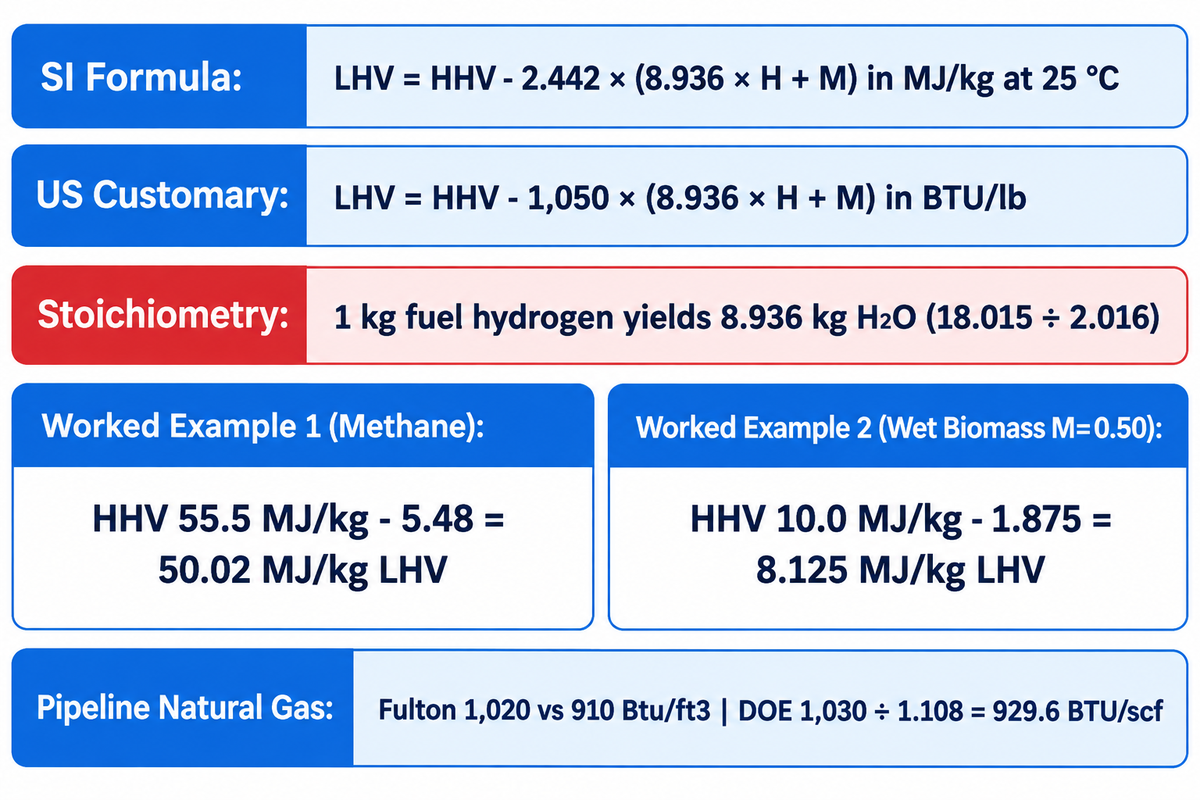
The standard mass-basis conversion subtracts 2.442 MJ/kg (1,050 BTU/lb) of latent heat for every kilogram of water formed or evaporated at 25 °C (77 °F). By stoichiometry, burning 1 kg of elemental fuel hydrogen yields 8.936 kg of H2O. For pipeline gas, Fulton’s North American natural gas benchmark lists HHV = 1,020 Btu/ft3 and LHV = 910 Btu/ft3.
Why does 1 kg of hydrogen yield 8.936 kg of water? In the reaction 2H2 + O2 → 2H2O, two hydrogen atoms (2.016 g/mol) combine with one oxygen atom (15.999 g/mol). They form water with a molar mass of 18.015 g/mol. Dividing 18.015 by 2.016 yields 8.936, which field handbooks commonly round to 9 × H. As noted in the LPELC / eXtension biomass combustion guide, the numerical difference between LHV and HHV equals the latent heat of vaporization per unit of fuel burned.
Exact mass-basis conversion (SI units, MJ/kg):
LHVar = HHVar − 2.442 × (8.936 × Har + Mar)
LHVar = HHVar − 2.442 × (8.936 × Har + Mar)
Engineering approximation (SI units, MJ/kg):
LHVar ≈ HHVar − 2.442 × (9 × Har + Mar)
US customary conversion (BTU/lb):
LHVar = HHVar − 1,050 × (8.936 × Har + Mar)
When reporting biomass analyses, laboratories will use various reporting conventions. One such convention is referred to as moisture inclusive (M). Some laboratories will report total elemental H (or total hydrogen) including the hydrogen bound to free moisture (M). Entering moisture-inclusive hydrogen into 8.936 × H while also adding M double-counts the water and underestimates LHV. Always pair the organic fuel hydrogen fraction Har with the separate free moisture mass fraction Mar when converting lower and higher heating values.
| Symbol | Physical Meaning | Units & Input Format |
|---|---|---|
| HHVar | As-received Higher Heating Value from calorimeter | MJ/kg or BTU/lb |
| LHVar | As-received Lower Heating Value for open-stack combustion | MJ/kg or BTU/lb |
| Har | Organic hydrogen mass fraction in as-received fuel (excluding H in H2O) | Decimal mass fraction (e.g., 0.25 for 25 wt%) |
| Mar | Free moisture mass fraction in as-received fuel | Decimal mass fraction (e.g., 0.50 for 50 wt%) |
| 2.442 / 1,050 | Latent heat of vaporization of water at 25 °C (77 °F) | MJ/kg H2O or BTU/lb H2O |
Worked Example 1, Pure Methane (CH4): Pure methane has a molar mass of 16.043 g/mol, with four hydrogen atoms contributing 4.032 g/mol (Har = 0.251, Mar = 0). Starting from an HHV of 55.5 MJ/kg, water formed per kilogram of methane is 8.936 × 0.251 = 2.243 kg H2O. Subtracting the latent heat of 2.442 × 2.243 = 5.48 MJ/kg yields an LHV of 55.5 − 5.48 = 50.02 MJ/kg. The resulting LHV/HHV ratio is 50.02 ÷ 55.5 = 0.901.
Worked Example 2 – Wet Wood Biomass (Mar = 0.50): Consider as-received wood chips with an HHVar of 10.0 MJ/kg, free moisture Mar of 0.50 and organic hydrogen Har of 0.03. The total water leaving the furnace per kilogram of wet fuel is (8.936 × 0.03) + 0.50 = 0.268 + 0.50 = 0.768 kg H2O. Multiplying 0.768 kg H2O by 2.442 MJ/kg gives a latent heat of 1.875 MJ/kg. Subtracting 1.875 from 10.0 yields an as-received LHV of 8.125 MJ/kg .
What is the LHV value of natural gas?
According to Fulton’s North American thermal fluid and boiler guide, the volumetric calorific values for pipeline natural gas are typically (LHV) 910 Btu/ft3 and (HHV) 1,020 Btu/ft3 (910 ÷ 1,020 = 0.892). U.S. Department of Energy Steam Tip Sheet #15 uses a pipeline HHV benchmark of 1,030,000 BTU per thousand cubic feet (1,030 BTU/scf). Dividing that by Clarke Energy’s 1.108 ratio gives us 1,030 ÷ 1.108 = 929.6 BTU/scf LHV.
Exact pipeline values vary with the blend of methane, ethane, propane, and inert nitrogen or carbon dioxide. Prior to locking contractual burner heat balances, check the local utility gas chromatograph certificate.
HHV vs LHV Values Across Natural Gas, Diesel, Coal, Biomass, and Hydrogen
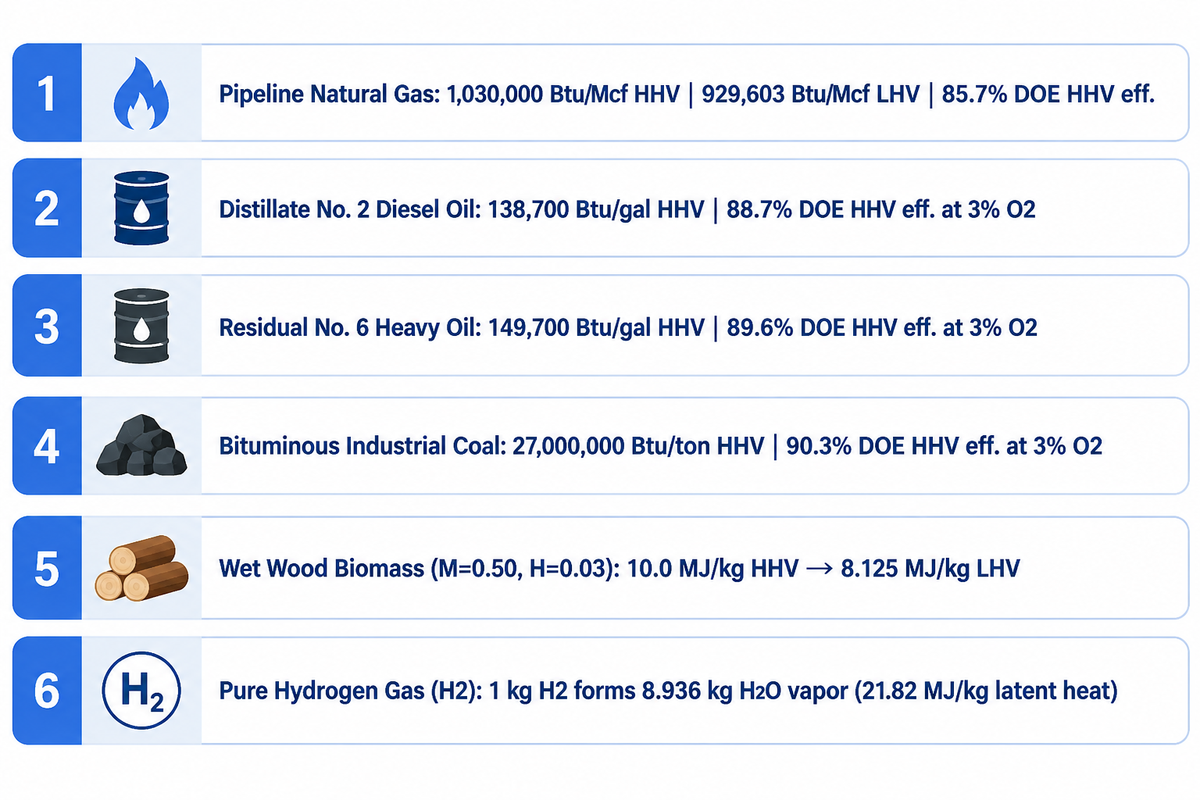
U.S. Department of Energy Steam Tip Sheet #15 Table 2 lists 1,030,000 BTU per thousand cubic feet for natural gas (85.7% efficiency) and 138,700 BTU/gal for Distillate/No. 2 Oil (88.7%). The same DOE table lists 149,700 BTU/gal for Residual/No. 6 Oil (89.6%) and 27,000,000 BTU/ton for coal (90.3%). In addition, the U.S. DOE Fuels Glossary lists 114,320 Btu per gallon of gasoline and notes that atmospheric nitrogen constitutes 78% of combustion air by volume.
Why do higher-hydrogen fuels show a wider HHV-to-LHV spread and lower HHV combustion efficiency in DOE Table 2? Pure hydrogen gas (H 2 ) contains no carbon at all, so every kilogram burned generates 8.936 kg of water vapor. Conversely, bituminous coal and residual fuel oil derive a larger share of their heat of combustion from carbon, producing less water vapor in the exhaust per unit of heat released. Liquid petroleum fuels such as diesel and gasoline sit between coal and natural gas because their hydrocarbon chains follow an intermediate hydrogen-to-carbon ratio.
| Fuel Type & Category | Sales Unit / Basis | Reference HHV Benchmark | Reference LHV / Basis Relation | DOE Table 2 HHV Combustion Efficiency | Primary Latent-Heat Driver |
|---|---|---|---|---|---|
| Pipeline Natural Gas (US Grid Benchmark) | Thousand cubic feet (Mcf) | 1,030,000 Btu / Mcf (DOE Table 2) | HHV ≈ 1.108 × LHV (929,603 Btu / Mcf LHV) | 85.7% (at 3% flue-gas O2) | High methane H/C ratio forming water vapor |
| North American Natural Gas (Volumetric) | Standard cubic foot (ft³) | 1,020 Btu/ft3 (Fulton benchmark) | 910 Btu/ft3 LHV (910 ÷ 1,020 = 0.892) | 85.7% class non-condensing | 110 Btu/ft3 latent heat of water vapor |
| Natural Gas Energy Billing Unit | MMBtu sales unit | 1,000,000 Btu / MMBtu (DOE Table 2) | 1,000,000 ÷ 1.108 = 902,527 Btu LHV | 85.7% (at 3% flue-gas O2) | Utility tariff indexed to gross heating value |
| Distillate / No. 2 Diesel Fuel Oil | US gallon (liquid) | 138,700 Btu / gallon (DOE Table 2) | Intermediate liquid hydrocarbon LHV/HHV ratio | 88.7% (at 3% flue-gas O2) | Lower H/C ratio than gas; zero free moisture |
| Residual / No. 6 Heavy Fuel Oil | US gallon (liquid) | 149,700 Btu / gallon (DOE Table 2) | High carbon density liquid LHV/HHV ratio | 89.6% (at 3% flue-gas O2) | Heavy aromatic carbon chains; sulfur acid limit |
| Commercial Motor Gasoline Reference | US gallon (liquid) | 114,320 Btu / gallon (DOE Glossary) | Volatile liquid hydrocarbon vapor exhaust | Internal combustion engine fuel | All exhaust water leaves engine in vapor state |
| Bituminous Industrial Coal | Short ton (solid) | 27,000,000 Btu / ton (DOE Table 2) | High fixed-carbon solid fuel LHV/HHV ratio | 90.3% (at 3% flue-gas O2) | Lowest hydrogen mass fraction among fossil fuels |
| Wet Wood & Agricultural Biomass | Kilogram as-received | 10.0 MJ/kg worked biomass baseline | 8.125 MJ/kg LHV at Mar = 0.50, Har = 0.03 | Governed by as-received moisture | Free fuel moisture + hydrogen oxidation water |
| Pure Hydrogen Gas (H2) | Kilogram mass basis | Zero-carbon elemental hydrogen fuel | Subtracts 2.442 × 8.936 = 21.82 MJ/kg latent heat | Requires condensing recovery for HHV parity | 1 kg H2 forms 8.936 kg H2O vapor |
When combusting wet agricultural residues and wood chips, see our biomass boiler fuel moisture and steam plant configuration to determine the appropriate size of the furnace grate and the induced-draft fan.
Boundary note: Representative published fuel heating values and LHV/HHV ratios are benchmarks for the fuel industry. Project boiler performance guarantees use a project-specific laboratory ultimate analysis or gas chromatograph report.
Why the Same Boiler Shows Higher Thermal Efficiency on an LHV Basis Than HHV
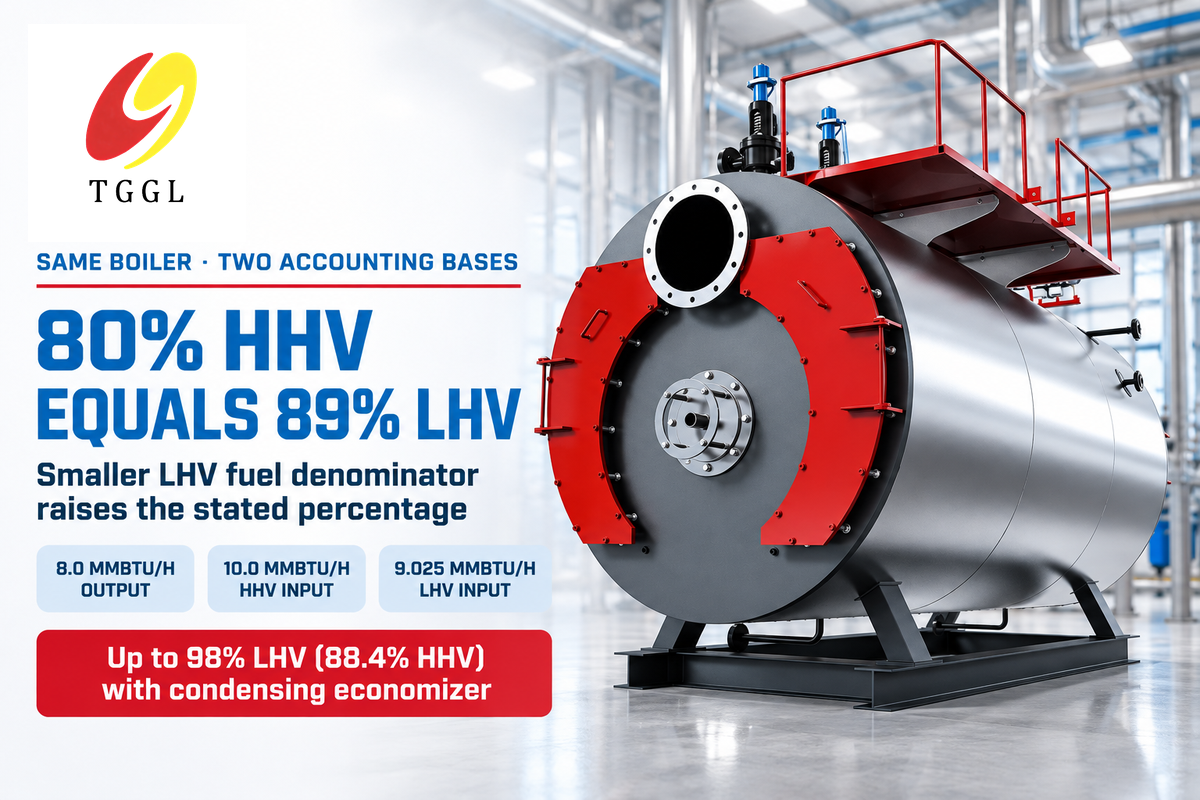
As documented in the ADGEfficiency HHV vs LHV technical comparison, a standard natural gas boiler achieves 80% efficiency on an HHV basis and 89% efficiency on an LHV basis, on the same physical unit. A non-condensing boiler, with an LHV calculation that divides the same steam output by a smaller fuel-input denominator, shows an even higher percentage on an LHV basis.
The American Boiler Manufacturers Association (ABMA) Guide for Determining and Testing Boiler Efficiency defines overall fuel-to-steam thermal efficiency. It’s determined by dividing boiler output (in BTUs) by boiler input (in BTUs) and multiplying by 100. When defining operating efficiency, switching the heating value convention from HHV to LHV doesn’t change the steam produced or the gas burned. It changes the accounting number assigned to the fuel input in the denominator.
Bidirectional boiler efficiency conversion equations:
ηHHV = ηLHV × (LHV ÷ HHV) = ηLHV ÷ 1.108
ηLHV = ηHHV ÷ (LHV ÷ HHV) = ηHHV × 1.108
Worked Numerical Proof (Same-Boiler HHV vs LHV Efficiency): Suppose an industrial steam boiler delivers 8.0 MMBtu/h of useful steam output while consuming 10.0 MMBtu/h of natural gas measured on an HHV basis. Dividing 8.0 MMBtu/h output by 10.0 MMBtu/h HHV input and multiplying by 100 yields that baseline HHV thermal efficiency. Under Clarke Energy’s natural gas ratio (HHV = 1.108 × LHV), that exact same fuel flow equals 10.0 ÷ 1.108 = 9.025 MMBtu/h on an LHV basis. Dividing the same 8.0 MMBtu/h steam output by 9.025 MMBtu/h LHV input yields 88.6% (rounded to 89% in ADGEfficiency Table 1).
| Heat Balance Component | HHV Basis (ASME PTC 4 Convention) | LHV Basis (EN 12952 / EN 12953 Convention) |
|---|---|---|
| Declared fuel heat input for 8.0 MMBtu/h steam output | 10.0 MMBtu/h gross heat input | 9.025 MMBtu/h net heat input (10.0 ÷ 1.108) |
| Latent heat of flue-gas water vapor | Charged as an unrecovered stack moisture loss | Excluded from the fuel input denominator |
| Dry flue-gas sensible stack heat loss | Measured at stack exit temperature and 3% O2 | Expressed as a fraction of net calorific input |
| Net fuel-to-steam thermal efficiency | 80% HHV (8.0 ÷ 10.0 × 100) | 89% LHV (ADGEfficiency Table 1 benchmark) |
To find burner turndown and shell construction that are the same across gas and distillate oil packages, see our oil and gas-fired steam boiler selection guide and check out our full line of industrial oil and gas-fired boiler systems.
Why can condensing boiler efficiency exceed 100% on an LHV basis?
Condensing boiler efficiency can exceed 100% on an LHV basis because the LHV denominator excludes the latent heat of water vapor from the defined fuel input. On industrial steam boilers with condensing economizers, efficiency reaches up to 98% on an LHV basis (98% ÷ 1.108 = 88.4% HHV). When a condensing heat exchanger recovers part of that excluded latent heat, the recovered energy adds to the numerator.
This always satisfies the first law of thermodynamics. As explained in the Cleaver-Brooks white paper on HHV and LHV efficiency calculations, HHV includes all energy content (even if lost to water vapor), while LHV excludes energy lost to water vapor. On our SZS water-tube steam boiler series, adding a condensing economizer increases thermal efficiency up to 98% on an LHV basis and remains below 100% on an HHV basis.
Flue Gas Dew Point: Condensing vs Non-Condensing Steam and Hot Water Boilers
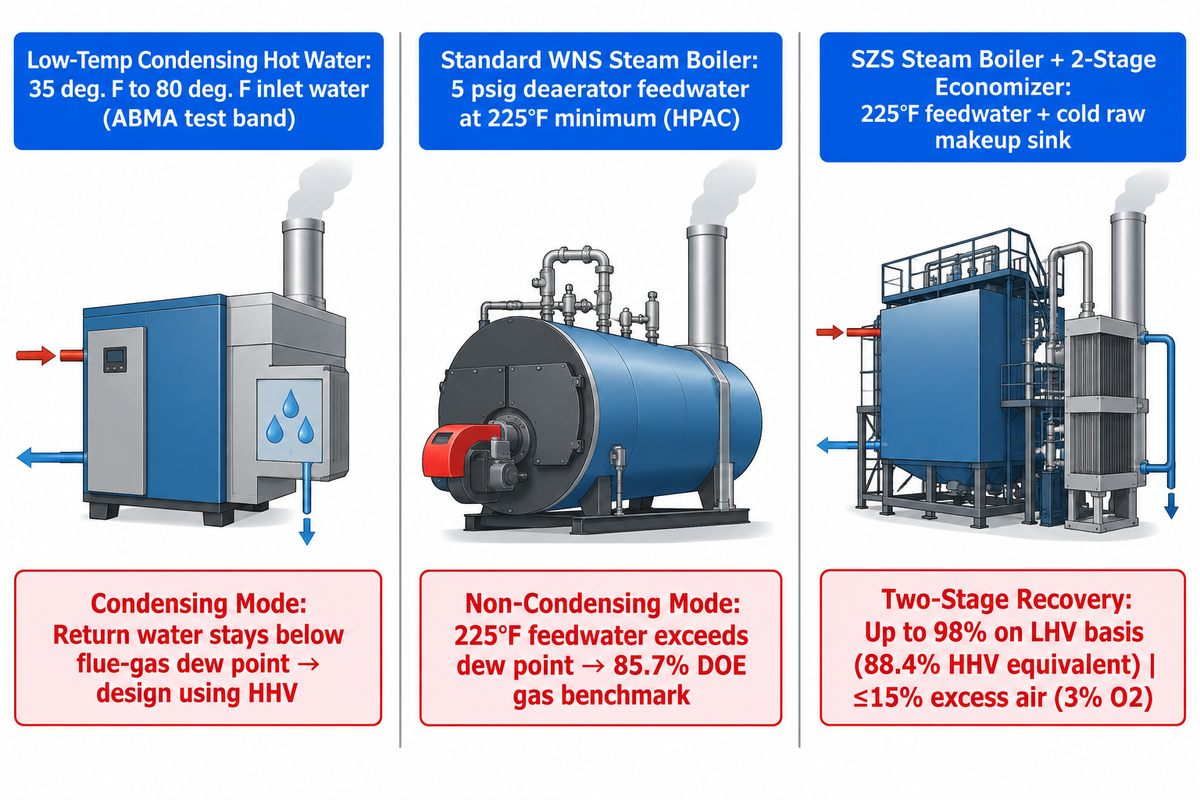
According to ABMA’s Determining & Testing Boiler Efficiency standard, condensing water tests require boiler inlet temperatures between 35 deg. F and 80 deg. F. Boilers do not condense when feedwater temperatures exceed the dew point of flue gas. In contrast, HPAC Engineering’s deaerator evaluation shows that steam plant deaerators operate at a normal pressure of 5 psig, ensuring a minimum temperature of 225°F.
Why does that 225°F deaerator temperature prevent primary flue-gas condensation in steam boilers? A pressurized steam deaerator must hold feedwater at 225°F (5 psig) to strip dissolved oxygen and carbon dioxide before water enters the boiler tubes. Because the entering feedwater is hotter than the water vapor condensation point in the flue gas, a single-stage feedwater economizer can only recover sensible heat. In addition, ABMA’s burner guideline notes that well-tuned gaseous and liquid fuel burners operate at excess air levels of 15% or less (3% as O2) while keeping carbon monoxide below 100 ppm.
Sulfur trioxide combines with water vapor to produce sulfuric acid vapor in the presence of sulfur-bearing fuels such as No. 2 diesel, residual No. 6 oil, or coal. For the non-condensing economizers on oil or coal boilers, the wall metal temperature of the tubes must be higher than the acid dew point to avoid cold end corrosion. For non-condensing fire-tube shell geometry, please refer to our three-pass fire-tube boiler heat transfer design illustration.
| Boiler Type & System Category | Heat-Sink Inlet Water Regime | Flue Gas Condensation Boundary | Latent Heat Recovery Mode | Benchmark Efficiency & Design Basis |
|---|---|---|---|---|
| Low-Temp Condensing Hot Water Boiler | 35 deg. F to 80 deg. F cold return water (ABMA test band) | Return water stays below flue-gas water dew point | Full condensing latent-heat recovery mode | Design using HHV per LPELC Rule 3 |
| High-Temp Process Hot Water Boiler | Return water above flue-gas water dew point | No water vapor condensation on tube surfaces | Non-condensing sensible heat recovery only | 80% HHV / 89% LHV gas boiler class |
| WNS Three-Pass Fire-Tube Steam Boiler | 5 psig deaerator feedwater at 225°F minimum | Feedwater exceeds water vapor dew point | Single-stage sensible feedwater economizer | 85.7% DOE Table 2 gas combustion benchmark |
| SZS Water-Tube Steam Boiler + Condensing Economizer | 225°F primary feedwater + cold raw makeup water sink | Secondary stage cools exhaust below dew point | Two-stage sensible + condensing recovery | Up to 98% on LHV basis (88.4% HHV equivalent) |
| High-Pressure 450 psig Industrial Steam Boiler | 230°F feedwater inlet (DOE Steam Tip Sheet #15 case) | Flue gas exits above condensation point | Sensible economizer or combustion air preheater | 85.7% DOE natural gas combustion efficiency |
| Distillate No. 2 Diesel Fired Steam Boiler | 225°F deaerated feedwater at 15% excess air (3% O2) | Tube metal kept above acid condensation point | Non-condensing carbon or alloy steel economizer | 88.7% DOE Table 2 distillate oil benchmark |
| Residual No. 6 Heavy Oil Fired Steam Boiler | Elevated feedwater inlet to protect cold-end tubes | Strict sulfuric acid dew-point margin required | Non-condensing sensible heat recovery only | 89.6% DOE Table 2 residual oil benchmark |
| Bituminous Coal Fired Steam Generator | Pressurized deaerator feedwater + air preheater | Stack gas maintained above acid and moisture dew point | Non-condensing dry-flue-gas heat recovery | 90.3% DOE Table 2 coal combustion benchmark |
| CHP Reciprocating Engine / Gas Turbine HRSG | High-temperature prime-mover exhaust gas stream | Exhaust remains above water vapor condensation point | Prime mover rated on LHV; total CHP on HHV | 60 to 80 percent total CHP system efficiency (EPA) |
Boundary note: Natural gas water dew point and oil or coal acid dew point vary with the burner excess-air ratio and fuel sulfur content. Economizer alloy selection and feedwater inlet temperature must be consistent with the project firing curve.
North American (ASME PTC 4) vs European (EN 12952 / EN 12953) Rating Conventions
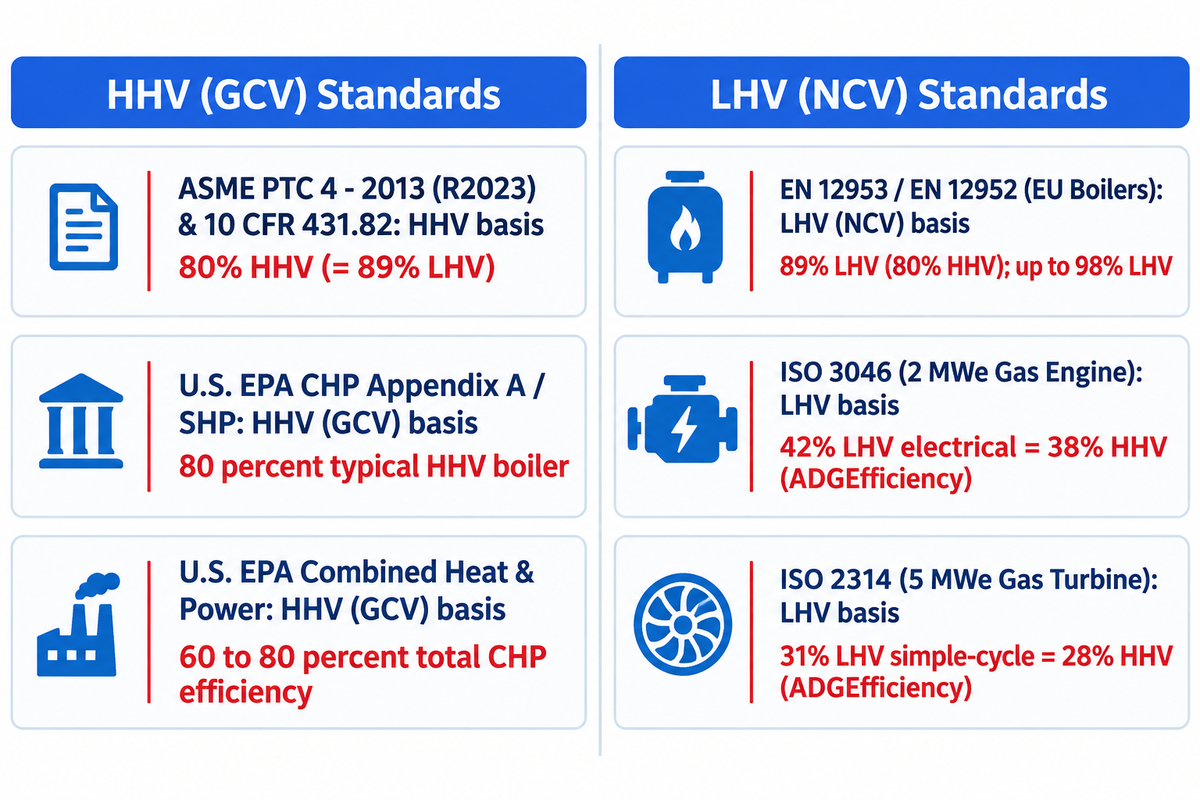
North American steam generator codes (ASME PTC 4 – 2013, reaffirmed in 2023, and 10 CFR 431.82) mandate Higher Heating Value (HHV) as the default efficiency denominator. In contrast, European boiler standards (EN 12952 and EN 12953) and international turbine and engine codes (ISO 2314 and ISO 3046) mandate Lower Heating Value (LHV).
This regional divide impacts combined heat and power (cogeneration) and data center power generation projects. As cited in Clarke Energy’s analysis of LHV vs HHV in onsite power economics, gas engine efficiency is always stated on an LHV basis because engine exhaust manifolds can’t condense water vapor. However, US natural gas utilities bill fuel on an HHV basis. Similarly, ADGEfficiency’s benchmark table indicates that a 2 MWe gas engine, stated at 42% LHV efficiency, delivers 38% HHV efficiency, while a 5 MWe gas turbine stated at 31% LHV efficiency delivers 28% HHV efficiency. The U.S. EPA CHP efficiency methodology guide comments that complete cogeneration plants generally achieve total system efficiencies in the range of 60 to 80 percent.
| Standard / Regulation Code | Equipment Scope | Default Basis | Published Benchmark Rating (HHV vs LHV) |
|---|---|---|---|
| ASME PTC 4 – 2013 (R2023) | Industrial fuel-fired steam generators (North America) | HHV (GCV) | 80% HHV typical boiler baseline (equals 89% LHV) |
| U.S. EPA CHP Appendix A / SHP | Separate heat and power industrial steam boilers | HHV (GCV) | 80 percent typical HHV boiler efficiency |
| EN 12953 / EN 12952 | Shell (fire-tube) and water-tube boilers (European Union) | LHV (NCV) | 89% LHV non-condensing (80% HHV); up to 98% LHV condensing |
| ISO 3046 (2 MWe Gas Engine) | Reciprocating internal combustion gas engines | LHV (NCV) | 42% LHV electrical (equals 38% HHV in ADGEfficiency Table 1) |
| ISO 2314 (5 MWe Gas Turbine) | Industrial gas turbines and prime movers | LHV (NCV) | 31% LHV simple-cycle (equals 28% HHV in ADGEfficiency Table 1) |
| U.S. EPA Combined Heat & Power | Total CHP system (electricity + useful thermal output) | HHV (GCV) | 60 to 80 percent total CHP system efficiency |
When incorporating steam boilers into a power plant or cogeneration facility, see our thermal power plant heat-to-electricity efficiency cycle guide. It analyzes prime-mover LHV heat rates and steam-generator HHV fuels.
Reading Calorific Value Units and Reference Conditions Without Conversion Errors
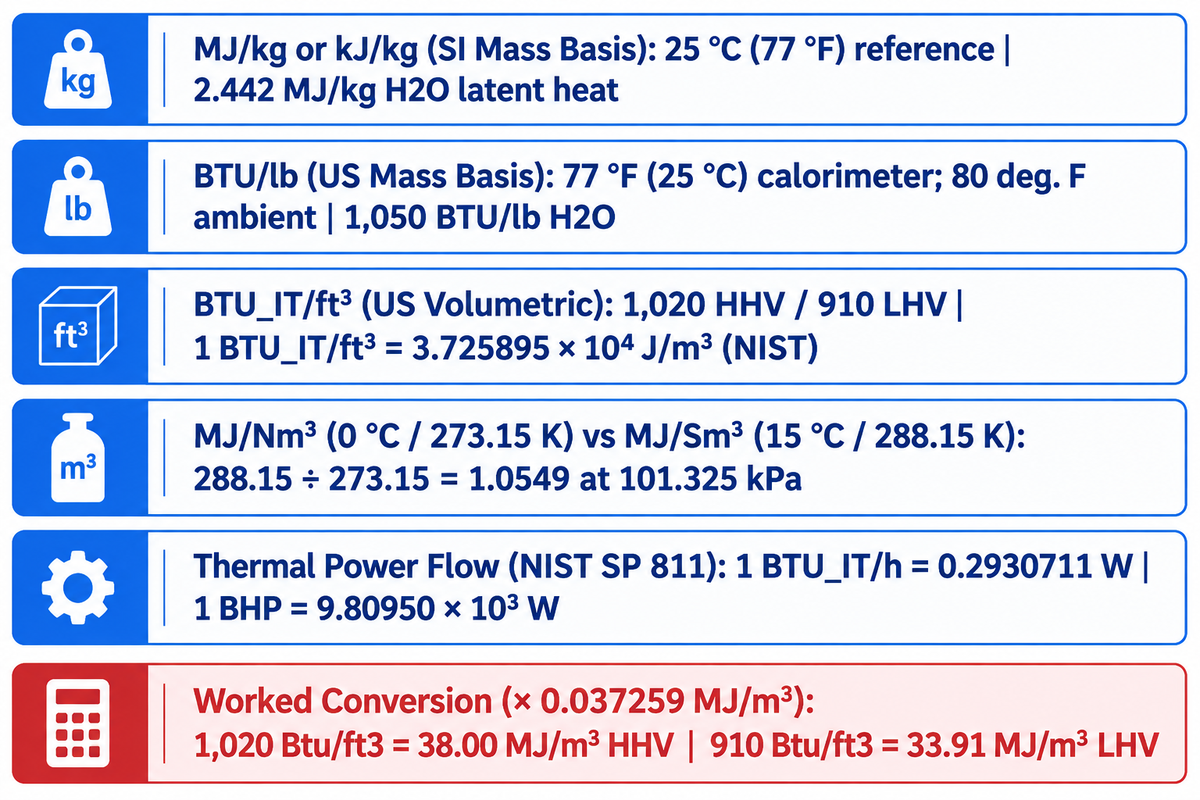
Volumetric gas calorific values change with metering reference temperature because ABMA efficiency calculations use 80 deg. F ambient temperatures while DOE Steam Tip Sheet #15 indexes fuel efficiency at 3% oxygen in flue gas. For exact SI energy conversions, NIST Special Publication 811 Appendix B.8 defines 1 BTUIT/h = 0.2930711 W and 1 BTUIT/ft³ = 3.725895 × 10⁴ J/m³.
Why does reference temperature alter volumetric heating value? By the ideal gas law, one cubic meter of gas at 0 °C (273.15 K, Normal cubic meter Nm³) holds more gas molecules than one cubic meter at 15 °C (288.15 K, Standard cubic meter Sm³) at 101.325 kPa. The absolute temperature ratio is 288.15 ÷ 273.15 = 1.0549. Failing to check both the heating value basis and the metering temperature stacks a volumetric density offset onto the heating-value basis gap.
| Unit Expression | Basis Type | Standard Reference Conditions | Key Conversion Factor & Governing Reference |
|---|---|---|---|
| MJ/kg or kJ/kg | Mass basis (solid, liquid, gas) | 25 °C (77 °F) calorimeter reference state | 2.442 MJ/kg water latent heat of vaporization |
| BTU/lb | Mass basis (US customary) | 77 °F (25 °C) calorimeter reference; 80 deg. F ambient | 1,050 BTU/lb water latent heat of vaporization |
| BTUIT/ft³ (BTU/scf) | US volumetric gas basis | North American pipeline gas (1,020 HHV / 910 LHV) | 1 BTUIT/ft³ = 3.725895 × 10⁴ J/m³ (NIST SP 811) |
| MJ/Nm³ vs MJ/Sm³ | ISO volumetric gas basis | Nm³ metered at 0 °C (273.15 K); Sm³ at 15 °C (288.15 K) | 288.15 ÷ 273.15 = 1.0549 temperature ratio at 101.325 kPa |
| BTUIT/h to Watt (W) | Thermal power flow rate | Continuous boiler heat input or output rate | 1 BTUIT/h = 0.2930711 W; 1 BHP = 9.80950 × 10³ W (NIST) |
Worked Volumetric Reference Conversion: Suppose a gas analysis lists an LHV of 910 Btu/ft3 and an HHV of 1,020 Btu/ft3 (Fulton North American benchmark). Multiplying by the NIST SP 811 factor of 3.725895 × 10⁴ J/m³ (0.037259 MJ/m³) converts 1,020 Btu/ft3 HHV to 1,020 × 0.037259 = 38.00 MJ/m³ HHV, and converts 910 Btu/ft3 LHV to 910 × 0.037259 = 33.91 MJ/m³ LHV.
Boundary note: Converting gas calorific values between mass and volume, as well as across different reference temperatures, requires the gas mixture specific gravity, compressibility factor, and declared metering pressure.
Normalizing Boiler Quotes and Utility Fuel Bills on a Consistent Heating-Value Basis
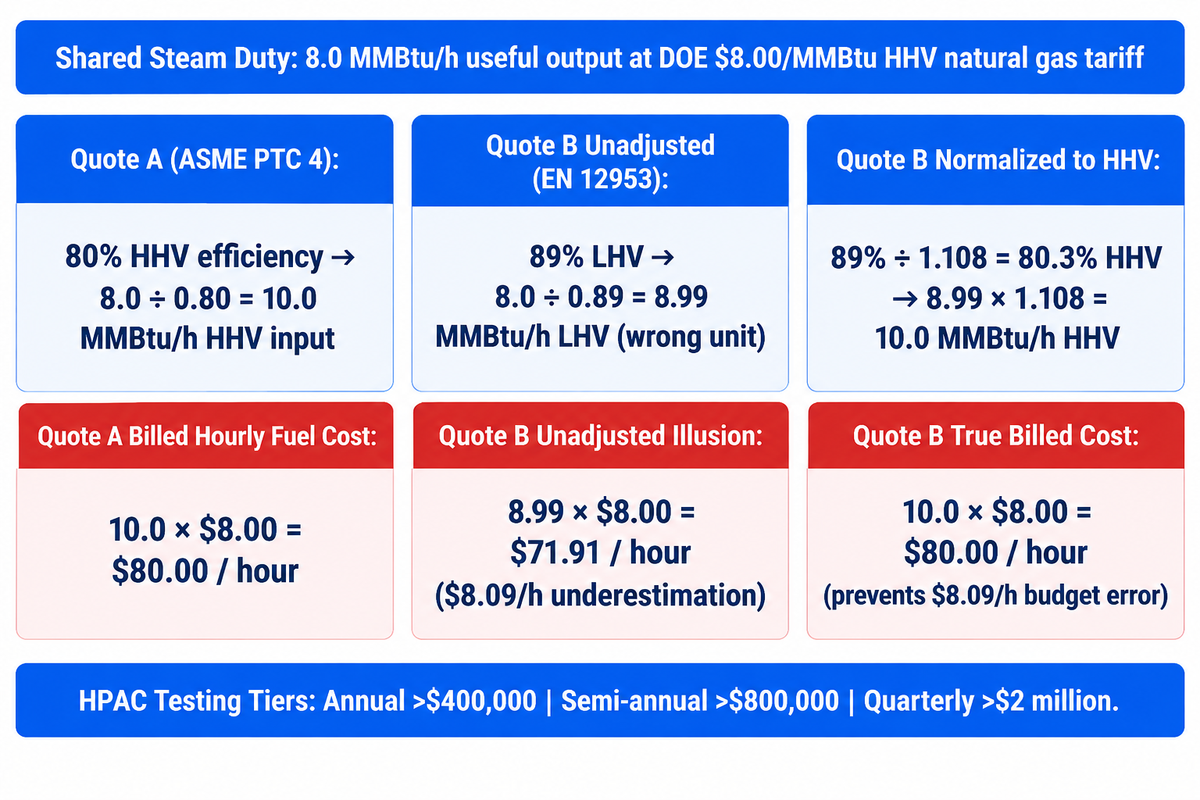
In the U.S. Department of Energy Steam Tip Sheet #15 benchmark example, a boiler fired with natural gas costing $8.00/MMBtu produces 450-psig saturated steam with 230°F feedwater at 85.7% HHV efficiency ($9.39 per 1,000 lb of steam). Meanwhile, HPAC Engineering’s boiler efficiency testing schedule recommends annual testing when fuel costs exceed $400,000, semi-annual above $800,000, and quarterly above $2 million.
Before evaluating fuel inputs for competing bids, confirm that both vendors produce the same useful thermal output. When useful thermal output is given in Boiler Horsepower (BHP) or pounds per hour of steam, use our guide on converting boiler horsepower ratings to BTU/h thermal output. According to DOE Steam Tip Sheet #15 Table 1, generating dry saturated steam at 150 psig requires 1,128 BTU/lb with 100 °F feedwater and 1,028 BTU/lb with 200 °F feedwater.
Worked Two-Quote Procurement Normalization (8.0 MMBtu/h Steam Duty): Suppose an industrial facility evaluates two competing bids for an 8.0 MMBtu/h natural gas steam load. The comparison applies the DOE $8.00/MMBtu HHV gas price and the ADGEfficiency Table 1 boiler benchmark:
- Quote A is rated under ASME PTC 4 at the Table 1 HHV efficiency baseline (0.80). Dividing 8.0 MMBtu/h useful output by 0.80 requires 10.0 MMBtu/h of billed HHV fuel input, costing 10.0 × $8.00 = $80.00 per operating hour.
- Quote B is rated under EN 12953 at 89% LHV thermal efficiency. If a buyer mistakenly divides 8.0 MMBtu/h by 0.89 without basis conversion, apparent fuel input looks like 8.99 MMBtu/h ($71.91/h). Once normalized by Clarke Energy’s 1.108 factor (89% ÷ 1.108 = 80.3% HHV), true billed fuel input is 10.0 MMBtu/h HHV ($80.00/h).
Normalizing both quotes to HHV eliminates the illusion of an 8.99 MMBtu/h fuel burn on Quote B and prevents an $8.09/h ($80.00 − $71.91) fuel budget underestimation.
| Evaluation Line Item | Quote A (ASME PTC 4 HHV Basis) | Quote B (Unadjusted EN 12953 Claim) | Quote B (Normalized to HHV Basis) |
|---|---|---|---|
| Required useful steam thermal output | 8.0 MMBtu/h | 8.0 MMBtu/h | 8.0 MMBtu/h |
| Brochure guaranteed thermal efficiency | 80% HHV (ADGEfficiency Table 1) | 89% LHV (ADGEfficiency Table 1) | 89% ÷ 1.108 = 80.3% HHV |
| Calculated hourly fuel energy input | 8.0 ÷ 0.80 = 10.0 MMBtu/h HHV | 8.0 ÷ 0.89 = 8.99 MMBtu/h LHV (wrong unit) | 8.99 × 1.108 = 10.0 MMBtu/h HHV |
| Hourly fuel cost at DOE $8.00/MMBtu HHV | 10.0 × $8.00 = $80.00 / hour | 8.99 × $8.00 = $71.91 / hour (underestimated) | 10.0 × $8.00 = $80.00 / hour |
| HPAC efficiency test frequency tier | Annual >$400,000; semi-annual >$800,000 | Quarterly testing above $2 million annual fuel spend | Verify on HHV utility bills |
Review our analysis of steam boilers: capital and lifecycle costs, to understand how efficiency normalization influences cost and economizer scope.
8-Point Boiler RFQ Heating-Value & Efficiency Verification Checklist
- Require every bidder to state fuel-to-steam thermal efficiency on both HHV (GCV) and LHV (NCV) bases in the proposal guarantee table.
- Specify whether shop and site acceptance tests follow ASME PTC 4 – 2013 (R2023) (HHV default) or EN 12952 / EN 12953 (LHV default).
- Provide the project gas chromatograph or ultimate analysis and fix the HHV/LHV ratio (i.e., 1.108 for natural gas) for all bidders.
- Declare whether volumetric gas calorific value is referenced to 60 °F (scf), 15 °C (Sm³), or 0 °C (Nm³) at 101.325 kPa.
- Fix the deaerator feedwater outlet temperature (225°F at 5 psig) at the economizer inlet boundary so non-condensing units are evaluated on equal inlet conditions.
- Record stack exit temperature, flue-gas oxygen percentage, and carbon monoxide concentration across firing loads per ABMA test guidelines.
- Require quoted percentages be overall fuel-to-steam efficiency (Output/Input X 100) rather than combustion analyzer readings.
- Prior to multiplying vendor inputs by the contracted utility natural gas rates, convert all inputs to MMBtu/h HHV.
Boundary note: Continuous blowdown and deaerator steam venting and cycling purges are excluded from steady-state fuel-to-steam efficiency normalization and are shown separately in the purchase order.
Need a Same-Basis Steam Boiler Engineering Proposal? Send our engineering team your required steam flow, operating pressure, deaerator feedwater temperature, and local fuel specification. We provide transparent dual-basis (ASME HHV and EN LHV) heat balances and complete heat-recovery package documentation.
Frequently Asked Questions
How do you convert LHV boiler efficiency to HHV boiler efficiency?
Divide the stated fuel LHV thermal efficiency by the HHV-to-LHV ratio (or multiply by LHV / HHV): ηHHV = ηLHV ÷ 1.108. For pipeline natural gas where HHV ≈ 1.108 × LHV, a non-condensing boiler rated at 89% LHV efficiency delivers an HHV efficiency of 89% ÷ 1.108 = 80.3%. Make sure to check the actual fuel gas composition on the test sheet before adjusting vendor performance guarantees to normal conditions.
Do natural gas utilities bill industrial plants on an HHV or LHV basis?
In North America and most international gas grids, natural gas utilities bill industrial consumers on a Higher Heating Value (HHV) basis. Bills are typically expressed in dollars per MMBtu, dekatherm, or therm (100,000 BTU HHV). Even in European grids where meters report kilowatt-hours, volume-to-energy conversion factors usually index to gross calorific value (GCV/HHV) per ISO 6976.
Why do gas turbines and reciprocating engines use LHV while steam boilers use HHV?
Gas turbines (tested under ISO 2314) and reciprocating engines (tested under ISO 3046) discharge exhaust gases well above the water vapor condensation point. Because moisture cannot condense inside the machine without corrosion, engine and turbine efficiency is stated on an LHV basis. North American steam and hot water boilers use HHV under ASME PTC 4 and 10 CFR 431.82 to match HHV fuel billing and compare condensing heat recovery fairly.
Does fuel moisture content affect HHV or LHV more in biomass boilers?
Fuel moisture content reduces the as-received Lower Heating Value (LHV) far more severely than the dry-basis Higher Heating Value (HHV). When Wood Chips or other agricultural residues are burned in a biomass boiler, the furnace has to evaporate both the free fuel moisture as well as water created from the oxidation of hydrogen. In a non-condensing boiler, that fuel moisture and steam are exhausted out of the boiler without condensing. Consequently, the latent heat of vaporization (2.442 MJ per kilogram of water) is unrecoverable. High wood fuel moisture content lowers the net usable LHV/kg of wood, increasing the size of the furnace, the required capacity of the induced-draft fan as well as the rate at which fuel has to be fed to the furnace.
What reference temperature is used for HHV and LHV in ISO 6976?
ISO 6976 specifies standard reference combustion and metering temperatures of 15 °C (288.15 K), 0 °C (273.15 K), or 25 °C at 101.325 kPa.
Is gross calorific value the same as higher heating value?
Yes. The term Gross Calorific Value (GCV) is synonymous with Higher Heating Value (HHV), and Net Calorific Value (NCV) is the same as Lower Heating Value (LHV).
References & Sources
- U.S. EPA: Catalog of CHP Technologies, Appendix A HHV vs LHV definitions and 80 percent typical boiler efficiency baseline, 2015.
- U.S. EPA: Methods for Calculating CHP Efficiency 60 to 80 percent total CHP system efficiency benchmarks.
- U.S. DOE: Steam Tip Sheet #15 fuel HHV benchmarks, 3% flue-gas O2 basis, $8.00/MMBtu example, and 150 psig steam enthalpy table, 2012.
- U.S. DOE: Fuels Glossary calorimeter condensation reference state, 114,320 Btu gasoline benchmark, and 78% atmospheric nitrogen share.
- Fulton Thermal Corporation: LHV vs HHV Efficiency North American natural gas 1,020 Btu/ft3 HHV and 910 Btu/ft3 LHV benchmarks.
- LPELC / eXtension: Biomass HHV and LHV Guide latent heat of vaporization and secondary condenser design rules.
- ABMA: Determining & Testing Boiler Efficiency fuel-to-steam efficiency formula, 15% excess air (100 ppm CO), 35 deg. F to 80 deg. F water test inlet, and 80 deg. F ambient reference, 2008.
- Cleaver-Brooks: Higher and Lower Heating Value in Efficiency Calculations condensing vs non-condensing efficiency basis.
- ADGEfficiency: HHV Versus LHV in Energy Efficiency Table 1 same-equipment HHV and LHV efficiencies (80% vs 89% boiler; 38% vs 42% 2 MWe engine; 28% vs 31% 5 MWe turbine).
- ASME: PTC 4 – 2013 (R2023) Fired Steam Generators North American test code reaffirmed in 2023.
- Clarke Energy: LHV vs HHV in Data Centers HHV ≈ 1.108 × LHV natural gas ratio and engine LHV vs utility HHV billing, 2026.
- HPAC Engineering: Evaluating Deaerator Operation 5 psig normal deaerator operating pressure and 225°F minimum feedwater temperature.
- HPAC Engineering: Optimizing Boiler System Efficiency $400,000, $800,000, and $2 million annual fuel cost testing thresholds.
- NIST Special Publication 811, Appendix B.8 exact SI conversion factors for BTUIT/ft³, BTUIT/h, and boiler horsepower.