Get in Touch with Taiguo

Industrial Electric Boiler
Industrial Electric Boiler Manufacturer: Custom Steam & Hot Water Systems
We build industrial electric boilers that produce steam and heat water at 99% efficiency — no combustion, no flue gas. Resistance-element and electrode boiler designs from 0.1 to 2 t/h, shipped to 100+ countries. CE, ASME, and ISO 9001 certified.
48+
Years Manufacturing
99%
Thermal Efficiency
100+
Countries Served
60,000m²
Factory Area
✓ ASME Certified
✓ CE Marked
✓ ISO 9001
✓ CCC Approved
Understanding Industrial Electric Boilers
What Is an Industrial Electric Boiler and How Does It Work?
An industrial electric boiler is an electrical vessel designed to generate steam and hot water without combustion. This is done using heating elements or electric current passing directly through the water, as in an electrode boiler. In contrast to fossil-fuel or gas-fired units, electric boilers have no onsite combustion, reducing local emissions and making installation and control much easier.
The efficiency of these industrial electric solutions is very high, essentially converting all input electricity into heat. With precise control, boiler systems can adjust capacity to match load, enabling efficient steam production, high-quality dry steam, and reliable hot water delivery for commercial and industrial use.
An electric boiler is a compact industrial boiler or water heater in which electricity provides the heat source to produce steam or heat water within a sealed vessel or tank. Using heating elements or an electrode design, it transfers electrical energy directly into the water to generate steam or hot water with exceptional efficiency. Since there is no combustion, there is no need for fuel handling, burners, or flues, reducing the carbon impact and making maintenance easier.
Electric boiler control systems deliver precise, rapid startup and consistent steam and hot water production by modulating capacity and ensuring reliable performance in rigorous industrial applications.
99% Thermal Efficiency
Nearly all input electricity converts directly to heat — no combustion losses, no flue gas waste.
Zero Onsite Emission
No CO₂, NOx, or SOx at the point of use. Supports decarbonization and ESG compliance.
Precision Control
PLC-based systems maintain ±0.1 bar pressure and ±1°C temperature accuracy.
Rapid 3–5 Minute Startup
Produces steam in minutes compared to 30+ minutes for gas-fired boiler systems.
Our Product Lines
Electric Steam Boiler Series: Wholesale Direct from China Factory
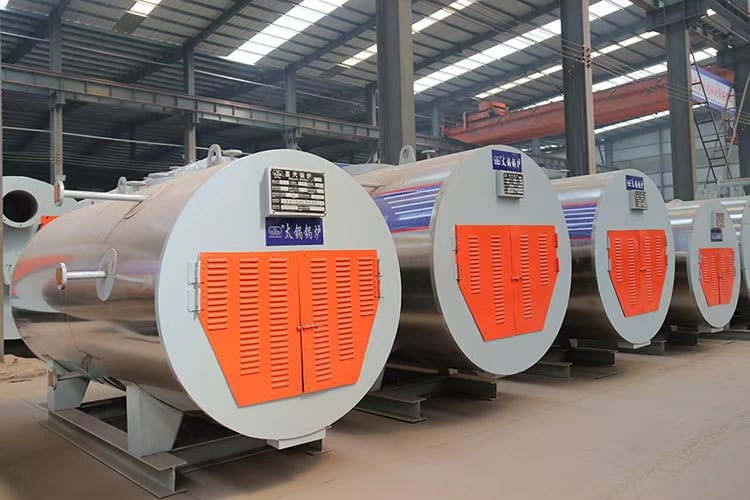
From compact vertical units to large horizontal systems, our electric steam boiler and electric hot water boiler packages are engineered as complete, factory-assembled solutions — ready for rapid installation with minimal site preparation. Each boiler uses high-quality stainless steel heating tubes and advanced PLC control for dependable, efficient steam production.
LDR Series Electric Steam Boiler
The LDR Series electric steam boiler features a compact vertical design with modular heating-tube units, enabling a flexible power range of 36 kW to 1400 kW. Fully automated control with remote access, rapid steam generation in 3-5 minutes, and a thermal efficiency of ≥95% make this boiler ideal for small to medium-sized factories.
50–2000 kg/h
Evaporation
36–1400 kW
Rated Power
0.1–1.0 MPa
Working Pressure
≥95%
Heat Efficiency
WDR Series Electric Steam Boiler
The WDR Series electric steam boiler features a horizontal design for optimal output at capacities over 1 ton/h. The electrical control cabinet is separated from the boiler body, preventing element aging. Equipped with stainless steel heating tubes with a lifespan 5–10× longer than standard tubes — delivering 99% thermal efficiency.
0.5–6 t/h
Steam Capacity
375–4500 kW
Electric Power
0.7–1.25 MPa
Working Pressure
99%
Heat Efficiency
Industry Solutions
Applications of Electric Steam Boilers Across Industries
Electric steam boiler solutions are used where precision, purity, and reliability are paramount. Electric steam boilers are an effective way for facilities aiming to reduce their carbon footprint and replace fossil-fuel or gas boilers to provide clean, decarbonized steam and hot-water generation for a wide range of industrial applications.
01
Food & Beverage
Pasteurization, sterilization, and cooking to meet FDA, HACCP, and SQF standards, along with steam for CIP cleaning.
02
Pharmaceutical
GMP clean steam is used for autoclaving, reactor heating, drying, and HVAC humidification in drug manufacturing.
03
Chemical Processing
Reactor heating, distillation, and drying with explosion-proof options for compliance with hazardous areas.
04
Textile & Dyeing
Steaming, dyeing, pressing, and finishing fabrics with consistent steam temperature control.
05
Brewery & Beverage
Craft and industrial breweries for mashing, boiling, and sanitization with accurate control of processes.
06
Hospital & Healthcare
Steam for sterilization of autoclaves, laundry services, and HVAC humidification in healthcare facilities.
07
Dairy Processing
Sanitary steam quality for pasteurization, CIP steam cleaning, and heating of processes.
08
Concrete Curing
Electric steam generators for curing precast concrete in difficult outdoor conditions.
Why Electric
Advantages of Industrial Electric Boiler Systems
Look, we’re not going to pretend electric boilers are perfect for every situation. If you have incredibly cheap natural gas and enormous steam demands — say, 20+ tons per hour — a combustion boiler probably makes more sense. But for the 0.1 to 2 t/h range that covers the majority of commercial and industrial electric applications? The case is pretty strong.
99% Thermal Efficiency — And That’s Not Marketing
When electric current passes directly into heating elements submerged in water, there’s nowhere for the energy to go except into the water. No stack loss (which eats 15-20% of a gas boiler’s input). No radiation loss through refractory walls. No unburned fuel going up the flue. High efficiency electric performance isn’t a claim — it’s physics. The electricity you pay for actually becomes steam.
Compact Package, Fast Installation
Without burners, fuel trains, flue gas paths, or chimney stacks, the whole thing shrinks. Our LDR0.1 is 900mm wide. That fits in spaces where you couldn’t even store a gas boiler’s control panel. Installation means: connect power, connect water, pipe the steam. No chimney routing, no gas piping, no fuel storage tank. Some sites have gone from delivery to first steam in under a week.
Zero Point-of-Use Emission
No exhaust, no flue, no local air quality impact. For hospital environments, food production facilities, pharmaceutical clean rooms — that matters. A lot. Pair the boiler with renewable electricity from the grid and your carbon footprint drops to nearly zero. Even with grid-average electricity, you’re still eliminating on-site combustion byproducts completely.
Startup Speed & Load Following
Cold start to operating pressure in 15-45 min depending on model size. No pre-purge cycle, no pilot ignition, no flame proving — just power on and the elements heat up. PLC control modulates capacity to follow load, so you’re not wasting energy maintaining a hot standby. Efficient steam production during the hours you actually need it, nothing burned during the hours you don’t.
Challenges We Solve
Common Industrial Heating Pain Points — and Our Solutions
As an experienced boiler manufacturer, we understand the real-world challenges procurement managers, plant engineers, and facility directors face when selecting industrial electric boiler systems. Here’s how Taiguo Boiler addresses each concern.
The Problem
“Our gas-fired boiler keeps failing emission inspections”
Tightening NOx and SOx regulations in the U.S. and EU mean older combustion boilers require expensive burner upgrades or SCR systems just to remain compliant. Some plants face fines. Others cannot renew their operating permits.
Our Solution
An electric steam boiler produces zero combustion exhaust. No NOx, no SOx, no CO, no particulate. Zero. You don’t need a stack, you don’t need emission monitoring equipment, and you don’t need to schedule annual combustion tune-ups. The compliance paperwork basically disappears.
Project Story
A spice processing plant in Guangdong had been running a 10-year-old gas or oil-fired boiler that couldn’t pass the updated local emission standards. We supplied a WDR1-0.7 electric steam boiler with a capacity of 1 t/h and 0.7 MPa. Installation took a weekend because there was no flue to route, no gas pipe to run. Their emission compliance issue? Gone. The facility manager told us that the annual savings from emission monitoring and burner maintenance alone covered about 30% of the boiler’s cost in the first year. Not a bad trade.
The Problem
“We need steam for sterilization, but there’s no gas line to this building”
Hospital annexes, new pharmaceutical clean rooms, remote food processing sites — sometimes there’s simply no fuel infrastructure available. Running a gas line may cost more than the boiler itself and require months of permitting.
Our Solution
An industrial electric boiler only needs electricity and water. No fuel source, no fuel storage, no fuel handling. If the building has adequate electrical capacity — and we help you figure that out early — installation is straightforward. Plug in the power, connect the water feed, pipe the steam. Done.
Project Story
We got a call from a hospital equipment integrator in Nigeria. They were fitting out a new sterilization wing, but the nearest gas main was 3 kilometers away. Running a pipe wasn’t realistic — cost, timeline, permits. We shipped two LDR0.3-0.4 units configured for a 380V supply, which matched their local grid. Dry steam quality met the autoclave specifications. The entire setup, from delivery to the first steam, took about five days. Honestly, the longest part was customs clearance, not the installation.
The Problem
“Maintenance costs on our old boiler are eating our budget”
Combustion boilers have burners, fuel trains, flame scanners, refractory, and flue gas paths that all need regular attention. The U.S. DOE estimates that gas boiler maintenance costs are roughly 16 times higher than those for electric boilers.
Our Solution
No burner to tune, no refractory to inspect, no flue to clean, no gas train valves to test. Electric boiler maintenance consists of checking electrical connections quarterly, inspecting heating elements annually, and maintaining your water treatment program. Our elements last about 20,000 hours — at 8 hours/day operation, that’s roughly 7 years before replacement.
Project Story
A textile dyeing facility in Bangladesh was spending close to $8,500/year on boiler maintenance — burner service, refractory patches, and annual combustion safety inspections. They switched to a WDR1.5-0.7 electric unit. First-year maintenance cost? About $600. Mostly water treatment chemicals and one electrical inspection. The production manager said — and I’m paraphrasing here — “We forgot we even had a boiler room.”
The Problem
“We want to decarbonize but can’t justify the cost of a full system overhaul”
Corporate sustainability targets and ESG reporting pressure continue to grow. But ripping out an entire steam plant isn’t practical for most production facilities.
Our Solution
Start with an electric boiler as a supplement, not a replacement. Use an electric boiler for base load or off-peak hours, and keep the fossil-fuel unit for peak demand. As your grid gets greener (and electricity is already the cheapest it’s been in many markets), you shift more load to the electric side. This phased approach cuts your carbon footprint without shutting down production for a month.
Project Story
A cosmetics manufacturer in Turkey had a corporate mandate to reduce its carbon footprint by 40% within three years. They couldn’t afford to replace their main gas boiler — it was only six years old. We provided a WDR2-0.7 electric unit to run in parallel. During off-peak electricity hours (cheaper rates), the electric boiler carries the entire steam load. During peak hours, the gas unit takes over. Net result: 38% reduction in on-site carbon emission in the first year, and their electricity cost increase was smaller than expected because off-peak rates in their region were genuinely low.
About the Manufacturer
Why Choose Taiguo as Your Industrial Electric Boiler Supplier
Your Trusted Electric Boiler Partner from China
Henan Taiguo Boiler Products Co., Ltd. is a professional Grade A industrial boiler manufacturer with decades of experience in design, manufacturing, and global supply of industrial thermal systems. Our full product range includes electric heating boilers, oil & gas fired boilers, biomass boilers, thermal oil heaters, steam generators, pressure vessels, and hot air furnaces — serving diverse industrial applications worldwide.
1976
Founded
60,000 m²
Factory Area
100+
Countries Exported
8
QA Systems
Grade A Licensed Boiler Manufacturer Since 1976
Nearly five decades of design, engineering, and manufacturing expertise in industrial thermal systems.
60,000 m² Manufacturing Base with Full Quality Control
Independent labs, CNC plasma cutting, automatic welding, and 8 comprehensive quality assurance systems.
ASME, CE, ISO 9001 International Certifications
Products meet the strictest pressure vessel and safety standards for North American and European markets.
Custom OEM Electric Boiler Engineering
Tailored voltage, capacity, vessel material, generator configuration, and control strategy for your exact requirements.
End-to-End Global Service & Support
From project consultation and custom design to manufacturing, delivery, installation guidance, commissioning, and after-sales support with our experienced overseas service team.
Selection Wizard
Electric Boiler Model Selector
Answer 4 quick questions and we will match you with the right Taiguo model for your application.

Frequently Asked Questions (FAQs)
An energy-efficient industrial electric boiler avoids energy losses as power is directly converted to heat with extremely high efficiency, thus reducing stand-by losses as well as optimizing load-matching through variable electrical controls. This approach to production facilities means much lower total energy consumption, considerable operating savings compared with an improperly matched system, and better harmonization with energy management systems. In concert with improved insulating wrapping of pipes, an effective electric boiler greatly aids in the reduction of facility-wide energy intensity and emissions, particularly if the electricity is carbon-free or at least sourced from renewable sources.
Electrical installations should be planned and carried out by competent personnel, using equipment suitable for the installation environment. Adequate lighting should be provided for visual tasks, and site safety procedures should include incident evaluation.
Short answer: yes, in a lot of cases. Electric boilers don't burn fossil fuel onsite — no combustion chamber, no burner assembly, no fuel pumps — which strips out maintenance headaches and emissions compliance paperwork. Electric heating elements respond faster than a burner flame too, so your steam or hot water output tracks setpoint changes tighter. The catch? Electricity cost per BTU is still higher than natural gas in some regions, and your facility's electrical capacity has to handle the added load. But where the grid is clean and rates are reasonable, ditching an oil or gas boiler for an electric steam boiler makes sense financially and environmentally.
Pumps and piping are the circulatory system of any boiler setup — get them wrong and even the best electric boiler won't perform. Undersized pumps can't move enough hot water or steam; oversized ones waste electricity and create control problems with valves hunting and pressure swings. Inside the boiler itself, heating elements or induction coils need to distribute heat evenly across the pressure vessel, because hotspots kill efficiency and shorten component life. Good flow control valves, proper baffling, and well-placed sensors keep things balanced. And don't skimp on pipe insulation downstream — we've walked through plants losing 8–10% of their thermal output through bare pipes. That's money radiating into the air.
Less than a gas-fired unit, but "less" doesn't mean "none." Routine checks include electrical connections (look for discoloration or arcing signs), heating element condition, control board diagnostics, and safety interlock testing. If you're running a steam boiler, blowdown schedules and water treatment are still critical — scale and corrosion don't care whether your heat source is electric or combustion, and they'll wreck a pressure vessel either way. Inspect pumps, valves, and pipe insulation at least quarterly. Stainless steel components help a lot in corrosive environments; one manufacturer we've worked with quotes 30% longer service intervals on stainless internals versus carbon steel in a food-grade steam generator application. Worth considering.
Yes — with the right spec. For potable hot water, you need food-grade stainless steel heat exchangers and compliant piping throughout; you can't just run raw municipal water through an industrial boiler and call it drinking-quality. Process steam is a different animal — the focus shifts to tight pressure and temperature control, certified pressure vessel construction, and properly rated safety valves. Some pharmaceutical and semiconductor processes need steam purity levels well beyond what a standard heater delivers, so the electric steam boiler has to be purpose-built. But when it's done right, electric heating gives you thermal precision that combustion-based systems honestly struggle to match.
A gas-fired boiler sends maybe 15–20% of its input energy straight up the stack as hot flue gas. An electric boiler? No combustion, no flue, no stack. Done. You still lose heat through distribution — pipes, pump housings, control cabinets, unrecovered condensate — but managing those losses is way more straightforward than dealing with combustion exhaust. The focus shifts to insulation and heat recovery: condensate return systems, jacket cooling loops, even capturing warmth from boiler room ventilation. You're not spending budget on flue gas scrubbing or emission monitoring, which frees up attention for the thermal efficiency stuff that actually moves the needle on operating cost.
Induction heating is still somewhat niche in the boiler world, but it's gaining ground. Instead of resistive elements sitting in water, induction coils create a magnetic field that heats the pressure vessel wall directly — fast heat-up, high efficiency, and fewer parts in contact with the process fluid, which means less corrosion and scaling. The engineering gets trickier though: localized thermal stresses mean the pressure vessel materials (usually stainless steel) have to handle repeated cycling, and the whole assembly still has to meet ASME or equivalent codes. When it works, an induction-based industrial boiler delivers tight control and solid reliability — but it's not automatically the right fit for every application. Talk to your engineering team, look at the capacity requirements, and run the numbers before committing.