Get in Touch with Taiguo

Concrete Autoclave For AAC Blocks — Industrial Autoclave Manufacturer
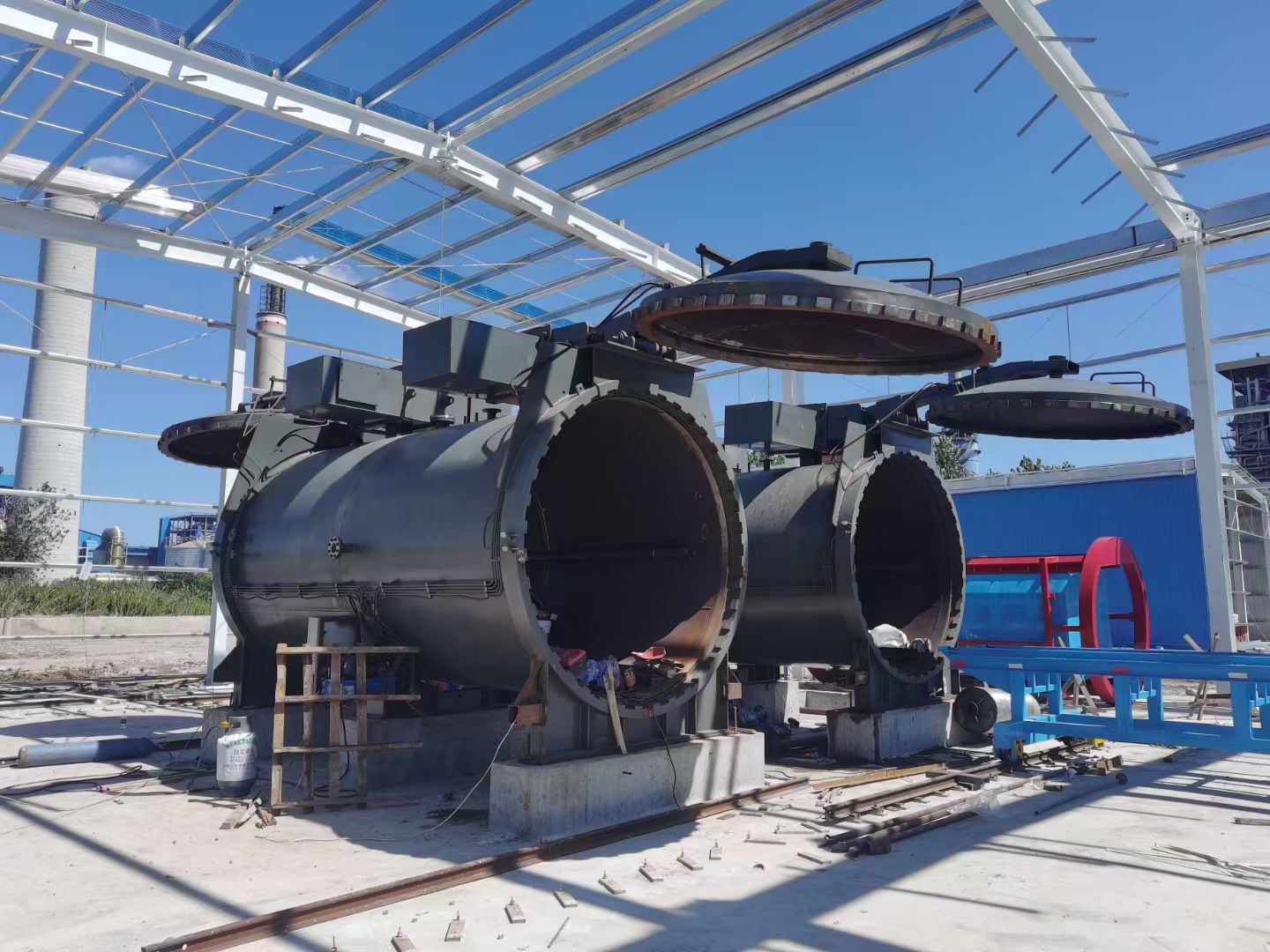
Taiguo deploys horizontal autoclaves from 1.65 m up to 3.0 m to steam-cure autoclaved aerated concrete block, sand-lime brick and fly ash product curing. Each and every autoclave is equipped with PLC automatic control, passes CE and ASME certification and bears a 2-year warranty for the pressure vessel body.


Φ1.65–3.0 m
Autoclave Diameter Range
1.0–1.6 MPa
Rated Pressure
80+
Countries Served
1976
Founded — 50 Years Experience
What Is a Concrete Autoclave
for AAC Production?
PRESSURE VESSEL ENGINEERING MODULE • INDUSTRIAL APPLICATION
01 // DEFINITION
The Core of Every AAC Plant
A concrete autoclave is a horizontal pressure vessel built to cure autoclaved aerated concrete blocks under high-pressure saturated steam. The autoclave is the single most critical equipment in every AAC plant because it is the unit which initiates the hydrothermal reaction that converts a soft, inherently porous green cake into a finished product building material with true structural integrity.
02 // COMPOSITION
Raw Materials & Gas‑Foaming
AAC — also called autoclaved cellular concrete or aircrete — is an autoclaved precast construction material made from cement, lime, silica sand or fly ash, water, and a minimal amount of aluminium powder. Aluminium reacts with the alkaline slurry producing hydrogen gas, forming millions of air bubbles. Once the slurry forms a green cake, it is cut and placed onto steel rail trolleys.
03 // REACTION CHEMISTRY
Hydrothermal Reaction & Tobermorite
Under saturated steam at 180–200 °C and 1.0–1.3 MPa, silica (SiO₂) and calcium hydroxide react. This produces tobermorite, a crystalline calcium silicate hydrate with a 1.1 nm layered structure. This creates compressive strength (2–8 MPa) while maintaining low dry density (300–800 kg/m³). Without the autoclave, tobermorite does not occur.
04 // PERFORMANCE ADVANTAGES
Insulation & Structural Efficiency
The voided cell structure provides superior insulation making AAC ideal for residential and commercial walls. At a standard density of 500 kg/m³, an AAC block weighs approximately 1/5 of a dense concrete block. This significantly reduces man‑hours during construction and lowers the site’s foundation loading requirements.
180–200°C
Steam Temp
1.3 MPa
Max Pressure
2–8 MPa
Comp. Strength
~20%
Weight Ratio
How the AAC Autoclave Curing Process Works
Each autoclave curing cycle takes four steps. Each step has several objectives and neglecting any step results in defects in the product, as operators learn quickly during the first few trial batch runs.
01
Loading & Sealing
Green cake blocks on the rail trolleys are pushed into the autoclave. The door opens rapidly and the interlock system detects the seal pressure. Then, steam enters.
02
Pressure Rise
Once the saturation steam is added it takes 1.5–3 hours to soak in. Heat rises from ambient to 180-200 C. Its PLC governs the rate of increase of temperature. If the push is too fast then it causes phase cracking in the green cake.
03
Constant Pressure Hold
The core curing phase. Steam pressure remains at 1.0-1.3 MPa during 6-10 hours while tobermorite crystals form throughout every block in the load. Duration depends on block density and raw material reactivity.
04
Depressurization
Steam is let off gradually over 1.5-3 hours. Controlled depressurization prevents cracking from sudden shifts in temperature and pressure. Blocks come out ready for use.
What Happens Chemically During Autoclave Curing
In short, the main reaction is simple:
SiO + Ca(OH) + H2O → Ca5Si6O16(OH)2·4H2O (tobermorite)
Saturated steam conditions above 170 C cause ground quartz sand to dissolve, react with the calcium hydroxide in the lime, and provide a cement hydration product. An interlocking web of tobermorite crystals binds the cellular structure.
Tobermorite is the desired product: you need saturated steam, not superheated steam. The fluid water component present in saturated steam is what allows the hydrothermal tobermorite reaction to take place. 1.3 MPa corresponds to 191.6 C and tobermorite optimum, saturated steam formation temperature. Higher temperatures does not necessarily means better tobermorite formation; above 210 C you start to form Xonotlite.
A built-in PLC has both pressure and temperature sensors through the whole cycle. Knowledgeable engineers can tweak the length of the constant-pressure hold time depending on the raw material blend fed to the kiln—coarse or fine quartz sand takes longer to convert, typical hold time drops from 10 hours to 7 or 8.
Autoclave Models & Technical Specifications
Taiguo offers five autoclave standard capacities, able to cover every size AAC line. All autoclaves use Q345R pressure vessel steel, make use of PLC automatic operation, and are supplied with safety relief valves, instrumentation and thermal insulation. Custom sizes are possible.
| Parameter | Φ1.65×21 | Φ2.0×21 | Φ2.5×24 | Φ2.85×26 | Φ3.0×23 |
|---|---|---|---|---|---|
| Inner Diameter (m) | 1.65 | 2.0 | 2.5 | 2.85 | 3.0 |
| Body Length (m) | 21 | 21 | 24 | 26 | 23 |
| Rated Pressure (MPa) | 1.1 / 1.4 | 1.4 | 1.4 / 1.6 | 1.6 | 1.6 |
| Design Temperature (°C) | 187 / 195 | 195 | 195 / 204 | 204 | 204 |
| Max. Operating Pressure (MPa) | 1.0 / 1.3 | 1.3 | 1.3 / 1.5 | 1.5 | 1.5 |
| Inside Track Gauge (mm) | 600 | 600 | 800 | 600 | 915 |
| Internal Volume (m³) | 46 | 68 | 121 | 172 | 172 |
| Total Weight (tons) | 18.7 / 21.5 | 25 | 51 / 58 | 62 | 70 |
| Overall Length (m) | 21.7 | 22.4 | 25.56 | 27.63 | 24.95 |
| Overall Width (m) | 2.62 | 3.05 | 3.25 | 3.58 | 3.65 |
| Overall Height (m) | 2.6 | 3.3 | 4.0 | 4.49 | 4.85 |
Source: Taiguo product literature. Within the same diameter group, the two values listed (e.g. 1.1/1.4) are two different pressure ratings available. All models feature automatic PLC operation and meet GB/T 150-2011. Custom sizes can be manufactured.
Key Design Features
SAFETY
Quick-Opening Door with Interlock
Side-swing door with imported rubber sealing gasket. A locking device prevents door opening while residual pressure remains inside the autoclave vessel—a must for ASME VIII and GB/T150 standards.
CONTROL
PLC Automatic Control System
PLC controls the whole curing cycle: steam inlet, pressure ascension rate, constant-pressure hold, decreasing pressure. Once the operator has set the optimum parameters, they are kept on memory, and the autoclave takes care of the calibration. Can operate under automatic or semi-automatic mode.
ENGINEERING
Thermal Expansion Bearing System
Three different types of bearings—fixed, movable and end bearings—positioned in different points of the autoclave vessel. This system takes into account the expansion and the contraction of the vessel during each heating and cooling cycle, avoiding the stress concentrations on the shell.
Applications — From AAC Blocks to Sand-Lime Bricks
Main application is AAC blocks production, but the same autoclave design can be applied to every product that need hydrothermal curing with saturated steam. Autoclaves from Taiguo are already present in plants producing all sorts of lightweight and calcium silicate building materials in more than 80 countries.
TYPE 01
AAC Blocks & Panels
Primary application: AAC blocks for load-carrying and non-loading-carrying walls, plus reinforced AAC panels for floors, roofs and cladding. Typical curing 1.0-1.3 MPa, 8-10 hours. Finished product provides thermal insulation of 0.08-0.16 W/(m·K)—about six to seven times better than dense concrete.
TYPE 02
Sand-Lime (Calcium Silicate) Bricks
Known as silica bricks, these products are actually made from lime and sand and cured at similar autoclave conditions. They provide compressive strength in the 10-30 MPa range—widely used as load-bearing masonry elements in Europe and Asia.
TYPE 03
Fly Ash Bricks
Instead of quartz sand, use coal combustion fly ash as source of silica. An autoclave converts fly ash into a sturdy, dimensionally stable brick from industrial waste. Curing conditions, 1.0-1.2 MPa, 6-8 hrs hold.
TYPE 04
Microporous Calcium Silicate Boards
High temperature insulation panels designed for industrial kiln applications. Custom designed autoclave channels to enable fine control of the upper pressure range (1.4-1.6 MPa) for achieving the optimum pore structure and fire rating for ‘endless’ operation at T>600 C.
Certifications, Safety & Compliance
All Taiguo autoclaves are pressure vessels under international and Chinese regulations. Taiguo holds manufacturing licenses that cover the whole range of industrial autoclaves and boilers supported by a totally independent physical and chemical testing laboratory, located in the 60,000 m Zhangji Industrial Park.
CE Marking
PED 2014/68/EU — European market
ASME U Stamp
BPVC Section VIII Div. 1
ISO 9001:2015
Quality Management System
ISO 14001
Environmental Management
Grade A License
China Boiler Manufacturing
Class 1 & 2 PV
Pressure Vessel Permits — SAMR
SGS Verified
Third-Party Inspection
BV / EAC
Bureau Veritas + Eurasian
Safety Features Built into Every Autoclave
Safety relief valves
Calibrated to open at the rated pressure. Each autoclave is equipped with two all safety relief valves to meet ASME Section VIII requirements.
Door safety interlock
Mechanical and electrical interlocks ensure the quick opening door cannot unlatch until internal pressure is lowered to zero. This is probably the most important safety feature on any autoclave.
Pressure & temperature instrumentation
Digital gauges and sensors to be integrated with PLC, with alarm limits set points to alarm on over-pressure and over-temperature conditions.
Emergency depressurization valve
Manual override for emergency situations to allow quick controlled depressurization.
Non-destructive testing (NDT)
100% radiograph test for all longitudinal and circumferential welds before delivery as per ASME Section V.
Applicable Standards
Taiguo autoclaves are designed and produced to meet the following: ASME BPVC Section VIII Division 1 (pressure vessel construction), GB/T 150-2011 (Chinese pressure vessel code), PED 2014/68/EU (European Pressure Equipment Directive), ISO 16528-1:2007 (performance specifications for boilers and pressure vessels), and ASTM C1693 (AAC product specification). Completed AAC products conform to ASTM C1693, BS EN 771-4, and GB/T 11968-2020 block standards.
Concrete Autoclave Price Guide — Factors & Ranges
Pricing for a autoclave is determined by five factors: vessel diameter, body length, pressure rating, accessories (PLC, insulation grade, instrumentation etc) and the certification of the country of destination (ASME U Stamp cost vs CE only). All the prices listed are FOB China and do not include installation, piping or the steam boiler.
Small Capacity
$7,500–$15,000
per unit
- Φ1.65 × 21 m (46 m³ volume)
- Rated 1.0–1.4 MPa
- 18.7–21.5 tons
- Suits 30,000–60,000 m³/yr plants
- PLC automatic control included
Mid-Range
$18,000–$35,000
per unit
- Φ2.0–2.5 m (68–121 m³)
- Rated 1.4–1.6 MPa
- 25–58 tons
- Suits 80,000–150,000 m³/yr plants
- Full insulation + PLC + instrumentation
Large Capacity
$35,000–$50,000
per unit
- Φ2.85–3.0 m (172 m³)
- Rated 1.6 MPa
- 62–70 tons
- Suits 200,000+ m³/yr plants
- Heavy-duty for panels + blocks
What Drives the Price Difference?
Vessel diameter is the dominating factor, as going from 1.65 m to 3.0 m increases steel weight and welding labor by about 3 times. Higher pressure ratings (1.6 MPa verses 1.0 MPa) lead to thicker shell plates, whereas higher rating increase material and weight, but bear no other restriction. The difference between ASME and CE-only certification is the costs for a licensed, third-party, Authorized Inspector to witness fabrication and hydrotest. Finally options such as the premium, thicker insulation material, SCADA, and Stainless internals would tend to push the price toward the top of each range.
Note: The autoclave accounts for 15-25% of the total investment in an AAC production line. The remaining 75-85% is the cutting machine, mold systems, mixing equipment, steam boiler and civil works. So it is worth spending more on getting the right autoclave size the first time.
Ready to Size Your Autoclave?
To let us know your desired total annual output,product, and site requirements. Taiguo’s engineering team will advise you on the ideal autoclave set up, and give you an estimate within 48 hours.
Get Your Custom QuoteAfter-Sales Service & Technical Support
Taiguo has service strategic partnership in excess of 80 countries by about 100 overseas agents. The company was founded in 1976; it has been exporting pressure vessels and boilers over 30 years thus the after sales network has been built up.
Protocol 01
24-Hour Response
Telephone/WhatsApp support with 24 hours reply assured. For problem with PLC or control, remote diagnosis through internet connection can be done which avoids site visit.
Protocol 02
On-Site Commissioning
One Taiguo engineer will be sent to your plant for installation supervision and first-batch commissioning. Standard Time on site: 15-25 days, depending on complexity of the plant. Operator training.
Protocol 03
Spare Parts & Warranty
2-year full warranty on the autoclave body; pressure vessel. 1-year warranty on accessories, valves, instrumentation. Door seal gaskets, safety valves, and other wear parts stocked and shipped within 48 hours.
AAC Block Production Capacity Planner
Configure your autoclave setup and instantly see projected annual output for your AAC block plant.
2
12 hours / cycle
10h12h14h16h18h
Annual Production Capacity
0
m³ finished AAC blocks / year
Medium Plant
Daily Output
0
m³ / day
Cycles / Day
0
per autoclave
Per-Cycle Output
0
m³ / cycle
Autoclaves
2
Φ2.5×24
Case Studies & Project References
AAC Block Plant — Dhaka, Bangladesh
A building materials company needed 80,000 m³/year of block capacity for the fast-expanding Bangladesh building market. Factory floor space was tight and the equipment had to deliver long service life under humid tropical conditions. Taiguo supplied three Φ2.0×21 m autoclaves rated at 1.4 MPa with 68 m³ internal volume, set up for staggered cycle operation so the cutting line never sits idle. Commissioning wrapped up in 18 days.
“The autoclaves have been running for over two years now with zero unplanned shutdowns. We replaced the door seals once at the 14-month mark, which took about 3 hours. The PLC makes the whole cycle hands-off.”
80,000 m³/yr
Annual Output Achieved
12 hr
Avg. Cycle Time
18 days
Installation to First Batch
Fly Ash Brick Factory — Addis Ababa, Ethiopia
An Ethiopian construction company wanted to make premium grade bricks from nationally abundant coal fly ash and use the bricks for a government housing project. Finding equipment within project budget and to specifications laid down by the Ethiopian Standards Agency. Taiguo supplied the design of a production line powered by two 2.524 m autoclaves operating at 1.4 MPa with 121 m of capacity on each. Its 800 mm track gauge allows wider trolleys for heavier brick loads per cycle. An engineer from Taiguo remained 25 days on site to instruct the local crew on the autoclave operation and safety, and the settings within their PLC for their specific fly ash chemistry.
“The Taiguo engineer adjusted our curing parameters three times during the first week based on test-cube results. By day 10, we were hitting 15 MPa compressive strength consistently.”
35M bricks/yr
Production Capacity
8.5 hr
Hold Time (fly ash)
100%
Local Fly Ash Utilization
Large-Scale AAC Plant Expansion — Lahore, Pakistan
A key Pakistani AAC producer was in the process of expanding from 100,000 to 250,000 m annual capacity. They were already operating autoclaves from another producer and required the new presses to suit their existing steam inventory and rail network. Taiguo delivered four 2.8526 m autoclaves rated at 1.6 MPa-the largest models in the standard range at 172 m³ volume each, built for mass production. At 1.6 MPa, the rating provides plant headroom to cure denser merchandise such as reinforced AAC panels alongside standard blocks. Weighing 62 tons, the units were arranged with a local heavy-lift contractor for vessel placement and arranged the bearing foundations to suit the existing rail centerline dimensions.
“We compared Taiguo against two European manufacturers. The quality of welding on the vessel shell was comparable, but the lead time was 40 days versus 120 days, and the price was about 40% lower. That made the decision straightforward.”
250,000 m³/yr
New Total Capacity
172 m³
Volume per Autoclave
1.6 MPa
Design Pressure
Frequently Asked Questions
A concrete autoclave is a large horizontal pressure vessel that cures pre-formed aerated concrete blocks using saturated steam at 180-200 C and 1.0-1.3 MPa. Silica and calcium hydroxide inside the autoclave undergo a hydrothermal chemical reaction to produce tobermorite, the crystalline calcium silicate hydrate responsible for AAC structural integrity. A single curing cycle runs 10-18 hours from loading to unloading, covering pressure rise, soaking at set pressure, and controlled depressurization.
It depends on what you turn per day. For a small one turning 50,000-80,000 m³/year, usually a Φ2.0×21 m autoclave (68 m³ each) with 2 units turning around is OK. A mid range with 100,000-150,000 m³/year would commonly run 3× Φ2.5×24 m autoclaves (3× 121 m³) rolling about. And if you are turning more than 200,000 m³/year, look at Φ2.85 or Φ3.0 m dia. For track gauge, 600 mm is the standard, but 800 mm or 915 mm track gauge is used for wide trolleys that enable larger loads per cycle. Always plan for one spare autoclave beyond the minimum count so you can maintain a unit without stopping production. Taiguo engineers can model your exact throughput needs during the quotation stage.
A full cycle is 10-18 hours. Rise in pressure is typically 1.5-3 hours as the saturated steam heats the vessel to 180-200 C. This is then followed by a 6-10 hour constant-pressure soaking period when tobermorite crystallizes in all the blocks. Topping out the depressurization takes a further 1.5-3 hours. Expert operators are able to reduce the total cycle time to ~ 11-12 hours once the steam feed and loading cycle are experienced. Hold time depends on block density and raw material reactivity. Running multiple autoclaves in staggered rotation lets the upstream cutting line keep feeding blocks without downtime, which is why most plants install at least two units.
Most AAC autoclaves run at 1.0-1.3 MPa (10-13 bar) with saturated steam at 180-200 C. Design pressure is typically 1.4 or 1.6 MPa. At 1.3 MPa the saturation temperature is roughly 191.6 C, ideal for tobermorite formation. An onboard PLC monitors both values continuously.
Look for ASME U Stamp for North America, CE mark under PED 2014/68/EU for Europe, and GB/T 150 for China. Your supplier should hold ISO 9001 accreditation. Taiguo carries all three plus Grade A boiler and Class 1 & 2 pressure vessel licenses.
Prices range from $7,500 to $50,000 per unit FOB China. A small Φ1.65×21 m unit at 1.0 MPa begins at $7,500-$12,000. Mid-range Φ2.5×24 m units at 1.6 MPa run $25,000-$35,000. Large Φ3.0×23 m autoclaves with full PLC control reach $40,000-$50,000. Installation, piping, and steam boiler costs are extra. On average the autoclave is 15-25% of a complete AAC line, so size selection is more important than saving a few thousand.
Yes. The hydrothermal principle is the same – saturated steam reacts with silica and calcium compounds to form calcium silicate hydrates. Because the principle is the same, AAC blocks, sand lime bricks, fly ash bricks, microporous calcium silicate board and slag bricks all use the same basic autoclave design. Only the curing cycle parameters (pressure, temperature, duration) differ, and all are controlled by the PLC. A plant producing a number of different products will save different recipes in PLC.
Inspect the door seal gasket every 500 cycles; replace every 1-2 years. Test safety relief valves annually per ASME. Check rail tracks every 6 months. Taiguo rates vessel body life at 15-20 years with routine NDT inspections.
Normal steam curing occurs at normal boiler conditions atmospheric pressure and about 100 C. Amorhous calcium silicate hydrate is formed as primary binding phase. Autoclave conditions pressure 1.0-1.3 MPa and about 180-200 C promote the formation of crystalline tobermorite. This imparts to AAC blocks significantly increased compressive strength 2-8 MPa compared to their very low density 300-800 kg/m. Without autoclave conditions true AAC cannot be produced only foam concrete with much lower structural performance.
Most plants run 2-6 autoclaves in staggered rotation. Rule of thumb: 2 autoclaves of Φ2.0 m or larger per 50,000 m³ of annual output. Taiguo engineers size the exact fleet based on product mix and daily targets.