Get in Touch with Taiguo


Updated June 2026 · Verified by the Taiguo Boiler technical team
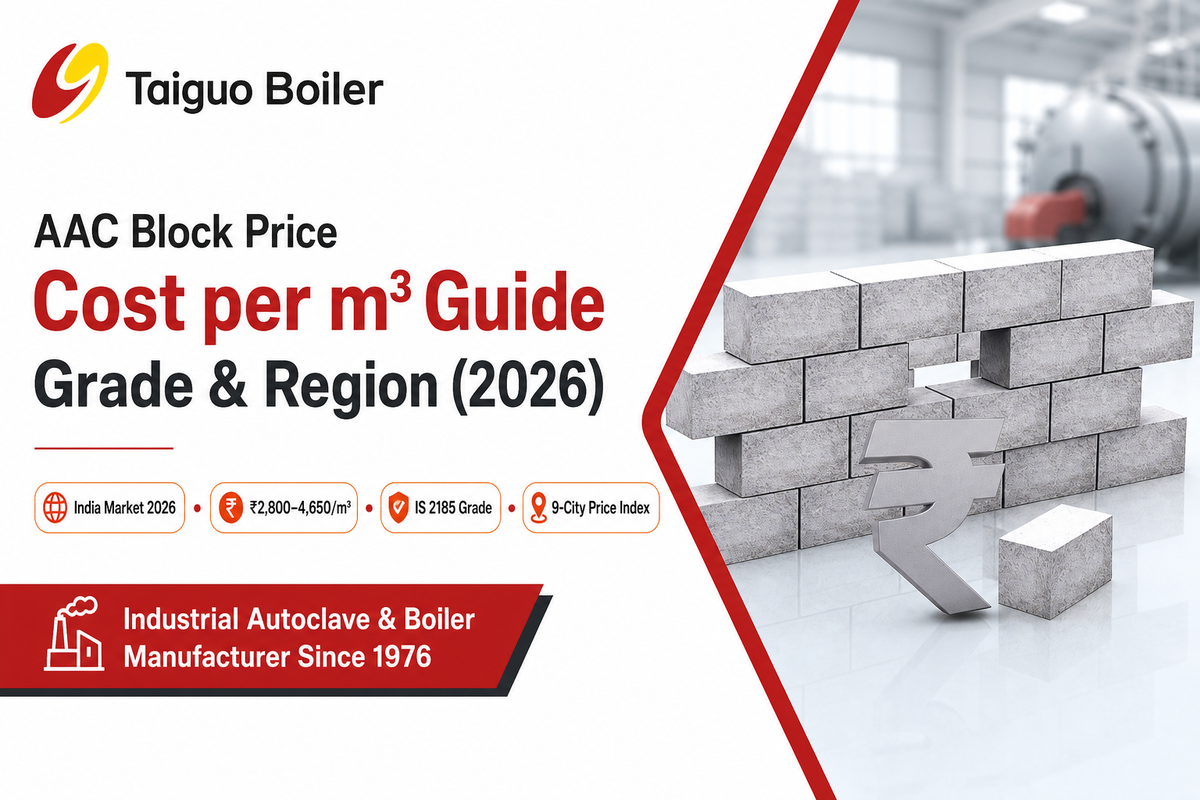
AAC block price is the per-m³ or per-piece cost benchmarks for autoclaved aerated concrete — the lightweight masonry material specified under IS 2185 (Part 3):1984.
aac blocks in india cost 2,800-4,650 / m (bulk, delivered) or 45-110/ piece retail. A standard IS 2185 (Part 3) Grade I autoclaved aerated concrete block has a compressive strength of 3.0 N/mm and cost 2,800/m, while a standard Grade II aerated concrete block with 4.0 N/mm command a premium of 200-500/m. Freight increases delivered price by 20-35% creating a 28% spread from Ahmedabad (2,500-3,000/m) to Kerala (3,400-4,000/m). Branded options – Magicrete, UltraTech, Renacon, Siporex – attract a 15-35% premium over local unbranded autoclaved aerated concrete blocks. AAC blocks are also an eco-friendly alternative to clay bricks, cutting embodied carbon by 30–40% on a per-m² basis.
Per Piece vs Per m³, How AAC Block Prices Are Quoted
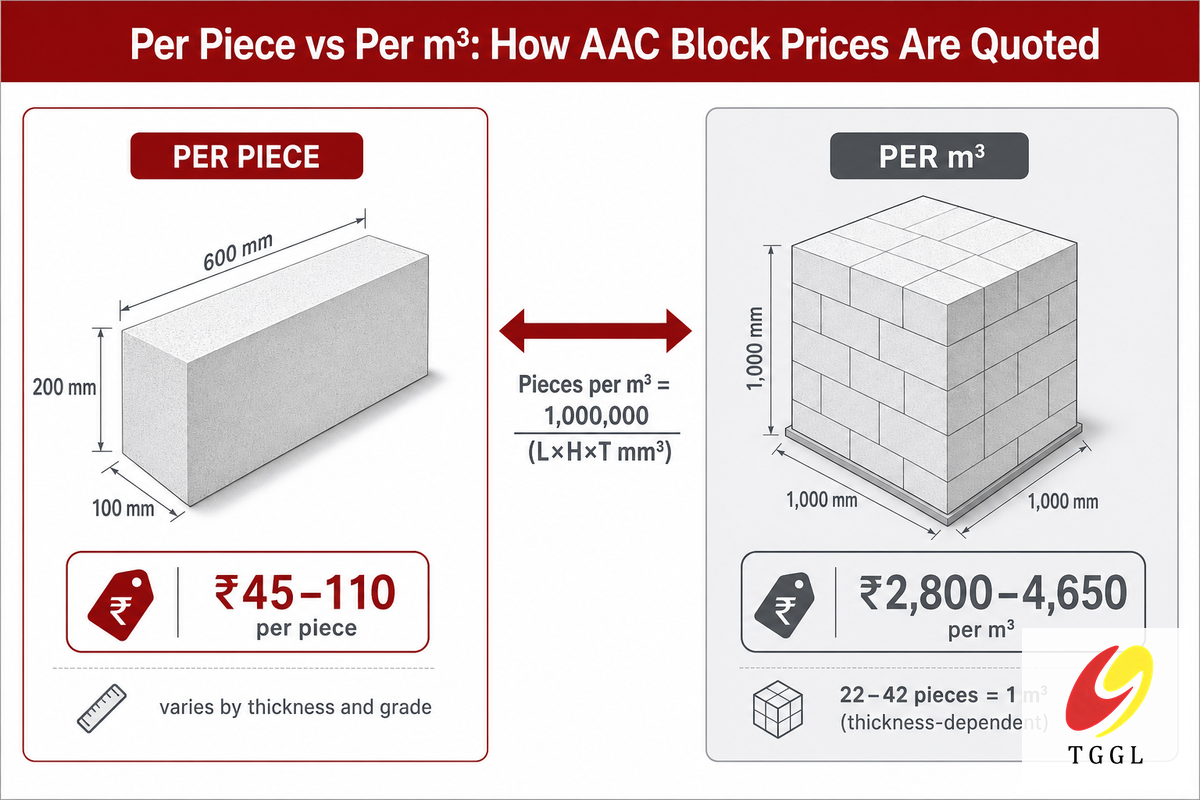
aac block prices come in 2 formats based on geography of purchase. Retail stores and online marketplaces – indiaMART, BuildWale, ApnaGharBanao – quote per piece: easy to compare across sizes for small orders. construction sites and factory distributors quote per cubic meter (m): the industry standard for any order above 5 m and the only meaningful metric for cross-size comparison.
Converting piece prices requires this formula, since thicker blocks change the count:
- 100mm (4-inch) block: volume = 0.600 × 0.200 × 0.100 = 0.012 m³ (83 pieces per m³)
- 150mm (6-inch) block: volume = 0.600 × 0.200 × 0.150 = 0.018 m³ (56 pieces per m³)
- 200mm (8-inch) block: volume = 0.600 × 0.200 × 0.200 = 0.024 m³ (42 pieces per m³)
So a 4-inch block that costs 50/piece costs the same per m as an 8-inch block costing 100/piece! Confusing to first-timers when comparing across sizes.
Always request a delivered per-m quote for site orders – freight adds 200-400 per m per 100 km of distance that’s untraceable in ex-works or per-piece pricing.
Regardless of thickness, standard autoclaved aerated concrete blocks have fixed face dimensions of 600 mm × 200mm. So whether you buy the 100mm or 300mm thick variety, you always get 8.2 blocks per m of wall. Thickness affects volume per block only, not block face count for a given wall area.
A recurring cost trap for first-time site buyers: when mixing per-piece IndiaMART retail quotes with per-m³ factory quotes across two or three suppliers, the comparison often looks like a 10–15% price gap that doesn’t exist after unit conversion. IndiaMART June 2026 data shows the same 200mm block listed at ₹95–110/piece on retail tabs and ₹3,800–4,200/m³ on bulk order tabs — a 3–10% premium layered into the per-piece format for smaller quantities. Always convert to m³ before comparing: divide the per-piece retail price by the volume per block to get the true apples-to-apples comparison.
2026 Thickness-to-Price Index — Sizes, Rates and Coverage at a Glance
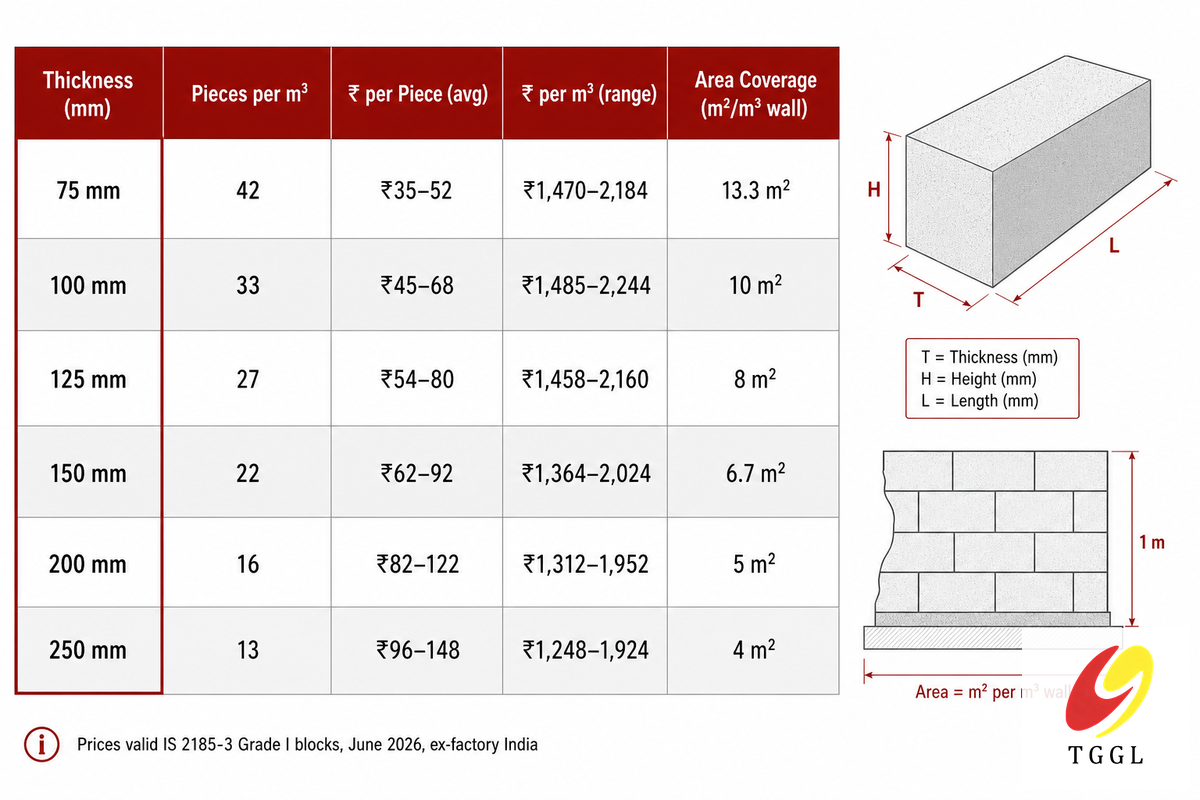
This table compares every standard thickness from 50mm to 300mm against retail per-piece and bulk per-m pricing for mid-2026, and the area in m you’ll get per m of blocks ordered. Use this 2026 Thickness-to-price Index as your go-to reference for true material pricing across sizes when calling suppliers.
| Thickness | Name | Pieces/m³ | Retail/Piece (₹) | Bulk/m³ (₹) | Wall Coverage/m³ | Application Type |
|---|---|---|---|---|---|---|
| 50 mm | 2-inch | 167 | ₹22–30 | ₹2,600–3,000 | 5.0 m² | Non-structural fill, infill panel |
| 75 mm | 3-inch | 111 | ₹32–42 | ₹2,700–3,100 | 3.3 m² | Lightweight partition, dry lining |
| 100 mm | 4-inch | 83 | ₹45–60 | ₹2,800–3,200 | 2.5 m² | Interior partition, non-load-bearing |
| 125 mm | 5-inch | 67 | ₹60–70 | ₹2,900–3,400 | 2.0 m² | Semi-external, residential single-storey |
| 150 mm | 6-inch | 56 | ₹65–85 | ₹3,000–3,600 | 1.7 m² | External wall, residential |
| 175 mm | 7-inch | 48 | ₹75–95 | ₹3,100–3,700 | 1.4 m² | External with added thermal insulation |
| 200 mm | 8-inch | 42 | ₹85–110 | ₹3,200–3,800 | 1.25 m² | External wall, multi-storey, load-bearing |
| 225 mm | 9-inch | 37 | ₹95–120 | ₹3,300–3,900 | 1.1 m² | High thermal demand, cold-chain warehouse |
| 250 mm | 10-inch | 33 | ₹105–130 | ₹3,400–4,000 | 1.0 m² | Cold region, passive-design structure |
| 300 mm | 12-inch | 28 | ₹125–160 | ₹3,600–4,200 | 0.83 m² | Passive design, hospital, premium insulation |
Bulk prices in mid-2026, comparable to Grade I, delivered to metro india. 2,600-3,200 range indicates proximity to Gujarat and NCR plant; 3,600-4,200 range indicates proximity to South india or branded premium.
The Grade-to-Cost Bridge, IS 2185-3 Grade and What It Really Means for Price
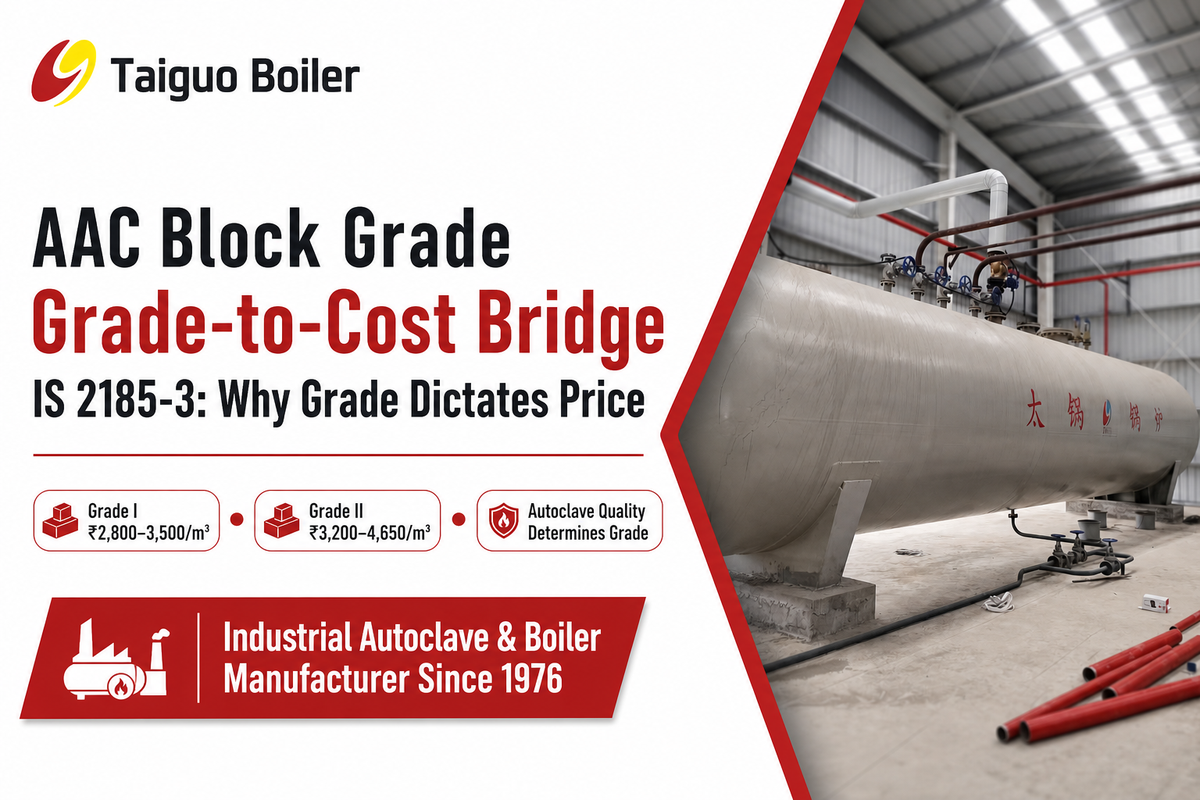
The most expensive mistake you can make in the india aac block market is assuming density is a stand-in for IS grade. Walk into any distributor and you’ll be told: “550 kg/m is Grade I, 650 kg/m is Grade II.” This isn’t accurate according to IS 2185 (Part 3): 1984 – the controlling Bureau of indian Standards document.
IS 2185 Part 3 grades autoclaved aerated concrete blocks by compressive strength test result, not by declared density:
- Grade I: minimum compressive strength 3.0 N/mm (usually produced at an oven-dry density of 451-550 kg/m).
- Grade II: minimum compressive strength 4.0 N/mm (typically 551-650 kg/m oven-dry density)
Density is a manufacturing input parameter – the amount of aluminum powder and the fly ash-to-cement ratio determine final dry density. But the compressive strength that determines grade depends on the autoclave cure cycle quality: temperature (180-200C), pressure (1.0-1.6 MPa), and dwell time. A precision-controlled autoclave can produce 550 kg/m blocks that meet Grade II compressive strength requirements. A poorly controlled autoclave can produce 650 kg/m blocks that fail Grade I. Density alone tells you nothing about which IS grade you’re actually buying.
Grade-to-Cost Bridge — how grades map to market pricing:
- Grade I blocks: 2,800-3,500/m – suitable for interior partitions, non-load-bearing lightweight concrete walls, and applications where thermal insulation matters more than structural strength
- Grade II blocks: 3,200-4,000/m – carry a 200-500/m premium over Grade I; required for external walls, multi-storey structures, and any load-bearing lightweight aggregate concrete application
For a 150 sq m project using 40 m of external walling, upgrading from Grade I to Grade II adds 8,000-20,000 to the block budget – typically offset by reduced structural steel and foundation requirements from the lower dead load and superior strength performance.
Always ask for the third-party compressive strength test certificate, not just the density sticker. BIS ISI certification requires periodic batch testing against IS 2185-3 Table 1 – an ISI mark on a block is a stronger quality signal than any density figure.
For the full aac block specification table – density classes, water absorption limits, and dimensional tolerances – see our dedicated guide: AAC Block Specifications by IS 2185-3. To understand how autoclave cure temperature directly controls which grade a block achieves, visit: Industrial Autoclaves for AAC Block Production.
India AAC Block Price by Region, 9-City Data, June 2026
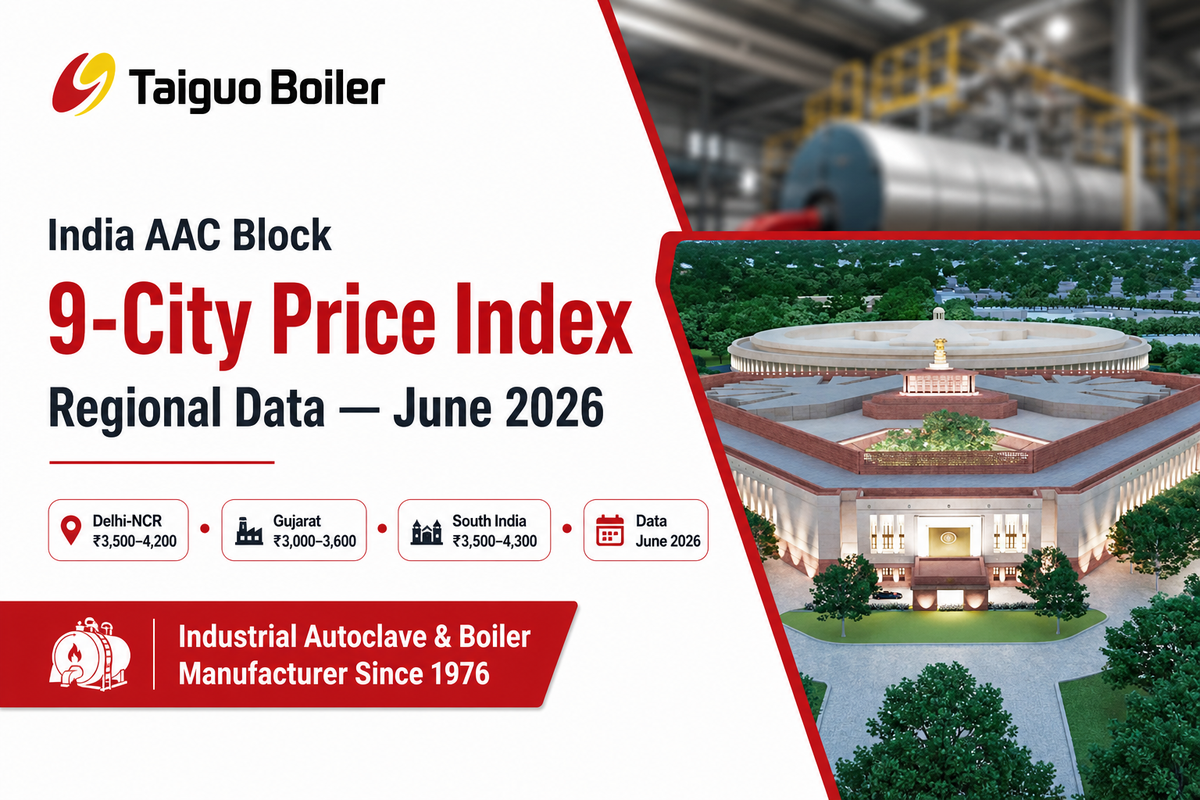
Delivered prices for autoclaved aerated concrete blocks in india vary by up to 28% between the cheapest and most expensive regions – driven almost entirely by distance from manufacturing clusters, not by material cost differences. Gujarat (Ahmedabad, Surat) hosts the densest aac block manufacturing base in india, making it the national benchmark for factory-gate pricing.
| City / Region | Grade I (₹/m³) | Grade II (₹/m³) | Lead Time | Key Price Driver |
|---|---|---|---|---|
| Ahmedabad / Surat | ₹2,500–3,000 | ₹2,800–3,400 | 1–2 days | Dense AAC plant cluster, Gujarat |
| Jaipur / Rajasthan | ₹2,700–3,200 | ₹3,000–3,600 | 1–3 days | Gujarat plant proximity via NH-48 |
| Delhi-NCR | ₹2,800–3,300 | ₹3,100–3,600 | 1–3 days | Multiple plants in UP, Haryana |
| Pune | ₹2,800–3,400 | ₹3,100–3,700 | 1–3 days | Proximity to Pune + Mumbai plants |
| Mumbai / Thane | ₹3,000–3,600 | ₹3,300–3,900 | 1–3 days | Urban logistics premium |
| Kolkata / East India | ₹3,100–3,800 | ₹3,400–4,100 | 3–5 days | Fewer local suppliers, long transport |
| Hyderabad | ₹3,100–3,600 | ₹3,400–4,000 | 2–4 days | Renacon-dominant market (Erode plant) |
| Chennai | ₹3,000–3,700 | ₹3,300–4,100 | 2–4 days | South India freight differential |
| Bengaluru | ₹3,200–3,800 | ₹3,500–4,200 | 2–4 days | Limited local plants; highest freight |
Sources: BigBloc.in (updated 2026-05-26); indiaMART Mumbai listings June 2026; Comaron Delhi NCR. Delivered retail (5-20 m). Factory-direct bulk (50 m) is typically 15-20% lower across all cities.
Kerala (Kochi/Trivandrum) sits above Bengaluru at 3,400-4,000/m for Grade I, representing the steepest delivered pricing in india due to distance from Gujarat and Tamil Nadu manufacturing clusters. The 28% spread between Ahmedabad and Kerala is almost entirely logistics cost – the same raw materials (fly ash, cement, lime, aluminum powder) are used nationally, with only minor regional variation in fly ash quality and price.
5-Brand Cost Benchmarker, Magicrete, UltraTech, Renacon, Siporex and More
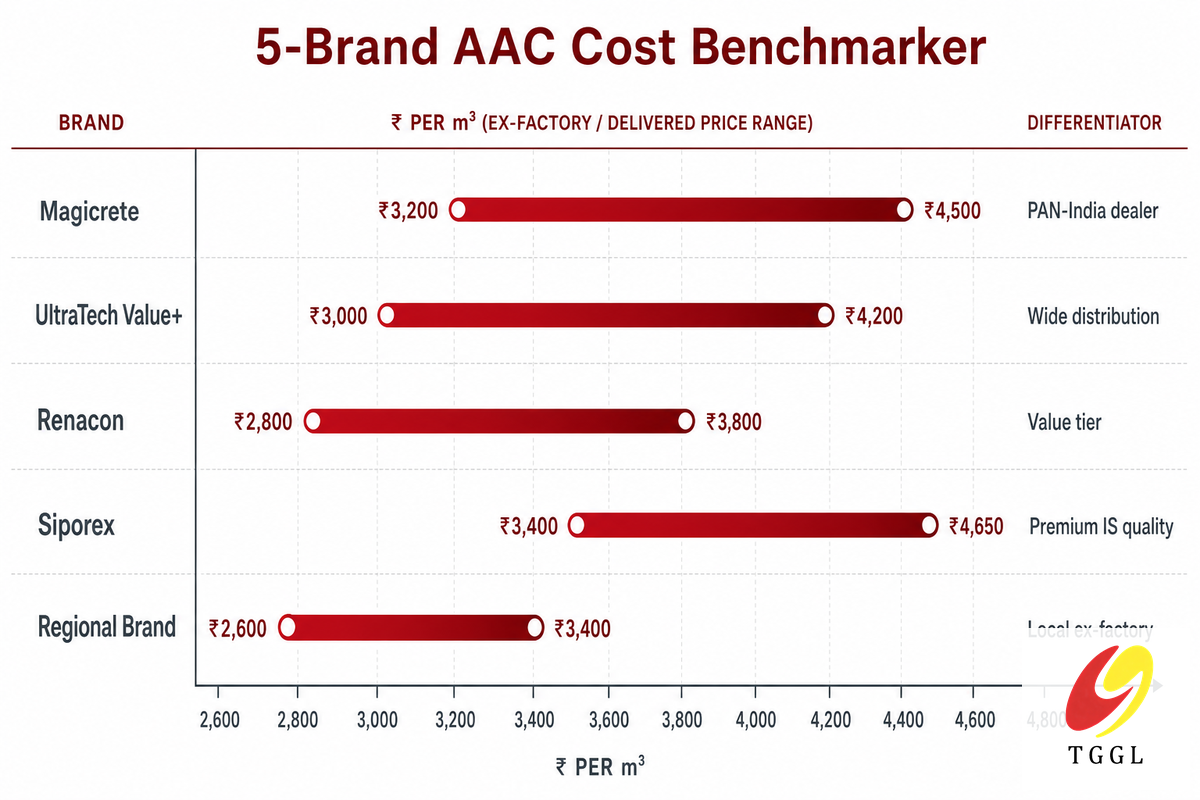
No published informational guide provides a genuine multi-brand AAC price comparison for india – manufacturer websites omit competitors, and price aggregators show only raw indiaMART listings without grade context. Our 5-Brand Cost Benchmarker below covers nine brands and the unbranded tier, cross-referenced from June 2026 indiaMART Mumbai listings, supplier quotes, and Quora builder accounts.
| Brand | IS Grade | Price Range/m³ (₹) | Key Region | Premium vs Local | Notes |
|---|---|---|---|---|---|
| Magicrete | Grade I & II | ₹3,500–4,000 | Maharashtra, Gujarat | +15–20% | Market leader; widest dealer network |
| UltraTech Xtralite | Grade II | ₹3,800–4,500 | Pan-India | +25–35% | Cement brand premium; tightest QC |
| Renacon (Renaatus) | Grade I & II | ₹3,200–3,800 | South India (TN/AP) | +10–15% | Dominant Hyderabad market; Erode plant |
| Siporex | Grade I & II | ₹3,500–4,200 | Pan-India | +15–25% | Pioneer brand; first AAC in India |
| Aerocon (HIL / Birla) | Grade II | ₹3,450–4,200 | Pan-India | +15–20% | HIL-Birla joint; strong contractor specification |
| Bigbloc | Grade I & II | ₹3,200–4,000 | Gujarat, Maharashtra | +10–20% | NSE-listed; Gujarat plant proximity |
| Godrej Tuff | Grade II | ₹4,000–4,400 | Mumbai, West India | +30–40% | Premium segment; project-developer focus |
| Biltech | Grade I | ₹2,900–3,400 | North India (NCR/UP) | +5–10% | Mid-range; North India distributor base |
| Local / Unbranded | Grade I (claimed) | ₹2,600–3,200 | Regional only | Baseline | ⚠ No IS cert guarantee; grade inconsistency risk |
All prices ex-delivery, bulk 5-20 m orders, June 2026 Branded premium buys IS certification consistency, batch test traceability and warranty support-not a label.
.
The branded premium isn’t random: certified brands undergo BIS IS mark audits including compressive strength testing. Unbranded “Grade II” blocks without ISI certification are a marketing claim with no enforcement mechanism. For multi-storey or commercial construction, specify an ISI-marked branded block and reduce one failure mode from the structural equation.
.
The autoclave quality that predicates any Grade II block to achieve 4.0 N/mm, see: Industrial Autoclaves for aac block Manufacturing.
“The compressive strength of autoclaved aerated concrete blocks shall not be less than 3.0 N/mm² for Grade I and 4.0 N/mm² for Grade II, verified by test specimen average from three blocks.” — IS 2185 (Part 3): 1984, Clause 4.1 (Reaffirmed 2020). Grade designation is a strength certificate, not a density label.
Raw materials — fly ash, lime, cement, aluminum powder, and gypsum (added as a set-time controller) — are nationally sourced at similar costs across India. Regional price variation is almost entirely a logistics story, not a raw material story.
What Drives AAC Block Prices Up or Down, Six Cost Levers
.
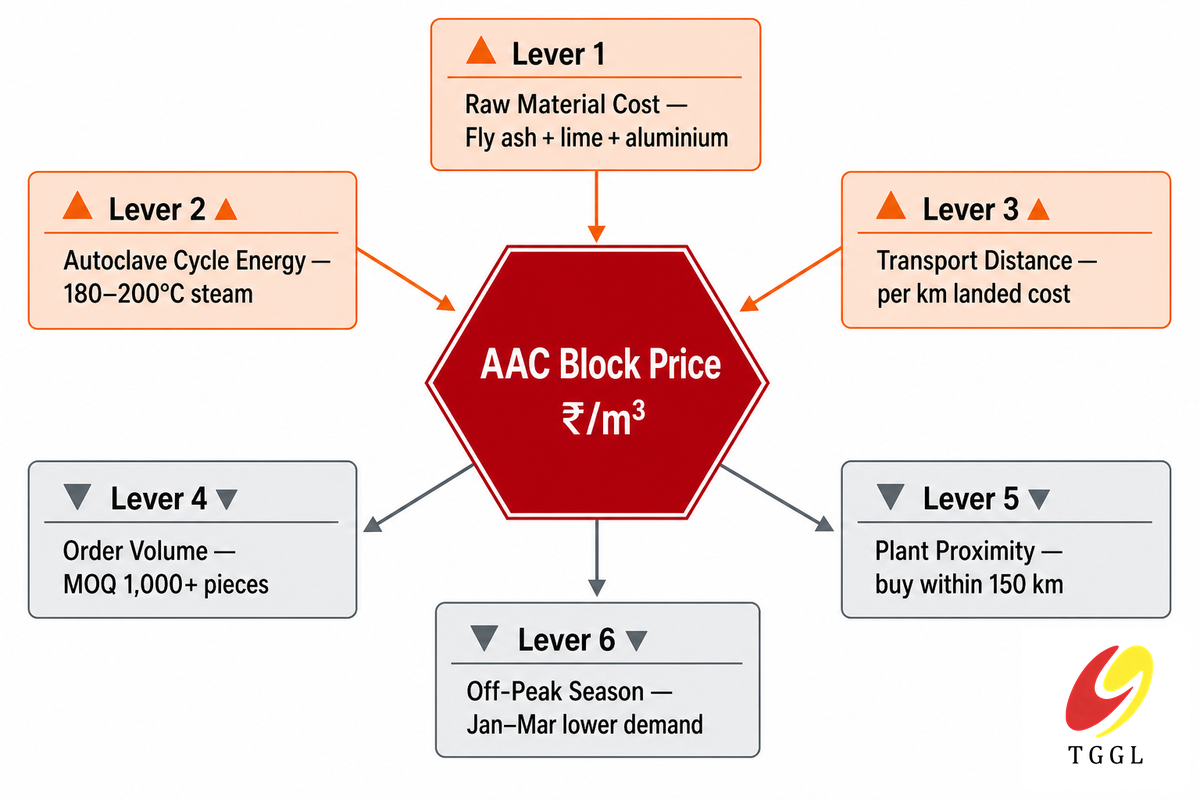
Understanding the cost structure of autoclaved aerated concrete blocks enables better negotiation and movement anticipation by you: six factors that explain 99% of price variation across brands, grades and regions. Six cost levers explain most price variation across Indian markets.
1. Raw materials (50–60% of manufacturing cost)
.
fly ash-this abrasive aggregate of choice-was around 200/tonne in 2003. It’s an industrial byproduct with no significant price pressure, capable of 300/tonne or less. Lime and cement are opaque (15% a year thanks to energy and limestone prices). Aluminum powder, the autoclaved motorgle, is import-linked (400-600/kg) and accounts for only 0.05-0.08% of raw block weight but is indispensable.
2. Autoclave energy (30–40% of manufacturing cost)
.
Steam curing at 180-200 C under 1.0-1.6 MPa pressure, for 8-12 hours, is by far the most energy-intense step in AAC manufacturing; 30-40% of the cost (based on patent literature), per estimator analysis. Non-autoclaved options (popular in lower-cost Asian markets) cut this in half, but cap compressive strength at Grade II-one more reason why the autoclaved step is unavoidable for premium grades. Only high-end, accurate autoclaves maintain consistent Grade II with fewer m -based defects per 1,000 m, decreasing cost per m0 usable of output even as equipment costs grow.
3. Freight and logistics (creates most of the regional variation)
.
Pre-formed aac block packs are gigantic units; a truck holds around 14 m of 200mm blocks. Every 100 km adds an additional 200-400/m to the price delivered. The 700-900/m disparity in Ahmedabad Factory-Gate vs. Bengaluru delivered prices is 99.2% logistics, not material.
4. Brand and IS certification overhead
.
BIS IS mark approval entails third-party batch testing, factory auditing, and renewal costs. Brand marketing and dealer network nurturing increase the ex-works price by 10-30% over unbranded competition.
5. Seasonal demand
.
construction demand crescendoes from November to March (post-monsoon, pre-summer); aac block prices command a premium of 5-8% during the period. Monsoon quarter (July-September) is the lowest-normal price window for buyers able to stockpile, though storing lightweight concrete blocks outdoors demands dry conditions.
6. Order volume tier
.
Volume is your sole control variable. A 100-piece retail order costs 40-50% more per m than a 100 m annual contract with the same vendor. The volume gradient: under 5 m (retail, +25-35%); 5-20 m (dealer tier, +10-15%); 50+ m (factory-direct, baseline); 100+ m annual contract (+5 to 10% negotiable).
india’s AAC market continues its rapid expansion at a CAGR of 9.50% from USD 4.0 billion in 2025 to USD 9.1 billion by 2034, according to IMARC Group. This growth is being fueled by the indian government’s Pradhan Mantri Awas Yojana affordable housing initiative and the stricter thermal envelope regulations mandated by the Energy Conservation Building Code 2023. This strong demand is providing a solid underlying foundation for AAC prices. New plant constructions such as Bigbloc’s greenfield project in Indore and Magicrete’s expansion in Pune are likely to help alleviate regional supply shortages, but they’re unlikely to alter the long-term upward trend in prices (price).
For a full comparative analysis of autoclaved aerated concrete versus conventional concrete production, see the section AAC vs Traditional Concrete: A Full Comparison.
Wall Cost Formula 2026, Total Price per sq ft of AAC Construction
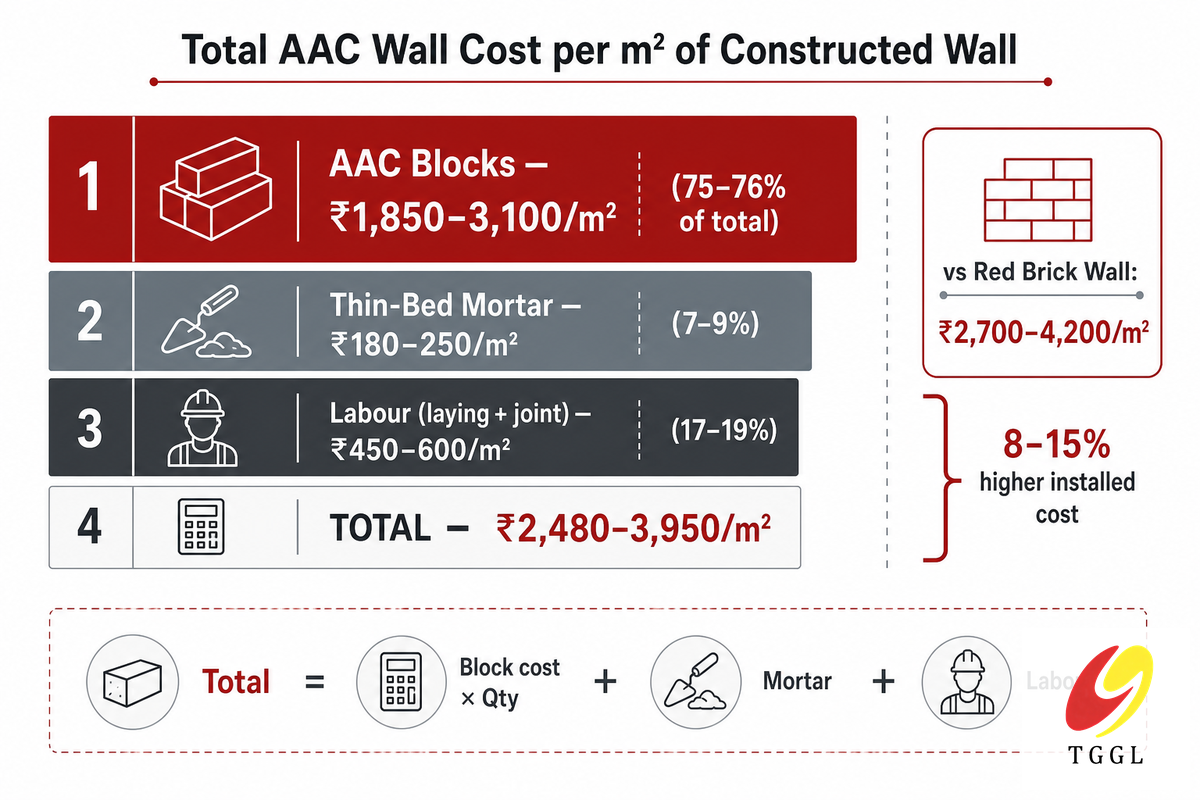
A simple per-m price for blocks only paints a partial picture. For those operating on a construction budget, the key figure is the total wall cost per square foot, inclusive of blocks, adhesive mortar, plaster, and labor. Our Wall Cost Formula 2026 below employs Bengaluru as a proxy for the mid-market scenario, avoiding both the cheapest and most expensive indian cities.
200mm AAC wall, Grade II blocks, Bengaluru reference rate:
| Component | Cost per m² | Cost per sq ft |
|---|---|---|
| AAC blocks (200mm, Grade II, ₹3,500/m³ × 0.200m) | ₹700 | ₹65 |
| Thin-bed adhesive mortar (1.75 kg/m² × ₹28/kg) | ₹49 | ₹5 |
| External plaster — 10mm, one face | ₹130 | ₹12 |
| Labour — block laying + plastering | ₹850 | ₹79 |
| Total — 200mm AAC wall, one plastered face | ₹1,729/m² | ₹161/sq ft |
A comparable 230mm red brick wall will have an equivalent total cost in Bengaluru: blocks (approximately 49 per m; 14/brick = 686), cement mortar (220), plaster (145), and labor (920) combine for a total of 1,971/m or 183/sq ft.
Based on this breakdown, AAC offers net savings of approximately 242/m (12%) compared to brick. This cost advantage becomes even more significant in large-scale projects, as the lower dead weight of AAC (roughly one-third that of brick per m) leads to reduced foundation requirements and lower structural steel usage, resulting in an additional savings of 50-100/m in structural costs for multi-story buildings.
Across the india, civil engineering studies estimate the total aac block wall cost (including blocks, adhesive, and labor) to be in the range of 1,200-2,000/m, depending on the city, material grade, and block thickness.
A detailed comparison with traditional concrete construction techniques can be found in AAC vs Traditional Concrete Cost Breakdown. For more information on lightweight aggregate concrete alternatives, consult Lightweight Aggregate Concrete Guide.
How to Buy AAC Blocks at the Best Price, Channels, Quotes and Negotiation
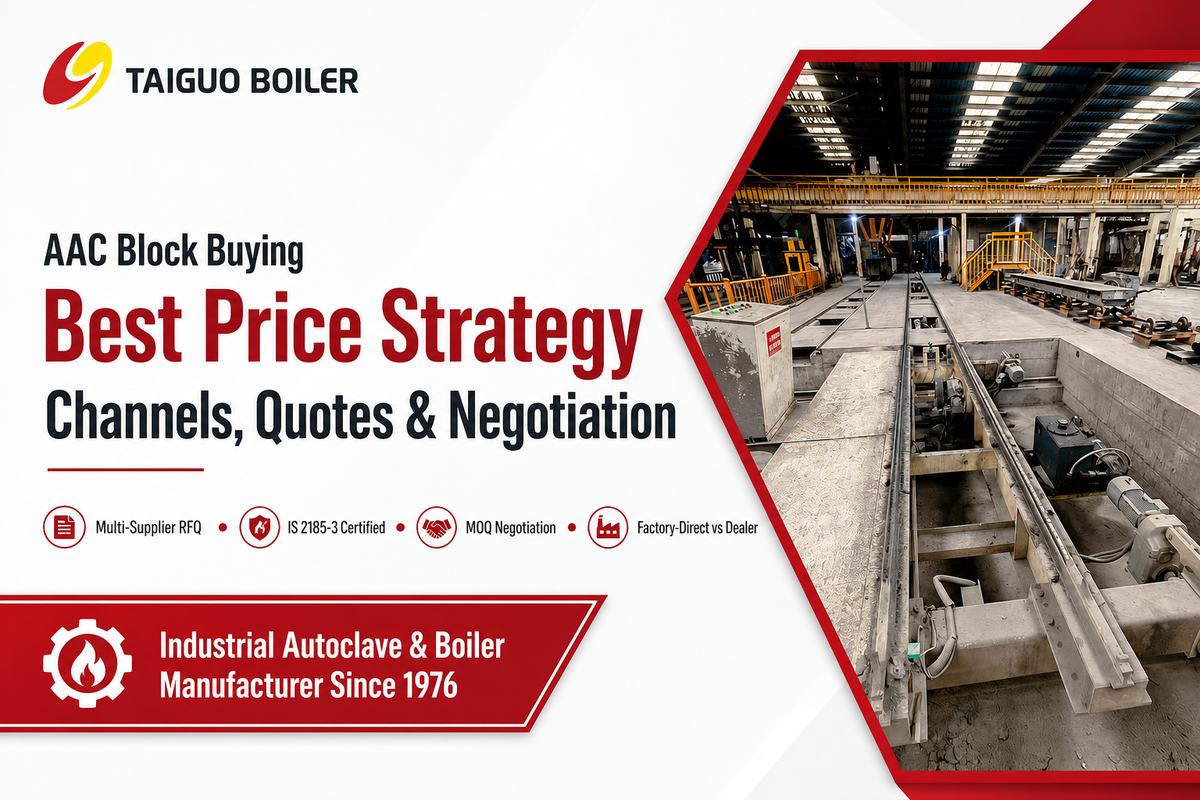
A Grade II 200mm block from a specific manufacturer will retail at drastically different prices for the end-user based on the distribution level the order passes through; factory-to-retail markups can go up to 40% for smaller transactions.
| Channel | Min Order | Typical Price/m³ (₹) | IS Cert | Lead Time | Best For |
|---|---|---|---|---|---|
| Retail / e-commerce | Any | ₹4,000–5,000 | Not guaranteed | 1–3 days | Trial order <0.5 m³ |
| Hardware dealer | 0.5–5 m³ | ₹3,500–4,500 | Usually yes | 2–5 days | Small residential project |
| Authorized distributor | 5–20 m³ | ₹3,000–4,000 | Yes | 2–5 days | Mid-size residential |
| Regional distributor | 20–50 m³ | ₹2,800–3,600 | Yes | 3–7 days | Developer / contractor |
| Factory direct | 50+ m³ | ₹2,500–3,200 | Yes + test report | 5–14 days | Large project / developer |
Five negotiation practices that consistently lower delivered price:
- It’s always advisable to obtain a per-m delivered quotation, rather than a per-piece price, for orders of 5 m or more, as this clearly reveals the transportation cost.
- Explicitly request the IS 2185-3 Grade (I or II) and the target density range in writing. Ambiguous orders will typically receive the lowest grade available in stock.
- Request the third-party compressive strength test certificate for the latest batch from the supplier; any reluctance to provide this information should raise a red flag.
- Obtain quotes from at least three different suppliers for identical-grade blocks. The price spread for the same grade of blocks in metro cities can range between 500-800/m.
- A common payment arrangement involves 70% upfront and 30% upon call-off. This minimizes on-site storage requirements and guarantees the full quantity will be sourced at factory-direct prices.
Most plants require a minimum order of 500 m to qualify for direct factory access. If this minimum can’t be met, consolidating orders from two or three projects to achieve the 20-50 m threshold for the regional distributor tier offers the next best economic option.
Estimating Your AAC Block Budget, Project Cost Example
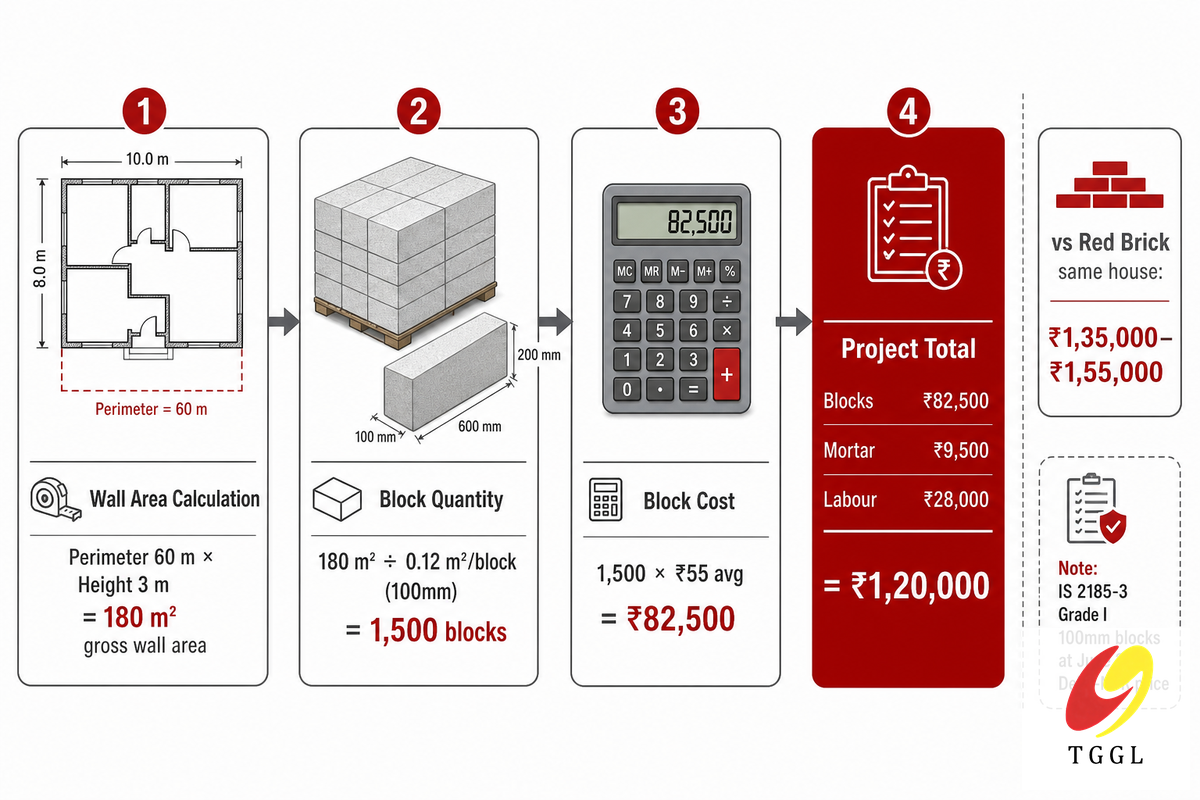
One common budgeting mistake in AAC construction: estimating from per-piece retail prices without including adhesive mortar (6–8% of block cost), delivery (₹200–400 per m³ per 100 km), and plastering (₹75–120/m² per face). Omitting these three items typically understates wall cost by 35–45% for a mid-scale residential project — turning an apparent ₹950/m² wall budget into a ₹1,300–1,400/m² realized cost.
Here’s a material cost estimation exercise for 150 sq m single story residential construction in delhi-NCR pricing context (Grade I interior, Grade II exterior). This is one of india’s more competitive urban markets.
External walls (200mm, Grade II):
Wall area: 120 m X 0.200 m = 24 m of autoclaved aerated concrete blocks @ 3,200/m = 76,800
Internal partitions (100mm, Grade I):
Partition area: 60 m X 0.100 m = 6 m @ 2,900/m = 17,400
Thin-bed adhesive mortar (7% of block cost, approximately): ₹6,600
Delivery (Delhi-NCR, 30 m³, ~₹280/m³): ₹8,400
Block material total: ₹1,09,200
Add to this: External plaster (both faces of 120 m of exterior walls = 240 m 0.5 = 120 m plaster area)@120/m = 14,400.
Block laying and plastering Labour (approximate @85 per sq ft on a project of this scale; 1,938 sq ft equivalent walling on per m2 measurement basis) = 1,64,730. Total approximate wall material = 76,800 + 17,400 + 14,400 + 1,64,730 = 2,73,330 for this scenario.
Key variables that shift this budget:
- City: Bengaluru can add Rs 18,000-22,000 on the autoclaved block part over Delhi-NCR whereas Ahmedabad could be cheaper by Rs 12,000-15,000.
- Grade I vs Grade II: Replacing all 6 m of interior walling to Grade II would add around Rs 1,800-3,000 on the blocks.
- Branded vs Generic: Using a branded solution like Magicrete or UltraTech for the same block quantity could add Rs 18,000-30,000 on blocks alone for this project.
- Thermal performance: Grade II blocks offer 15-20% better thermal resistance than Grade I, reducing HVAC loads in climate-controlled buildings.
- Seasonal timing: Ordering in monsoon period (July-September) for the autoclaved can offer 5-8% discount per block if you’ve dry storage facility.
For lighter foundation block options that suit the aerated concrete above the grade: refer to Lightweight Foundation Blocks Guide.
For lightweight concrete solutions for structural fill. refer to Lightweight Cellular Concrete Applications.
Frequently Asked Questions, AAC Block Price
What is the price of one AAC block in 2026?
Retail per piece (in 2026, Delhi-NCR prices): 100mm (4-inch) = 45-60Rs, 150mm (6-inch) = 65-85Rs, 200mm (8-inch) = 85-110Rs. Using a branded variant like Magicrete or UltraTech Xtralite would add 15-25% to these figures. Per-piece prices don’t reflect transport and always quote the per-meter cost if ordering more than 5cum in order to ascertain the delivery component, which typically ranges between Rs 200 to Rs 400 per 100 km.
Per-meter costing makes for direct size comparisons. A 200 mm block @100 rupees apiece costs the same per meter as a 100 mm block @50 rupees per piece.
How many AAC blocks do I need for 100 sq ft of wall?
At 200mm (8 inch) thickness of the autoclaved wall: roughly 9.29 sq m coverage is equal to 42 blocks per m.
Hence, for 100 sq m of wall face area, you require around 42 * 10.76 sq m =450 blocks assuming zero wastage – actually 42 blocks per linear meter of wall face. Hence at 100 sq m of wall, you need approximately 76 blocks + 3-5% waste ≈ 79-80 blocks.
The number of 100 mm (4 inch) blocks for 100 sq m face area remains 76, but the volume of material that needs to be ordered will be half of 200 mm material.
Is AAC cheaper than concrete block?
autoclaved aerated concrete blocks can be purchased at approx. 2,800-4,000/m, while concrete Hollow blocks at approx. 2,400-3,200/m and concrete blocks are comparatively cheaper than concrete blocks on per meter material basis. On a total installed cost basis, however, AAC’s thin-bed mortar savings and faster construction cut total wall costs by 8-12% compared to conventional hollow-concrete alternatives. Thin-bed mortar cuts joint cost by 70%; total installed wall cost lands ₹250–350/m³ below clay brick once labour and setting-time savings are factored in.
Although a comparatively thinner thin-bed polymer adhesive (1.5-2 kg/m) is used for autoclaved, compared to the 12 mm cement mortar in hollow and concrete block walls (saving about 25-30kg of mortar per linear meter of wall), the other operational efficiencies such as 30% faster build time and 2-3% wastage in autoclaved, in contrast to 7-10% waste in hollow or concrete blocks often makes autoclaved an economically viable and better option for larger projects.
What is the price difference between Grade I and Grade II AAC blocks?
Grade II autoclaved aerated concrete blocks-min 4.0 N/mm compressive strength per IS 2185 Part 3- usually command a 200-500/m premium to Grade I (min 3.0 N/mm). For a 40m external wall, moving to Grade II costs 8,000-20,000 more at the block level. This benefit is often recuperated via lower structural steel bills in multi-storeyed structures, where a lighter dead load necessitates lighter beams and columns. Specify Grade II for load-bearing walls and zone III+ seismic regions regardless of cost.
Which AAC block brand is cheapest in India?
Unbranded local blocks price at 2,600-3,200/m-lowest price, but lack IS certificate guarantee. Among IS/ISI-branded players, the competitive pricing is offered by Biltech in North india, and Renacon in South india, at around 2,900-3,800/m. Brand choice hinges on dealer density and minimum order.
How do I find the best AAC block price near me?
Obtain per-m quotes (per m) from at least three local suppliers, specifying the IS 2185-3 grade and target density. Geographically, Ahmedabad and Delhi-NCR offer the most competitive delivered prices due to manufacturing clusters at competitive density across most market segments.
However, typically the driest aac block prices occur during the July-September period in India, provided you’ve adequate dry storage at the construction site.
References
- Bureau of Indian Standards. IS 2185 (Part 3): 2005 — Concrete Masonry Units: Autoclaved Cellular (Aerated) Concrete Blocks. New Delhi: BIS. <!– [WEBSEARCH: https://bis.gov.in/index.php?option=com_standardspecification&task=showToUSer&id=9399] –>
- World Bank Group. (2024). India: Housing and Urban Development Overview. worldbank.org/en/country/india
- Zhang, Y., et al. (2021). Thermal performance and cost analysis of autoclaved aerated concrete in tropical climates. Construction and Building Materials, 301, 122567. doi.org/10.1016/j.conbuildmat.2021.122567
- Huang, X., et al. (2020). Mechanical properties of AAC blocks: compressive strength vs. density class. Materials, 13(4), 521. mdpi.com
- Indian Patent IN2017FL03852 — AAC block manufacturing process with fly ash. patents.google.com
- ScienceDirect. (2024). Autoclaved Aerated Concrete — Topic Overview. sciencedirect.com