Get in Touch with Taiguo


Updated November 2026 · Commercial & Industrial Thermal Engineering Reference
In any boiler vs water heater comparison, fluid loop topology sets the boundary. A water heater runs an open potable circuit that stores fresh tap water above 140°F and delivers it near 120°F to fixtures through mixing valves, replacing every drawn gallon. By contrast, a boiler heats closed-loop water up to 200°F in homes (up to 250°F in commercial H-stamp systems) or generates steam for space and process loads. Under state boiler laws such as WAC 296-104, potable heaters crossing 200,000 Btu/hr, 210°F, 120 gallons, or 160 psi enter ASME boiler code scope.
Facility engineers, mechanical contractors, and building owners often inspect a water heater and a boiler side by side in mechanical rooms. Misjudging a water heater vs boiler replacement can lead to oxygen rust of cast iron, failed state vessel inspections, and/or cold winter showers. Residential replacements typically span $800 to $1,809 for standard tank heaters versus $3,605 to $8,450 for home boilers per 2026 contractor data. Commercial and industrial plants can cost far more for custom multi-megawatt packages.
Quick Specs: Boiler and Water Heater Benchmarks
| Potable Hygiene Boundary | Store above 140°F (60°C); circulate above 120°F (49°C) per CDC Legionella guidance |
| ASME Vessel Crossover Limits | 200,000 Btu/hr (58.6 kW), 210°F (99°C), 120 gallons (454 L), or 160 psi per WAC 296-104 |
| Relief Valve Standard Settings | 150 psi / 210°F T&P valve on potable tanks vs. 30 psi pressure relief on low-pressure hydronic per Plumbing & Mechanical |
| Condensing Flue-Gas Ceiling | Return water below ~138°F enables condensing mode; hotter return drops efficiency near 87% per Consulting-Specifying Engineer |
| Typical Service Lifespan | 8–12 years (tank heater), 15–20 years (tankless), 20–30+ years (commercial or steam boiler per CSE) |
Boiler vs Water Heater: Core Functional and Loop Differences
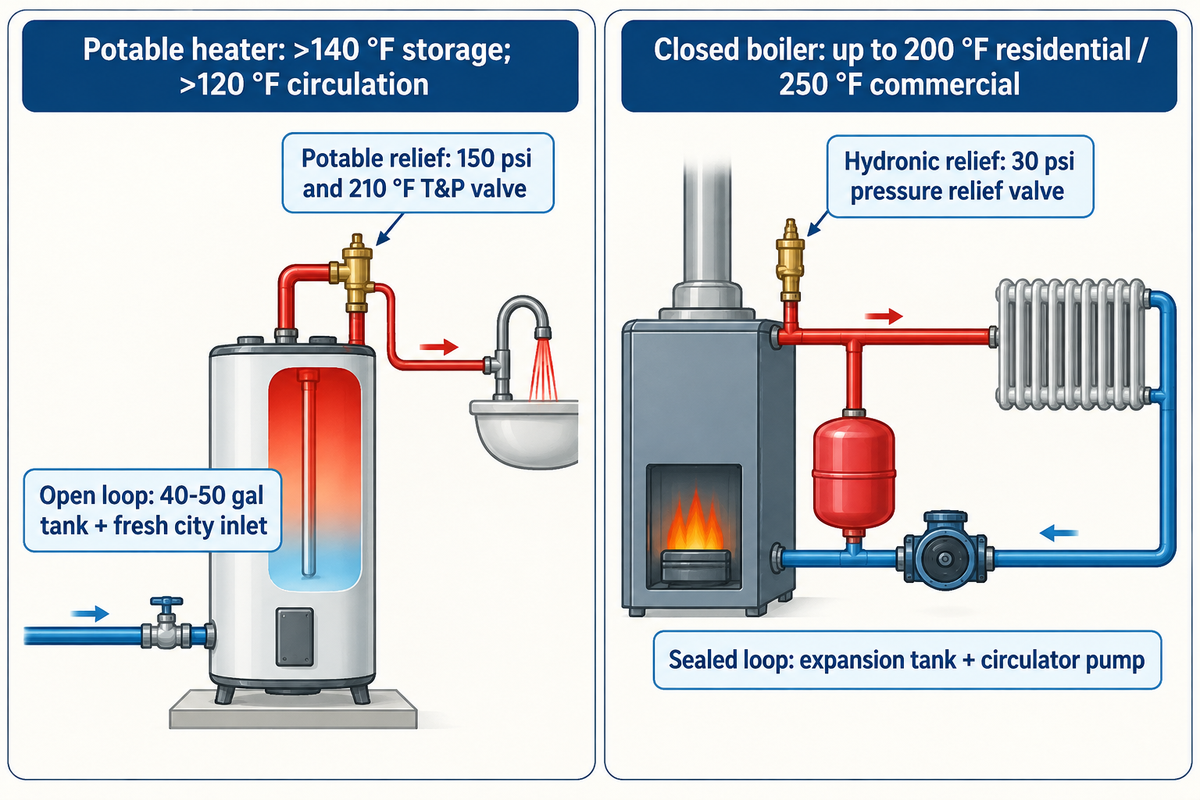
Potable water heaters store municipal tap water above 140°F, circulate it above 120°F to provide hot water for domestic showers, sinks, and washdown lines, and replace every drawn gallon. Boilers recirculate sealed water up to 200°F or generate pressurized steam that serves radiators, fan coils, and industrial jackets without consuming the fluid. Choose a closed-loop boiler whenever space or process heating dominates.
Site walkthroughs reveal the difference between a water heater and a boiler within seconds. Core CDC potable loop rules separate differences between water heaters providing domestic hot water above 140°F and how a closed boiler provides space heat. That visual difference between a boiler and a tank unit shows first at the cold inlet. A standard water heater stores 40-50 gallons to heat your water, in residential closets, and connects to a municipal shutoff and hot outlet line. A brass temperature and pressure relief valve is also located there on the upper shell. A heating boiler connects to supply and return headers, an external expansion tank, pressure-altitude gauge and a bronze or cast-iron circulator pump.
During building audits, confusing a boiler and a hot water tank usually results in misquoted bids. A 2,000 square foot mid-Atlantic building using a 50 BTU per sq. foot cold factor results in a 100,000 BTU boiler load for a U.S. contractor. Quoting a 40 gallon domestic tank heater for that 100,000 BTU space-heating job results in a radiant loop that’s way too small. In our 10-Dimension Boiler vs. Water Heater Architecture Matrix, we compare the key differences, across residential, commercial and industrial equipment.
| Engineering Dimension | Potable Water Heater | Hydronic or Steam Boiler |
|---|---|---|
| 1. Primary Thermal Duty | Supply hot water to faucets, showers, dishwashers, and sanitation taps | Deliver space heat or process energy via closed piping or steam headers |
| 2. Fluid Loop Topology | Open once-through circuit fed continuously by fresh city water pressure | Closed recirculating hydronic loop or condensate-return steam loop |
| 3. Water Potability | Potable drinking quality; lead-free brass, glass lining, or stainless wetted parts | Non-potable oxygen-depleted fluid; compatible with cast iron and carbon steel |
| 4. Operating Temperature | ~120°F fixture delivery; stored above 140°F for pathogen control (CDC) | Up to 200°F residential hydronic; up to 250°F commercial H-stamp or steam |
| 5. Relief Valve Protection | Combination T&P valve rated up to 150 psi and 210°F (CSA Z21.22) | Pressure-only safety relief valve (30 psi typical on low-pressure hydronic) |
| 6. Heat Delivery Emitter | Open plumbing fixtures, mixing valves, commercial dish racks, hose stations | Radiators or underfloor heating manifolds, air-handler coils, jacketed vessels |
| 7. Governing US Standards | 10 CFR 430 / 431 federal rules; ASME Section IV Part HLW above state limits | ASME BPVC Section IV (“H” stamp) or Section I (“S” stamp power boilers) |
| 8. Capacity Sizing Metric | Storage gallons (40–120 gal), First-Hour Rating, or GPM at winter rise | Continuous BTU/hr, MW (0.35–14 MW packaged hot-water boilers), or steam t/h |
| 9. US Residential Installed Cost | $800–$1,809 tank; $1,500–$4,500 tankless (3-source U.S. contractor range) | $3,605–$8,450 typical ($5,914 Angi 2026 average); industrial custom-quoted |
| 10. Expected Service Life | 8–12 years for tank water heaters; 15–20 years for tankless models | 10–15 years combi; 15–30+ years hydronic, commercial, and steam boilers |
Is a boiler the same as a water heater?
No, a boiler and a water heater are distinct appliances built for separate fluid loops and plumbing codes. Water heaters heat fresh drinking water for open taps and appliances. By contrast, a boiler heats captive water or steam that circulates through radiators, radiant slabs, or process heat exchangers before returning for reheating.
Even their burner controls reflect the different duties of water heaters and boilers. On-off thermostats are common on simple controls for conventional tank heaters to keep stored potable water ready. Modern boilers, on the other hand, control the firing rate over several part-load steps to maintain radiator supply to track the outdoor weather.
Open Potable Loops vs Closed Hydronic and Steam Circuits
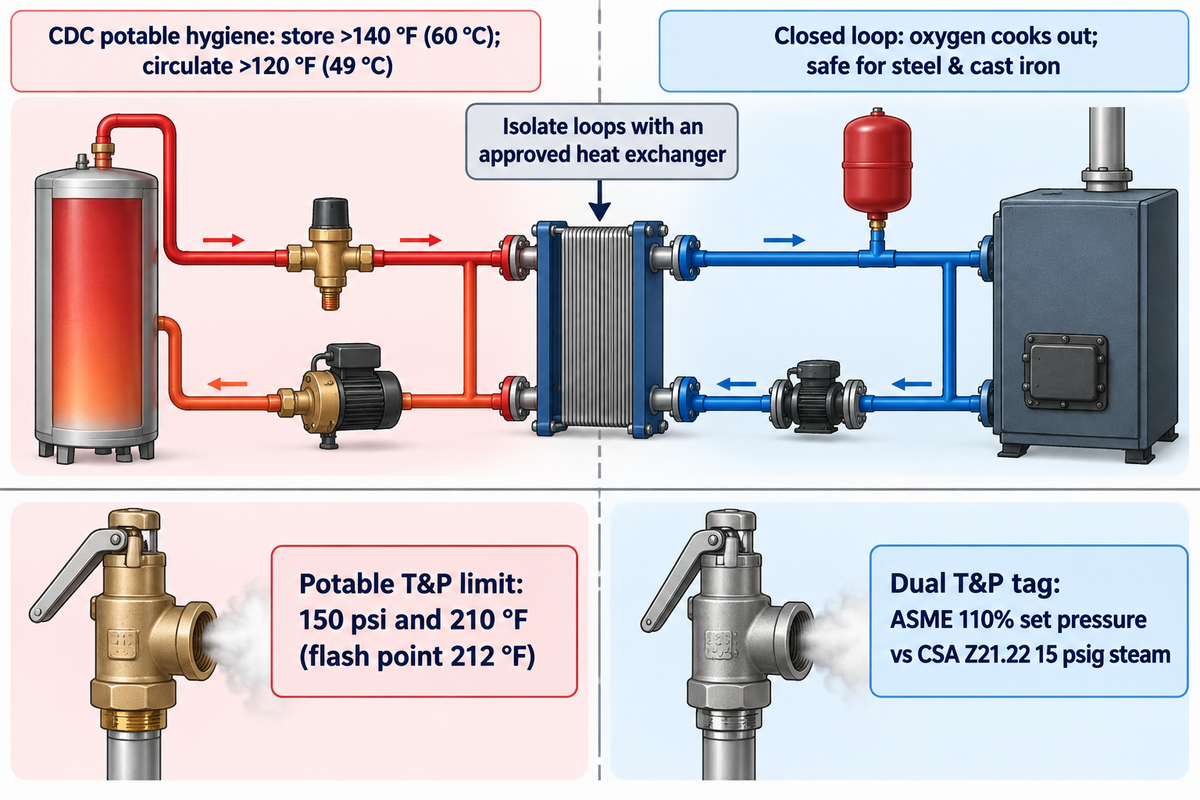
Open potable water heaters can’t connect directly to cast-iron radiators because water from the city contains dissolved oxygen and rapidly rusts heaters, valves and pumps. Closed-circuit heating boilers contain stagnant, chemically-treated water which also fails drinking water quality standards. Isolate the two loops using an approved heat exchanger, when the same burner serves both loads.
The CDC advises storing hot water above 140°F (60°C) and maintaining circulating hot water above 120°F (49°C).
Think of a potable water tank like a coffee urn that takes in fresh cold water every time a cup is poured. Cold water enters through a dip tube so incoming water enters the bottom of the glass-lined tank. With each draw of water, oxygen is also introduced, so recirculating water lines require a bronze or stainless-steel pump. Per CDC potable water control guidelines, engineers place thermostatic mixing valves close to faucets so tanks stay above 140°F without scalding skin.
Closed heating circuits are similar to a sealed automobile cooling system. After initial fill and air purging, dissolved oxygen cooks out of the captive water within days. Once the dissolved oxygen is gone, a circulator pump pushes the hot water through steel pipe or cast-iron sections for decades without sludging. In some plants, boilers circulate hot water or steam across a shell-and-tube exchanger to return clean condensate to the feed tank.
⚠️ Common Mistake: Misreading Dual-Stamped T&P Valve Nameplates
Potable heaters use combination T&P valves set no higher than 150 psi and 210°F so overheated water cannot flash to steam above 212°F. Per the National Board Pressure Relief Department, dual-rated T&P tags list two BTU/hr capacities. ASME Section IV tests steam at 110% of set pressure, whereas ANSI/CSA Z21.22 applies 15 psig steam on a separate potable basis that lists lower capacity. Sizing a non-ASME commercial water heater off the higher ASME number leaves the tank under-protected.
When Does a Water Heater Legally Become a Boiler?
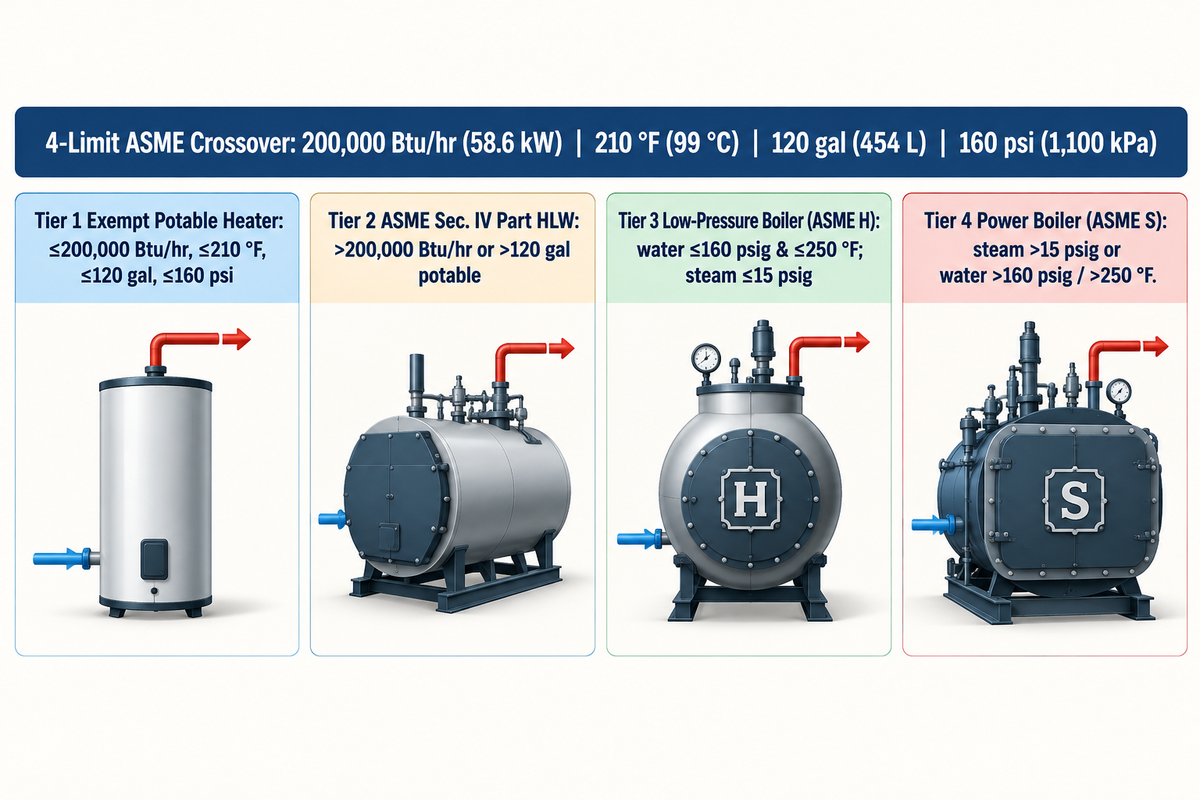
Under state boiler laws such as Washington WAC 296-104-010, a potable water heater enters regulated ASME scope once it exceeds 200,000 Btu/hr (58.6 kW) input, 210°F (99°C) temperature, 120 gallons (454 L) water storage, or 160 psi (1,100 kPa) pressure. Crossing 200,000 Btu/hr classifies the appliance as an ASME-stamped hot water supply boiler.
Washington State’s boiler code mandates: “Water heaters exceeding 200,000 Btu/hr (58.6 kW) input must be ASME code stamped and shall be considered a hot water supply boiler.”
General web summaries often end with residential closets and miss this legal step-change. We group these four ceilings as the 4-Limit ASME Crossover Rule, documented by IAPMO specialist Tony Marcello in Plumbing & Mechanical. According to IAPMO specialist Tony Marcello in Plumbing & Mechanical, below these four ceilings, a standard water heater would ship as residential potable water equipment, and would not require National Board registration. Crossing even one threshold requires ASME Boiler and Pressure Vessel Code construction, revised biennially per the Materials Technology Institute.
Federal energy law adds a parallel commercial split under 10 CFR § 431.102. Commercial gas storage heaters start above 75,000 Btu/h at under 4,000 Btu/h per gallon. Packaged hot water supply boilers span 300,000 Btu/h to 12,500,000 Btu/h at 4,000 Btu/h per gallon or higher. Under state rules such as Washington’s WAC 296-104, a 250,000 Btu/hr water heater must be ASME code stamped and is regulated as a hot water supply boiler. Public-assembly exemptions tighten further in several states, so check registration rules with your local inspector before ordering.
| Equipment Regulatory Tier | Code & Stamp | Operating Envelope | Inspection Impact (e.g., WAC 296-104) |
|---|---|---|---|
| 1. Exempt Potable Water Heater | Potable appliance listing (No ASME stamp) | ≤200,000 Btu/hr, ≤210°F, ≤120 gal, ≤160 psi | Plumbing permit at install; exempt from periodic state boiler inspection |
| 2. ASME Potable / Hot Water Supply Boiler | ASME Sec. IV Part HLW stamp | >200,000 Btu/hr or >120 gal potable (≤160 psig, ≤210°F) | ASME nameplate & state operating certificate; periodic external inspection |
| 3. Low-Pressure Heating Boiler | ASME Sec. IV “H” stamp | Closed water ≤160 psig & ≤250°F; steam ≤15 psig | Boilers require low-water cutoffs, burner interlocks, and state certificates |
| 4. High-Pressure / Power Boiler | ASME Sec. I “S” stamp | Steam >15 psig, or closed water >160 psig or >250°F | Strictest weld radiography, licensed operator rules, annual internal/external checks |
At what point does a water heater become a boiler?
A potable water heater is legally regulated as a hot water supply boiler once burner input exceeds 200,000 Btu/hr (58.6 kW). It also requires an ASME stamp above 120 gallons, 160 psi, or 210°F. Physically, it still feeds open potable fixtures rather than closed radiators. Mechanical inspectors nevertheless enforce boiler room clearances, relief piping, and periodic vessel checks.
Hybrid Options Compared: Combi Boilers, Indirect Tanks, and Tankless Water Heaters
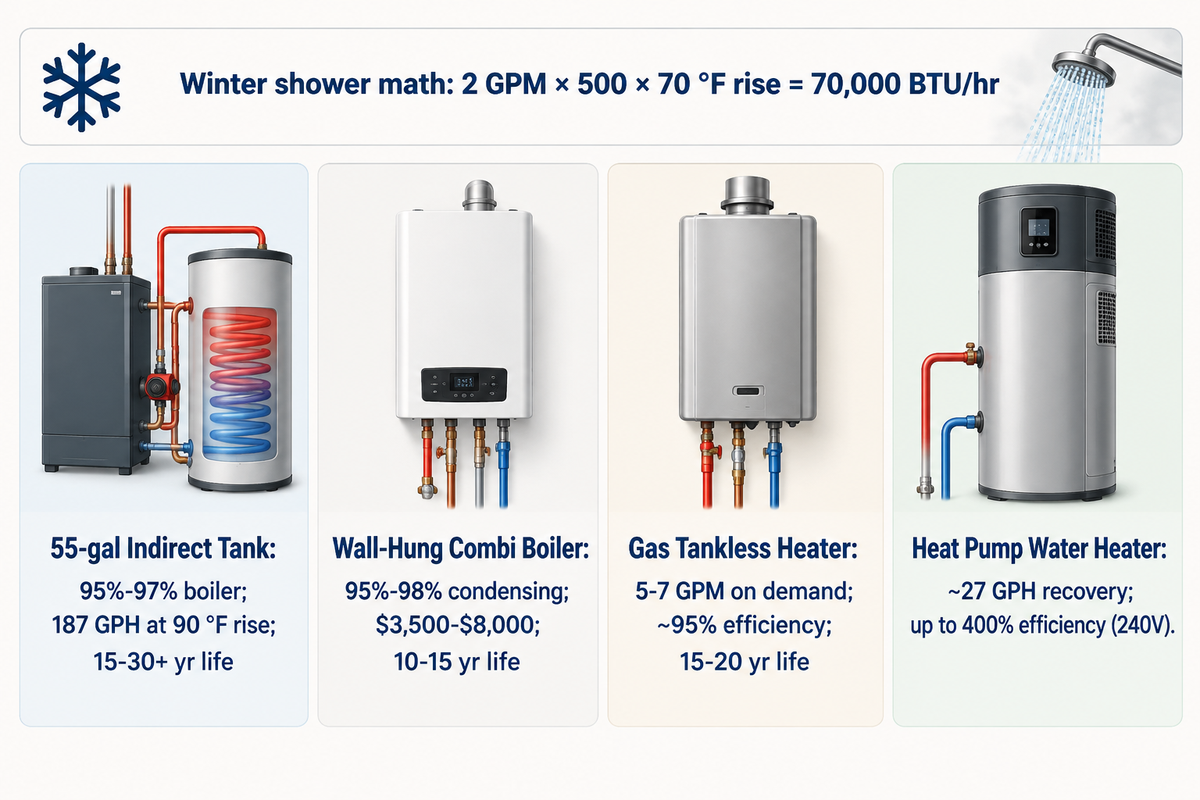
A closed-loop hydronic boiler with an insulated indirect water heater is an ideal solution for high multi-shower recovery, especially during winter when radiators are in service. Wall-hung combi boilers save floor space and provide both heating and hot water from one cabinet, yet winter groundwater temperatures cap their continuous tap flow. Choose an indirect storage tank whenever simultaneous water needs exceed two winter showers (4.0 GPM at a 70°F rise).
Winter inlet temperature exposes the gap between instant water on demand and buffered storage. Design example from GreenBuildingAdvisor’s hydronic sizing analysis: one 2 GPM shower at a 70°F winter rise (35°F inlet to 105°F shower) requires 2 × 500 × 70 = 70,000 BTU/hr of continuous heat. Running two showers plus a sink pushes instantaneous load past 140,000 BTU/hr. With a 55-gallon indirect tank, a 140,000 BTU/hr boiler is only needed if you want a non-stop 187 GPH at a 90°F rise after depleting storage. Continuous tap flow drops linearly as winter groundwater cools, so size tankless and combi units against coldest-month inlet water.
Hydronic technicians on HeatingHelp point out a second win over old tankless coils submerged inside cast-iron boilers. A tankless coil forces the boiler to stay hot 24 hours a day in summer, wasting fuel up the flue. With an indirect tank, water is heated only when hot water is needed. Between calls, the boiler sits cold; during a hot water call, priority controls pause the space-heating zones for up to 15 minutes. Buildings heated with a forced-air furnace or heat pump don’t need a boiler at all. Instead, they pair ductwork with gas tankless units that heat water on demand (5-7 GPM) or with electric heat pump water heaters.
| System Configuration | Tap Hot Water Delivery | Efficiency & Electrical / Gas Needs | Service Life & Best Fit |
|---|---|---|---|
| Hydronic Boiler + Indirect Tank | Buffered storage tank + coil heat exchanger; handles multi-bath spikes | 95%–97% modulating boiler; cold-start summer operation cuts standby loss | 15–30+ yr boiler life; cold-climate homes, hotels, and apartments |
| Wall-Hung Combi Boiler | Internal plate exchanger heats hot water on demand; pauses space loop during draw | Up to 95%–98% condensing; $3,500–$8,000 installed | 10–15 yr life; compact apartments or 1–2 bath homes |
| Standalone Gas Tankless Heater | 5–7 GPM on demand; dedicated to potable fixtures only | ~95% efficiency; often needs gas-line and stainless or PVC vent upgrades | 15–20 yr life; homes with warm-air furnaces needing wall-saving DHW |
| Heat Pump Water Heater (HPWH) | Large insulated tank water heater; ~27 GPH heat-pump recovery | Up to 400% efficiency vs. electric resistance; needs open air & 240V circuit | All-electric decarbonization retrofits with garage or basement clearance |
Do I need a hot water heater if I have a boiler?
Yes, a standard heating-only boiler still needs a separate domestic water vessel for potable taps. It can be paired with either an indirect storage tank, a separate tankless water heater, or a standalone tank water heater. Only dual-circuit combi boilers or boilers fitted with an isolated domestic coil heat tap water.
Sizing Logic: Peak Draw Recovery vs Continuous Thermal Duty
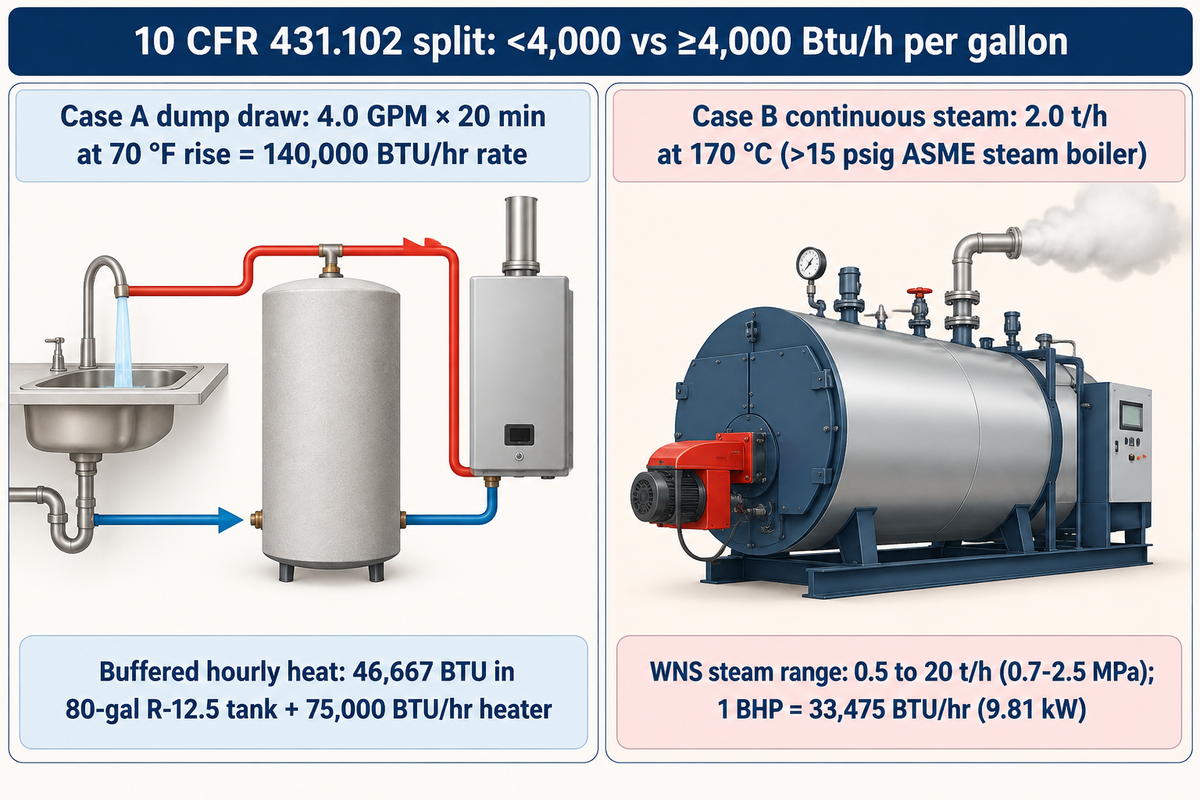
Engineers size commercial water heaters around short dump draws and storage recovery, while industrial boilers are sized for sustained hourly megawatt or steam-tonnage loads. Under 10 CFR § 431.102, equipment below 4,000 Btu/h per gallon relies on stored volume. Units at or above 4,000 Btu/h per gallon operate as instantaneous heaters or hot water supply boilers.
When washdown spikes far exceed average hot water demand, store hot water in unfired tanks; 10 CFR § 431.110(b) requires those tanks to carry at least R-12.5 insulation. 10 CFR § 431.110(b) dictates that unfired storage tanks must have R-12.5 thermal insulation. Storage tank water heaters absorb the 20-minute spike so a smaller burner can recover in between shifts. Continuous space-heating or jacketed reactor loads demand modulating boilers that can throttle down to match heat loss without short-cycling.
Peak-to-Base Thermal Duty Selector: Worked Potable Dump vs. Continuous Steam Example
Design basis: Case A assumes a kitchen washdown drawing 4.0 GPM for 20 minutes hourly with a 70°F temperature rise. Case B assumes continuous 170°C saturated steam for food plant sterilization at a rate of 2.0 t/h.
Arithmetic & selection: Case A demands 4.0 × 500 × 70 = 140,000 BTU/hr during the 20-minute draw. Total hourly heat is just 140,000 × (20 ÷ 60) = 46,667 BTU. Buffering that 80-gallon draw in an R-12.5 tank lets a 75,000 BTU/hr heater recover within the hour without short-cycling. In Case B, sustained 2.0 t/h steam duty above 15 psig requires an ASME steam boiler rather than a potable heater. The figures are drawn to represent duty profiles rather than end flange sizes, which take into account altitude and piping.
Continuous process steam from 0.5 to 20 t/h at 0.7 to 2.5 MPa uses WNS horizontal fire-tube steam boilers over banked water heaters. When delivering hot water and steam across multiple production lines, keep in mind that 1 boiler horsepower equals 33,475 BTU/hr (9.81 kW) of evaporation duty. You can assess your peak tonnage and a 10% to 15% safety margin in our steam tonnage and boiler load sizing tool prior to submitting your tender documents.
Efficiency Ratings Decoded: Water Heater UEF vs Boiler AFUE and Thermal Efficiency
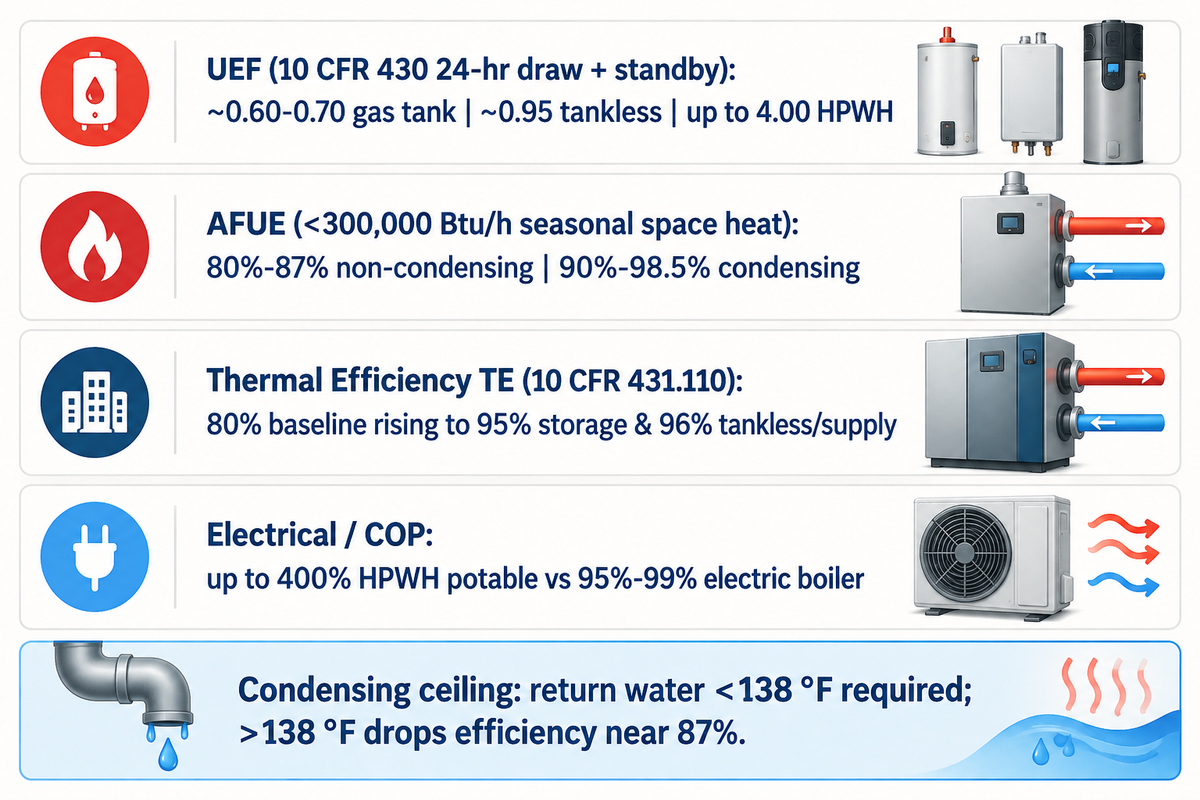
Comparing 0.95 UEF water heater efficiency to a 95% AFUE boiler misleads consumers because federal test labs evaluate different denominators. Water heater UEF incorporates 24-hour draw bins and standby cool-down, whereas boiler AFUE and commercial Thermal Efficiency measure seasonal or steady-state combustion recovery. Pay extra for condensing boilers only when hydronic return water runs below roughly 138°F, because hotter return water blocks flue condensation.
Field physics often overrides catalog stickers. Engineer Ramez Afify shows in Consulting-Specifying Engineer that return water above roughly 138°F blocks flue condensation and drops efficiency near 87%. Adding outdoor reset controls lets older radiator loops run cooler during mild weather so condensing mode still operates across most heating hours. On the electric side, U.S. Patent US8111980B2 notes that domestic resistance elements reach 800°F to 900°F within seconds. In AOS Holding Co.’s filing, replacing bimetal thermostats with proportional modulation cuts heating energy use by nearly 10%, partly by curbing overshoot.
| Rating Metric | Equipment Scope | Test Condition & Denominator | Verified Field Range |
|---|---|---|---|
| Uniform Energy Factor (UEF) | Consumer water heaters (≤75k Btu/h gas tank; ≤200k gas tankless; ≤12 kW electric) | 10 CFR 430 24-hour simulated draw pattern including tank standby loss | ~0.60–0.70 standard gas tank; ≥0.80 condensing tank; ~0.95 gas tankless; up to 4.00 pump water heaters |
| Annual Fuel Utilization Efficiency (AFUE) | Residential heating boilers (<300,000 Btu/h input) | Seasonal space-heating output divided by annual fuel input with cyclic losses | 80%–87% non-condensing; 90%–98.5% condensing below 138°F return |
| Thermal Efficiency (TE) | Commercial water heaters & hot water supply boilers (10 CFR 431.110) | Steady full-load heat transferred to water; paired with separate standby Btu/h cap | 80% baseline rising to 95% (gas storage) and 96% (gas tankless/supply boiler) |
| Electrical Conversion / COP | Heat pump water heaters vs. commercial electric boilers | Ambient refrigeration heat transfer vs. direct immersion element conversion | Up to 400% HPWH potable vs. 95%–99% electric boiler |
Above heat-pump temperature limits, zero on-site flue gas and 95% to 99% electrical conversion make closed-loop electric hot water boiler plants preferable to combustion heaters in emission-restricted facilities. Keep heat pump water units dedicated to potable preheat or domestic storage where the ambient compressor rooms stay warm.
Application Matrix: Residential, Commercial, and Industrial Selection
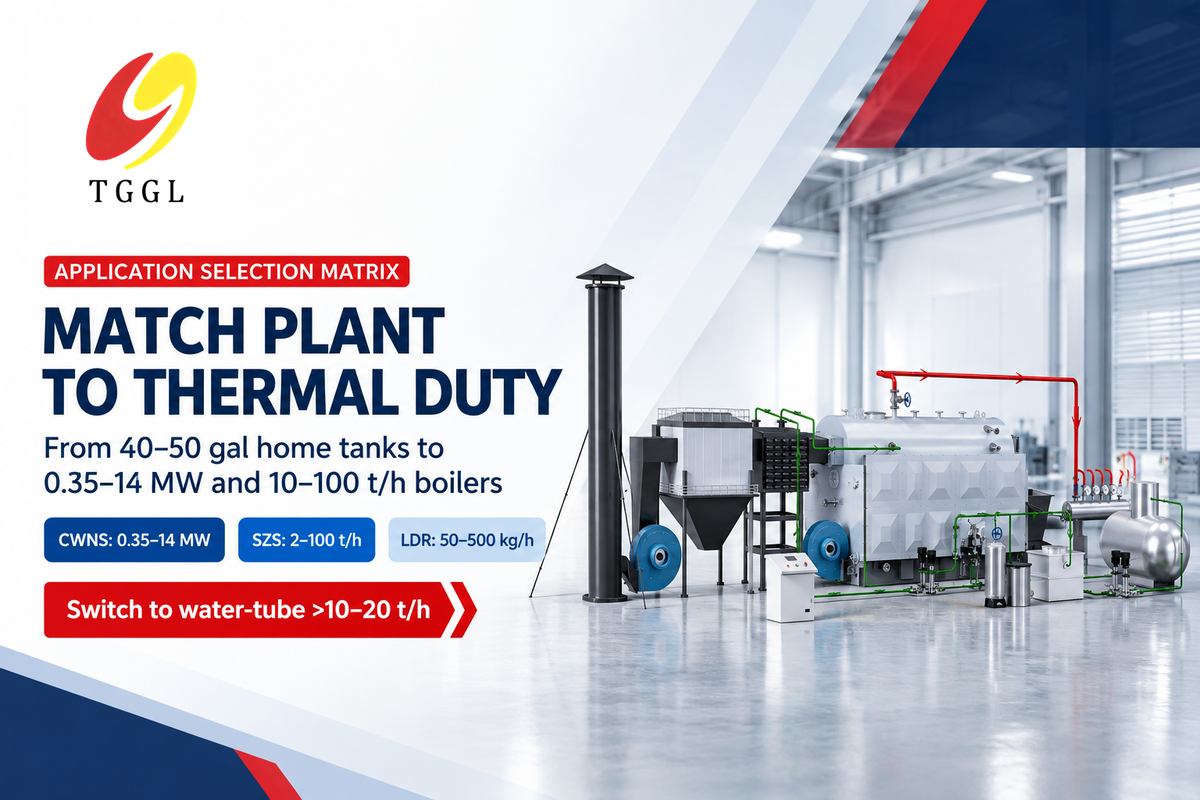
Whether a given facility installs a water heater or boiler is determined by factors such as required fluid temperature, potable contact and megawatt scale. Single family residences use either warm-air or hydronic loops to heat your home. Meanwhile, 40–50 gallon tanks supply water for showers and daily faucets when households need hot water for daily tasks, and dedicated domestic heaters cover hot water for household laundry. Campuses and factories run closed boilers from 0.35 MW up to 100 t/h. Switch from fire-tube to water-tube boilers once steam demand exceeds 10–20 t/h or pressure tops 2.5 MPa.
When choosing between a boiler or a water heater for commercial properties, separate domestic sanitation from building heating. Hotels and hospitals often run central boilers that heat water through double-wall plate exchangers to ensure that the potable water loops are isolated while space loops are modulated. Conversely, small retail suites without hydronic emitters simply let water heaters heat water directly for restrooms.
In Taiguo Boiler’s published industrial lineup, CWNS oil and gas fired hot water boilers span 0.35 MW to 14 MW at 0 to 1.25 MPa. Fire-tube boilers cost less per ton below 10 t/h and simplify tube brushing. Above that tonnage and pressure crossover, D-type SZS water-tube steam and hot water boilers deliver 2 to 50 t/h standard (up to 100 t/h custom) at 1.0 to 4.9 MPa. Compact LDR electric steam units cover 50 to 500 kg/h with a 3-to-5-minute startup.
| Facility / Application | Recommended Equipment Class | Loop Isolation & Code Tier | Typical Capacity Band |
|---|---|---|---|
| 1. Single-Family Home (Forced Air) | Tank, gas tankless, or HPWH water heater | Open potable loop; non-ASME residential listing | 40–50 gal tank or 5–7 GPM tankless |
| 2. Hydronic Home (Radiators / Slab) | Modulating boiler + indirect tank (or combi) | Closed hydronic (“H” stamp) + isolated coil | 30,000–135,000 BTU/hr (1,000–3,000 sq. ft. homes) |
| 3. Multifamily Apartment Block | Central hydronic boilers + indirect R-12.5 tanks | ASME Sec. IV “H” or “HLW” commercial rack | 300,000–2,500,000 BTU/hr (0.1–0.7 MW) |
| 4. Hotel & Hospitality | CWNS hot water boiler + plate heat exchangers | Closed primary loop; >140°F potable storage + mixing | 0.35–3.5 MW hot water + buffered DHW tanks |
| 5. Hospital & Healthcare | Redundant WNS steam + CWNS hydronic boilers | ASME Sec. I “S” autoclave steam + potable loop >140°F per CDC program | 1–10 t/h steam (0.7–1.6 MPa) |
| 6. Commercial Laundry Plant | Hot water supply boiler + WNS steam ironer boiler | ASME HLW high-recovery dump + Sec. I steam | 300,000+ BTU/hr DHW + 0.5–4 t/h steam |
| 7. Cleanroom / Lab Sterilization | LDR vertical electric steam boiler | Zero-flue point-of-use steam at 0.7 MPa | 50–500 kg/h steam (3–5 min fast startup) |
| 8. Greenhouse & Ag District Heat | CWNS gas or DZL biomass hot-water boiler | Closed hydronic soil/perimeter loop (0–1.25 MPa) | 0.7–14 MW thermal output |
| 9. Food, Beverage & Chemical Plant | SZS D-type water-tube steam boiler | ASME Sec. I high-pressure process header | 10–100 t/h steam at 1.0–4.9 MPa |
Upfront Cost, Maintenance, Water Chemistry, and 15–25 Year Lifespan
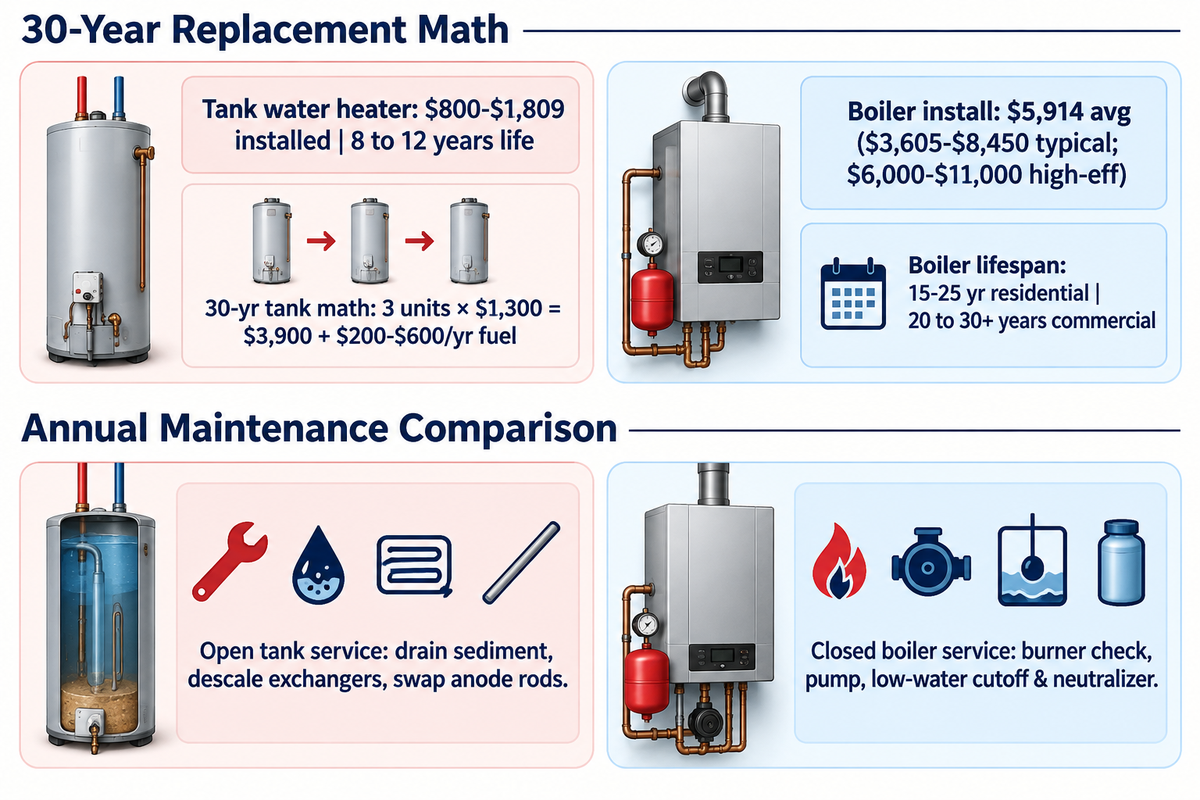
Across U.S. residential replacements, tank water heaters cost $800 to $1,809 installed and last 8 to 12 years. Residential boiler installation averages $5,914 ($3,605 to $8,450 typical; $6,000 to $11,000 high-efficiency) across a typical 15-to-25-year residential lifespan. Cast-iron and commercial boilers reach 20 to 30+ years per Consulting-Specifying Engineer. Industrial packaged boilers require custom quotes sized to steam tonnage, design pressure, and burner trim.
A boiler’s 20-to-30-year service life spreads its higher installed price across two to three water heater replacements. Based on U.S. residential cost records, swapping a tank water heater every 10 years at $1,300 per unit totals $3,900 across three heaters over 30 years, plus $200 to $600 per year in domestic water-heating fuel bills. One residential boiler installed at the $5,914 average (plus $50–$300 local permit fees) heats the entire building for 15 to 30 years, carrying $500 to $2,000+ in annual whole-home heating fuel costs. Commercial and industrial boiler skids are custom-quoted because higher design pressure within the SZS 1.0 to 4.9 MPa range increases drum and tube wall cost.
The routine nature of maintenance for an open vs closed system is very different. Water heaters are simpler to pipe than multi-zone hydronic plants, yet fresh mineral-rich tap water enters daily. Water heaters take in fresh, mineral- and oxygen-bearing tap water, which means the annual service drains sediment and descales exchangers and swaps anode rods before the tank rusts. Water heaters need expansion tanks on check-valved branches. Otherwise, a water heater could weep from its 150 psi T&P valve. Boilers typically retain treated oxygen-free fill water and therefore require an annual burner combustion check, pump inspection, low-water cutoff test, and condensate neutralizer service. Plant buyers can model multi-year fuel bills in our boiler operating cost calculator.
What are the downsides of using a boiler?
Higher upfront installation costs ($3,605 to $8,450 residential versus $800 to $1,809 for a tank heater) are the primary downside. Hydronic radiators also respond slower to thermostat changes, occupy more mechanical space, and provide zero summer air conditioning without separate mini-splits or chilled-water handlers. Oversizing a cast-iron boiler for domestic hot water also causes sub-3-minute short-cycling that drags seasonal efficiency down, and separate water heaters may still be needed unless an indirect tank or combi circuit is installed.
2026–2029 Efficiency Rules, Grid-Interactive Shifts, and Vendor Landscape
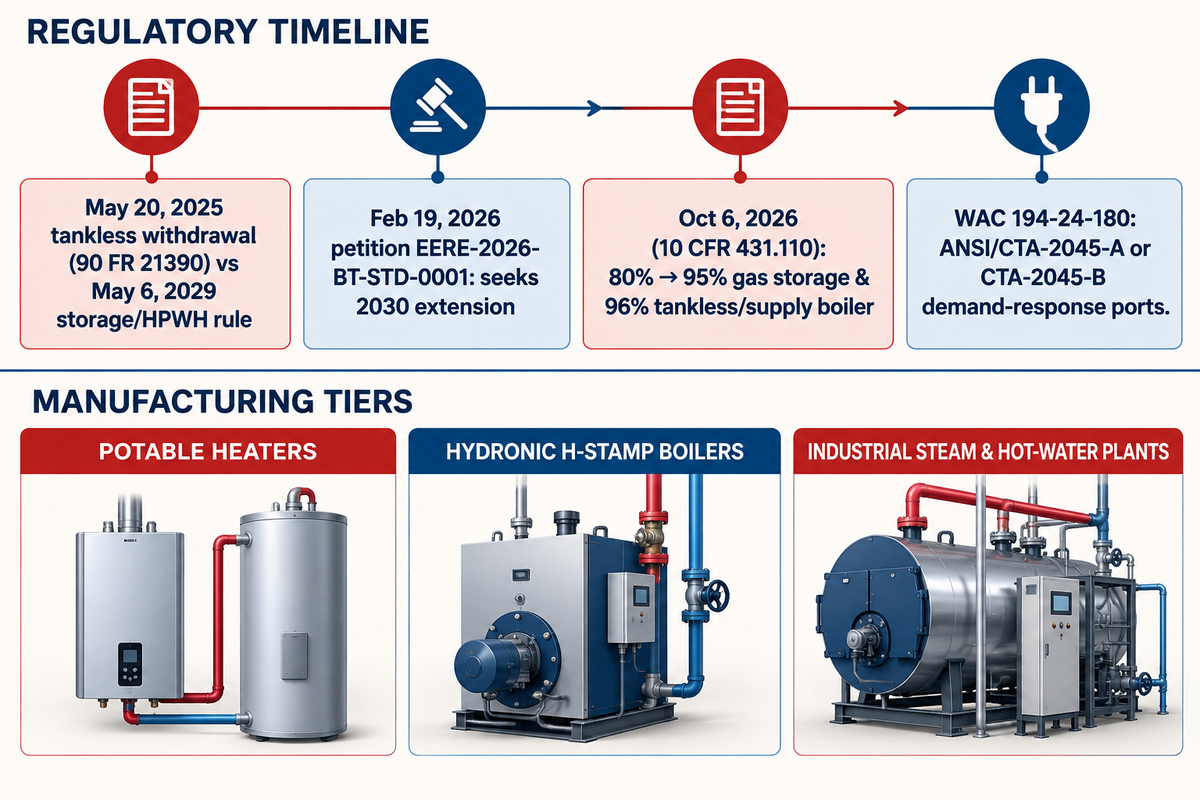
Enacted U.S. federal efficiency mandates between October 2026 and May 2029 push commercial gas water heaters into condensing designs while splitting consumer tank and tankless rules. As such, facility managers planning 2026/2027 replacements must check for floor drains, condensate neutralizers and polypropylene or stainless vents before ordering gas units.
Three changes to federal and state regulations occurring over the next four years will impact how buyers compare a boiler and water heater:
- October 6, 2026 Commercial Gas Rule (10 CFR § 431.110): Minimum thermal efficiency jumps from 80% to 95% for commercial gas storage heaters. Commercial gas instantaneous heaters and hot water supply boilers rise to 96%. On February 19, 2026, gas associations filed petition EERE-2026-BT-STD-0001 seeking a 2030 extension, so check DOE enforcement status during 2026 bids.
- May 20, 2025 Withdrawal vs. May 6, 2029 Consumer Rule (DOE Consumer Water Heaters): Updated standards for consumer storage and heat pump water units take effect May 6, 2029. Meanwhile, the separate consumer gas tankless final rule was withdrawn on May 20, 2025 (90 FR 21390).
- Grid-Interactive CTA-2045 Ports (WAC 194-24-180): States such as Washington require ANSI/CTA-2045-A or CTA-2045-B demand-response ports on electric storage heaters for off-peak preheating.
Understanding differences between boilers and water heaters also prevents sending bids to the wrong factory tier. Potable and traditional water heater manufacturers (such as A. O. Smith, Rheem, Bradford White, and Rinnai) focus on glass-lined storage tanks, domestic tank vs tankless models, separate hot water heaters, and ASME Part HLW commercial potable vessels. Hydronic boiler specialists (Weil-McLain, Lochinvar, Viessmann, Navien) build ASME Section IV “H” heating boilers, including condensing models. Industrial boiler manufacturers (Cleaver-Brooks, Miura, Fulton, Hurst, Taiguo Boiler, etc.) build high-capacity fire-tube, water-tube, electric, and biomass steam and pressurized hot water plants.
Specifying Commercial or Industrial Thermal Equipment
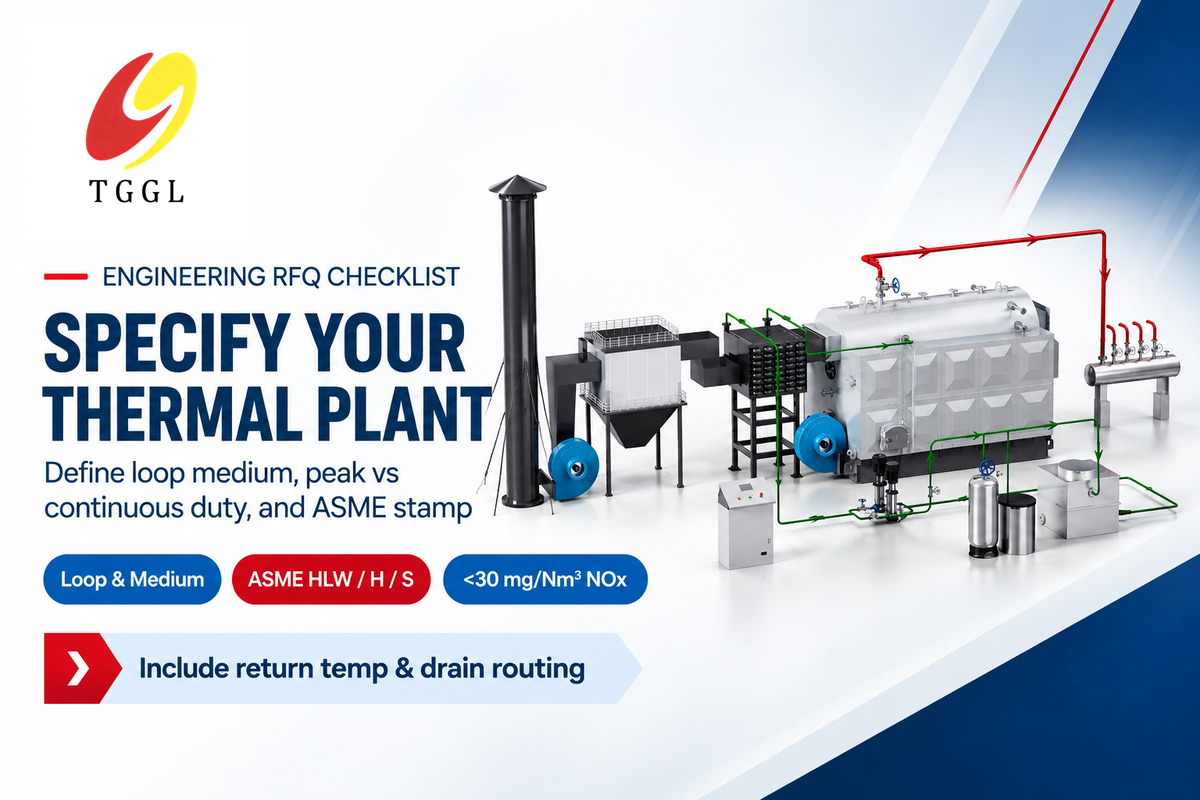
Complete thermal inquiry sheets prevent undersized exchangers, missing ASME stamps, and costly flue redesigns. Your facility may require heating and hot water from a central plant or process steam. Copy the seven verification lines below directly into your engineering request for quotation.
RFQ checklist — copy these into your quote request:
| Parameter | Recommended range | Why it matters | How to verify |
|---|---|---|---|
| 1. Fluid Loop & Medium | Open potable water vs. closed hydronic (≤250°F) vs. steam (0.7–4.9 MPa) | Determines potable lead-free wetted parts vs. oxygen-free steel boiler construction | Confirm piping schematic and indirect plate exchanger isolation |
| 2. Peak vs. Continuous Load | Peak GPM & draw minutes (potable) or continuous MW / t/h + 10%–15% safety margin | Prevents short-cycling oversized boilers or starving peak washdown shifts | Verify peak hourly load log and burner modulation turndown ratio |
| 3. Supply & Return Temps | >140°F potable storage / <138°F boiler return for gas condensing | Return water above 138°F drops condensing boiler efficiency near 87% | Verify design-day radiator coil schedule and outdoor reset curve |
| 4. Required Code Stamp | Non-ASME (≤200k Btu/hr, ≤120 gal) vs. ASME HLW, H (≤160 psig), or S (>15 psig steam) | Missing ASME stamps or National Board numbers fail state boiler commissioning | Inspect rubbings of ASME data report and state AHJ filing rules |
| 5. Relief Valve Rating Basis | ≤150 psi / 210°F CSA Z21.22 (non-ASME) or ASME Sec. IV / I relief capacity | Dual-stamped T&P valves list higher ASME capacity than CSA potable capacity | Match valve tag BTU/hr basis to vessel construction code |
| 6. Fuel, Power & NOx Limit | Natural gas, oil, dual-fuel Y(Q), biomass, or 380V/480V electric; <30 mg/Nm³ NOx | Sets gas-train pressure, 240V/480V feeder size, and air-quality permit compliance | Review burner turndown curve and local low-NOx emissions permit |
| 7. Efficiency Rule Cutoff | ≥95% TE commercial gas storage / ≥96% TE commercial gas tankless (Oct 6, 2026 rule) | Condensing flues require polypropylene/stainless vents and condensate drains | Confirm manufacture date compliance and mechanical room drain routing |
Founded in 1976 across Taiguo Boiler’s 60,000 m² manufacturing plant, our factory builds CWNS, WNS, SZS, LDR, and DZL boilers from 50 kg/h electric units to 100 t/h water-tube plants. In houses, a retail water heater provides domestic hot water directly. When a central boiler provides thermal energy required for campuses, hotels, hospitals, and industries, we provide packaged boilers for providing domestic hot water.
Need Engineering Sizing for a Commercial or Industrial Boiler Plant?
Share your required MW or ton-per-hour load, operating pressure, fuel source, and ASME or local code jurisdiction. Our boiler engineers will return a matched CWNS, WNS, SZS, LDR, or DZL technical specification and factory-direct quotation.
Frequently Asked Questions
How much does a new boiler and water heater cost?
Installing a new water heater in a U.S. home costs $800 to $1,809 for a standard tank or $1,500 to $4,500 for tankless, while residential boiler installation averages $5,914 ($3,605 to $8,450 typical).
High-efficiency condensing home boilers run $6,000 to $11,000 installed, combi boilers run $3,500 to $8,000, and annual home operating bills average $200 to $600 for water heaters versus $500 to $2,000+ for whole-home boilers. Commercial and industrial packaged boilers are custom-quoted by megawatt or steam-tonnage capacity.
Can you have hot water without a boiler?
Yes, most North American homes and light commercial buildings don’t have boilers, and heat tap water.
Properties warmed by a ducted furnace or central air-source unit connect a standalone gas water tank, tankless heater, or heat-pump water heater to the municipal cold main. Showers, sinks, and laundry sinks operate independently from space heating.
Is boiler heat cheaper than a furnace?
Natural gas boilers and forced-air furnaces cost about the same per unit of heat when both run at 95-98% condensing efficiency. Monthly fuel bills track local gas-to-electric tariffs, return-water temperature below 138°F, and duct leakage.
Zoned hydronic boilers eliminate duct losses in the attic and allow each room to have different thermostat settings; however, upfront boiler installation costs are higher than a standard furnace swap.
Does a boiler heat water for a shower?
A heating-only boiler will never send radiator loop water to a shower head; only a combi boiler or a boiler heating an indirect tank heater will heat shower water.
The heat exchanger barrier keeps radiator water from entering the potable water supply.
Can you use a water heater for radiant floor heating?
No, plumbing codes bar circulating open potable water through standard non-potable heating parts unless every wetted pipe, valve, and bronze or stainless pump carries potable lead-free certification and prevents Legionella stagnation below 120°F.
Behind an isolating double-wall plate heat exchanger, a 40 to 50 gallon tank heater can serve a small radiant zone, however it doesn’t have the continuous heating to fulfill the demands of a cold climate and hot water.
How long do boilers and water heaters last?
Standard tank heaters have a life expectancy of 8 to 12 years and tankless heaters 15 to 20 years.
Combi boilers last 10 to 15 years and commercial and steam boilers serve 20 to 30+ years.
Our Engineering Perspective
We compiled this boiler vs water heater guide by cross-checking federal 10 CFR 430 and 431 tables, state ASME HLW exemptions, and National Board relief-valve rules. Industrial capacity bands reflect published CWNS, WNS, SZS, and LDR plant datasheets, while residential costs synthesize verified 2026 U.S. contractor records. Published by Henan Taiguo Boiler Products Co., Ltd. for engineering reference.
References & Sources
- 10 CFR § 431.102 Definitions: Commercial Water Heaters and Hot Water Supply Boilers U.S. Electronic Code of Federal Regulations
- 10 CFR § 431.110 Energy Conservation Standards for Commercial Water Heating Equipment U.S. Department of Energy / eCFR
- Docket EERE-2026-BT-STD-0001: Commercial Water Heating Equipment Rulemaking Notice – U.S. Department of Energy
- Consumer Water Heaters 10 CFR Part 430 Compliance & Rulemaking U.S.
- U.S. Centers for Disease Control and Prevention (CDC)
- Washington State Legislature
WAC 296-104 Boilers and Unfired Pressure Vessels (WSR 26-18-075)
- Washington State Legislature
WAC 194-24-180 Electric Storage Water Heaters ANSI/CTA-2045 Standard
- ASME/National Board vs. CSA Rating on T&P Relief Valves The National Board of Boiler and Pressure Vessel Inspectors
- An Overview of Recent ASME BPVC Revisions Materials Technology Institute (MTI)
- Plumbing & Mechanical (Tony Marcello, IAPMO)
- Plumbing & Mechanical (Donald M. Jones)
- Retrofitting With Condensing Boilers – Consulting-Specifying Engineer (Ramez Afify, PE)
- US8111980B2: Water Heater and Method of Controlling the Same AOS Holding Co. (USPTO)