Get in Touch with Taiguo


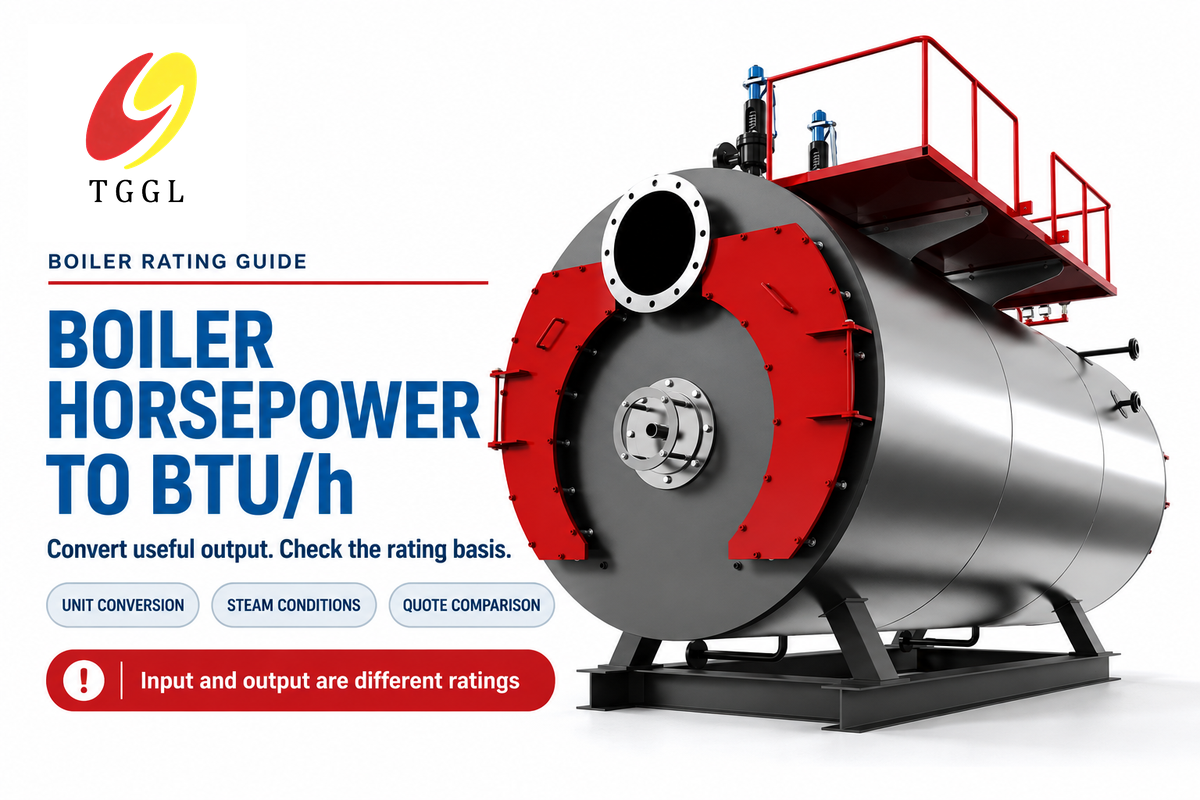
To convert boiler horsepower to BTU per hour, multiply by 33,475. This gives the conventional heat-output rating for a boiler.
Quick calculation: BTU/h output = boiler horsepower × 33,475.
Reverse calculation: boiler horsepower = BTU/h output ÷ 33,475.
Reverse calculation: boiler horsepower = BTU/h output ÷ 33,475.
The chart allows you to check common ratings quickly. Worked examples below explain steam conditions and show how to compare two offers whose headline numbers use different units.
Convert Boiler Horsepower to BTU/h
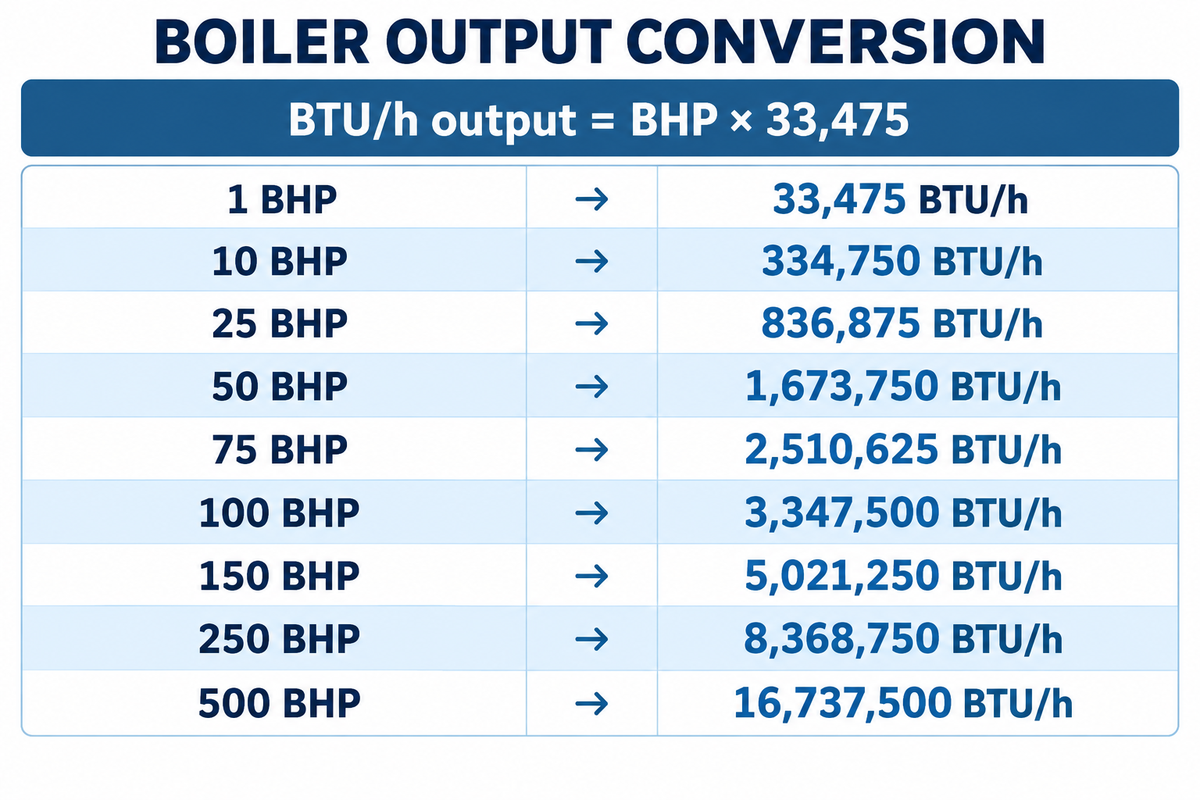
According to the factor of the American Boiler Manufacturers Association, one boiler horsepower is approximately 33,475 BTU/h. In such cases, multiply the boiler horsepower rating by this factor to obtain the thermal output. Keep the same factor throughout a comparison.
Boiler horsepower and BTU/h converter
Convert a boiler thermal output rating between boiler horsepower and BTU/h, using the conventional factor 33,475 BTU/h per boiler horsepower. Choose BHP or BTU/h in the unit fields.
Equivalent thermal output
This calculator uses the conventional 33,475 factor published by Roth Pump. It does not convert mechanical horsepower, fuel input, total BTU energy or actual steam flow. Other references may use slightly different boiler-horsepower conventions; use the basis stated in the contract for precision work.
This calculator uses the conventional 33,475 factor published by Roth Pump. It does not convert mechanical horsepower, fuel input, total BTU energy or actual steam flow. Other references may use slightly different boiler-horsepower conventions; use the basis stated in the contract for precision work.
Enter an output rating and choose BHP or BTU/h for each unit. BHP means boiler horsepower.
This entry is ambiguous. Use a comma only as the decimal mark, for example 1,5, and do not type thousands separators.
How many BTU is 1 boiler HP?
One boiler HP is conventionally 33,475 BTU per hour of heat output. The hour matters: Horsepower is a rate of energy transfer, and BTU in itself describes an amount of energy. This conversion is applied to the thermal capacity of the boiler; a fuel input specification requires an efficiency calculation to be compared to an output.
For example, let’s say an offer states a boiler output of 100 BHP. Then, 100 × 33,475 gives an output of 3,347,500 BTU/h. Put this result in the output column of the comparison worksheet, and state the supplier’s conditions alongside it.
A motor marked 100 HP requires a different conversion. If the quotation simply states “HP,” have the vendor identify the rated component prior to using the table.
| Boiler horsepower | Output, BTU/h |
|---|---|
| 1 BHP | 33,475 |
| 10 BHP | 334,750 |
| 25 BHP | 836,875 |
| 50 BHP | 1,673,750 |
| 75 BHP | 2,510,625 |
| 100 BHP | 3,347,500 |
| 150 BHP | 5,021,250 |
| 250 BHP | 8,368,750 |
| 500 BHP | 16,737,500 |
Conversion factors can vary a bit from source to source. ABMA’s packaged-boiler guide gives 33,475; dividing NIST’s watt entries gives approximately 33,471.4 BTUIT/h. Minor variations like these in reference sources are separate from boiler efficiency.
Convert BTU/h Back to Boiler Horsepower
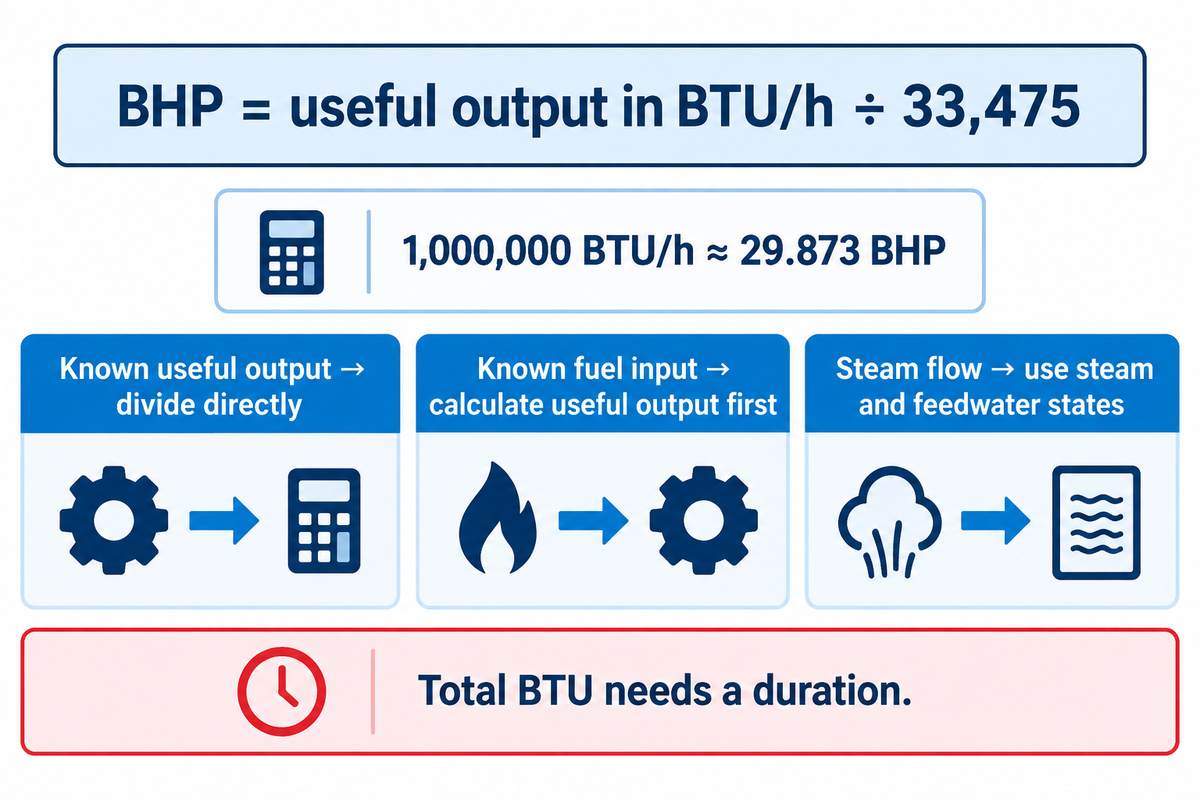
A useful output of 1,000,000 BTU/h converts to approximately 29.873 boiler horsepower using this guide’s factor. To get conversion in the other direction, divide output by 33,475. When the available figure is fuel input, first multiply it by the applicable overall efficiency to calculate useful output. Don’t interchange the two ratings.
How do I convert BTU to horsepower for a boiler?
Convert a boiler’s BTU-per-hour output to horsepower by dividing by 33,475. If your document states total BTU, first determine average BTU/h by dividing total BTU by the time in hours. A figure without duration or rate requires clarification before a power conversion can be made.
Suppose an equipment schedule lists 1,000,000 BTU/h of useful boiler output. This method gives an equivalent rating without restricting the selection to a specific boiler model.
For a smaller example, 30,000 BTU/h useful output ÷ 33,475 is about 0.896 boiler horsepower. The same power is about 11.79 mechanical horsepower. If 30,000 BTU describes total energy instead, you need the delivery time to make either conversion.
- Known useful output: divide directly by the conversion factor.
- Known fuel input: use the fuel-input calculation first.
- Known pounds of steam per hour: calculate heat transfer from the steam and feed states.
Boiler Horsepower vs Mechanical Horsepower
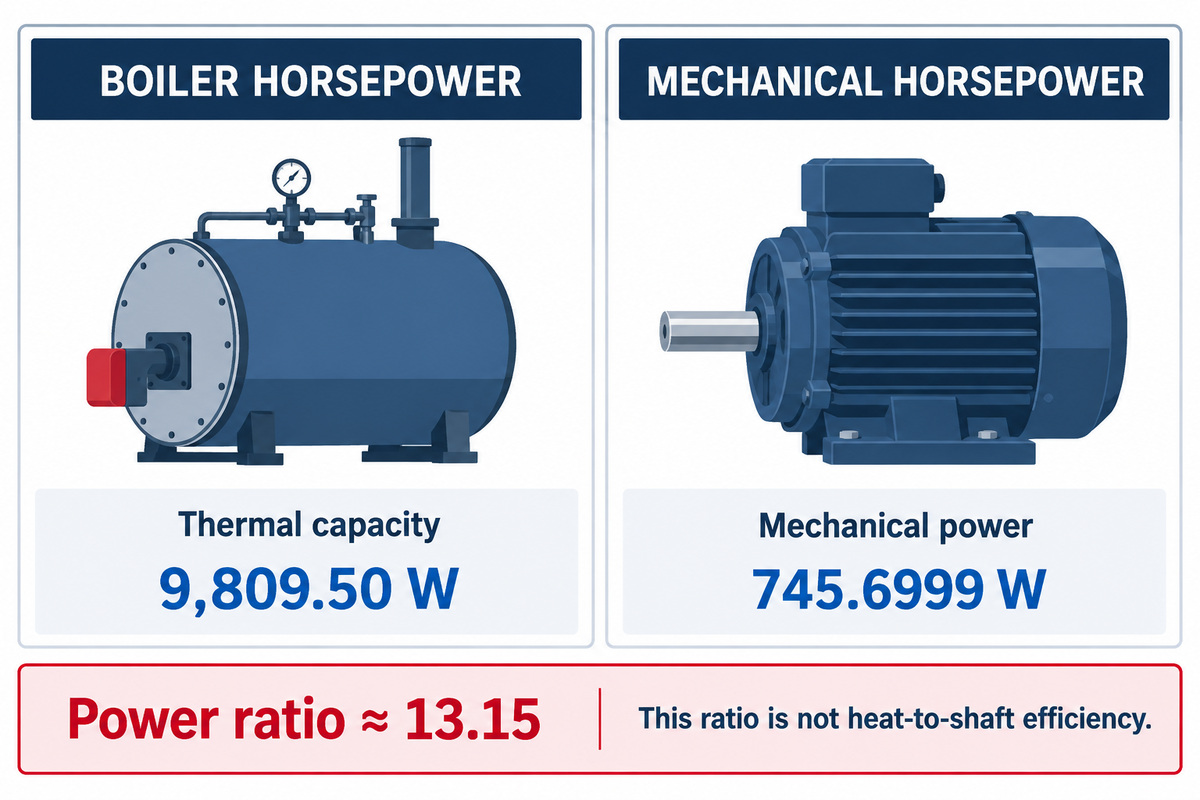
One boiler horsepower is approximately 13.15 times the power of one mechanical horsepower, using NIST definitions. Boiler horsepower refers to thermal capacity and mechanical horsepower refers to mechanical power such as shaft output. A general horsepower converter can, therefore, yield a very different result if it assumes mechanical power.
| Label on document | Meaning to establish | Appropriate conversion |
|---|---|---|
| Boiler horsepower | Thermal capacity | About 9.81 kW per BHP |
| Mechanical horsepower | Mechanical power | About 2,544.43 BTU/h per hp |
| BHP without definition | Boiler or brake horsepower? | Hold calculation until clarified |
According to NIST’s conversion table, the value for boiler horsepower is given as 9,809.50 W and the value for mechanical horsepower is given as 745.6999 W. These definitions state that the ratio isn’t a heat to shaft efficiency.
On a burner technical datasheet, motor horsepower can appear close to the firing-rate specification. Procurement should copy the full label and component name into the equipment schedule, rather than just copying an HP number.
Read BTU/h, kW, MBH and MMBtu/h Correctly
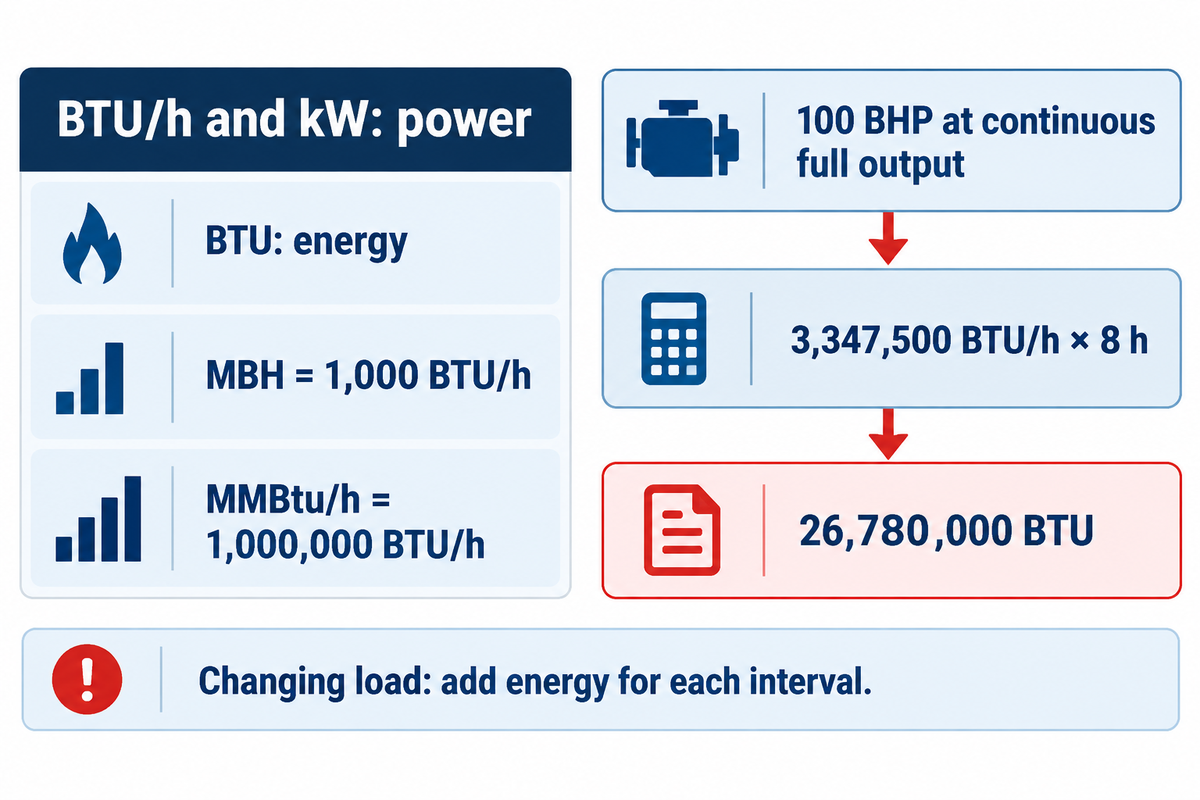
Using the conversion convention, 100 BHP is equal to 3.3475 MMBtu/h. BTU/h and kW are units of power; BTU is the unit of energy. Full units of measure should be shown on a quote, as the absence of a multiplier or time base can change the meaning of a statement prior to performing any engineering evaluation.
If a specification states “BTU boiler,” it should be read as a boiler with a heat rating, not a separate boiler type.
- BTU/h: heat transferred in one hour at the stated rate.
- kW: power; for this conversion, it’s thermal output rather than electrical consumption.
- MBH: defined here as 1,000 BTU/h.
- MMBtu/h: defined here as 1,000,000 BTU/h.
Suppose the example 100 BHP boiler delivers its full rated output continuously for eight hours. Energy delivered is 3,347,500 BTU/h × 8 h = 26,780,000 BTU. For a changing load, add the energy delivered for each interval rather than assume the boiler continuously delivers its rated output for the entire shift.
NIST identifies one International Table BTU as 1,055.056 joules and one BTUIT/h as 0.2930711 W. Those units relate energy to time; neither a steam volume nor a tank’s water capacity alone provides the missing rate.
Quotation check: a boiler submittal that says 199 MBH means 199,000 BTU/hr; have the supplier expand “MBtu” in writing on the quotation. Use a free online unit converter only after its base unit and time interval match the specification.
Why 34.5 lb/h Does Not Always Mean Actual Steam Output
The traditional 34.5 lb/h per boiler horsepower describes equivalent evaporation from and at 212°F. Water starts at its boiling temperature and becomes steam at that temperature. Actual steam production requires the heat added between the entering feedwater and leaving steam, so feedwater temperature and steam conditions determine how much steam the boiler can produce.
For a steady-state balance, use the useful heat transferred to the steam and the enthalpy rise per pound. Spirax Sarco’s boiler-rating explanation differentiates actual evaporation from the reference rating. A hotter liquid inlet typically leaves less heat to add for the same specified steam state.
Steam flow, lb/h = useful heat to steam, BTU/h ÷ enthalpy rise, BTU/lb
Enthalpy rise = steam enthalpy − feedwater enthalpy.
Enthalpy rise = steam enthalpy − feedwater enthalpy.
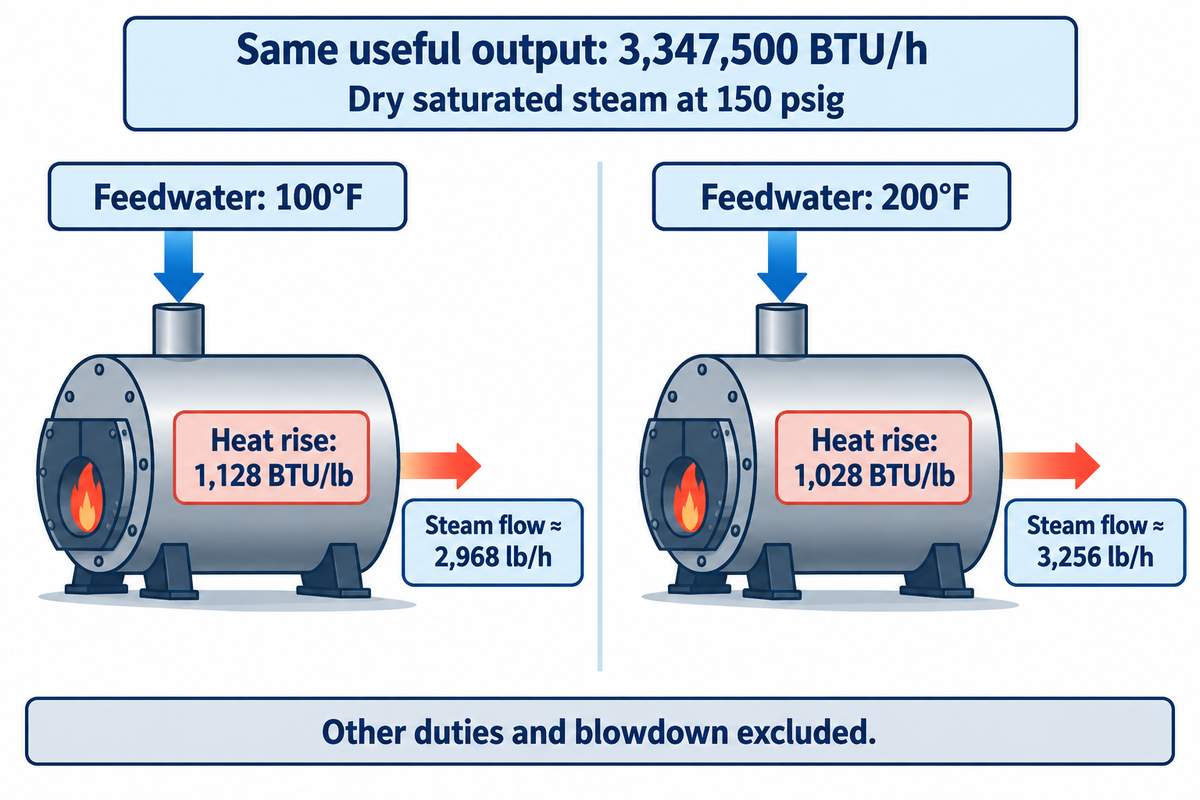
Suppose useful steam output is fixed at 3,347,500 BTU/h and the outlet is dry saturated steam at 150 psig. The U.S. Department of Energy’s steam-generation table gives these heat requirements:
- For dry saturated steam at 150 psig with 100°F feedwater, the heat requirement is 1,128 BTU/lb: 3,347,500 ÷ 1,128 ≈ 2,968 lb/h.
- With 200°F feedwater and dry saturated steam at 150 psig, the heat requirement is 1,028 BTU/lb: 3,347,500 ÷ 1,028 ≈ 3,256 lb/h.
The feedwater temperature has an effect on the mass of steam at the specified output. Other duties and blowdown have been neglected in these calculations. These should be considered when doing a complete system balance.
Steam quality also matters. ASHRAE’s steam-systems chapter distinguishes dry saturated vapor from steam containing water droplets. Wet or superheated steam requires the corresponding enthalpy instead of the dry-saturated value.
- Obtain feedwater temperature at the agreed inlet measurement point.
- Accurate steam properties should be selected using the stated outlet temperature or dryness condition.
Our Mollier diagram guide is a resource for interpreting steam properties used in the calculation.
Separate Fuel Input from Useful Boiler Output
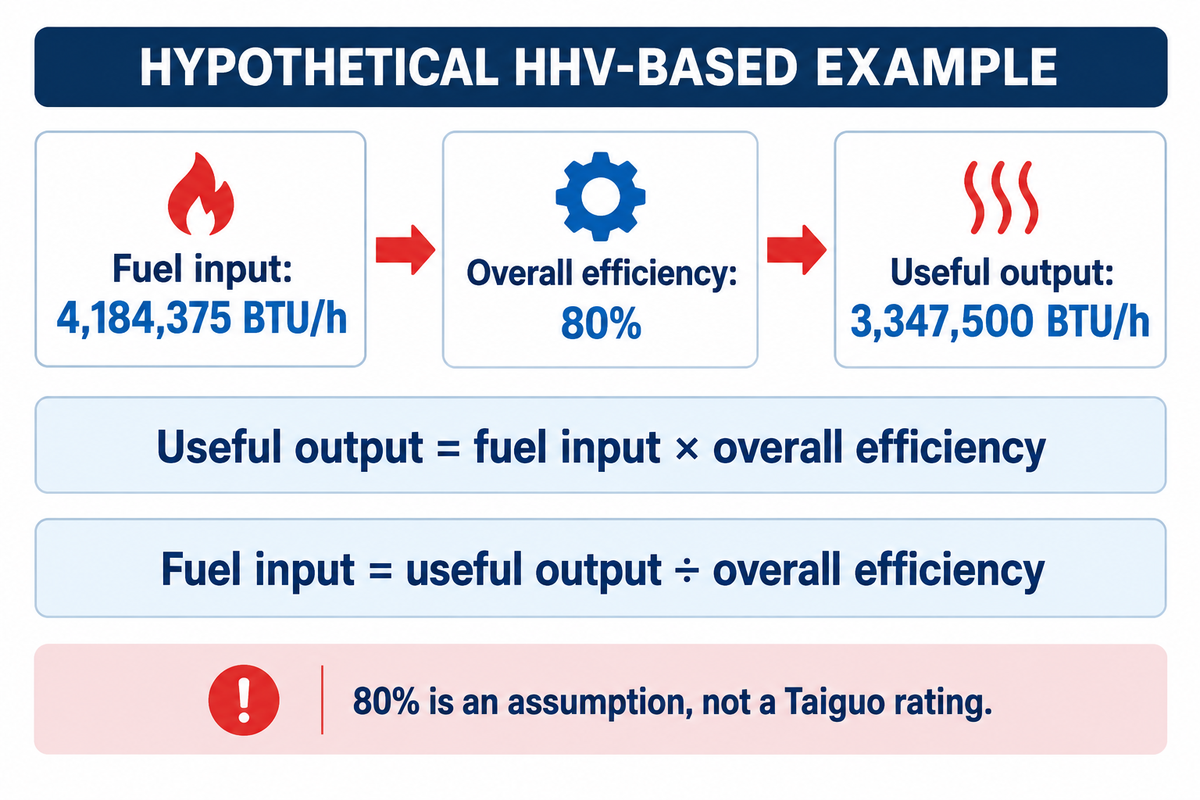
At a presumed 80% overall efficiency, 100 BHP of useful output requires 4,184,375 BTU/h of fuel input. Divide output by efficiency to find input; multiply input by efficiency to find output. Use the same basis for fuel heating value, equipment boundary and operating conditions for both quantities.
Useful output = fuel input × overall efficiency
Fuel input = useful output ÷ overall efficiency
Write 80% as 0.80 in these equations.
Fuel input = useful output ÷ overall efficiency
Write 80% as 0.80 in these equations.
At an assumed 80% overall fuel-to-steam efficiency on a higher-heating-value basis, the calculation is 3,347,500 ÷ 0.80 = 4,184,375 BTU/h input. ABMA defines input/output efficiency as the boiler output/input ratio. The 80% value is a hypothetical assumption, not a Taiguo product rating.
An assessment of combustion efficiency doesn’t consider all the losses included in an overall assessment of fuel-to-steam efficiency. ABMA states that an assessment of combustion efficiency alone shouldn’t be used to compare fuel usage:
“it should not be the sole factor used in economic evaluations.”
HHV and LHV treat the condensation of water-vapor differently. Pair the quoted efficiency with the matching fuel value; don’t combine an LHV efficiency with an HHV fuel input.
Load and test durations should be on the same line. The DOE’s short cycling guidance discusses cycle efficiency and includes references to firing, purging and idle periods. Constant-firing test results and whole-cycle results describe different operating intervals.
When an efficiency definition is missing, leave the fuel calculation open. For the measurement method, see our boiler-efficiency calculation guide.
Avoid Rating Mistakes Before Sizing a Steam System
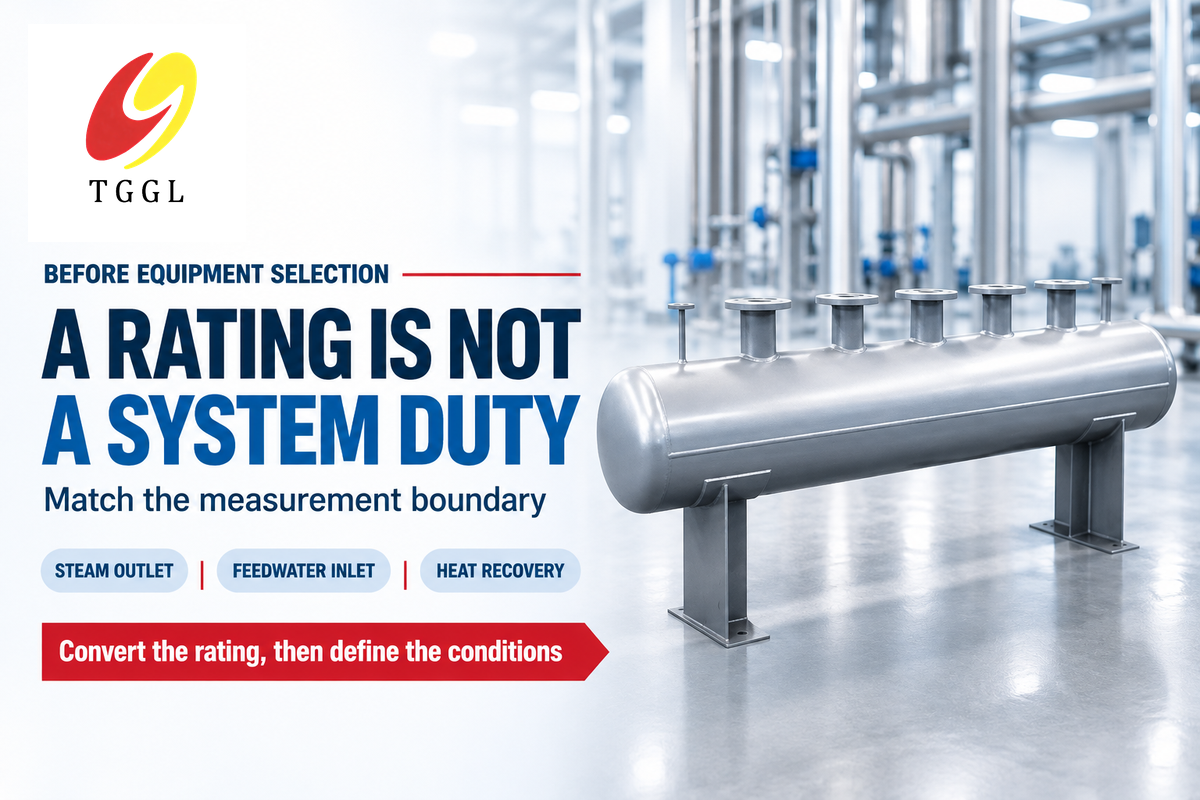
A 100 BHP rating converts to about 3.35 million BTU/h, but delivered steam duty still depends on the agreed conditions. Follow the rating through the feedwater inlet, steam outlet and heat-recovery boundary before selecting the equipment.
- Rating → procurement: acquire unit definition and determine input or output.
- Steam and feedwater → process engineer: stipulate pressure basis, inlet temperature and outlet state.
- Heat recovery → project engineer: determine if an economizer falls within the quoted performance boundary.
- Operating load → maintenance: compare load records, cycling and equipment condition with the test duty.
- Delivered duty → finance: determine running cost with matched output and operating hours.
For example, comparing a bare boiler unit with a package that includes feedwater heat recovery would require a common measurement boundary. Boiler heating-surface area alone also can’t replace the specified thermal rating.
Sizing and power conversions must be kept separate. Our industrial boiler sizing calculator helps determine design capacity and the conversion chart is a tool for expressing an established duty in consistent units.
Compare Boiler Quotes on the Same Output Basis
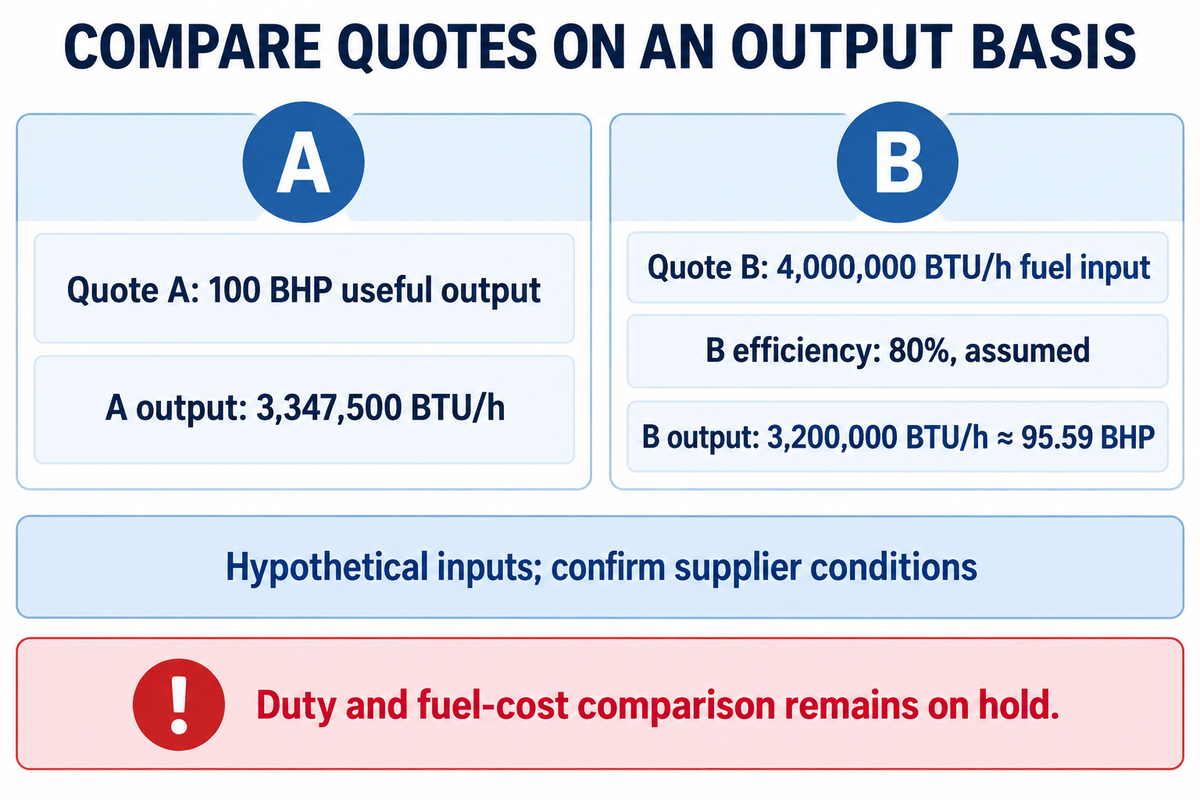
For a hypothetical case, a fuel input of 4 million BTU/h at an overall boiler efficiency of 80% would give an output of about 95.59 BHP. Thus, a 100 BHP output offer would give a greater amount of calculated heat under those assumptions. Consider operating conditions and package boundaries to determine which offer satisfies process requirements.
Same-Output Boiler Comparison
For B, assume 80% overall efficiency: 4,000,000 × 0.80 = 3,200,000 BTU/h output. Dividing that output by 33,475 provides approximately 95.59 BHP.
The worksheet categorizes each piece of quote data and shows what’s still lacking an agreed value. Replace assumptions with the supplier’s declared performance data prior to ordering.
According to ABMA, actual boiler input and output can be measured using instrumentation. Firing rates and cycling should be a part of the comparison. The U.S. Department of Energy states that efficiency goes down with short cycling and/or multiple boilers running at low firing rates.
| Data type | Quote A | Quote B |
|---|---|---|
| Reported rating | 100 BHP | 4,000,000 BTU/h |
| Rating category | Useful output | Fuel input |
| Calculated useful output | 3,347,500 BTU/h | 3,200,000 BTU/h |
| Overall efficiency | Needed for fuel comparison | 80%, assumed |
| Heating-value basis | Request declaration | Matching HHV basis assumed |
| Steam outlet condition | Specify pressure and state | Specify the same duty |
| Feedwater condition | Specify inlet temperature | Specify the same inlet |
| Recovery equipment | List included equipment | Align package boundary |
| Decision status | Output arithmetic complete; duty and fuel-cost comparison on hold pending conditions | |
For oil- or gas-fired application purposes, compare Taiguo’s WNS fire-tube steam boilers to the SZS water-tube steam boiler range against that duty. The industrial steam boiler price guide covers quotation cost factors beyond capacity.
Send the required steam flow, pressure and feedwater temperature with your quotation request. Taiguo’s oil and gas boiler range can be utilized as a starting point for discussing the package.
Request a Boiler QuotationFrequently Asked Questions
How many BTU is a 100 HP boiler?
If HP means boiler horsepower, a 100 HP boiler has a conventional rated output of about 3,347,500 BTU per hour. The calculation uses 100 multiplied by 33,475 and describes heat output rather than the burner fuel-input requirement. Actual steam flow also requires the feedwater temperature and steam conditions, so the converted rating alone doesn’t select a steam-flow value.
What is boiler horsepower?
Boiler horsepower is a unit used to express a boiler’s thermal output capacity, with a traditional reference of 34.5 pounds of water per hour. Evaporation is from and at 212 degrees Fahrenheit: water already at that temperature becomes steam at the same temperature. Boiler horsepower is a different unit from mechanical horsepower.
How many BTUs is 1 horsepower?
One mechanical horsepower is approximately 2,544.43 BTU per hour, while one boiler horsepower is conventionally about 33,475 BTU per hour. BTU alone is energy, so a quantity expressed without a duration can’t be converted directly to horsepower. For a steam-boiler rating, establish that the supplier means boiler horsepower and has stated a heat-transfer rate before calculating.
Does boiler horsepower change with efficiency?
The unit conversion doesn’t. Efficiency changes the fuel input required to achieve a given useful output under the stated test conditions.
How to determine boiler horsepower?
Determine useful heat output in BTU per hour and divide by 33,475 to get boiler horsepower. To calculate the output with regard to the overall efficiency of the unit, the input should first be multiplied by the overall efficiency.
Steam mass flow requires the steam and feedwater enthalpies at the specified conditions. Multiply the flow by the enthalpy rise to get the heat transfer, then convert that output to BHP. The heat needed to evaporate each pound changes accordingly.
How many horsepower is 10,000 BTU?
If you mean 10,000 BTU per hour of boiler output, it’s approximately 0.299 boiler horsepower. The same power magnitude is about 3.93 mechanical horsepower. A quantity of 10,000 BTU without a duration can’t define horsepower.
References & Sources
- American Boiler Manufacturers Association: Packaged Firetube Boilers conventional horsepower definition, 2003.
- NIST Guide to the SI, Appendix B.8 energy and power conversion factors.
- U.S. Department of Energy: Benchmark the Fuel Cost of Steam Generation steam enthalpy increments and heating-value definitions, 2012.
- ABMA: Determining & Testing Boiler Efficiency overall and combustion-efficiency distinctions, 2008.
- U.S. Department of Energy: Minimize Boiler Short Cycling Losses cycle efficiency and load conditions, 2012.
- ASHRAE Handbook, Chapter 11: Steam Systems dry saturated and wet-steam definitions, 2020.