Get in Touch with Taiguo

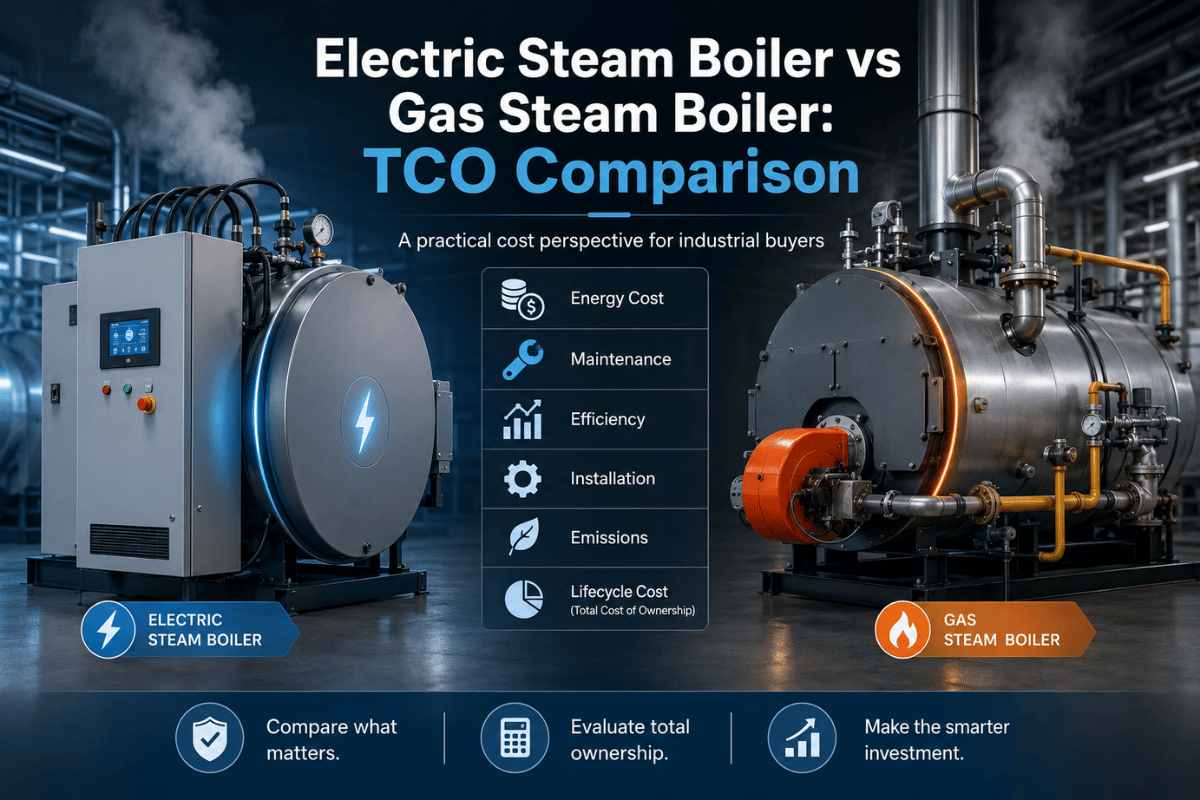
Electric Steam Boiler vs Gas Steam Boiler: TCO Comparison

Contents
show
Electric vs. Gas Steam Boiler: A Technical Overview
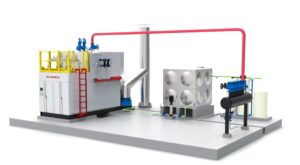
Both types produce saturated steam for heating, process, or power applications – the difference lies in how they generate heat and what infrastructure they require. An electric steam boiler converts electrical energy to heat through resistive elements or electrode contact; a gas steam boiler combusts natural gas in a burner and transfers heat through a heat exchanger or fire tubes.
⚡ At-a-Glance Specs
| Specification | Electric Steam Boiler | Gas Steam Boiler |
|---|---|---|
| Capacity range | 72 – 14,400 kW | Steam output (WNS/SZS) |
| Thermal efficiency | ≥98% (point-of-use) | 92–98% with economizer (premium); 80–85% standard |
| Working pressure | Up to 1.6 MPa (232 psi) | Up to 2.5 MPa (362 psi; SZS water-tube) |
| Direct emissions | Zero on-site | ~52.9 kg CO₂/MMBtu (EPA AP-42) |
| Flue/vent required | No | Yes — flue design, combustion air, NOx permit |
| Typical service life | 15–20 years | 15–25 years |
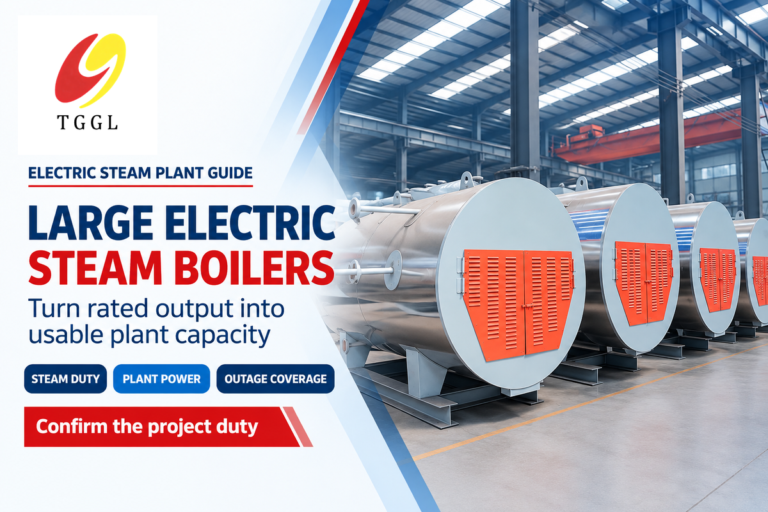
| Taiguo product line | Industrial electric boiler (72–14,400 kW) | WNS gas-fired fire-tube boilers |
For facilities with reliable natural gas supply and high-volume continuous steam loads, a gas steam boiler delivers a lower cost per kilogram of steam. For plants without gas infrastructure, operating under stringent air-quality regulations, or running intermittent steam cycles, an electric steam boiler often makes more practical and financial sense — and the modular, scalable design of modern electric units means output can be expanded efficiently as steam demand grows.
How Electric and Gas Steam Boilers Generate Steam
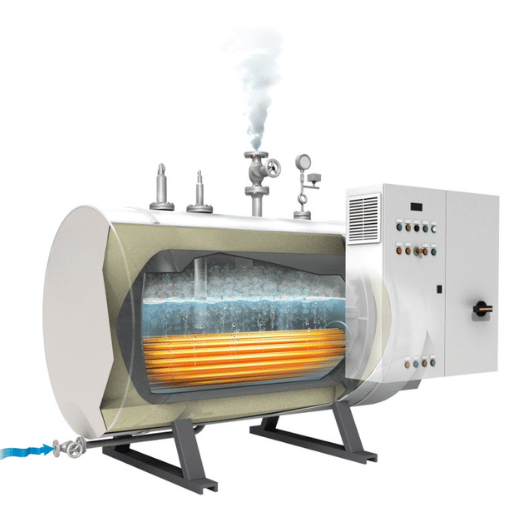
Understanding the operating mechanism of each boiler type is not academic – it determines what infrastructure your site needs, where failures occur, and what your maintenance schedule looks like.
⚡ Electric Steam Boiler
Mechanism: AC current passes through resistive heating elements or directly through water (electrode boilers). Water absorbs the heat, converts to steam. No combustion, no flame, no flue gases.
Advantages:
- Simple control — modulates output element-by-element
- Up to 15:1 turndown ratio for variable loads
- No combustion air calculation or flue design
- Rapid startup: steam in 10–15 minutes
Core constraint: Requires 3-phase power supply; large units demand substantial amperage and transformer capacity.
🔥 Gas Steam Boiler
Mechanism: Natural gas combusts in a burner, producing hot flue gas (900-1,100°C). Heat transfers through fire tubes or a heat exchanger into the boiler water. Flue gas exits through a stack at 160-200°C in a single-pass design, or as low as 110°C with an integrated economizer.
Advantages:
-
- High-capacity steam output at lower fuel cost
- Taiguo WNS three-pass fire-tube design captures flue heat for 92–96% base efficiency
- Proven at industrial scale for 24/7 continuous operation
Core constraint: Requires gas supply line, flue/vent system, combustion air design, and periodic combustion tune-ups.
Electric heating eliminates combustion entirely — that simplicity is its primary reliability advantage. Both types of steam boiler require a feedwater system, blowdown management, and a steam distribution network. Water undergoes a phase change from liquid to saturated steam inside the pressure vessel; managing that transition efficiently — controlling latent heat input, operating pressure, and feedwater quality — is the core engineering challenge for either boiler type. For alternative heating solutions where pressurized steam is not required, a thermal oil heater may be worth evaluating alongside either boiler type.
Efficiency Ratings: Why 98% vs. 92% Doesn’t Settle the Operating Cost Question
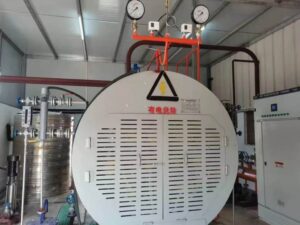
Most buyers overestimate the efficiency gap between electric and gas boilers — and that gap is almost never the deciding factor on operating cost. An electric steam boiler achieves ≥98% point-of-use efficiency because it produces no flue gas losses. A premium gas steam boiler with an integrated economizer (such as the Taiguo WNS and SZS series) reaches 92–98% — a high efficiency level that narrows the gap considerably — by recapturing flue heat. Industry-standard and older gas units typically operate at 80–85%, consistent with LBL’s Industrial Applications Center benchmarks for well-maintained fossil fuel-fired boilers.
Cost-per-unit-of-steam is the real question — and it depends entirely on local fuel prices, not the efficiency percentage printed on the nameplate.
🔧 Engineering Note — The Electric Boiler Break-Even Rule
Electric steam boilers achieve competitive operating costs when the electricity-to-gas price ratio stays below 3.0:1 (expressed in equivalent $/MMBtu).
| Market Scenario | Electricity ($/MMBtu equiv.) | Gas ($/MMBtu) | Ratio | Winner |
|---|---|---|---|---|
| US Industrial Avg (2024–2026) | ~$25.1 (8.58¢/kWh) | ~$3.92 (2024 avg) | 6.4:1 | Gas ✓ |
| Low-cost hydro market (e.g., Pacific Northwest) | ~$14.7 (5.0¢/kWh) | ~$4.50 | 3.3:1 | Gas (narrowly) |
| Clean-energy PPA or off-peak industrial rate | ~$11.8 (4.0¢/kWh) | ~$4.50 | 2.6:1 | Electric ✓ |
Note: electricity $/MMBtu = (¢/kWh × 10) ÷ 3.412. At US industrial average rates, the ratio sits at 6.4:1 — well above the 3.0 break-even threshold. Electric steam boilers become cost-competitive in regions where clean electricity rates fall below approximately 4¢/kWh.
Is It Cheaper to Run an Electric Boiler or a Gas Boiler?
At typical US industrial utility rates, gas is cheaper to operate — often by a factor of three or more per unit of steam produced. The EIA reports industrial electricity at approximately 8.58¢/kWh, which translates to roughly $25/MMBtu in energy-equivalent terms. Industrial natural gas averaged $3.92/MMBtu in 2024. Even accounting for the electric boiler’s higher thermal efficiency (≥98% vs. 80–85% for standard gas units), the fuel cost gap remains wide.
That said, operating cost is not the only variable. Facilities in states with strict air-quality regulations, those that already pay demand-charge premiums that cap benefit from further gas use, or those locked into long-term renewable electricity agreements can find electric steam generation genuinely cost-competitive.
Always run the break-even calculation above with your actual tariff data before deciding. When you divide the costs of electric energy ($/MMBtu equivalent) by the cost of natural gas ($/MMBtu), the result tells you which side of the break-even line your facility sits on. At US industrial averages, that ratio is 6.4 — comfortably in gas territory. In markets where the ratio falls below 3.0, electric boilers can produce steam at a competitive or lower operating cost than gas.
Total Cost of Ownership: Purchase Price, Operating Cost & 15-Year Lifespan
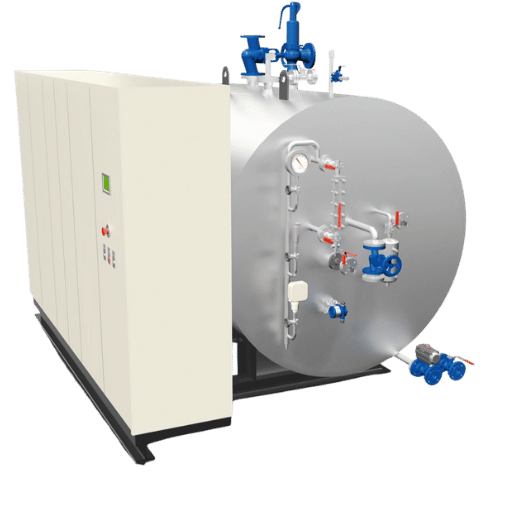
Capital cost alone does not reveal the true cost of a steam boiler.
For a high-output industrial unit running 6,000 hours per year, the accumulated fuel bill over 15 years dwarfs the initial purchase price – making the operating cost per tonne of steam the number that matters most.
| Cost Category | Electric Steam Boiler | Gas Steam Boiler |
|---|---|---|
| Capital cost (indicative) | Lower per-kW; no burner, flue, or gas line | $10K–$350K (small fire-tube); $120K–$950K+ (large water-tube) |
| Infrastructure add-on | $10K–$100K+ (3-phase power upgrade; see H2-5) | Gas supply line, flue/vent system, permit fees |
| Fuel cost (US industrial avg, per MMBtu steam) | ~$25.7 ($25.1/MMBtu electricity ÷ 0.98 eff.) | ~$4.26–$4.90 ($3.92/MMBtu gas ÷ 92–80% eff.) |
| Annual maintenance | Up to 50% less than gas (element replacement, no NDT) | Quarterly burner inspection + annual tube/heat exchanger service |
| Asset life / warranty | 15–20 years | Taiguo: 2-yr warranty, 15-yr spare parts | 15–25 years | Taiguo: 2-yr warranty, 15-yr spare parts |
Case reference: At the Asia-Pacific Taiguo WNS10-1.0-Q installation, an upgrade to a modern gas fire-tube boiler with economizer achieved a 15% reduction in fuel consumption versus the outgoing unit, delivering a 14-month payback period on the capital investment.
For comparable data on your facility’s steam load, use Taiguo’s industrial boiler sizing calculator to estimate output requirements before requesting pricing.
Infrastructure & Installation: What Your Site Must Have Before You Buy
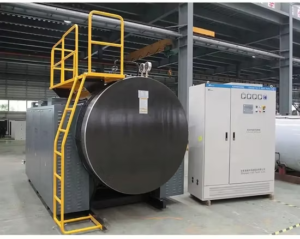
Infrastructure mismatches are the single most expensive mistake in boiler procurement.
The following pre-purchase checklist maps what each boiler type demands from your site.
⚡ Electric Steam Boiler — Site Requirements
- Three-phase 480V (or 415V) power supply confirmed at adequate amperage
- Dedicated electrical sub-panel and breaker sized for boiler kW rating
- Transformer capacity: a 500 kW electric boiler at 480V 3-phase draws ~602A – verify utility service capacity
- Demand charge exposure: large electric boilers trigger industrial demand charges that can add thousands per month to the electricity bill
- Electrical permit and grid interconnect approval
- ASME Section I pressure vessel certification (same as gas)
- Water treatment system: feedwater conductivity must stay ≤100 µS/cm to protect heating elements
🔥 Gas Steam Boiler — Site Requirements
-
- Natural gas supply pipe with adequate pressure (typically 2–14″ water column at burner inlet); gas steam boilers require correct pipe sizing for full-load flow rate
- Gas meter upgrade if existing service is undersized
- Flue system design: material, height, and diameter per local code (UL 103 or equivalent)
- Combustion air supply: confined space rules apply for indoor installations
- Air quality permit: new gas combustion installations in regulated jurisdictions (e.g., California SCAQMD) typically require 6–18 months to permit
- Low-NOx burner compliance with applicable BACT requirements
- ASME Section I pressure vessel certification
🔧 Engineering Note — 3-Phase Power Upgrade Costs
If 3-phase service is already available at the building, a connection and transformer upgrade typically costs $10,000-$20,000. If the utility must extend the service from the nearest 3-phase line, costs commonly reach $30,000-$60,000.
Underground installation in complex sites can exceed $100,000. These one-time costs must be factored into the electric boiler capital budget – they are not included in boiler list prices.
Why Are Electric Boilers Not Commonly Used in Industrial Settings?
Four structural barriers explain the relatively low industrial adoption of electric steam boilers in North America. First, the electrical infrastructure cost for high-capacity boilers is substantial — a 2 MW electric boiler requires service capacity that many industrial sites simply do not have, and the upgrade cost can match or exceed the boiler itself. Second, industrial demand charges penalize high-coincident peak loads, inflating the effective electricity cost well beyond the headline tariff rate; engineers who overlook peak demand charges consistently underestimate the true operating cost of electric installations. Third, natural gas has historically priced at 3–7× lower cost per MMBtu than industrial electricity in North America, making gas the economically dominant choice for continuous high-load steam generation. Fourth, large industrial processes requiring uninterrupted steam (24/7 refinery, pharmaceutical, paper) place a premium on dual-fuel gas resilience that electric-only systems cannot match without significant battery or backup infrastructure.
Intermittent or batch-load applications tell a different story. Autoclaves, food-processing batch cycles, and laboratory steam systems all benefit from electric boilers’ fast startup, precise load modulation, and installation simplicity — particularly when electricity rates are favorable.
Environmental Impact & Regulatory Compliance
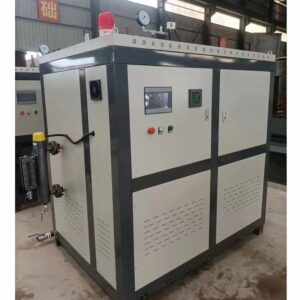
With zero direct emissions on-site — no CO₂, no NOx, no particulate matter – electric steam boilers win out of the box wherever the air-quality regs bite, like in California’s South Coast Air Quality Management District (SCAQMD), where gas-combustion equipment increasingly must meet ever-tighter BACT rules.
Yet, even with fuel-fired systems, the emissions are well characterized, and relatively controllable. Burning natural gas produces roughly 52.9 kg CO₂ per MMBtu of heat input (EPA AP-42, Section 1.4). At one Taiguo South America facility running a dual-fuel gas/biomass unit, modern gas boilers fitted with SNCR control NOx to levels below 30 mg/Nm³.
The electric-is-cleaner argument holds, with one important caveat: upstream grid emissions. In 2023, the US average grid carbon intensity was around 386g CO₂/kWh (according to EIA data), equal to about 113 kg CO₂/MMBtu equivalent — that’s over twice the direct emissions from burning gas. But a state-by-state approach matters: California’s grid sits around 202g CO₂/kWh, while Wyoming’s exceeds 780g/kWh. A facility with a lot of renewables on the grid, or its own PPA with clean power, *will* cut lifecycle carbon by going electric. One running on a coal-heavy grid likely will not.
✅ Regulatory Checklist — Before Specifying Your Boiler Type
- New source review (NSR) requirements for natural-gas combustion systems: check your local air district’s standards.
- Clean Air Zones and nonattainment areas (NOx or PM): Is your facility located within one?
- Your utility’s grid emissions factor (not national): Give it a call!
- IRA 48C credit: Is an electric industrial heating project available for a 30% investment tax credit (see H-9)?
- Carbon priced market (e.g., EU): Account for ETS or carbon tax on gas use in a 15-year total cost of ownership (TCO).
Reliability, Maintenance & Expected Service Life
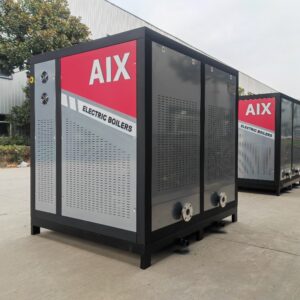
Under proper specification, installation, and maintenance, both boiler types are exceptionally reliable. Where they differ strikingly is in maintenance character, service frequency, and the technical skill level required.
| Maintenance Task | Electric Boiler | Gas Boiler |
|---|---|---|
| Water quality / conductivity monitoring | Critical (≤100 µS/cm) | Standard (TDS control) |
| Burner inspection & combustion tune | Not applicable | Quarterly |
| Heating element inspection | Annual | Not applicable |
| Heat exchanger / tube inspection | N/A | Annual (ASME Section VII) |
| Non-destructive testing (NDT) / statutory inspection | Not required | Every 5 years (regulatory) |
| Flue & refractory inspection | N/A | Annual |
| Overall maintenance cost | Up to 50% lower than gas | Baseline |
“Maintenance costs for the unit can be 50% or less those of fuel-fired steam boiler systems”, noted Fulton’s Managing Director, Carl Knight, in a 2022 industry article – primarily due to the lack of servicing required on a combustion system and the absence of statutory, often costly non-destructive tests on metal components.
Uptime reference: The Taiguo SZS20-1.6-Y water-tube gas boiler installed at a Middle East petrochemical facility achieved 99.5% operational uptime across three years of continuous service, with a 60% reduction in blowdown frequency versus the unit it replaced — an indicator of well-engineered pipe and pressure-vessel design combined with effective water treatment. High equipment utilization rates like this directly reduce the cost-per-tonne-of-steam, improving the long-term TCO case for either boiler type when properly maintained.
Which Steam Boiler Should You Choose? A 4-Variable Decision Matrix
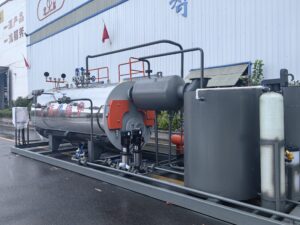
Here are four key factors driving the choice of boiler for many facilities; map your site to this matrix for a first-cut recommendation, and have a Taiguo engineer customize it for your exact conditions with your tariff data and profile.
| Gas Supply | Electricity Tariff | Steam Load | Emissions Pressure | Recommendation |
|---|---|---|---|---|
| Available | High (>$0.07/kWh) | Continuous | Standard | Gas — clear winner on operating cost |
| Available | High (>$0.07/kWh) | Intermittent | Standard | Gas preferred; electric viable for small backup |
| Available | Low (≤$0.05/kWh) | Intermittent | Standard | Either viable — compare on capex + permit timeline |
| Available | Low (≤$0.05/kWh) | Continuous | Strict (CAZ / nonattainment) | Electric — compliance advantage + cost-competitive |
| Not available | Any | Any | Any | Electric — only practical option |
| Available | High (>$0.07/kWh) | Continuous | Strict (CAZ / nonattainment) | Hybrid (gas base + electric peak) — assess 15–40% capex premium |
| Not available | High (>$0.07/kWh) | Continuous, high-capacity | Standard | Consider biomass-fired boiler as alternative fuel path |
| Available | Low (≤$0.05/kWh) | Intermittent | Strict | Electric — lowest emissions, cost-competitive |
Unsure where you fit in? Start by modeling your steam load profile with our industrial boiler sizing calculator, and then speak with a Taiguo engineer who can match those figures against your utility’s tariff and your local air regulations.
Industry Outlook: The Electric Shift in Industrial Steam (2025–2026)
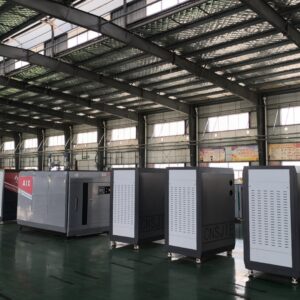
Industrial steam boiler economics are shifting — and three converging forces are improving the case for electric steam boilers across a growing segment of industrial buyers.
First, the Inflation Reduction Act’s Section 48C Advanced Energy Project Credit provides a 30% investment tax credit for qualifying industrial electrification projects. The DOE allocated approximately $6 billion of 48C credits across 140+ projects in 30 states in January 2025, with at least $4 billion reserved for facilities in designated energy communities near closed coal infrastructure. Facilities replacing fossil fuel-fired boilers with electric equivalents may qualify — reducing the effective capital cost of electric installations by nearly a third.
Second, US grid carbon intensity is declining as renewable power generation expands, averaging roughly 2% annual improvement. An electric steam boiler purchased today operates on progressively cleaner electricity without any hardware changes — a decarbonization trajectory its gas-fired counterpart cannot replicate. Meanwhile, natural gas prices remain volatile; the price fluctuations of 2021–2023 (swings from $3 to $8+/MMBtu for industrial buyers) are a reminder that facilities locked into gas-only heating solutions carry commodity risk that electric boilers do not.
3. Keyword Search Trends: A crude but useful indication of buyer interest shows the phrase “electric boiler vs gas boiler” rising to 1,600 monthly searches by September to October next year from summer levels below 300. Procurement personnel are obviously researching switching ahead of forced action.
🔧 2025–2026 Action Checkpoint
Before settling on boiler specs for a new install or replacement, be sure to research three points: your state’s 48C energy community status at the DOE portal, your utility’s estimated electricity rate trends for the next five years (several are filing for higher rates to upgrade the grid), and if your site could be eligible for a clean-energy Power Purchase Agreement that makes the effective cost of electricity below 5¢/kWh and shifts the break-even ratio. Today’s boiler will still be in operation 15-25 years from now. Your macro energy future will come into play long before that boiler retires. (To explore biomass for energy as a transitional option, read our piece on whether biomass energy is renewable.)
Frequently Asked Questions
About Taiguo Boiler
This guide was reviewed by the engineering team at Taiguo Boiler, a Grade A industrial boiler manufacturer founded in 1976, ISO 9001:2015, ASME, and CE PED certified. Taiguo manufactures electric steam boilers (72–14,400 kW), gas-fired fire-tube WNS and water-tube SZS boilers (0.5–30 t/h), biomass boilers, thermal oil heaters, and industrial autoclaves — supplying customers in 100+ countries from a 60,000 m² manufacturing facility with 46 R&D engineers. Efficiency data and case study references in this article reflect first-party Taiguo specifications and documented installations.