Get in Touch with Taiguo


A laminated glass autoclave is more than just a pressure vessel with heating system. It’s a late-stage pressure-lamination step in a series that begins with clean layers of glass, conditioned interlayer, accurate layup and effective de-airing, including when buyers use the label bulletproof glass for tested bullet-resistant or protective glazing. It should be evaluated based on the final product and method of acceptance as opposed to catalog diameter and duplicated cycles.
This guide stays with glass lamination. For broader equipment context, see Taiguo’s industrial autoclave systems overview and industrial autoclave guide. Adjacent process guides cover rubber vulcanization, composite autoclave manufacturing, aerospace composite autoclaves, and prepreg carbon-fiber autoclave cure; their recipes and acceptance logic should not be transferred to laminated glass.
Short answer: specify the machine around usable load geometry, loaded temperature distribution, pressure stability, vacuum service, traceable controls and an agreed representative test load. Keep the process recipe owned by the approved interlayer system and your product qualification.
What a Laminated Glass Autoclave Must Actually Control
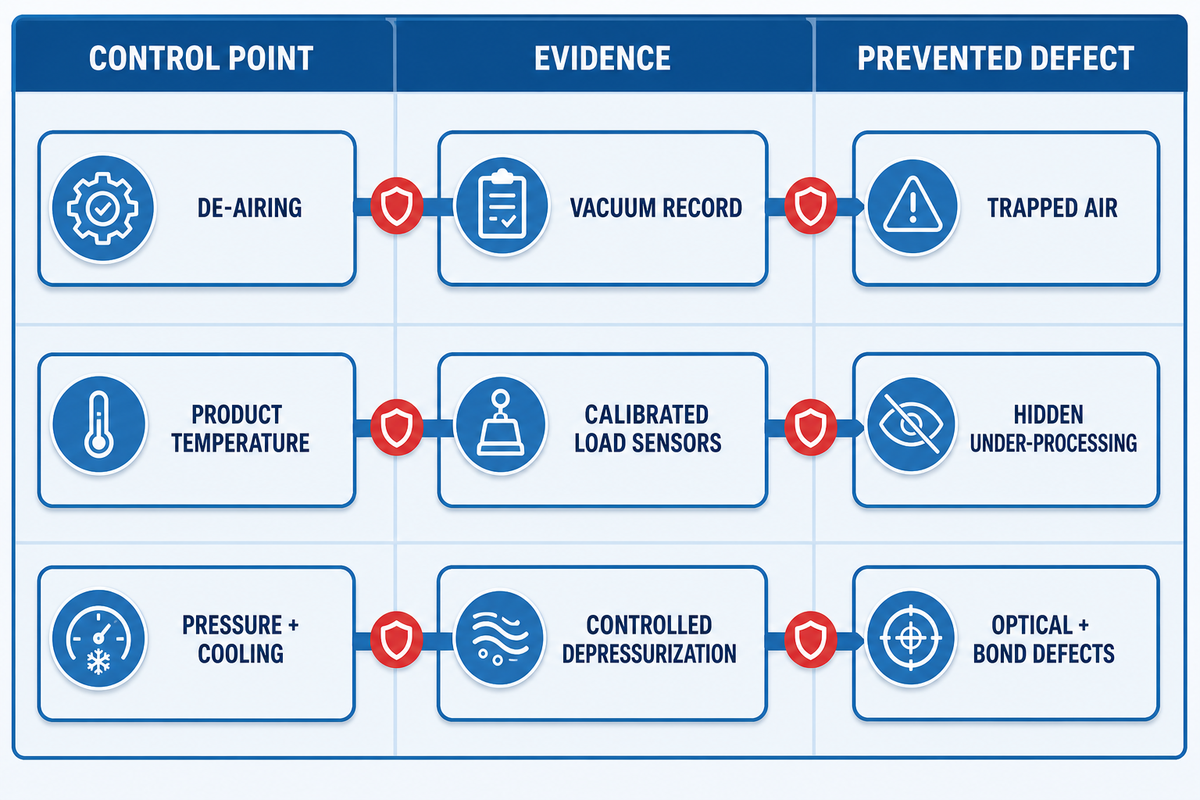
The autoclave must be able to create repeatable conditions throughout the laminate. This controlled process involves the removal of residual air, the transfer of heat into the glass stack, the application of pressure, adequate time at the required product condition and cooling, all while pressure protects the bond. A weak link upstream can become evident after an otherwise stable cycle. In glass processing, the glass laminating autoclave is only one part of the laminating process. A plant also has to control glass sheets, the interlayer material, pre-lamination air pockets, and the loaded glass panels; GlassOnWeb’s technical overview likewise separates de-airing from autoclaving.
Glass contains thermal mass. Chamber air can reach its target before the coldest pane or thickest stack does. A mixed rack can also divert circulation, shade thermocouples or create local temperature lag. The critical question should therefore be, “What did the product experience?” rather than, “What did the controller display?”
| Control point | Evidence to request | What it prevents |
|---|---|---|
| De-airing | Vacuum or nip records, bag integrity checks | Trapped air that pressure alone cannot reliably erase |
| Product temperature | Calibrated load sensors at agreed cold spots | Under-processing hidden by chamber-air readings |
| Pressure and cooling | Trend data, hold stability and controlled depressurization | Optical and bond defects during the final part of the cycle |
How the Autoclave Cycle Creates a Clear Bond
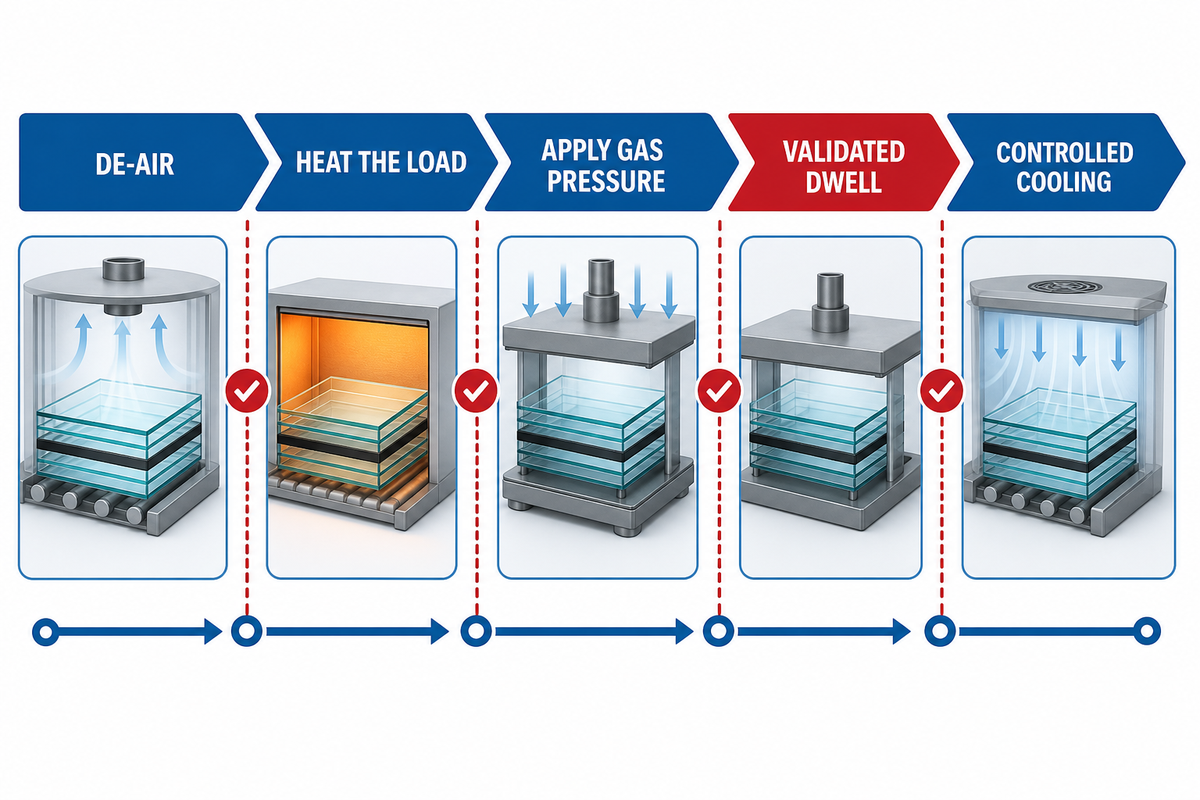
When laminated glass is produced, five operations make up a validated glass laminating cycle for laminated glass products: pre-lamination de-airing, heating, application of pressure to the stack, dwell at the required product condition, and cooling of the stack under pressure. None of these operations is a cure-all. More pressure cannot compensate for dirty glass, incompatible materials, wet interlayer or a leaking vacuum bag.
Can one temperature and pressure setting work for every laminate?
No. Published examples can help explain the process, but they should not be adopted as production recipes unless they are current and approved for the exact interlayer and construction. Approval of the interlayer, number and thickness of plies, use of tempered glass, coating orientation, insert materials, panel curvature, rack density and actual glass temperature all impact validation. Refer to the interlayer manufacturer’s current processing and qualify the complete construction.
For a mixed load, place product sensors in the areas of heat transfer that are expected to be the slowest and confirm that the complete load reaches the validated window before dwell timing is credited. Cooling and pressure release also need to be defined. This method eliminates the frequent documentation mistake of starting to time from the air setpoint while the product is still catching up. That distinction matters across glass production: a cycle developed for a lightly loaded rack should not be copied automatically to a full rack. Glastory’s lamination guidance warns that a recipe optimized for a small amount of glass will most likely not work with a full load, so commissioning should challenge the load cases the machinery will actually process.
One practical boundary is safety glazing. In the U.S. 16 CFR Part 1201 defines impact test requirements for architectural glazing materials. A stable autoclave cycle supports a manufacturing control, but it doesn’t take the place of product testing and doesn’t prove that every new construction of the laminate complies.
Turn Product Mix into an Autoclave Specification
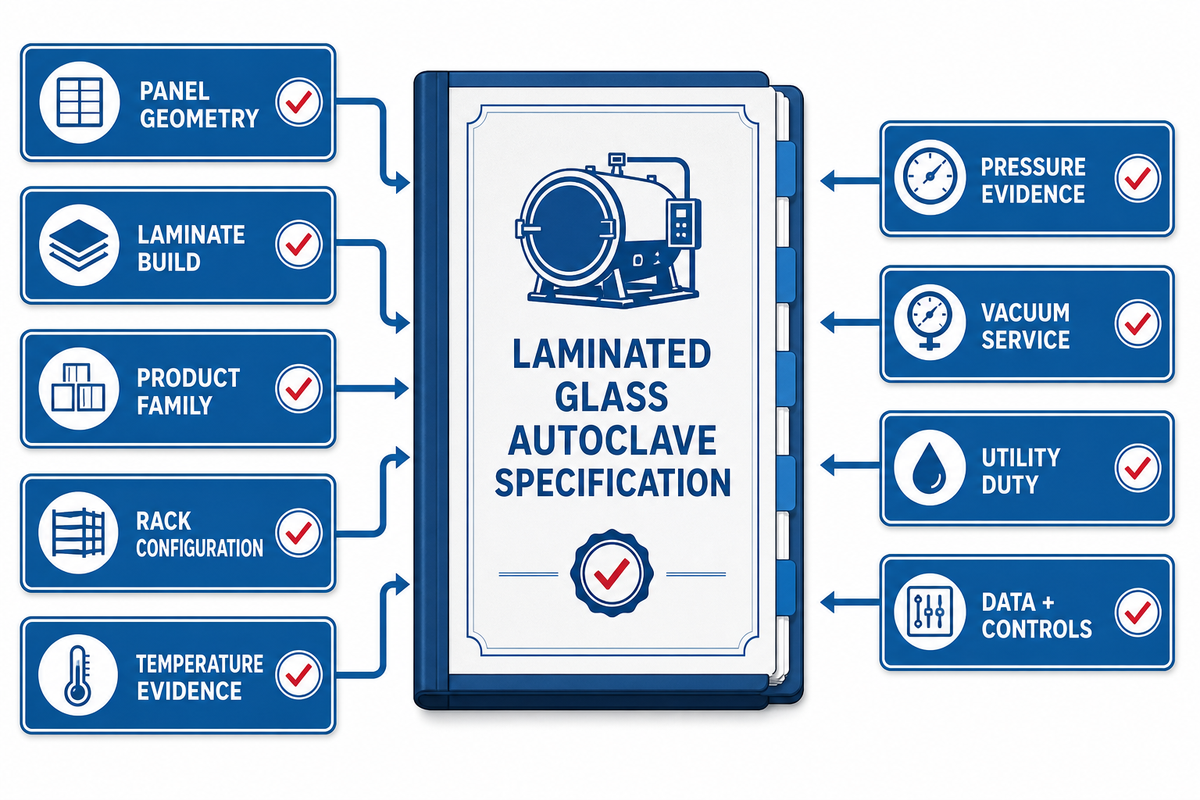
The right specification starts with a load envelope: maximum panel length, width and curvature; laminate build; rack pitch; batch mix and desired throughput. Articulate that volume in usable chamber space by subtracting door, fan and duct openings, racks and circulation ways. Nominal diameter isn’t usable diameter.
| Input category | Buyer-supplied evidence | Supplier response to verify |
|---|---|---|
| Panel geometry | Largest flat and curved constructions | Usable load envelope and rack clearance |
| Laminate build | Glass, interlayer, coating and insert combinations | Supported qualification boundaries |
| Product family | Architectural, transport or protective-glazing mix | Representative and worst-case test loads |
| Rack configuration | Spacing, restraint and handling method | Circulation path and support concept |
| Temperature evidence | Sensor locations and calibration records | Loaded mapping and cold-spot method |
| Pressure evidence | Required stability and release logic | Trend, alarm and hold-test method |
| Vacuum service | Zones, connections and bagging approach | Leak-check and monitoring plan |
| Utility duty | Available power, air, water and ventilation | Declared demand and interface schedule |
| Data and controls | Recipe, user, alarm and batch-record needs | Traceable export and access-control demonstration |
- Define the product family. Give a representation of typical and worst case panels and not just the largest panels.
- Representative racks must show glass spacing and restraints, and provide clear paths for lifting and circulation.
- State controls such as the mapping method, quantity of sensors, calibration of sensors, pressure tolerance, vacuum zones and interval of data capturing.
- Bind utilities to duty. Verify the electrical load, heating medium, compressed-air capacity, cooling water, ventilation and recovery assumptions.
- Define records. Require recipes, user permissions, alarms, batch IDs, trends and exportable records.
The required code and registration depend on the installation jurisdiction. The ASME Boiler and Pressure Vessel Certification program describes manufacturer certification and mark use. It is advisable to require the supplier to indicate the exact design code, edition, certification scope and local registration path, rather than writing “ASME” in general terms.
RFQ rule: a performance statement needs a test method. “Good uniformity” is not an acceptance criterion; a defined load, calibrated sensors, locations, stabilization rule and allowed deviation are.
PVB Autoclave, EVA Oven, or Autoclave-Free Line?
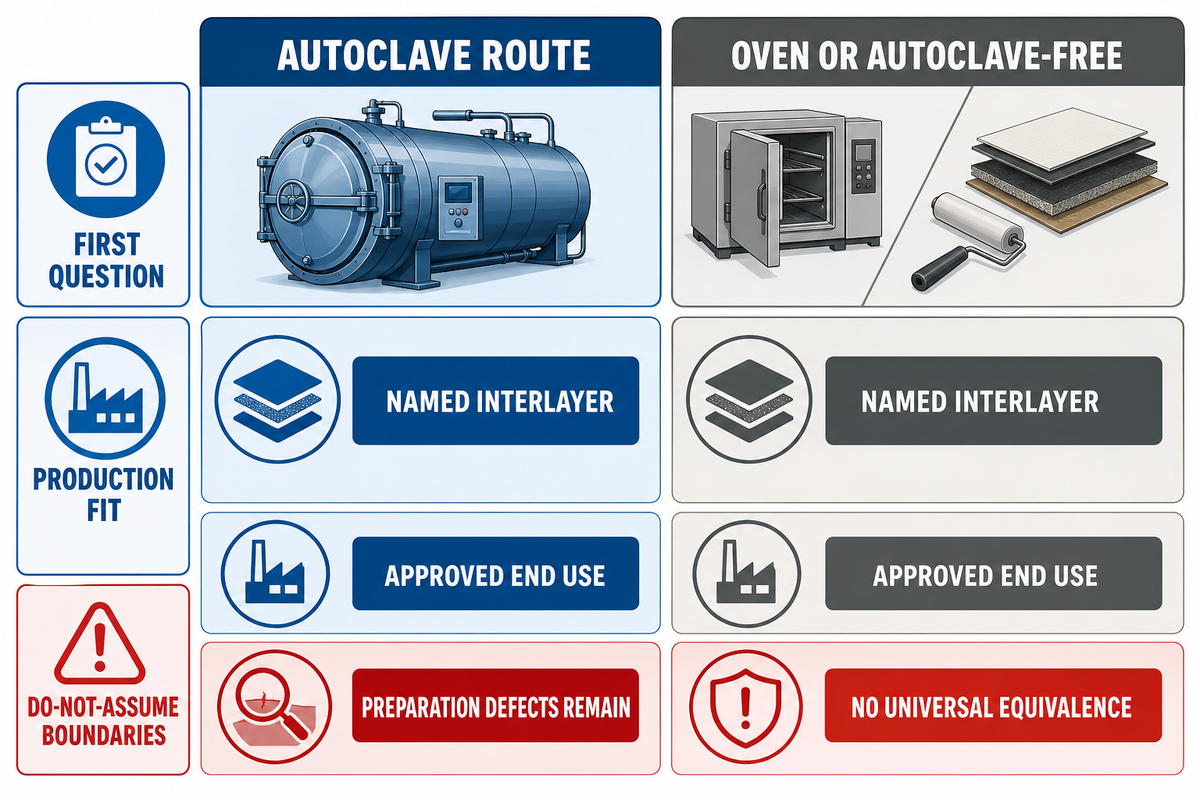
Common processes are: for traditional PVB and ionoplast laminates, de-airing followed by autoclave processing; for EVA products, vacuum laminating. Qualified autoclave-free PVB systems also exist. However, their approval and processing window must be in concert with the product and customer requirement.
| Decision factor | Autoclave route | Oven or autoclave-free route |
|---|---|---|
| First question | Is the named PVB or ionoplast construction qualified for this cycle? | Is the exact EVA or alternative PVB system approved for the end use? |
| Production fit | Batch loading, broad pressure capability, high-value architectural or transport products | Suitable batch sizes and constructions where vacuum-oven processing is qualified |
| Do not assume | Higher pressure automatically fixes preparation defects | Lower equipment complexity means equivalent approval for every application |
The UK’s National Protective Security Authority guide to glass interlayers explains that post-breakage behavior is one factor that informs interlayer selection. This is why the route selection can’t be attributed to energy consumption or cost. A laminate is a safety system. Safety systems are required to satisfy multiple missions during the qualification process. For that reason, non-autoclave glass laminating and autoclave-free laminated glass should be treated as qualified process routes, not shortcuts. A furnace or vacuum oven can fit an approved EVA system, while autoclave systems can fit specified PVB or ionoplast constructions; neither choice alone proves that the resulting laminated glass panel is compliant safety glass.
Diagnose Bubbles, Haze, Edge Delamination, and Optical Distortion
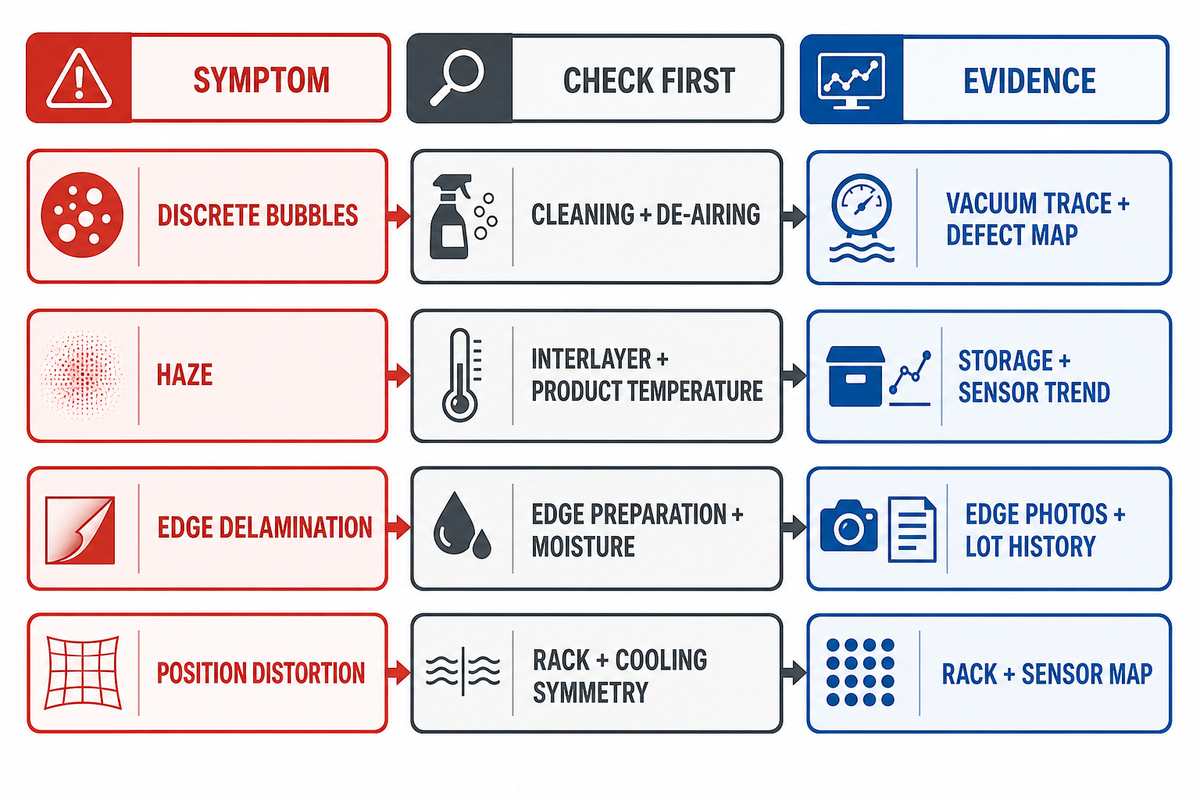
Defect diagnosis can be viewed as an evidence ladder. The order of recording the defect is: load position, when it occurred, its shape, location and any other evidence pertinent to the case. An isolated central bubble isn’t the same as a continuous edge band. A rack position pattern isn’t the same as roller trail. “Increase pressure” is a best guess, not a root cause method. A glass-industry troubleshooting discussion shows why the same cycle can behave differently with thicker glass. Keep downstream causes in the same investigation too, including for automotive products: moisture exposure, glazing tapes and sealant compatibility should be investigated as possible contributors to edge symptoms after lamination, so automatic attribution of a visible defect to an autoclave fault is not justified.
| Symptom | Check first | Evidence before adjustment |
|---|---|---|
| Discrete bubbles | Cleaning, de-airing, bag or edge integrity | Pre-laminate appearance, vacuum trace, defect map |
| Haze | Interlayer condition, compatibility, actual product temperature | Storage record, lot, sensor trend, reference sample |
| Edge delamination | Edge preparation, moisture exposure, sealant compatibility | Lot history, edge photos, downstream material list |
| Position-related distortion | Rack support, circulation and cooling symmetry | Rack map, sensor map and repeated-load comparison |
This defect-evidence ladder moves from material and layup records to de-airing evidence, cycle trends, rack position and post-process handling. Change one controlled variable at a time.
Calculate Throughput and Total Cost Before Comparing Quotes
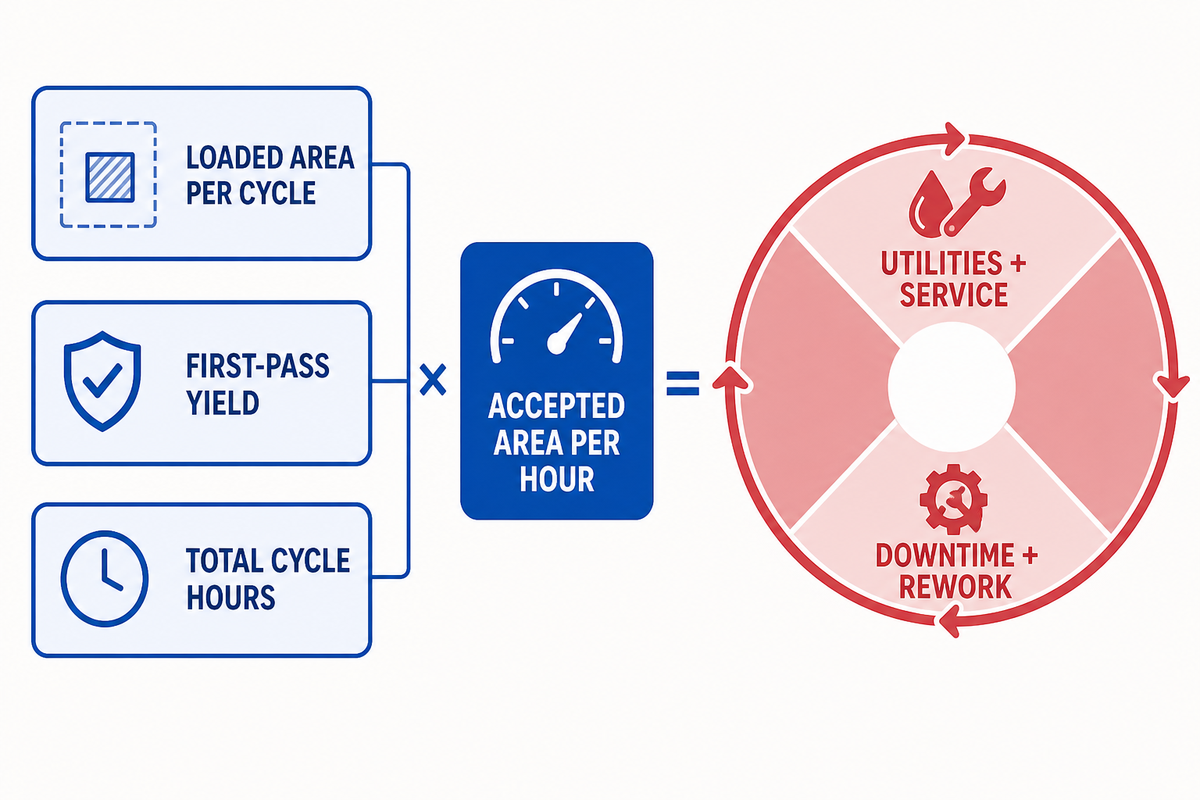
Autoclave economics are based on accepted output. Volume of the vessel isn’t necessarily tied to accepted output. A first, rough estimate of accepted output could be loaded glass area × first-pass yield ÷ total cycle hours. Results must be based on realistic product mix, loading and unloading times, heat up and cool down, and expected availability.
An example is a representative load of 180 m² yielding 95% first-pass accepts 171 accepted m². If loading, processing, cooling and unloading take 5.5 hours, the rate is 31.1 accepted m² per operating hour. A nominally larger vessel could lose in this comparison if its racks reduce usable area or its thermal mass extends the cycle.
Build the ownership worksheet with installation, foundations, lifting, utilities, heating energy, compressed air, cooling, scheduled service, calibration, spares, operator time, recipe validation, and rejection handling. Also include production and reject downtime. Apply several product mixes and tariffs. Record electrical heating, steam where a site actually uses it, compressor power, cooling demand and standby losses as separate utility lines. That makes energy consumption visible without implying that one published glass-plant case can predict another factory’s operating cost. Without these inputs, price bands from suppliers aren’t actionable.
Verify the Supplier with a Glass-Specific FAT and SAT
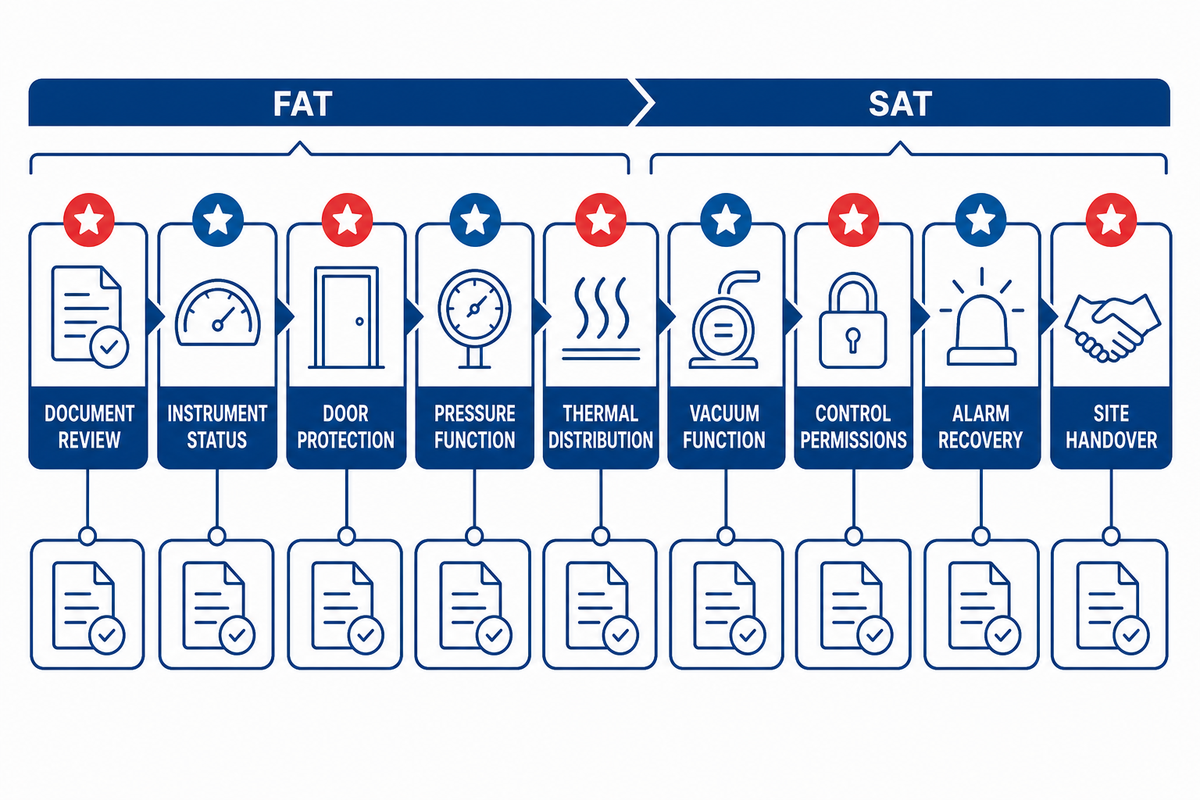
A factory acceptance test should verify functions on an agreed load. Begin document review and check calibration status and pressure-vessel records. Then verify recipe permissions, interlocks and alarms, pressure hold, vacuum service, trend capture and recovery behavior. Use a representative load if a contracted performance test requires a loaded performance test. Keep equipment acceptance separate from finished-product conformity. 16 CFR Part 1201 defines safety performance requirements and test methods for covered architectural glazing; a FAT or SAT can verify the vessel and controls, but it doesn’t replace product testing, marking or market-specific conformity evidence.
| Acceptance check | Record to retain | Decision it supports |
|---|---|---|
| Document review | Approved drawings and purchased specifications | Build matches the order |
| Instrument status | Calibration and sensor identification | Measurements are traceable |
| Door protection | Interlock challenge record | Unsafe opening is prevented |
| Pressure function | Hold trend and relief-device records | Pressure behavior is documented |
| Thermal distribution | Loaded sensor map and trend | Cold spots are evaluated |
| Vacuum function | Zone and leak-check record | De-airing support is verified |
| Control permissions | User, recipe and audit-trail demonstration | Changes are attributable |
| Alarm recovery | Alarm challenge and recovery record | Abnormal events are handled |
| Site handover | Utility checks, training and open-item list | Installation-dependent issues are closed |
Assessments of site procedures and jurisdiction regulations cover worker safety. OSHA’s pressure-vessel inspection directive demonstrates that pressure equipment can’t be treated as an ordinary heated chamber. The buyer should arrange with the responsible parties guarding and lockout, relief devices, access control, instruction on operations, and inspection.
- ✔ Approved drawings, codes, specifications, materials, certificates, manuals and other purchased documentation match the purchase order.
- ✔ Calibrated pressure and temperature instruments are traceable and identified.
- ✔ Door and pressure interlocks and fan, heating, and emergency interlocks have been challenged and documented.
- ✔ The sensor map and load show the agreed distribution.
- ✔ At handover, recipes, alarms, users, audit trails, and export files are available.
- ✔ Site acceptance repeats installation-dependent checks with actual utilities.
What Is Changing in Glass-Lamination Buying Decisions?
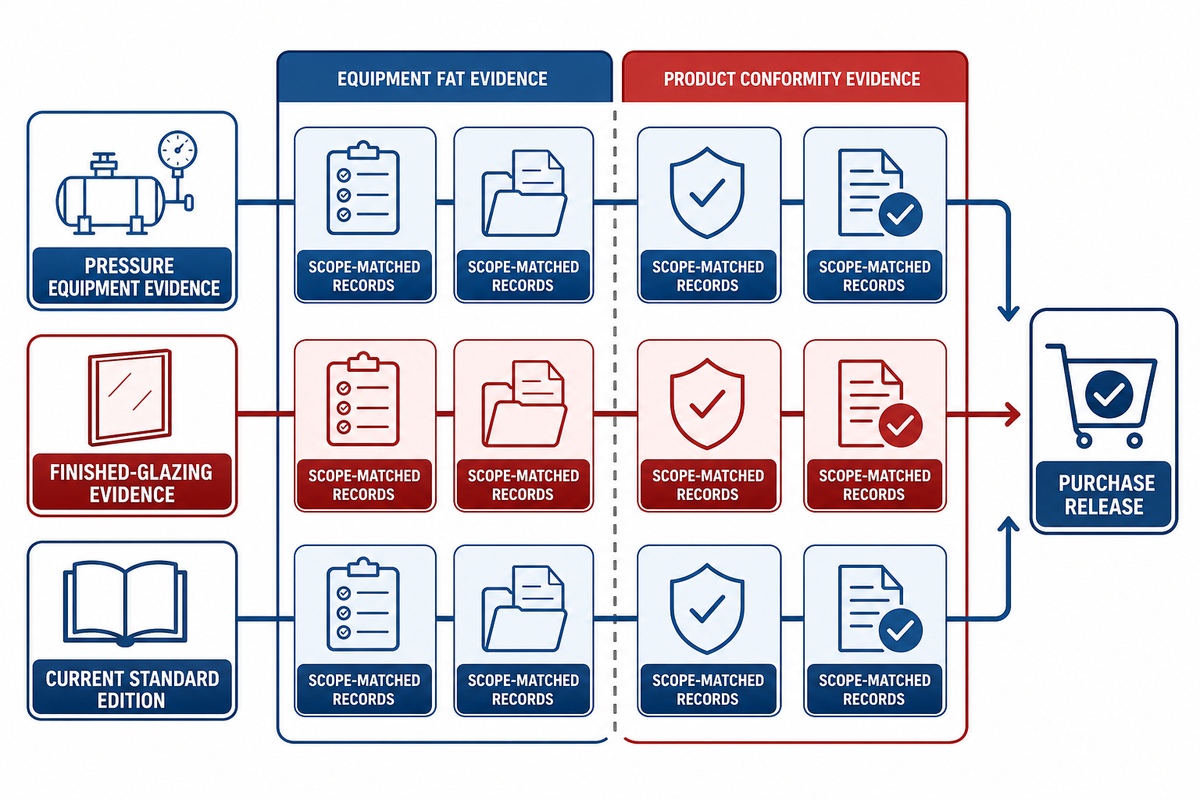
Current search results show comparisons of PVB autoclave routes against EVA and autoclave-free production routes. The standards layer is moving too: ANSI’s 2026 update records a revised safety-glazing edition and changes to testing and marking. Buyers should therefore keep the applicable edition, market and finished-product evidence explicit instead of treating CE, a pressure-vessel mark or a machine test as interchangeable proof.
Buyers should write flexible but testable requirements: recipes permitting multiple qualified systems, sufficient numbers of sensor channels, exportable data, utility metering, and rack designs that are amenable to be documented rather than improvised.
Frequently Asked Questions
Can glass be autoclaved?
Yes, if the assembly and interlayer are designed for an approved lamination process. The vessel doesn’t melt normal glass; it applies controlled heat and gas pressure to a pre-laminated stack after de-airing. The validated process should be in accordance with the interlayer supplier’s guidance and consider glass thickness, laminate build, load geometry, sensors, and cooling.
What temperature and pressure should a laminated glass autoclave use?
There’s no safe universal recipe. Published recipes describe common practices and not a commissioning specification. Setpoints, ramp rates, dwell, vacuum timing and cooling must be validated for the named interlayer, product construction, load arrangement, actual glass temperature and applicable quality requirements.
How do you prevent bubbles in laminated glass?
Consider the mechanics separately for pre-lamination air removal and autoclave-cycle issues. Review glass cleanliness and integrity of the bags, nip or vacuum, sensor position, heating distribution, and cooling under pressure. Record where and when bubbles occur. Defect maps and cycle traces can better direct process improvement than blindly increasing pressure or time, especially with no hypothesis.
Is an EVA laminating oven better than a PVB autoclave?
There’s no best route. Choose from the approved interlayer systems, end use, edge exposure, optical targets, route of certification, batch mix, and customer specification.
What belongs in a glass-autoclave factory acceptance test?
Use an agreed representative load and verify calibrated sensors, distribution, pressure stability, vacuum performance, alarms, recipes, records and data export. Address deviations prior to shipment.
How This Guide Was Framed
This guide uses publicly available technical and regulatory sources to inform glass-lamination questions. It doesn’t assert an end-user recipe, production output or project dataset. Final vessel code, cycle validation and compliance of finished products remain project- and jurisdiction-specific.
Send Your Product Mix, Not Just a Diameter
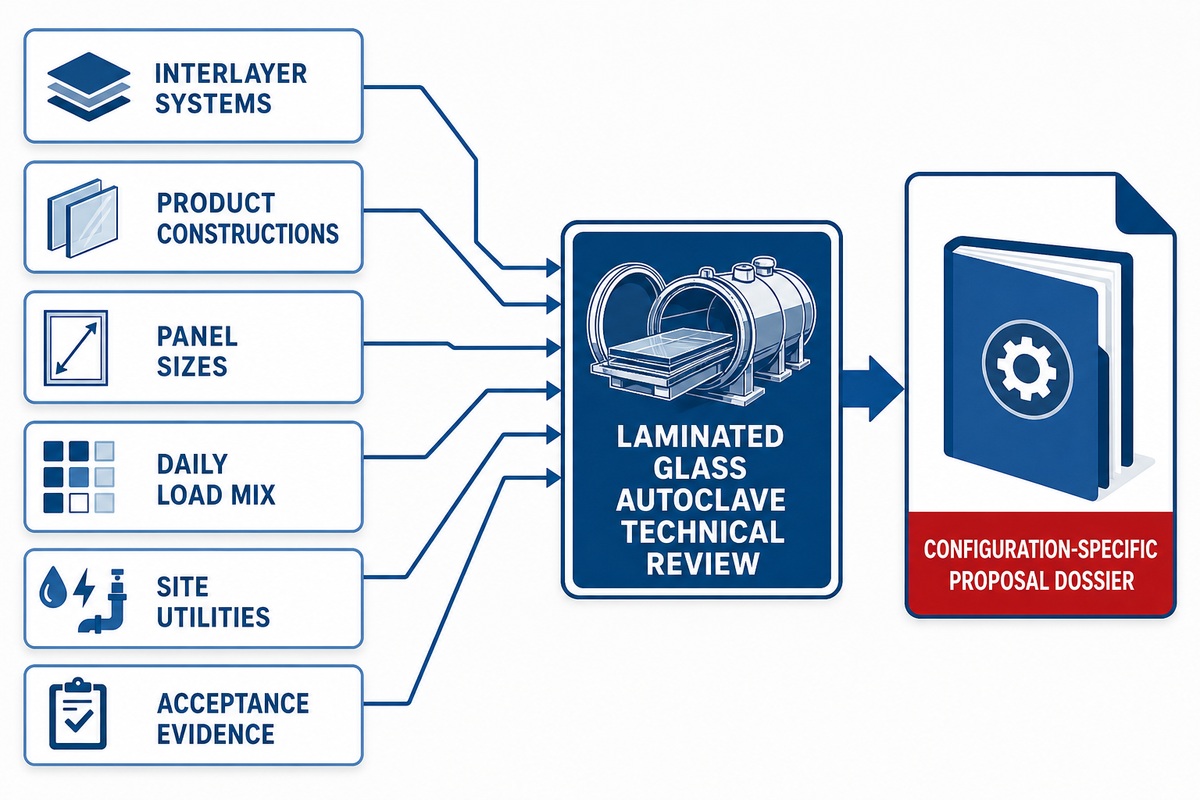
Provide maximum panel dimensions, laminate builds, interlayer systems, daily product mix, available utilities, installation country and the type of evidence required for acceptance. Taiguo can comment on an industrial autoclave system based on your information, but not treat a generic cycle as a production recipe.