Get in Touch with Taiguo

Chemical Reactor Autoclave: A Practical Buyer’s Guide

Contents
show
CHEMICAL PROCESS EQUIPMENT GUIDE
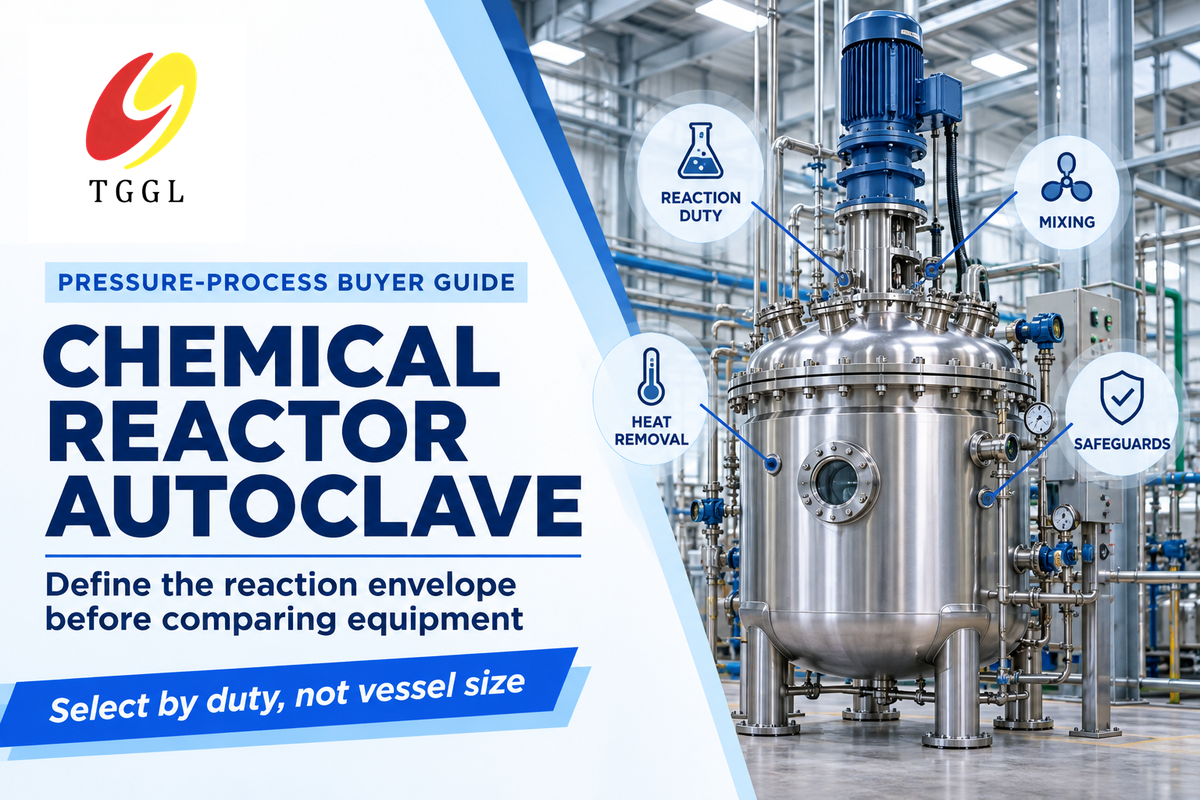
A chemical reactor autoclave, also described in search results as an autoclave vessel, reactor vessel, or chemical autoclave, is selected by applying “safety first” to the vessel, temperature and pressure, mixing duty, containment, safeguards, cycle time, evidence, and phase control. Whether a supplier calls the package a high pressure autoclave reactor or a high-pressure autoclave, a chemical reactor autoclave isn’t selected from pressure-vessel capacity alone; the reaction envelope controls the choice.
Engineering boundary: This guide helps buyers organize an RFQ and challenge assumptions. It does not size a pressure vessel, relief device, agitator, or cooling system. Those decisions require reaction data, the governing jurisdiction, and review by qualified process, mechanical, and safety engineers.
Chemical Reactor Autoclave vs Sterilization Autoclave
What is a chemical reactor autoclave, and how is it different from a sterilization autoclave?
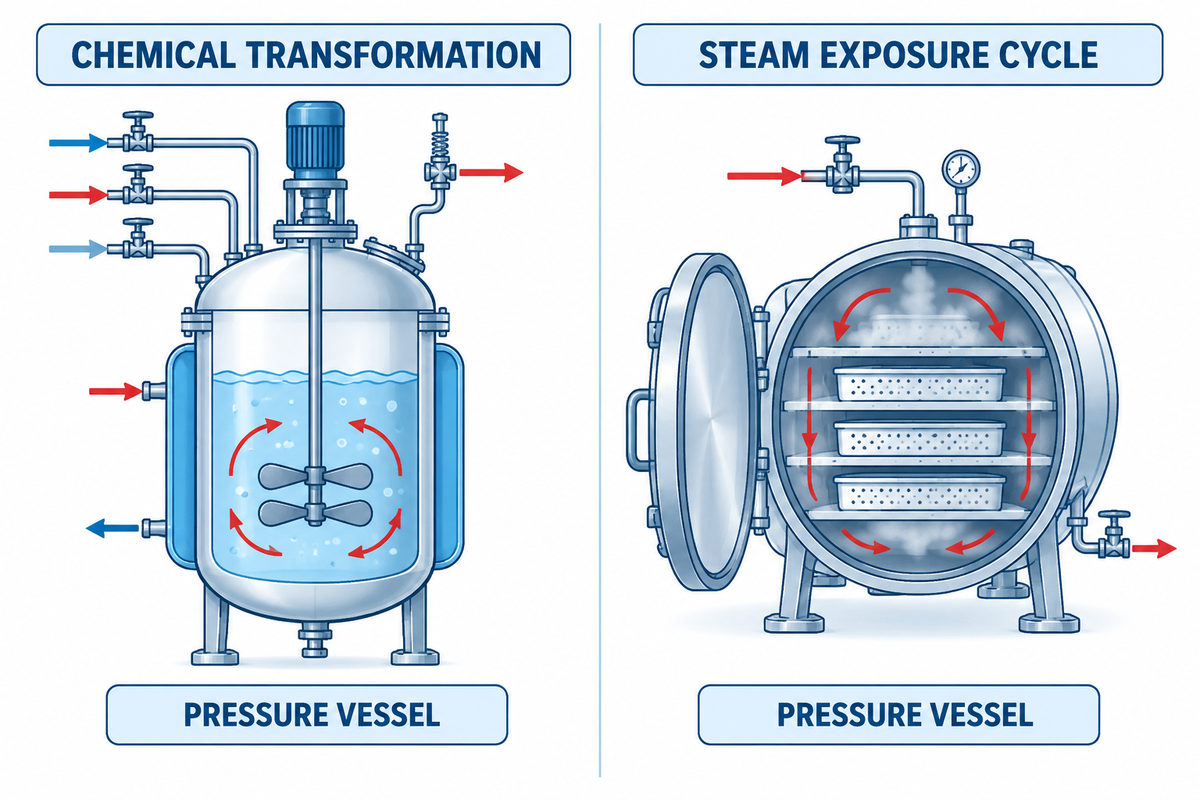
The two machines have different pressure-vessel requirements. A sterilization autoclave uses a validated steam-exposure cycle to achieve a microbial inactivation target; lab autoclaves are used for that duty under a different acceptance basis. A chemical reactor autoclave creates and controls conditions for a chemical transformation, including transitions from atmospheric conditions into the defined operating envelope. Its performance is judged by conversion, selectivity, containment, and repeatability.
The change in the specification is reflected in the difference in the autoclave requirements. A reactor may require control of reactants, rapid removal of heat, and relief based on reaction behavior, while a sterilizer may require control of air and steam removal.
In research and development, a small “autoclave reactor” may help perform hydrothermal synthesis, other chemical synthesis work, catalytic hydrogenation, or polymerization; across scientific research industries, researchers use autoclave reactors for hydrothermal and solvothermal synthesis under a defined test protocol, and such scientific research units are used in the chemical industry under a research acceptance basis. An industrial “high pressure reactor” uses the same scientific principles at a different risk and production level. Whether the chamber is stainless steel, Hastelloy or other alloy, high temperature service and a driven stirrer must still be judged against the actual chemistry, with high temperature and high pressure duty, high pressure and temperature interactions, and stirring speed recorded in the selection basis. A hydrothermal synthesis reactor is one such application for chemical reactor autoclave.
| Decision | Chemical reactor autoclave | Sterilization autoclave |
|---|---|---|
| Primary outcome | Defined chemical or material transformation | Validated microbial inactivation |
| Process inputs | Reactants, solvents, catalysts, gases, solids, impurities | Steam, load configuration, air-removal and exposure conditions |
| Critical functions | Mixing, addition, gas dispersion, heat removal, containment | Steam distribution, penetration, exposure and drying |
| Acceptance evidence | Reaction-envelope tests, safeguards, mixing and thermal performance | Cycle records and load-specific sterilization validation |
Taiguo’s Industrial autoclave systems page covers general configurations and commercial enquiries. This guide covers chemical-reaction design and procurement questions.
What Defines the Reaction Design Basis for Equipment Comparison?
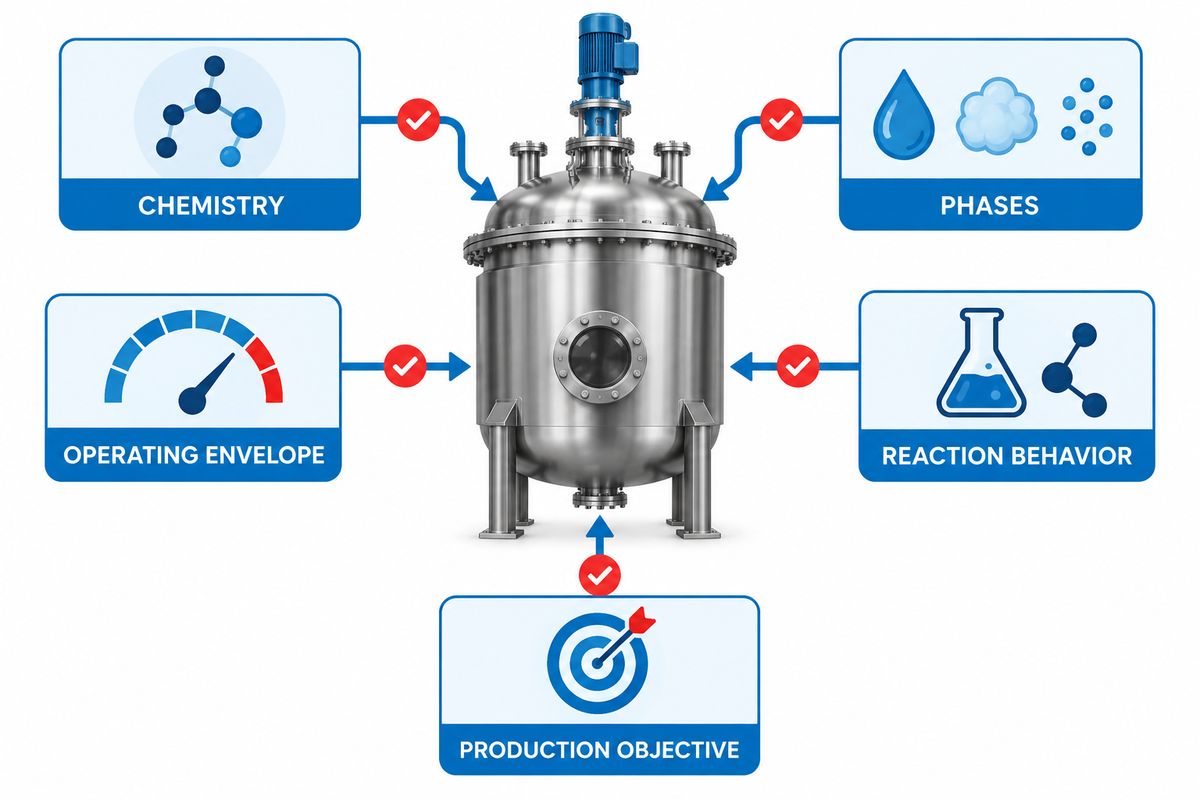
A supplier shouldn’t configure a reactor based on product name alone. Design basis should include description of normal operations, starts and stops, cleanings, and credible deviations. The UK Health and Safety Executive (HSE) states process design should identify operational deviations and impurities before detailed mechanical design, and materials should be compatible during normal operation as well as excursions.
Engineering reference: UK HSE plant-design guidance frames the design basis around process conditions, materials, controls, relief, and commissioning.
Start with a controlled data sheet separating known values from assumptions:
- Chemistry: All products, reactants, intermediates, solvents, catalyst, contaminants and cleaning agents, and their concentration and addition sequence.
- Phases: gas-liquid, liquid-liquid, slurry, crystallizing, foaming, or viscosity-changing behavior across the entire batch.
- Operating envelope: The normal and maximum credible operation of the device should be considered, including vacuum and fill ranges, temperature ranges, expected fatigue, and thermal cycles.
- Reaction behavior: heat generation, gas generation, accumulation risk, decomposition onset, and sensitivity to addition or mixing failure.
- Production objective: accepted product per batch, required cycle frequency, campaign length, cleaning and changeover expectations.
If a value isn’t determined or measurable, say so. “To be established by calorimetry,” for example, would be better and clearer than stating, “Vendor will assume….”
Materials, Seals, Agitation, and Heat Transfer as One System
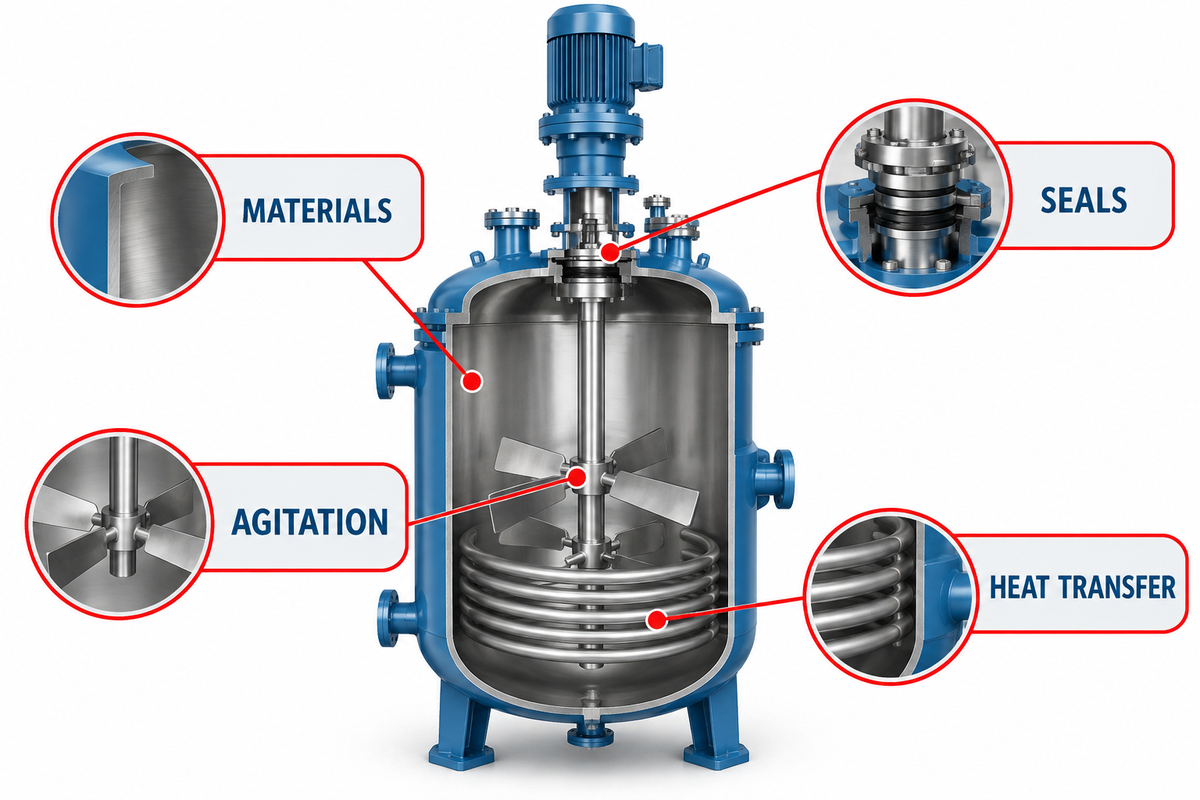
How should an industrial buyer select the vessel material, seals, agitation and heat-transfer system?
Materials, seals, agitation, and heat-transfer decisions are closely related because each one changes the operating limits of the others. For corrosive chemical processes, chemistry, corrosion, pressure, and the pressure gauge arrangement affect material selection, fabrication, and instrumentation review. Fluid phases and agitation affect mixing and sealing, while heat release and wall fouling affect jacket or coil duty.
Engineering reference: UK HSE plant-design guidance treats materials, pressure systems, process design, controls, and relief as linked design considerations.
| Decision type | Question it should trigger | Evidence to request |
|---|---|---|
| Chemical composition and impurities | Which corrosion, embrittlement, swelling, contamination, or galvanic mechanisms are credible? | Compatibility review, corrosion data, coupons or laboratory tests where uncertainty remains |
| Pressure, temperature, and cycling | What design code, allowable stress, fatigue assessment, gasket, and seal limits apply? | Design calculations, material certificates, weld and heat-treatment records |
| Gas-liquid or slurry duty | Does the impeller suspend solids, disperse gas, or only blend the bulk liquid? | Mixing objective, torque curve, speed range, scale-up basis, test method |
| Exothermic duty | Can heat be removed at the worst credible generation rate, including fouling and utility variation? | Calorimetry basis, heat-transfer calculation, utility specification, control response |
| Toxic or volatile service | Is a dynamic shaft seal acceptable, or is a magnetic drive or double-seal system justified? | Leakage philosophy, seal plan, monitoring and failure response |
| Viscosity change | Can the drive deliver torque at the worst point in the batch? | Viscosity curve, motor and gearbox rating, torque margin |
| Solids and crystals | Will particles settle, abrade surfaces, or block small passages? | Suspension criterion, clearance review, drain and cleanout test |
| Sampling under pressure | Can a representative sample be taken without unsafe exposure? | Sampling procedure, valve arrangement, containment review |
| Cleaning and changeover | Can every wetted area be drained, inspected, and cleaned? | Coverage test, residue limit, access and dismantling plan |
Don’t choose an alloy based on a single compatibility chart. Temperature, concentration, water content, chlorides, dissolved gases, stress, the condition of the weld, and cleaning chemistry can affect the mechanism of failure across the specified temperature and pressure conditions, including elevated temperature and pressure excursions. The same is true for linings. A liner can protect the surface, but it introduces questions about permeation, heat transfer, inspection, mechanical damage, and repair when high surface exposure or imperfect coverage concentrates attack.
Prove Heat Removal for Normal and Credible Upset Cases
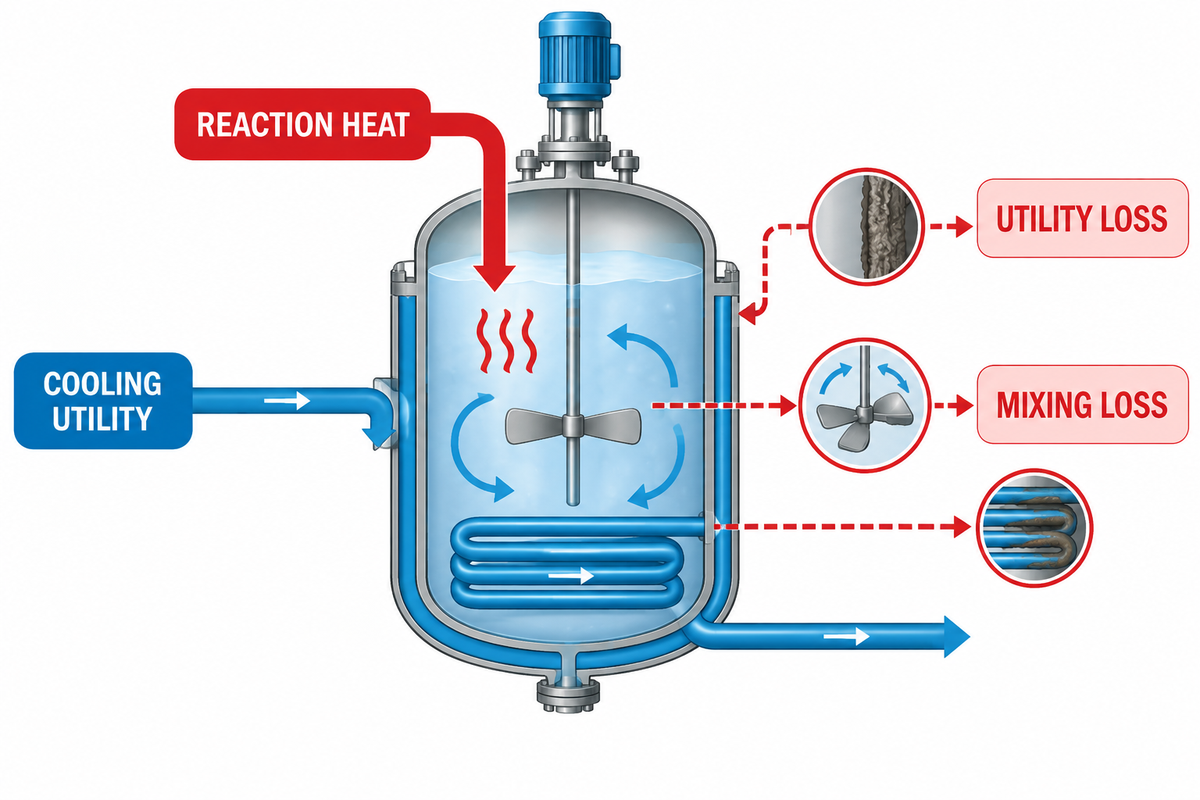
Heating capacity sells a cycle; cooling capacity protects it. The question for a jacketed reactor shouldn’t be whether it can hold a setpoint during a benign water test. Because autoclave reactors are equipped with a heating system, the question is not simply how fast temperature rises; the temperature reaction profile must show whether the entire system can remove the heat of the fastest probable reaction at the specified fill, viscosity, fouling, agitation, and utility condition.
Incident reference: the US CSB T2 Laboratories investigation documents a runaway reaction following loss of adequate cooling.
A review of the process identifies four heat loads: sensible heating or cooling of the batch, heat of reaction, phase-change load, and heat introduced by the equipment or environment. Then evaluate the vulnerabilities: loss of process cooling water, failure of control valves, loss of agitation, delayed addition, reactant buildup, fouling, or a restart after phases have separated.
Tests for reaction calorimetry and decomposition may be required. Published overall heat transfer coefficients don’t take the place of a validated basis because of geometry, fluid properties, agitation, jacket design, and fouling.
Fail safe features can share the same failure mode. A quench which depends on effective mixing can be compromised by the same agitator failure which initiated the event. Therefore, its chemistry, available free volume, foaming, injection and mixing dependence should be assessed separately.
Relief, Inerting, Controls, and Emergency Shutdown
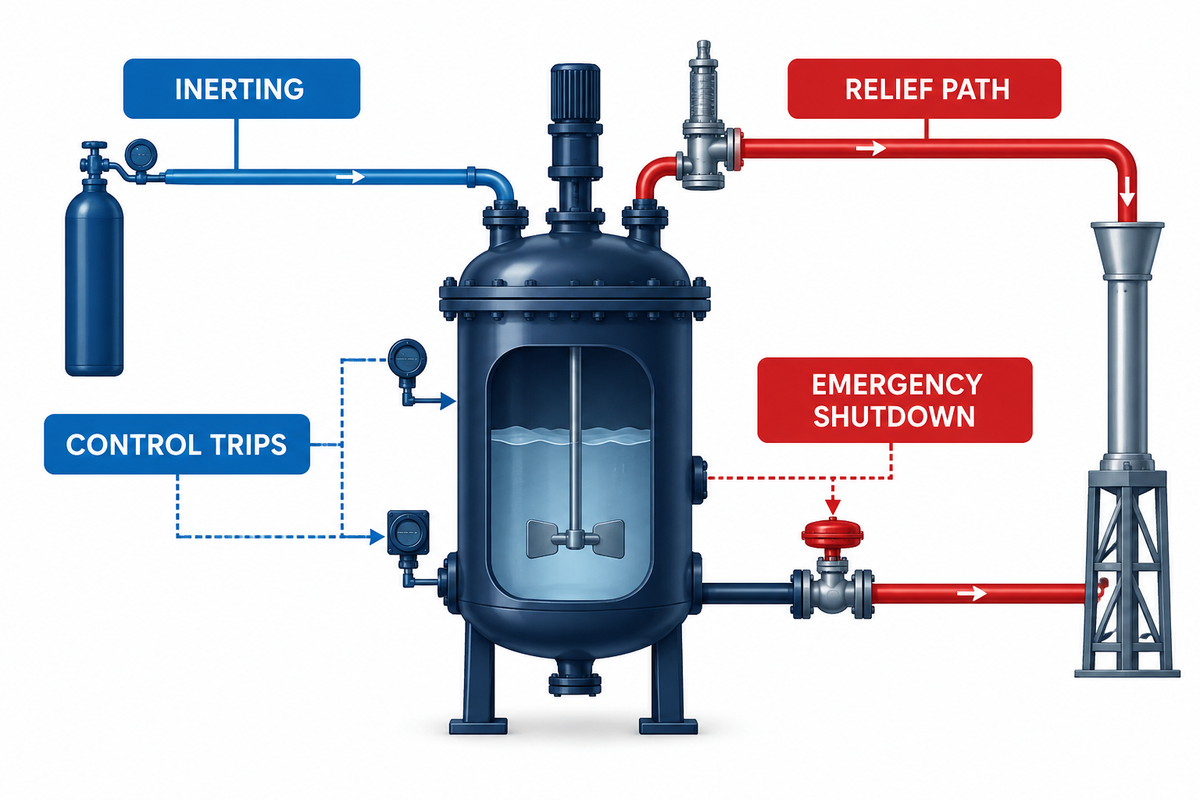
What safety information belongs in a chemical reactor request for quotation?
Start with scenarios, not a shopping list of instruments. It’s the responsibility of the buyer’s process-safety team to define plausible causes and consequences, detection, preventive and protective actions, and safe disposition. The equipment supplier then defines what the package provides, and what remains in the customers’ plant.
Controlling pressure may also involve discharging material from the vessel. A relief device may restrict pressure, but may allow the downstream transfer of hot, toxic, flammable, and/or still reacting material. Relief discharge from the vessel may be restricted to certain areas, and quench systems, knockout vessels, and treatment systems may be requested outside the reactor package.
| Scenario | Data required | RFQ question |
|---|---|---|
| Runaway or decomposition | Heat and gas generation versus temperature and time | Which independent trips, relief basis, quench, dump, or containment interfaces are included? |
| Loss of cooling | Utility reliability, thermal inertia, time to critical condition | What happens on low flow, high return temperature, power loss, or valve failure? |
| Loss of agitation | Phase separation, settling, hot-spot and restart hazards | Does the control system stop additions and prevent an unsafe restart? |
| Air ingress or oxygen exposure | Flammability limits and oxygen sensitivity | How are inerting, purge verification, oxygen monitoring, and permissives arranged? |
| Blocked or misrouted discharge | Maximum pressure source and discharge hazards | Where do relief and vent streams go, and can that destination accept the event? |
The design of relief systems is highly dependent upon the nature of the fluid and the type of case being considered, as outlined in the AIChE guidance on pressure-relief sizing. The EPA pressure-vessel safety alert describes some potential reasons for reviewing the operating scenarios and protective systems. Compliance with the code addresses the mechanical aspects of construction. Process safety requires sufficient evidence.
Usable Throughput and Total Cost Beyond Nameplate Volume
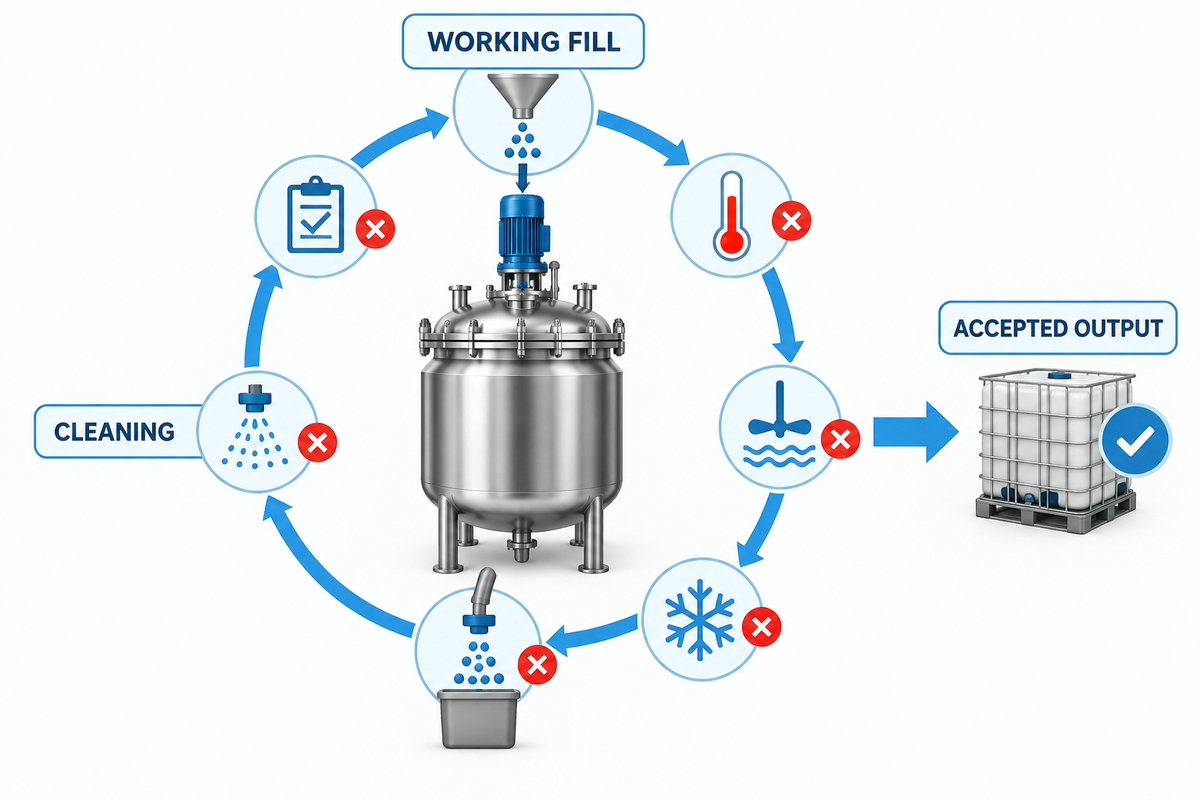
Which specifications determine usable throughput and total cost?
Compare accepted output over a real production period, using working fill, accepted yield, complete cycle time, cleaning, changeovers, downtime, and batch rejection rather than the nominal vessel volume. Use the following expression as a transparent starting point, then qualify every input with the agreed production and acceptance basis:
Engineering reference: UK HSE plant-design guidance includes commissioning and verification of design intent, supporting comparison on usable performance rather than nameplate volume alone.
Accepted output per week = accepted product per batch × batches per week
The accepted product per batch isn’t the nominal vessel volume. It accounts for working fill, displaced volume from coils and internals, headspace, conversion, selectivity, and losses due to isolation and rejection of batches. Batches per week is determined by charging, heat up, reaction, cooling, depressurization, sampling, discharge, cleaning, inspection, and changeover.
A larger vessel can produce less accepted output if heat transfer stretches the cycle, mixing creates variation in product quality, cleaning consumes the time window, or batches are rejected.
Costs associated with installation of a package, utilities, inert gas, and cooling should be included. Costs associated with hazardous area work, relief disposal, instrumentation and controls, spares, seals, maintenance, inspection, cleaning, and validation should also be included. Operator time and cost of off-spec material should also be considered. Compare the same boundary for every bidder.
Turn the Design Basis Into an Auditable RFQ
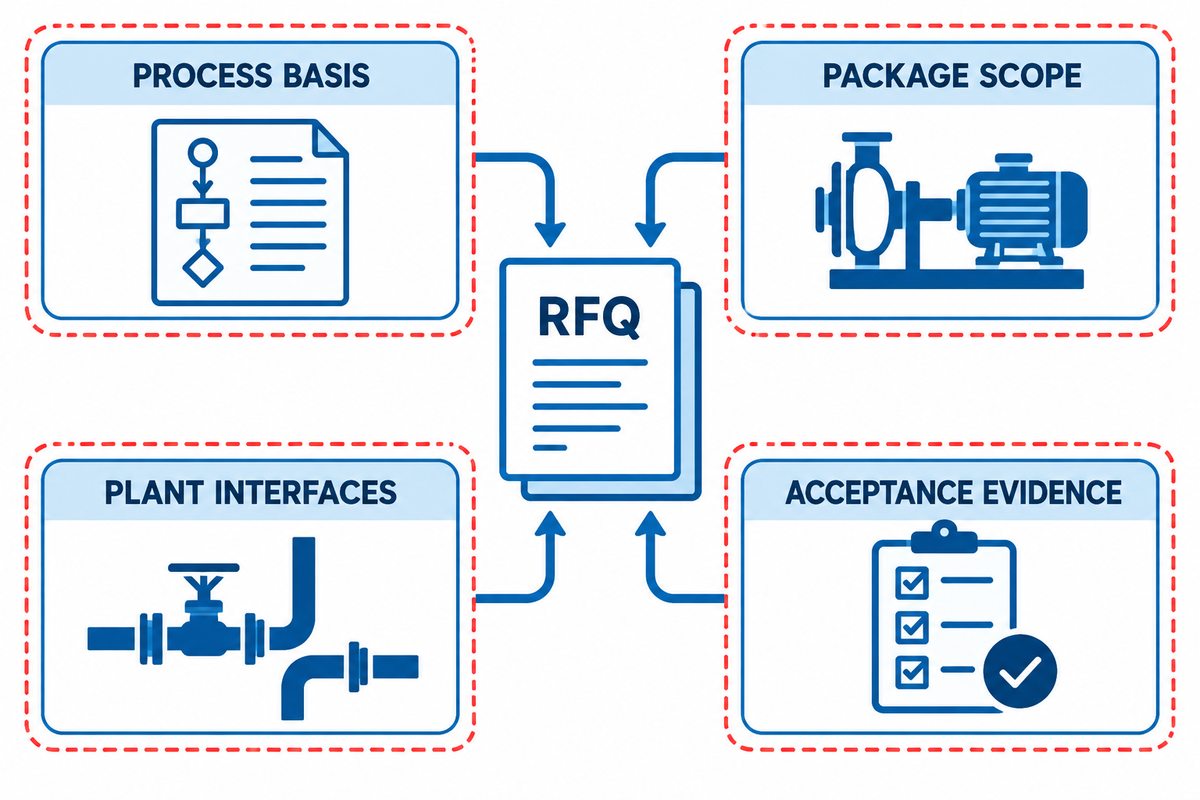
Responsibility is evident in a well-drafted RFQ. Provide design basis, process flow, preliminary P&IDs, utility system, classification of hazardous areas, code and jurisdiction, documentation, and acceptance criteria. Use a compliance matrix with four answers: included, excluded, deviation, or information required.
Engineering reference: UK HSE plant-design guidance supports documenting the design intent and verifying it during commissioning.
Who sizes the relief device? Who verifies the discharge destination? Who supplies the oxygen analyzer? Who owns the control narrative? Who verifies chemical compatibility? Who provides the final setpoint list? There are gaps in quotation that turn into variation orders and safety gaps later on.
Minimum RFQ evidence pack
- Reaction and physical-property data with unknowns highlighted
- Maintenance access, isolation points, and inspection responsibilities
- Normal, design, upset, vacuum, and cleaning conditions
- Change-control requirements for any post-award design deviation
- Mixing, addition, heat-transfer, containment, and sampling objectives
- Code, certification, inspection, documentation, and traceability requirements
- Cause-and-effect philosophy and plant/package interface list
- FAT, shipment, installation, commissioning, and performance acceptance criteria
Require Representative-Load Evidence at FAT and Commissioning
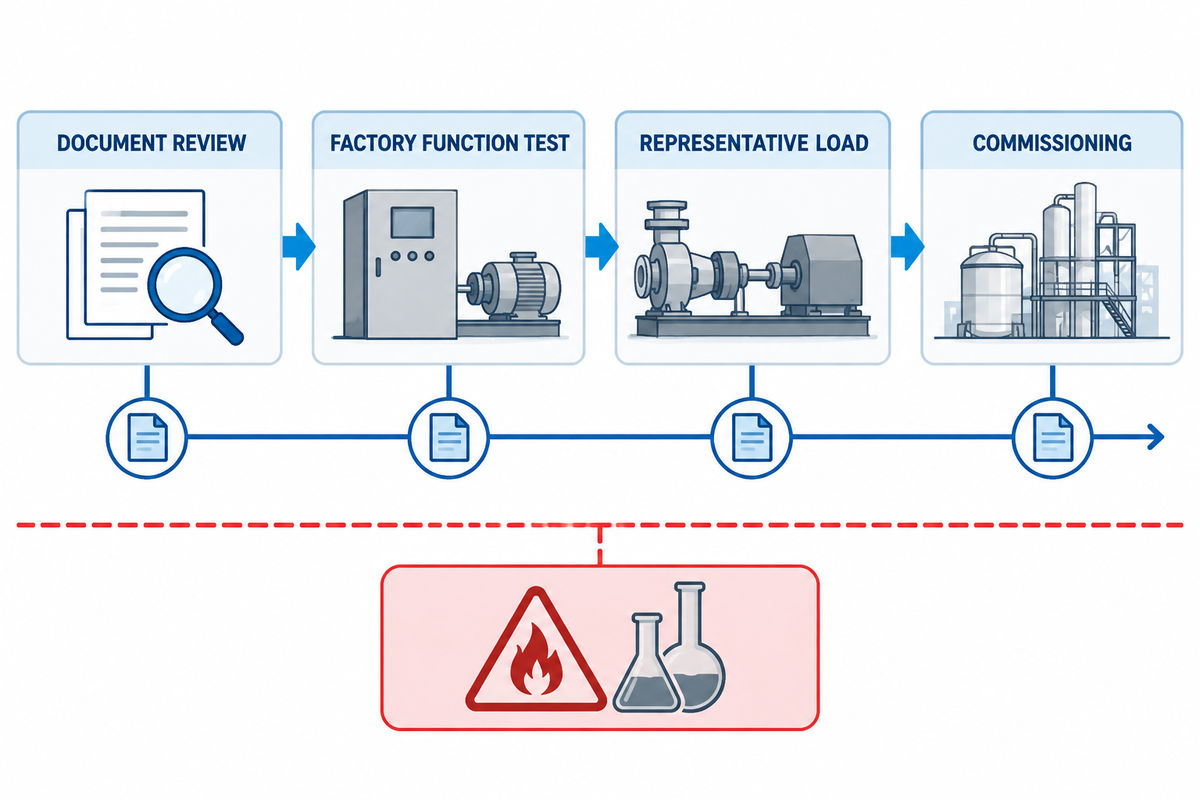
What documents and tests should a buyer require?
Acceptance should happen in layers. Design and build document review should prove design intent. Testing and demonstration in the fabrication shop should prove function and safety prior to shipment. Site acceptance testing should prove safe operations under agreed conditions. Passing one layer doesn’t replace another.
A representative load test proves only the functions and conditions tested. It doesn’t replace other tests like reaction hazard screening, isothermal adiabatic calorimetry, decomposition, and other end-use cases. Functional evidence and chemical evidence must be separated in the acceptance matrix.
For context on the manufacturer on the category page, see About Taiguo. Adjacent applications require different evidence: the site’s pharmaceutical autoclave guide, rubber vulcanization guide, and wood preservation guide shouldn’t be used for chemical reaction specifications.
| Stage | Examples of evidence | What it does not prove |
|---|---|---|
| Document review | Calculations, drawings, material traceability, weld procedures, NDE, calibration, manuals | Actual integrated operation |
| Factory acceptance test | I/O checks, alarms, permissives, trips, rotation, leakage, pressure tests, software records | Performance with the site utilities and real process |
| Site acceptance and commissioning | Installation checks, utility capacity, loop checks, inert tests, controlled process trials | Every future recipe or untested upset |
| Representative-load performance | Heat-up and cool-down, mixing indicators, pressure control, repeatability, accepted output | Conditions outside the agreed test envelope |
HSE commissioning guidance includes pressure and leak tests, protective-device tests, alarm and trip testing, P&ID checks, inert fluid tests, and process-material commissioning. Turn these into witnessed acceptance points with objective criteria.
Use the Reaction-Envelope Gate Before Shortlisting a Supplier
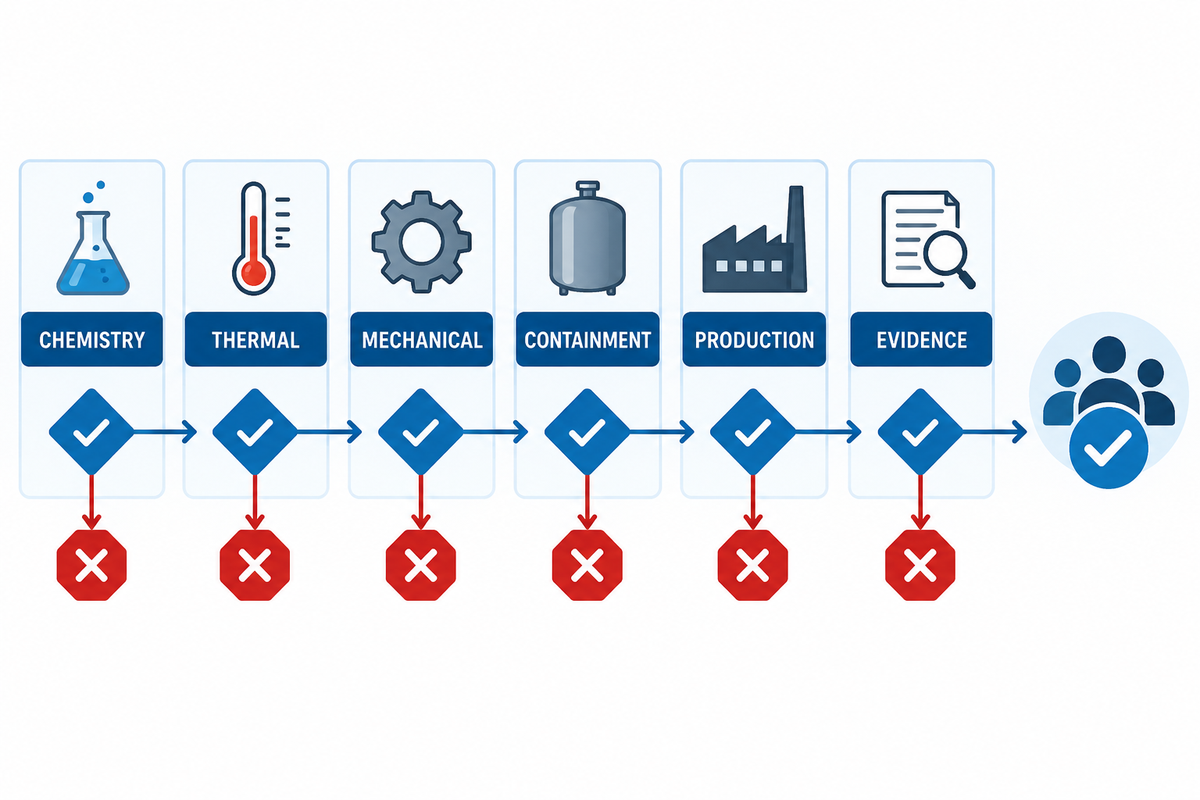
A supplier shortlist is premature if any load bearing input is missing and no one owns the work to establish it. Use this six-part gate:
Engineering reference: UK HSE plant-design guidance provides the process, mechanical, control, relief, and commissioning checks behind this reaction-envelope gate.
- Chemistry gate: documentation of compositions, impurities, and credible reactions.
- Thermal Gate: Evidence plans for heat generation, cooling, decomposition and utility loss are provided.
- Mechanical Gate: pressure, temperature, vacuum, cycling, materials, fabrication and inspection are defined.
- Containment Gate: definitions of seals, sampling, venting, and relief, as well as emissions, are provided.
- Production Gate: Working volume and cycle time, yield, cleaning and availability are provided.
- Evidence Gate: Calculations, records, FAT, commissioning and performance are provided.
- Interface gate: package and plant responsibilities are assigned for utilities, controls, relief discharge, installation, and commissioning.
If these inputs are undefined, a firm configuration doesn’t mean that the offered solution is necessarily the cheapest or fastest. Other assumptions may be hidden in the configuration.
Discuss Your Pressure-Process Requirements
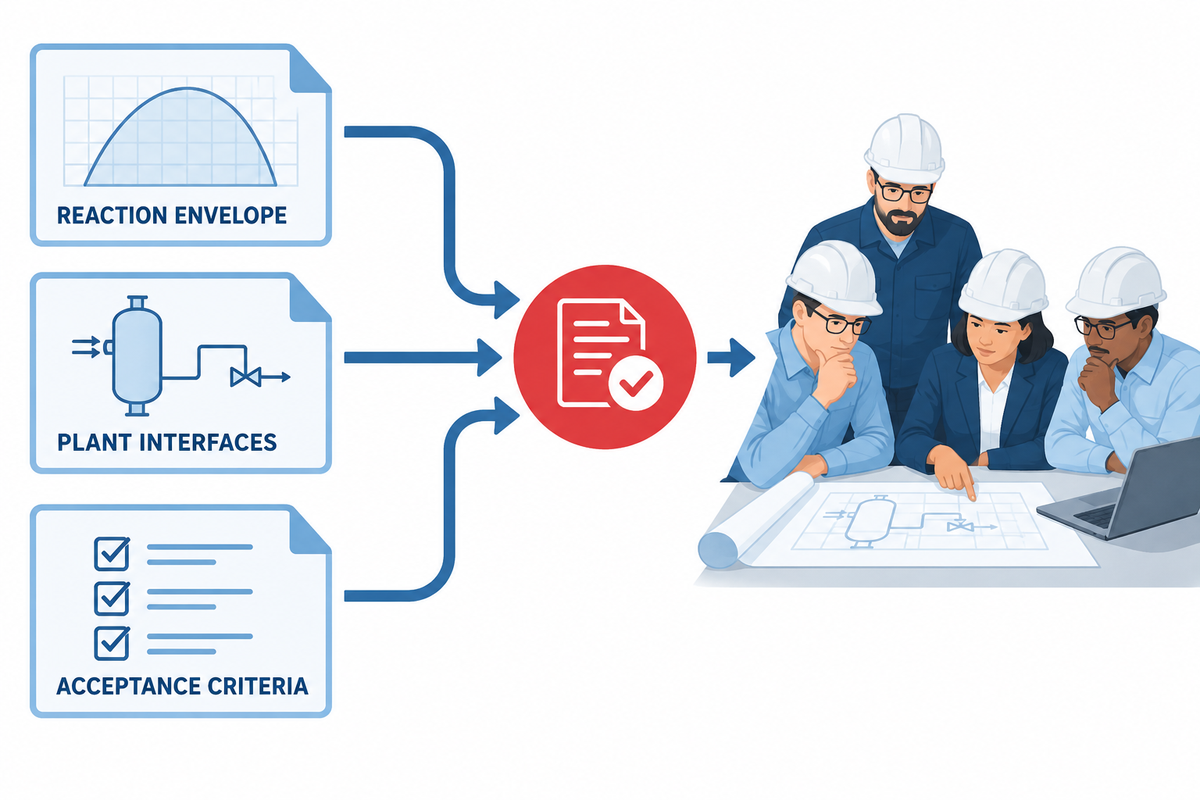
Taiguo’s stated manufacturing capabilities cover industrial autoclaves. For a chemical reaction duty, send the complete reaction envelope and ask for a documented capability review rather than assuming suitability from a catalogue rating.
Engineering reference: use the UK HSE plant-design checklist to organize the reaction and plant-interface information sent for technical review.
Frequently Asked Questions
Is a chemical reactor autoclave the same as a steam sterilizer?
No. While two systems may both be pressure vessels, Chemical reactor is concerned with the definition of a chemical reaction, while thermal vessels are defined by phase contact, mixing and utility loss. Shared pressure ratings don’t make the systems interchangeable. Sterilization evidence therefore cannot establish reaction heat removal, mixing, chemical compatibility, gas generation, or relief adequacy.
Some smaller-scale hydrothermal or solvothermal units use a lined pressure container, sometimes without the active mixing and other process systems described here. This report is for the industrial customer. It won’t consider every research autoclave unit as a production reactor package.
Which vessel material is best for a high-pressure chemical reactor?
Select a material that’s compatible with all alloys and chemicals, impurities, and contaminants expected during normal, cleaning, and excursion conditions, considering coking, cracking, embrittlement, fatigue, corrosion, contamination, fabrication, inspection, and lifecycle. There’s no best alloy. Compatibility data and commissioning tests will help with the selection when the alloy is still uncertain.
How much headspace should a batch reactor have?
Size headspace from gas evolution, vapor pressure, foaming, thermal expansion, fill variation, agitation, addition sequence, displaced internals, and the relief scenarios established for the actual reaction. A “reasonable” percentage isn’t a safe design basis. Justify and document the selected operating volume for every bidder.
What safety devices does a reactor autoclave need?
Where the safeguard set isn’t sufficient to ensure safe operation, it may be necessary to install other safeguards. These may include relief systems which route to a safe destination, pressure and temperature trips, inerting and/or purge, oxygen monitoring, agitation failure logic, cooling flow detection, charging permissives, and emergency quench or dump systems; pressure relief systems and low temperature trips belong to the same scenario-based review.
What should a buyer send before requesting a quotation?
Send details of chemicals and their concentrations, physical properties, normal and design conditions, reaction and decomposition data, mixing and thermal objectives, material and containment restrictions, utilities, production schedule, cleaning, codes, documentation, and acceptance tests. Clearly identify missing data. Assign responsibility to provide it.