Get in Touch with Taiguo



Wet Back vs Dry Back Boiler: Advantages, Design Differences, and How to Choose
If you are choosing a firetube boiler for an industrial steam or hot water application, one of the earliest design choices you will need to make is whether you would prefer a wet back or dry back configuration. Both configurations have been used for many years, but they are dimensioned differently in terms of how they accomplish combustion gas reversal at the rear of the boiler—by a single factor, this difference has significant implications for efficiency, maintenance, operational costs, thermal stress, and equipment life-cycle.
This document explains the features of each design, compares the options across the dimensions which are most significant to plant engineers and procurement specialists, and provides a decision framework for selecting the optimum requirement for your specific application. For related pricing considerations, see our industrial steam boiler resource.
In This Guide
What Are Wet Back and Dry Back Boilers?
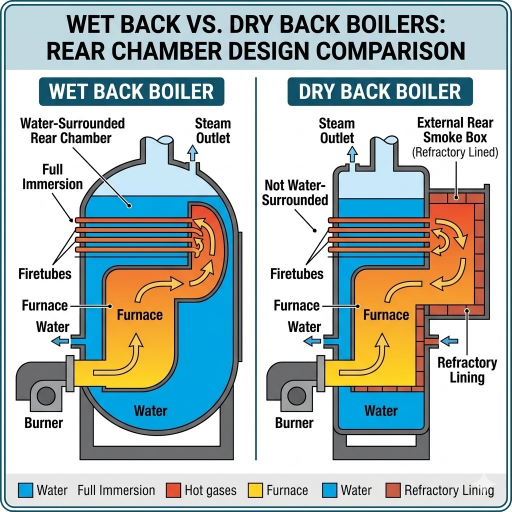
A wet back boiler refers to a firetube boiler with a rear reversing chamber, which is completely surrounded by water. Here, combustion gases leaving the furnace pass through a water-cooled turnaround chamber before entering the second pass of tubes. As the chamber is contained within the pressure vessel, heat from the hottest section of the gas path is delivered directly into the boiler water rather than being absorbed by refractory material.
By contrast, a dry back boiler uses a refractory lined rear wall to deflect flue gas. The rear door is a steel casting and lined with castable refractory or firebrick. This refractory line acts as a heat barrier—it insulates rather than transmits heat. Dryback boilers were the original Scotch marine design, and their market share has declined steadily.
55%
Firetube share of industrial boiler market (2025)
25+ yrs
Expected boiler service life with proper maintenance
Most contemporary firetube boiler deployments in the industrial steam sector now employ wetback configurations—industry leaders including Cleaver-Brooks, Burnham, and Superior Boiler, have standardized wet back design on their implementations. As noted by Powermaster, refractory materials were removed from rear turnaround chambers by boiler manufacturers more than 80 years ago.
Design and Construction: Wet Back vs Dry Back
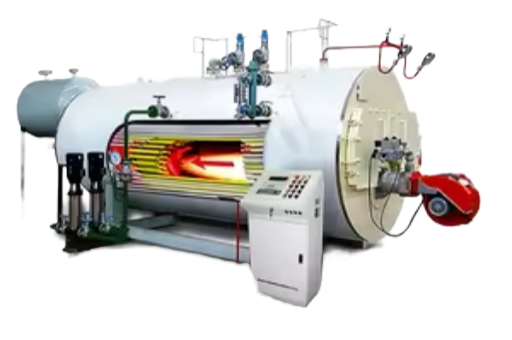
With a wetback boiler, the chamber is a water-cooled steel enclosure sitting within the boiler shell. Gas leaves the combustion chamber, enters this water-jacketed reversal chamber, reverses 180 degrees, and flows into the second pass tubes. The rear tube sheet is a separate plate that can expand and contract independently from the boiler shell.
With a dryback boiler, the rear wall is lined with refractory material — castable refractory or firebrick. A hinged steel door provides access for maintenance. The rear tube sheet is common to the boiler shell, meaning it cannot move independently when temperature changes occur. This creates a stress concentration point during thermal cycling.
| Design Dimension | Wet Back | Dry Back |
|---|---|---|
| Reversing Chamber | Water-cooled, surrounded by boiler water | Lined with refractory (firebrick or castable) |
| Rear Tube Sheet | Separate plate — allows independent thermal expansion | Common to shell — constrained, stress concentration |
| Rear Wall Heat Path | Heat transfers directly into water | Heat absorbed by refractory (insulated, not transferred) |
| Heating Surface | ~5.0 sq ft per rated BHP | Lower — refractory wall contributes no heating surface |
| Thermal Stress | Reduced — uniform temperature distribution | Higher — hot spot at refractory/tubesheet boundary |
| Access for Inspection | Rear handhole or front tubesheet access | Hinged rear door — easy visual access |
💡 Pro Tip
When inspecting a wet back boiler, check the water-cooled reversing chamber for scale buildup or pitting. Sitting in the hottest gas zone, poor water treatment affects this chamber before other surfaces show damage.
Efficiency and Heat Transfer Comparison
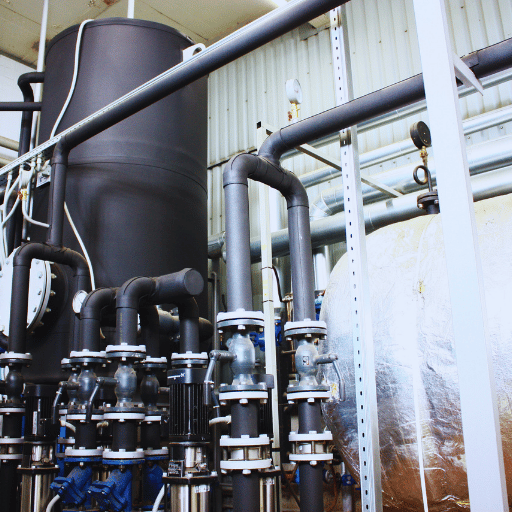
How wet back and dry back boiler heat transfer efficiency differs comes down to what happens with heat at the rear of the boiler. With a wetback boiler, combustion gases come in contact with a water cooled surface in the spot where the gas is hottest – right after leaving the furnace. That heat transfers into the boiler water. With a dryback boiler, the same heat is heated by refractory material that insulates instead of conducts, resulting in radiation losses through the rear wall.
Modern firetube boilers operate at 80-84% combustion efficiency on natural gas at typical operating pressures. As the U.S. Department of Energy Steam Tip Sheet #25 explains, every 40F drop in flue gas temperature equates to about a 1% gain in boiler efficiency. Because wet back designs cool the gas more efficiently at the rear turnaround, they reclaim heat that a dryback boiler would lose to the refractory wall.
| Efficiency Factor | Wet Back | Dry Back |
|---|---|---|
| Rear Wall Heat Recovery | Direct water cooling — heat transferred to steam/water | Refractory absorption — heat lost through radiation |
| Efficiency Over Time | Stable — water-cooled surfaces do not degrade | Declining — refractory deteriorates, increasing losses |
| Gas Temperature at Pass 2 Entry | Lower — water cooling reduces gas temperature | Higher — refractory retains heat in gas stream |
| Tube End Stress from Hot Gas | Reduced — cooler gas enters second pass tubes | Higher — hotter gas enters tubes |
One key concept: dryback boiler efficiency does not operate the same throughout the life of the boiler. As the refractory material wears from repeated thermal cycling, radiation losses through the rear wall becomes more prominent. As the DOE Improving Steam System Performance Sourcebook points out, keeping boiler components in optimal condition is critical for maintaining named efficiency – and refractory is one of the most swiftly degrading components in a dryback setup.
Maintenance, Durability, and Total Cost

Maintenance conditions are one of the most dramatic contrasts between wetback and dryback boilers. Dryback units must include refractory periodically checked and replaced – an added expense and downtime burden wet back designs avoid entirely.
| Maintenance Task | Wet Back | Dry Back |
|---|---|---|
| Refractory Replacement | Not applicable — no refractory materials used | Approximately every 3 years for rear door refractory |
| Rear Door Sealing | No rear door — sealed pressure vessel | Proprietary gaskets and sealing kits required |
| Thermal Stress Inspection | Standard annual inspection — lower risk | Closer monitoring needed at tubesheet boundary |
| Water Treatment Impact | Critical — scale on reversing chamber reduces performance | Important but refractory damage is the primary concern |
| Tube Inspection Access | Front tubesheet or rear handhole access | Full rear door removal — easier visual access |
Based on industry maintenance records, dryback rear door refractory must be replaced approximately every three years throughout the boiler life. Failing to properly maintain the refractory and providing it less than optimal service life can reduce the refractory lifespan by 50% or more. Refractory materials in a boiler furnace and reversing chamber must face thermal cycling up to 3,000F, meaning they develop cracks and spalling over time.
The National Board of Boiler and Pressure Vessel Inspectors cites that thermal stresses in firetube boilers are proportional to the temperature differential between the furnace and the outer shell. Other modes of failure include leaks at tube-to-tubesheet joints, cracked tubesheet ligaments, and broken stays – all of which are fatigue failures that compound over time, shortening the lifespan of the boiler. Wet back designs minimize these thermal stresses by promoting even temperature profiles across the rear tubesheet.
⚠️ Common Mistake
Dryback refractory replacement costs — including materials, labor, and downtime — can accumulate to match or exceed the original cost of the boiler over its 25-year service life. Always calculate TCO, not just purchase price, when evaluating a steam boiler pricing guide.
Key Advantages of Wet Back Boiler Design

The wet back boiler has become the standard configuration for modern firetube boilers for several interconnected reasons. Each advantage stems from the same core idea: surround the reversing chamber with water rather than relying on refractory lining.
- Higher sustained efficiency – The water-cooled reversing chamber enables efficient heat transfer by capturing heat from the combustion gases at the hottest point in the gas path and delivering it directly into the boiler water rather than losing it through refractory radiation.
- No refractory degradation — wet back designs do away with refractory materials in the rear turnaround altogether. There is nothing to erode, crack, or spall, and no scheduled refractory replacement downtime.
- Reduced thermal stresses – The separate rear tube sheet in a wetback boiler can freely expand and contract reducing the thermal fatigue at the tube-to-tubesheet joints. The service life of the pressure vessel is extended.
- Lower lifetime maintenance costs – Stripping refractory from the mixture removes a recurring expense line that dryback operators face every few years. No separate rear door gaskets or proprietary sealing kits are needed.
- Steady steam generation – As the water-cooled chamber maintains steady heat transfer characteristics for years to decades it provides a steadier more predictable output of steam with improved water circulation.
- Smaller functional footprint – Due to the fact that they do not need to accommodate the swing room that is required of hinged dryback doors the wet back boilers possesses a smaller overall rear footprint.
A Firetube boiler managed with a well maintained water treatment system can routinely expect better than 25 years service. Industry data from all leading manufacturers shows that wet back designs are particularly durable and show strong operational reliability – Cleaver-Brooks has hundreds in service for 50+ years.
Which Design Should You Choose?
Your choice will be driven by the usage pattern, maintenance offerings, and available budget. Here is a simple decision matrix.
Choose Wet Back When:
- Your application requires steam boiler operation above 200 BHP
- You want to minimize long-term maintenance costs and downtime
- Your plant is operating with a steady or high-duty cycle with frequent thermal cycling
- You are firing natural gas or dual-fuel burner setups
- You are emphasizing lowest total cost of ownership over initial purchase cost
- You have limited rear clearance available for the door swing
Choose Dry Back When:
- Your budget is limited to lowest initial equipment cost
- You need to access the rear for frequent tube inspection in highly corrosive fuel applications
- The boiler is operating with a low duty cycle with little thermal cycling
- Your maintenance team has refractory repair capabilities in-house
⚠️ Common Mistake
Selecting a dryback boiler for high-duty industrial steam applications where the boiler undergoes frequent start-stop cycles is a common error. Thermal cycling accelerates refractory deterioration and tubesheet fatigue in dryback designs — precisely the failure modes that wet back configurations avoid by reducing thermal cycling damage. For boiler projects with emission reduction targets, the sustained efficiency of a wet back unit also delivers lower combustion emissions per unit of steam produced.
In most industrial boiler implementations – food processing, chemical plants, hospitals, universities, and manufacturing – wetback provides a better value proposition over the years. If you need help sizing a boiler for your specific application, Get a Quote for Your Boiler Project →
Frequently Asked Questions

Q: What is the difference between a wet back and a dry back boiler?
View Answer
It comes down to the rear reversing chamber. A wet back boiler takes this chamber and surrounds it with water, so heat flows directly into the boiler water. A dry back boiler lines the rear wall with refractory instead.
Q: What are the main advantages of a wet back boiler?
View Answer
Wet back boiler advantages include higher sustained thermal efficiency (the water-cooled chamber absorbs heat that dryback designs lose through refractory), no refractory replacement costs, reduced thermal stresses on the tubesheet, lower lifetime maintenance expenses, more consistent steam output, and a more compact rear profile. These benefits add up over the 25+ year life of the equipment.
Q: Do wet back boilers cost more than dry back boilers?
View Answer
Wet back boilers have a higher initial purchase price because of their more involved internal construction. However, total cost of ownership runs lower because wet back units need no refractory replacement, less rear door maintenance, and hold higher efficiency over their service life. Industry sources report that dryback refractory costs alone can add up to match the original equipment price over 25 years.
Q: What is a three-pass wet back boiler?
View Answer
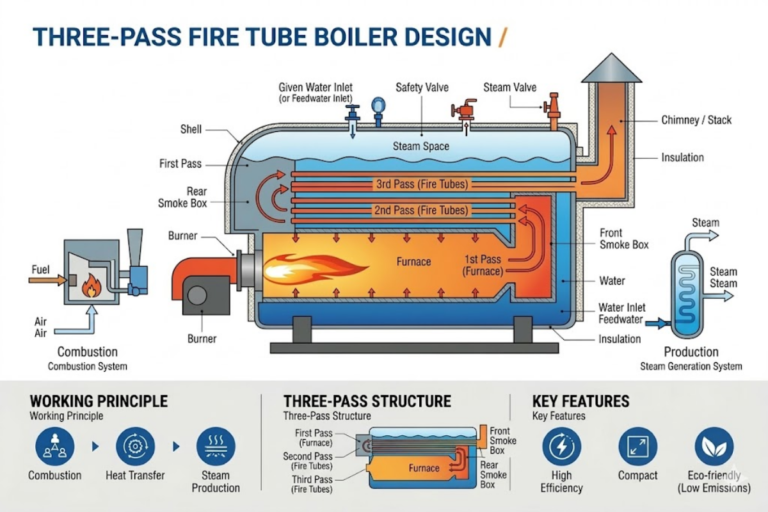
A three-pass wet back boiler sends combustion gases through three separate passes within the boiler shell. Pass 1 is the combustion chamber (the large central furnace tube), where 40–60% of total heat transfer takes place. At the rear, a water-cooled reversing chamber redirects gases into the second pass tubes. After traveling to the front, gases reverse again and flow through the third pass boiler tubes before exiting to the flue for complete combustion heat recovery. This three-pass arrangement pulls maximum heat from a single fuel burn. Because the reversing chamber in a three-pass wet back unit handles gas at the highest temperature in the entire system, using a water-cooled chamber rather than refractory at this point has an outsized effect on overall boiler efficiency and durability. Learn more in our three-pass fire tube boiler design guide.
Q: How long does a wet back boiler last compared to dry back?
View Answer
The lifetimes of either can go 25 years or more: wet back boilers are a little longer-lasting because they lack refractory and thermal duress at the tubesheet.
Q: What ASME codes apply to fire tube boiler design?
View Answer
Fire tube boilers in the United States must comply with the ASME Boiler and Pressure Vessel Code (BPVC). Section I covers power boilers operating above 15 psig steam. Section IV applies to heating boilers below that threshold. Section II specifies materials, Section V covers nondestructive examination methods, and Section IX establishes welding and brazing qualifications. Both wet back and dry back designs must meet these same code requirements.
About This Analysis
Taiguo supplies wet back and dry back firetube boilers for steam and hot water use. This comparison guide is based on published technical literature from the U.S. Department of Energy, the American Society of Mechanical Engineers, and the National Board of boiler and pressure vessel inspectors. For some application-specific results, we reference industry experience where specific names and costs were not available from public sources.
References & Sources
- DOE Steam Tip Sheet #25 — Installing Turbulators on Two- and Three-Pass Firetube Boilers — U.S. Department of Energy
- Improving Steam System Performance: A Sourcebook for Industry — U.S. Department of Energy
- Best Management Practice #8: Steam Boiler Systems — DOE Federal Energy Management Program
- Boiler and Pressure Vessel Code (BPVC) — American Society of Mechanical Engineers
- Thermally Induced Stress Cycling in Firetube Boilers — National Board of Boiler and Pressure Vessel Inspectors