How a Biomass Power Plant Works — A Step-by-Step Guide From Fuel Handling to Grid Electricity
A biomass power plant uses wood chips, agricultural waste, and other organic materials to generate electricity for the grid by incinerating the material to create high-pressure steam followed by expansion through a turbine that drives a generator. This guide covers the entire process – from the fuel yard to the boiler and steam turbine all the way to the condenser and pollution controls – and provides the information needed for buyers, operators, and curious readers to make a decision about specifying, financing, or connecting to a plant.
Quick Specs: Biomass Power Plant at a Glance
Quick Specs
| Typical capacity |
1–100 MWe (utility scale up to 2,580 MWe at Drax UK) |
| Standalone electric efficiency |
20–25% (heat-rate ~13,500 BTU/kWh) |
| CHP combined efficiency |
70–85% with cogeneration heat recovery |
| Lifecycle GHG |
~230 g CO₂e/kWh (varies with feedstock + supply chain) |
| Fuel use |
~1 dry ton wood per MWh of electricity |
| Capex (small-scale) |
$3,000–$5,000 per kW installed (DOE/FEMP) |
| Plant design life |
25–30 years; mid-life refurbishment extends to 40+ |
What Is a Biomass Power Plant? Components Inside the Fence
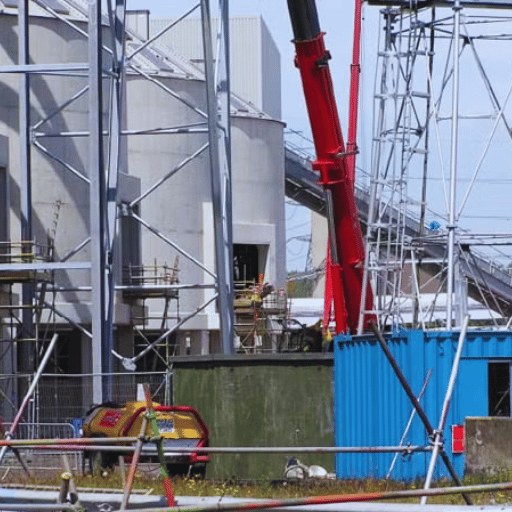
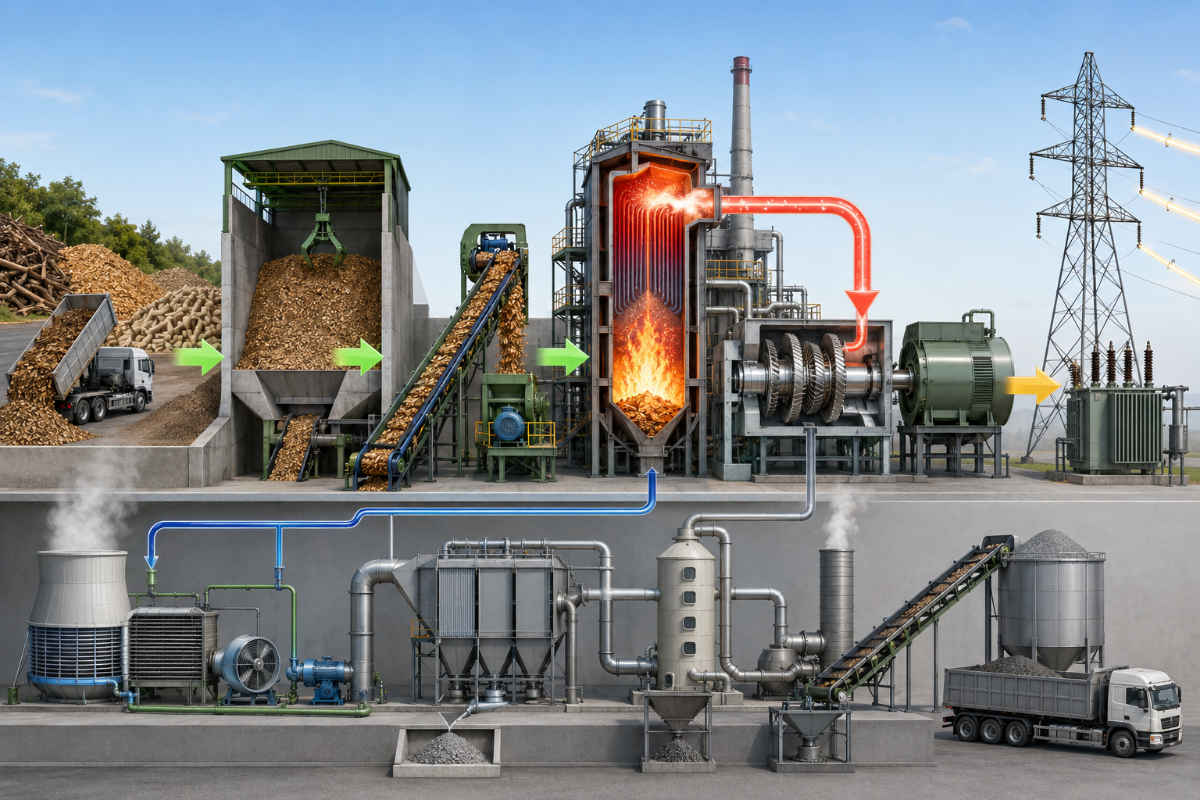
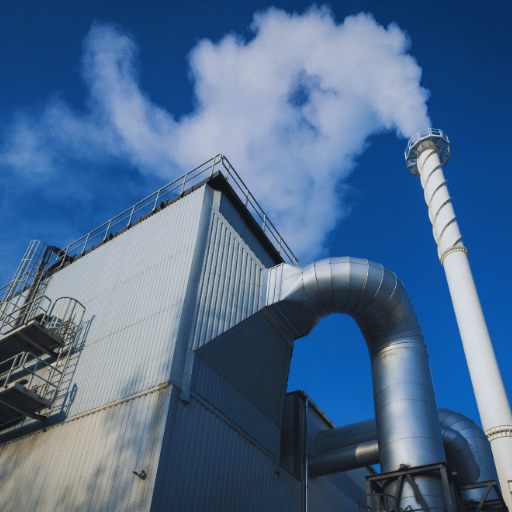
Biomass, as defined by the U. S. Energy Information Administration, is “renewable organic material that comes from plants and animals.” A biomass power plant is the facility that converts that organic feedstock into electric power, usually through direct combustion driving a steam Rankine cycle. Six subsystems make up almost every modern installation:
- Fuel yard and handling — outdoor storage piles, silos, conveyors, hammermills, and metering screws that condition wood chips, pellets, or agricultural residue before combustion.
- Industrial biomass boiler — typically a chain-grate, fluidized-bed, or water-tube design where biomass combustion releases heat that converts feedwater into superheated steam. An industrial biomass boiler sized 6–25 t/h is common for mid-scale CHP, while utility plants run banks of larger water-tube units such as the SZL water-tube biomass boiler series.
- Steam turbine and generator — a multi-stage condensing or back-pressure turbine spinning a synchronous alternator at 3,000 rpm (50 Hz grids) or 3,600 rpm (60 Hz grids) to generate electricity.
- Condenser and cooling tower — condenses spent steam back to feedwater, rejecting waste heat through wet or dry cooling.
- The emissions control train—cyclones, baghouse fabric filters, electrostatic precipitators, and SCR/SNCR systems for particulates, NOx and other regulated pollutants under US EPA Boiler MACT or equivalent rules.
- Ash handling and grid interconnection — bottom-ash and fly-ash conveyors plus a step-up transformer and protective relays tying the generator into the transmission network.
Two clarifications worth pinning down. One, a ‘biomass plant’ may be referring to just the boiler island or the entire facility. How biomass is used in the plant (heat only, power only, or combined heat and power) determines where you should draw the boundary when reading vendor brochures.
Second, biomass power plants differ structurally from biofuel refineries (which produce ethanol or biodiesel) and from anaerobic digesters that produce biogas; all three convert biomass to energy, but only the first feeds steam directly into a turbine.
The 5-Stage Process: From Fuel Yard to Steam Turbine
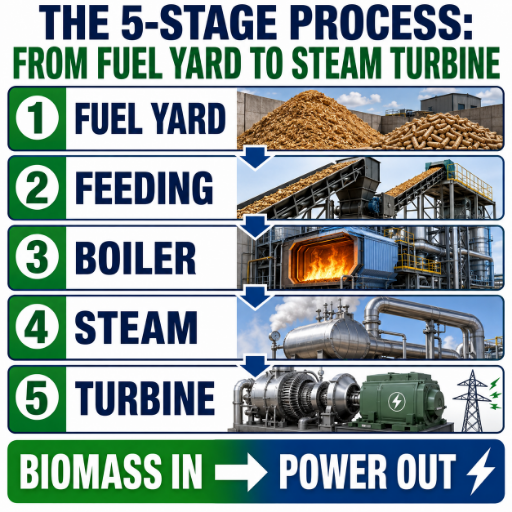
Modern biomass electricity generation follows a five-stage thermodynamic chain. Each stage has measurable parameters worth knowing before you walk a plant or sign a contract for biomass power generation services.
Stage 1 — Fuel Yard and Preparation
Raw biomass feedstock will be delivered to an outdoor yard by trucks, rail cars or barges. The material is sized to approximately 25-50 mm chips, screened for oversize and tramp metal, and transported by conveyors to covered silos. Most of the wood chips arriving at the plant are green lumber and arrive at a moisture content of 40-55% (wet basis) as per the Whole Building Design Guide (WBDG); since water must be boiled off before the heat it contains can be used productively, plants commonly pre-dry their feedstock to ≤20% moisture using heat carried by flue gas. Underestimating storage and drying needs is the most common project mistake – a biomass boiler installation process that ignores fuel yard logistics tends to underperform from week one. Where wet wood chips require conditioning before storage or combustion, evaluate wood chip drying equipment from TCPEL against the required throughput, inlet moisture and target moisture, with the fuel specification agreed with the boiler supplier.
Stage 2 — Combustion in the Boiler
Inside the furnace, biomass meets primary and secondary air on a moving grate or in a fluidized bed of inert particles such as sand. Temperatures are raised to around 850–1,200°C. Air staging keeps NOx low; lime injection in fluidized-bed designs captures sulfur. According to the DOE-supported Whole Building Design Guide, fluidized-bed systems generally produce more complete carbon conversion and accept a wider range of feedstocks than grate combustors, at the cost of higher fan power.
Stage 3 — Steam Generation
Combustion gas transfers its heat through water-wall tubes, economizers, and superheaters. Utility-scale plants typically run live steam at 480–540°C and 60–180 bar; smaller industrial CHP units run lower (250–425°C, 30–60 bar). Higher steam conditions raise efficiency but demand alloy upgrades and tighter feedwater chemistry.
Stage 4 — Steam Turbine and Generator
Superheated steam expands through a multi-stage steam turbine, dropping pressure and temperature while converting thermal energy to rotational shaft work. A directly coupled synchronous generator turns that shaft work into alternating-current electric power. Utility plants typically run at 3,000 or 3,600 rpm to match grid frequency; smaller geared units may turn faster.
Stage 5 — Condensation and Heat Rejection
Spent low-pressure steam enters a vacuum condenser, gives up its latent heat to circulating cooling water, and returns to liquid form for pumping back to the boiler — a closed Rankine loop. A wet cooling tower or air-cooled condenser sheds the rejected heat. In a CHP plant, much of that low-grade heat is harvested for district heating, kiln drying, or process steam instead of being thrown away.
📐 Engineering Note
Live steam at 540°C / 90 bar yields a heat-rate of roughly 13,500 BTU/kWh, equating to about 25% gross electric efficiency on woody biomass. Reaching 30% requires ultra-supercritical conditions (≥260 bar / 600°C) rarely deployed below 100 MWe because the metallurgy and feedwater chemistry penalty outweighs fuel savings at smaller scale.
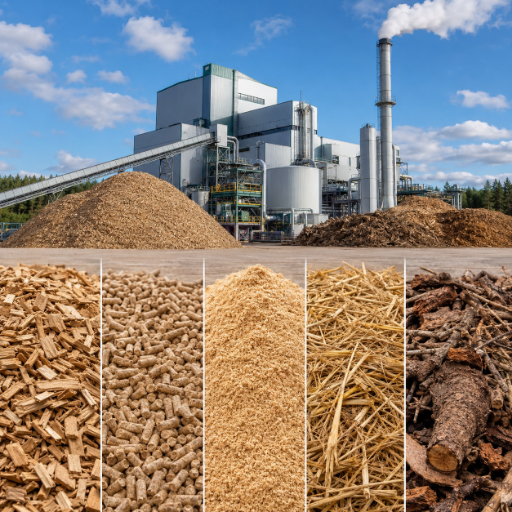
Biomass feedstock is anything but uniform. A plant’s economics, emissions profile, and ash chemistry all hinge on which fuel it actually burns. Five families dominate, each with measurable heating value and operating quirks. For a deeper feedstock breakdown, see the biomass fuel types guide.
| Feedstock family |
Typical heating value (dry basis) |
Moisture content |
Best fit |
| Woody biomass — chips, pellets, sawdust |
18–19 MJ/kg |
10–55% |
Utility power, large CHP |
| Agricultural residue — bagasse, rice husk, straw, palm kernel shells |
15–17 MJ/kg |
10–25% |
Sugar mills, rice processors, regional CHP |
| Energy crops — switchgrass, miscanthus, short-rotation coppice |
16–18 MJ/kg |
10–20% |
Co-firing, dedicated mid-scale plants |
| Municipal solid waste / RDF |
10–13 MJ/kg |
25–40% |
Waste-to-energy, landfill diversion |
| Wet wastes — manure, food waste, sewage sludge |
Routed to anaerobic digestion (biogas) |
75–95% |
Dairy, sewage plants, landfills |
One pattern recurs across every NREL Lessons-Learned audit: biomass fuel quality varies far more than coal quality, so the plants that succeed long-term are the ones that invested in fuel sampling, testing, and supply diversification before commissioning. Density-based purchase contracts (priced per GJ rather than per ton) help align supplier incentives with plant needs.
Conversion Pathways: Beyond Direct Combustion
Direct combustion plus a steam Rankine cycle makes up by far the majority of installed biomass power capacity globally, but it isn’t the only way. Three alternatives matter when feedstock, scale, or local economics lead an otherwise default project design down a different path.
Direct Combustion (the default)
Solid biomass burns on a grate or in a fluidized bed; combustion products heat water to steam; steam drives a turbine. About 70%+ of biomass power plants worldwide use this approach, including most chain-grate units in the DZL chain-grate boiler series for industrial CHP. It is the lowest-cost pathway when a steady supply of uniform fuel is available.
Co-Firing With Coal
Existing pulverized-coal boilers can burn 5–15% biomass blended into the coal feed with modest grinding and burner modifications. Biomass co-firing was popular in the EU through the 2010s as a cheap decarbonization wedge, but EU policy is phasing it out post-2030 in favor of dedicated biomass boilers or BECCS retrofits.
Gasification
Per EIA, gasification heats biomass to 800–900°C with limited oxygen to produce a syngas (mostly CO + H₂) with usable energy content of about 10–15 MJ/Nm³. Syngas can fuel internal-combustion engines, gas turbines, or — after conditioning — fuel cells. Plants are typically smaller (1–10 MWe) and more capital-intensive per kW than direct combustion.
Anaerobic Digestion
Wet biomass (manure, food waste, sewage sludge) decomposes inside oxygen-free digesters at 35–55°C, producing biogas that is roughly 55–65% methane. Biogas powers a reciprocating engine generator that drives an alternator. Anaerobic digestion is the dominant route for landfill gas capture, dairy CHP, and wastewater treatment plants. Per EIA, biogas is also called biomethane or renewable natural gas after upgrading.
Decision Framework — Which Pathway Fits Your Scenario?
| Uniform pellets, ≥20 MWe utility scale |
Direct combustion + steam Rankine cycle |
| Wet feedstock (manure, food waste) |
Anaerobic digestion + biogas engine |
| Mixed agricultural residue, 1–10 MWe distributed |
Gasification + IC engine or gas turbine |
| Existing coal plant, emission compliance |
Co-firing retrofit (5–15% blend) |
| On-site steam load + 1–30 MWe |
CHP with chain-grate or BFB boiler |
Combined Heat and Power: Why Cogeneration Doubles the Output
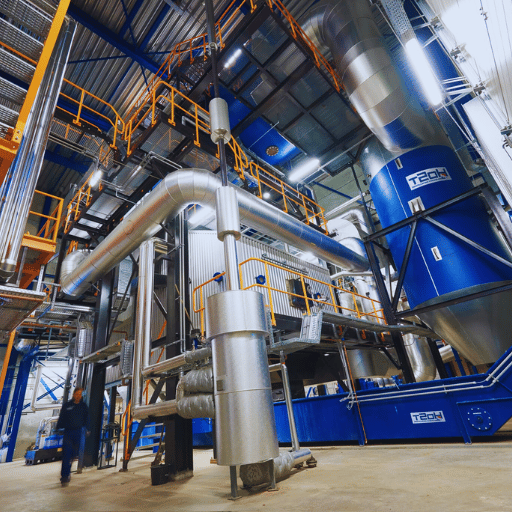
Power-only biomass systems waste most of their energy production as low-grade heat, which combined heat and power systems convert into useful thermal output for an industrial host. Per WBDG, “These combined heat and power (CHP) systems greatly increase overall energy efficiency to approximately 80%, from the standard biomass electricity-only systems with efficiencies of approximately 20%.” That four-fold jump in fuel utilization is the single most consequential design decision in biomass power generation.
How efficient are biomass power plants?
A standalone biomass-to-electricity plant typically converts 20–25% of fuel energy into electric power; the rest leaves the stack or the cooling tower. A back-pressure or extraction-stage steam turbine paired with a host heat load — kiln drying, district heating, food processing steam — recovers another 50–60% of fuel energy as useful thermal output. Combined, the plant utilizes 70–85% of the fuel.
The catch: that high combined number only holds when the heat side has a year-round customer matching the steam output. Power-to-heat ratios for steam-turbine CHP typically sit between 1:3 and 1:5, so a 5 MWe biomass plant generates 15–25 MWth of recoverable heat — useful at a sawmill or paper mill but stranded in a remote location with no host load. The biomass boilers built for industrial CHP are typically sized to match the heat load first, with electricity as a bonus byproduct rather than the primary product. Operators chasing maximum revenue should also study the biomass boiler efficiency factors that determine whether design specs translate to real fuel savings.
📐 Engineering Note
A condensing steam turbine extracts roughly 25% of fuel energy as electric power. Adding a back-pressure or extraction stage lifts total fuel utilization to ~80%, but only when there is a year-round host load matching the heat output. Sizing CHP for peak rather than average heat demand strands capacity nine months out of twelve.
The Carbon Question: Is Biomass Really Renewable?
Biomass earns its renewable-energy classification because the carbon released during combustion was recently absorbed from the atmosphere by photosynthesis. That biogenic-carbon argument breaks down in practice when forest payback periods stretch across decades.
If a tree takes 60 years to regrow but one hour to burn, calling biomass ‘instantly renewable’ is a category error. The 6:1 carbon payback truth: forest biomass typically reaches atmospheric carbon parity over 6–100 years, depending on species and silviculture. Only short-rotation coppice and agricultural residues reach parity within 1–3 years.
Modern biomass plants can drive lifecycle greenhouse gas emissions down to roughly 230 g CO₂e/kWh per IRENA ranges — well below fossil fuel benchmarks like coal (≈820 g) and natural gas (≈490 g) but well above wind or solar (10–50 g CO₂e/kWh). Stack emissions of particulate matter, NOx, CO, and SO₂ are managed through cyclones, baghouses, electrostatic precipitators, and SCR/SNCR — all required under US EPA Boiler MACT regulations or equivalent rules. Meanwhile, Massachusetts removed biomass-fired electricity from its Renewable Portfolio Standard in 2012 because state officials concluded the GHG benefit was not clear — a reminder that ‘renewable’ is a policy classification, not a thermodynamic guarantee. Buyers comparing fossil and renewable options often find a useful baseline in this biomass vs natural gas comparison.
Industry Outlook: Where Biomass Power Goes Next (2026–2030)
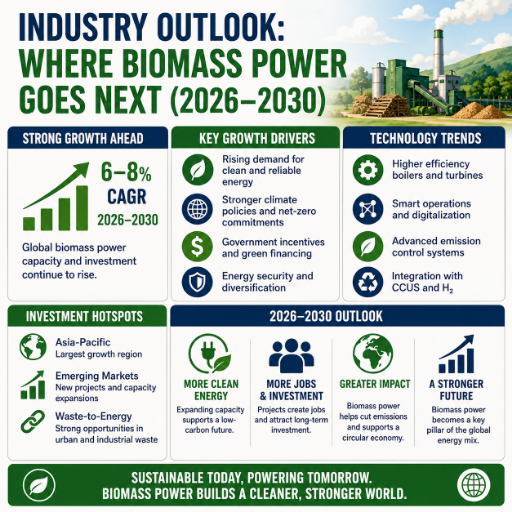
According to IRENA’s Renewable Capacity Statistics 2024, global bioenergy capacity reached roughly 148 GW at end-2023, up from about 115 GW in 2015 — a steady but unspectacular trajectory compared with wind or solar. Three regional pictures matter for the rest of the decade.
Europe. Co-firing with coal is winding down as coal plants retire post-2030. Drax in the UK — the world’s largest dedicated biomass facility at roughly 2,580 MWe across four converted units — is targeting BECCS (bioenergy with carbon capture and storage) capable of capturing about 8 Mt CO₂ per year, which would make it the largest engineered carbon-removal project on the planet if delivered.
Asia-Pacific. Largest growth zone — China’s 14th Five-Year Plan added biomass power expansion targets, Japan’s FIT program continues to underwrite imports of wood pellets, and India’s New & Renewable Energy program subsidizes agricultural-residue plants. Pellet supply chains running between the US Gulf Coast and East Asia are now a major energy-trade flow, with shipments such as Drax’s 63,907-tonne cargo from Baton Rouge highlighting the logistics scale.
North America. Capacity in the US fleet is largely stagnant; biomass accounted for about 7% of US electric power sector renewable energy in 2023 per EIA. California’s biomass fleet totals 800 MW across 66 facilities — a useful benchmark for regional planning. Three energy technologies worth watching through 2030: BECCS retrofits at coal-converted units, pellet-supply transparency under SBP and FSC certification, and distributed CHP behind the meter for industrial decarbonization. For procurement teams scoping vendors, our leading biomass boiler manufacturers roundup covers the active suppliers in this space.
Frequently Asked Questions
Q: What is the difference between a biomass power plant and a biomass boiler?
View Answer
A biomass power plant is the entire facility — fuel yard, boiler, steam turbine, generator, condenser, emissions controls, and grid interconnection. A biomass boiler is just the heat-generating component within that plant, also sold standalone for process heat or hot water without electricity generation. For additional guidance on equipment selection, see our
biomass-fired boiler buyer’s guide.
Q: How much does it cost to build a biomass power plant?
View Answer
Per DOE/FEMP guidance, small-scale (5–25 MWe) direct-combustion plants run $3,000–$5,000 per kW installed, with levelized cost of electricity at $0.08–$0.15 per kWh. Gasification systems run higher at $5,000–$8,000/kW. Combined-cycle natural gas, by comparison, runs $1,000–$2,000/kW — biomass is dispatchable but capital-heavy. See our
industrial biomass boiler cost guide for boiler-island budgeting detail.
Q: Are biomass power plants more expensive than solar?
View Answer
Yes, on capex and on levelized cost. Utility-scale solar PV runs roughly $1,000/kW installed and produces electricity at $0.03–$0.05/kWh — but at a 20–25% capacity factor. Biomass plants run 80–90% capacity factor and dispatch on demand, so direct kWh-cost comparisons miss the point. Solar wins for daytime energy; biomass wins for around-the-clock dispatchable renewable power.
Q: How long does a biomass power plant last?
View Answer
Design life is 25–30 years for major equipment, with mid-life refurbishment (re-tubing, turbine repair, control-system upgrades) typically extending operations to 40+ years. Drax’s converted units at the UK biomass facility were originally built as 1970s coal plants — refurbishment plus fuel conversion gave them another two decades of useful life.
Q: Where is the biggest biomass plant in the world?
View Answer
Drax Power Station in North Yorkshire, UK, with roughly 2,580 MWe of biomass capacity across four units originally built for coal. Drax burns wood pellets sourced largely from US Southeast forests, with single shipments topping 63,000 tonnes. No other dedicated biomass facility comes close to that scale.
Q: Do biomass power plants release carbon dioxide?
View Answer
Yes — combustion releases CO₂ directly at the stack, and lifecycle GHG runs roughly 230 g CO₂e/kWh. Biomass earns its renewable label because regrowth absorbs equivalent CO₂, but the timing matters: forest biomass takes 6–100 years to reach carbon parity, while agricultural residues and short-rotation crops reach parity in 1–3 years. BECCS retrofits aim to capture stack CO₂, but standard plants do not.
About This Analysis
This guide synthesizes data from the U.S. Energy Information Administration, the DOE/FEMP Whole Building Design Guide, IRENA Renewable Capacity Statistics 2024, IPCC AR6 Working Group III, and the California Energy Commission. Reviewed by the Taiguo Boiler engineering team, drawing on 50+ years of industrial biomass boiler design and CHP integration experience across 80+ countries.