Get in Touch with Taiguo


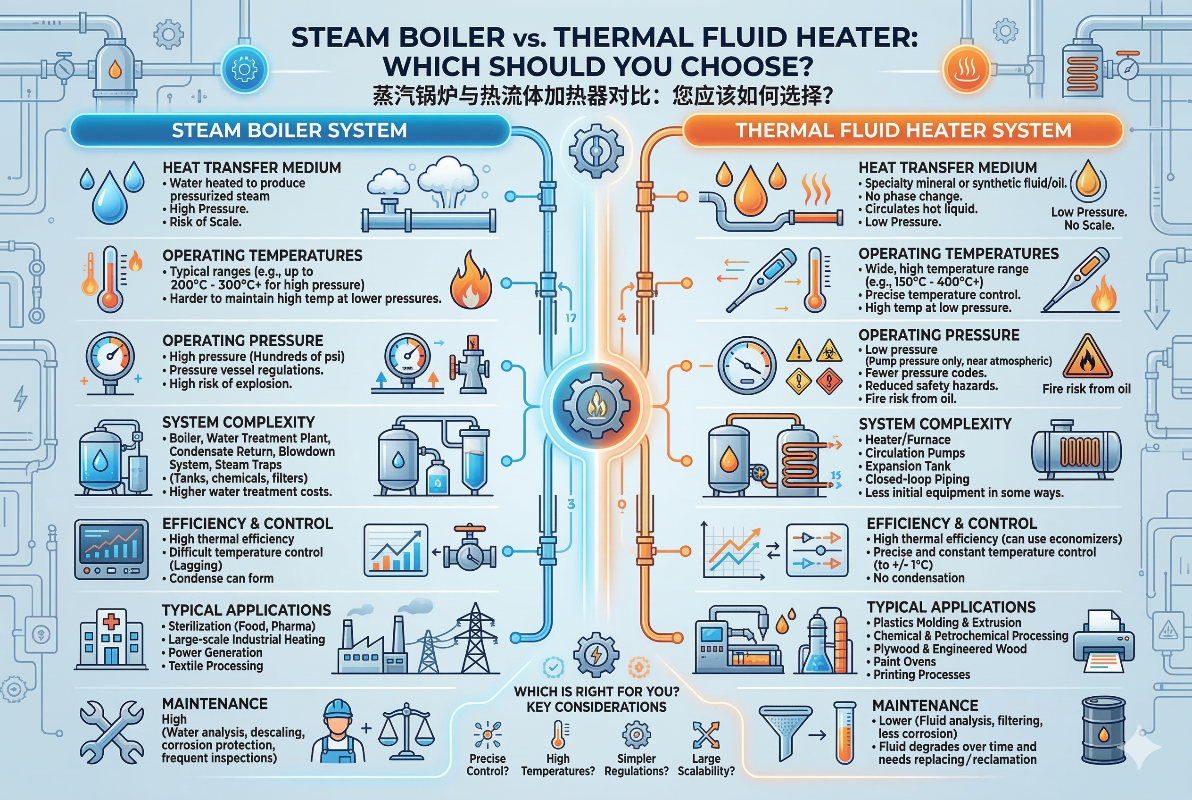
Steam boiler (or – my apologies – utility boiler), or thermal fluid heater? Surely the most important decision in any process heating project, yet many facilities and contractors choose steam simply because they are familiar with the system. Steam and thermal fluid are the same goals achieved in very different ways, with very different risk profiles, for very different applications. Bumping a bad decision for years of higher maintenance bills, safety compliance issues, or an inability to achieve your temperature target could be costly.
In this section, I will compare the steam boiler versus thermal fluid heater (sometimes called a thermal oil heater, hot oil heater, or thermic fluid heater) on the dimensions that matter most for an industrial process: temperature, pressure, energy performance, maintenance, safety, upfront investment, and total cost of ownership. Together we will learn which industrial heat source is the right fit for your process.
Quick Comparison: Steam Boiler vs. Thermal Fluid Heater
But before I give you the solution, here is a summary comparison table for the two systems. This summarizes the most common search parameters and illustrates the fundamental technology difference:
| Attribute | Steam Boiler | Thermal Fluid Heater |
|---|---|---|
| Heat transfer medium | Water / Steam | Thermal oil or synthetic fluid |
| Max operating temperature | ~300°C (superheated steam) | Up to 400°C (near-atmospheric) |
| Operating pressure | High — 15 psig to 3,000+ psig | Near-atmospheric (~0.8 MPa max) |
| System complexity | High: steam traps, condensate return, water treatment | Low: closed-loop, no phase change, no traps |
| Temperature precision | Pressure-dependent (±5–10°C typical) | Independent control (±1–2°C) |
| Licensed operator required | Yes, in most jurisdictions (ASME/OSHA) | Generally not required |
| Initial capital cost | Lower | Moderate to higher |
| Best suited for | Sterilization, autoclaving, humidification, food processing | Chemical, asphalt, plastics, textile, high-temp industrial processes |
Key Takeaway: Steam boilers excel when your process requires direct steam contact or when existing steam infrastructure is already in place. Thermal fluid heaters win on temperature range, precision, and long-term operating costs.
How a Steam Boiler Works
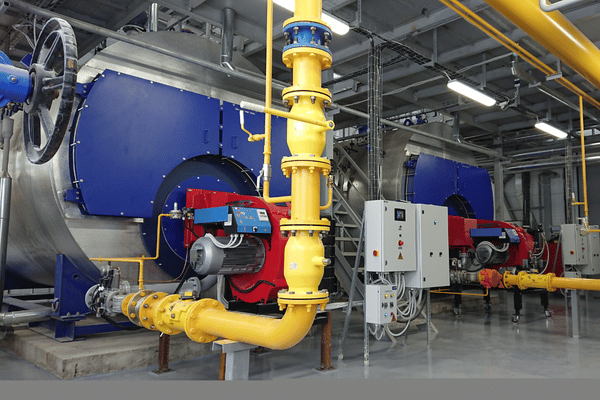
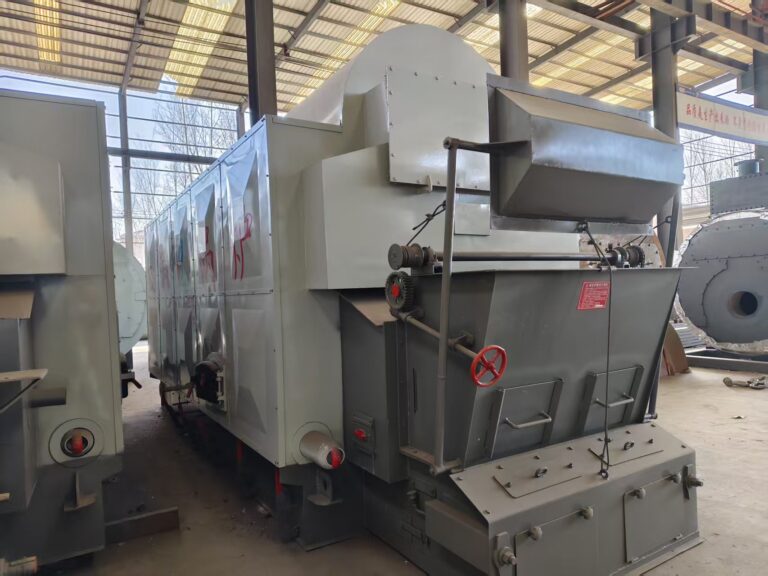
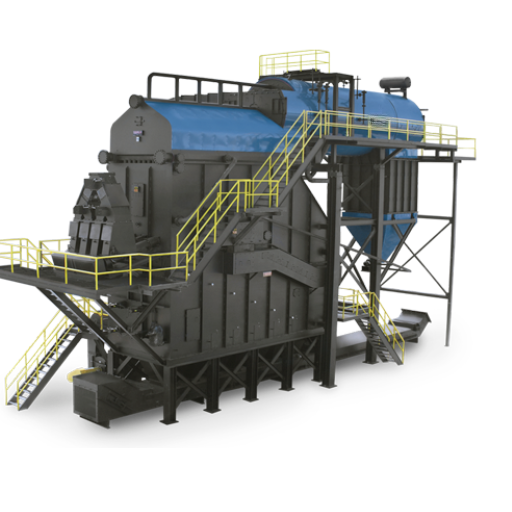
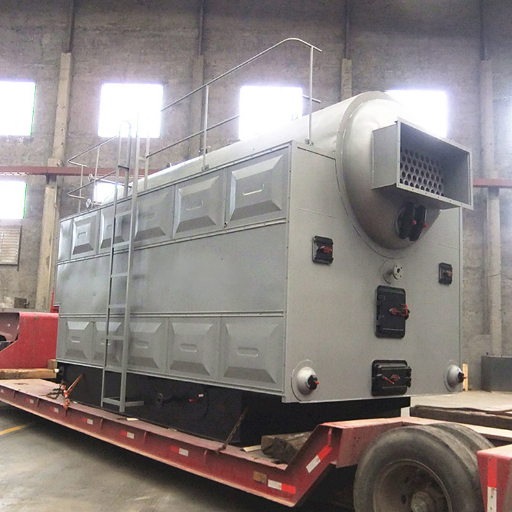
A steam boiler — also called a steam generator in many industrial contexts — is a vessel in which water is heated under pressure to create steam that acts as the medium to transfer heat into process equipment. The phase change at the core of the technology – water to steam and back – creates the fundamental distinction from thermal fluid and the technology’s primary operational challenge:
Core components of a steam boiler system:
- Burner and firebox – provides the fired from natural gas, oil, coal,or biomass
- Steam drum and coil / fire-tube passes — transfer heat from flue gases to produce saturated steam at operating pressure
- Steam piping network – high-pressure pipes moving steam around the facility to the process heats
- Steam traps – exude condensate without losing vacuum or live steam
- Condensate return system — recovers cooled condensate for reuse
- Feed water chemistry / dosing – defends equipment from scale, corrosion and microbiologic infection
Design, operation, and maintenance is all governed by American Society of Mechanical Engineers (ASME) Boiler and Pressure Vessel Code (BPVC), Section I. Although low-pressure boilers (maximum 15 psig) are common in many facilities, typical operational ranges are 15 psig up to 250 psig for fire-tube boilers while pressure water-tube systems are found in power plants operating at 3,000+ psig. This high-pressure steam system is what makes most steam boilers require regulated operators with American Society of Mechanical Engineers (ASME) coded credentials within OSHA 29 CFR 1910 or similar state programs.
Steam is rarely a good choice for one-way transfer of heat to a fluid (conduction) or as the heat source for indirect heat transfer (convection). Where it is needed for direct contact with a product – autoclaving, sterilization, humidification in a paper mill, a steam-jacketed vessel in a chemical plant – no thermal fluid heater can replace it.
Key Takeaway: Steam boilers are regulated pressure vessels requiring certified operators. They are the right choice when direct steam contact is a process requirement — not simply because steam is familiar.
How a Thermal Fluid Heater Works
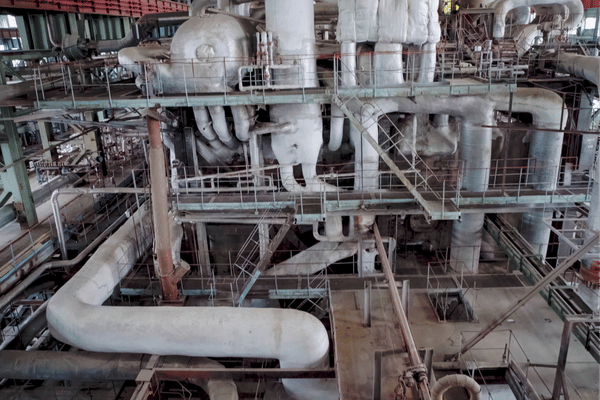
A thermal fluid heater circulates an oil in a closed loop through a coil in a heater, as the oil get so hot is pumped into the process as the energy transfer medium. Where the heater is a connected to a burner as with gas, fuel oil, LPG, or waste oil, the oil is heated in an external coil to the process and then retruned for reheating as shown below. In order to do this effectively no phase change is allowed to take place.
Core components of a thermal fluid heating system:
- Burner and combustion chamber – heats fluid flowing in pipe around the coil
- Coil heat transfer heating element (inner / outer pass) – expands contact surface
- Circulating pump – maintains thermal oil velocity in system at 2.5 m/sec to prevent coke deposit build-up in thermal oil
- Expansion tank – thermal expansion of liquid at high temperature
- Heat exchangers – transfer heat to process equipment
- Oil-gas separation – removes the light ends that are created as the oil is aged
A synthetic heat transfer medium such as Therminol VP-1 (a diphenyl oxide/biphenyl eutectic) requires from 12C to 400C according to the Eastman Chemical specification – pressures that, in steam, would require hundreds of psig. Because the boiler operates at near at pressure even at 350C, it does not set off the high pressure boiler regulations that apply to steam boilers.
Taiguo’s thermal oil boiler series performs at 95%+ thermal efficiency with a three pass flue gas design and 1C temperature set point control. For the chemical, asphalt, plastics molding or textile dyeing business – in which every process operates at between 200C and 350C of precision temperature control – a thermal fluid heater system simply performs well above the performance of a traditional steam boiler
Key Takeaway: Thermal fluid heaters reach up to 400°C at near-atmospheric pressure, with no steam traps, no condensate return, and no water treatment — making them simpler to operate than a steam boiler in most process heating applications.
Head-to-Head: 5 Key Technical Differences
That is the five dimensional parameters that factor into any engineering team choosing a thermal fluid heater vs. a steam boiler for an installation or retrofit
1. Temperature Range
Saturated steam at atmospheric pressure is 100C. To hit 200C in a steam plant requires a minimum of approximately 15.5 bar (225 psig) to be present and manned. This comes with a entire stack of infrastructure, safety features and licensed human capital investment. Superheated steam can be elevated to 300C but the pressure requirements start ramping rapidly. A thermal fluid heating system operated at roughly 350C in Therminol VP-1 will operate at near at pressure and at no greater high pressure classification.
~300°C
Steam Boiler Max Temp
(superheated, high pressure)
400°C
Thermal Fluid Heater Max Temp
(near-atmospheric pressure)
2. Operating Pressure
Steam physics dictate that to hit 200C you need to generate the pressure of roughly 15 bar; to reach 250C roughly 40 bar is necessary. Those high-temperature steam pressures must be intensively inspected, requires per regulatory code, a licensed boiler operator on-site all the time, and to the extent possible tests and safety equipment such as relief valves. At roughly 250C a equivalent thermal fluid system operates at less than 5 bar eliminating most of the regulatory burdens of high-pressure steam.
3. Energy Efficiency
On paper, forced draft steam boilers seem to be 80-85% efficient in combustion. In fact, the U.S. Department of Energy’s Advanced Manufacturing Office reports that in industrial plant conditions, where the routine maintenance, survey, and repair of steam traps is not performed within three to five years, 15-30% of traps have failed and are letting live steam go straight through. Blowdown, latent heat lost through condensation at steam traps, and uninsulated condensate return line losses further erode the attractive Boiler Efficiency number.
This thermal fluid heating system avoids all three loss mechanisms. As there are no steam traps to fail, no blowdown is needed, and there is no de-aerator energy expense. As it is a closed loop system, the same fluid circulates while very little thermal energy is lost.
These losses have been well documented by the DOE’s Federal Energy Management Program, in the Steam Trap Performance Assessment program, and research has shown that mere routine trap surveys can bring the failure rate down to 5% or lower – yet many facilities never bother.
4. Maintenance Complexity
Unlike a lot of the other equipment or systems the boiler system has a substantial operation and maintenance effort that is often underestimated at the time of purchase. Condensate return lines are subject to corrosion. Steam traps are prone to fail in the open as well as closed position.
Boiler water has to be constantly monitored and conditioned to prevent formation of scale deposit and corrosion due to oxygen infiltration. Blowdowns must be done to keep the level of dissolved solids in check. All this adds up to a recurring operating cost that mounts up over the life of the boiler which can be anything from 15 to 20 years.
A huge benefit of a thermal fluid system is the difficulty of service. The closed loop system requires no water treatment. Fluids are sampled annually – tests of viscosity, acid number and flash point- to compare against the ongoing chemistry testing in a steam plant.
Pump seals, expansion tank levels require checking and re-filling as needed. Fluid renewal occurs on average every 3-5 year, depending on operating temperatures.
5. Temperature Control Precision
In a steam system, pressure and temperature are coupled by steam tables. Increase process temperature and you increase boiler pressure and vice versa. The indirect relationship makes fine temperature control in a steam system very difficult.
Nearly all steam heated processes operate within 5-10C of target. Thermal fluid heating separates temperature from pressure altogether: fluid temperature is controlled by burner modulation and circulation flow rate so process temperature can be held to 1-2C—a critical factor in plastics molding, textile dyeing and pharmaceutical intermediates manufacturing where thermal uniformity directly impacts product quality.
Key Takeaway: Thermal fluid heaters outperform steam boilers on temperature ceiling (400°C vs. 300°C), precision (±1°C vs. ±5–10°C), and long-run efficiency — the gap widening in facilities where steam trap maintenance is deferred.
Safety and Maintenance: Which Is Easier to Operate?
One of the most stubborn misconceptuations arises in the attitude of the plant manager who believes that the automation of a boiler system by using steam is all the safer because “we have used them for hundreds of years.” While many steam generation issues are regulated due to explosions and or scaldings, OSHA 29 CFR 1910 and equivalent in most countries require operators licensed to run steam boilers as pressure vessels, complete with relief valves, hydrostatic testing on 2-4 year cycles and injection with a third party, all costs of actual labor.
Steam boiler safety and maintenance checklist:
- Annual third-party pressure vessel inspection (mandatory in most jurisdictions)
- Monthly steam trap survey and replacement of failed traps
- Continuous boiler water treatment chemical dosing
- Weekly blowdown to control total dissolved solids (TDS)
- Quarterly condensate line inspection for corrosion
- Licensed boiler operator on shift whenever boiler is running
Different risk profile is associated with thermal fluid heaters. Since they are not operated at high pressure they do not harbor explosion risk similar to a high pressure steam boiler. The risk of fire in case of thermal oil leakages needs to be considered.
Since most mineral oils have flash point of 180-220 C,synthetic fluids such as Therminol VP-1 have a flash point of 124 C, the risk is nominal in closed loop systems and automatic shut down controls as well as secondary containment.
Thermal fluid heater maintenance checklist (Taiguo engineering guidelines):
- Yearly thermal fluid analysis: viscosity, acid number, flash point, and carbon residue
- Quarterly circulation pump seal inspection
- Monthly expansion tank fluid level check
- Annual burner inspection and combustion analysis
- Replace fluids every 3-5 years or as analysis show it becomes degraded.
- No water treatment, no steam trap replacement, no blowdown necessary
Net result: a well-designed thermal fluid heating system needs fewer scheduled preventive maintenance interventions than a comparable steam boiler, is safer to operate at high temperatures due to near-atmospheric pressure, and doesn’t require a trained licensed operator in most jurisdictions. For plants that struggle to find and retain licensed boiler operators – a real challenge in many manufacturing areas – this operational economy is a substantial one.
Key Takeaway: High-pressure steam is more tightly regulated than thermal fluid — not less. Thermal fluid heaters typically carry lower maintenance overhead and no licensed operator requirement, making them simpler to integrate into facilities without a dedicated boiler room team.
Which Should You Choose? Industry-by-Industry Guide
With over 30 years experience designing, supplying, and maintaining both steam boilers and thermal fluid heaters for industrial customers across more than 100 countries, our engineering team here at Taiguo has been asked this question in practically every industrial segment. The truthful answer is never “thermal fluid in all circumstances is better” – it is indeed a nuanced one with a basis in four core process needs.
The 4-question decision framework:
- Does your process involve direct contact with steam? (sterilization, autoclaves, steam injection) In these cases, select a steam boiler. No thermal fluid heater can replace direct contact with live steam.
- Does your process involve temperatures above 200 C? In this case, lean toward thermal fluid. Achieving 200 C with live steam boils down to ~15 bar (220 psig) operation with an expensive pressure vessel infrastructure.
- Do you have licensed boiler operators working for you full-time? If not, thermal fluid heater reduces that staffing dependency.
- Is reduction in 5-year total cost of ownership your primary KPI? If so, simulate water treatment, steam trap replacement, and blow-down costs of a steam system across the operating life – thermal fluid will almost always post a lower total cost of ownership after year 3.
| Industry | Recommended System | Primary Reason |
|---|---|---|
| Food & Beverage (sterilization) | Steam Boiler | Direct steam contact required; FDA/GMP compliance |
| Chemical processing (>200°C) | Thermal Fluid Heater | High-temp at low pressure; precise temperature control |
| Asphalt & bitumen heating | Thermal Fluid Heater | 200–250°C at atmospheric pressure; simple closed-loop |
| Textile dyeing & finishing | Thermal Fluid Heater | ±1°C precision; no moisture contamination risk |
| Pharmaceuticals (sterilization) | Steam Boiler | WFI steam purity + GMP regulatory requirements |
| Plastics & rubber molding | Thermal Fluid Heater | Precise mold temperature ±1°C; no pressure risk |
| Plywood & wood processing | Thermal Fluid Heater | Press plate heating at 160–220°C; simple distribution |
| Hospitals & commercial buildings | Steam Boiler | Existing steam infrastructure; lower retrofit cost |
For manufacturing plants in the chemical, asphalt, plastics, or textile industries that are evaluating a new installation, Taiguo’s line of thermal oil boilers – available in capacities from 120 kW up to 14,000 kW – are designed with these industries’ needs for higher temperature, stringent control in mind.
Key Takeaway: If your process needs direct steam, stay with a steam boiler. If your process needs temperatures above 200°C, precision control, or lower operating costs over a 5+ year horizon, a thermal fluid heater is the stronger choice for most industrial applications.
Frequently Asked Questions
Not Sure Which System Your Process Needs?
Taiguo’s engineering team has specified industrial heating systems across 100+ countries since 1976. Share your process temperature, capacity and application and we will recommend the right system and help you determine the 5 year TCO for both options.
Editorial Transparency – Taiguo has manufactured both steam boilers and thermal fluid heaters for fifty years. This comparison was written to enable industrial buyers to make the right choice for their process – not to promote either product line. Where thermal fluid heaters are the smarter engineering choice we say so, where steam boilers are the correct answer we say that too. The recommendations in this piece are based on process specification not product margins.
References & Sources
- ASME Boiler and Pressure Vessel Code (BPVC) Section I: Rules for Construction of Power Boilers — American Society of Mechanical Engineers (ASME)
- Steam Challenge: Industrial Steam Systems Energy Efficiency — U.S. Department of Energy, Advanced Manufacturing Office
- Steam Trap Performance Assessment — U.S. Department of Energy, Federal Energy Management Program (FEMP)
- Inspect and Repair Steam Traps — National Renewable Energy Laboratory (NREL), U.S. Department of Energy