Get in Touch with Taiguo


![AAC Block Manufacturing Plant Setup Guide [2026]](https://taiguo-steamboiler.com/wp-content/uploads/2026/07/aac-block-manufacturing-plant-featured.png)
An AAC block manufacturing plant is the combination of production equipment, an autoclave and its steam supply, and a facility layout needed to turn fly ash or sand, cement, lime, gypsum, and aluminum powder into finished autoclaved aerated concrete blocks. The quick-reference specs below summarize scale, cycle time, and land footprint before the full equipment, sizing, and cost breakdown that follows.
Quick Specs
| Typical annual capacity | 65,000 – 400,000 m³/year |
| Core production equipment | 7 categories, from batching to packaging (see equipment table) |
| Autoclave cycle | 180–220°C, 8–12 bar, 8–12 hours per batch |
| Autoclaves needed by scale | 2–3 (mini) to 3–4 large / 8–12 small (industrial) |
| Land area by scale | ~4,000 m² (mini) to 15,000 m² (industrial) |
An aac block manufacturing plant is less a single machine purchased from a list, and more of an entire project: the configuration of an autoclave sized for your required throughput; a steam supply the autoclave can run on; a plant site allowing smooth, uninhibited material flow from batching through to packaging; and the inevitable, often understated, civil and utility works required for the project. In this guide, we cover the necessary equipment, the key choices around autoclave and steam supply, plant design, and scale of operations needed to estimate a plant investment.
In this guide: An AAC block plant converts fly ash or sand, cement, lime, gypsum, and aluminum powder into lightweight, fire-resistant building blocks — roughly a quarter the weight of solid clay brick, with several times its thermal insulation, fire resistance, and durability under long-term compressive load, plus the insulation properties that come from its air-cell structure — through a production process of mixing, casting, cutting, and autoclave steam curing (driven by a chemical reaction between aluminum powder and lime) — covered in full in our AAC block manufacturing process guide. This article covers the energy-efficient plant setup side: what equipment to buy, how to size the autoclave and its steam supply, how to lay out the facility, and what it actually costs to build. It focuses on standard solid AAC blocks; reinforced AAC roof and floor panels (RAAC) require additional rebar-embedding stations not covered in the equipment list below.
AAC technology dates to the mid-1920s, when the Swedish architect J.A. Eriksson patented the process; today it’s one of the most widely used sustainable construction materials worldwide, and every leading manufacturer in the category still follows the same core chemistry. Inside the mixing drum, aluminum powder reacts with the lime and water in the slurry to release hydrogen gas, which forms millions of tiny air bubbles as it works upward through the still-liquid mix; those tiny air bubbles are what give AAC blocks their excellent thermal insulation and roughly a quarter the weight of solid material, once the autoclave locks the cellular structure in place. Compared to traditional clay bricks, or compared to conventional dense concrete block, this air-bubble structure is the basis for most of the advantages of AAC: lighter loads on structural framing, faster laying, and better insulation per unit of wall thickness – which is exactly why the use of AAC blocks in construction has grown steadily across both residential and industrial building.
Complete Equipment List for an AAC Block Plant
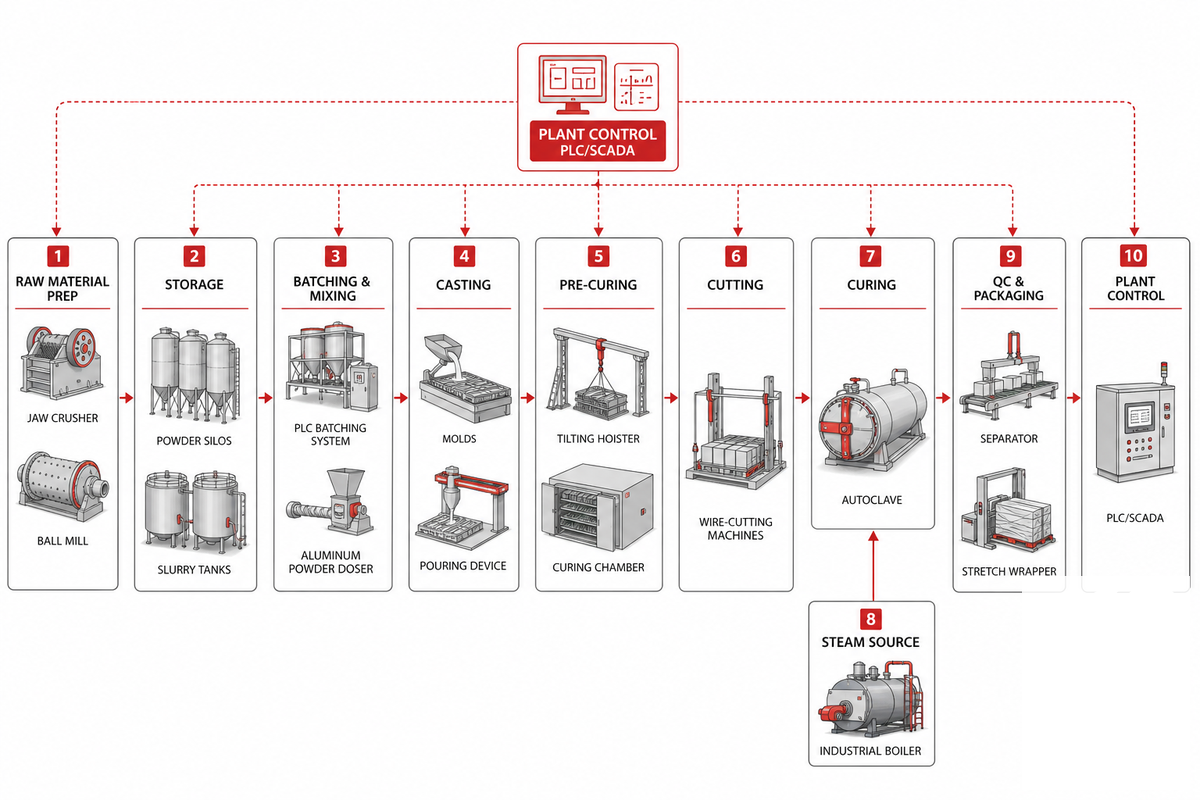
What you’re purchasing isn’t a single block, an aac block plant, but rather the entire line. Equipment price lists often include just the autoclave, or a single “starter” line item – this can explain how two “50,000 m³/yr plants,” quoting entirely different prices, are both said to contain “the same” basic equipment; one quote may represent machine prices, the other turnkey. Before getting quotes, make sure you account for every category of equipment you’ll need to cost out.
| Stage | Equipment | Function |
|---|---|---|
| Raw material prep | Jaw crusher, ball mill | Grinds fly ash/sand and lime to the fineness needed for the autoclave reaction |
| Storage | Powder silos, slurry storage tanks, slurry agitators | Holds ground cement/lime powder and fly ash slurry ahead of batching |
| Batching & mixing | PLC batching system, mixing drum, aluminum powder doser | Doses raw materials by weight; aluminum powder dosing precision is the single most sensitive step in the recipe |
| Casting | Molds, pouring device, mold cars | Receives the slurry and holds it through the rising/pre-curing reaction |
| Pre-curing | Tilting hoister, curing chamber | Flips and holds the green cake at controlled temperature until it’s firm enough to cut |
| Cutting | Vertical and cross wire-cutting machines, cutting car | Slices the green cake to final block sizes and dimensions, measured in cubic meters of output, before autoclaving |
| Curing | Autoclave, ferry car, hardening car | Steam-cures the cut blocks at 180–220°C / 8–12 bar to develop final strength (see next section) |
| Steam source | Industrial steam boiler | Supplies the autoclave — sized separately from the autoclave itself (see “Steam Supply” below) |
| QC & packaging | Block/panel separator, clamping hoist, stretch wrapper | Separates, samples for density/strength, and packages finished blocks |
| Plant control | PLC/SCADA system | Centralizes batching recipes, cycle logging, and remote monitoring across the line |
Many vendors quote only the cutting and casting stage of this process separately as an “aac block making machine,” “block machine,” or some such shorthand that’s fine in a quote document, but represents just one of ten necessary steps in an AAC plant. Observe that the steam boiler appears in its own separate line – distinct from the autoclave. That’s of great significance, more than is often perceived by those in their first plant-build. We discuss its implications further.
💡 Pro Tip
Aluminum powder accuracy is so tight that about ± 0.02% variations in dosing can result in a change of 50-100 kg/m³ in block density. Ask vendors what controls and logs their batching system has for dosing aluminum powder – beyond the specs of the mixer – since this single variable drives more product quality complaints than any other step in the aac block machine line, and fine aluminum powder is itself a regulated combustible dust that dictates how the batching station must be ventilated and grounded.
Choosing the Right Autoclave for AAC Production
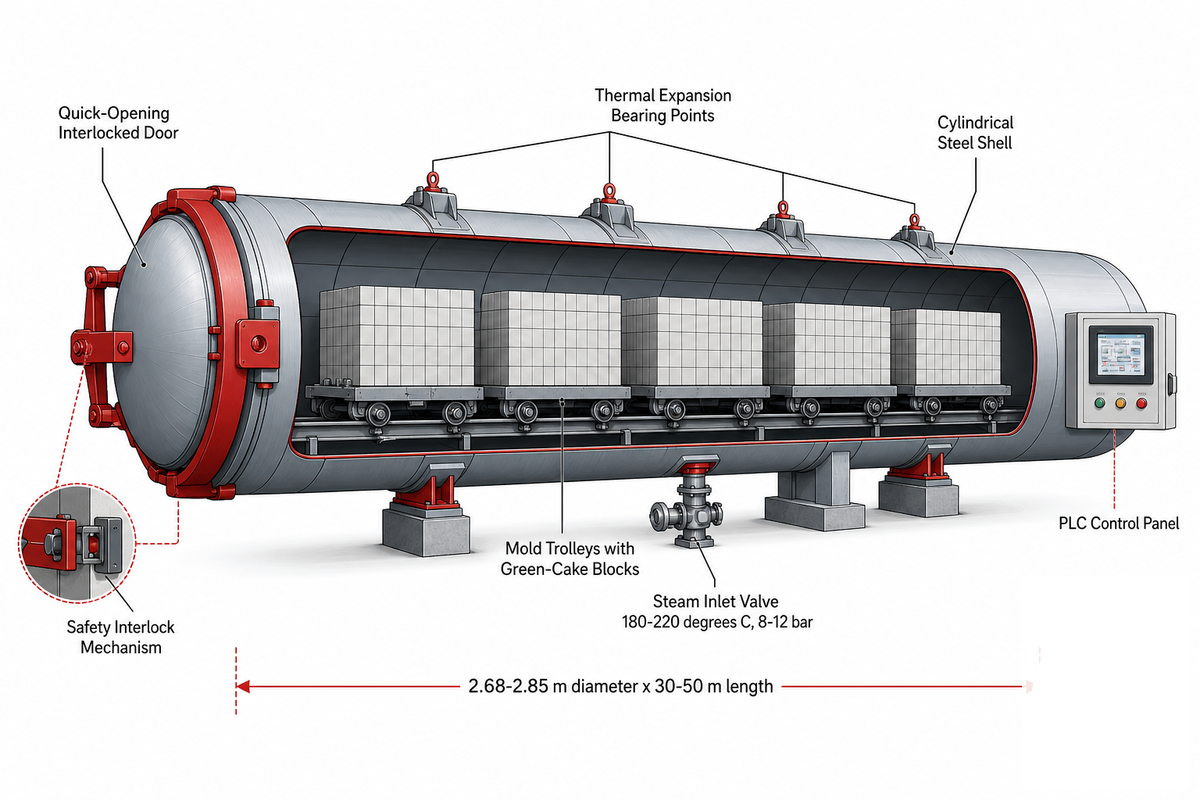
The largest single component of the aac plant is the autoclave; any mistakes here will be costly to fix. An industrial autoclave running on high-pressure steam operates at temperatures between 180-220°C and pressures of 8-12 bar for between 8-12 hours. Typically, they’re 2.68 to 2.85 meters in diameter and 30 to 50 meters in length, and capable of accommodating six to ten mold trolleys simultaneously per batch cycle. Details on how to specify the size and type of autoclave based on target output capacity can be found in our industrial autoclave purchasing guide.
One should avoid mistakenly using a single specification for autoclaves in disparate applications. A autoclave used to cure composites requires a fraction of the pressure of an AAC plant, uses compressed air or nitrogen, and won’t be steam heated. Simply substituting a composite vessel for an AAC one isn’t a minor change; it’s a different pressure vessel code. Ensure any purchased autoclave is built and stamped to the relevant AAC standards (such as ASME Section VIII Division 1 for the US or equivalent GB 150/PED code for the target market) before authorizing purchase.
📐 Engineering Note
Most plants with target annual production of 200,000-400,000 m³ use several smaller autoclave vessels on a staggered schedule rather than one enormous machine. This staging approach means that you can off-load and re-load one vessel’s steam curing (heating and cooling) cycle while other units are still under steam, keeping the cutting and packing lines continually fed, instead of delivering one large burst of cured product to the front end of the line daily. Be sure to confirm the number of vessels required by getting the actual count from your vendor’s throughput model based on the size of the vessels they quote.
Steam Supply, Sizing the Boiler Behind the Autoclave
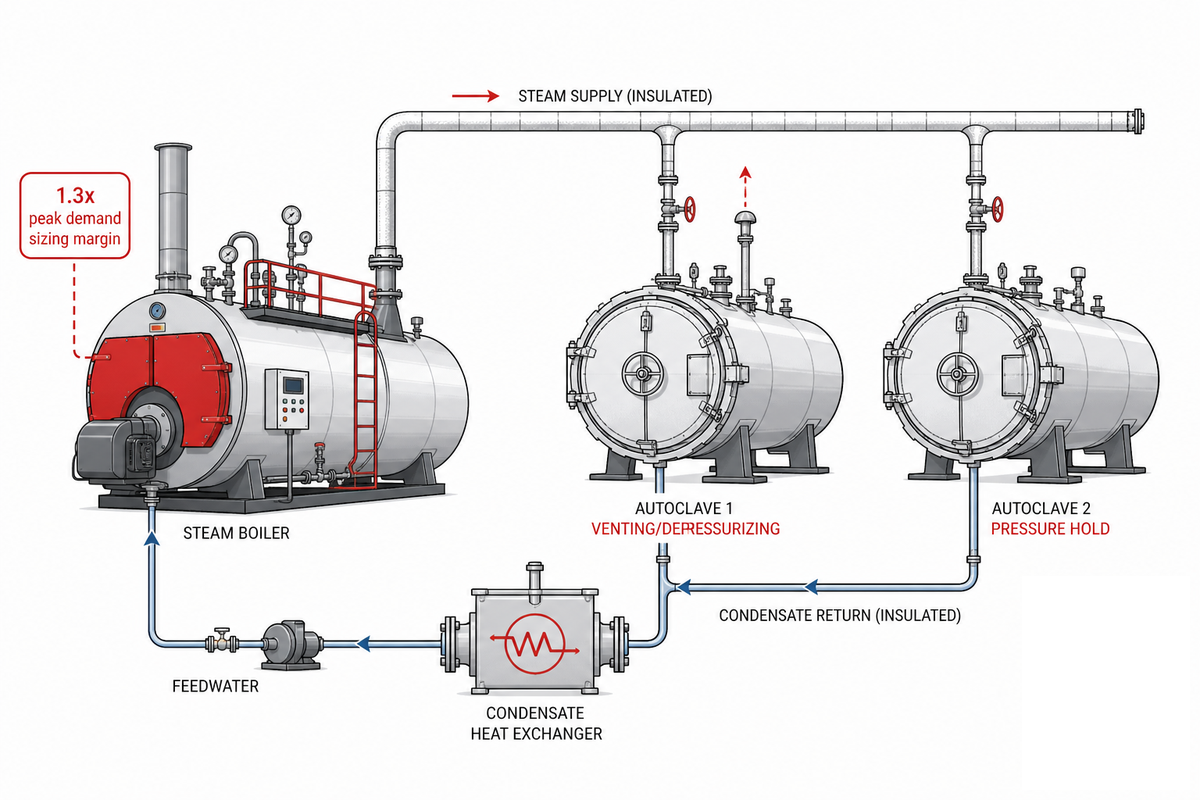
While every aac plant equipment list includes a autoclave, almost none specify how the plant get the steam. The boilerplate plant equipment lists we examined when preparing this guide list “boiler” as a single line item with no supporting sizing, fuel source or connectivity information regarding how the steam is routed to the autoclave. This oversight is where most new AAC plants budgets get in trouble: a poorly-sized boiler can’t bring a autoclave up to temperature in the allotted time, thus extending cycle time and leaving blocks under-cured.
Standard industrial boiler sizing practices-based on the Spirax Sarco method-use steam capacity in kg/hr equal to hourly steam demand, multiplied by a safety factor typically around 1.1-1.2 to accommodate normal fluctuations in steam demand. However, for an AAC plant, we recommend sizing the boiler at a higher factor of 1.3× the peak steam demand of a single autoclave — the 1.3× Steam Margin Rule — to accommodate both the initial heat-up steam surge and the peak demand during the overlap of staggered autoclave steam usage.
“A boiler sized to the autoclave’s average steam draw looks correct on paper and then falls behind the first time two vessels ramp up together. We size AAC steam supply off peak overlap demand, not average demand, and build in the extra margin at the design stage, it’s far cheaper than retrofitting a second boiler once the plant is already running.”
Steam doesn’t have to be purely an ongoing cost, however. There are several autoclave control systems available that route steam from a discharging autoclave into an adjacent vessel that’s currently heating up-instead of venting it out into the atmosphere. These systems are reported to reduce the amount of fresh steam required to make AAC by 25-30%, per AAC Worldwide’s coverage of autoclave operation. As with autoclave count, inquire about this feature with your vendor and request the vendor’s own field measurements of savings. Using condensate heat exchangers to pre-heat boiler feedwater also lowers overall energy consumption and fuel costs further. Note that these strategies don’t reduce the peak steam demand required during initial system heat-up.
The pain point Taiguo’s engineering team hears most often from first-time AAC buyers is a boiler quoted to the autoclave’s average demand rather than its peak: because a cold-start autoclave can briefly draw 20-30% more steam than its steady-state rate, a boiler sized only to average load stalls at exactly the moment two vessels overlap – typically the first week of staggered-cycle operation, when the schedule is still being tuned. That failure mode is why the 1.3x Steam Margin Rule exists: it is a specific, precision-sized allowance for that surge, not a generic safety cushion.
The fuel is then dictated by what’s available on-site and what your operation already uses – your most common fuel choices for your AAC steam are most likely natural gas or biomass, both catered for in our oil & gas fired and biomass fired boiler range, respectively.
Plant Layout, Zoning an AAC Production Facility
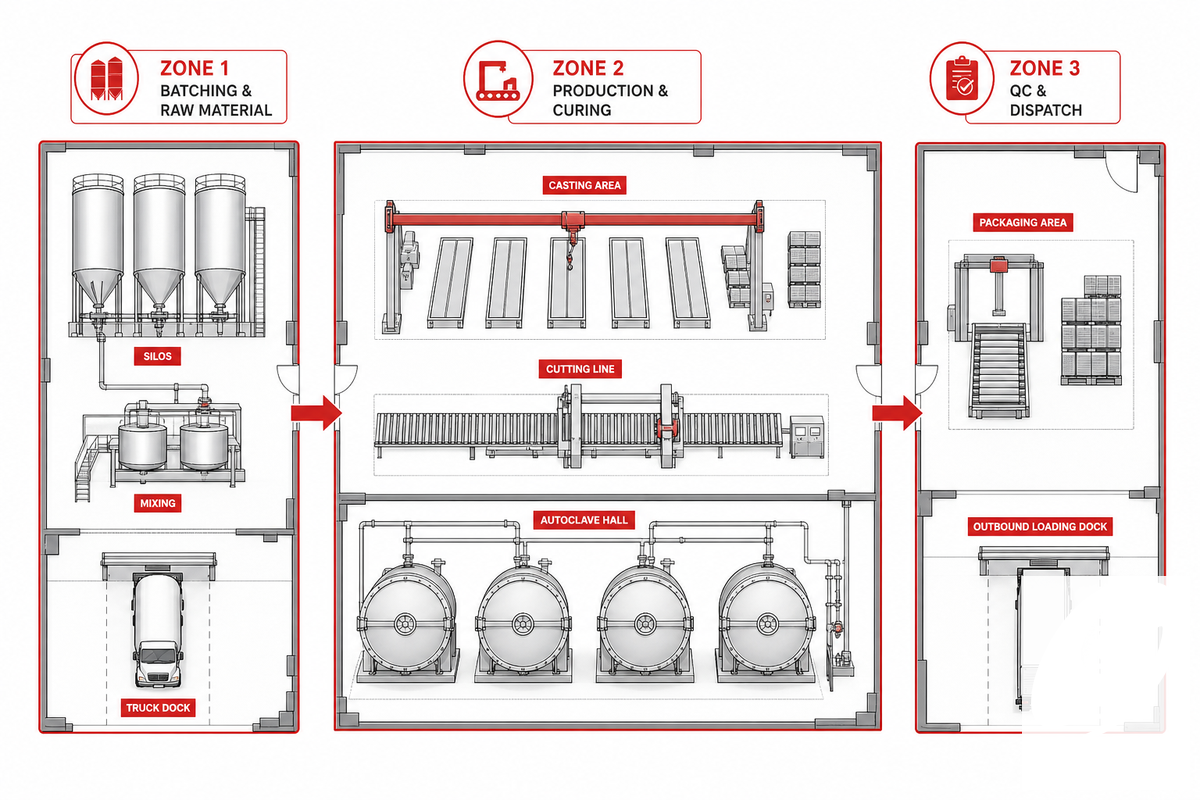
A aac plant floor plan should always follow the flow of material, which naturally breaks into what we call the 3-Zone Layout Framework. Your Batching & raw material Zone contains silos, slurry tanks, and mixing stations, situated for convenient truck access, as this is your highest volume traffic of fly ash / sand delivery. Your Production & Curing Zone will accommodate your casting, pre-curing, cutting, and the largest of your footprint by a country mile, the autoclave hall – as this contains only 30-50m long autoclave vessels. Finally, your QC & Dispatch Zone is responsible for block separation, sampling, packaging, and outbound loading, placing it to separate your finished-goods traffic from the inbound raw materials traffic.
Land size requirement is directly proportional to your planned capacity; the smaller compact format plant can operate in as little as ~25,000-30,000m, while your larger standard industrial plant (200,000-400,000m3/yr) requires a 9,000-15,000m production hall alone (and that doesn’t include yards and warehouses). Be sure to leave yourself with the capacity to expand – future autoclave capacity additions are far more economical if you’ve considered space beside your current autoclave hall, as opposed to the alternative where you’ll have to re-work your cutting lines or batch lines.
Getting this wrong is a real, recurring pain point: because the autoclave hall alone can run 30-50m long, a mid-size operator who boxes it in with permanent batching silos on one side and a warehouse on the other has effectively capped capacity at whatever autoclave count fits the day-one footprint. Taiguo’s engineering team sees this most often on retrofit projects, where a plant built for 3 autoclaves later needs 6 to meet demand and discovers the extra 2-3 vessels physically don’t fit without relocating the entire cutting line – a delay and cost that a $0 decision (leaving one open bay in the original site plan) would have avoided entirely. Pressure-vessel codes such as ASME Section VIII Division 1 also set minimum access and clearance requirements around each vessel, which should be built into the autoclave hall’s footprint from day one, not retrofitted later.
Capacity Tiers, Mini, Mid-Size & Industrial-Scale AAC Plants
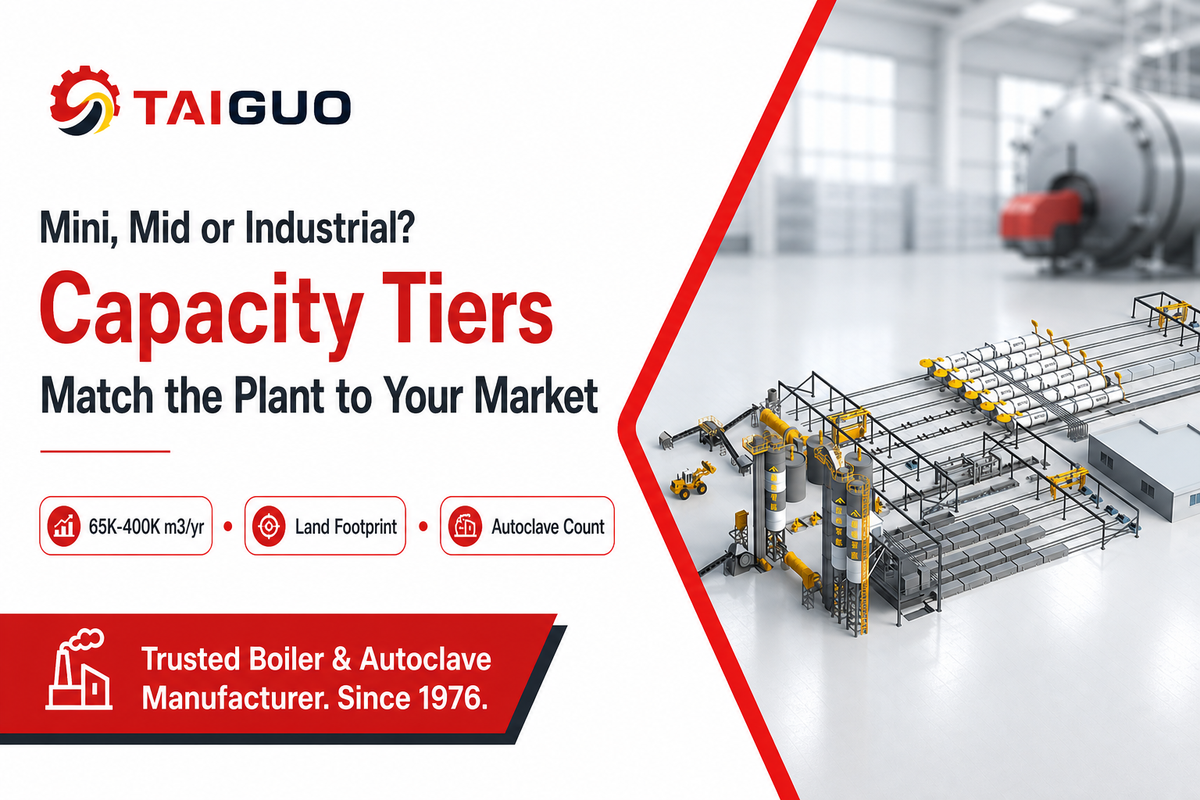
The “bigger is better” adage doesn’t apply automatically; with up to 40% reduction in your land & building budget compared to your large industrial lines, a compact-format AAC plant can produce from around 65,000m3/yr and still remain well under the industry figure of around 100,000m3/yr as the cut-off for industrial capacity, as a compact plant will utilise a smaller footprint in their mold/cake size. This model was designed for distributed, smaller regional markets who couldn’t effectively move 100,000m3 of blocks through the standard distribution chain; the message for new investors is simple: design the plant for your available market, not the largest the manufacturer will sell you.
| Tier | Annual output | Autoclaves (vendor/vessel-size dependent) | Land area |
|---|---|---|---|
| Compact | 65,000–160,000 m³/yr | Reduced-footprint vessels (fewer, smaller units) | ~25,000–30,000 m² (up to 40% less than standard-scale) |
| Mini (standard format) | 50,000–100,000 m³/yr | 2–3 | ~4,000 m² |
| Mid-size | 100,000–200,000 m³/yr | 3–4 (larger vessels) or up to 6–8 (smaller vessels) | 5,000–8,000 m² |
| Industrial-scale | 200,000–400,000 m³/yr | 3–4 (larger vessels) or up to 8–12 (smaller vessels) | 9,000–15,000 m² (production hall) |
A quick search for mini AAC plant cost or an AAC block manufacturing plant for sale will surface plenty of machine-only listings; treat any advertised price there as a starting point for vendor diligence rather than a final delivered cost, since the same equipment-vs-turnkey gap described above applies whether you’re pricing an AAC block manufacturing plant in USA or in an emerging market – it’s a global listing pattern, not a region-specific one.
Which Tier Fits Your Market?
- Dispersed / smaller regional markets which would be unable to move 100% of a full-size plant’s capacity Compact tier
- First-time AAC investor looking to test the market before expanding, and then scale-up later (allowing for room in floor plan to extend autoclave section). Mini tier, with land reserved for future autoclave additions
- Established construction market with known offtake, and strong distribution and logistics reach Mid-size to industrial-scale
Total Capital Investment, What It Actually Costs to Build
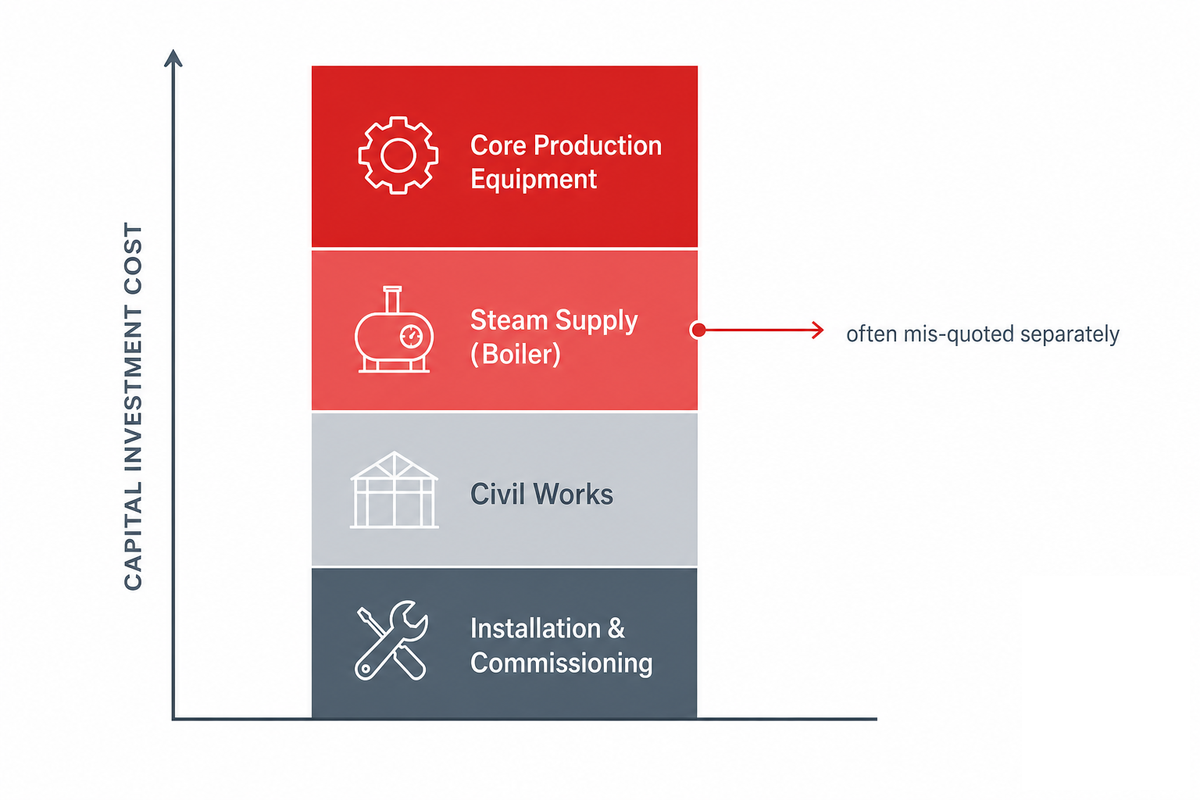
When you’re looking at published “investment” figures for the aac plant, remember they often mean very different things; one manufacturer may advertise their equipment-only costs at roughly $48,500 for a 50,000m3/yr line, whilst on the very same webpage, they’ll also include a $800,000 estimated investment figure for a 50,000m3/yr plant that appears nowhere else on their site without explaining the significant difference (which will most likely be installation, building, commissioning etc). Other manufacturers will provide overall production costs estimates, anywhere from $1million to $5million, for your entire setup, and this gives no insight into what has been included in this cost.
You should break your budget down into these four categories, and expect your vendor quote to do the same:
Total Investment Categories
- Core production equipment – The machinery in the table above including autoclave; this is normally the only item included in a “machine price” quote
- Steam supply – The boiler and fuel-handling/piping; this is frequently quoted separately or excluded from an “equipment” figure
- Civil works – Site, building/foundations for autoclave/vessel loads, and utilities connections
- Installation, commissioning & training – A lengthy, usually multi-month effort (equipment suppliers frequently quote 6-12 months from order to full commercial production for a standard line)
A real, detailed itemized cost breakdown we recently reviewed for a 30,000 m³/year reference configuration, dated 2023, and priced in Chinese Yuan, so consider it illustrative only- showed the autoclave and the tilting hoister as the top two equipment line items by cost; the boiler was substantial, but below them. This weighting, where autoclave and material handling drive equipment cost and the boiler is a major but not overwhelming expenditure, is consistent with our experience pricing steam systems for our AAC clients. The pain point buyers run into here is budgeting the boiler as an afterthought because it’s typically a smaller line-item than the autoclave itself: a boiler quote that looks minor by comparison to the vessel price is exactly how a project ends up meaningfully short at the financing stage, since lenders underwriting an AAC plant loan expect a single itemized capex schedule, not a partial one Taiguo’s team has to reconstruct after the fact. This mirrors the same equipment-vs-turnkey framing AAC Worldwide uses when comparing compact and standard-format plant economics.
The benefits of AAC that help explain its growing use of AAC blocks in construction start upstream, at the raw-material stage: AAC blocks are made – and lightweight blocks are made, more broadly, across the category – from regionally available industrial byproducts, most commonly fly ash from coal-fired power plants, though plants that include fly ash as a primary input can also include raw material blends using bottom ash or sand depending on local supply. For an investor, well-run manufacturing of AAC can be a profitable AAC business precisely because these inputs are typically cheap byproducts, provided your equipment vendor can offer AAC-specific machinery and support rather than generic block-making lines adapted after the fact.
Choosing a Turnkey Equipment Supplier
The aac block industry includes both dedicated aac manufacturing machine builders and larger concrete block plant equipment groups that added an aac block production line onto an existing product range; when comparing quotes, ask whether the machine manufacturer you’re evaluating specializes in AAC or treats it as one line among several, since specialization tends to show up in production efficiency and after-sales support for AAC-specific issues. A genuine aac block plant manufacturer will have committed engineering resources to autoclave-and-boiler integration specifically, rather than adapting general manufacturing machines built for other product lines.
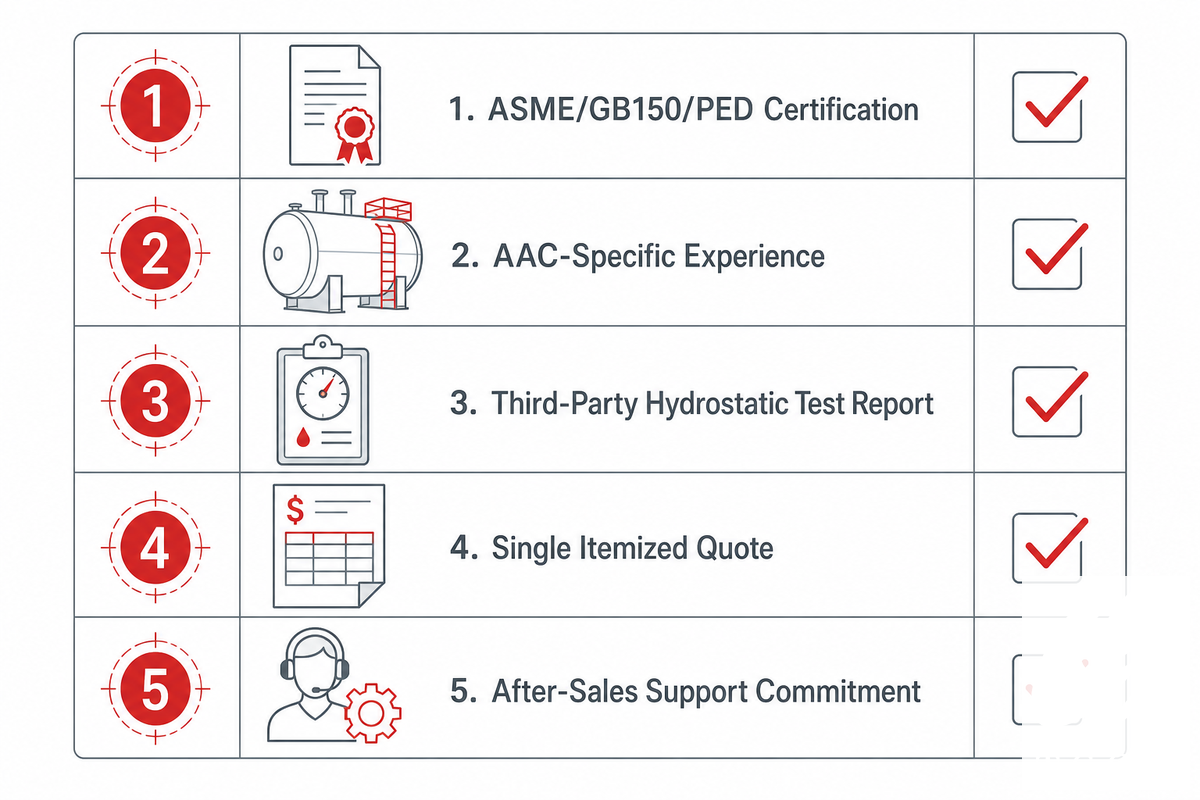
Once fabricated and shipped, correcting a specification error for the autoclave is expensive and time-consuming; vessel dimensions and pressure rating can’t be adjusted. Do your vendor diligence *before* you ask for a quote, not after:
- ASME Section VIII Division 1 (or the equivalent for your target market, such as GB 150 / PED) certification with a copy of the Certificate of Authorization presented *before* fabrication commences; not after delivery
- Specific AAC experience – A boiler for composite curing or food service won’t meet the demands of an AAC autoclave
- Independent, third-party hydrostatic test report at 1.3× design pressure; don’t accept a self-certified report
- A single, complete, itemized quote inclusive of all equipment, steam supply, installation, and training; avoid machine price quotations that force you to solicit these elements elsewhere
- Commitments for after-sales support and parts replacement documented in writing; unplanned downtime can be a plant-killer, especially if autoclave cycles are run back-to-back
Equipment diligence is important, but supply chain risks pose an equally grave threat to an upcoming plant. The planned $25 million aac plant project in Kerrville, TX, which had survived 3-4 years of high-level negotiations and even gained the support of the governor’s office, was scrapped in November 2025 when Austin White Lime Company – the sole source of the needed quicklime and the state’s largest supplier of this essential input – ceased operations. The closest alternative supplier was in Mississippi, and the shipping cost for the lime rendered the project unviable. “It didn’t pencil out for them,” the city’s assistant city manager told local officials. The equipment and building plan were seemingly solid; the project failed because a make-or-break supply chain dependency had been built on a single supplier’s operation without adequate contingency planning. Confirm material availability for lime, fly ash, and gypsum, with at least one backup supplier identified before committing any capital funds, not after.
Taiguo Boiler has been a provider of industrial steam boilers and autoclaves-including custom autoclaves for AAC block production-for approximately 50 years, under China’s Grade A boiler manufacturing license and an ASME-equivalent design verification. For a facility that require a combined autoclave and steam source properly sized from the beginning, consult us about a shared specification review.
Permits, Certifications & Staffing
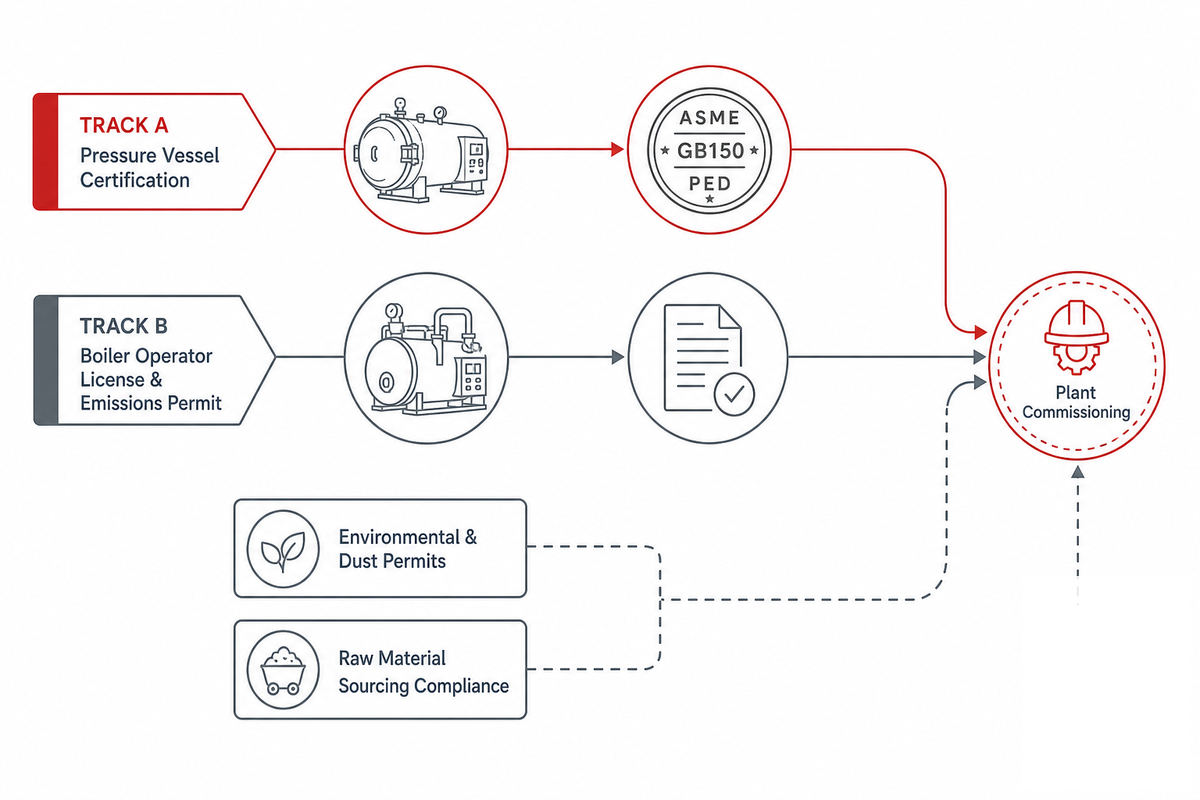
Equipment alone doesn’t permit a aac plant to legally operate:
- Pressure vessel certification for the autoclave-whether it’s ASME Section VIII Division 1 (US), GB 150 (China), or PED 2014/68/EU (Europe); ensure to know your jurisdiction prior to placing an order.
- Boiler operator licensing and emissions permits-separate and distinct from the autoclave’s pressure-vessel certification, these can often be a planning afterthought for new owners as they fall under the boiler, not the AAC process itself.
- Environmental and dust permits for handling raw material, including for storage and grinding of fly ash, plus local quality standards for finished-block sampling.
- raw material sourcing compliance-if sourcing fly ash as a byproduct of coal combustion, be sure to verify it meets beneficial-use or product-specification requirements within your target market, rather than simply assuming it’s an unregulated commodity input.
- Minimum staff levels: operators for batching and mixing, autoclave and boiler operators (separate licensing), a cutting line technician, and quality control/lab personnel to take samples for density and compressive strength testing.
The pain point Taiguo’s team sees most in permitting is treating the boiler’s operator license and emissions permit as bundled with the autoclave’s pressure-vessel certificate, because both sit inside the same building. They’re two separate approval tracks, filed with two different regulatory bodies in most jurisdictions – a distinction that matters because a plant that clears its ASME/GB150 autoclave inspection can still be blocked from startup for weeks over an unfiled boiler emissions permit, since that permit review typically runs 30-90 days independently of the pressure-vessel timeline. Fly ash sourced as a coal-combustion byproduct carries its own separate compliance layer under EPA beneficial-use criteria (or the equivalent standard in your jurisdiction), which should be confirmed before, not after, signing a raw-material supply contract.
Industry Outlook, What’s Changing for AAC Plant Investors (2025–2028)
Two structural trends matter more to a new aac plant investment than any single market-size forecast. First, major building-materials groups across the construction industry continue to invest heavily in AAC capacity, a sign of green building demand still growing: Holcim, for instance, is expanding its Romanian operations with a multi-million-euro investment reported in trade publications, and separately moved to acquire Xella, the Ytong AAC brand holder (pending regulatory approval). Other regional companies, such as DVI Production, along with a joint venture between Siam cement and Bigbloc Construction in India, are opening new lines. This committed capital represents a stronger signal of actual demand than any potential growth forecast.
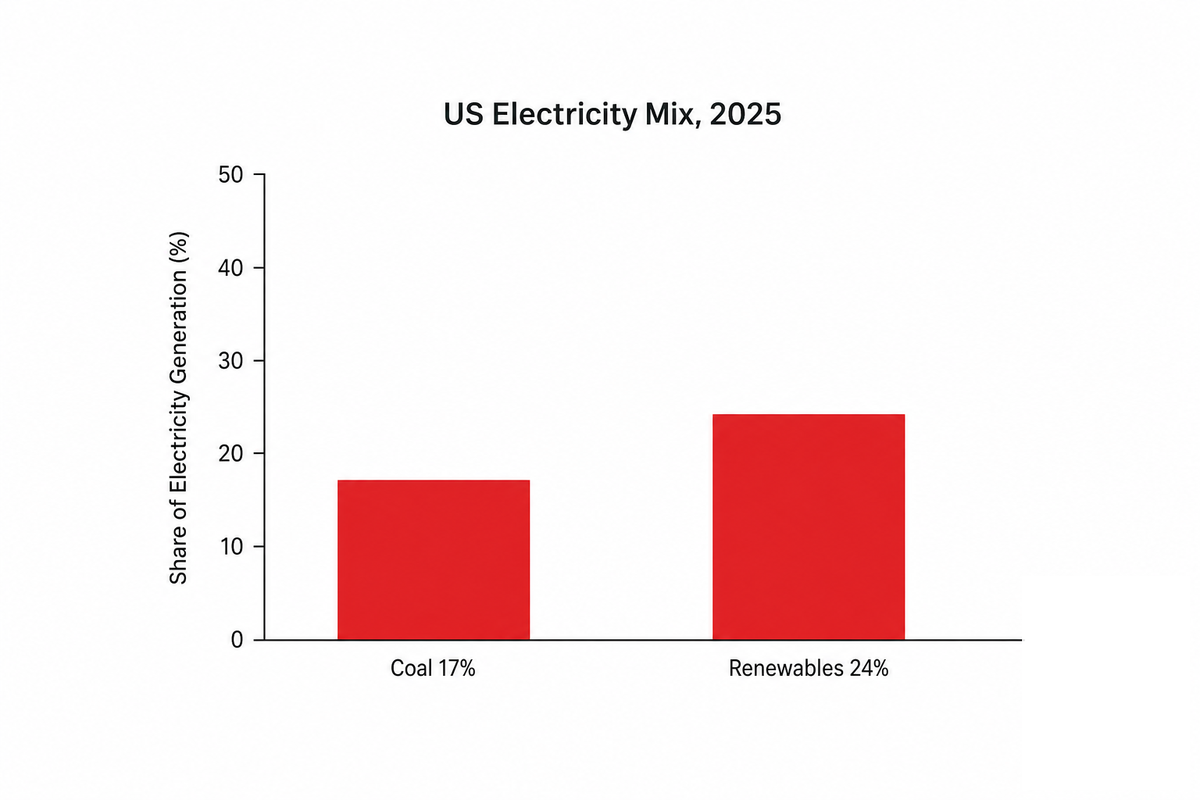
Second, and more subtly: AAC’s primary, low-cost raw material is a byproduct of coal-fired power generation. The U.S. Energy Information Administration indicates that the share of coal in U.S. utility-scale electricity generation had fallen to approximately 17% by 2025, with renewables accounting for about 24% (compared to around 12% in 1990). A plant based on the assumption of cheap, abundant fly ash forever should treat this supply as a dynamic variable, and verify local fly ash sourcing meets EPA beneficial-use or product-specification criteria within the feasibility study.
Market-size estimates for AAC differ wildly by reporting house and definitions, with recently reported figures ranging between $12bn to $36bn (or more) for what purports to be the same global market – indicating that the differences say more about definition differences than the industry trajectory itself. Use any individual CAGR figure for context, but not as an input to any financial plan on its own. On the tech front, autoclave steam transfer systems and compact-plant formats are lowering the capital requirements needed to participate in small, or spread out markets within the wider global AAC market and sustainable construction push – a genuine opportunity to compare with full-size construction if you don’t have an addressable market in excess of 100,000 m³/year of demand clearly.
On the regulatory side, ASME also published its 2025 edition of the Boiler and Pressure Vessel Code with revisions to pressure vessel design rules – be sure any autoclave system you consider for 2026 or later conforms to the 2025, and not a prior, edition of this Code.
The real-world pain point behind both trends is the same: because raw-material and equipment-code assumptions are usually locked in during the first feasibility pass and rarely revisited, a plant modeled on 2023-era fly ash pricing and a pre-2025 pressure vessel edition can be under-budgeted by the time it breaks ground 12-18 months later. Taiguo’s team recommends re-running both checks – fly ash supply and current ASME/GB150 edition – at the final investment decision, not just at the initial feasibility study.
Frequently Asked Questions
Q: How much does it cost to start an AAC block plant?
View Answer
You can find quoted figures anywhere from roughly $800,000 for a small production line’s total setup, up to $1-5 million for bigger plants, but the figures rarely clarify exactly what this is for. You must also account separately for: production equipment, steam boiler, civil works (land, building, foundation) and installation and commissioning. A machine-only quote in tens of thousands is not the whole story.
Request an itemized quotation split into these four categories before comparing different suppliers.
Q: What’s the minimum investment required for an AAC plant?
View Answer
The smallest option at approximately 65,000 m³/year provides the lowest cost of entry; with a land-and-building cost up to 40% lower than standard line, it relies on the small footprint of its mold/cake for less civil works and smaller size equipment. A small-scale, standard-format (50-100,000 m³/year, 3 autoclaves) plant is more typically what equipment suppliers cite as the first tier of investment. Whether the quoted “minimum investment” is for the plant only or for a turnkey operation is to be clarified.
Q: What production capacity should I choose for my market?
View Answer
Size the facility for known demand, not a vendor’s highest capacity line- One of the biggest mistakes in opening a aac plant is over estimating sales capacity. Many localized or smaller regional markets are better served by a small-format plant (65,000-160,000 m³/year), because industrial-scale plants require minimum demand of 100,000 m³/year and up for economic feasibility. Secure options to expand later to medium or industrial scale once the market is proven, instead of over-building early on.
Q: Automatic vs. semi-automatic AAC equipment, which should I choose?
View Answer
An initial investment advantage applies to the cheaper, often seen on mini-capacity systems, where reduced volume output simply does not warrant the entire labour saving of full automations. Fully automated batching, cutting and PLC/SCADA controls also serve to minimise labour levels and, in particular (thanks to the accuracy of aluminum powder), improve the batch-to-batch consistancy important as both volume and quality requirements grow. automation level, again, remains a programmable choice with most vendors in the same equipment range, and is a choice per job rather than a fixed by-capacity-level one.
Q: Is an AAC plant a good investment, and how long is the payback period?
View Answer
AAC continues to be one of the biggest attractions for real capital investment from major building materials groups-Holcim’s ongoing Romanian acquisition activity and expansion, and its attempt to buy Xella, are better demand indicators than any single market forecast. Because they represent actual capital already allocated to building materials expansion rather than theoretical models, Holcim’s moves suggest stronger real demand for AAC going forward. The key factors determining a given site’s payback period are the availability and cost of local fly ash, energy costs to operate the autoclave/boiler system, and a firm commitment of offtake prior to any significant investment. A generalized payback period across various markets is nonexistent; you’ll be safest considering any vendor’s standard ROI claims as marketing language until you’ve modeled your specific local fuel, labor, and raw-material costs. The Kerrville failure previously discussed offers an excellent example of a scenario where the equipment numbers work but an unaddressed assumption on the supply side dooms the project. Address both before spending a dime on equipment.
Q: What size autoclave does an AAC plant need?
View Answer
Industrial AAC autoclaves typically come in diameters of 2.68-2.85 m and lengths of 30-50 m, carrying 6-10 trolleys each time. To meet a production volume of 200,000-400,000 m³/yr, it is standard practice to operate multiple units (roughly 3-4 large vessels or up to 8-12 smaller ones, on a staggered cycle) rather than a single, oversized one. See our industrial autoclave guide (linked above) for a full size-estimation walkthrough across all autoclave applications.
Q: Should I build an AAC plant or a CLC (non-autoclaved) plant instead?
View Answer
Cellular lightweight Concrete (CLC) foregoes the autoclave, utilizing ambient temperature curing. This leads to a lower capital investment than true autoclaved AAC, but also a lower compressive strength. If a higher strength-to-weight ratio and proven specification acceptance are key selling points for your target market, the investment in autoclave technology will be justified; however, for lower-spec applications where the simpler process and lower capital expense of CLC would suffice, a direct comparison is in order. Review our lightweight cellular concrete guide for an exhaustive comparison.
Why We Write This
Taiguo Boiler has been manufacturing industrial steam boilers and autoclaves since 1976 and has delivered autoclaves specifically for the production of aac block. The boiler steam supply guidelines and margin-of-safety (1.3×) referenced in this document represent standard Taiguo engineering practice for coupling steam capacity to autoclave demand rather than a general industry benchmark. Equipment cost examples shown from vendor websites should be considered historical references and are to be verified with individual suppliers prior to any budgeting process.
References & Sources
- ASME BPVC Section VIII Division 1American Society of Mechanical Engineers
- 2025 ASME Boiler and Pressure Vessel CodeAmerican Society of Mechanical Engineers
- Methods of Estimating Steam ConsumptionSpirax Sarco
- AAC Compact Plant: Size Doesn’t Always Matter, the Right Technology DoesAAC Worldwide
- Safe and Efficient Operation of AutoclavesAAC Worldwide
- Electricity in the United StatesU.S. Energy Information Administration
- Coal Combustion Residuals, Beneficial UseU.S. Environmental Protection Agency
- New ACC Plant Marks Third Investment by Holcim RomaniaCemNet / International Cement Review
- In a Major Economic Blow, Megaacrete Cancels Kerrville Manufacturing Plant DealThe Kerr County Lead (Nov. 2025)
Related Articles
- Autoclaved Aerated Concrete Block: The Complete Manufacturing Processfull raw material and process breakdown behind the blocks this plant produces
- Industrial Autoclave Guideautoclave types, specs, and buying criteria across composites, AAC, wood, and rubber applications
- AAC Block Specifications, Sizes & Gradesdensity classes and dimensional standards your plant’s QC line will test against
- AAC Block Price Guidewhat your finished blocks are worth per m³ once the plant is running
- Lightweight Cellular Concrete Guidethe non-autoclaved alternative, compared