Get in Touch with Taiguo


Quick Specs
| Typical capacity range | 36 kW – 4.5 MW (50 kg/h to 6 t/h steam) |
| Thermal efficiency | ~99% electric vs. 77–82% for a modern code-minimum gas boiler |
| Equipment price band | $5,000 (100 kW) to $200,000+ (1–5 MW) |
| Install timeline | 3–5 days (simple swap) to several months (utility service upgrade) |
| Typical payback | Depends heavily on local electricity rate — see the payback section below. |
Industrial electric boiler cost is the combined total of the equipment price, the electricity to run it, and the years it takes to recoup that investment against a comparable gas boiler. That total breaks into three separate numbers, and vendors usually only show you one of them. The equipment quote alone seems simple — just the price on the invoice — but things get complicated when electricity prices, installation work, and years of operating cost come into play. Three elements make up that real cost: what you pay for the boiler itself, what it will cost you to run, and how long it will take to recoup that investment relative to a gas boiler. These units serve commercial and industrial facilities across dozens of distinct industrial applications and industrial uses, and every model is built to generate steam or hot water reliably for heat and steam duty in a heating system that has to run every day, not just occasionally.
A medium industrial electric steam boiler (1 ton/hour of steam, approximately 700–750 kW of power) might cost about $10,000–$45,000 upfront. Electricity costs to run it, however, run three to five times higher than for natural gas on a per-unit of heat output basis. It’s an open question as to when, if ever, the two costs converge, given local gas prices, electricity prices and how many hours a year the boiler operates.
- Equipment price climbs with boiler capacity, and it does so less than linearly — bigger units are cheaper per kW of electrical capacity.
- Using the average industrial U.S. price of electricity, most industrial electric boilers don’t pay back against their natural gas alternatives over typical investment horizons.
- Some U.S. states already operate at an electricity price below which an industrial electric boiler is genuinely cost-competitive against a natural gas one.
What Drives Industrial Electric Boiler Cost?
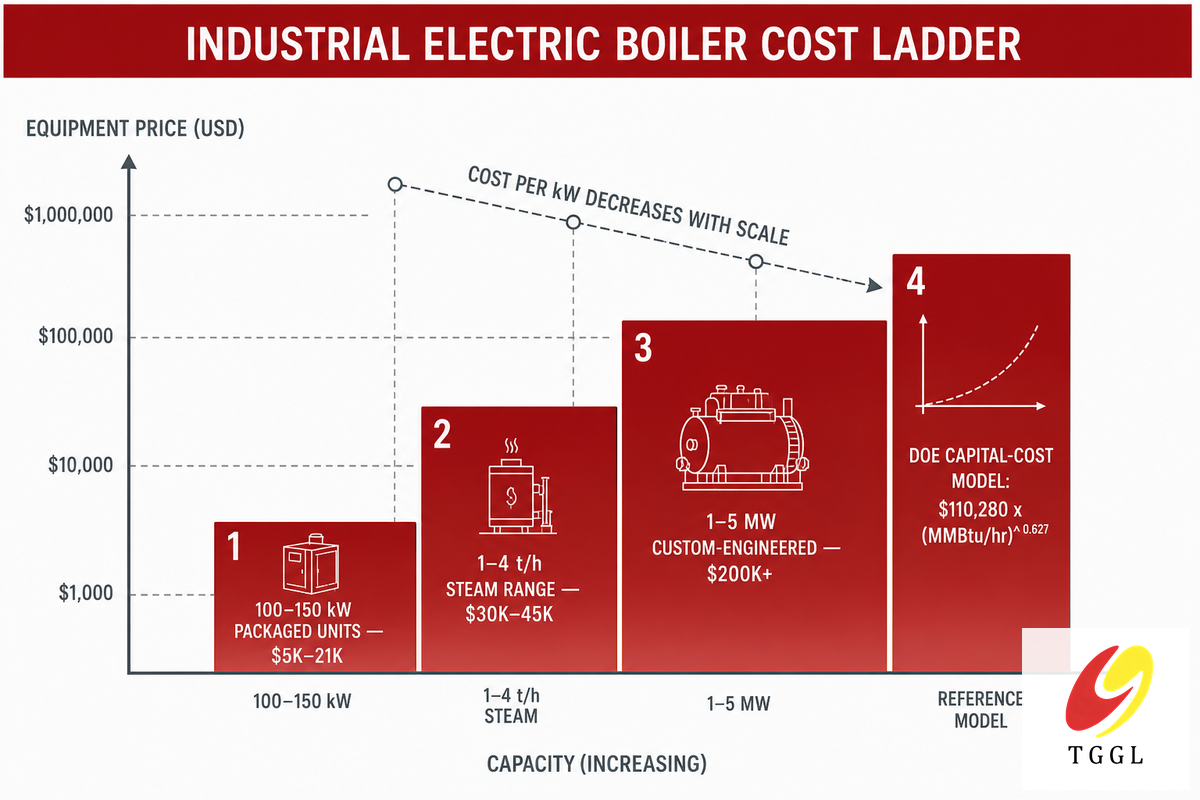
Industrial electric boiler cost is driven primarily by the amount of steam or hot water you need to generate, not by the brand on the nameplate, and equipment price climbs with capacity but less than linearly, so larger units cost less per kW of installed capacity than smaller ones.
Small, laboratory- and pilot-line sized boilers (50-100 kg/h) can cost a few thousand dollars; units that range from 1-6 tons of steam per hour used in food processing plants, textile mills or hospitals typically cost between the low tens and hundreds of thousands of dollars when the capacity climbs beyond 1 MW of electric input. Sorting by power demand, four independent sources (a decarbonization guide from Lawrence Berkeley National Lab, two manufacturer equipment guides and a boiler rental price sheet) yielded a pretty consistent band of pricing.
$5K–21K100–150 kW packaged units
$30K–45K1–4 t/h steam range
$200K+1–5 MW custom-engineered
How much does an industrial boiler cost?
Any industrial boiler, electric or otherwise, generally costs from about $5,000 for a small, 100 kW package up to well over $200,000 for custom-designed systems rated between 1–5 MW, with the exact figure set by capacity, pressure class, and voltage far more than by brand.
Smaller industrial electric boilers are usually less expensive than a similar size gas or oil fired boiler simply because they lack a burner, combustion train and flue; however, that differential shrinks and can even reverse for very large systems where the costs of switchgear and transformers become significant parts of the equipment quote. If your own search for industrial electric boiler cost near me turns up mostly local HVAC contractors, that’s normal — industrial-scale suppliers like Taiguo usually quote directly rather than through a local dealer network, so working out electric boiler cost per hour for your own facility is often more useful than a local search.
The two main electric steam boiler lines offered by the manufacturer Taiguo reflect that cost pattern from the supplier perspective, with its small vertical LDR-series electric steam boiler serving light duty industrial needs up to 360 kW (500 kg/h), while its large, horizontal WDR-series electric steam boiler scales from 375 kW up to 4.5 MW (6 tons per hour of steam) for continuous, heavy-duty operation, a line-up of 12 different models in the middle range.
The Model-to-Capacity Cost Ladder
Since equipment prices follow the capacity of the boiler quite closely, finding the general range is best achieved by picking out a capacity class and estimating your cost prior to requesting formal quotes. Taiguo provides a good look at such an array of models, covering the full spectrum of 12 vertical and horizontal electric steam boilers in this range:
| Model | Type | Steam capacity | Electric power | Rated pressure |
|---|---|---|---|---|
| LDR0.05 | Vertical | 50 kg/h | 36 kW | 0.7 MPa |
| LDR0.1 | Vertical | 100 kg/h | 72 kW | 0.7 MPa |
| LDR0.2 | Vertical | 200 kg/h | 144 kW | 0.7 MPa |
| LDR0.3 | Vertical | 300 kg/h | 216 kW | 0.7 MPa |
| LDR0.5 | Vertical | 500 kg/h | 360 kW | 0.7 MPa |
| WDR0.5 | Horizontal | 0.5 t/h | 375 kW | 0.7–1.25 MPa |
| WDR1 | Horizontal | 1 t/h | 750 kW | 0.7–1.25 MPa |
| WDR1.5 | Horizontal | 1.5 t/h | 1,050 kW | 0.7–1.25 MPa |
| WDR2 | Horizontal | 2 t/h | 1,500 kW | 0.7–1.25 MPa |
| WDR3 | Horizontal | 3 t/h | 2,250 kW | 0.7–1.25 MPa |
| WDR4 | Horizontal | 4 t/h | 3,000 kW | 0.7–1.25 MPa |
| WDR6 | Horizontal | 6 t/h | 4,500 kW | 0.7–1.25 MPa |
📡 Engineering Note
DOE’s own capital-cost model for electric boilers, Capital Cost (2018$) = $110,280 × (MMBtu/hr)^0.627, prices a 10 MMBtu/hr unit at roughly $467,200 and implies $14,000–$47,000 per MMBtu/hr across a 10–250 MMBtu/hr range, a useful sanity check against any vendor quote.
For steam versus hot-water electric boilers specifically, steam units generally cost 15-25% more at the same heat output because they carry a pressure-vessel design and steam-quality controls a hot-water unit doesn’t need. Pricing for industrial electric boiler cost also depends on required steam pressure and voltage class – a unit built for 4,160-25,000V electrode-heating service costs differently from a standard 208-600V resistance-heating unit of similar output. When you request an electric boiler price from a manufacturer, ask for the figure broken out by kW or t/h rather than a single lump sum – it makes comparing quotes across industrial electric boiler manufacturers far easier. Before you request cost estimates, nail down your boiler size and duty cycle first. Compact vertical units like the LDR series suit a tight boiler room, while the larger horizontal WDR line needs more floor space but covers a wider range of industrial uses in the textile industry, food plants, and other high-temperature process settings that depend on precise temperature control and the full technical details of the steam spec, not just a nameplate rating.
Key Factors to Consider
- Required capacity (kg/h or t/h steam, or kW for hot water)
- Working pressure and steam temperature
- Electrode versus resistance heating technology (see our electrode vs. resistance electric boiler comparison)
- Voltage class and available electrical service
Electric Boiler Operating Cost, The Electricity Bill Reality
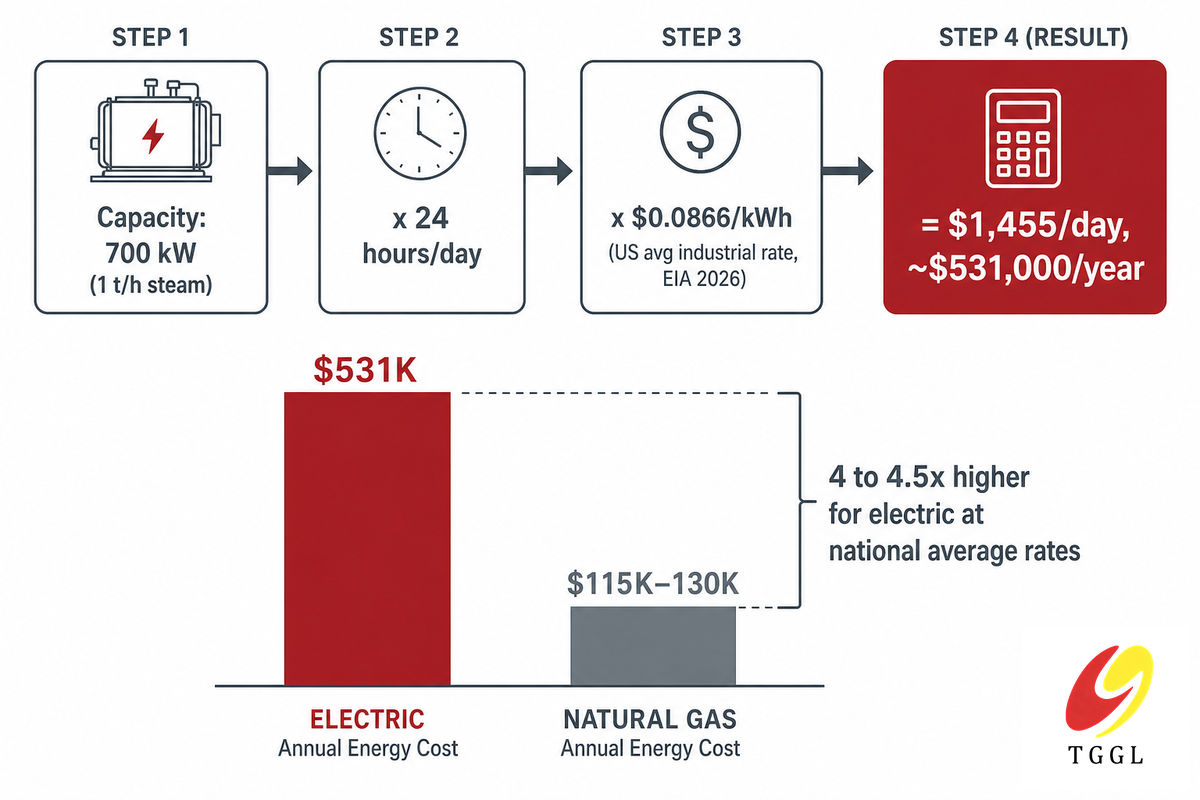
Electric boiler cost to run is driven mainly by one number: your local electricity price, and it varies enormously by location. The U.S. average industrial electricity rate was 8.66 cents/kWh as of April 2026, according to the U.S. Energy Information Administration — up from 8.21 cents a year earlier — but state averages range from 5.86 cents/kWh in Oklahoma to nearly 20 cents/kWh in California. That six-cent spread across states matters more to your bill than almost anything else in this article, and it’s the number to check before you compare industrial electric boiler cost per hour against your current gas bill. Once you know your local rate, working out electric boiler cost per hour at your own site is simple: multiply the boiler’s kW rating by your rate, then multiply by the hours it actually runs. High efficiency electric heating does deliver real energy efficiency and energy saving gains over the equipment’s life, but the short-term picture is dominated by the initial investment and upfront costs, not the promise of lower costs down the road; a few suppliers offer a volume discount on multi-unit orders, which can shift the payback math slightly in your favor.
Here’s the math, worked end to end. A 1 t/h (roughly 700 kW) electric steam boiler running 24 hours a day at the national average rate consumes about 700 kWh × 24 hours × $0.0866/kWh ≈ $1,455 per day, or roughly $531,000 per year at full continuous load. A comparably sized gas boiler delivering the same useful heat output, burning natural gas at a typical industrial rate of about $4.90 per thousand cubic feet and running at 77-82% efficiency (the federal minimum for a new gas boiler under 10 CFR 431.87, not the 70% figure often cited for older equipment), lands closer to $115,000-$130,000 per year in fuel cost. That’s roughly 4 to 4.5 times the annual energy cost for electric – close to the raw per-unit commodity price gap between the two fuels, because a modern gas boiler’s 77-82% efficiency is high enough that it doesn’t give electric’s near-100% efficiency much room to close the gap the way an older, 70%-efficient gas unit would.
“The barrier is rarely whether the technology works. It is usually that running electricity costs more than burning gas, because of how we price and tax the two.”
Jan Rosenow, Director of European Programmes, Regulatory Assistance Project
Note: this comparison covers electrode and resistance electric steam boilers – the same category as Taiguo’s LDR and WDR series. Industrial heat pumps are a separate electrification technology with a coefficient of performance above 1.0, and can post materially shorter paybacks under the right conditions; that’s a different piece of equipment with a different cost story, not a resistance boiler.
A frequently overlooked variable: demand charges, which typically make up 30-70% of a commercial or industrial electric bill on top of the per-kWh energy charge. Real facilities have captured meaningful savings by shifting load away from peak demand windows – a dairy cooperative earns roughly $12,000 a year from demand-response enrollment, and a steel producer earns an estimated $500,000-$1,000,000 a year the same way. A field measurement by Oak Ridge National Laboratory on real Chicago-area utility rates found 24.6-25.8% realized savings from load-shifting alone – a bit below the 30-50% range some equipment marketing claims, though achievable at the upper end when stacked with additional demand-response incentive programs. That’s a real, measurable lever, but shifting your own load to off-peak hours lowers your bill; it doesn’t by itself make electric cheaper than gas.
Electric vs Gas Boiler Cost: Where Each One Wins
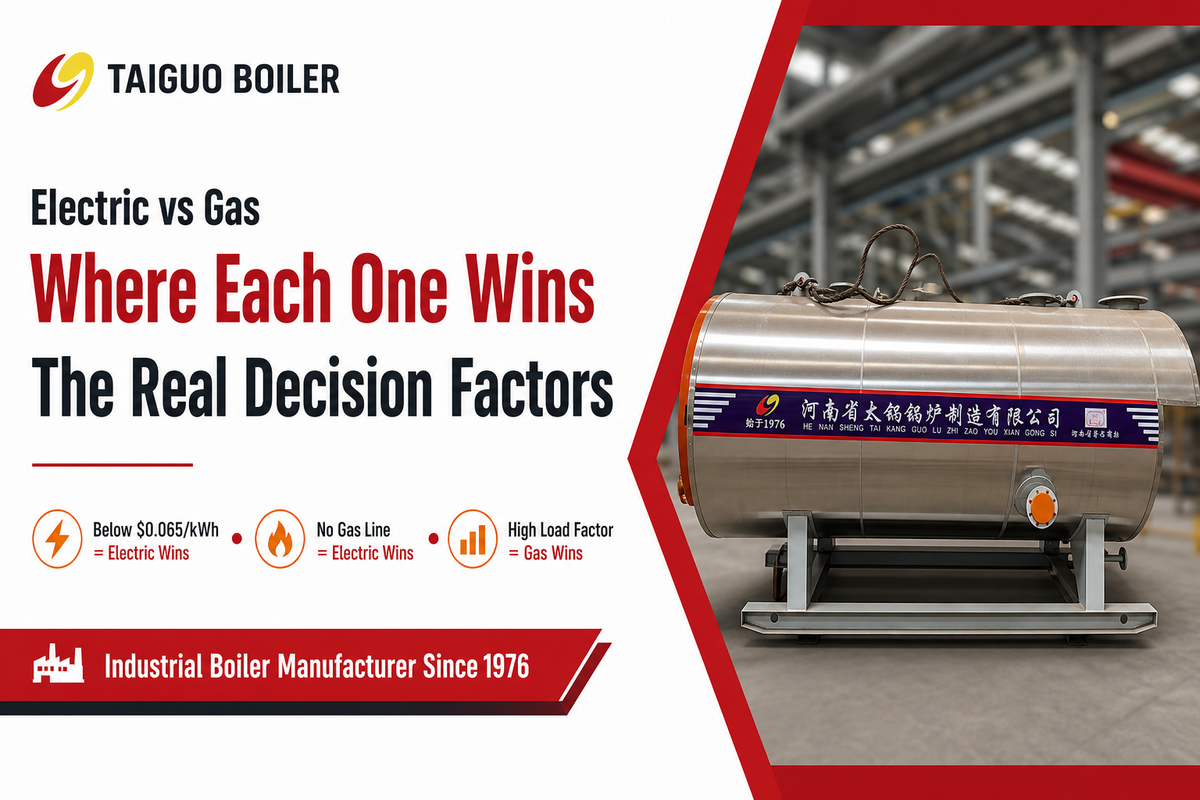
Electric boiler cost beats gas boiler cost in a specific, identifiable set of situations — not universally. The deciding factors are your local electricity rate, your local gas rate, how many hours a year the boiler runs, and whether you have a decarbonization mandate that changes the calculation entirely.
Gas usually wins when
- Electricity runs above roughly $0.065/kWh
- Natural gas stays below roughly $1.14/therm locally
- The site already has gas service and flue infrastructure
- Boiler runs near-continuously at high load factor
Electric usually wins when
- Electricity is below roughly $0.065/kWh (several non-hydro U.S. states qualify — see below)
- No gas line exists and the alternative is propane or fuel oil
- A decarbonization mandate or low-carbon grid changes the calculation
- Fast startup (3–5 minutes) and zero on-site combustion matter more than raw fuel cost
Against propane or fuel oil specifically, electric is the more reliable winner: a facility without gas-line access paying $2.19-$2.49 per gallon for propane, against local electricity of $0.06-$0.10/kWh, comes out ahead on electric far more consistently than the same facility would against piped natural gas. That distinction matters: electric boilers reliably beat propane and fuel oil, but only conditionally beat grid natural gas.
On regulatory exposure, the comparison is narrower than it first looks. EPA’s Boiler MACT rule (40 CFR 63 Subpart DDDDD) sets hazardous air pollutant limits for coal-, oil-, and biomass-fired boilers – natural-gas-fired boilers aren’t directly subject to those limits, and gas boilers at area sources are explicitly exempt from the related NESHAP. If your current unit burns coal, oil, or biomass, the compliance case for switching to electric (or to gas) is real. If your current unit already burns natural gas, the “regulatory pressure” argument for switching to electric is weaker than marketing materials sometimes suggest. Natural gas boilers and other fossil fuels equipment still need flue gas handling, condensate return, and steam supply piping that an electric unit skips entirely. During the off-season, that idle infrastructure still needs upkeep even when the boiler barely runs, and a leftover furnace or supplementary heat source sitting unused is its own maintenance liability.
5-Year Total Cost of Ownership & Payback Period
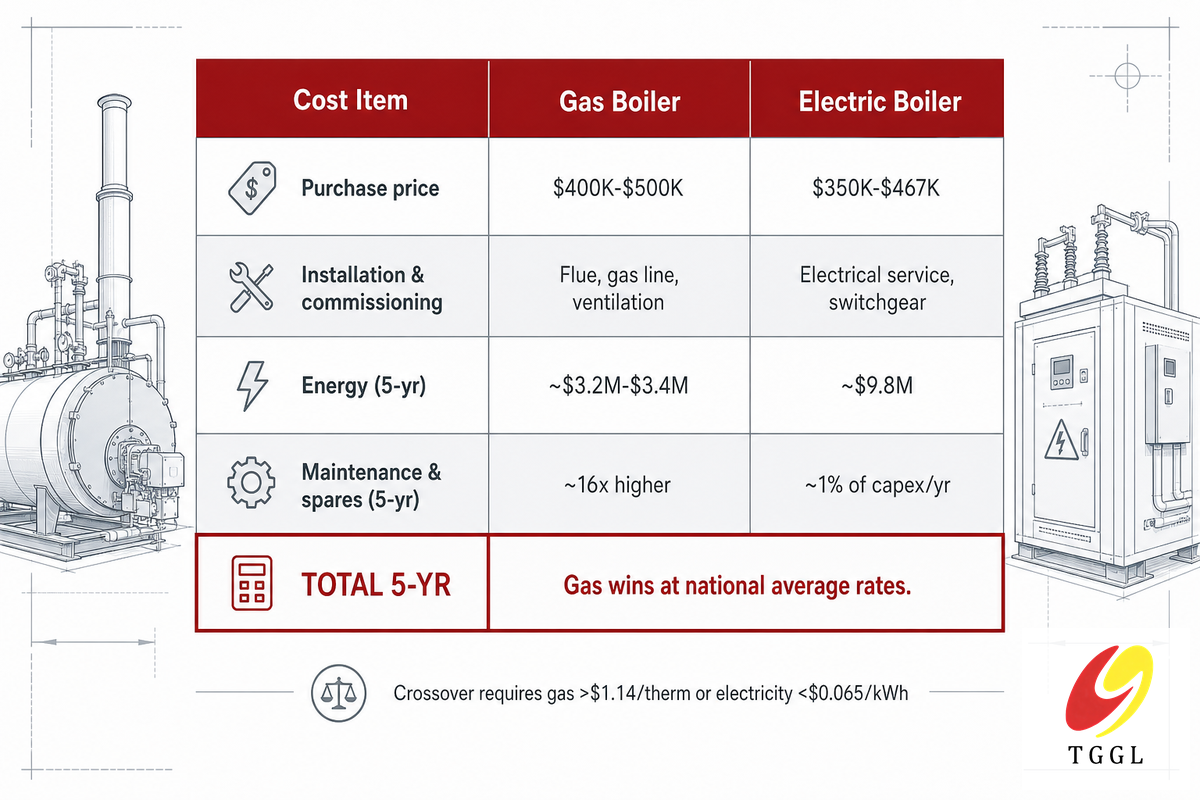
The 5-year total cost of an industrial electric boiler comes down to one honest number: at typical U.S. electricity and gas rates, most electric boiler installations don’t pay back against a gas boiler at all. That isn’t the answer most vendor pages give, but it’s what a Department of Energy/Lawrence Berkeley National Laboratory worked example and an independent facilities-engineering case study both show.
The Capex-Opex Crossover Point
The Capex-Opex Crossover Point is the gas-rate-and-electricity-rate combo where an electric boiler’s cheaper up-front and maintenance costs finally win out against its higher operating cost. We total it up with a 5-Point Cost Framework: purchase price, installation and commissioning, five-year energy spend, five-year maintenance and spares, and downtime risk.
The 5-Year Cost Ledger for a 10 MMBtu/hr boiler (illustrative DOE/LBL example, U.S. average rates):
| Cost item | Gas boiler | Electric boiler |
|---|---|---|
| Purchase price | $400,000–$500,000 | $350,000–$467,000 |
| Installation & commissioning | Flue, gas line, ventilation | Electrical service, switchgear |
| Energy (5-yr, at avg. rates) | ~$3.2M–$3.4M | ~$9.8M |
| Maintenance & spares (5-yr) | ~16x higher than electric | ~1% of capex per year |
| Downtime risk (5-yr) | Burner/flue service outages | Minimal, few moving parts |
Payback example: at the 2021 U.S. average rates DOE/LBL modeled ($7.90/MMBtu gas, $0.11/kWh electric, 70% vs. 99% efficiency), the same 10 MMBtu/hr facility spent $677,346/year on gas energy versus $1,953,612/year on electric energy — electric cost about $1.28 million more per year, and never paid back the lower-maintenance advantage within a 25-year facility life. A 2024 case study of a Baltimore facility reached the same conclusion at current local rates: the electric design’s 25-year lifecycle cost ran about 12% higher than the gas design.
That point is both specific and calculable: We put it around natural gas >$1.14/therm, or electricity <$0.065/kWh (per our FacilitiesNet analysis). And it’s hardly just a Quebec-hydro peculiarity – EIA’s April 2026 state-level data includes a handful of non-hydro US states already in that range or lower, such as Oklahoma (5.86 cents/kWh), Montana (5.99), Arkansas (6.20), Iowa (6.26), New Mexico (6.27) and Texas (6.33). (One caveat when doing your own math: low-cost industrial electricity is usually accompanied by low-cost industrial natural gas, so those prices need to be considered together.)
Real Deployments With Published Cost Figures
| Valmet, Tampere, Finland | 3 MW electric boiler, €2 million total investment, grid upgrade from 3.5 MW to 7 MW |
| Hydro, Alunorte, Brazil | 60 MW (95 t/h) electric boiler, roughly $130/kW installed, about 20-month build |
*Figures from project sources and should be considered direction-setting benchmarks only; not a quote for your own site.*
Installation, Permitting & Hidden Infrastructure Costs
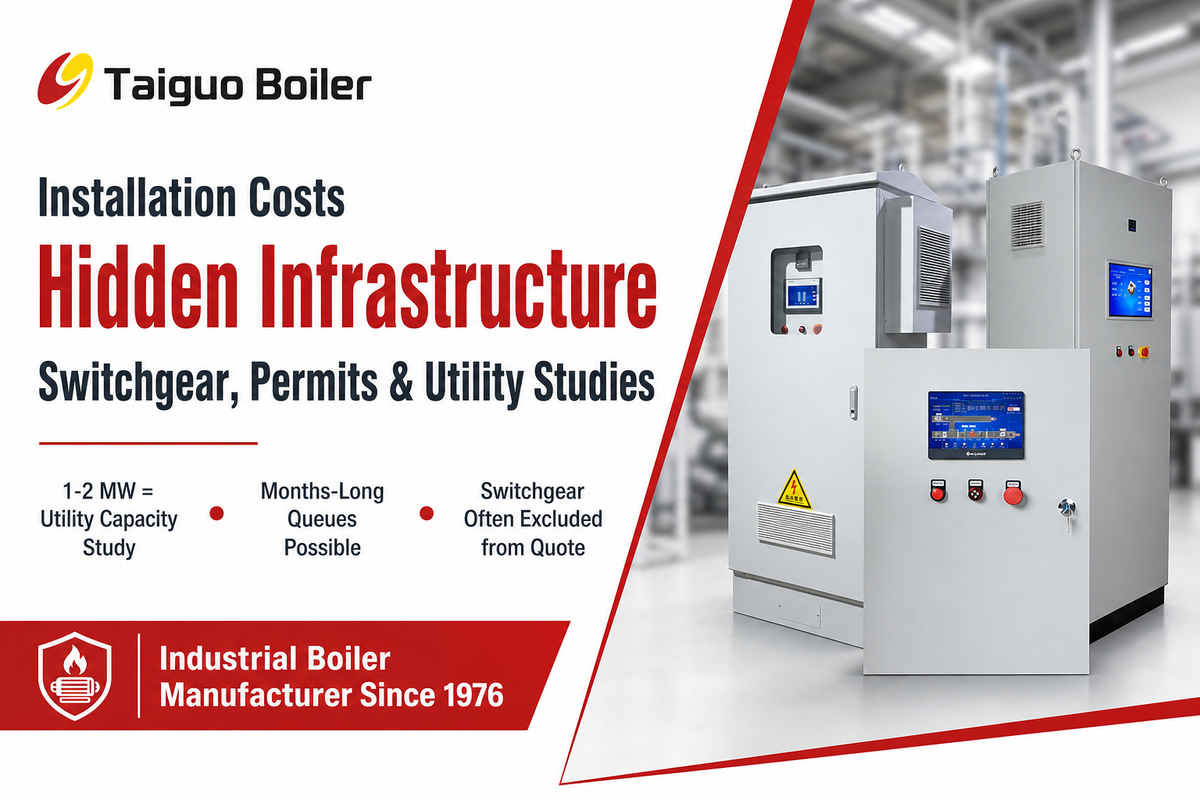
A large portion of an industrial electric boiler budget gets squandered, not on the unit cost itself but on a suite of electrical infrastructure improvements often excluded from a quote. Forum posts and articles by heating-industry practitioners invariably cite this as a major pitfall: customers budget for the boiler hardware but overlook the substantial switchgear and transformer upgrades needed to power a boiler in the hundreds of kilowatts range.
As industrial electric boiler capacity climbs beyond the few hundred kilowatts range, electrification becomes much more than simple rewiring. Three engineers writing in the trade press explain how projects of 5,000–20,000 hp often entail new substations, load flow analyses, short-circuit analyses, and motor-starting studies, in addition to on-site steam, feedwater, and gas or flare systems upgrades. Boilers above roughly 1–2 MW typically require formal utility capacity studies to get approved for connection; depending on your local feeder capacity, that can mean months-long queues. Boiler installation costs typically bundle labor costs for the electrical tie-in with any additional costs tied to your facility’s specific requirements. So confirm the control system is compatible with your existing building automation platform before signing off; a manufacturer’s warranty rarely covers a wiring hazard or a water leak caused by a mismatched installation.
- Verify your available electrical service with your utility before placing an order.
- Budget for switchgear, transformers and feeders-in addition to the boiler itself.
- Submit initial notification and compliance paperwork to the EPA through their CEDRI system if the installation will displace a non-gas boiler.
- Verify your boiler’s nameplate and code compliance under the 2025 ASME BPVC Section I/IV standards if your boiler uses resistance heating elements.
(As a real-world reminder of the scale, the DOE Office of Clean Energy Demonstrations provided funding to Kohler for an electric boiler that will be integrated into a 21-megawatt solar array with 20.5 megawatts of storage, which gives some context for the broader capital investment required for larger electric boiler projects.)
Why Electric Boiler Demand Is Rising Faster Than Gas
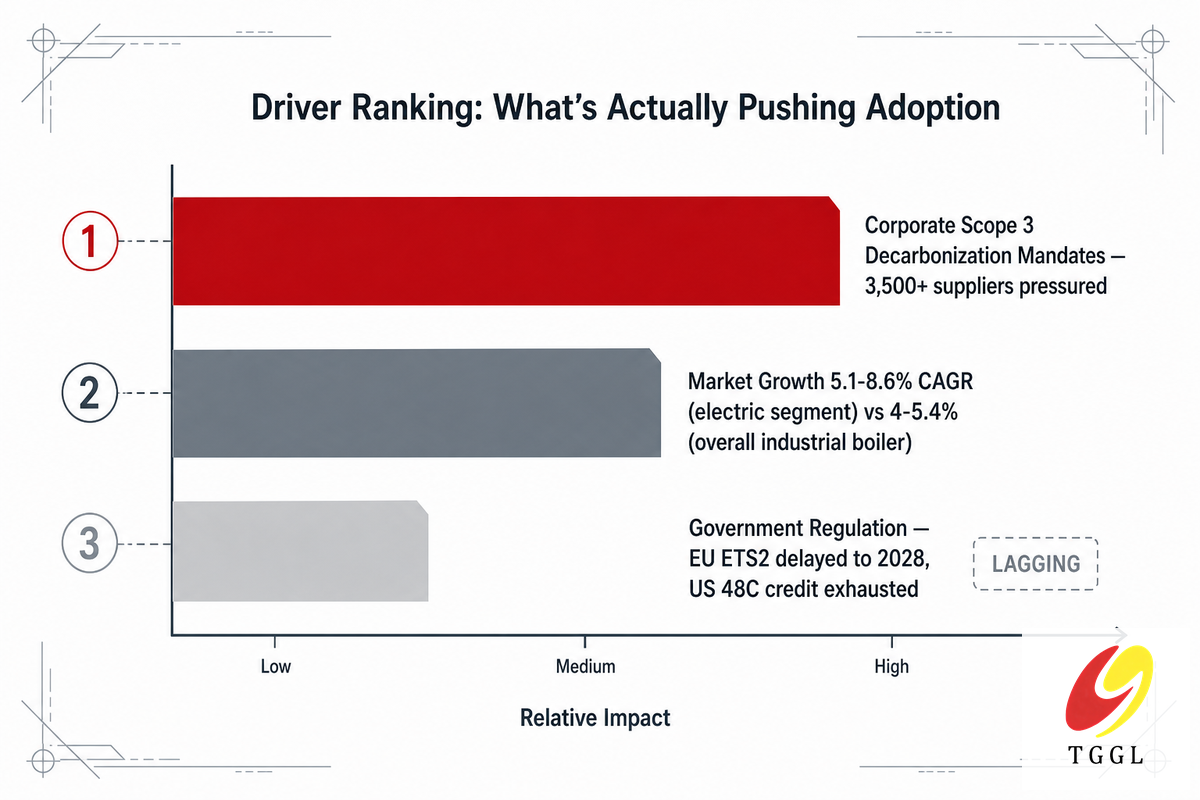
Electric boiler demand is rising faster than the overall industrial boiler market mainly because corporate buyers, not government mandates, are pushing the requirement down their supply chains right now, and that corporate pressure is arriving well ahead of anything comparable coming out of federal or state regulators.
One major global manufacturer has already cut its Scope 1 + 2 emissions by 88% and is working toward 98%, so it’s now demanding that roughly 3,500 of its suppliers spending over $250,000 a year with it set science-based emissions targets of their own. The vast majority of those suppliers get 80% of their emissions from process heat, and 60% of that is gas-fired — which is exactly the load a switch to electric boilers would displace.
In the regulation space, things are slower; the European Commission postponed the expansion of the EU’s ETS2 carbon pricing for industrial and building heat, to January 2028 from the planned 2027, and in the U.S. both funding rounds for the Section 48C clean-energy tax credit for qualifying industrial decarbonization projects, worth 30% with prevailing-wage and apprenticeship compliance, or 6% as a base credit, were already allocated, the $10 billion budget fully spoken for with no room for a third round via the 2025 One Big Beautiful Bill Act.
If your 2026 project schedule has been contingent on the 48C clean-energy tax credit, it should be confirmed with the agency at time of reading because as we’re writing, no further allocation can be expected for new projects.
Standards writers have begun to adapt as well; the 2025 ASME edition of BPVC Section I, the Boiler and Pressure Vessel Code, includes its first explicit section addressing construction terminology for resistance type electric heating elements.
ASME’s 2025 BPVC Section IV revision also updates its wording to permit direct indication of electric boiler input power on the nameplate, measured in kilowatts (kW), in place of the existing exclusive measurement of Btu/hr input. The significance is this represents the code catching up to the technology that’s been around for decades, but it had long been relegated to an afterthought to fuel-fired design.
There’s a caveat; before calling an electrification project a done deal for a CO2 emissions reduction: it depends on how green the local grid actually is. A facility on a coal-intensive grid will realize far less emissions reduction per unit of steam by switching to electric than one on a hydro, nuclear, or renewable-heavy grid, so verify the local eGRID emissions factor before you declare it. Note this analysis compared electric to gas boilers; it didn’t consider combined heat-and-power systems. Sustainability goals aside, the practical constraint most facilities run into first is local electrical service availability, not corporate intent, and that availability question needs answering before the boiler covers any real heating needs on-site.
Life Expectancy, Maintenance Cost & When the Math Still Favors Gas
What is the life expectancy of an industrial boiler?
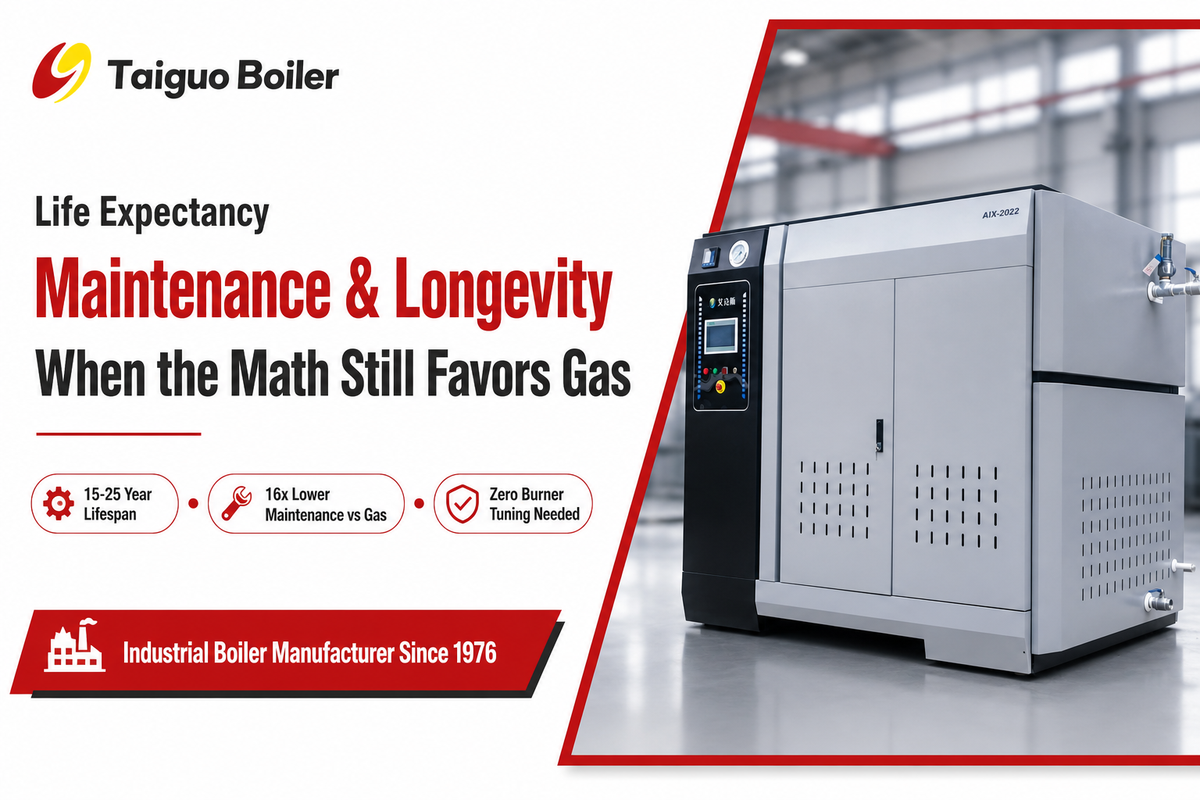
Industrial boiler lifespan, electric or fuel-fired, averages between 15 and 25 years once a unit is in service, with well-maintained units reaching the high end of that range and neglected units falling well short of it long before the equipment is fully depreciated on the books.
Electric units carry real maintenance advantages over the long term, including zero burner tuning, zero flue cleaning, and zero combustion safety testing – all of which means annual maintenance on a gas boiler can run up to 16 times higher than an equivalent electric boiler over their working life.
Switch to electric when
- Local electricity is below roughly $0.065/kWh
- No gas line exists, and the alternative is propane or fuel oil
- Low-carbon local grid meaningfully supports a decarbonization goal
- Fast startup and zero on-site emissions carry real operational value
Don’t switch to electric when
- Local electricity sits well above the $0.065/kWh threshold
- The boiler runs near-continuously at large scale (energy cost dominates)
- Grid carbon intensity in your region is high (weak decarbonization case)
- Available electrical service can’t support the added load without months of utility lead time
Real reversal case you should know – a New Jersey craft brewery who changed over to direct electric heating went back to a low-pressure steam boiler when they scaled production tenfold, with the owner plainly saying steam cost much less for the process on that scale. That’s an example that runs counter to the easy assumption that electric keeps winning as scale grows – and it matches the DOE/LBL work above, where high, constant-load operation is precisely where the rate structure causes electric to struggle.
Key takeaway
Industrial electric boiler cost only beats gas on a 5-year view when your electricity rate is near or below $0.065/kWh, or when the realistic alternative is propane or fuel oil — everywhere else, run the numbers before you buy.
Q: What is the average cost of an electric boiler?
An industrial electric boiler averages $10,000–$45,000 for a common 1–4 t/h steam unit, or roughly $5,000–$200,000-plus across the full 100 kW to 5 MW range once you count custom-engineered, large-capacity systems built for continuous heavy industrial duty. Equipment price climbs with capacity but less than linearly, so larger units typically cost less per kilowatt of installed capacity than smaller ones.
Small residential and commercial electric boilers run far less, often $1,500–$6,500, and are a fundamentally different product class than the industrial units this guide covers. On the industrial end, you’ll find that boiler price generally scales closely with output capacity, and steam units will always be more expensive than hot water boilers for the same output.
Q: How much does a 200,000 BTU boiler cost?
A 200,000 BTU/hr unit, roughly 59 kW of electric power draw, sits at the small end of the industrial electric boiler range and prices in the low thousands of dollars for the equipment alone, before installation, controls, and any required electrical service work are added on top of that base equipment figure.
At that scale, the unit itself often represents the smallest part of the investment. Installing the unit, along with controls and the necessary electrical work, will often add substantially to the cost. Be sure to get your facility’s current electrical capacity from your utility before specifying an industrial unit of this size — even small units can cause electrical service upgrades if your existing system is near its limit. Searching for an industrial electric boiler near me is a reasonable first step for confirming a local installer, though the equipment itself is usually sourced directly from a manufacturer rather than a nearby distributor.
Q: What is the life expectancy of an industrial boiler?
Most industrial boilers last 15–25 years with proper maintenance, regardless of whether they burn gas or run on electricity, with well-serviced units reaching the upper end of that range and neglected units falling well short of it long before the equipment is fully depreciated on the books, according to facilities-engineering sources covering both boiler types over multi-decade service records.
However, the purchase price for the boiler unit tends to the higher end of the range for electric boilers, as they avoid much of the combustion-related maintenance that can significantly shorten the service life of fuel-fired equipment when it is neglected: burner adjustment and cleaning, flue pipe corrosion, and boiler-scale cleaning on the hot-side heat transfer surface. While both fuel types will require water treatment to avoid scale on the water-side surface, electric units bypass the regular burner inspection/cleaning and flue-pipe inspection schedule which makes up a substantial portion of a fuel-fired unit’s long-term maintenance expense.
Q: How much does an electric boiler cost to install in 2026?
Installation typically adds $5,000–$15,000 or more on top of the equipment price, driven mainly by electrical service upgrades rather than the mechanical connection itself, and that gap widens further once a unit crosses roughly 1 MW.
Installation costs range from 3-5 days for units requiring nothing more than hooking them into an existing electrical service up to several months for those needing utility service study or new electrical switchgear. Work with your operations team to ensure your project schedule accounts for any required electrical construction, not boiler delivery.
Q: What’s the average boiler replacement cost?
About the same as a new installation of equal capacity, plus removal of the old unit and any code upgrades the swap triggers, so budget close to the full installed price rather than a discounted like-for-like swap.
Replacing a fuel-fired boiler with an electric unit eliminates the cost of a new flue or fuel piping, but may add electrical service upgrade costs; the overall effect on cost varies depending on what existing infrastructure is in place at your site. Get quotes from an electric boiler manufacturer directly rather than relying only on whatever an “industrial electric boiler near me” search happens to surface, since equipment specification and freight both shift the final delivered price.
Q: Does a gas boiler use electricity too?
Yes — a gas boiler still needs electricity for its igniter, control system, and circulation or feedwater pumps, though the amount is small compared to the gas it burns for heat.
When looking at boiler proposals, this is a useful thing to check: a gas-fired boiler’s own electrical demand for controls and pumps should already be accounted for in your existing baseline electrical load, not folded into the discussion about which heat source (electric or gas-fired) you are considering.
Why We Write This
Since 1976, Taiguo Boiler has been producing both steam and hot-water boilers, including LDR and WDR series electric steam boilers. This guide draws on our product specifications, government data on energy prices, technical case studies, and user comments-because we believe an accurate presentation of capital and operational costs, even including situations where electric isn’t the better option, is more valuable to buyers than sales material featuring only the highlights. (Last updated July 2026)
⚠️ Important
This comparison does not take into account the costs of steam/electrode or hot-water electric resistant boilers versus those of the gas boiler. It also excludes the cost comparisons of industrial heat pumps or the use of CHP (combined heat and power).
See Taiguo’s Industrial Electric Boiler Range →
Our full industrial electric boiler selection guide goes over the entire selection process outside of capacity sizing, hot water versus steam, and application fit. For a technology selection, instead of a cost one, please see our guide on how an industrial electric boiler works for mechanical explanations, and our technical comparison of electric and gas steam boilers for the engineering differences that underpin the figures cited above. Our roundup of leading electric boiler manufacturers provides a wider market overview, while facilities evaluating broader fuel decisions may wish to examine our thermal oil boiler systems and gas-fired boiler range for applications where an electric or gas steam boiler won’t meet the process heat demand.
References & Sources
- Electric Power Monthly, Table 5.6.A — U.S. Energy Information Administration
- Replace Conventional Boiler with Electric Boiler (Decarbonization Tipsheet) — Lawrence Berkeley National Laboratory / U.S. Department of Energy
- Industrial, Commercial, and Institutional Boilers (Boiler MACT) — U.S. Environmental Protection Agency
- Qualifying Advanced Energy Project Credit (Section 48C) — Internal Revenue Service
- Office of Clean Energy Demonstrations — U.S. Department of Energy
- EU Emissions Trading System (ETS2) — International Carbon Action Partnership
- Boiler and Pressure Vessel Code, Section I (2025 Edition) — American Society of Mechanical Engineers
Related Articles
- Industrial Electric Boiler: Selection Guide for Steam & Hot Water — full buying guide beyond cost
- Electric vs Gas Steam Boiler — the technical differences behind these cost figures
- Electrode Boiler vs Resistance Boiler — which electric heating type fits your load
- How Does an Industrial Electric Boiler Work? — the mechanics behind the efficiency numbers
- Top 15 Industrial Electric Boiler Manufacturers — who else makes these systems