Get in Touch with Taiguo


Updated July 2026.
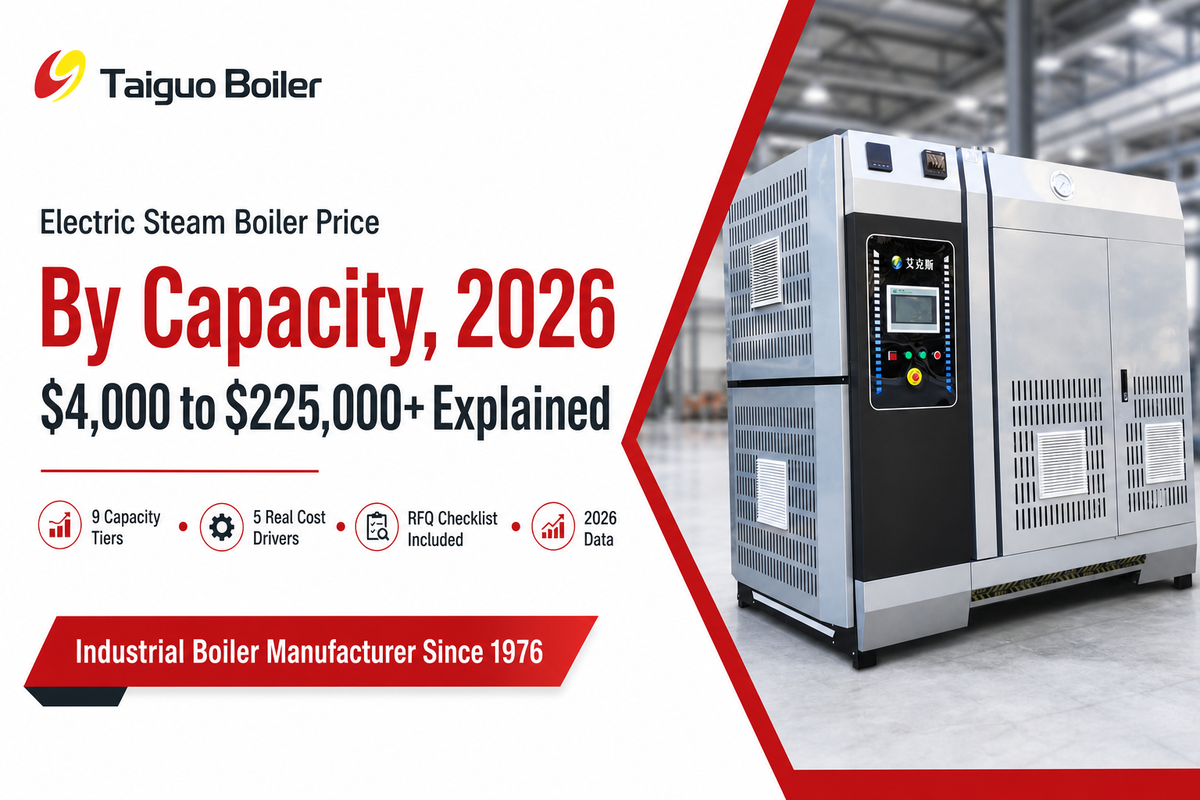
Electric steam boiler price is the amount a supplier quotes for an electrically heated steam-generating unit, and it runs from about $4,000 for a 50 kg/h lab unit up to $200,000 or more for a 6 t/h industrial line — but the number on any single price-guide article rarely matches what you’ll actually be quoted. This guide breaks the range down by capacity tier, explains why quotes vary, and gives you a checklist to get an apples-to-apples number.
Quick Specs
| Typical capacity range | 36 kW – 4,500 kW (50 kg/h – 6 t/h) |
| Price range (packaged units) | $4,000 – $225,000+ |
| Thermal efficiency | 95% – 99% (vs. 70-85% for well-maintained fuel-fired units) |
| Startup time | 3-5 minutes (no combustion warm-up) |
| Biggest hidden cost | Electrical service upgrade — can range from a few thousand dollars to $480,000+ |
What Determines Electric Steam Boiler Price? (5 Real Cost Drivers)
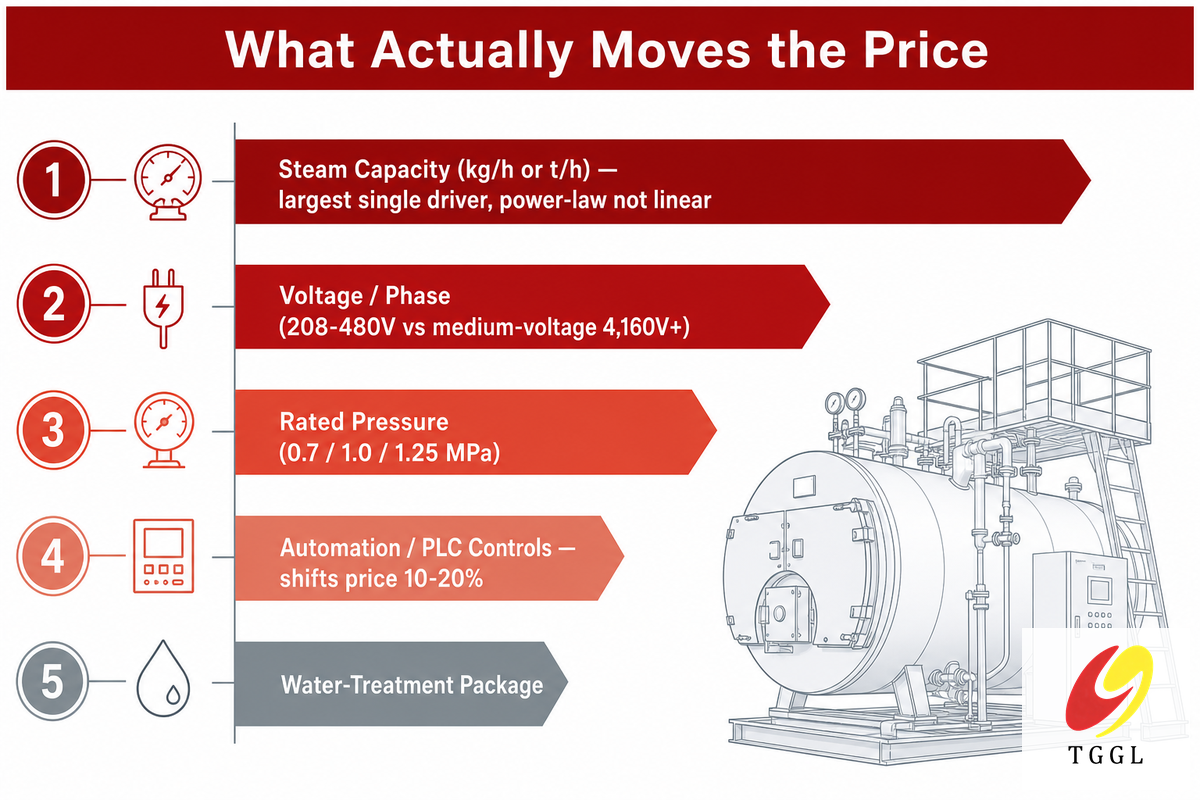
Five parameters influence electric steam boiler price more than fuel type alone: capacity, voltage and phase, rated pressure, automation level, and water-treatment package. Part of the reason is efficiency: the DOE/LBL Industrial Assessment Centers tipsheet puts electric boiler efficiency at 95-99%, against 70-85% for well-maintained fossil-fired units, so higher-spec configurations earn back part of their premium in energy performance. A 500 kg/h electric boiler can be sourced from two different vendors-say, for as little as $8,000, and as much as $15,000-depending on the cost attributed to these five variables (as per an analysis of manufacturer price-guide data).
| Driver | Price impact | Not suitable for |
|---|---|---|
| Steam capacity (kg/h or t/h) | Largest single driver — price roughly tracks a power-law curve, not a straight line | Ignoring this makes small-unit $/kW look transferable to large units, which it isn’t |
| Voltage / phase (208-480V vs. medium-voltage 4,160V+) | Medium-voltage electrode designs add engineering cost above roughly 1 MW | Facilities without 3-phase or medium-voltage service already on site |
| Rated pressure (0.7 / 1.0 / 1.25 MPa) | Higher pressure ratings need thicker pressure-vessel steel and re-certification | Low-pressure process heat where 0.7 MPa is already overkill |
| Automation / PLC controls | Basic on/off vs. full PLC with remote diagnostics can shift price 10-20% | Single-shift, single-operator sites where basic controls are enough |
| Water-treatment package | Softener/deaerator add-ons protect heating elements but add to quoted price | Sites already running a shared plant-wide water-treatment system |
This concrete illustration comes from the example of Taiguo’s own WDR line; every model in this 0.5-6 t/h family of equipment has been available at three distinct pressure ratings (0.7, 1.0, or 1.25 MPa), so even when two customers select the “same” WDR2, their prices will differ purely based on which box is checked for pressure-even before capacity, voltage, or control system choices are made.
A complete installation is more than the boiler itself — the whole point is to generate steam reliably, so budget for a feedwater valve train, condensate return piping, and stainless steel steam headers as part of the same packaged boiler system, not an afterthought. Confirm temperature control and water-treatment components are sized correctly; skipping that step is a common way maintenance costs creep up over the unit’s service life. Because there is no combustion, an electric steam generator needs no chimney or exhaust ductwork. That is one reason facilities replacing an aging fossil-fuel heating system often find electric steam generation a more compatible, economical fit for tight indoor spaces.
Which Capacity Class Fits Your Industry?
Different buyer segments cluster into different capacity classes, and matching your application category to the right class before you request a quote narrows the price bands above to the ones that actually apply to you. A hospital and a chemical plant rarely need the same pressure rating or footprint, even at similar steam output, so use the table below as a starting filter before you size anything more precisely.
| Industry / application | Typical capacity range | Pressure need | Key requirement |
|---|---|---|---|
| Laboratory / research | 50-300 kg/h | 0.7 MPa | Compact vertical footprint, precise control |
| Food processing | 500-4,000 kg/h | 0.7-1.0 MPa | Clean steam, HACCP/FDA-ready |
| Pharmaceutical | 1,000-4,000 kg/h | 0.7-1.25 MPa | CGMP-compliant, validated purity |
| Textile / garment | 1,000-6,000 kg/h | 0.7-1.25 MPa | Stable pressure, precise temperature |
| Hospital / healthcare | 500-3,000 kg/h | 0.7-1.0 MPa | Ultra-quiet, zero on-site emission |
| Chemical processing | 1,000-6,000 kg/h | up to 1.25 MPa | No open flame, inherent safety |
| Brewery / beverage | 500-3,000 kg/h | up to 1.0 MPa | Compact footprint, no chimney |
| Commercial laundry | 500-2,000 kg/h | up to 1.0 MPa | No venting, urban-friendly |
| General / mixed-load industrial | 300-2,000 kg/h | 0.7-1.25 MPa | Flexible configuration for variable loads |
Seven of nine rows reflect Taiguo’s own published per-application configuration guidance for its WDR and LDR series; laboratory and general/mixed-load rows are reasonable extrapolations from the same product line’s smallest and mid-range models.
Electric Steam Boiler Price by Capacity, kW, kg/hr, and BHP Price Bands
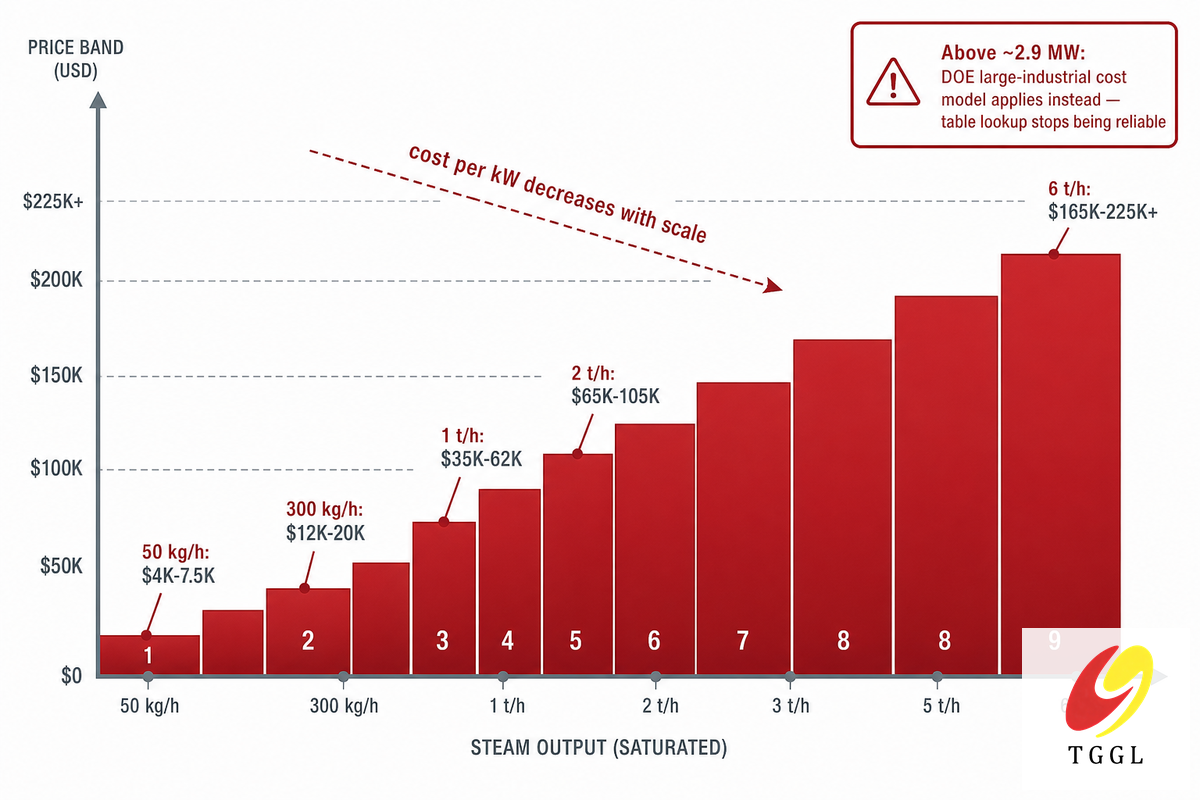
Electric steam boiler price rises from approximately $4,000 at 36 kW (50 kg/h) to $225,000 or more at 4,500 kW (6 t/h), based on a 9-tier band cross-referenced across two independent price-guide sources and Taiguo’s own published 12-model LDR and WDR catalog. Real buyer searches already frame the question this way — “1 ton steam boiler price” and manufacturer queries in the 216-360kW range are live search terms, not hypothetical ones. Buyers phrase the same question differently depending on scale: industrial electric steam boiler price, small electric steam boiler price, or electric steam generator industrial pricing all point to the same capacity-driven bands below.
How Do I Size an Electric Steam Boiler for My Facility?
Select capacity by required steam output, not by estimating the required horsepower. Sum up the simultaneous maximum steam demand of all running loads in your facility, including sterilizers, jacketed vessels, CIP systems, and dryers, then add a 10-15% margin for line loss and future capacity increases.
If your process demands 450 kg/h of steam at once, buy the 500 kg/h tier, not the 300 kg/h tier — an undersized boiler runs at 100% duty cycle with no reserve for process startups. Match rated pressure to your highest-pressure load, not the facility average.
The 9-Row Capacity-to-Price Band Stack
| Steam output | Power | Comparable model class | Typical price range | Limitations / not suitable for |
|---|---|---|---|---|
| 50 kg/h | 36 kW | Lab / small-batch class | $4,000 – $7,500 | Not for continuous multi-shift production, lab/pilot-line only |
| 100 kg/h | 72 kW | Compact small workshop class | $6,000 – $10,500 | Single-phase service is often insufficient; confirm 3-phase availability first |
| 200 kg/h | 144 kW | Small-medium class | $9,500 – $16,000 | Interpolated between two independent price-guide bands — confirm with supplier |
| 300 kg/h | 216 kW | Medium class | $12,000 – $20,000 | Typically still 208-480V; verify against your site’s service before ordering |
| 0.5 t/h | 375 kW | Light industrial class | $18,000 – $32,000 | Not suitable if you need 3+ pressure options; confirm rated MPa first |
| 1 t/h | 750 kW | Medium industrial class | $35,000 – $62,000 | Electrical service upgrade is commonly required above this tier — see next section |
| 2 t/h | 1,500 kW | Large industrial class | $65,000 – $105,000 | Single-source interpolation at this tier — treat as directional, get a real quote |
| 4 t/h | 3,000 kW | Multi-line industrial class | $115,000 – $165,000 | Medium-voltage electrical infrastructure is typically required at this scale |
| 6 t/h | 4,500 kW | Top of packaged range | $165,000 – $225,000+ | Above roughly 2.93 MW (10 MMBtu/hr), the DOE/LBL capital-cost model ($14,000-$47,000 per MMBtu/hr, following a power-law curve) shows a different cost pattern than small-packaged-unit pricing — a 10 MMBtu/hr electric boiler prices near $467,000 in that model, so table lookups stop being reliable past this point and you need an engineered quote |
Price points derived by correlating two third-party price-guide references in Q2 2026. Capacity and kW output based on Taiguo’s own published LDR and WDR series specification sheet. Pricing is variable and is a function of raw materials and components; consult with your supplier for a definitive quote.
Why You Can’t Always Get a Sticker Price: Catalog vs Custom-Quoted Systems
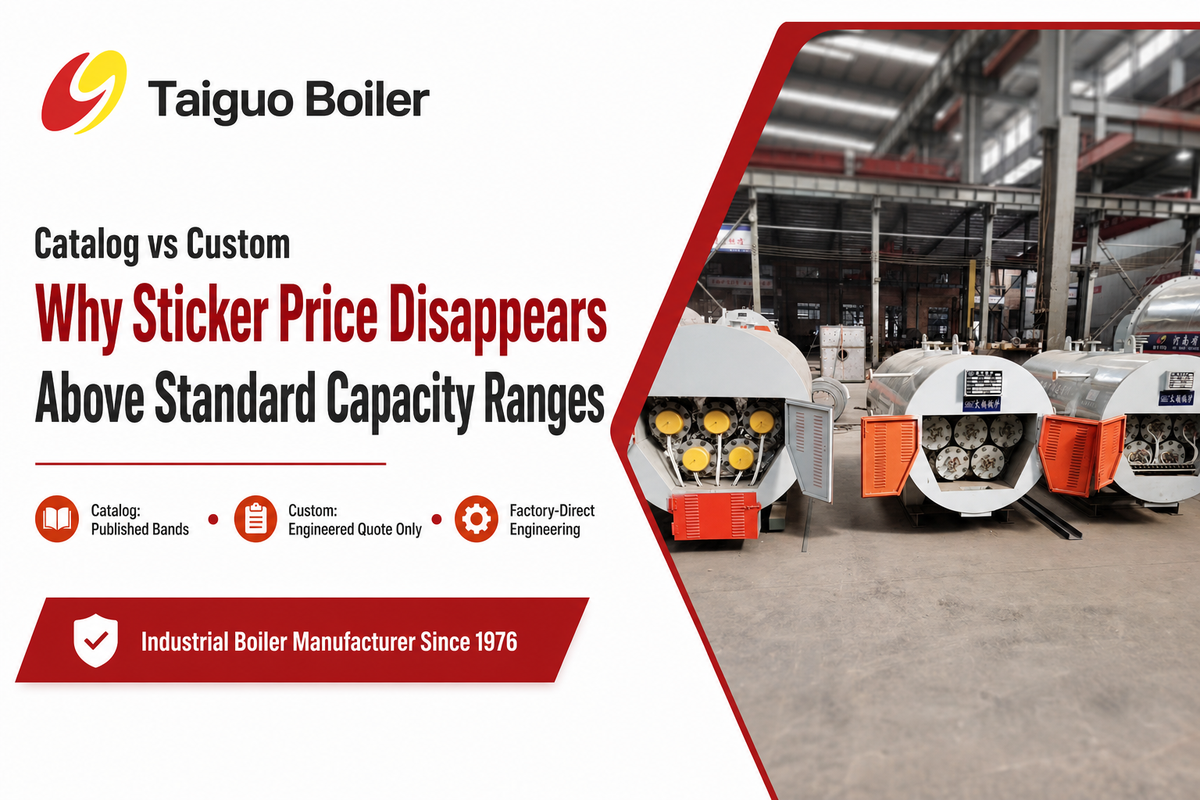
Every major manufacturer markets electric steam boiler equipment via a quote request, even though third-party price-guide websites publish exact dollar amounts for identical classes. We checked four manufacturer product pages and found every single one directing buyers to “Request a Quote” instead of showing a dollar figure.
Call it The Catalog-to-Custom Price Cliff: the point where a published price band stops being reliable and a real number only comes from an engineered quote.
That split is important because it provides you information about what you’re shopping for. Published pricing for a price-guide table (such as the capacity band presented above) represents market pricing collected across many sellers and regions – which is a good budgeting average, but not something any one manufacturer will confirm for you before knowing your exact scope. Taiguo’s own WDR page acknowledges this explicitly: the cost is “based on your steam capacity, voltage and control systems,” and bulk discounts are offered for multiple units – three variables, not one.
💡 Pro Tip
View any published price table – including the one shown above – as a template budget for your project, not a quote. The difference between “market range” and “your exact number” often grows with increasing capacity: at 50 kg/h the spread across manufacturers is several hundred dollars; at 2 t/h and higher it can reach tens of thousands.
We also found one mistaken data entry to be worth noting: not every published pricing guide in this industry is accurate. One competitor’s costs page shows a 216 kW “low-capacity” unit at $2,000 – shockingly low next to its own $85,000 figures for a smaller-efficiency low-pressure unit two paragraphs later. When a data entry is inconsistent with that company’s own data, treat every figure on that page as unreliable. Part of why configurations keep shifting: recent USPTO filings such as US11862973B2 show active engineering work on coupling electric boilers with other capacity-optimization systems, so today’s catalog spec isn’t necessarily tomorrow’s.
Electrical Service & Installation Requirements That Affect Your Final Price
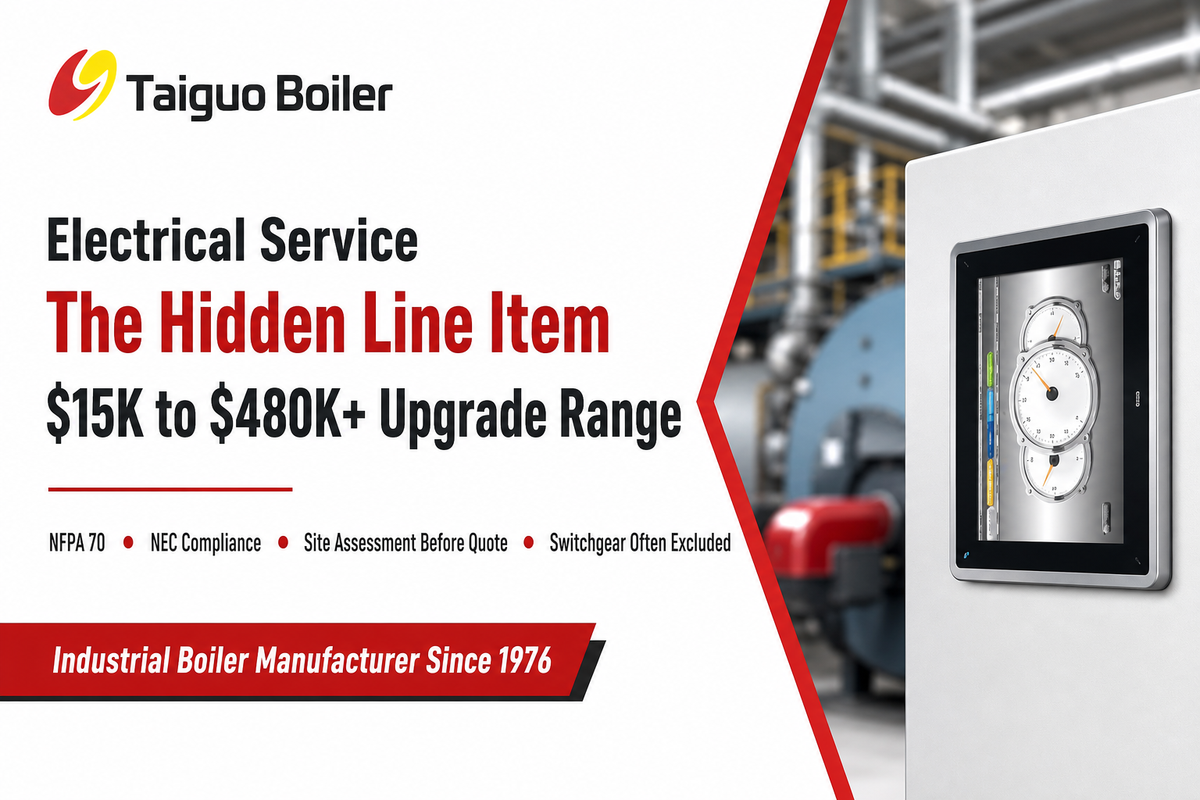
Electrical service upgrades for the initial industrial electric boiler installation can range from $15,000 for a modest panel and breaker upgrade to $480,000 or more when a new utility transformer and switchboard are necessary – and this type of charge is usually not accounted for in a buyer’s early budget projection.
The upper end of the price range is high because “installation cost” covers two vastly different scopes, and the one figure you can compare against a real, named installation is on the higher end. A documented 2023 boiler replacement project, presented at a U.S. Department of Energy Better Buildings conference, priced the boiler at $153,940, but the “Upgraded Electrical Service” line item alone – a new 4,000-amp switchboard, a 3,200-amp main breaker, and a dedicated 1,200-amp breaker for the new boiler – cost $482,712, more than three times the boiler itself. That project had a 10-12 month material lead time and involved a full week of plant shutdown to implement. Some estimators cite a lower $15,000-$150,000 range for smaller-scope industrial panel and breaker work – treat that figure as a loose starting point, not a ceiling, since it comes from a single commercial estimator rather than a documented project.
📐 Engineering Note
Electrical service sizing must follow the edition of NFPA 70 (the National Electrical Code) that your State has officially adopted – states adopt new editions independently on their own schedules. While the 2026 NEC edition has been published, regulations in your state depend on when your electrical authority adopts it. Verify the version of your project’s code edition with your electrical contractor or state licensing authority before identifying scope.
Electrical-trade forums feature a repeated error: treating a service upgrade like swapping out a box. As one installer discussing an unrelated $60,000 solar installation aptly put it when asked for a quote estimate: the proper sizing of the wires and breakers, permitting and utility coordination are all their own line items, not an add-on to the equipment price. Factor in a site electrical assessment before obtaining a boiler quote, not after.
New vs Used Electric Steam Boilers: Price Trade-offs
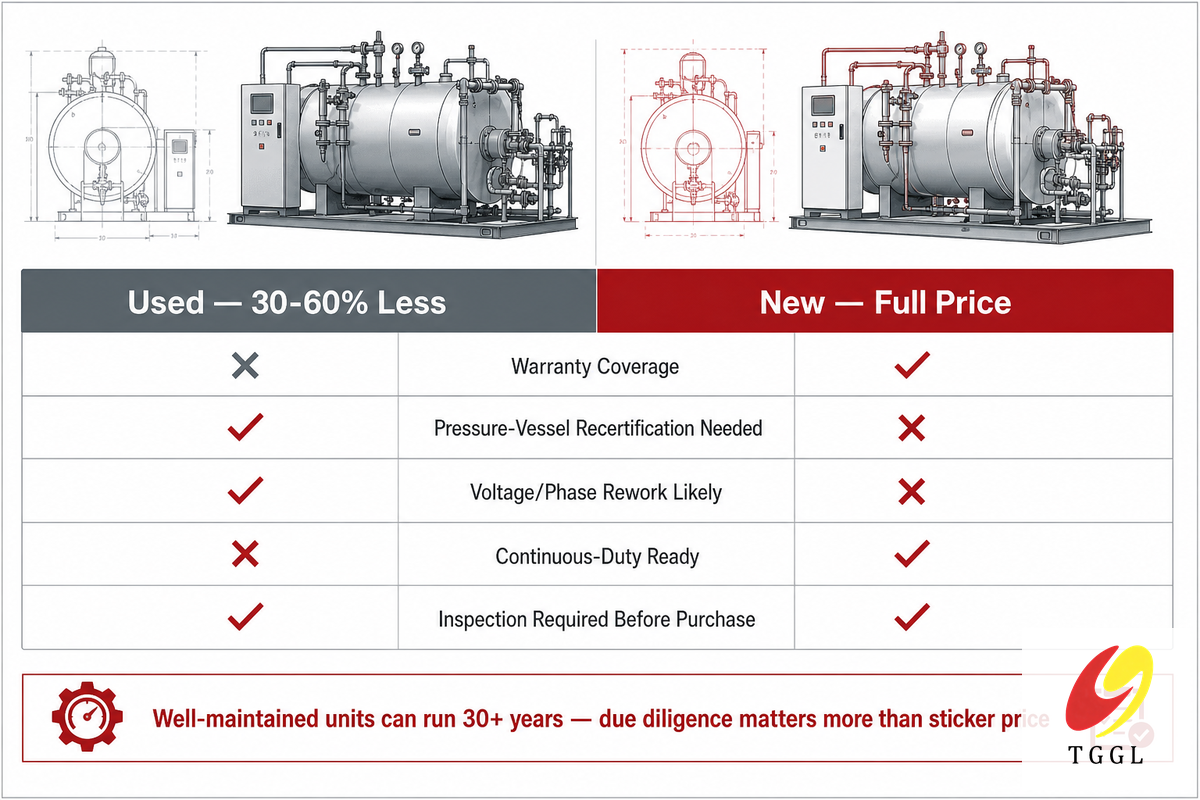
Used electric steam boilers can be purchased for 30-60% less than new, but the secondary market for this equipment is shallower and more unevenly developed than it’s for gas-fired models – most listings still direct you to the seller for a price quote rather than showing one prominently.
✔ When Used Makes Sense
- You need to rapidly add capacity, and you can tolerate a shorter operational life from the machine.
- Your process load is designed to function as backup or only on a seasonal basis, not on a continual-duty cycle.
- You can have a trained inspector check the heating element condition and verify pressure-vessel certifications.
- Brands like Sussman, Electro-steam, and Cleaver-Brooks are regularly featured on the secondary market, giving you an established name to inspect.
⚠ When It’s a Trap
- You’ve no manufacturer warranty or post-purchase support; you assume the wear that has already been put on the heating elements.
- You might need additional electrical work done to accommodate your facility’s electrical requirements, such as voltage and phase configuration changes.
- In your locale, the pressure vessel may require recertification before it can be operated legally.
- High-duty-cycle production loads may quickly erode the money you saved if the machine fail midway through an operational period.
Equipment longevity cuts both ways here: a 70 HP, 125 PSI unit built in 1994 was still listed for resale in 2026, evidence that well-maintained steam boilers can remain functional for three decades — which is exactly why used-market due diligence on maintenance history matters more than the sticker price.
“The steam generator is the only piece of equipment I haven’t had to worry about.”
— Joe Silvestri, in a published Clayton Industries customer case study
That kind of long-run reliability is exactly what a used-equipment buyer is betting on when skipping the new-unit warranty — verify maintenance records before assuming it applies to the specific unit you’re looking at. It’s also worth checking how old the design is: recent patent activity like CN120556888B‘s multi-energy coupling approach shows the underlying technology is still evolving, so a decades-old used unit may lack control-system features that newer designs take for granted.
Electric vs Gas-Fired: The Purchase-Price Gap
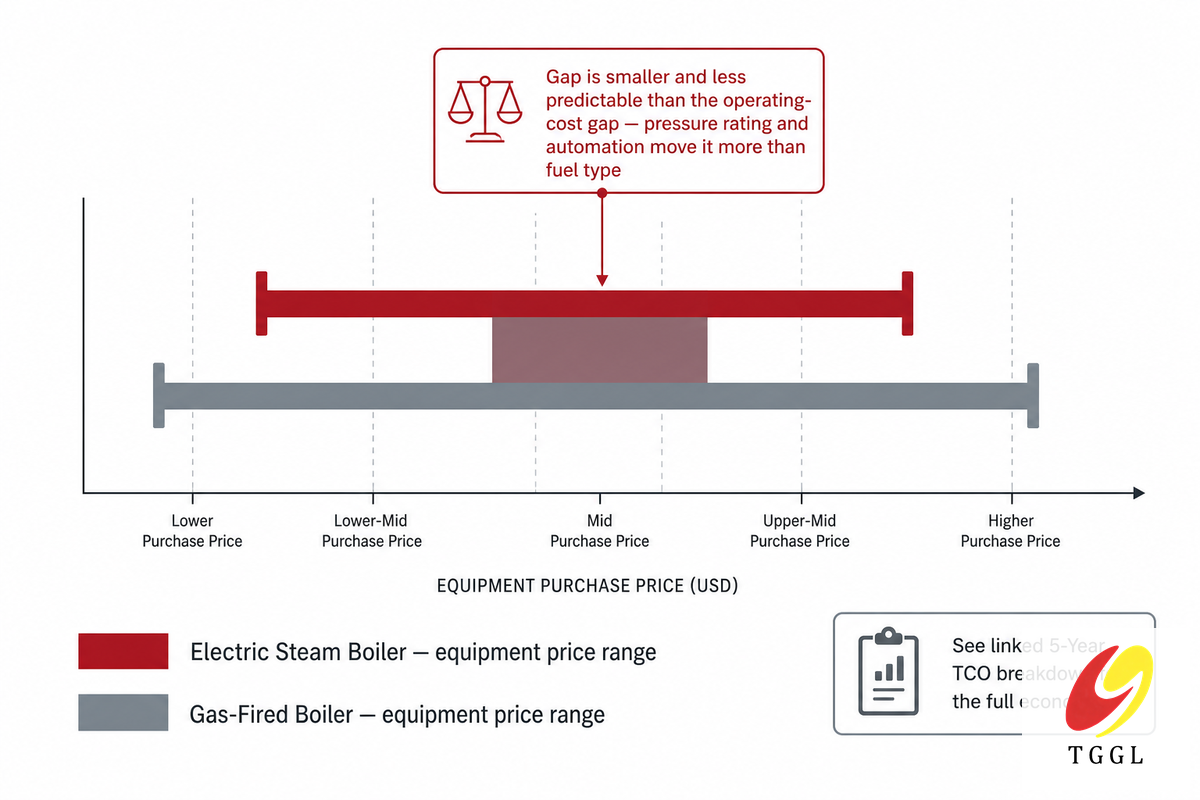
Electric steam boilers don’t carry a predictable price premium over comparable gas-fired units. Their equipment price gap versus equivalent gas-fired units is smaller and less predictable than their operating-cost difference, and changes in pressure rating or automation can shift it either direction.
This is a narrow comparison. Most buyers actually care about the total 5-year cost of operation and purchase price, which we’ve already thoroughly discussed in our 5-year total cost of ownership breakdown. For more insight on efficiency, fuel switching, and emissions than this cost summary covers, review our full electric vs gas comparison. A 2025 study is another reminder that lower electricity prices in a given time frame don’t always guarantee a lower total operating cost. That means it’s dangerous to lump price assumptions for both purchase price and operating cost together.
How to Get an Accurate Quote (RFQ Checklist)
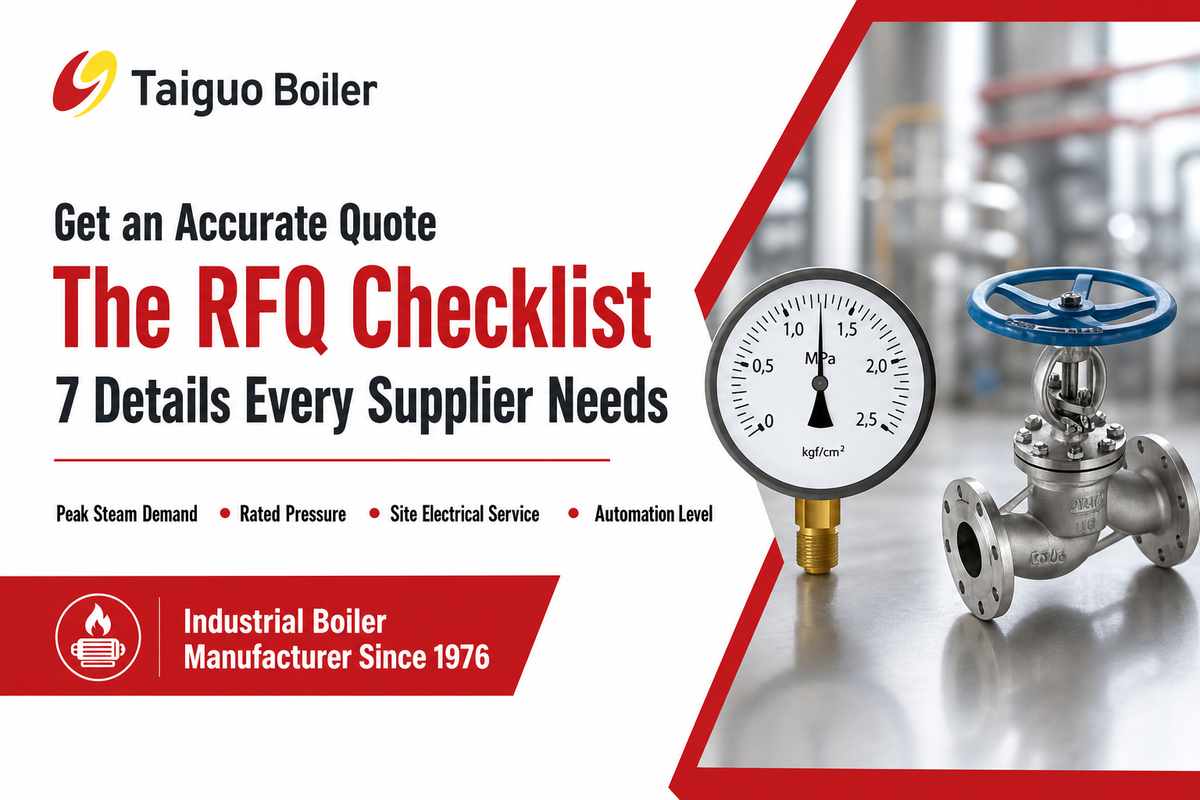
To get an apples-to-apples comparison for the electric steam boiler, you must have seven specific details, such as its capacity, pressure rating, electrical configuration, automation capabilities, water treatment approach, and on-site specifics of installation, on hand-otherwise, two suppliers could quote very different models for the “same” boiler.
RFQ checklist — copy these into your quote request:
| Parameter | Recommended range | Why it matters | How to verify |
|---|---|---|---|
| Peak steam demand | Actual kg/h or lb/hr, +10-15% margin | Undersizing forces 100% duty cycle with no startup reserve | Sum simultaneous process-load steam draws, don’t guess from horsepower |
| Rated pressure | 0.7 / 1.0 / 1.25 MPa | Must match your highest-pressure load, not the average | Check the nameplate pressure rating of your most demanding downstream equipment |
| Site electrical service | Existing voltage, phase, available amperage | Determines whether a service upgrade is needed before the boiler can even be installed | Get a site electrical assessment before requesting boiler quotes, not after |
| Automation level | Basic on/off vs. full PLC with remote diagnostics | Can shift quoted price 10-20% for the same capacity | Decide based on shift coverage and whether remote monitoring is needed |
| Water treatment package | Softener / deaerator, or none | Protects heating elements from scale but adds to quoted price | Check whether a plant-wide water-treatment system already covers this |
| Installation timeline | Material lead time + install/commissioning window | Larger units can carry 10-12 month lead times and require full plant shutdown to install | Ask each supplier for both figures separately, not a combined estimate |
| New vs used tolerance | Specify explicitly either way | Suppliers may quote used/refurbished stock unless you rule it out | Specify new units only, in writing, if warranty coverage matters to you |
Send all seven same parameters to a minimum of two suppliers prior to even discussing any dollars-a quote that’s missing three of those seven can’t be directly compared to one which specified all seven, regardless of how close the headlined dollar amount. Suppliers respond faster and more efficiently to a compact, well-specified RFQ than to an open-ended “what’s your best price” email.
Q: How much does an electric steam boiler cost?
Electric steam boiler price ranges from about $4,000 for a 50 kg/h lab-scale unit to $225,000 or more for a 6 t/h industrial unit, with capacity as the single biggest driver.
Between those limits, your voltage, rated pressure, automation level, and water treatment package are all price-shifting drivers, and a complete breakdown is shown in the capacity to price table above on 9 different price tiers. Above roughly 2.9 MW (10 MMBtu/hr), your costs begin to follow the U.S. Department of Energy’s price structure for large-scale industrial boilers rather than the small-packaged boiler market, so you need an engineered quote rather than a table lookup at that point.
Q: Is an electric steam boiler cheaper to buy than a gas-fired one?
Not consistently — the purchase-price gap between electric and gas units of equal capacity is smaller and less predictable than the operating-cost gap, and pressure rating or automation choices move it more than fuel type does.
Pressure rating and automation level move purchase cost more than fuel choice does, and the gap can run either direction. That is narrower than most buyers actually mean, though — the real comparison is total 5-year cost including electricity or gas rates. See our dedicated TCO breakdown and full comparison for the complete economics.
Q: What size electric steam boiler do I need?
Size to your peak simultaneous steam demand plus a 10-15% margin, not to a guessed horsepower number, and match rated pressure to your single highest-pressure process load rather than the average across your facility.
Add up the total steam output of every load in the facility running concurrently, then size your boiler to meet the highest required pressure among those loads. For example, if the plant has several loads that together require 450 kg/h of steam, size to the 500 kg/h tier rather than 300 kg/h, to leave reserve capacity for startup surges.
Q: Why do quotes for the same capacity vary so much between suppliers?
Because capacity is only one of five real price drivers — voltage and phase, rated pressure, automation level, and water-treatment package each move the number independently, so two “same capacity” quotes are rarely apples-to-apples.
Voltage, pressure rating, automation level, and water treatment each move price on their own — see the cost-drivers table earlier in this guide.
Q: What is the lifespan of an electric steam boiler?
Heating elements are typically rated for 20,000+ operating hours, and well-maintained units can remain in service for decades, since the pressure vessel and control system usually outlast several tube replacements.
At roughly 8 hours/day, 300 days/year, 20,000 hours works out to about 8+ years of heating-tube life — a wear-part figure, not the boiler’s total service life. Pressure vessels and control systems can outlast several tube replacements; some units built decades ago are still in resale circulation on the used market today.
Q: Should I buy new or a used/surplus unit?
Used makes sense for backup or seasonal loads where you can inspect condition first; new is safer for continuous-duty production, since a used unit carries no warranty and may need voltage or phase rework.
A used boiler costs a fraction of the price — 30 to 60 percent less — but does not include warranty, and will almost always require some amount of voltage or phase conversion, as well as possibly a vessel recertification. For a comparison of pros and cons, see the advantages and limitations above.
Q: What industries commonly use electric steam boilers?
Food processing, pharmaceutical manufacturing, hospitals, laboratories, textile finishing, and commercial laundry facilities are the most common adopters, since these industries need clean steam without combustion byproducts or fuel storage on site.
These include a diverse range of industries from pharmaceuticals and food production, to universities and industrial laundry operations, and all of them need clean, reliable steam without combustion byproducts. In some cases that is because their facility has specific emission requirements or constraints against fuel-fired boilers, and in others it is due to indoor installation preferences over a legacy hot-water heater or fossil-fuel boiler systems setup. This broad application segment is covered by small packaged boiler makers offering pre-engineered steam equipment with components for water treatment already built in. It is also covered by large full-scale industrial suppliers such as Bosch, Clayton, Taiguo, and Cleaver-Brooks. All of them deliver efficient steam with low-NOx, environmentally friendly operation and steady steam quality regardless of usage pattern.
About This Analysis
The capacity-to-price table in this guide cross-references two independent third-party price-guide sources against Taiguo’s own published 12-model LDR and WDR electric steam boiler specifications, and against a U.S. Department of Energy capital-cost model for large-scale industrial units. Where a single source couldn’t be independently verified, including a manufacturer’s own marketing claim about federal tax-credit eligibility, we didn’t present it as fact. Reviewed by the Taiguo Boiler technical team.
References & Sources
- Replace Conventional Boiler with Electric Boiler — Lawrence Berkeley National Laboratory / U.S. DOE Industrial Assessment Centers
- Lessons Learned from the Industrial Electrification Working Group — U.S. Department of Energy Better Buildings Solution Center
- What Changed in the 2026 NEC? — National Fire Protection Association
- The Impact of Electric Boilers and Heat Storages — Hiltunen et al., 2025 (peer-reviewed)
- Electrification of Industrial Facilities — POWER Magazine
- Europe Taps Electric Boilers to Balance the Grid — POWER Magazine
Related Articles
- Industrial Electric Boiler Cost: 5-Year Total Cost of Ownership — the full Capex-Opex-payback breakdown behind the purchase price
- Electric vs Gas Steam Boiler: Full Comparison — efficiency, emissions, and fuel-switching beyond price
- Electrode Boiler vs Resistance Boiler — how heating-element type affects both design and cost driver #2
- How Does an Industrial Electric Boiler Work? — the mechanics behind the catalog-vs-custom quoting split
- Top 15 Industrial Electric Boiler Manufacturers — the supplier landscape behind the price bands above
Need a real quote instead of a table lookup? Taiguo’s engineering team can size and price a unit for your exact capacity, pressure, and voltage requirements.