Get in Touch with Taiguo


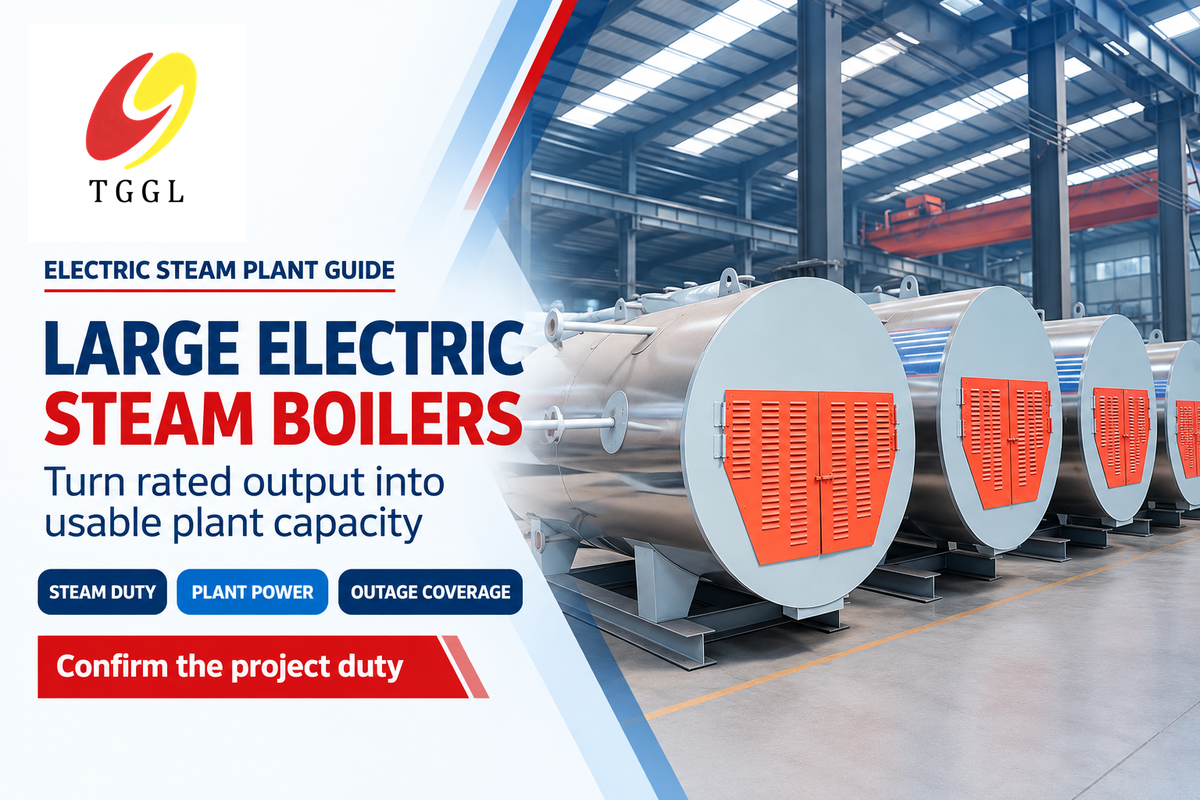
Large industrial electric steam boilers create process steam using resistance elements or electrodes. Determine capacity from steam demand and available plant power: a 5 t/h load requires about 3.51 MW, assuming a useful enthalpy rise of 2,500 kJ/kg with a conversion efficiency of 99% and before any auxiliary loads. The plant arrangement depends on the limitations of the available supply and surviving output after an outage.
Updated October 2026
Quick planning inputs
- Steam demand: continuous t/h, peak t/h and peak duration.
- Steam conditions: delivery pressure, dryness and feedwater temperature.
- Electrical supply: firm available kW, voltage and coincident plant demand.
- Continuity: essential steam load and the failure scenarios it must survive.
Large industrial electric steam boilers are process-heating units powered by electricity. Size them from steam duty, then check continuous electrical capacity, water treatment and outage coverage. A larger nameplate alone cannot keep production supplied.
Key planning points
- Several boilers on one failed power supply still lose electric steam production.
- The same t/h rating requires different input power when feedwater or steam conditions change.
- High conversion efficiency doesn’t settle electricity tariffs, distribution losses or installed cost.
- A delivery date becomes a usable production date only after utilities and commissioning are complete.
Large industrial electric steam boilers: capacity and scope
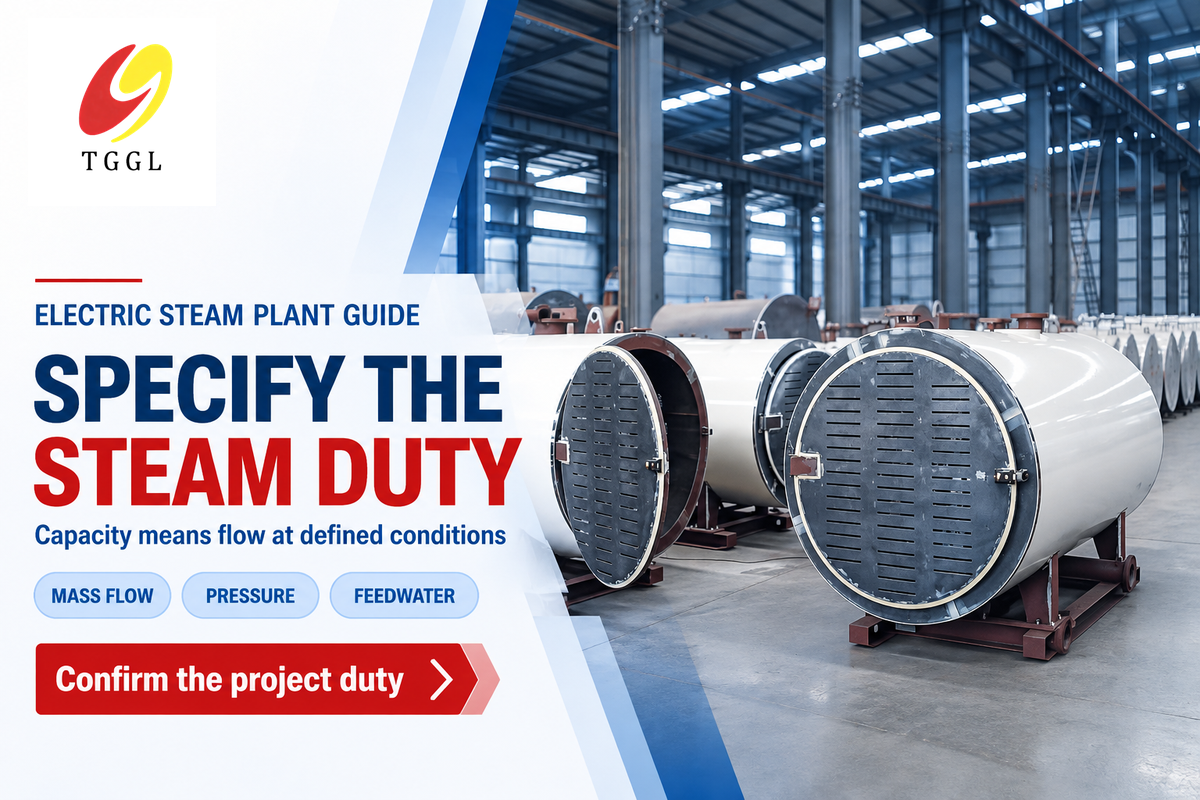
There’s no single, universal limit for “large” in steam capacity. A plant needs a continuous mass flow at a specified pressure, plus enough response for its production peaks. Resistance and electrode designs both serve industrial processes; the electrical interface and guaranteed operating point are more useful technical specifications than the size label. For general equipment selection, start with the industrial electric boiler overview; this guide focuses on plant power limits, firm steam capacity and system integration.
| Required service | Equipment family | Selection consequence |
|---|---|---|
| Process steam | Electric steam boiler or electric steam generator | Specify steam mass flow and delivery conditions. |
| Liquid-water circulation | Electric hot water boiler | Specify water flow and supply/return temperatures. |
| High-temperature liquid heat transfer | Thermal oil heater | Match the process to the fluid and permitted operating envelope. |
How does an industrial electric steam boiler work?
Resistance heating works like an immersion heater: insulated elements immersed in water transfer heat into it. Electrode boilers pass current directly through the boiler water to generate heat. In this case, boiler control systems adjust the electrical input to meet the steam demand. Pressure control, water level protection and treatment are part of the system.
The EECA technical guide to electric steam generation provides details of both methods. Its equipment examples also show why hot-water configurations and steam-service ratings should be kept separate. A textile finishing line and a pharmaceutical sterilization process may use steam at different pressures and quality requirements, even with similar hourly consumption.
For the operating sequence, see how an industrial electric boiler works. A steam generator label doesn’t eliminate the pressure-equipment duties associated with the design and installation of the equipment.
Steam boiler sizing: convert steam duty into electrical input
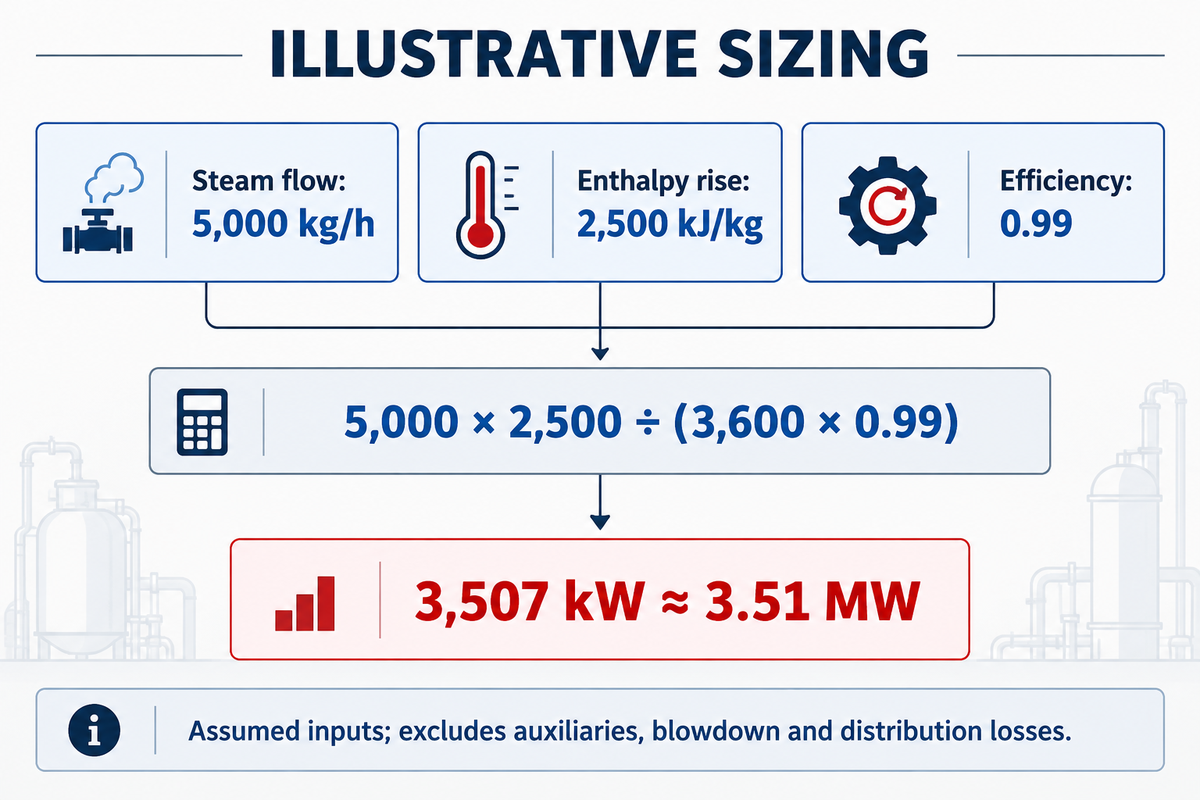
A 5 t/h steam duty requires about 3.51 MW of boiler input, using the assumptions provided below. Electrical demand follows the thermal energy added to each kilogram of water, hence providing a t/h figure alone is incomplete. Colder feedwater increases the heating requirement; steam pressure and condition determine the outlet enthalpy.
Assumed inputs for this sizing example
Steam flow = 5,000 kg/h; useful enthalpy rise = 2,500 kJ/kg; boiler conversion efficiency = 0.99. This steady-state calculation excludes blowdown duty, auxiliary electricity and downstream distribution losses.
Input power (kW) = steam flow (kg/h) × enthalpy rise (kJ/kg) ÷ (3,600 × efficiency)
5,000 × 2,500 ÷ (3,600 × 0.99) = 3,507 kW, or approximately 3.51 MW.
The U.S. Department of Energy steam-cost guide states that the analysis of steam systems is based on mass and enthalpy balances. For procurement, the enthalpy difference at the required steam condition and the actual feedwater temperature is used. The 2,500 kJ/kg input is an example assumption and isn’t based on a steam-table value for a particular pressure.
| Steam demand | Calculated boiler input | Excluded from this column |
|---|---|---|
| 1 t/h | 701 kW | Auxiliary and distribution loads |
| 2 t/h | 1,403 kW | Auxiliary and distribution loads |
| 3 t/h | 2,104 kW | Auxiliary and distribution loads |
| 4 t/h | 2,806 kW | Auxiliary and distribution loads |
| 5 t/h | 3,507 kW | Auxiliary and distribution loads |
| 6 t/h | 4,209 kW | Auxiliary and distribution loads |
| 8 t/h | 5,612 kW | Auxiliary and distribution loads |
| 10 t/h | 7,015 kW | Auxiliary and distribution loads |
| 12 t/h | 8,418 kW | Auxiliary and distribution loads |
Example: A boiler serving a continuous line and a batch cooker is replaced in a food processing plant. Procurement receives a quote stating only 5 t/h. The plant engineer adds the steam pressure and feedwater condition to the specification and separates the line’s continuous demand from the cooker’s peak demand. Each department receives the electrical load rather than treating 5 t/h as a fixed electricity demand. Water treatment and blowdown remain separate energy loads.
An engineering note belongs beside the rating: distinguish gauge pressure from absolute pressure when selecting steam properties. Record units along with the values. Units can be bar(g) or bar(a) or psi. The industrial boiler sizing calculator can support preliminary comparisons; the final equipment schedule needs the complete operating conditions.
Electric boiler power requirements: find the binding limit
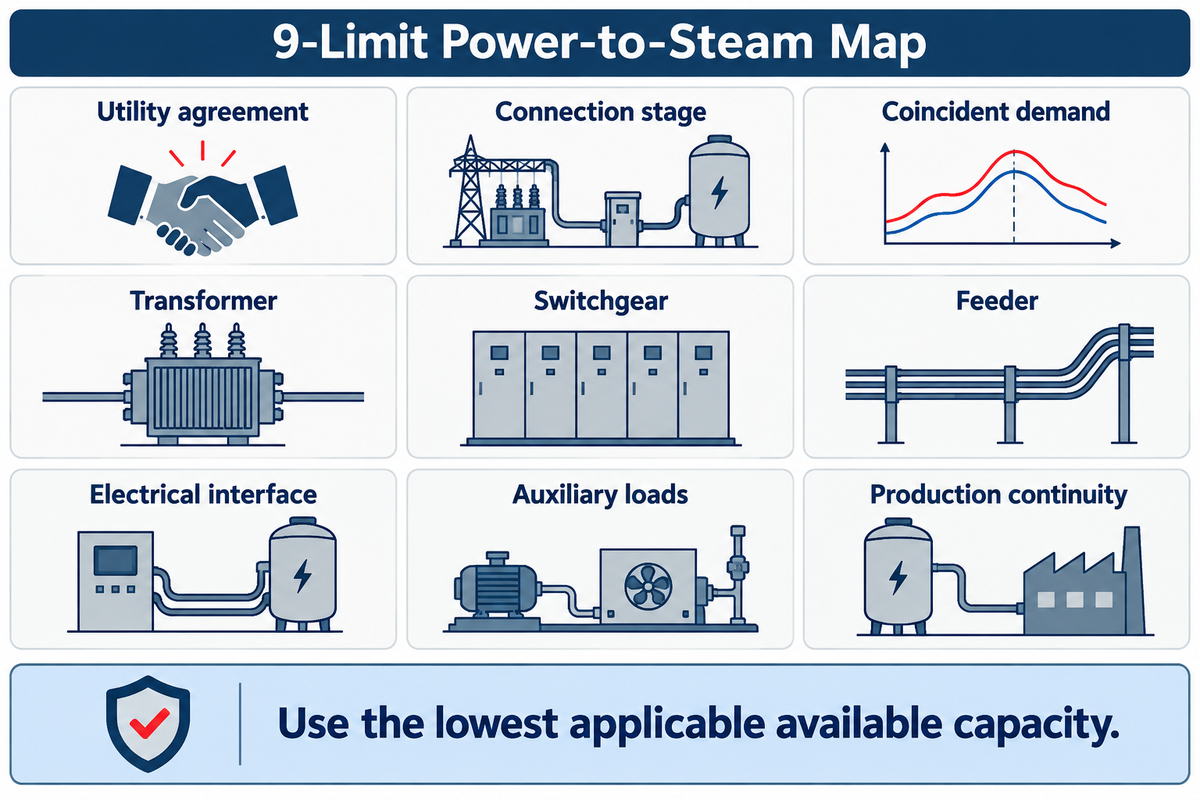
Usable electric boiler power is the lowest applicable capacity, taking into account other plant loads and required allowances. Transformer nameplate capacity is just one of several inputs. A utility contract or connection stage may limit the capacity, and so may switchgear and feeder ratings. Also, power quality requirements may impose a lower limit, and change the appropriate equipment arrangement.
9-Limit Power-to-Steam Map
The 9-Limit Power-to-Steam Map locates the constraint that limits boiler steam production prior to fixing the purchase specification.
| Limit | Measured or documented input | What changes the decision |
|---|---|---|
| 1. Utility agreement | Firm import kW and any curtailment terms | Interruptible capacity cannot support every continuous duty. |
| 2. Connection stage | Capacity available on the commissioning date | Future reinforcement may exceed the initial allocation. |
| 3. Coincident demand | Site interval-load profile in kW | Production equipment can consume apparent spare capacity. |
| 4. Transformer | Permitted loading and remaining capacity | Ambient conditions and other loads affect the usable margin. |
| 5. Switchgear | Rated assembly and protection study | A larger transformer does not upgrade the downstream assembly. |
| 6. Feeder | Permitted circuit loading and voltage drop | Cable route and installation conditions constrain delivery. |
| 7. Electrical interface | Voltage, topology, fault level and power-quality requirements | Boiler technology must match the supply system. |
| 8. Auxiliary loads | Feed pumps, treatment and controls demand | Steam production needs services beyond the heater input. |
| 9. Production continuity | Power available during the specified outage or curtailment | Normal-operation capacity may disappear in the critical case. |
The EECA guide links electric steam production to site demand profile and network capacity. Restrictions in contracts merit their own line: the UK connections action plan describes flexible and phased contracts. That’s an example of time-dependent access from the UK; the terms of the local supply agreement dictate the conditions for each project.
Example: This plant has 4.2 MW contractual headroom, 4.5 MW at the transformer, 4.0 MW through the switchgear, and 3.8 MW through the feeder. These limits are assumed to be usable real power limits after the effects of other loads. The feeder limits the addition. With 0.10 MW reserved for auxiliaries, the 3.51 MW boiler example leaves roughly 0.19 MW of arithmetic headroom. If the contract later restricts the addition to 2.8 MW, only 2.7 MW remains for heating, enough for about 3.85 t/h under the earlier assumptions. The equipment can be operating normally while production still loses steam capacity.
For this example, on-site generation is held constant. A plant changing an existing combined heat and power system needs to balance the combined heat and power prior to applying the incremental-load calculation. The 0.19 MW isn’t a prescribed engineering reserve.
Boiler redundancy: compare firm output after an outage
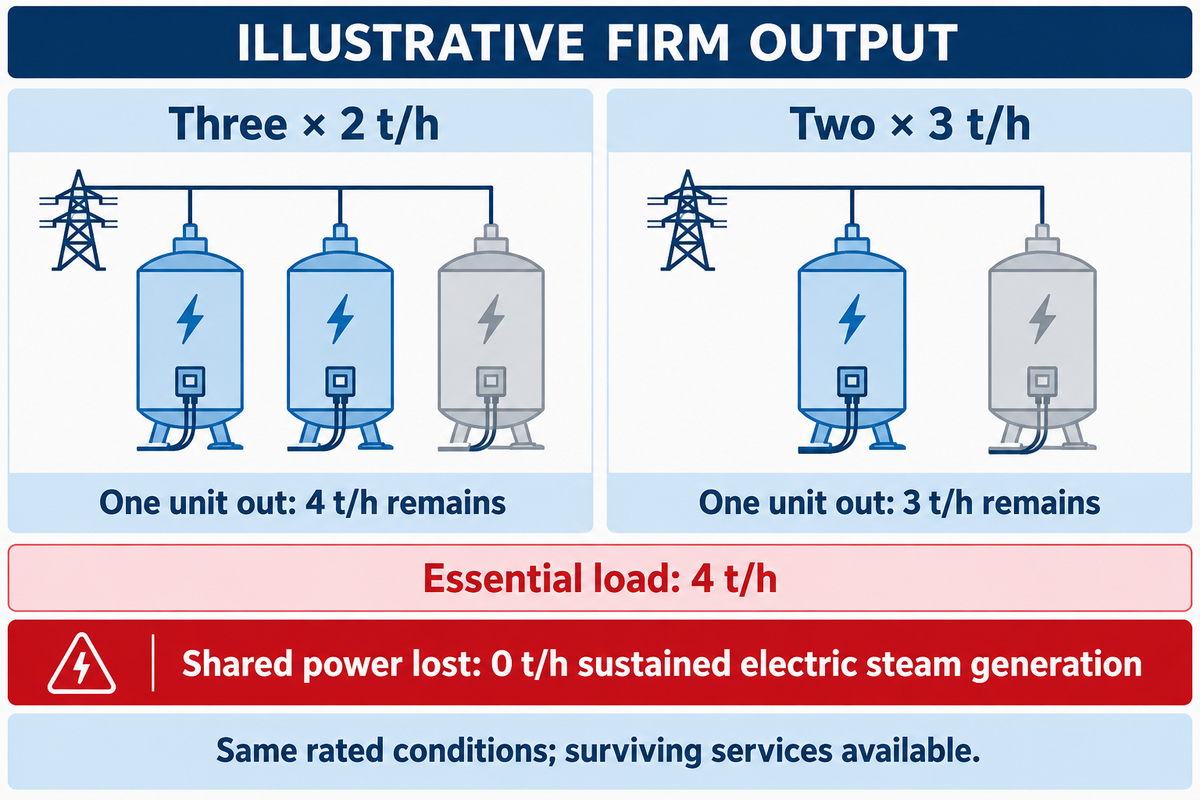
Three 2 t/h units leave 4 t/h after one is unavailable; two 3 t/h units leave 3 t/h. Both these arrangements have 6 t/h total. These arithmetic differences matter when essential production needs 4 t/h, but surviving boilers still need working power, feedwater and controls to deliver that output.
| Scenario | Three × 2 t/h | Two × 3 t/h |
|---|---|---|
| All units available | 6 t/h | 6 t/h |
| Largest single unit unavailable | 4 t/h: meets essential load | 3 t/h: 1 t/h short |
| Shared electrical supply unavailable | 0 t/h sustained electric steam generation | 0 t/h sustained electric steam generation |
Residual stored steam can support brief service after a trip, but doesn’t transform the last row to sustained production. The ABMA white paper by Gene Tompkins discusses switching steam production between energy sources. The EECA guide identifies parallel heat sources as an option for resilience and electrical peak shaving.
Example: a dairy keeps 4 t/h of essential steam demand during a planned shutdown. The essential demand can be met by the three smaller units after a single-boiler outage. Two of the units can remain online while the other unit is isolated for maintenance. A common feedwater pump failure changes the result: the available heaters cannot replace missing water supply. The plant manager therefore separates the planned-maintenance case from a shared-service failure. A standby fuel-fired boiler may cover the latter only when its own pumps, controls and fuel services remain available. The transfer sequence of the fuel-fired boiler also has to be within the process pressure tolerance.
There’s resistance equipment and there’s electrode equipment, and both can share the same electrical failure. The comparison of electrode boiler and resistance boiler covers the difference in technology. For a fuel-based alternative, the comparison of electric and gas steam boiler covers the tradeoffs.
Steam header control: handle peaks without oversizing
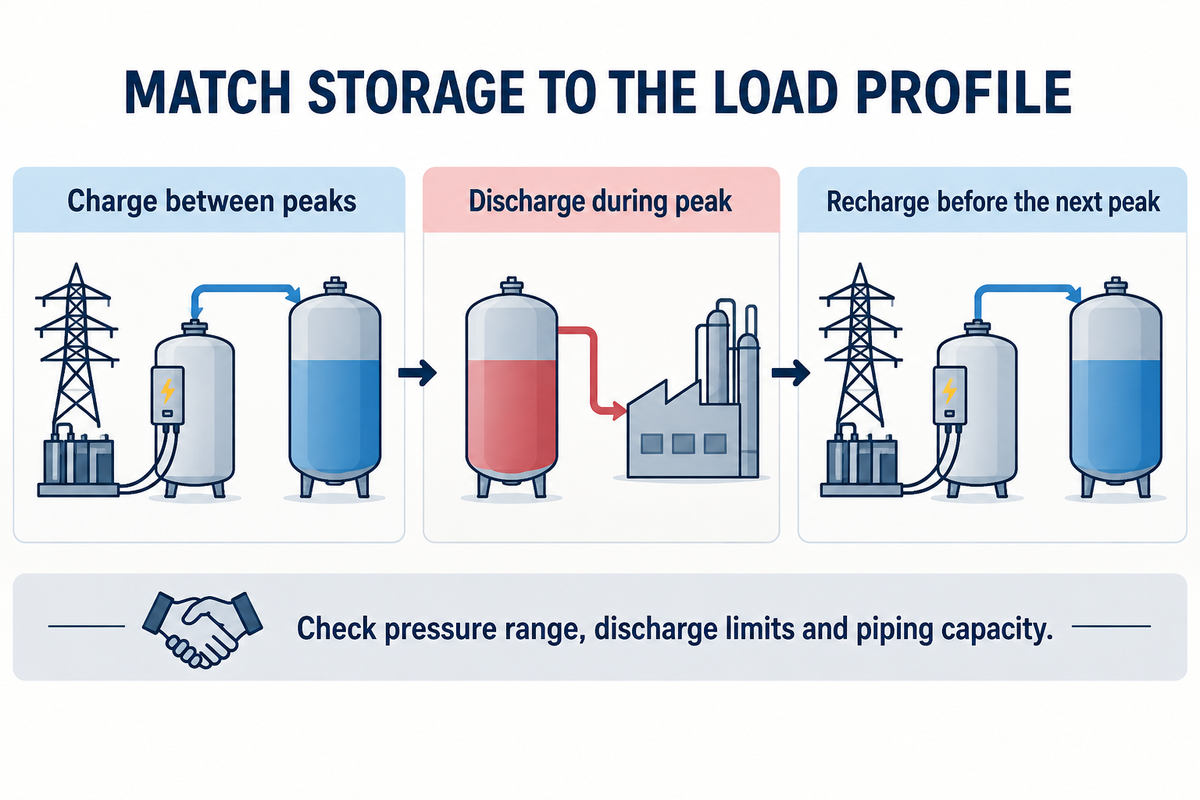
Steam accumulators can bridge a temporary gap between boiler output and process demand, provided that sufficient energy is stored and the accumulator can be recharged between demand peaks. Continuous excess demand requires additional production or reduced process demand. The useful duration for storage follows the demand profile and pressure range, and discharge limits of the system.
- Measure the peak’s duration as well as its t/h maximum.
- Separate repeated batch starts from the continuous steam load.
- Check the recharge interval against the next production peak.
- Include header pressure drop and piping capacity in the system design.
A 2025 SINTEF preprint on hybrid steam-electric systems models different storage options in the Norwegian and German electrical systems. Their optimization neglects mass-flow constraints in the steam piping. Such systems still need checks of piping capacity and discharge limits before the selected equipment is installed. Matching storage to the load profile can support reducing energy waste from unnecessary continuous peak production.
Digital controllers can reduce electrical input quickly, but precise control of the heater does not by itself settle the response of the steam header. Sudden changes in demand can lower pressure and disturb boiler water. For a batch process, the acceptance sequence should reproduce the relevant demand change, and record the pressure recovery, along with steam output. For a process that requires a precise temperature, verify the heat-transfer equipment and its controls, and check the functioning of the equipment during the acceptance sequence.
Boiler feedwater: match treatment to steam quality
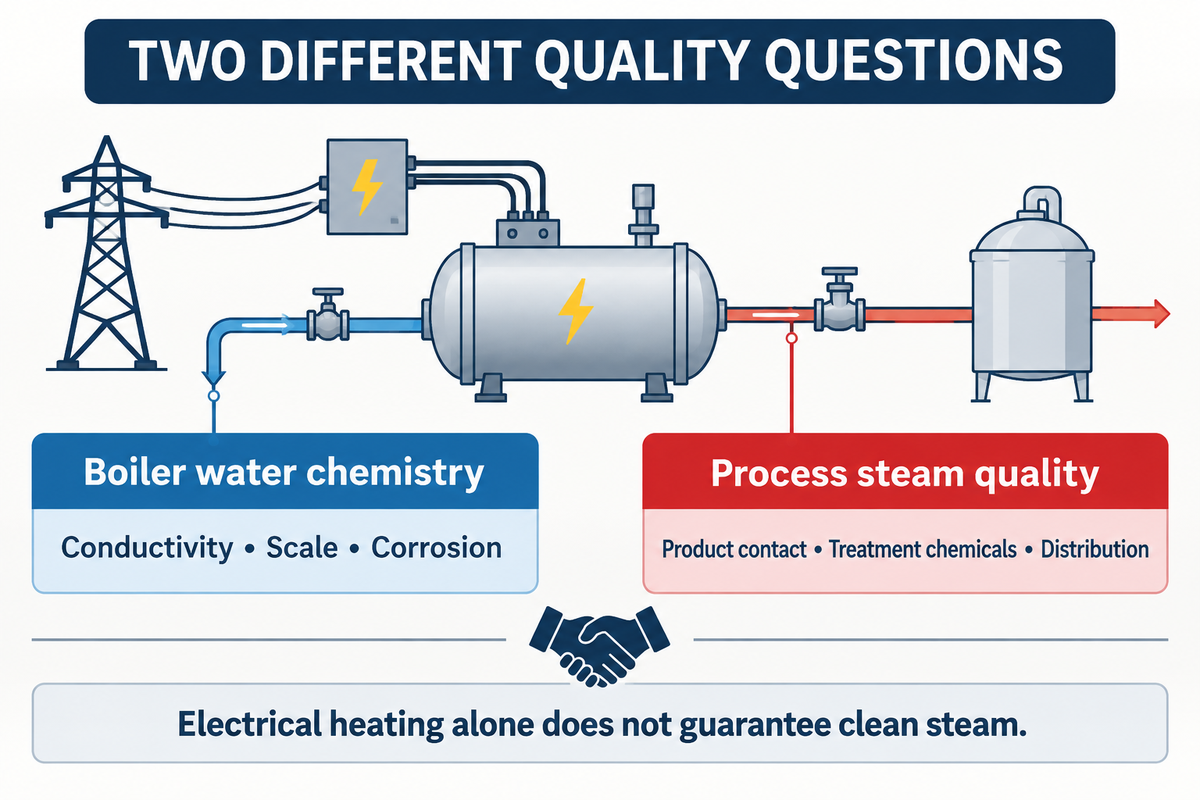
Electrode boiler water treatment needs to address conductivity, scale and corrosion. Resistance units also need water treatment to protect wetted parts and heating surfaces. Separately, the process determines acceptable steam quality: food contact and pharmaceutical service add contamination risks that the electrical heat source alone does not resolve.
| Question | Responsible role | Required output |
|---|---|---|
| What water chemistry suits the model? | Supplier and water-treatment specialist | Model-specific operating and sampling limits |
| What returns through condensate piping? | Utilities team | Condensate-quality and return-condition record |
| What contacts the product? | Quality assurance | Steam-quality specification for the process |
| What happens during demand changes? | Commissioning team | Pressure and quality acceptance results |
In the EECA water treatment discussion, conductivity and scale/corrosion controls are treated separately, along with treatment chemicals for culinary steam. A stainless steel vessel doesn’t replace a full steam specification. Apparently clear feedwater doesn’t replace sampling.
A food processor using indirect heating through a heat exchanger coil may have different steam-contact requirements from a line injecting steam into food. The quality team needs to delineate that distinction before procurement selects treatment systems. Manufacturer conductivity limits apply to the specified model and measurement conditions; transferring a setting from another electrode boiler can change both control behavior and maintenance requirements.
Maintenance requirements: keep electric steam generation available
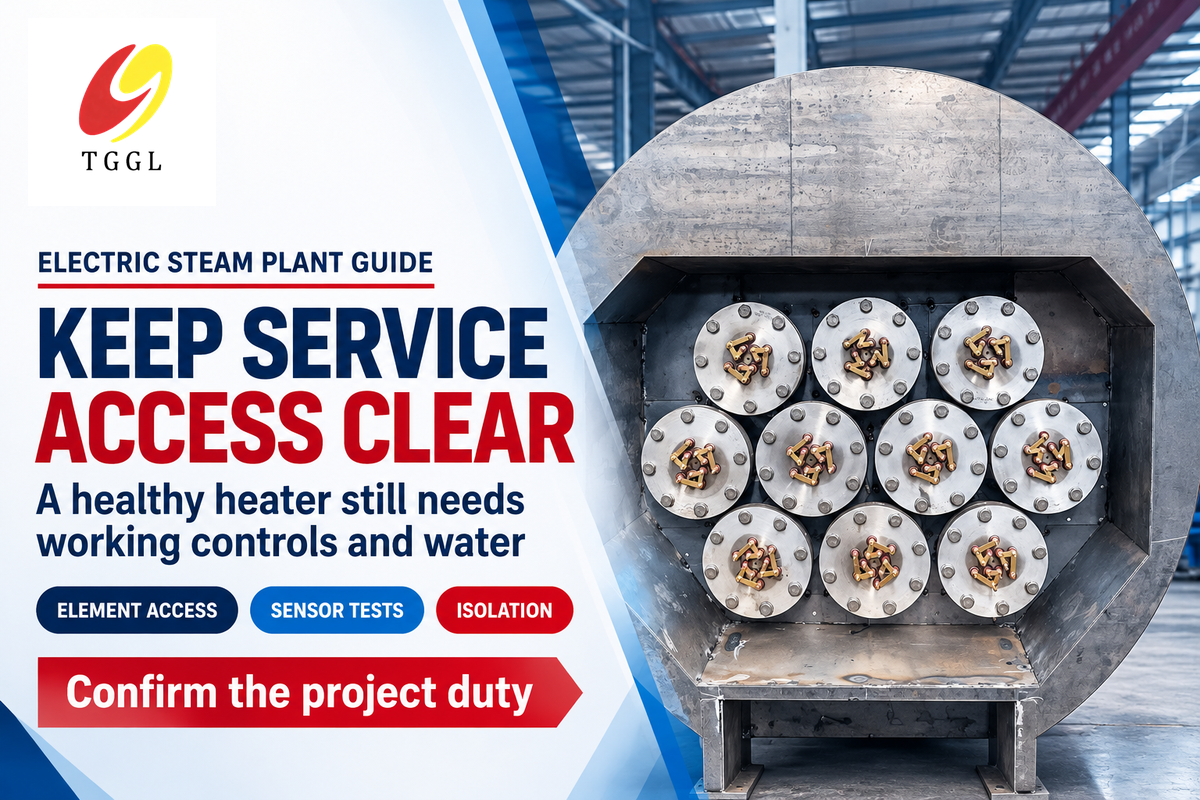
Unlike combustion boilers, electric heaters require no combustion air for a burner or complex venting for combustion gases. Pressure, electrical and water-system maintenance remain. Service access for heating elements, sensors and pumps affects how quickly a failed component can be replaced. Low maintenance is useful only when the plant has the personnel, spares and isolation arrangements needed to perform it.
“There’s no such thing as a maintenance-free device invented by man.”
- Provide withdrawal space for the longest replaceable heating element or assembly.
- Record water-level sensor tests and the model’s required control checks.
- Keep feedwater and condensate treatment within the equipment instructions.
- Plan electrical isolation and pressure isolation before opening equipment.
- Match spare parts to the installed model, rather than just its rated kW.
The National Board article is an archive maintenance lesson, not a current inspection schedule. It instructs its readers to consult the applicable code edition. For an electric plant, the supplier’s service instructions and local requirements determine the work and the interval. Minimal maintenance shouldn’t be a plan with no testing records.
A failed sensor can stop an otherwise healthy heater. A maintenance review therefore needs the replacement procedure and access route, as well as the component price. Modular heating equipment offers operational flexibility when the remaining modules can keep the required duty available during the repair.
Installed boiler scope: price the complete steam system
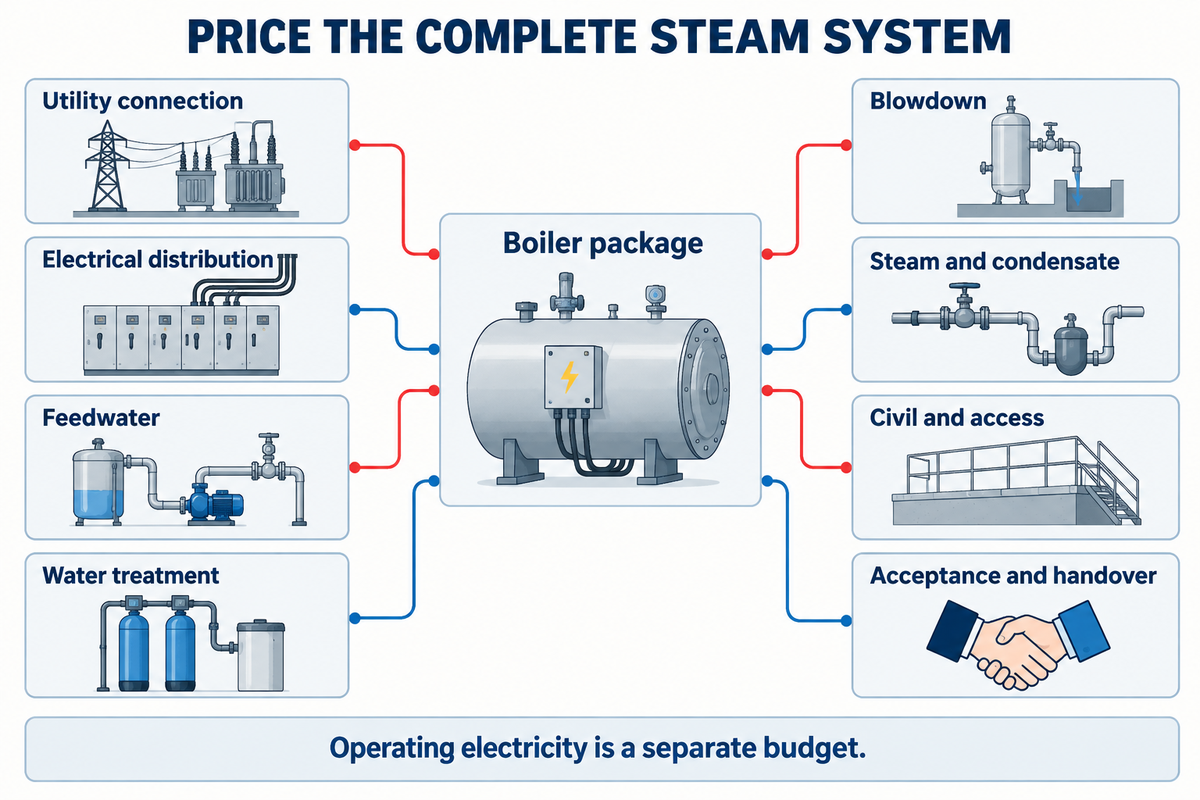
Boiler scope includes electrical interconnections and water systems, steam tie-ins, and commissioning work. Finance should check the applicable tariff for kWh energy charges and any kW demand charges. A high energy efficiency figure does not determine the total bill or remove the cost of bringing power to the boiler room.
| Scope group | Deliverable to price | Typical owner to assign |
|---|---|---|
| Boiler package | Rated unit, controls and stated accessories | Equipment supplier |
| Utility connection | Firm capacity and energization works | Utility/customer project team |
| Electrical distribution | Transformer, switchgear, feeder and protection | Electrical contractor |
| Feedwater | Tank, pumps and supply connection | Utilities contractor |
| Water treatment | Treatment plant, monitoring and chemicals | Water-treatment specialist |
| Blowdown | Handling, cooling and discharge arrangements | Utilities contractor |
| Steam and condensate | Header tie-in, return piping and insulation | Mechanical contractor |
| Civil and access | Foundation, delivery route and service clearance | Site contractor |
| Acceptance and handover | Tests, records, training and spare parts | Named commissioning lead |
Packaged boilers can arrive pre-assembled while several of these work packages remain outside the equipment quote. A missing feedwater connection or unfinished electrical feeder can prevent steam production after delivery. The industrial electric boiler cost guide describes the categories in more detail.
Are electric boilers worth it?
Electric boilers can be worth the investment where the available power, tariff and process duty produce an acceptable installed and operating cost. The comparison should include avoided fuel equipment, service work and any electrical upgrades. A plant with limited running hours has a different cost balance from one used for continuous industrial heating.
Under the sizing example, 4,000 full-load hours consume about 14.03 million kWh for the boiler conversion duty. Each $0.01/kWh change in the price of energy changes that amount by about $140,292. Auxiliary electricity, blowdown, and other operational costs remain additional.
The Department of Energy utility-rate guide defines demand-charge look-back or a ratchet. High demand at one point can increase the demand charge for later periods under such a tariff. A standby boiler deserves a demand-charge review before being subjected to a full-load trial.
Electric equipment has no on-site combustion gases from its heater. Electric heating eliminates on-site combustion emissions; electricity generation can still produce lifecycle carbon dioxide, so emission-free operation describes only that on-site boundary. Renewable energy procurement and local environmental regulations belong in the project’s energy and permitting assessment.
For supplier screening, use the separate short list of large industrial electric steam boilers and compare each quote at the same steam duty. This guide’s scope table may expose an omitted work package before the lowest equipment price becomes the purchase decision.
Integration and utility requirements: reach steam-ready status
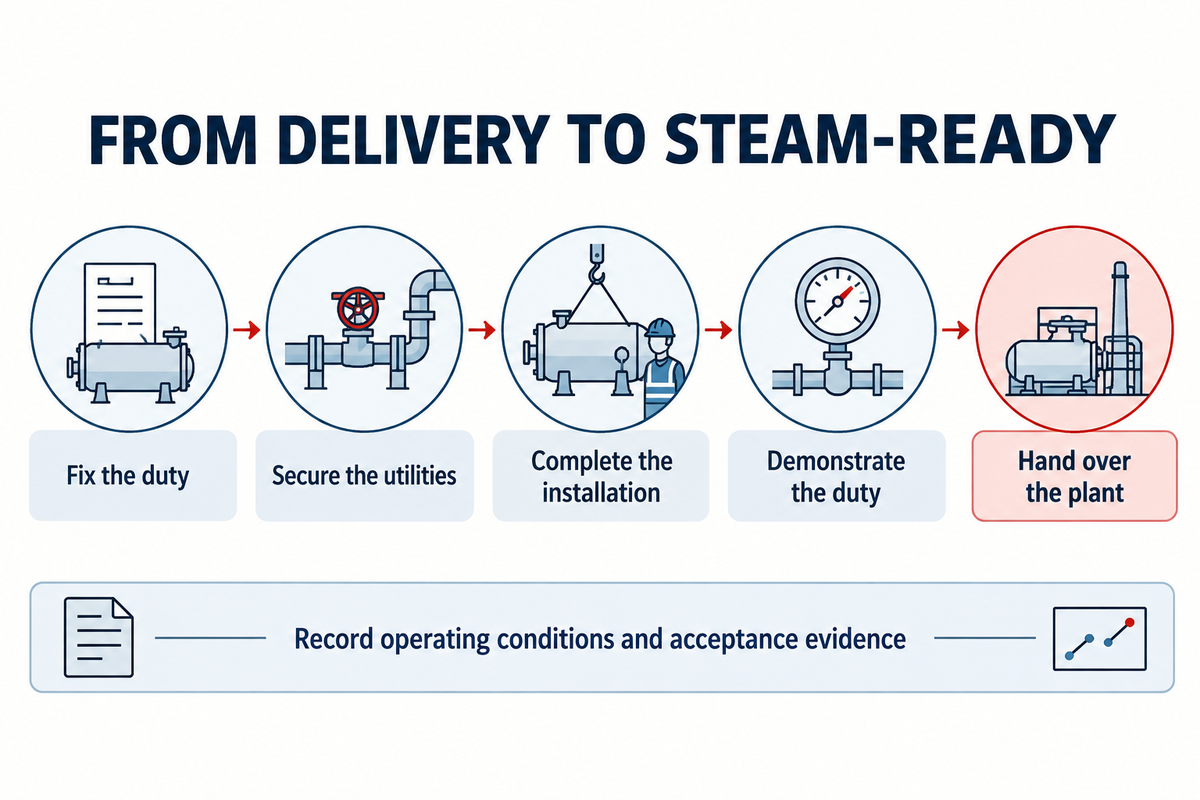
A steam-ready installation has an energized electrical supply, working water systems and accepted operation at the required duty. Earlier shipment of the vessel is considered a milestone. The commissioning plan should name who completes each connection and who accepts the steam conditions, so production scheduling follows a usable system rather than a shipping notice.
- Fix the duty. Record continuous demand, peak duration, steam conditions and essential outage load.
- Secure the utilities. Resolve capacity, connection timing and water-treatment responsibilities.
- Complete the installation. Finish electrical, mechanical and control interfaces.
- Demonstrate the duty. Run the agreed performance and demand-change sequence with recorded results.
- Hand over the plant. Deliver operating instructions, test records and maintenance information.
The ASME Boiler and Pressure Vessel Code page presents the 2025 edition. Project documentation should state the applicable construction rules and the edition adopted by the Jurisdiction. ASME construction and electrical approvals address different matters; labels such as ASME and UL should be checked against the exact equipment and required approval scope.
What are the installation clearance requirements for industrial steam boilers?
Installation clearance must accommodate the applicable code, electrical working space and the manufacturer’s service envelope. Use the greatest applicable clearance on each side of the unit, including the space needed to remove serviceable parts. Withdrawal of an element, travel of a door, and a lift may take the equipment beyond the vessel outline, so the equipment layout should take into account all required movements, including those required for maintenance.
Duty and utility conditions should be included in a request for quotation. Replace the example values with the agreed values of the plant. The test method should be stated in the same row.
| Parameter | Recommended range | Why it matters | How to verify |
|---|---|---|---|
| Continuous steam duty | Example target: 5 t/h | Sets the continuous production requirement | Guaranteed duty point and acceptance run |
| Essential outage duty | Example minimum: 4 t/h | Separates critical load from full production | Agreed single-unit-outage sequence |
| Available added power | Example ceiling: 3.8 MW | Limits combined boiler and auxiliary demand | Utility and electrical design records |
| Auxiliary allowance | Example input: 0.10 MW | Reserves power for supporting services | Supplier load schedule |
| Steam conditions | Project pressure and quality values | Determines usable process steam | Pressure/quality measurements at agreed boundary |
| Acceptance sequence | Continuous duty plus defined peak event | Tests response as well as nameplate output | Signed commissioning procedure and results |
Taiguo Boiler should receive the duty and utility information as one project brief. Include the load profile, water analysis and site layout with the industrial electric boiler inquiry.
Electric steam boiler FAQs
What is an electrical steam generator?
An electrical steam generator uses electricity to convert water into steam.
Industrial designs use resistance elements or electrodes, with controls that regulate heat input as demand changes. The required pressure and steam quality determine whether a model suits the process. A generator can be compact, but equipment classification follows its construction and operating conditions. The name alone doesn’t exempt it from pressure-equipment requirements.
What are the disadvantages of electric boilers?
Electric boilers can face high electricity costs, limited available power and dependence on the electrical supply.
Connection upgrades can add cost and delay commissioning. Demand charges can make a short operating peak expensive, while water treatment and inspection still require attention. These disadvantages matter most when steam demand is continuous or the existing supply has little headroom. A duty-and-tariff comparison helps distinguish a suitable site from one that needs another heating solution.
What are the regulatory compliance requirements for steam boiler installations in the United States?
U.S. installations need the pressure-equipment and electrical approvals required by the applicable jurisdiction.
The project team should identify the accepted construction code and edition, registration or inspection obligations, and local installation requirements. Operating pressure and equipment classification influence the review. The authority having jurisdiction determines which rules apply. Supplier documents should identify the exact model and approval scope, with commissioning records retained for the installed system.
Can an electric boiler produce steam during a power outage?
An electric boiler cannot sustain steam generation without a suitable alternative electrical supply.
Stored steam may provide brief service. Continued production needs enough surviving energy supply for the heater and its auxiliaries, or another steam source with working supporting services.
How much does an industrial electric steam boiler cost?
The installed cost is the boiler price plus electrical, water, steam-connection and commissioning costs; operating electricity is a separate budget.
Equipment price changes with capacity, pressure, materials and control capabilities. Electrical reinforcement, feedwater treatment and steam tie-ins can materially change the installed scope. Compare quotations at one duty point with the same inclusions. Finance should then calculate energy consumption and demand charges from the expected operating profile, rather than applying a universal multiplier to the vessel price.
Is electric steam automatically clean steam?
No. Steam purity depends on the complete water, equipment and distribution system.
Direct product contact requires an appropriate quality specification. Electrical heating removes the combustion process but doesn’t remove dissolved substances, treatment chemicals or potential contamination from downstream equipment.
Are large industrial electric steam boilers made in the USA?
Yes, U.S. suppliers offer industrial electric steam boiler equipment.
Manufacturing location, product type and available capacity should be compared for the particular model. For example, the Precision Boilers ST Series brochure identifies U.S. production of electric steam boilers; confirm the origin of the quoted model. The supplier shortlist linked above covers options without replacing the engineering specification. For an imported unit, local service arrangements, documentation and installation approvals belong in the quotation review alongside output and price. The required steam duty remains the starting point for selecting boiler manufacturers.
Key takeaway
A boiler purchase becomes usable steam capacity only when the electrical supply, water systems and surviving equipment can meet the specified production duty together.
Discuss your steam duty with TAIGUO
Send the continuous and peak steam loads, delivery pressure and available electrical capacity. Add the essential outage load so the quotation can address the operating arrangement as well as the boiler package.
This guide integrates public technical guidance and stated calculation examples. Equipment selection and installation require the project’s operating conditions and applicable engineering approvals.
References & Sources
- Electrode and Electric Resistance Steam Generators and Hot Water Heaters, New Zealand Energy Efficiency and Conservation Authority, 2019.
- How to Calculate the True Cost of Steam, U.S. Department of Energy.
- Connections Action Plan, UK Department for Energy Security and Net Zero and Ofgem, 2023.
- Why Steam? An ABMA White Paper, Gene Tompkins, HPAC Engineering, 2020.
- Techno-economic optimization of hybrid steam-electric energy systems, Olav Galteland and colleagues, SINTEF Energy Research, 2025 preprint.
- Low-Water Cutoff: A Maintenance Must, Dan Mushalko, National Board Bulletin, 1996.
- Evaluating Your Utility Rate Options, U.S. Department of Energy, Federal Energy Management Program.
- Boiler and Pressure Vessel Code, American Society of Mechanical Engineers.
Related Articles
- Industrial electric boiler overview
- Planning industrial electric heating
- Costs of industrial electric boiler systems
- Comparing electric steam and natural gas equipment