Get in Touch with Taiguo


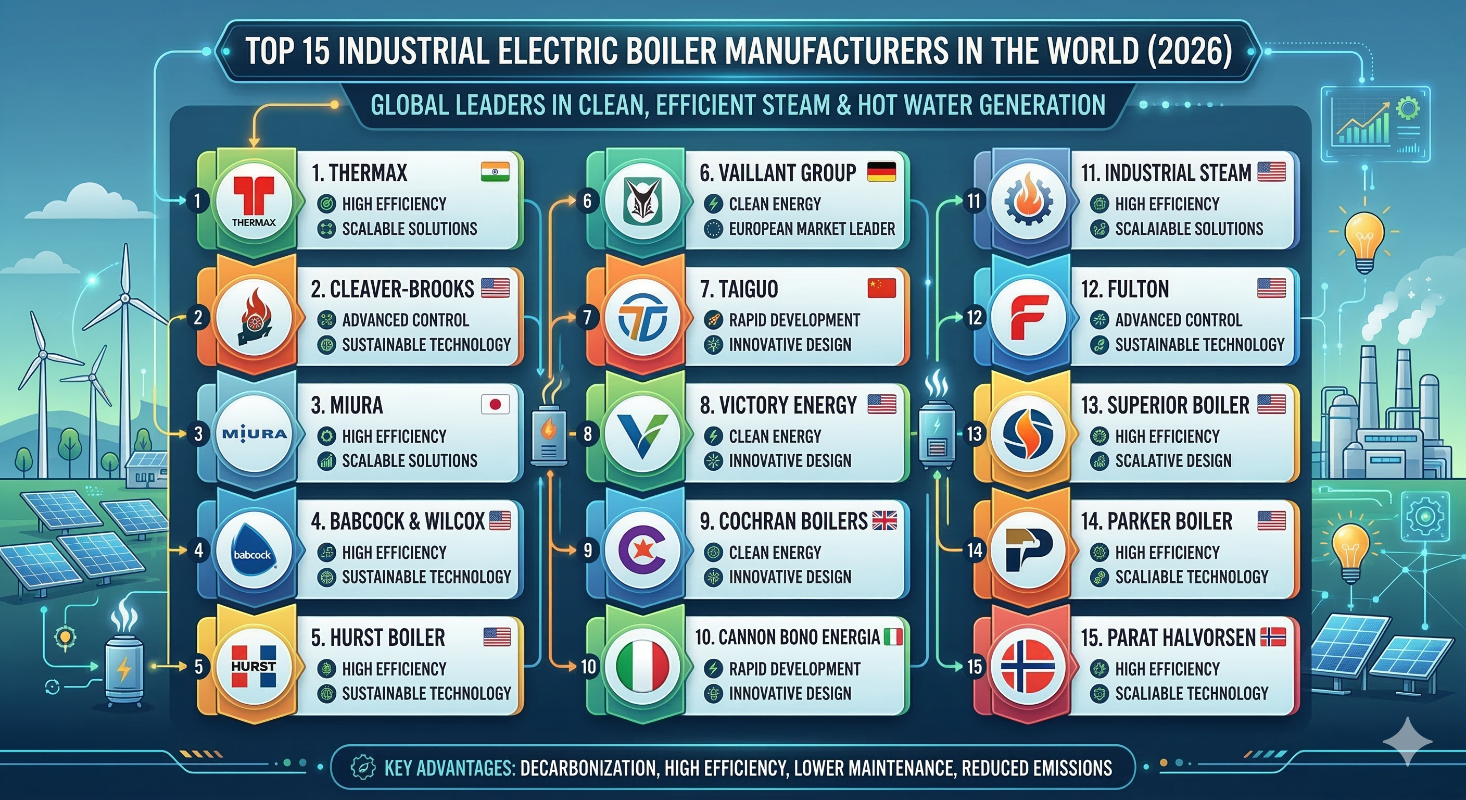
Top 15 Industrial Electric Boiler Manufacturers in the World (2026)
The worldwide industrial electric boiler market exceeded USD 285.1 million in 2024 and is forecasted to grow at over 16.9% CAGR through 2034, according to Global Market Insights. The industry is being driven by a structural shift away from combustion based steam generation as process industries face tightening emissions caps, increased natural gas costs, and rising demand for net-zero compliance.
In contrast to traditional oil-fired or gas-fired processes, industrial electric boilers provide close to 100% thermal efficiency with a zero on-site NOx / SOx / CO2 emissions footprint – a critical differentiator for food and beverage, chemical, pharmaceutical, and textile processors operating in emissions-sensitive environments. The IEA anticipates industrial electrification levels will increase from around 40% now to over 50% by 2035, with electric steam generation playing a central role in that transition.
However, not all electric boiler suppliers are created equal. Certification coverage, engineering pedigree, range of capacity, global service support network, and spare parts availability vary dramatically across the global supplier menu. This guide presents the top 15 industrial electric boiler makers in the world – providing validated information on company histories, product sets, strongest points, and critical limitations – so buying teams and operation staff can buy with confidence.
16.9%
CAGR 2025-2034
~100%
Thermal Efficiency
Zero
On-site NOx / CO2
What to Look for in an Industrial Electric Boiler Manufacturer

Before examining individual suppliers, procurement teams should set out an evaluation criteria. Five criteria below enable consistent long-term vendor comparison.
- Certification and standards – The ASME Boiler and Pressure Vessel Code (BPVC) Section I set tough design, manufacturing, inspecting, and testing parameters for electric boilers operating above 15 psig – cross-border must-have for U.S. projects. CE mark / PED compliance is essential for European applications. ISO 9001 is the minimum global quality standards baseline.
- Pressure vessel engineering – Ensure system working pressure range (0.7-2.5 MPa for most industrial operations) and steam output (kgs/hr or tons/hr) are aligned with process demand. OEM and tailor-made solutions are critical for non-standard voltages, limited plant space, or containerized (skid-mounted) boilers.
- Technology type – Resistance element boilers (0.01-4 MW, 380V) are suitable for standard commercial and industrial base-load needs. Electrode boilers (4-80+ MW, 6-20 kV) are for large Power-to-Heat and grid balancing capacities. The matching of technology to process load profile has the biggest lifecycle energy cost implications.
- Global service network – On-demand spare parts availability, commissioning support, and ability to remote troubleshoot determine operation risk post-installation. Suppliers with regional / country focus support service engineers mitigate risk of outage.
- Lifecycle economics – Feedwater treatment requirements, blowdown system design, economizer integration, operative element change interval, and total costs of ownership – not capital outlay alone – should be considered. The U.S. DOE FEMP program promotes lifecycle cost analysis as the primary purchasing measure for industrial boilers.
Takeaway: Certification scope and lifecycle cost analysis should drive supplier selection — not unit price alone. A boiler operating 8,000+ hours annually with inadequate feedwater treatment or limited spare parts availability will cost far more over its service life than its purchase price suggests.
Top 15 Industrial Electric Boiler Manufacturers in the World
Profiles cover global established leaders and regional domain specialists across North America, Europe, and Asia. Positions reflect the extent of electric boiler and heater focus, certification scope, worldwide service support, and pedigree.
#1. Taiguo — China, Est. 1976
Official Website: taiguo-steamboiler.com
Taiguo is a Grade A certified industrial boiler manufacturer with nearly 50 years of Engineering experience based out of a 60000 m2 manufacturing facility and exporting to over 100 countries. Possessing ASME, CE and ISO 9001 certifications, Taiguo is the manufacturer of the electric steam boilers and hot water boilers engineered for zero-emission industrial heating. Taiguo products operate on a full project cycle – from custom-engineered design & prototype testing in the factory to project commissioning & after-sales technical support.
Main Products:
- Taiguo’s Electric steam boiler (50-2,000 kg/h; 36-1,400kW; 0.1-1.0 MPa)
- WDR Series Horizontal Electric steam boiler (0.5-6 t/h; 375-4,500 kW; 0.7-1.25 MPa; 99% efficiency)
- Electric Hot Water Boilers for process and comfort heating
- Thermal oil heaters (YYQW, YGL series)
Strengths
- 99% thermal efficiency due to direct electricity-to-steam conversion (WDR series) with no combustion or other thermodynamic losses
- Steam-ready in 3-5 minutes from cold start
- Zero point-of-use NOx or CO2 emissions – in line with ESG & decarbonisation policies
- Stainless steel heating elements rated at ~20,000 hours’ operation, minimum maintenance
- Grade A + ASME/CE/ISO 9001 – compatible across North America, Europe, Asia-Pacific
- Focussed on 8 industries – food & beverage, pharmaceutical, chemical, textile, brewery, dairy, healthcare and construction
Limitations
- Higher operational expenditure where regional electricity tariffs are significantly higher than natural gas equivalents
- Brand awareness of North American markets is weaker than legacy US manufacturers
Expert Note: Taiguo’s WDR horizontal series offers a compelling combination of high-efficiency performance, full ASME/CE compliance, and global delivery capability that few manufacturers at this price point can match. For buyers sourcing 0.5-6 t/h steam capacity, explore Taiguo’s full industrial electric boiler range at taiguo-steamboiler.com/industrial-electric-boiler/.
#2. Bosch Industriekessel — Germany, Est. 1865
Official Website: bosch-industrial.com
Founded in 1865 as Loos, Bosch Industriekessel (a Bosch Thermotechnik business) has commissioned more than 120,000 boiler machines in 140+ countries. Its ELSB electric steam boiler series, plus strategic tie-in with A.E.P. Thermal Inc. for Medium Voltage electrode boilers (throughout 2023) position the company as leading European engineer for industrial decarbonisation of heat
Main Products: ELSB Electric Steam boiler (350-7,500kg/h; up to 24 bar), universal steam boilers (U-MB, U-ND series), thermal fluid heaters, waste heat recovery boilers.
Advantages
- 160+ years of engineering heritage; global service network in 140+ countries
- High-capacity ELSB for large-scale industrial steam production
- Bosch Group R&D backing for hydrogen-ready boiler systems
- ISO 9001, PED, TUV certified
Drawbacks
- Premium pricing reflects Bosch brand; total cost higher for smaller companies
- Electric boiler line comparatively newer than their conventional legacy
#3. Babcock & Wilcox — USA, Est. 1867
Official Website: babcock.com
Founded in 1867 by the inventors of the water-tube boiler, B&W built the world’s first utility boiler (1881) & now supplies 300+ GW of generating capacity across 60+ countries. The BabcockWanson division specialises in industrial steam solutions; in 2023 acquired PARAT Halvorsen, considerably strengthening their electrode boiler product offering for large industrial & Power-to-Heat applications
Strengths
- 155+ years of boiler innovation; world-class engineering credentials
- Strong power generation, nuclear, and heavy industrial presence
- PARAT acquisition adds electrode boiler and Power-to-Heat capabilities
Limitations
- Known for large utility boilers; small industrial electric units not focal point
- High minimum order quantities; long lead time; less appropriate for smaller companies
#4. PARAT Halvorsen — Norway, Est. 1842
Official Website: parat.no
Based out of Flekkefjord, Norway since 1842 – operators of electrode boilers since 1990, PARAT Halvorsen is the market-leader of High Voltage Electrode Boilers for Power-to-Heat applications. Their IEH series utilises the conductivity of water as the heating element, achieving 99.9% thermal efficiency and allowing fast load modulation – essential for renewable power supply & grid-balancing. PARAT entered the BabcockWanson Group in 2023
Main Products: PARAT IEH High Voltage Electrode boiler, PARAT IEL Low Voltage Electrical Element boiler, Marine & offshore electric steam systems
Advantages
- Global #1 in high-voltage electrode boiler technology
- 35+ years of electrode design & engineering; most suitable for renewable energy penetration
- Serves oil & gas, petrochemical, and grid-balancing applications
Drawbacks
- Specialist technology background limits application for generic steam Requirements
- High-voltage infrastructure requirement adds significant project cost
#5. Chromalox — USA, Est. 1917
Official Website: chromalox.com
Founded in Pittsburgh in 1917, Chromalox introduced the industry to the first metal sheathed resistance heating element – the prototype of modern industrial electric heating equipment. Contemporary, now part of Spirent Technologies, Inc., Chromalox provides complete industrial electric heating solutions & systems, including boilers, steam generators, heat tracing, vaporizers and heat transfer systems to process industries worldwide.
Strengths
- 100+ years of electric heating technology leadership
- Broad portfolio covering all industrial heating segments
- Custom engineering for hazardous-location and classified-area applications
Limitations
- Boilers but less specialized than dedicated boiler producers
- Extended lead times for custom configurations
#6. Sussman Electric Boilers — USA, Est. 1917
Official Website: sussmanboilers.com
Sussman and Co. built the first industrial electric steam generator in 1917 for the garment industry and has become what it markets as the world’s largest catalogued commercial and light industrial electric steam boiler manufacturer. Now part of DHT (Diversified heat transfer) since 2022, Sussman offers the broadest US market coverage for electric boilers — from 3 kW miniature laboratory units to 5,000 PPH industrial output capacity, complemented with electric hot water boilers to 9,200 MBH.
Advantages
- Deepest US market electric boiler catalog; broadest capacities
- All ASME, UL, CSA, NEC standards compliant; stainless steel variations available
- Strong reputation in healthcare, laboratory, aerospace, and HVAC humidification
Drawbacks
- The 2022 acquisition might impact product availability and supply chain stability
- Primarily North American market; limited global distribution
#7. Reimers Electra Steam — USA, Est. 1908
Official Website: reimersinc.com
Reimers Electra Steam Inc. has produced electric steam boilers & generators since 1908 in the US. Making it one of the market’s oldest operating equipment manufacturers, the company specializes in small, flameless electric steam generators (1.5-750 kW) for commercial and light industrial markets, boasting rapid startups, zero emissions and efficiency in limited floor space.
Strengths
- 115+ years of unbroken US manufacturing heritage
- Compact, flameless design — no venting required; rapid installation
- Zero-emission; ideal for indoor air quality and decarbonization requirements
Limitations
- 350 kW capacity limit; not for high-capacity industrial needs
- Narrow product range; limited scalability for large plants
#8. Cleaver-Brooks — USA, Est. 1929
Official Website: cleaverbrooks.com
Founded by John Cleaver and Raymond Brooks in 1929, producer of the world’s first packaged boiler – package electric steam boiler- Cleaver-Brooks has been a household name in North American boiler production. In 1988, they purchased the Coates line which introduced electric resistance and electrode boiler solutions to the company’s offerings, leading to an all-in-one electric boiler room package containing burner, controls and supplementary equipment.
Key focus: LVR Electric Resistance Boilers (90-540 kW), electrode boilers, condensing boilers, full-scope boiler room systems.
Advantages
- Stream of over nine decades of manufacturing expertise; well established in North American market
- Full electric boiler system package- burner, controls, secondary equipment
- Advanced controls and power metering on electric models
Drawbacks
- Electric resistance electric boiler line less relevant; limited range for boilers
- Market focus on mid-sized commercial and industrial applications- not high capacity electric
#9. Lattner Boiler — USA, Est. 1918
Official Website: lattner.com
Established in Cedar Rapids, Iowa in 1918, Lattner Boiler Manufacturing offers a range of electric boilers and fuel fired boilers for processes in medical sterilization, food processing, dry cleaning and light industrial markets. Known for competitive pricing, proven designs and easily sourced spare parts the company’s products are popular in the cold Midwest US market with short lead times.
Strengths
- Over a century of manufacturing history; competitively priced products for common markets
- Simple, durable designs with readily available spare parts
- Capacities served in multiple end markets- dry cleaning, healthcare, food processing, industrial process
Limitations
- Primarily US focused- struggling to penetrate international markets or to compete effectively with low cost competitors
- Slower pace of product innovation vs. technology-focused competitors
#10. Miura — Japan, Est. 1927
Official Website: miuraz.co.jp
Established in Matsuyama, Japan in 1927, producing boilers since 1959, Miura was responsible for the development of the historic once-through steam generator design and operates today as one of the world’s largest industrial steam boiler manufacturers with facilities across USA, Canada, Brazil, Mexico and Asia. The Miura approach to once-through technology produces steam in less than 5 minutes from cold start, is up to 40% smaller in floor space footprint than a comparable firetube design, and boasting full IoT capabilities for remote analytics and predictive maintenance.
Advantages
- Once-through steam in less than 5 minutes; machinery footprint
- Strong IoT integration; real-time remote monitoring and predictive maintenance
- Global manufacturing and service network across Americas and Asia-Pacific
Drawbacks
- Once-through design demands high purity treat/feedwater – operationally demanding
- Higher initial investment vs. conventional firetube electric boilers
#11. Precision Boilers — USA, Est. 1946
Official Website: precisionboilers.com
Part of the Thermor Group, Precision boilers was born in Morristown, Tennessee during the late 1940’s. Today managing high voltage jet electrode boilers operating at 13.2kV line voltage – one of the highest power ratings commercially available in North America for native electrical power generation and industrial decarbonization.
Strengths
- HVJ Electrode boiler at 13.2 kV – the highest class of capacity for industrial decarbonization
- A complete range of high voltage electrode solutions to meet all capacity requirements
- Thermon Group backing ensures R&D and supply chain continuity
Limitations
- Mid-tier international brand recognition; primary market is North America
- Electrode boiler line requires significant electrical infrastructure investment
#12. Fulton Boiler — USA, Est. 1949
Official Website: fulton.com
Established in Pulaski, New York in 1949, Fulton was responsible for the development of the industry standard vaporproof steam boiler design, one that all competitors emulate. Today as a truly multinational manufacturer, with manufacturing plants in USA, UK, China and beyond, powering one of the world’s most renowned providers of steam, hot water, thermal fluid heat transfer and related systems. Fulton steam boilers and superheaters can be integrated into commercial and industrial applications in 75+ countries.
Advantages
- Pioneered vertical tubeless design — proven technology adopted industry-wide
- Multi-national manufacturing (USA, UK, China) – proven global delivery service
- 75+ year award-winning engineering track record and extensive customer support network
Drawbacks
- electric boilers have a narrower product portfolio in comparison; less specialist focus in this local market
- Premium pricing in markets where local alternatives are available
#13. Thermax — India, Est. 1966
Official Website: thermaxglobal.com
Formed in 1966, fellow Indian enterprise (as Wanson India), Thermax has grown into India’s leading energy and environmental system supplier, now working in 90+ countries. Its boiler division (TBWES) covers electrics, biomass, gas and waste heat recovery boiler solutions.
Strengths
- All-in-one energy solutions concept offering to OEM customers
- Cost-competitive Indian manufacturing with global delivery to 90+ countries
- Listed company with strong governance and financial stability
Limitations
- electric boilers does not dominate boiler drive focus; catalog less differentiated than dedicated industry specialists
- Limited after-sales presence outside major Asian markets or key export pathways
#14. ATTSU — Spain, Est. 1993
Official Website: attsu.com
Created in 1993 by pooling resources of three existing Spanish boiler suppliers (Arcones, Tecnivap and Teyvi), the ATTSU Group combines a total 103+ years boiler manufacturing heritage. Based in Spain, 60+ Export markets, with all range design and manufacturing performed locally, as part of the CE marked and PED compliant family of 10-5,000kg/h capacity, all electric boiler models – available as ready mounted or independent OEM packaged assemblies.
Advantages
- CE marked, PED compliant and all locally manufactured from Spain
- Significant capacity (10-5,000 kg/h), no packaged ready mains-mounted boilers for OEM use
- Well proven European and global export record; multi-language engineering literature help facilitate overseas orders
Drawbacks
- Nominally a smaller global presence than either US or German specialist suppliers; Asia-Pacific distributor network is also limited
- Custom order lead times of 8-12 weeks from Spain
#15. Forbes Marshall — India, Est. 1946
Official Website: forbesmarshall.com
Founded in 1946, Forbes Marshall is India’s first and largest steam engineering and energy efficiency solutions provider. Their end-to-end approach covers electric boilers alongside steam traps, flowmeters, controls, and complete energy audit services – a distinct choice for plants seeking total steam system optimization rather than just a boiler vendor, servicing process industries across 90+ countries.
Strengths
- End-to-end steam system approach- boiler + instrumentation + controls + service from one source
- Energy efficiency consulting heritage reduces total steam system operating cost
- Extensive service network across India and South/Southeast Asia
Limitations
- electric boiler line smaller in capacity range vs. European or US specialists
- Primarily strong in Asian markets; limited direct service presence in Western markets
Takeaway: The 15 manufacturers fall into three natural tiers: high-efficiency pure electric boiler specialists (Taiguo, Sussman, PARAT, Reimers), full-service industrial boiler leaders (Bosch, B&W, Cleaver-Brooks, Miura, Fulton), and diversified industrial energy companies (Thermax, Forbes Marshall). Match your supplier tier to whether you need electric-only depth, multi-fuel flexibility, or integrated energy system support.
Top 15 at a Glance: Comparison Table
| # | Manufacturer | Country | Est. | Electric Focus | Global Reach |
|---|---|---|---|---|---|
| 1 | Taiguo | China | 1976 | 5/5 | 100+ countries |
| 2 | Bosch Industriekessel | Germany | 1865 | 4/5 | 140+ countries |
| 3 | Babcock & Wilcox | USA | 1867 | 3/5 | 60+ countries |
| 4 | PARAT Halvorsen | Norway | 1842 | 5/5 | Europe / Global |
| 5 | Chromalox | USA | 1917 | 4/5 | N. America / Global |
| 6 | Sussman Electric Boilers | USA | 1917 | 5/5 | N. America |
| 7 | Reimers Electra Steam | USA | 1908 | 5/5 | N. America |
| 8 | Cleaver-Brooks | USA | 1929 | 3/5 | N. America |
| 9 | Lattner Boiler | USA | 1918 | 3/5 | N. America |
| 10 | Miura | Japan | 1927 | 4/5 | Americas / Asia-Pac |
| 11 | Precision Boilers | USA | 1946 | 4/5 | N. America |
| 12 | Fulton Boiler | USA | 1949 | 3/5 | Global (5+ countries) |
| 13 | Thermax | India | 1966 | 3/5 | 90+ countries |
| 14 | ATTSU | Spain | 1993 | 4/5 | Europe / 60+ countries |
| 15 | Forbes Marshall | India | 1946 | 3/5 | 90+ countries |
How to Choose the Right Industrial Electric Boiler Manufacturer
With 15 credible suppliers profiled, the practical challenge is narrowing the field for your specific project. This five step framework reflects how experienced plant engineers approach boiler manufacturer selection – as a risk-weighted evaluation, not a checkbox exercise.
- Match steam output to process load – Calculate peak and average steam demand in kg/h or t/h. Resistance element boiler systems cover 50-6,000 kg/h for most industrial steam applications. Electrode-based systems cover multi-MW loads. Over specifying wastes capital; under-specifying creates reliable performance risk during peak demand periods.
- Verify certifications for your destination market – ASME (North America), CE/PED (Europe), GB standards plus Grade A/B manufacturing license (China and much of Asia). Importing a non-compliant boiler triggers costly re-certification or rejection at customs. Require certified test records, not self declared compliance alone.
- Model total lifecycle cost, not unit price – A cost-effective electric boiler is the least expensive per kg of steam produced over 15+ years. Ask manufacturers what steps they take to reduce energy consumption — economizer options, variable load control, and insulation standards vary significantly. Model feedwater treatment requirements, blowdown system costs, heating element replacement at 15,000-20,000-hour intervals, and energy costs at your local electricity tariff before comparing quotes.
- Evaluate after-sales support infrastructure – Ask: Does the manufacturer have a service engineer within 24 hours of your plant? Can spare parts ship within 72 hours? Is remote diagnostics available? Customer support quality over a 15-year service life matters more than the purchase specification alone.
- Align with your energy transition roadmap – If your facility is moving toward grid-integrated Power-to-Heat (as actively funded by the U.S. DOE Industrial Efficiency and Decarbonization Office), prioritize suppliers with electrode boiler technology. For standard process steam at 0.7-1.25 MPa as your near-term need, a high-efficiency resistance electric boiler from a Grade A certified manufacturer delivers the most cost-effective solution without the electrical infrastructure investment electrode systems require.
Common Mistake: Many procurement teams select suppliers based on quoted unit price without modeling feedwater treatment and blowdown system costs. In practice, these auxiliary systems represent 15-25% of total installation cost — and ongoing feedwater quality failures are the leading cause of premature heating element failure in electric steam boilers. Always request a full system scope from shortlisted manufacturers before comparing quotes.
Frequently Asked Questions
How do industrial electric boilers work?
Industrial electric boilers convert electrical energy directly into heat using one of two technologies. Resistance boilers pass current through immersion heating elements submerged in water. Electrode boilers pass alternating current (6-20 kV) directly through the water itself, which serves as the electrical resistance medium. Both approaches produce steam and hot water without combustion — no burner, no flue gas, no NOx or CO2 emissions at the point of use — achieving efficiencies of nearly 100%, compared to the 75-85% typical of natural gas firetube boilers. Unlike gas boilers, there is no heat exchanger between the combustion zone and the water vessel; electricity converts directly to thermal energy with near-zero loss. The result is saturated steam at process grade quality with zero fossil fuel dependency.
What industries use industrial electric steam boilers?
Food processing, pharma, chemical plants, textile mills, breweries, dairies, hospitals, power plants. Any process needing a clean, zero-emission steam.
What is the difference between resistance and electrode electric boilers?
Resistance boilers (0.01-4 MW; 380V) heat water through immersed elements. Electrode boilers (4-80+ MW; 6-20 kV) pass current directly through the water – the water is the resistor. Electrode systems are capable of higher capacities and react to grid signals in seconds, making them the best choice for Power-to-Heat and renewable integration projects. Resistance boilers are the work horses of conventional commercial and industrial steam production. Both achieve nearly-100% efficiency.
Are industrial electric boilers more expensive to operate than gas boilers?
Operating expenditure is driven mainly by that location’s relative electricity v. natural gas tariff differentials. For locations with renewable electricity below $0.06-0.08/kWh, electric boilers can beat the entire operating expenditure per kg of steam – especially when taking into consideration added carbon and NOx taxes, and combustion system maintenance. Electric boilers cut out burner maintenance, pipe-chimney cleaning, flue-gas sampling, and fuel-storage. In locations where the electricity tariff is 3-4x relative to the natural gas energy equivalent, operating costs will be higher. The DOE FEMP procurement guidelines recommend a full lifecycle assessment – including delivery energy use and maintenance – before selecting the fuel-based or electric boiler option.
Which certifications should I require from an industrial electric boiler manufacturer?
Design requirements are destination market-dependent. North America: ASME BPVC Section I compliance with the ASME S or E stamp for power and electric boilers. Europe: CE mark and Pressure Equipment Directive (PED 2014/68/EU). China and Asia: GB standards and a Grade A or Grade B boiler operating license from the local special equipment supervisory authority. As a common baseline, ISO 9001 quality management certification from the manufacturer gives assurance of their manufacturing process quality controls, regardless of market. For high-pressure usage (over 1.6 MPa), verify compliance with the local pressure vessel inspection authority – in the US that is the National Board of Boiler and Pressure Vessel Inspectors.
Final Thoughts
The worldwide transition away from fossil fuel combustion toward electric steam generation is a procurement reality for thousands of industrial plants navigating decarbonization targets, rising gas prices, and ESG reporting requirements. The 15 vendors listed here host the largest pool of proven, certified industrial electric boiler solutions found anywhere worldwide in 2025 – from 3 kW laboratory-sized units to electrode boiler plants of 80+ MW for megawatt-scale Power-to-Heat grid integration.
For procurers trying to find a Grade A certified industrial electric boiler equipment supplier with proven global delivery to 100+ nations, ASME/CE/ISO 9001 approvals, and a 50-year manufacturing record, Taiguo’s LDR and WDR electric boiler series deliver affordability, near-100% thermal efficiency (~99%), 3-5 minute startups, and 100% compliance with North American, European, and Asia-Pacific standards. See the full selection at taiguo-steamboiler.com/industrial-electric-boiler/.
Editorial note: This guide has been assembled from manufacturer’s publicly-available information, official company websites, standard documentation from ASME, research documents from IEA and DOE, and third-party market research. Manufacturer rankings are indicative of electric boiler level of specialization for the specific subsidiary; the extent of its certification program; the breadth of engineering services available; and the heritage / quality of its engineering work—this is in no way a paid entry. Taiguo is the principal brand discussed within.
Tech specs have all been validated through individual datasheets published by the manufacturers, as of early 2025.
References & Sources
- Electrification — Energy System — International Energy Agency (IEA)
- Purchasing Energy-Efficient Boilers — U.S. Department of Energy, Federal Energy Management Program
- Industrial Efficiency and Decarbonization Office — U.S. Department of Energy
- ASME Boiler and Pressure Vessel Code (BPVC) Standards — American Society of Mechanical Engineers
- Industrial Electric Boiler Market — Global Forecast 2025-2034 — Global Market Insights