Get in Touch with Taiguo


Updated September 2026
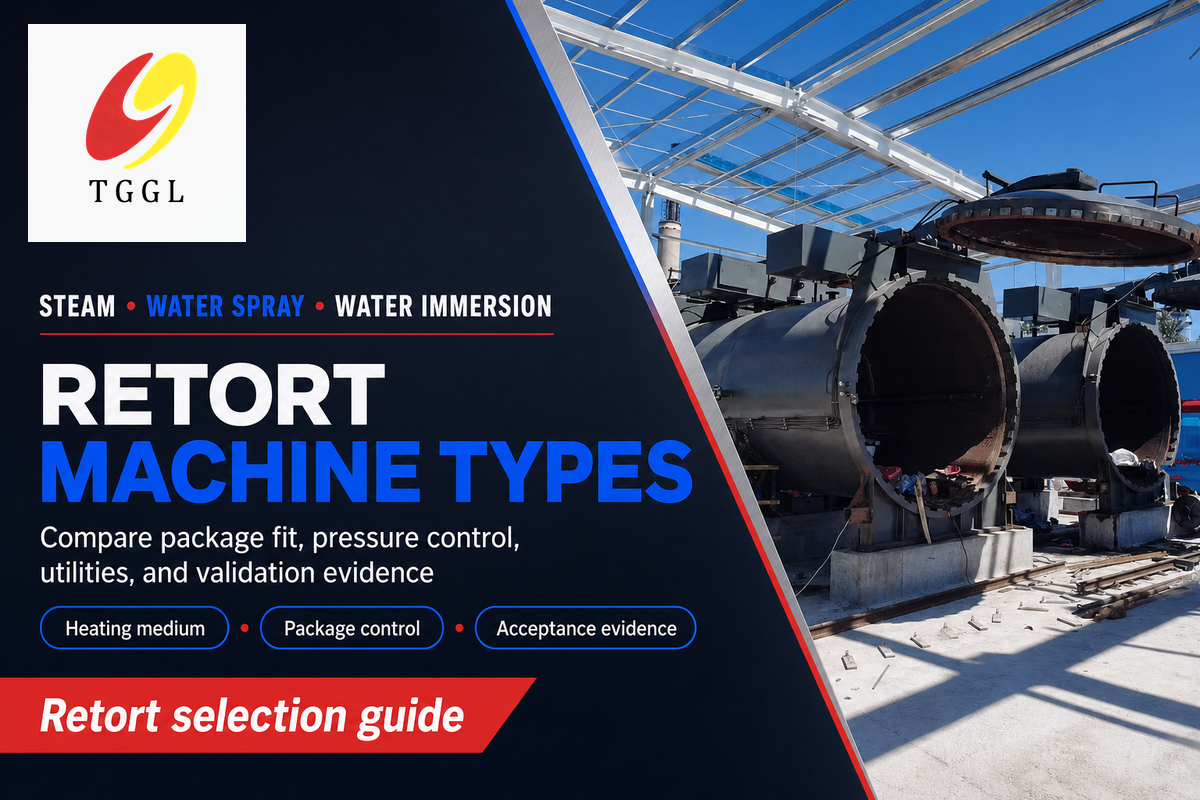
A retort machine is pressure-processing equipment that delivers a scheduled thermal process to sealed food containers. A retort machine cannot be selected by heating medium alone. Saturated steam, water spray, and water immersion transfer heat at the package surface differently, but package pressure, load motion, production rate, utilities, and process validation often determine which design can run the real product safely and repeatably.
Key takeaway
Start with the package and product, separate 4 design axes, then require heat-distribution and heat-penetration evidence for the proposed load. No retort solution is universally best.
Quick Answer: Which Retort Type Fits Which Job?
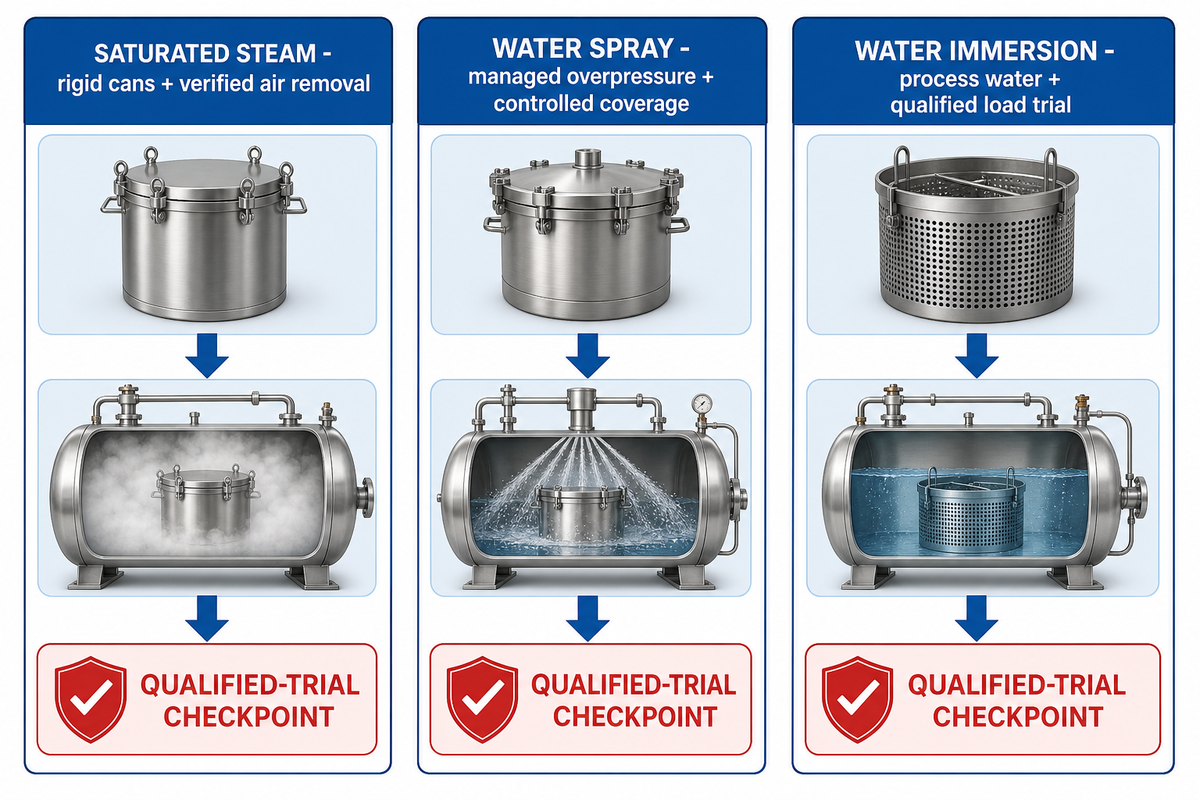
Saturated steam is the conventional starting point for rigid cans when direct steam heating and verified air removal suit the process. Water spray becomes attractive when packages need managed overpressure and controlled surface coverage. Water immersion surrounds the load with process water and can suit overpressure or rotary duties. Actual trials remain decisive.
If you process flexible pouches, semi-rigid trays, glass jars, metal cans, or bottles on one line, begin with the package limits rather than asking which medium is best. Define the pressure, support, orientation, heating, and cooling conditions each package must survive. For a production buyer, the main risk is assuming that a medium label proves package control; only a qualified study on the intended load can support that decision.
On a production line where container types span a wide range, a batch retort may look versatile, but the qualified load study still determines which formats belong together.
Define the Comparison Boundary Before Comparing Machines
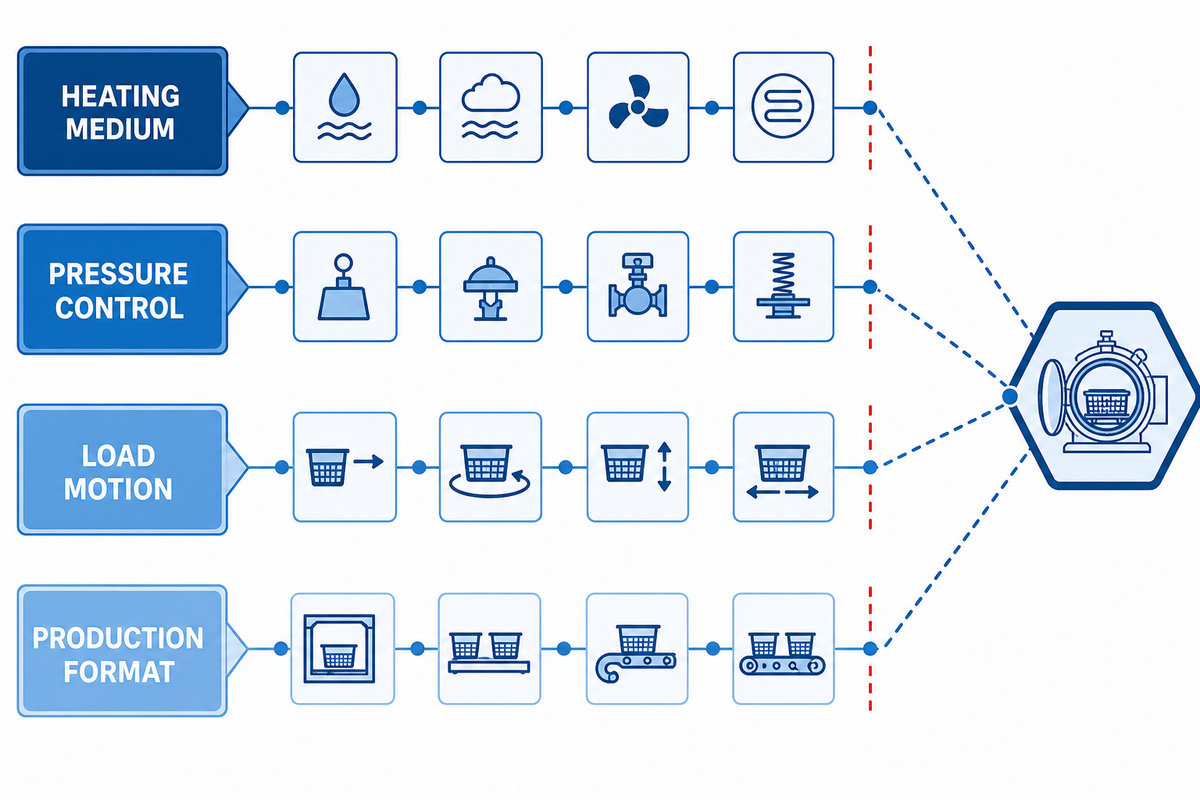
A food retort is pressure-processing equipment that delivers a scheduled thermal process to sealed containers. Four design axes must stay separate: heating medium, pressure-control method, load motion, and batch or continuous production format. Combining those axes under one “retort type” heading hides engineering differences and produces a weak request for quotation.
“Scheduled processes for low-acid foods shall be established by qualified persons having expert knowledge of thermal processing requirements.” — 21 CFR 113.83
The heating medium answers how energy reaches the container surface. Overpressure answers how vessel pressure is managed independently of product temperature when the package needs support. Agitation describes rotary, rocking, reciprocating, or other validated motion that may change product heat transfer. Batch or continuous design answers how loads enter and leave the system.
Keeping the four axes separate controls a specific failure risk: a study that qualifies one medium, motion, and load combination does not automatically qualify another. Organize supplier drawings and test reports on the same axes. Send pouch-specific pressure and lethality questions to the guide for planning a validated retort-pouch cycle; send commercial sizes and quotation choices to the vessel configuration and quotation page.
3-Medium Retort Decision Matrix
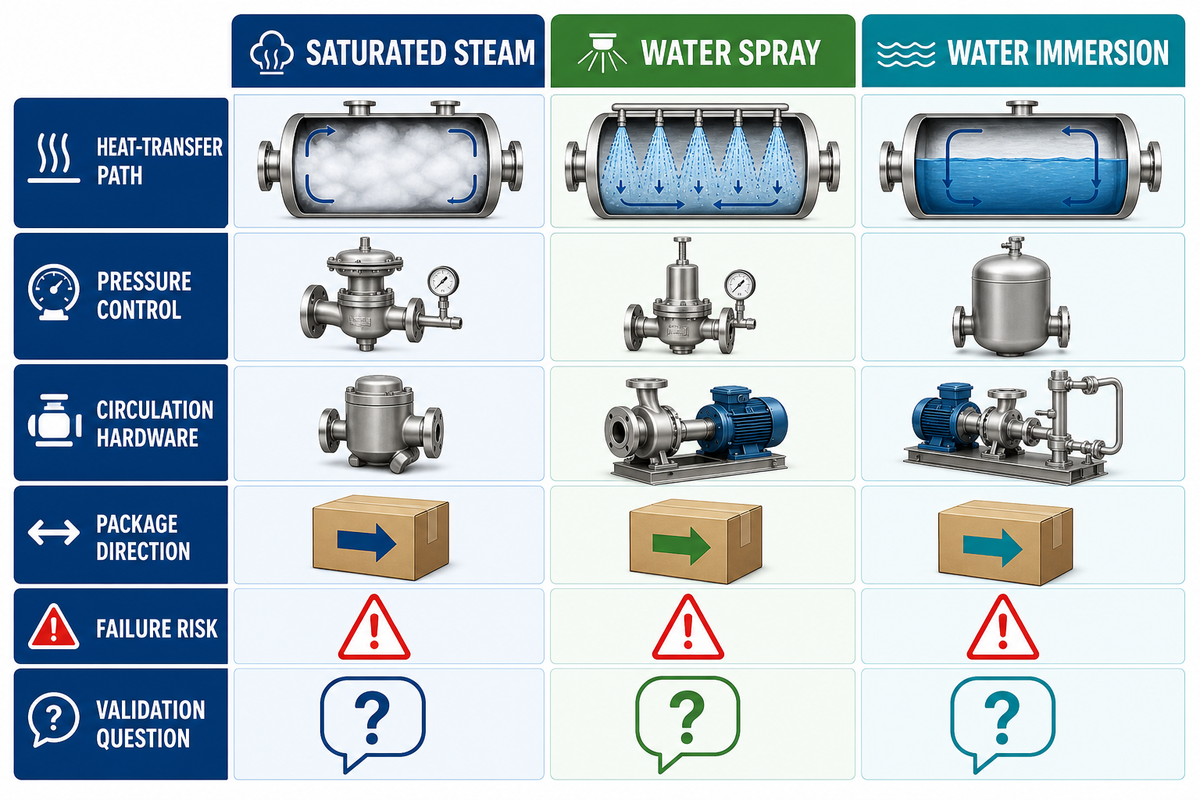
Use this grid to compare the three heating media by heat-transfer path, pressure control, circulation hardware, loading direction, characteristic failures, and validation questions. A qualified manufacturer or supplier should connect every proposed configuration to the actual food, container, production load, and acceptance evidence. The table supports a trial plan rather than issuing a purchase verdict.
| Retort type / decision criterion | Saturated steam | Water spray | Water immersion |
|---|---|---|---|
| Heat-transfer path | Steam condenses directly on exposed package surfaces. | Recirculated heated water is distributed through nozzles or headers. | Process water surrounds all or most of the load and is circulated. |
| Air during heating | Air must be removed under the validated vent schedule. | Air may be deliberately controlled for overpressure, depending on design. | Air pressure may support the package above the water surface or throughout the vessel. |
| Conventional starting package | Rigid, double-seamed metal cans. | Pouches, trays, cups, jars, and cans when the layout is proven. | Rigid and pressure-sensitive packs that suit immersion, restraint, and motion design. |
| Circulation hardware | Steam inlet, spreader, vents, bleeders, and condensate removal. | Pump, water inventory, heat exchanger or steam injection, headers, and nozzles. | Water storage or fill circuit, pump, heat input, level control, and flow path. |
| Pressure-control question | Is pure steam maintained after complete venting? | How does the air loop track package pressure during heating and cooling? | How do water head and air pressure interact across the load? |
| Characteristic failure to test | Residual air, blocked bleeders, condensate pockets, or premature timing. | Nozzle blockage, pump-flow loss, coverage shadowing, or basket obstruction. | Wrong water level, stratification, weak circulation, or mistimed transfer. |
| Cooling concern | Water entry and air support must follow the scheduled process. | Spray coverage and overpressure must protect seals as internal pressure falls. | Cooling circulation, level, pressure, and thermal shock require control. |
| Motion options | Static or an engineered agitated variant. | Static or an engineered agitated variant. | Static or rotary/other motion when package restraint and machine design allow. |
| Maintenance focus | Vents, bleeders, valves, traps, sensors, and spreaders. | Nozzles, strainers, pump, seals, exchanger, air valves, and sanitation. | Level devices, pump, seals, tank/transfer valves, restraints, and sanitation. |
| Acceptance question | Does the proposed vent and load pattern remove air before process timing? | Does the tested distribution study cover nozzle layout and full production loading? | Does the study cover level, flow, temperature, pressure, and any basket motion? |
Saturated-Steam Retorts: Simple Medium, Demanding Air Removal
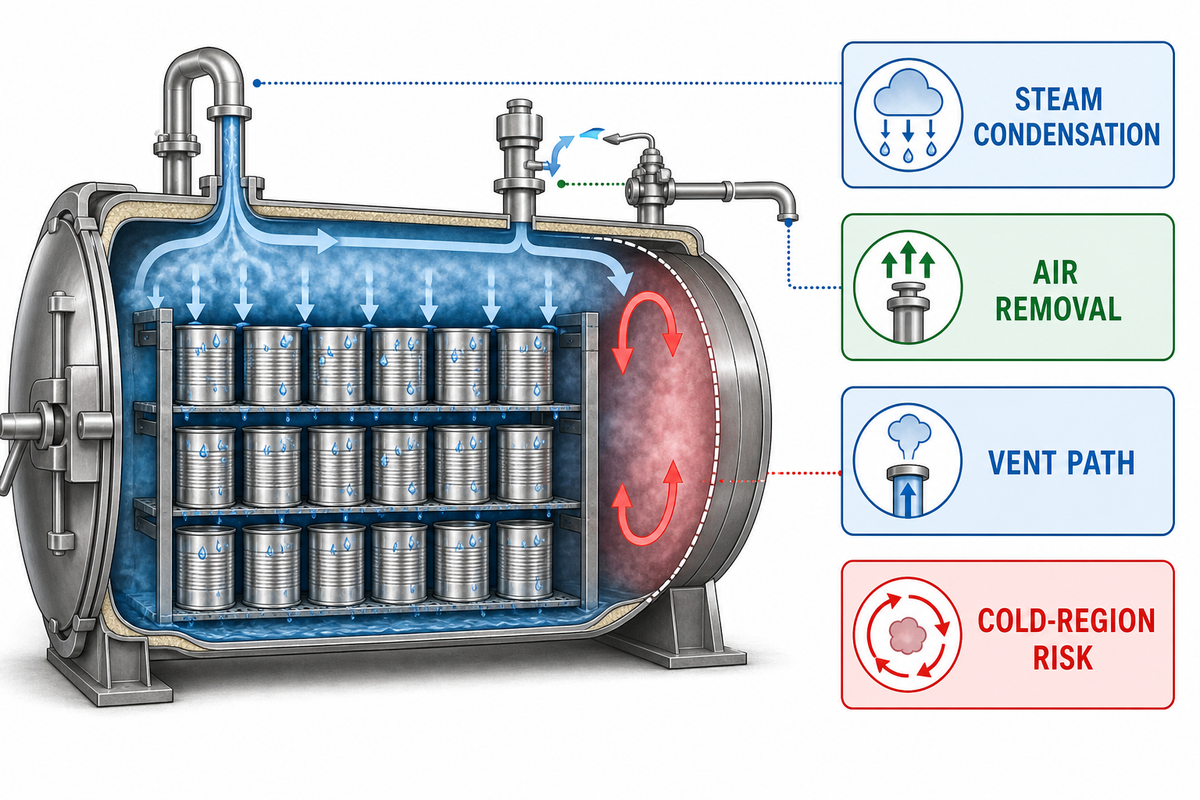
Saturated steam transfers heat by condensing on the package surface. Its central control requirement is not merely reaching a target temperature; the vessel must first remove air and establish the validated steam environment. It remains a strong candidate for rigid, double-seamed metal cans when steam delivery, venting, loading, instrumentation, condensate removal, and cooling follow the scheduled process.
Residual air creates a failure risk because a steam-air mixture breaks the expected saturated-steam temperature-pressure relationship and may leave cold regions in the load. The operator therefore needs observable bleeders, correctly positioned vents, adequate steam delivery, and a clear rule for when process timing begins. A controller cannot compensate for a vent path that has not been proven under the production load.
For procurement, require drawings of the inlet, spreader, vent manifold, bleeders, temperature sensors, recorder, pressure gauge, cooling valves, and basket geometry. Compare them with the proposed heat-distribution study. If a divider, crate, or container orientation changes, ask the processing authority and supplier whether the qualified study or scheduled process must be repeated.
Traditional canning retorts are familiar sterilization equipment for canned foods in tin cans, yet a uniform chamber reading is not proof of uniform heat distribution, reliable processing, or food safety.
Water-Spray Retorts: Coverage and Pressure Are Separate Jobs
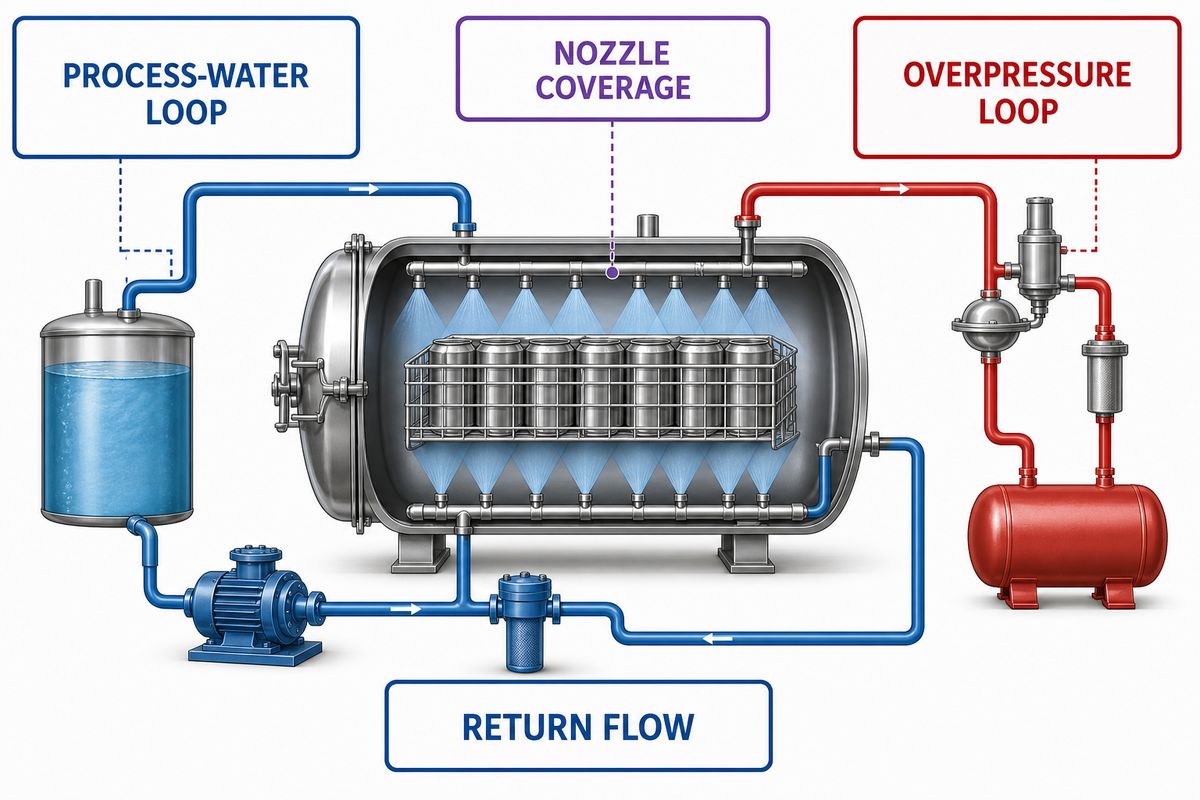
A water-spray retort uses a limited inventory of process water, recirculated by a pump and distributed over the load through nozzles or headers. Heat may enter through direct steam injection or a heat exchanger. A separate compressed-air loop may manage overpressure, so circulation performance and package-pressure protection need distinct tests.
Spray can be a suitable starting candidate for flexible pouches, semi-rigid trays, cups, glass containers, and cans, but the layout is conditional. A flat pouch can block flow to the pack below; a deep tray can create a shadow; a dense basket can alter return flow; and a clogged nozzle can change distribution without changing the chamber display. The failure risk is uneven package coverage because basket geometry controls the flow path.
Inspect nozzle pattern, basket clearance, pump flow, strainer access, heat-exchanger duty, air-valve response, water sanitation, and cooling. Require a qualified distribution report for the intended rack and production load, not an empty chamber or a different container. Avoid “most precise,” “fastest,” or universal ±0.5°C uniformity claims unless the tested configuration supports them.
Water-Immersion Retorts: Thermal Mass, Level, and Flow
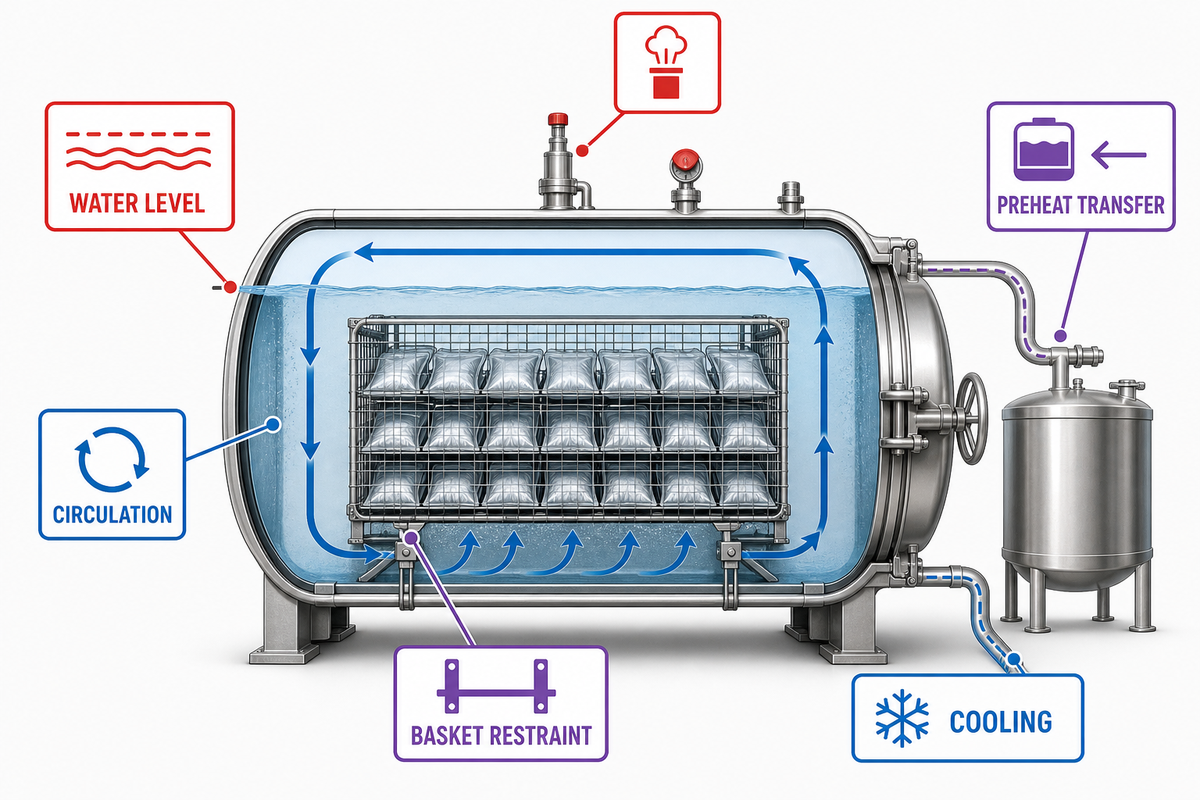
A water-immersion retort places the load fully or substantially in process water, heated in the vessel or transferred from a preheat tank depending on the design. Circulation, water level, overpressure, basket restraint, transfer timing, and cooling determine performance. Immersion can support static or rotary duty, but neither is automatic.
Ask whether the machine fills around a cold load, transfers preheated water, or retains water between cycles. Then require the basis for come-up time, peak steam use, pump flow, tank volume, pressure tracking, and cooling-water demand. The failure risk is stratification or an exposed pack because water level and circulation can vary across the load; a qualified distribution test under production conditions is the evidence. If rotation is proposed for viscous food, prove that the container geometry and headspace create the expected internal movement.
Container-to-Process Compatibility Map
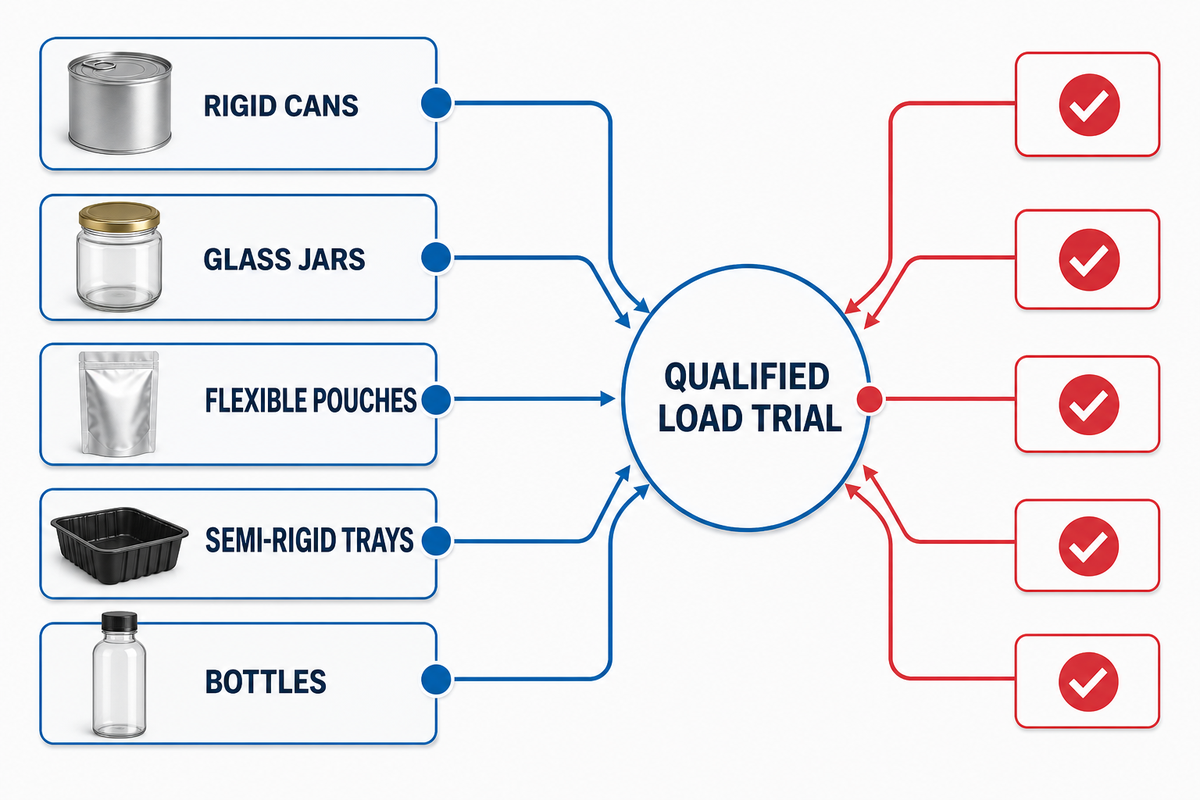
Package material alone does not choose a retort. Closure strength, headspace, trapped gas, wall stiffness, seal design, orientation, support, thermal-shock sensitivity, and internal product motion all matter. Use this map to eliminate weak candidates and define trials. The buyer’s risk is treating a package label as proof; require qualified heat-distribution and heat-penetration work on the actual load.
| Package type / criterion | Main sensitivity | Candidate direction | Trial question |
|---|---|---|---|
| Double-seamed metal can | Seam, vacuum, fill, orientation | Steam is conventional; spray or immersion may also be engineered. | Does the load pattern preserve medium access and the scheduled orientation? |
| Glass jar | Closure vacuum, breakage, thermal shock | Pressure-managed water modes are common candidates; design proof is required. | How are pressure and cooling-water temperature controlled? |
| Flexible pouch | Seal load, headspace, expansion, rack contact | Spray or immersion with validated overpressure and support. | Does pressure tracking protect the seal during heating and cooling? |
| Semi-rigid tray | Lid seal, paneling, nesting, flow shadow | Spray or immersion after rack and coverage trials. | Can medium reach every major surface in the production stack? |
| Plastic cup or bottle | Body deformation, cap/foil seal, headspace | A pressure-controlled water system may be a candidate. | What differential-pressure window can the package tolerate? |
| High-viscosity product | Slow internal convection or conduction | Evaluate motion separately from medium. | Does static or agitated processing improve the cold-point response? |
| Particulate product | Particle size, distribution, and cold location | Any medium must be tested with the real formulation. | Which component controls heat penetration? |
| Low-headspace pack | Limited internal movement during rotation | Static duty may be adequate; motion needs proof. | Will rotation actually move the product rather than the package alone? |
| Multi-SKU basket | Mixed geometry, loading errors, recipe assignment | Use only within a documented process grouping. | Which SKU and location define the worst case? |
| New lightweight package | Seal and wall strength during fast pressure change | Screen overpressure and rack restraint before choosing medium. | What happens at the hardest heating-to-cooling transition? |
Counterintuitive point: A thin package may heat quickly yet be harder to protect during cooling. Product pressure can remain elevated while vessel temperature and pressure fall. Faster heat transfer therefore does not mean easier package control; the cooling pressure profile and seal response deserve their own acceptance trial.
Utilities, Circulation, and Control Tradeoffs
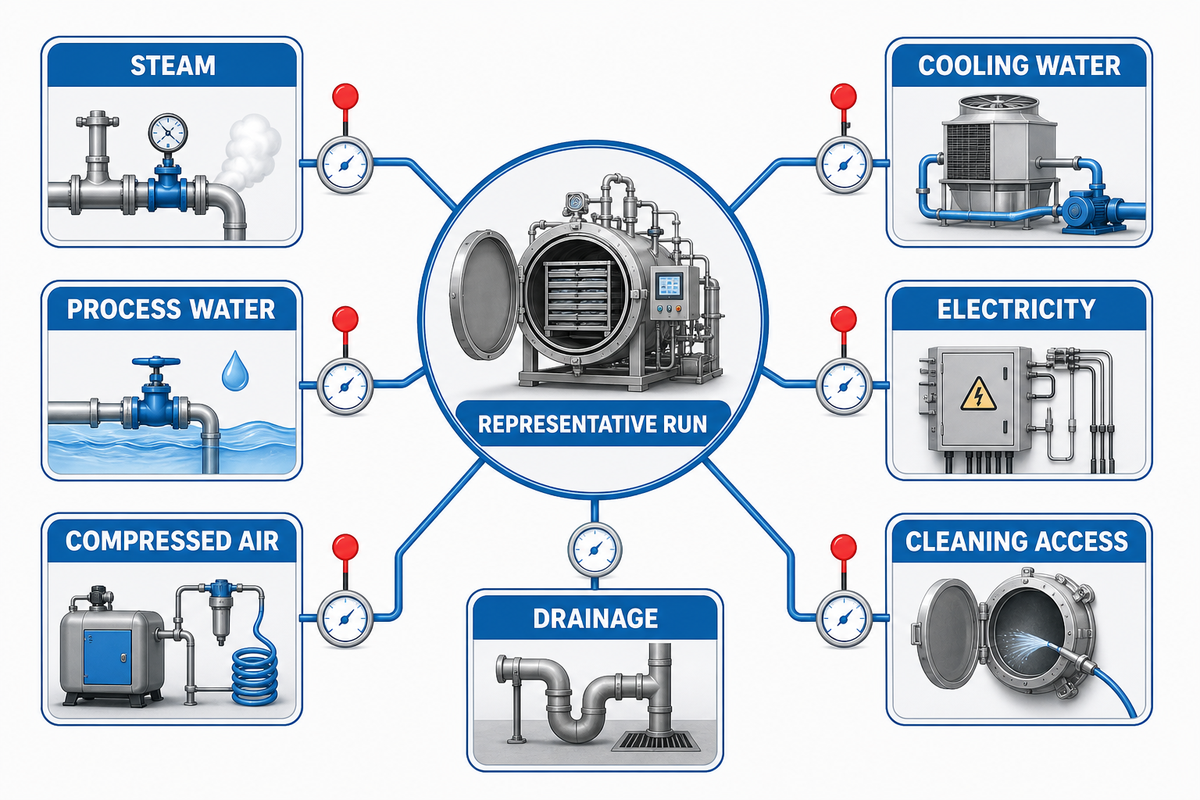
Utility demand follows the complete cycle and machine layout, not the medium name. Steam capacity, condensate handling, process-water inventory, pump duty, compressed-air demand, cooling-water conditions, drainage, electrical supply, and cleaning access should be stated on one basis. A buyer risks undersizing services when brochure averages omit simultaneous demand, so compare peak loads and repeatable production cycles.
Ask vendors to state starting temperature, basket count, fill pattern, come-up definition, hold basis, cooling endpoint, ambient conditions, and concurrent demand. Meter steam, water, air, and electricity during a representative acceptance run. The resulting test report gives procurement a defensible basis for product quality and operating-cost comparison.
Where steam generation is the bottleneck, review the plant-side assumptions in this guide to planning food-plant steam services. The retort request should still identify peak mass flow, pressure, quality, and concurrency rather than naming boiler horsepower alone.
An automated retort can improve repeatability, but manual checks remain part of acceptance. Treat the retort sterilizer as one element of system reliability; efficient operation still depends on maintained utilities, instruments, and records.
6-Input Retort Selection Evidence Screen
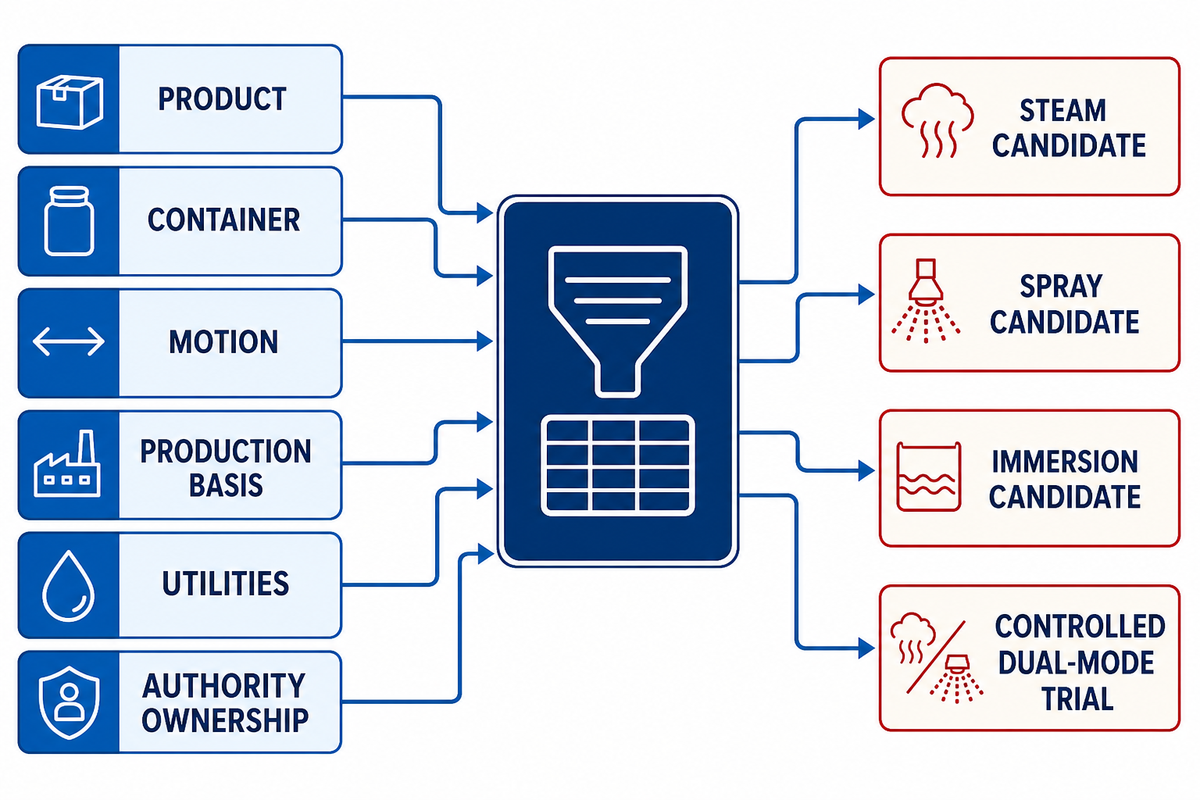
A useful request for quotation needs six evidence groups before a supplier recommends steam, spray, immersion, or a dual-mode trial. These inputs connect the product and package to motion, output, utilities, and validation ownership. Missing one group does more than reduce quotation accuracy; it can hide a process limit or acceptance cost.
- Product and process objective. List formulation families, pH classification, viscosity, particulates, initial temperature, whether the process must extend shelf life, and the destination market.
- Container system. Send drawings, materials, dimensions, fill weight, headspace, closure or seal specification, orientation, dividers, racks, and acceptable deformation limits.
- Motion requirement. State whether the baseline is static and why rotary, rocking, or reciprocating agitation is being considered. Describe the product behaviour that motion is expected to change.
- Production basis. Give packs per basket, baskets per batch, batches per hour, shifts, SKU mix, changeover rules, loading method, unloading system, labour assumptions, and space limits.
- Utilities and environment. Document steam, water, compressed air, electricity, cooling, drainage, sanitation, elevation, ambient conditions, and other machinery that creates concurrent demand.
- Authority and evidence ownership. Name who establishes the scheduled process, performs distribution and penetration studies, approves deviations, trains operators, and signs the final acceptance record.
Once complete, route the project to one of four outcomes: a steam candidate, a spray candidate, an immersion candidate, or a controlled dual-mode trial. If the package pressure window is unknown, do not guess. Obtain package-supplier data and test representative samples before freezing the vessel and control configuration.
Retort Evidence Pack Checklist for Purchase Acceptance
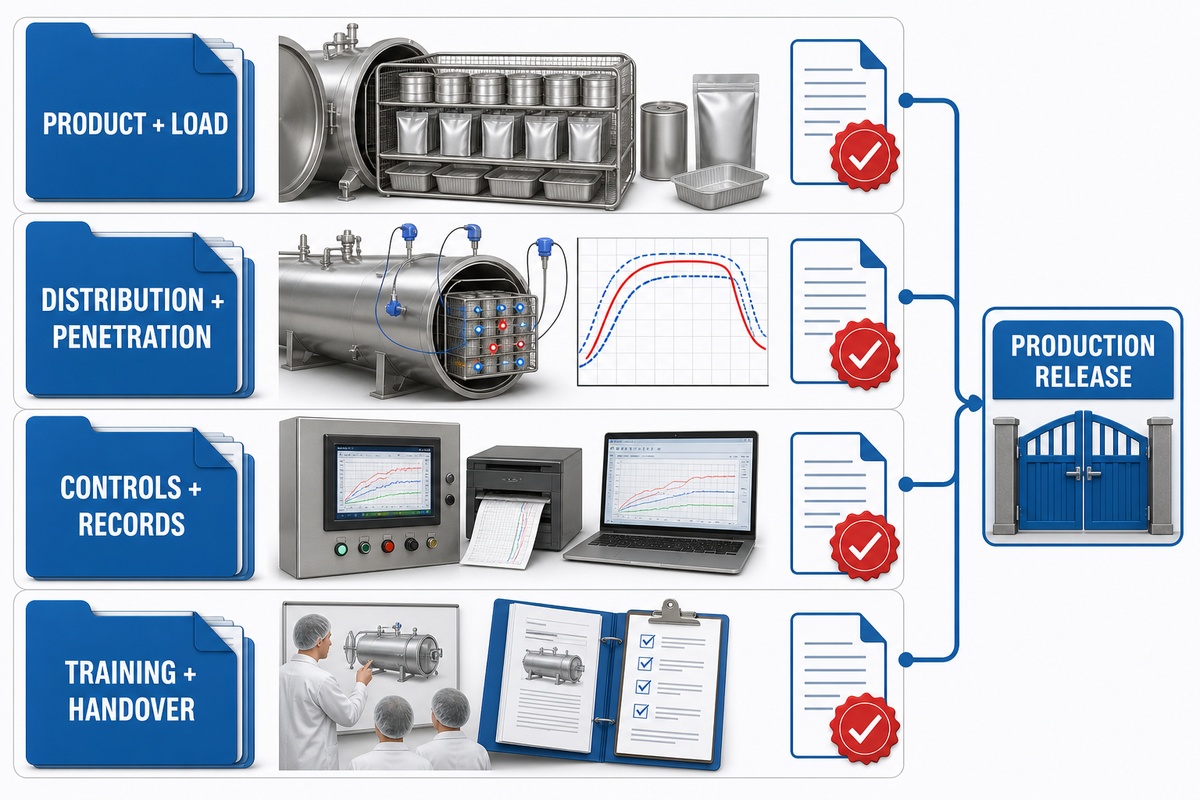
Purchase acceptance should close the gap between a running pressure vessel and a validated production process. Build one evidence pack around the actual product, container, rack, load, recipe, utilities, and control system. It should show repeatability, define critical factors, assign decision ownership, and preserve records operators can use after handover.
Retort Evidence Pack Checklist
- Approved product and container families
- Basket, divider, rack, and load drawings
- Processing-authority scope and scheduled process
- Empty and loaded heat-distribution reports
- Product heat-penetration studies
- Temperature and pressure calibration records
- Recipe version, access, and change control
- Alarm, interlock, and deviation tests
- Peak utility measurements
- Pressure-managed cooling results
- Representative-load repeatability runs
- Changeover and cleaning instructions
- Operator training and competency records
- Preventive maintenance and spare parts
- Document handover and retention rules
For heat distribution, define sensor count and placement from the vessel, load, and processing-authority protocol rather than copying a generic number. For heat penetration, identify the expected slowest-heating product location and the worst package/load condition. Challenge utilities at the agreed peak. Test loss of pump flow, blocked or abnormal circulation, air failure, sensor disagreement, recipe access, and power recovery where applicable.
Do
- Test the representative production load.
- Record peak utility conditions.
- Assign deviation ownership.
Don’t
- Accept an empty-vessel result as load proof.
- Infer package safety from pressure rating.
- Release an uncontrolled recipe.
Automatic controls can manage routine valve actions, but they require access control and readable records. Confirm reference-instrument checks, recorder review, deviation handling, and controller access. The plant’s failure risk is releasing an unverified recipe because an automated cycle appeared normal; qualified acceptance tests and reviewed records are the evidence, not a generic high-temperature sterilization claim.
For large-scale sterilization of food, do not assume a linear scale-up; change settings only after the supplier’s processing capabilities have been proven on the actual load. Do not maximize batch output before the scheduled process addresses bacteria control across the intended product range and various packaging formats.
Frequently Asked Questions
Which retort machine type is best for flexible pouches?
Water-spray and water-immersion systems are common starting candidates because both can apply controlled overpressure, but neither is automatically safe for every flexible pouch design and product.
Film structure, seal strength, fill ratio, headspace, rack support, orientation, product viscosity, motion, and cooling pressure have to be evaluated together. Test representative packs at the intended load density, then use heat-distribution and heat-penetration results to confirm the machine configuration and scheduled process before commercial production and safe release begin.
How do heating medium and overpressure differ in a retort?
Heating medium transfers thermal energy to the package, while overpressure supports the package by controlling vessel pressure independently when package construction and cooling conditions require it.
Steam, sprayed water, or immersion water describes the primary heat-transfer path at the package surface. Overpressure is a separate control function commonly created with compressed air or another validated pressure method. Specify both items independently, then test heating, cooling, pressure tracking, package deformation, and seal integrity with the intended product, container, rack, and load.
Does water immersion always run faster than steam?
No. Water immersion does not always run faster because total cycle time depends on the product, container, load, agitation, come-up, scheduled hold, and cooling limits.
Immersion offers a substantial circulating thermal mass, while direct steam offers condensation heat transfer. Matched trials must use the real formulation, fill weight, starting temperature, package, basket, loading density, motion, process endpoint, and cooling endpoint. Review come-up, scheduled hold, pressure profile, cooling duration, and repeatability before declaring either cycle shorter. A heating-medium label alone can’t establish output.
Can a retort sterilize any shelf-stable food?
No retort is automatically suitable for every shelf-stable food; commercial processing conditions must be established for the specific formulation, package, load, equipment, and operating limits.
Acidity, particle size, viscosity, closure, and cold-point behaviour affect the process. Rated temperature alone doesn’t approve a food.
What should a buyer send before requesting a quotation?
Send six input groups: product, container, motion, production basis, utilities, and validation ownership, together with the destination market, representative samples, and a written proposed acceptance protocol.
Include formulation families, container drawings, materials, fill weight, closure, headspace, orientation, and acceptable deformation. State packs per basket, baskets per batch, batches per hour, shifts, SKU mix, loading and unloading assumptions, and changeover rules. List available steam, water, air, electrical, cooling, and drainage conditions. Name the supplier, processing authority, package specialist, and plant owner responsible for each trial, record, deviation, and final acceptance decision before the machine configuration is frozen.
About Taiguo Boiler
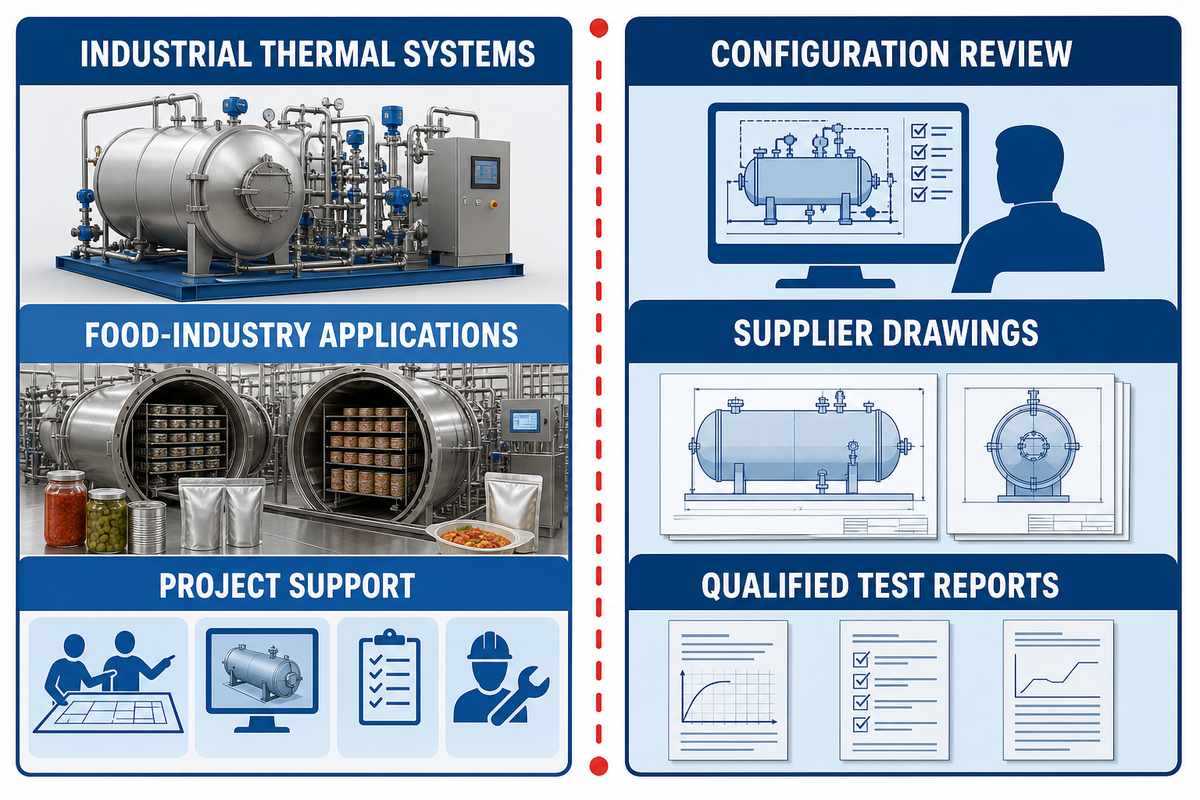
Taiguo states that it has manufactured industrial thermal systems since 1976, serves food-industry applications, and supports projects from consultation through after-sales service. Those company facts do not establish a retort-specific result for your product. The buyer’s risk is mistaking company history for application proof, so use the six-input evidence screen to require a bounded configuration review, supplier drawings, and qualified test reports before acceptance.
Prepare a Retort Configuration Review
Bring your product family, container drawing, motion requirement, production basis, utilities, and validation ownership. Taiguo can then discuss an equipment direction without treating a generic machine label as a finished process.
Related Articles
- Plan pouch-cycle pressure, lethality, and validation
- Compare commercial vessel configurations and quotation inputs
- Plan food-plant steam utilities and peak demand
References & Sources
- Electronic Code of Federal Regulations, 21 CFR Part 113
- 21 CFR 113.40, Equipment and procedures
- Canadian Food Inspection Agency, Commercial sterilization of low-acid food in hermetically sealed containers
- Peer-reviewed review of thermal processing and retort heating methods, PubMed Central
- Institute of Food Technologists, Retort pouches and trays
Prepared by DD from the cited regulatory, government, peer-reviewed, and professional sources. The final scheduled process must be established for the specific product, container, equipment, and operating conditions.