Get in Touch with Taiguo

Industrial Electric Boiler: Complete 2026 Buyer’s Guide

Contents
show
The most reliable sources to design industrial boiler replacement By the Taiguo Engineering Team – Taiguo builds industrial electric steam boilers from 36 kW to 1400 kW, all compliant with the ASME B&PVC Code. This guide is the result of our many years of industrial engineering e×perience and readily available industry information.
You are commissioning a pharmaceutical cleanroom boiler, an industrial food grade steam line, or planning to decarborize your process with steam. Permitting the gas pipeline infrastructure to your site either proves prohibitorily e×pensive, it’s simply disallowed on property, or there’s no such infrastructure readily available.
What Is an Industrial Electric Boiler — and How Does It Work?
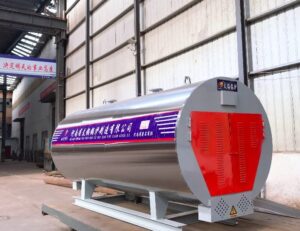
Industrial electric boilers are machines that directly transform an input of electricity into either saturated steam or hot water, and do so without combustion, a chimney, and absolutely no requirements for natural gas supply. Boiler operating principals are rather straightforward; an electrical supply feeds the resistance-type Heating Elements inside the boiler, and Electricity flow thru Water the Electrodes inside the pressure chamber to produce hot water to eventually Steam.
- Electrical Input Electricity supplies resistance elements or electrodes inside a pressure vessel
- Resistance Elements / Electrodes Heatingelements provide heat thru resistance when electricity passes thru them; Water conducts electricity that powers boiler electrodes.
- Generate steam: Water reaches boiling point and converts to saturated steam at the set operating pressure.
- Steam Output The boiler then regulates the discharge pressure thru its outlet valve.
Electric steam boilers that produce steam for process, cleaning, or sterilization in excess of 15 psig are “power boilers,” as defined under Section I of the ASME Boiler and Pressure Vessel Code (B&PVC). ASME recognizes two basic types: those employing immersion resistance elements (PEB-2.4) and those utilizing electrodes to conduct current through the water itself (PEB-5).
While functionally similar, their fundamental differences dictate requirements for water quality and construction throughout the unit’s life cycle.
Industrial Electric Boiler: Quick Specifications
| Parameter | Typical Range |
|---|---|
| Capacity | 3 kW – 50 MW+ |
| Steam pressure | Up to 24 bar (348 psi) |
| Thermal efficiency | 98–100% |
| Standard | ASME B&PVC Section I (steam >15 psig) |
| Electrical supply | 208V–600V (immersion) / 4.16 kV–25 kV (electrode) |
| On-site emissions | Zero |
The 98 to 100% thermal efficiency characteristic of all electric boilers provides a key technical and environmental advantage. Since they lack an exhaust stack and burning the fuel, virtually every bit of electrical input is converted into useful heat.
In contrast, standard gas-fired boilers run at 80–85% thermal efficiency. For organizations sourcing power from renewable sources, the entire equation becomes carbon-free.
However, there’s one thing they can’t do: if your industrial electricity rates consistently exceed $0.12 per kWh, electric boilers generally cannot match the raw fuel costs of natural gas.
The comparison below explains the trade off.
Types of Industrial Electric Boilers: Immersion Element vs. Electrode
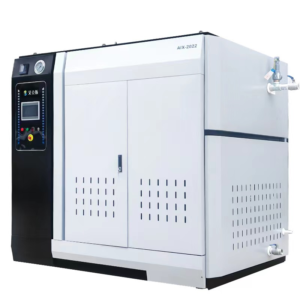
Although both types of boilers may be referred to as “industrial electric boilers,” they employ entirely different heating technologies. Choosing between them depends on four key inputs: your required capacity, available electrical service, water treatment capability, and required startup speed.
Immersion-Element Steam Boilers
Immersion-Resistance Electric Boilers The immersion-resistance design, as the name implies, features electrically heated elements submersed within the insulated water and steam vessel. These are ASME-coded pressure vessels offered as skid-mounted packaged units, with capacities from 3 kW up to approximately 2,250 kW.
The LDR series electric steam boiler is a true example of the immersion-element boiler — the most widely deployed design type on facilities that require less than 1 MW of clean, reliable steam. The total warm-up time from cold is around 10-15 minutes, and the output can be cycled up or down by cycling banks of elements ON/OFF by using a plc-based sequencing system. This boiler is the right selection in applications that require precise temperature control within a specific range.
Electrode-Type Steam Boilers
Instead of a heating element, the electrode boiler relies on the water itself being the medium that converts the electricity to steam. The alternating electric current is applied to a pair of or an array of submerged electrodes that pass the current directly through the water in the boiler.
That type of technology requires stringent quality standards. An ASME PEB 5.3 requirement limiting the overall conductance to less than 1 microSiemen per cm (less than 1 S/cm), and the specific resistivity to more than 1 megohm-cm (as with stainless-steel electrode assemblies), ensures that a deionized water supply becomes necessary equipment when selecting this design.
The WDR series electric steam boiler covers mid-range electrode-type applications. An industrial electrode boiler can be as large as 50 MW in a single package, and manufacturers like Cleaver-Brooks, PARAT Halvorsen and others may produce 50 MW-range industrial electrode boilers that operate at as high as 25 kV.
It should be noted, in contradiction of popular notions, that electrode boilers are not only a big technology. The industrial electrode segment in 24-60 kW accounts for about 38% of the installed boiler base in 2025 making them a commercially available and economical option below 1 MW.
| Feature | Immersion Element | Electrode |
|---|---|---|
| Capacity range | 3 kW – 2,250 kW | 24 kW – 50 MW+ |
| Startup time | 10–15 min | <30 seconds |
| Electrical supply | 208V–600V | 4.16 kV–25 kV |
| Water treatment | Standard softened water | Deionized (≤1 µS/cm) |
| Maintenance item | Element replacement (5–7 yr) | Minimal; no elements |
| Best fit (capacity) | <1 MW | >500 kW; process steam, power-to-heat |
| Equipment cost | Lower per kW | Higher per kW; offset by reduced maintenance |
How Does an Electrode Boiler Work?
An alternating electric current flows between two submerged electrodes, or multiple electrode assemblies, in an electric boiler; the ionic current conducted by the water generates heat as a result of the water’s resistance to flow; no intermediate element needs to be heated or replaced in order to transfer that energy.
The absence of elements translates into a unit with no element wear, no scale buildup on elements, and no element replacements being scheduled into the maintenance schedule, making electrode boilers the best choice for demanding process steam systems that expect long periods of high-load operation. For a full comparison of boiler technologies, see types of industrial boilers →
Capacity and Sizing: Calculating the Right kW for Your Process
Your electric boiler should be selected based on your load which would be expressed as lb/h, kg/h, etc. A good working formula for selection of a saturated steam boiler at roughly atmospheric pressure, 0 psig (0 bar), or approximately 100 C. is:
kWrequired = steam demand (kg/h) × 0.641
The result should include the selection plus a 10% buffer for load cycling, pipeline heat loss, cold startup loss, etc:
kWrequired = steam demand (kg/h) × 0.70
Note: For saturated steam boilers at 0 psig, we are selecting the 100 C condition. If you plan on operating with steam pressure, you would need to select for total heat content using the specific enthalpy of vaporization corresponding to the desired steam pressure. You would then need to use the boiler selection calculation procedure.
| Steam demand (kg/h) | Base kW (×0.641) | With 10% safety factor (×0.70) | Boiler size to specify |
|---|---|---|---|
| 50 kg/h | 32 kW | 35 kW | 36 kW packaged unit |
| 100 kg/h | 64 kW | 70 kW | 72 kW |
| 250 kg/h | 160 kW | 177 kW | 180 kW |
| 500 kg/h | 320 kW | 354 kW | 360 kW |
| 1,000 kg/h | 641 kW | 705 kW | 720 kW |
| 2,500 kg/h | 1,603 kW | 1,763 kW | 1,800 kW / electrode type |
Boiler design for pressure vessels with steam above 15 psig must comply with ASME Section I, as well as hydrostatic testing and code stamping. Use the industrial boiler sizing calculator for automated output based on your steam pressure and temperature inputs.
How Are Electric Boilers Sized?
Electric boiler sizing depends on three input requirements: (1) The maximum steam needed per hour (kg/hr) in your process’s most challenging condition; (2) The boiler’s operating pressure in psig or bar; and (3) the pattern of startup, shutdown and load variation. Use the kW = kg/hr 0.641 equation for the boiler base load, then increase the figure by 10 to 20 percent, based on your system’s average heat losses and anticipated load spikes.
To efficiently supply a continuous industrial process over 500 kW, an PLC-modulated electrode boiler avoids the oversized inefficiency of fixed-element boilers which cycle on and off more frequently than needed. Properly sized multi-element immersion, or electrode boiler with modulation system delivers ±2C control accuracy needed in the sterile processing (SIP/CIP) required for pharmaceutical, and some food production applications. Secondary inputs (system piping, pumps, and valves for the condensate loop) impact steam loop pressure stability, not the total kW rating of the boiler itself.
Industrial Applications: Where Electric Boilers Outperform Gas and Biomass
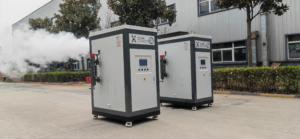
But some applications simply weren’t meant for steam boiler generation via combustion. Electric steam boilers often dominate total cost-of-ownership, compliance, or other criteria in the following industries.
Food and Beverage Processing. Industrial culinary-steam applications require 100 percent clean steam, without combusted byproducts-no additional steam filters or scrubbers are needed. An example, which used private investment of $22.4 million and ran as a DOE demonstration facility in the northeastern U.S. starting Jan. 10, 2024, at Kimberly-Clark, effectively converted a gas-fired boiler to an electric unit to provide “all culinary steam” to commercial scale. The result was a 77% reduction in the process carbon intensity for steam generation.
Pharmaceutical Manufacturing. Strictly regulated by the FDA and GMP, sterile processes require pure WFI (Water For Injection), or similarly purified steam for applications such as cleanroom autoclave sterilization.Electric boilers have a distinct advantage in eliminating any potential contamination risk associated with boiler water from burner fuel-side contamination,and simplified validation records can be achieved. Flue gas from a burner and stack pipe not being present can also decrease required footprints for equipment housed in spaces adjacent to cleanrooms.
Chemical and Textile Plants. Tight control of process-steam temperatures and pressures, achievable through PLC-modulated immersed-element technology, are critical in chemical process or textile applications where any variance in the input could cause defect in end product quality. By replacing gas or oil, the risk of an explosion or the presence of any risk related to a pilot flame will be eliminated in the hazardous environments common in chemical plants.
The Ultimate in Electric Steam – Alumina Refining.Hydro Alunorte-the world’s single largest refinery for alumina-now uses electric steam boilers that can provide 270 tons of steam per hour, replacing two coal-fired boiler plants. They estimate total yearly reductions of 550,000 tons of co emissions. This system (including a long-term, renewable energy supply agreement) went online on January 6, 2025, after the largest investment to date in an electric steam application: NOK 580 million. This success demonstrates that commercially viable electric steam is now possible at scale-as long as clean energy supplies are secured with a long-term energy purchase agreement.
“It’s an important milestone for the operation. Alunorte is already among the most energy-efficient refineries and this initiative takes us even further in our decarbonization efforts.”
Electric boilers also serve commercial and industrial hydronic heating systems in buildings — governed under ASME Section IV (heating boilers, low pressure) rather than the Section I power boilers covered in this guide. For non-steam electric heating applications, see our industrial electric heating systems guide →
Electric Boiler vs. Gas Boiler: An Honest Comparison for Industrial Buyers
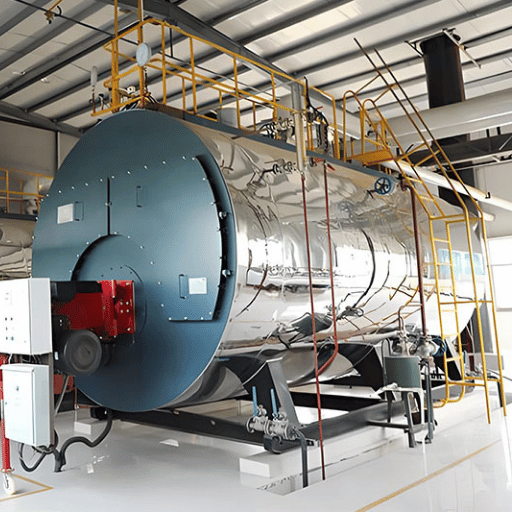
So what are the answers everyone in Procurement needs Finance and operations to agree with the data?
Below the cases in order that go to Gas:
Advantages of Industrial Electric Boilers
- 0 onsite emissions, Co, NO or particulates produced at the source. Helpful for emission regulations, carbon footprint reporting, ESG procurement.
- 98-100% thermal efficiency means you will achieve boiler energy output. Most gas boilers achieve between 80% and 85% (traditional gas boilers).
- Reduced maintenance expenses – no burner maintenance, no heat exchanger fouling or no need for flue inspection on an annual basis. Typical industrial maintenance costs $3,000 – $5,000 / year for electric versus $8,000 – $12,000 / year for gas.
- Quick start-up: Electrode boilers start from standby to full duty in less than 30 seconds, ensuring prompt and timely provision of process steam for jobs with a time-of-day schedule, or power-to-heat.
- Zero fossil fuel infrastructure – not a gas main, not a pressure reduction station, not an air for combustion supply and not an on-site fuel tank like that of an oil powered system.
Where Gas-Fired Boilers Win
- Fuel raw cost: industrial power costs about $15/MMBtu nation-wide (US, 2024, DOE) vs about $5-7/MMBtu for natural gas. The 2-3x cost-difference is the biggest factor that large industrial facilities can’t avoid gas-fired steam boilers.
- Lower capital cost: Similar gas systems cost roughly 40% less upfront than equivalent electric systems. For a 5 MW system, the installed electric cost exceeds $700,000 versus approximately $420,000 for a comparable gas installation.
- Grid availability – Boilers running on electric power have a complete dependence on the grid being up and running.- Last year, Texas and California saw over 30 industrial operations shut down by grid outages.- gas powered boilers aren’t impacted by grid issues.
What Are the Disadvantages of Electric Boilers?
The four main disadvantages are: (1) Electricity operating cost — in North America and parts of Asia, industrial electricity runs 2–3x more per unit energy than natural gas; (2) Grid dependency — unlike gas boilers, electric steam generators are fully dependent on grid stability and voltage; (3) Higher capital cost — an installed 5 MW electric steam boiler system exceeds $700,000 versus approximately $420,000 for a comparable gas unit; (4) Electrode-specific infrastructure — electrode boilers require 4.16–25 kV high-voltage grid service, which may not be available on-site and can add 20–25% to the project budget in transformer and switchgear upgrades.
The 3-Question Electric vs. Gas Boiler Selection Framework
| Question | If YES → | Guidance |
|---|---|---|
| Q1: Is zero on-site emission a compliance requirement or firm CSR commitment? | Electric wins this criterion | Gas cannot meet zero on-site emission; proceed with electric specification |
| Q2: Is your facility’s electricity tariff consistently below $0.10/kWh? | Electric TCO is competitive | Verify 10-year TCO at your specific tariff using maintenance savings and carbon costs |
| Q3: Do you need <200 kW with fast startup and minimal infrastructure? | Immersion-element electric is ideal | Size an immersion-element packaged unit; standard 400V supply, no water treatment required |
If the answer to all three questions was NO – gas likely wins on TCO 5 year – BUT… check the 20 year and regulated market impacts of carbon tax, and the differential in running costs.
Electric reaches price-parity when the price of electricity is 2:1 that of natural gas as per an published break-even for an EPCB Boiler (April 2026). Currently, a significant portion of the natural gas industrial tariffs in the US and Asia have prices which are greater than or equal to 3x their gas price (with gas operating costs being lower). A detailed 20-Year Total Cost of Ownership (TCO) for a 500 kg/h industrial boiler (Giconmes, March 2025) shows electric: €660K–€850K and gas: €920K–€1,300K.
This difference comes mainly from maintenance cost reduction of electric compared to gas (60k-180k) and a reduction in compliance costs related to CO2.
You can find a full gas vs. oil comparison here – gas vs oil boiler comparison . Alternative thermal oil system options are discussed thermal oil boilers . Other types of alternative boiler types include; biomass boilers.
What Does an Industrial Electric Boiler Cost? (CAPEX, OPEX, and 10-Year TCO)
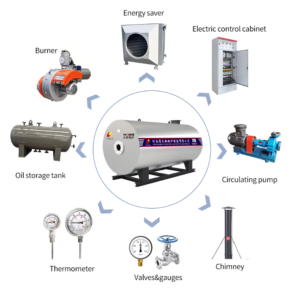
Although no manufacturer would provide a public list price for an industrial electric boiler (as pricing can be specific to the project itself), market figures for the year 2024/25 provide helpful guidelines:
| Capacity band | Estimated equipment cost | Typical application |
|---|---|---|
| <50 kW | $3,000–$8,000 | Lab, light commercial, small process |
| 50–200 kW | $15,000–$50,000 | Small industrial, pharmaceutical, food |
| 200 kW–2 MW | $50,000–$250,000 | Mid-range process steam, commercial industrial |
| >2 MW (5 MW example) | >$700,000 installed | Large process, power-to-heat, electrode type |
5 MW’s installed figure of>$700,000 comes out to a little over $140/kW installed – and that figure includes grid support improvements, which usually run to 20-25% of the project cost – e.g., a dedicated transformer, high voltage cables, switches and an upgraded electrical panel. Strictly looking at hardware alone, the capital disparity over a similar scale gas-fired boiler stands around 40%. For the transformer portion of an electrical-infrastructure enquiry, power and distribution transformers from Toplit should be matched to the project's actual load and supply specification; the figures above are not a transformer quotation.
Use the boiler operating cost calculator to model your specific electricity tariff and operating hours. Or request a quote with your capacity and pressure requirements.
10-Year Operating Cost Snapshot
For a 200 k W boiler 4,000 hours per annum:
- At $0.08/kWh: annual electricity = $64,000 (10-yr: $640,000)
- At $0.12/kWh: annual electricity = $96,000 (10-yr: $960,000)
- Annual maintenance: electric $3,000–$5,000 vs. gas $9,000–$11,000 → saves $40,000–$80,000 over 10 years
Maintenance Schedule Overview
Although electric boiler needs far more less maintenance compared to combustion boilers, but to follow ASME code, regular inspection is required :
- Weekly: testing for water quality (electrode furnaces conductance must be 1 S/cm, is the measurement of water quality)
- Annual Check: Immersion heater integrity; pressure relief valve; calibrating controls and safety interlocks
- Element Replacement(Immersion Type)Every 5 – 7 years element life depends on water quality
- As required by jurisdiction: ASME inspection, hydrostatic pressure test
Available Government Incentives
Many markets also partially offset the capital costs. In 2024, the rebates represent up to 35% of the CAPEX (in 22+ countries):
- Germany: €120 million industrial electrification program
- US DOE: $180 million on 85 industrial clean heat demonstrations (2024-2025)
- UK: British Industrial Competitiveness Scheme – Electricity cost reduction of 40 / MWh (from 2027)
Installation Requirements and Grid Infrastructure

Installing the electric boiler crosses paths between ASME pressure vessel code in the mechanical world and the National Electrical Code (NEC) power side. If either side falls out of code then your installation will have delays getting permit approval, cause an inspection fail and in worst case scenarios, rework after installation.
Pressure Vessel Compliance (ASME B&PVC)
- I – Power Boilers. This applies to all of the electric steam generating boilers operating in a capacity over 15 psig. The unit requires an ASME Section I code stamp on the boiler drum.
- PEB-2.4: Construction rules for immersion-resistance element boilers (element type, vessel design, pressure ratings)
- PEB-5.3: Material requirements for electrode boiling-tubes (austenitic grade Types 304, 304L, 316, 316L and 347) and water purity (max. cond.1 S/cm).
- Section IV: regulates for heating boilers under 15 psi (hot and low-pressure steam hot water).
Electric Heating Equipment Compliance (NEC)
- NEC Article 424: Fixed electric heating equipment – electric boilers and similar uses – electrical, circuit sizes and protection.
- NEC 2017 Part IX: Electric Boilers for Industrial Processes – This part covers industrial process heating by electric resistance or electrode technology.
- NEC Article 430: Motors and Controllers – Includes requirements for the protection of motor circuits, in this case, the feed pump, condensate return pump, and auxiliary motor load in the steam system.
Pre-Installation Infrastructure Checklist
Confirm your facility and electrical engineering teams are aligned on the following before issuing an electric boiler specification:
- Electrical service capacity: Standard 4-in immersion heating element style boilers require three-phase, 208V-600V. Electrode style boilers require dedicated, three-phase high voltage of 4.16 kV – 25 kV.
- Transformer requirement and sizing: Projects above 200 kW often require a custom, dedicated transformer; factor 20-25% of project total cost for project infrastructure (transformer, switchgear, wiring).
- Panel and feeder sizing: Per NEC Article 424, circuits serving any heating equipment should be sized not to exceed 125 percent of the continuous load when serving as a source to overcurrent devices.
- Water treatment needs: Electrode boilers must operate on 1 S/cm conductance- or deionized water supply; this generally requires a dedicated RO/DI or demineralization unit to process raw water.
- Valve and pressure relief selection: ASME code pressure relief valve size, steam outlet isolating valve specification, and feedwater control valve selection will be addressed.
- Permitting and interconnection delays: Large-scale (>1 MW) electrode steam solutions require 4-6 months for utility electrical service interconnection approval and electrical permitting; plan far in advance for capital projects.
- ASME inspection scheduling: For Section 1, code-stamp compliant boilers, your jurisdiction’s authorized inspection agency should be consulted and informed during project construction as their access is needed during hydrostatic testing and at certain construction milestones.
For project-specific infrastructure guidance, contact the Taiguo engineering team. For full product specifications, see the industrial electric boiler product range →
The $19.8 Billion Shift: Industrial Electrification Trends Through 2035
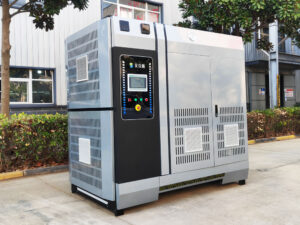
The industrial electric steam boiler market is not just experiencing incremental growth; it is poised for exponential expansion driven by converging policy trends, renewable energy economics, and major capital investment initiatives.
$9.4BGlobal market 2025
$19.8BForecast 2034
8.6%CAGR (2026–2034)
9.9%Electrode segment CAGR
Global market size estimates by Straits Research (November 2025) project the industrial electric steam boiler market to reach $9.4 billion in 2025 and nearly double to $19.8 billion by 2034 at an 8.6% compounded annual growth rate (CAGR). The electrode boiler segment leads at a 9.9% CAGR, with the process steam applications market leading the growth at 10.5% CAGR over 2026-2034.
Three structural forces drive this growth:
- Decarbonization policy drivers: Climate policies such as the EU’s Fit for 55 initiative and corresponding mandates in North America are increasingly forcing industrial heat producers to move away from fossil fuels. Even modest carbon taxes can add $5,000-$10,000 per year to a natural gas boiler’s operating expenses, dramatically changing the 10-year total cost of ownership in regulated markets. This shift often makes electric boiler solutions cost-competitive, even against higher electricity tariff rates.
- Renewable integration flexibility: As wind and solar power generation grows, creating surplus electricity during off-peak hours, large industrial electrode boilers function as the ideal, flexible absorbers for this curtailed renewable energy. These boilers efficiently convert excess electricity into stored thermal energy or directly into usable process steam, a “power-to-heat” approach that eliminates grid operators’ costs and revenue loss associated with managing this excess generation.
- Proven large-scale deployments. In March 2025, PARAT Halvorsen delivered three 50 MW electrode hot water boilers to Vattenfall’s Netherlands operations – a 150 MW combined power-to-heat installation demonstrating the technology at utility scale. At the process steam scale, Hydro Alunorte’s January 2025 commissioning of 270 t/hr of electric steam capacity (NOK 580 million investment) delivered up to 550,000 tonnes of annual CO2 reduction in alumina refining.
These are not pilot projects. They are the operational baseline for the capital planning cycle that runs through 2035.
The U.S. government has committed $180 million across 85 industrial clean heat demonstration projects (DOE, 2024-2025), with the 23,100 commercial and industrial boilers in the 2.5-50 MMBtu/h range representing the near-term conversion target. For facilities already operating in regulated markets, the financial case for electric boiler conversion strengthens with each annual carbon price increase.
See also: thermal oil boiler guide → | gas-fired boiler guide →
Frequently Asked Questions
Q: Why are electric boilers not commonly used in heavy industry?
View Answer
Three factors limit adoption in heavy industrial settings: (1) electricity cost – industrial electricity costs 2-3x more per unit energy than natural gas at most global tariff rates, which matters enormously at the multi-MW scale of a steelworks or cement plant; (2) grid capacity constraints – facilities requiring sustained 10-50 MW steam loads often find that available grid capacity at the industrial site is insufficient or requires prohibitively expensive infrastructure upgrades; and (3) capital cost premium – large electrode installations cost approximately 40% more than comparable gas infrastructure. In sectors where carbon compliance is mandated and renewable power contracts are available – alumina refining, food production, pharmaceuticals – electric adoption is accelerating rapidly.
Q: How does an industrial electric boiler work?
View Answer
An industrial electric boiler converts electrical energy directly to steam via either immersion heating elements (which resistively heat the water) or electrode current (where current passes through the water itself). There is no combustion, no flue, and no fossil fuel supply required. Thermal efficiency runs 98-100%, compared with 80-85% for standard gas-fired boilers. For steam generation above 15 psig, ASME B&PV Section I governs construction and pressure certification.
Q: How much does a large industrial boiler cost?
View Answer
A 5 MW industrial electric steam boiler system with installation exceeds $700,000 based on 2024 market data – approximately $140/kW installed. Grid infrastructure (transformer, switchgear, high-voltage cabling) accounts for 20-25% of that project budget. A comparable gas-fired installation costs approximately 40% less in capital. However, electric boilers have significantly lower maintenance costs ($3,000-$5,000/year vs. $9,000-$11,000/year for gas), which partially offsets the capital premium over a 10-year operating period.
Q: What are the disadvantages of electric boilers?
View Answer
The four main disadvantages: (1) High electricity operating cost – 2-3x more expensive per MMBtu than natural gas in most markets. (2) Full grid dependency – no independent operation during outages. (3) Higher capital cost – approximately 40% more than gas-fired equivalents at comparable output. (4) Water treatment requirement – electrode boilers specifically require deionized water (1 S/cm), which adds infrastructure cost and ongoing water quality management.
Q: How are electric boilers sized?
View Answer
To estimate the size of the steam generation needed, the formula to use is: kW = steam demand (kg/h) × 0.641, to which 10% should be added to cover system heat losses in pipework and initial startup demand. For pressures higher than atmospheric steam (saturated), the enthalpy (heat value) of vaporization rises and is quoted in steam tables at each operating pressure. If the system is for a continuous industrial process and is larger than 500 kW, the boiler would typically include the ability to modulate its output either by having PLC controlled element switching or immersion depth control, to compensate for and avoid the inefficiency of an oversize boiler that runs at part load. Use the sizing calculator for automatic output calculation.
Q: Why would a company use an electric boiler instead of gas?
View Answer
Why choose to make the transition?There are 5 key drivers:1) No on-site emissions: critical for corporate sustainability pledges, LEEDS certification, or areas with fuel combustion restrictions.2) Significantly lower maintenance cost: With no burners and therefore no risk of flue-fouling or associated inspection costs, there’s very little maintenance required.3) Eliminate gas infrastructure: No need for gas connection or gas pressure reduction stations and no need for a combustion air supply or its associated ancillaries.4) Renewable energy integration: The electricity powering the unit can come from renewable tariffs or on-site solar/wind, generating carbon-neutral steam at point of use.5) Quick Start-up: Electrode boiler fired steam can be available in under 30 seconds from cold, enabling an on-demand system.This also enables for “power to heat” strategies and is ideal for batch or non-continuous process industries.