Get in Touch with Taiguo


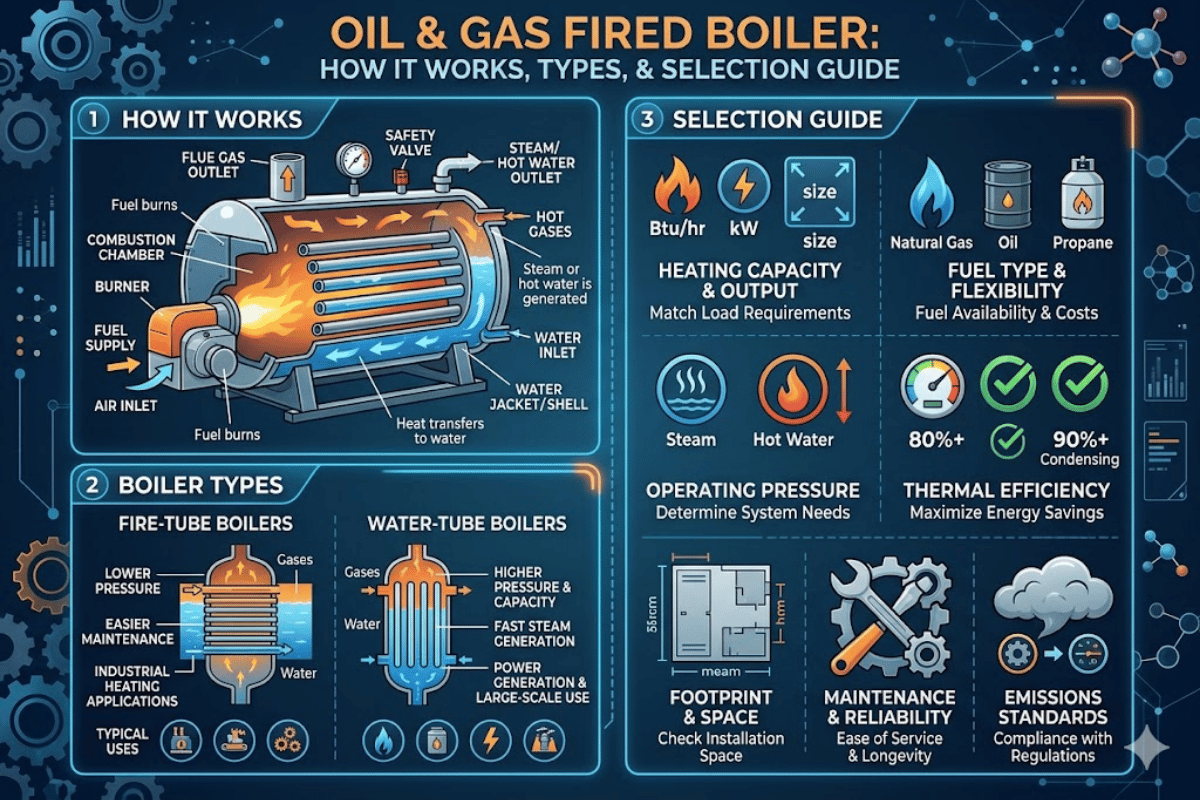
An oil and gas fired boiler is a mechanical device used to transform the chemical energy of liquid or gaseous fuels into usable thermal energy – flowing out of the boiler in the form of steam or hot water to power industrial processes in hundreds of applications, from food manufacturing to textile dyeing to chemical processing. If your plant uses natural gas, diesel, heavy fuel oil or both, having a solid understanding of the function, available types and selection criteria of oil and gas fired boilers directly impacts operating cost, plant availability and legal compliance.
Quick Specs: Oil and Gas Fired Boilers
| Fuel Types | Natural gas, LPG, diesel, heavy fuel oil, dual-fuel |
| Capacity Range | 0.5–130 t/h (steam) or 0.35–116 MW (hot water) |
| Working Pressure | 0.7–3.82 MPa (design pressure varies by model) |
| Thermal Efficiency | 85–98% (non-condensing 85–92%, condensing up to 98%) |
| Applicable Standards | ASME BPVC, EN 12953/12952, IBR, GB/T 16508 |
| Common Applications | Food & beverage, textile, chemical, pharmaceutical, paper & pulp, building materials |
What Is an Oil and Gas Fired Boiler?
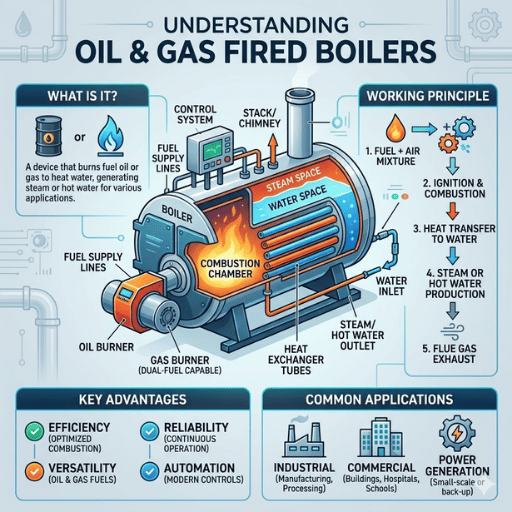
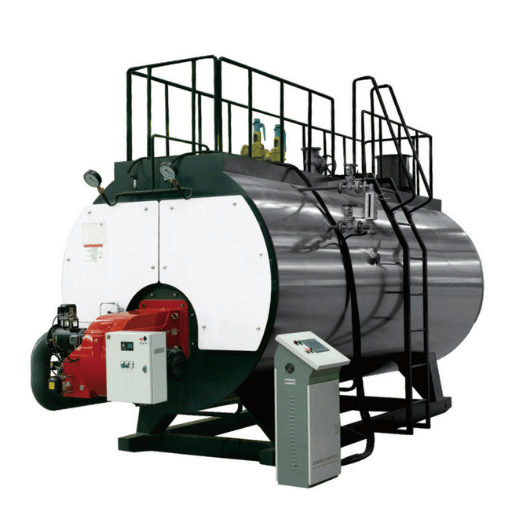
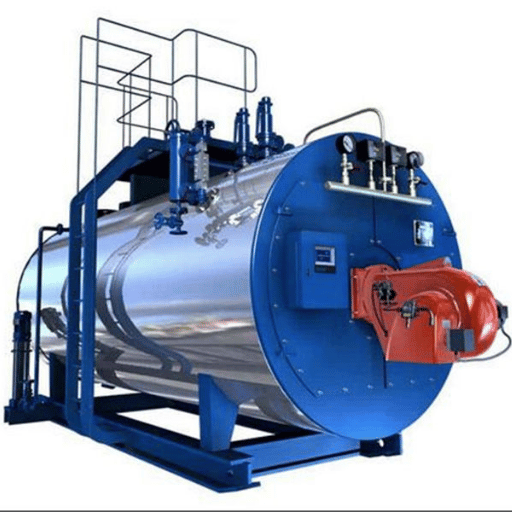
An oil and gas fired boiler is a pressure vessel used to burn liquid petroleum fuels (diesel, heavy fuel oil) or gaseous fuels (natural gas, LPG) to generate steam or hot water for industrial heating applications. The oil and gas fired boiler capacity provides from small (0.5 t/h vertical units for light industrial work) to very large (130 t/h water-tube boilers for power plants and chemical facilities).
Differing from solid-fuel steam plants that require systems to handle the fuel and scrub the ash, oil and gas fired systems afford totally automated burn conditions with startup times of as little as 5-15 minutes from cold conditions. For this reason, they tend to be the automatic choice where ease-of-management, rapid response and minimal on-site labor are prime considerations.
What Is an Oil Fired Boiler?
An oil fired boiler uses a liquid petroleum energy source as the input energy. Light oil (diesel) or heavy fuel oils (sometimes called furnace oils) are atomized through a nozzle in the combustion chamber, heated up to their ignition temperature then ignited. In that region, temperature rises as high as 1,400 degrees centigrade, as heat from hydrocarbon combustion is transferred to water vapor and carbon dioxide remains as combustion products. According to the U.S. Department of Energy, oil fired boilers remain the mainstay in many parts of the world where natural gas pipeline infrastructure is limited.
Taiguo Boiler, a Class A boiler manufacturer since 1976, with around 50 years of experience servicing the thermal systems of companies in 100+ countries around the world, offers four different oil and gas fired boiler series, each intended for different load levels and operational regime.
How Does an Oil and Gas Fired Boiler Work?
At its core, the oil fired boiler working principle involves a thermodynamic cycle consisting of 4 steps. No matter if the boiler is run on hydrocarbons, the fundamental path of energy flows remains the same.
The Four-Stage Combustion Cycle
- Fuel atomization and delivery. Feed to the burner. Pumps, pressure regulators and nozzles work in tandem to prepare the fuel. A nozzle injects liquid fuel at high pressure into a combustion chamber for effective mixing with a pre-heated air stream, creating a fine mist of atomized droplets ready for ignition.
- Ignition and combustion. An electronic spark or pilot flame initiates combustion inside a sealed chamber, releasing immense thermal energy at temperatures reaching 1,200–1,400°C.
- Heat transfer. Flue gases are introduced into the heat transfer apparatus, which is a water tube or fire tube. Heat energy from hot gases transfers to water through radiation and convection.Three pass fire tube if gas is inserted in fire tubes and water is surrounding them, while the gases contract the water tube in three diverging points so they remain for a longer period of time .
- Steam or hot water output. When the water is warmed by its absorption of thermal energy it may either be heated to the temperature set point of the hot water boiler or allow the water to reach its saturation temperature and evaporate into steam, in the case of a steam boiler. Steam or hot water then travels via piping to process equipment, coils, radiators, or heat exchangers downstream.
📐 Engineering Note: Boiler Thermal Efficiency
Thermal efficiency is defined as: = (Qoutput / Qinput) 100% where Qoutput is heat gained by water/steam and Q input is the heat generated by the conversion of fuel into heat. Typical non-condensing modern oil fired and gas fired boilers will have a thermal efficiency of 85-92%. Condensing boilers for gas and oil fired boilers will have efficiencies of 95–98% as they condense a considerable proportion of the flue gas water vapour however they need a return water temperature less than the dew point of the flue gas which for natural gas is circa 55C.
“The single most influential factor on real-life boiler efficiency is not the nameplate rating-it is the combustion air-to-fuel ratio. A mere 1% excess air excess over optimum efficiency will influence the thermal efficiency by 0.5-1%. This would significantly waste the fuel over 20 years of boiler life.
— Thermal Systems Engineering Review, Industrial Heating Magazine
Types of Oil and Gas Fired Boilers: Fire-Tube vs Water-Tube
There are two basic types of oil and gas fired boilers, fire-tube and water-tube, each being appropriate to a specific range of capacity and pressure requirements and every application. Understanding these structural differences — especially for gas fired boilers in various configurations — is critical for matching equipment to your facility’s actual steam or hot water demand.
| Model Series | Structure | Capacity | Max Pressure | Efficiency | Best For |
|---|---|---|---|---|---|
| WNS Fire-Tube | Horizontal, 3-pass | 1–20 t/h | 1.6 MPa | 92%+ | General industrial steam, food processing, textile |
| SZS Water-Tube | D-type, dual-drum | 4–130 t/h | 3.82 MPa | 93%+ | High-capacity steam, power generation, chemical |
| CWNS Hot Water | Horizontal, fire-tube | 0.35–14 MW | 1.0 MPa | 92%+ | District heating, hotel HVAC, hot water supply |
| LHS Vertical | Vertical, fire-tube | 0.1–2 t/h | 1.0 MPa | 90%+ | Small workshops, laundry, labs, space-limited sites |
✔ Fire-Tube Advantages
- Lower capital cost per ton of steam capacity
- Simpler internal structure — easier maintenance access
- Large water volume provides thermal inertia (handles load fluctuations)
- Compact footprint for capacities under 20 t/h
- Takes seconds to install – it is normally shipped as just a packaged unit.
⚠ Water-Tube Advantages
- Higher steam generation capacity (up to 130+ t/h)
- Works at higher pressures (3.82 MP a and higer)
- Faster steam generation — smaller water volume responds quickly
- Higher thermal efficiency at scale (93–95%)
- Better suited for superheated steam applications
Oil Fired vs Gas Fired Boiler: Which Fuel Is Right?
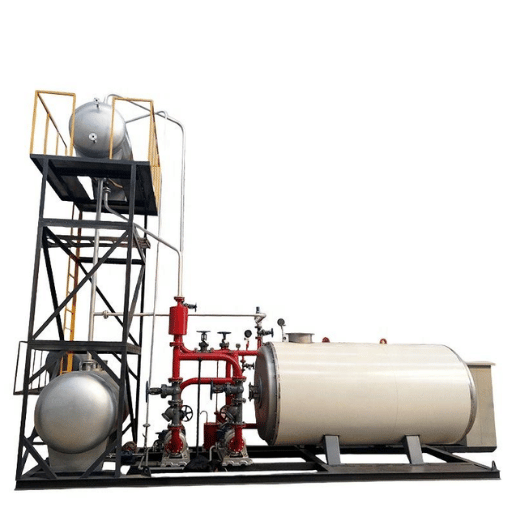
Choosing between an oil boiler and a gas boiler ultimately boils down to one of four aspects: availability of the fuel, running costs, needs for emissions or levels of maintenance. Both gas and oil fuel types can power the same boiler structures described above, but each presents distinct economic and operational trade-offs in energy costs and heating costs that compound over the equipment’s 15-25 year service life.
| Factor | Natural Gas Boiler | Oil Fired Boiler |
|---|---|---|
| Fuel Cost (US avg.) | $3–6 / MMBtu | $15–28 / MMBtu (heating oil) |
| Thermal Efficiency (AFUE) | 85–98% | 83–95% |
| NOx Emissions | 0.05–0.10 lb/MMBtu | 0.12–0.20 lb/MMBtu |
| Fuel Storage Required | No (pipeline supply) | Yes (above/underground tank) |
| Maintenance Intensity | Low — clean combustion, minimal residue | Higher — oil residue clogs nozzles, requires frequent cleaning |
| Fuel Supply Reliability | Depends on pipeline network | Stored on-site — independent of grid |
According to the U.S. Environmental Protection Agency, industrial boilers using residual oil are limited to 0.20 lb/MMBtu.
Boilers that use distillate oil are limited to 0.12 lb/MMBtu. Boilers that use gas are generally two to three times less nitrogen oxide than oil fired boilers.
For a more detailed comparison, read our gas vs oil fired boiler comparison guide.
💡 Pro Tip: Dual-Fuel Flexibility
If your facility is in an area where natural gas supply is intermittent or pricing is volatile, consider a dual-fuel burner. Many modern oil and gas boilers accept both fuels through a single burner assembly — allowing you to switch between gas and oil based on real-time fuel economics without any hardware modification.
⚠️ Common Mistake: Choosing Fuel Based on Purchase Price Alone
“Industry” practitioners also consistently describe the typical buyer as concerned with equipment purchase price while ignoring the 90/10 truth of boiler economics: approximately 90% of total life cycle cost of ownership is fuel over the boilers 15-25 year life and about 10% is equipment purchase price. A $20,000 5% higher annual fuel utilization efficiency boiler may cost more today but will break even in 2-3 years and provide another 15 years of savings. Always price everything over its entire life cycle (buy in to buy out); not your invoice.
How to Select the Right Oil and Gas Fired Boiler for Your Facility

Picking the right industrial boiler is not strictly a catalog choice – it is an engineering decision that must take into account your current process steam profile, mandatory future capacity requirements, site limitations and local fuel infrastructure. Below, a decision matrix correlates common industrial scenarios to the boiler type most likely to supply the greatest value in performance, cost and dependability.
| If You Need… | Consider | Because |
|---|---|---|
| Steam at 1–20 t/h for general production | WNS fire-tube boiler | Packaged unit, fast startup, fully automated, lowest capital cost per ton |
| High-capacity steam >20 t/h or pressure >1.6 MPa | SZS water-tube boiler | Higher pressure rating, larger output, better efficiency at scale |
| Hot water for district heating or HVAC | CWNS hot water boiler | Optimized for hot water circuits, no steam drum required |
| Small steam load <2 t/h with limited floor space | LHS vertical steam generator | Minimal footprint, no boiler room required in many jurisdictions |
| Highly variable load (30–100% swings) | Multiple smaller boilers in parallel | Better turndown ratio, stage firing matches actual demand, built-in redundancy |
Determine your process steam capacity with the industrial boiler sizing calculator.
📐 Engineering Note: Sizing Formula
Required boiler capacity = Process steam demand + Distribution loss (usually 5-10%) + Design margin (10-15%). Distinguish between the typical industry trap of excessive margin that leads to oversize (>25-30%) boiler units that must operate at low fire for longer time periods and the knowledge that a excess 20% oversize boiler can operate at high fire more often to reach its peak efficiency. As 1 DOE report reminds us – tuning the fuel nozzle by 1% can cut your fuel bill by 10%.
- Calculate the true maximum steam/hot water flow rate in kg/h or MW
- Evaluate your potential for growth (but stop point at 25%)
- Research fuel availability and prices from your local supplier
- Clarify air and water emission limits with your local authority
- Size your boiler design for your available floor space and ceiling height (horizontal versus vertical footprint)
- Check feedwater quality — water treatment may be required to protect the heat exchanger from scale buildup
- Evaluate service technician availability and regular maintenance support in your region
Efficiency, Energy Savings, and Operating Costs
Owning an oil and gas fired boiler costs far more than the invoice price suggests. In 20 years $200,000 fired in a boiler will have cost us an estimated $4 million in fuel alone! A horrendous waste that visually dwarfs any variance in initial equipment tag prices. This is the 90/10 Rule of Boiler Economics: 90% of total life cycle cost of ownership is heat energy in fuel, while the other 10% is capital investment.
85–98%
Thermal Efficiency Range
5.4%
Market CAGR 2026–2035
15–25 yr
Typical Service Lifespan
According to Global Market Insights, the industrial boiler market passed USD 12.1 billion in 2025 and will grow at a CAGR of 5.4% through 2035 – attributable to the growth in need for effective heat and steam sources across the manufacturing industry. Simultaneously, the USD 117.81 billion world demand for gas fired boilers at a 6.89% CAGR by 2034 suggests that more process heat is moving from oil and coal to cleaner burning natural gas.
In January 2025, the U.S. Department of Energy proposed updated AFUE standards for both gas fired and oil fired boilers, indicating further forward movement to tighten regulation on boiler efficiency. Taking equipment procurement plans into consideration, any new boilers should surpass the above upcoming standards.
Use our boiler operating cost calculator to reach a rough estimate of annual fuel cost by inputting your capacity, fuel type and efficiency rating. Check out our step-by-step outline of both direct and indirect boiler efficiency calculation methods.
⚠️ Water Quality Matters More Than Most Buyers Realize
Water contaminated with poor quality causes deposits forming on heat exchange surfaces, effectively creating an insulating layer between the boiler burner surface and transfer medium. Industry practice indicates that a deposit of 1 mm thickness drops the boiler water heat transfer efficiency by 8-12%. Performing consistent water treatment and blowdown cycles are not optional, but mandatory to attain nameplate efficiency through out the service life of the boiler.
Frequently Asked Questions

Q: Will oil fired boilers be banned?
View Answer
There is no outright global ban, but various countries have already begun constraining further use. The UK is aiming to stop installation of new oil boilers in off-grid residential applications by 2035. The EU has a listed minimum efficiency value, in the Ecodesign Directive. Large industrial oil fired boilers currently are not under restriction, although emission permt covering the operators’ permitting process are becoming more and more strict every year.
Q: What is the average cost to replace an oil fired boiler?
View Answer
Replacing a residential oil boiler costs. Industrial steam fired oil boilers range in price from $50,000 for a 1 t/h unit to over US$2 million for high capacity systems, depending on pressure rating, capacity and auxiliary equipment.
Q: How long will an oil fired boiler last?
View Answer
Proper maintenance and water treatment can extend the life of industrial oil and gas fired boilers to between 15 and 25 years. Cast iron residential models can often operate beyond 20 years. Internal corrosion from poor water quality — not burner or control system failure — is what most commonly limits service life.
Q: Can you convert an oil fired boiler to natural gas?
View Answer
Yes – converting an oil fired boiler to gas is generally common practice and straightforward, if they are a compatible design to begin with. The conversion process involves replacing the oil burner with a gas burner, running the gas line, and changing the controls to suit. New boilers are often shipped as ‘dual-fuel ready’ and allows the conversion process to be very simple. Fuel switch conversion costs can be recovered in 1-3 years through lower fuel costs and maintenance.
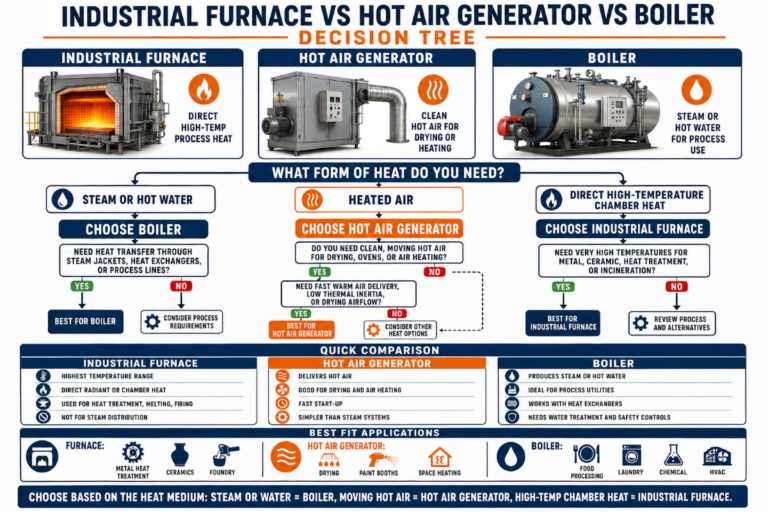
Q: What is the difference between a boiler and a furnace?
View Answer
A boiler heats water, or makes steam, which is distributed over a piping system. A furnace heats air, which is delivered over a duct system. Boilers technically use water or steam; furnaces use water directly.
Q: Are gas fired boilers being phased out?
View Answer
Gas boilers have restrictions in the home (parts of the EU and some parts of US are already discouraging the use of new gas heating systems). Industrial gas fired boilers, however, are not being phased out and many plants are switching to gas from coal and oil to meet lower emission standards. The Industrial gas fired boilers market is anticipated to expand at a CAGR of 6.89% during the forecast period of 2018-2034.
Decision makers ready to compare and select an oil and gas fired boiler suitable for their application?
About This Technical Guide
Authored by the Taiguo Boiler engineering team based on fifty years of combined industry experience designing, manufacturing and commissioning oil and gas fired steam and hot water boilers. efficiency levels and emissions data referenced in this article is from publicly available data from government agencies (U.S. DOE, EPA) and authenticated industry data. For assistance evaluating and sourcing the right size oil or gas fired boiler for your project or for fuel conversion assistance contact our technical team direct.
References & Sources
- Oil-Fired Boilers and Furnaces — U.S. Department of Energy
- Gas-Fired Boilers and Furnaces — U.S. Department of Energy
- Summary of Proposed NOx Emission Limits for Industrial Sources — U.S. Environmental Protection Agency
- Energy Conservation Standards for Consumer Boilers (2025) — Federal Register / U.S. DOE
- Industrial Boiler Market Size, 2026–2035 Trends Report — Global Market Insights
- Gas Fired Boilers Market Size & Forecast to 2034 — Fortune Business Insights
Related Articles
- WNS Oil Gas Steam Boiler Complete Guide — Detailed specifications, working principle, and application scenarios
- Fire-Tube vs Water-Tube Boiler: Which Is Right for You? — Head-to-head structural and performance comparison
- How to Choose an Industrial Steam Boiler — Step-by-step selection methodology
- Industrial Steam Boiler Price Guide — Cost factors, pricing ranges, and ROI analysis
- Oil Gas Dual Fuel Boiler — When and why to choose dual-fuel capability