Get in Touch with Taiguo

Rubber Vulcanization Autoclave Engineering: Heating Mediums, Load Tooling, Thermal Sizing, and Operating Cost

Contents
show
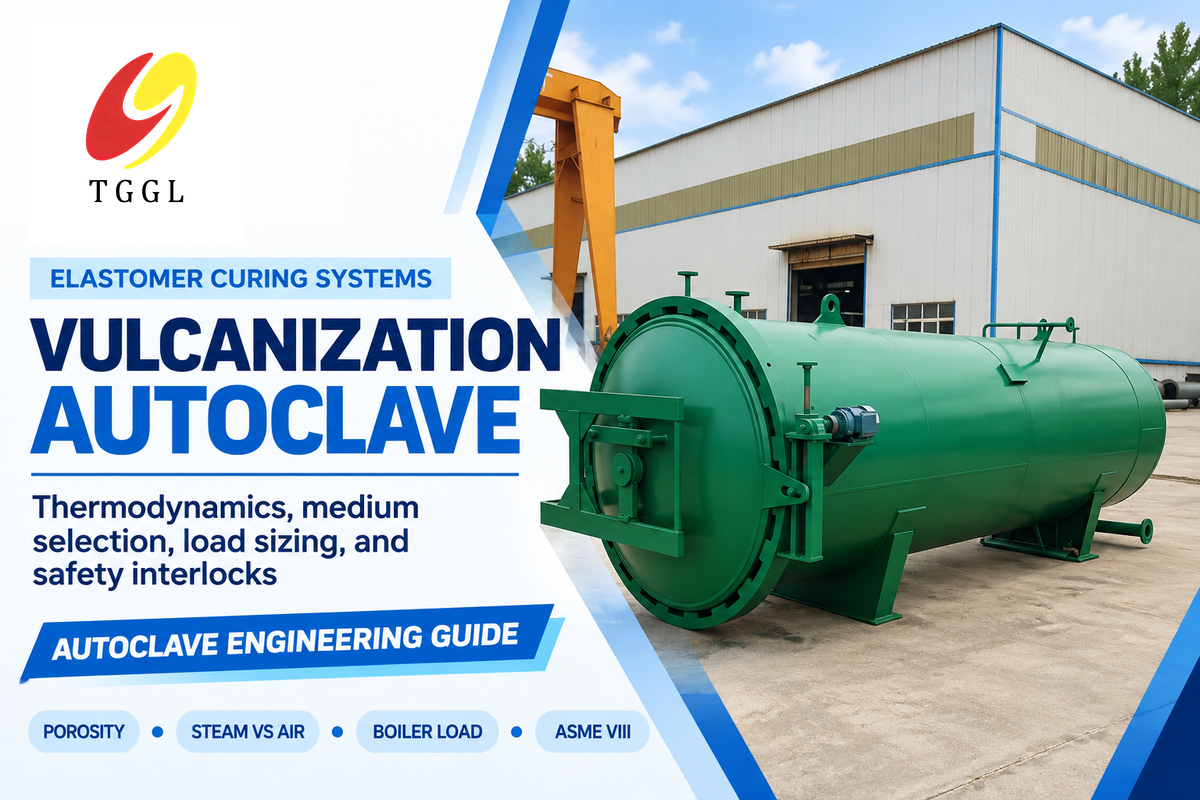
A rubber vulcanization autoclave operates at 0.4 to 1.0 MPa (58 to 145 psi) and 140 to 180 °C. It holds hydrostatic pressure above the 0.618 MPa absolute vapor pressure of water at 160 °C to prevent porosity. Flat platen presses or atmospheric tunnels do not exert equal radial force on all parts. This industrial rubber machinery consolidates multi-ply cord layers in mandrel hoses, thick rollers, mining cables, and tank linings.
Many plant engineers consider chamber pressure as a secondary variable and size their steam plant based on rubber mass alone. In practice, decoupling chamber overpressure from heat transfer stops volatile boiling during steam vulcanization. Most of the total heat during ramp-up is absorbed by bulky steel mandrels and vessel shells. In this article, we analyze boiling thermodynamics, heating mediums, boiler sizing, door interlocks, and multi-year costs.
Engineering Summary & Key Design Benchmarks:
- At 160 °C, trapped moisture flashes to steam below 0.618 MPa absolute (0.518 MPa gauge). Autoclaves hold 0.6 to 1.0 MPa gauge overpressure until the part cools below 85 °C.
- Direct condensing steam delivers 6,000 to 12,000 W/m²·K film heat transfer. Indirect forced hot air or nitrogen circulation delivers 35 to 85 W/m²·K at 3 to 6 m/s airflow.
- Under the Parasitic Steel-to-Rubber Thermal Ratio in a Φ2.0 m × 6.0 m vessel, steel hardware dominates ramp-up heat demand. This load requires 1,150 to 1,400 kg/h of peak boiler steam capacity.
- ASME Section VIII Division 1 UG-35.2 and EU PED 2014/68/EU mandate redundant mechanical zero-pressure pins. These locks block bayonet ring rotation above 0.005 MPa residual pressure.
How a Rubber Vulcanization Autoclave Suppresses Porosity and Crosslinks Elastomers
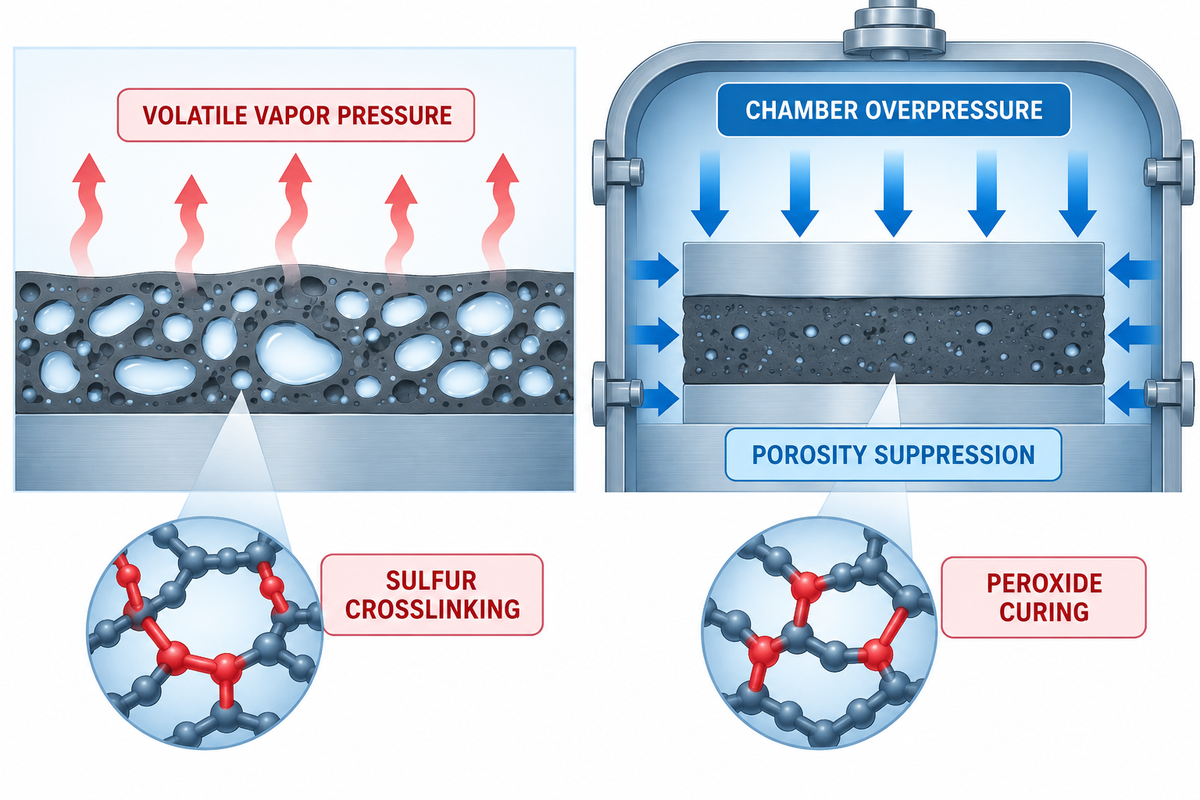
Atmospheric ovens, without refrigeration, result in cure. Trapped moisture and compounding volatiles boil at 100 °C to 140 °C before the elastomer crosslinks. According to U.S. EPA AP-42 Section 4.12 rubber processing technical data, industrial autoclave temperatures span 120 °C to 190 °C at 205 to 620 kPa. Holding chamber pressure above water vapor saturation keeps moisture and plasticizers dissolved throughout the curing process.
During mixing on a two roll mill, rubber vulcanization chemistry and crosslinking kinetics govern compound transformation. Before heat activates the curatives, raw rubber behaves like a soft thermoplastic mass under mechanical stress. Long polymer chains slide past each other and permanently deform. As heat is introduced to the chamber, chemical reactions form covalent sulfur bridges and carbon-carbon bonds along chains to create a 3D cross-link Network. This creates reversible elasticity, high tensile modulus, and elastic recovery in cured rubber.
However, chemical crosslinking and physical consolidation compete against severe thermal lag in thick sections. Compounded rubber has a low thermal diffusivity of roughly 0.11 mm²/s. The outer skin of a thick roller cover rapidly heats up to 155 °C in a hot chamber while the inner steel bond line remains cool. If chamber pressure drops and viscosity is low, dissolved gases in the polymer nucleate into micro-voids.
To alleviate void nucleation and ply separation, process engineers implement a 4-Stage Hydrostatic Cure Profile on every batch.
| Cycle Stage | Chamber Pressure (MPa g) | Chamber Temperature (°C) | Primary Thermodynamic & Mechanical Function |
|---|---|---|---|
| Stage 1: Air Purge & Pressurization Ramp | 0.205 → 0.60 MPa | 35 → 145 °C (at 1.0–2.5 °C/min) | Sweeps insulating air pockets from the shell and builds hydrostatic consolidation before compound viscosity drops. |
| Stage 2: Intermediate Step Dwell (Thick Parts) | 0.50 → 0.62 MPa | Hold below 110 °C pre-cure dwell | Equalizes heat across thick cross-sections while wet nylon cure tape shrinks thermally to compact plies. |
| Stage 3: Crosslinking Cure Dwell | 0.60 → 1.00 MPa (6 bar g standard) | 140–180 °C (standard 170 °C) | Holds pressure above the 0.618 MPa abs water vapor threshold at 160 °C to reach full crosslink cure modulus. |
| Stage 4: Pressurized Cooling & Controlled Vent | Hold 0.55 MPa overpressure until vent | 160 → 85 °C (at 1.5–3.0 °C/min) | Maintains air or water overpressure until core temperature drops below 85 °C, preventing depressurization blow-out. |
How does steam pressure influence the vulcanization process in autoclaves?
Steam pressure controls both the saturation condensing temperature inside a direct-steam autoclave and the hydrostatic force that prevents volatile boiling. At 0.60 MPa gauge (87 psi), saturated steam condenses at 165.0 °C across the workload. It releases 2,066 kJ/kg of latent heat while exceeding internal moisture vapor pressure. This force compacts calendered sheets and eliminates sponge porosity across multi-ply rubber assemblies.
High chamber pressure also forces softened elastomer into grit-blasted steel mandrels and textile cord weaves. According to Olmar industrial vulcanisation autoclave guidelines, standard cycles run near 170 °C (350 °F) and 6 bar gauge (90 psi). This pressure ensures full chemical crosslinking and tight inter-ply adhesion. Supply pressure stability is regulated by a modulating PID inlet valve so saturation temperature never drifts during the dwell.
Direct Live Steam vs. Indirect Hot-Air and Nitrogen Autoclaves: Heating Medium Trade-Offs
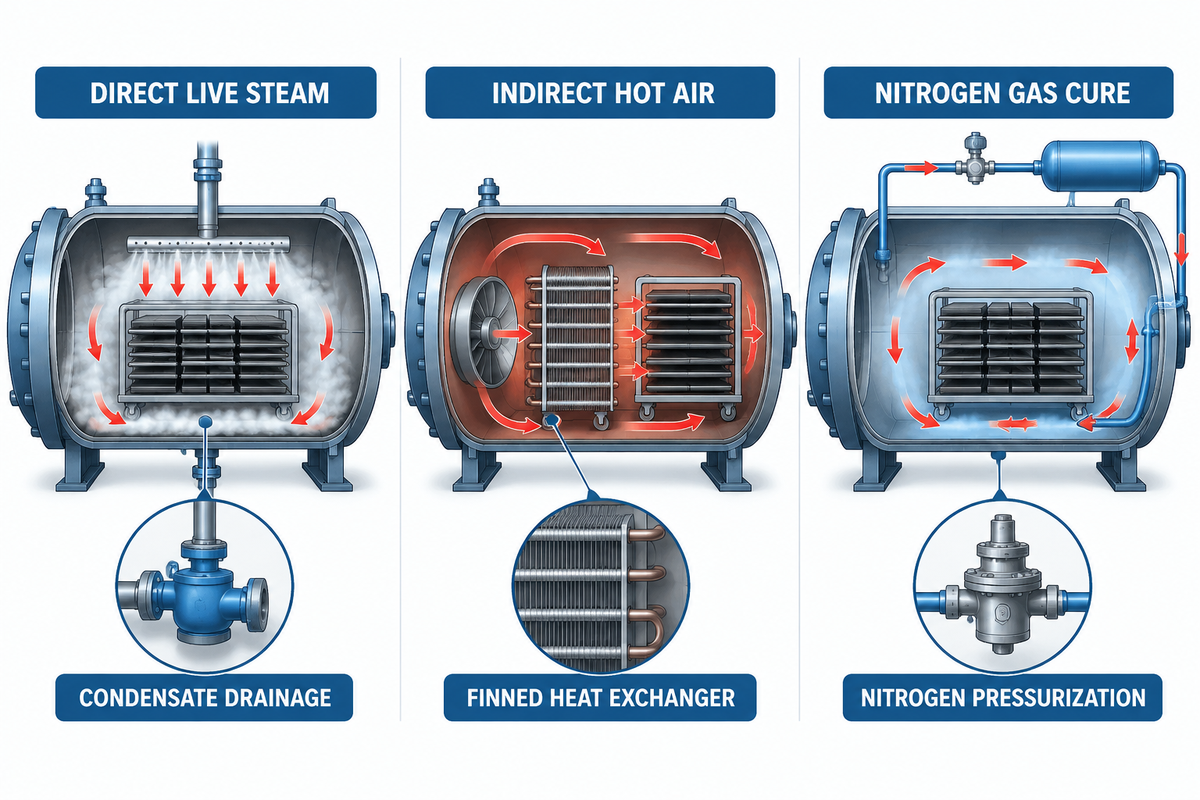
Of all autoclaves, direct steam autoclaves provide the quickest heating and the lowest capital costs for sulfur-cured hoses and tank linings. Indirect hot-air or nitrogen autoclaves are used when compound curing requires the absence of moisture. Choosing the correct vulcanizing autoclave for rubber prevents chronic surface tackiness and cosmetic water staining.
The physical space between the two systems is due to boundary-layer phase change. Per Spirax Sarco steam engineering data, condensing steam releases about 2,100 kJ/kg of latent heat at constant temperature. This condensation achieves a film heat transfer coefficient of 6,000 to 12,000 W/m²·K. By contrast, dry air or nitrogen at 0.6 MPa and 3 to 6 m/s achieves only 35 to 85 W/m²·K. As such, direct steam heats heavy steel mandrels much faster than dry gas convection. Direct steam, however, locks temperature to saturation pressure, unless air overpressure is inserted in the vulcanizing machine.
When no gas boiler house is available, process engineers often consider indoor electric heating and boiler systems or electric hot-air vessels. Table 2 compares four autoclave heating modes against compression molding and continuous extrusion tunnels:
| System Architecture | Film Heat Transfer Coefficient | Temp / Pressure Control | Temp Uniformity | Best-Fit Elastomer & Product Scope |
|---|---|---|---|---|
| Direct Live Saturated Steam | 6,000–12,000 W/m²·K | Coupled saturation curve; 0.4–0.8 MPa g at 151–175 °C | ±1.0 °C (after air purge) | Nylon-wrapped mandrel hoses, sulfur-cured NR/SBR/NBR rollers, rubber-lined tanks. |
| Indirect Steam-Coil Hot Air (Air-Over-Steam) | 35–85 W/m²·K (at 3–6 m/s fan flow) | Fully decoupled (0.6 MPa air at 120–180 °C) | ±1.5 °C with annular ducting | Tire retreading, unwrapped extruded profiles, rubber shoes, moisture-sensitive parts. |
| Electric-Heated Pressurized Hot Air | 35–85 W/m²·K (VFD circulation fan) | Fully decoupled; up to 1.0 MPa air and 190 °C | Within ±2.0 °C | Silicone, FKM fluoroelastomers, aerospace seals, plants using electric steam or air. |
| Nitrogen-Purged Indirect Autoclave | 35–85 W/m²·K (closed-loop N₂) | Decoupled N₂ pressure (0.4–1.0 MPa); oxygen-free inert purge | ±1.5 °C | Peroxide-cured EPDM, platinum silicone, high-voltage cable splices. |
| Compression / Injection Molding Machine | High-pressure steel platen conduction | Mechanical hydraulic clamp; 150–190 °C | ±1.0 °C across platen | High-volume O-rings, precision molded gaskets, compact shock mounts. |
| Continuous Salt-Bath (LCM) / Microwave Oven | Molten salt bath or microwave tunnel | Atmospheric pressure; 180–220 °C | ±2.0 °C along tunnel | Unreinforced sponge weatherstripping, continuous solid window extrusion profiles. |
To set up any vulcanizing autoclave rubber line without guesswork, apply the 3-Gate Heating Medium Selector.
- Gate 1 checks oxygen and free-radical sensitivity on organic peroxide curatives with unwrapped surfaces. Specify a Nitrogen-Purged Indirect Autoclave or wrap the part in wet nylon tape to prevent surface tackiness.
- Gate 2 checks moisture and condensate tolerance, where water causes whitening or insulation damage. Choose an Indirect Steam-Coil or Electric Hot-Air Autoclave, where compressed air supplies pressure and finned tubes supply dry heat.
- Gate 3 checks thermal mass where a batch carries heavy steel mandrels that tolerate moisture. Specify a Direct Live-Steam Autoclave with air-overpressure cooling to capture 2,066 kJ/kg latent heat and cut ramp time.
What differences exist between sulphur and peroxide curing systems in vulcanization?
Sulphur curing systems build polysulfidic bridges across unsaturated double bonds in natural rubber, SBR and NBR. Peroxide curing systems generate free radicals that form carbon-carbon bonds in saturated elastomers like EPDM and silicones. Carbon-carbon bonds hold higher bond dissociation energy than polysulfidic sulfur links. Therefore, peroxide cures resist heat aging up to 180 °C, while sulfur cures provide higher dynamic tear strength.
Inside a vulcanizing autoclave, this chemical choice dictates the pressurizing gas. Sulfur vulcanization tolerates hot compressed air and direct steam without surface inhibition. However, sulfur compounds suffer reversion if overheated above 160 °C. On the other hand, peroxide free radicals react with molecular oxygen (O₂) to form inactive peroxy species. Curing an unwrapped peroxide EPDM part in hot air leaves the outer skin permanently tacky.
Load Engineering by Product: Mandrel Hoses, Rubber Rollers, Cables, and Tank Linings
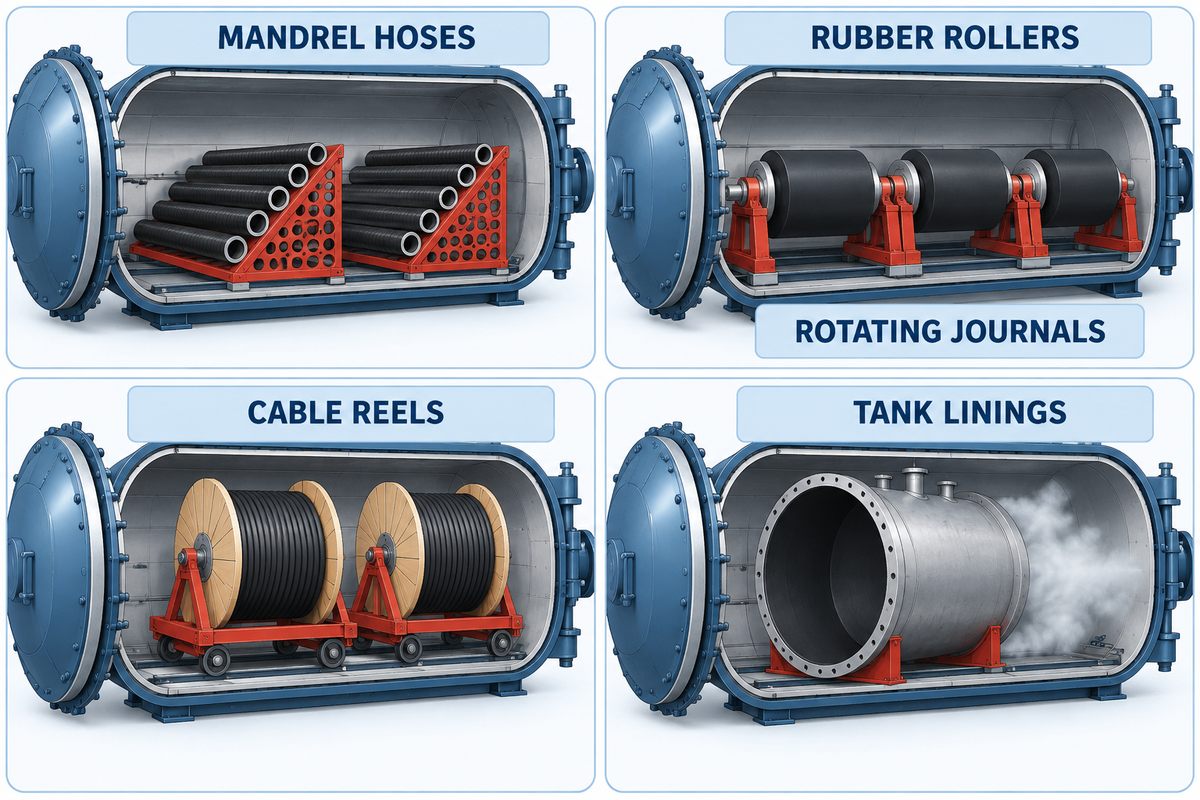
Internal autoclave tooling, such as V-groove carts, nylon shrink wraps, roller rotation drives, and step-cure ramps, helps keep heavy rubber assemblies concentric. Proper load tooling prevents gravity sag and ovality and helps control bond-line undercure.
According to Bondtech turnkey rubber vulcanizing system specifications, one horizontal vessel platform can support hoses, rollers, cables, tank linings and retreaded tires. Each product requires a matched rail carriage and cure recipe.
In industrial hose production, operators build dredging, oilfield, and hydraulic hoses on long steel mandrels. The next step is to wind an inner ply of calendered rubber tube, a textile braid or wire, and an outer cover. As depicted in Rubber-Mexico mandrel-formed hose manufacturing documentation, an uncured rubber hose is loaded by a spiral nylon wrap. Above 110 °C the nylon shrinks and causes a radial mechanical squeeze. This helps expel trapped air and fuses the reinforcement plies.
Two additional challenges faced by heavy industrial rollers with rubber covers are gravity slump and thermal lag. While on a ramp from 90 °C to 110 °C, the viscosity of the uncured rubber compound is at its minimum. If a roller is supported and sits still on a rack, rubber compounds slump. To avoid this, autoclaves with sealed drives pass a drive shaft through the rear of the roller and help rotate the carriage at 2 to 6 RPM.
In practice, as noted in Eng-Tips EPDM roller vulcanization field discussions, ramping a thick roller straight to 155 °C cures the outer skin too early. The locked outer shell traps inter-ply voids and starves the steel core adhesive of heat. Holding a pre-cure dwell below 110 °C under full pressure lets the compound flow and equalize thermally before final heating.
| Product Application Type & Category | Chamber Pressure & Medium | Step-Cure Temperature Profile | Mandatory Internal Tooling & Wrapping |
|---|---|---|---|
| Type 1: Mandrel-Built Industrial Rubber Hose | 0.45–0.62 MPa g direct saturated steam | Ramp 1.5 °C/min → 152 °C × 60–90 min | Cantilevered pin racks or V-cradles; cross-wrapped wet nylon tape; open mandrel ends for internal steam flow. |
| Type 2: Heavy Industrial Rollers (25–80 mm Cover) | 0.50–0.62 MPa g steam or air-over-steam | Pre-cure <110 °C dwell → 150 °C × 120–180 min (0.5–1.5 °C/min ramp) | Journal bearing cart with 2–6 RPM rotary drive; double nylon shrink wrap; pressurized cool below 85 °C. |
| Type 3: Mining, Marine & Subsea Cables | 0.60–1.00 MPa g steam or nitrogen/hot air | Ramp 1.2 °C/min → 145–160 °C × 90–150 min | Flanged curing pans or motorized reel stands; high-tension nylon tape; core thermocouple inside inner coil turn. |
| Type 4: Commercial & OTR Tire Retreading | 0.40–0.60 MPa g indirect steam-air or electric air | 100–125 °C low-temp envelope cure × 150–240 min | Overhead monorail tyre hanger rack; flexible curing envelope evacuated via continuous vacuum manifold. |
| Type 5: Rubber-Lined Chemical Tanks & Pipes | 0.25–0.50 MPa g direct or internal exhaust steam | Ramp 0.8 °C/min → <110 °C dwell → 142 °C × 120–180 min | Flanged rail bogie for tank shell; internal condensate siphon; air-overpressure hold during cooling. |
| Type 6: Spliced Fabric & Steel-Cord Conveyor Belts | 0.50–0.62 MPa g direct saturated steam | Ramp 1.5 °C/min → 148–155 °C × 60–120 min | Motorized heavy drum winder with interleaved release liner; edge restraint bars to prevent belt camber. |
| Type 7: Calendered Rubber Sheet & Expansion Joints | 0.40–0.60 MPa g direct steam or air-over-steam | Ramp 1.5 °C/min → 150–160 °C × 45–90 min | Perforated hollow steel curing cylinder wrapped in cotton or nylon tension cloth; bottom condensate drain pan. |
| Type 8: Extruded EPDM & Silicone Profiles | 0.50–0.80 MPa g indirect hot air or nitrogen | Ramp 2.0 °C/min → 165–180 °C × 30–60 min | Multi-tier perforated stainless trays stacked on rail trolley; talc-dusted or silicone-lined support grooves. |
| Type 9: Vulcanized Rubber Shoes & Footwear Lasts | 0.30–0.50 MPa g indirect steam-heated hot air | Ramp 2.0 °C/min → 130–142 °C × 45–60 min | Double-deck aluminum last trees on wheeled rack; dry air circulation to preserve foxing tape gloss. |
Large-diameter vessels thus process conveyor belts, marine fenders, retread truck tires, and calendered rubber sheet rolls on a single shop floor.
How does batch curing impact the overall cable manufacturing process?
Batch autoclave curing offers a flexible schedule to balance the continuous jacket extrusion and high-voltage testing. It also allows large, heavy, marine and mining cables to achieve uniform crosslink density without sag. For standard power cables, continuous vulcanization (CV) steam tubes work well. But large multi-core trailing cables deform under their own weight in a suspended CV tube.
In a batch production line, operators wind the taped cable on a perforated steel drum or a flat curing pan. For equal heating, operators place a reel of cable in an autoclave. Insulation is avoided due to the hydrostatic pressure. Because of the cable layers being a thermal barrier, a PT100 probe is placed in the center of the stack. A pre-heat dwell is given to ensure the inner turns cure fully.
Sizing the Vessel and Matching Steam Boiler Capacity: Thermal Load Worked Example
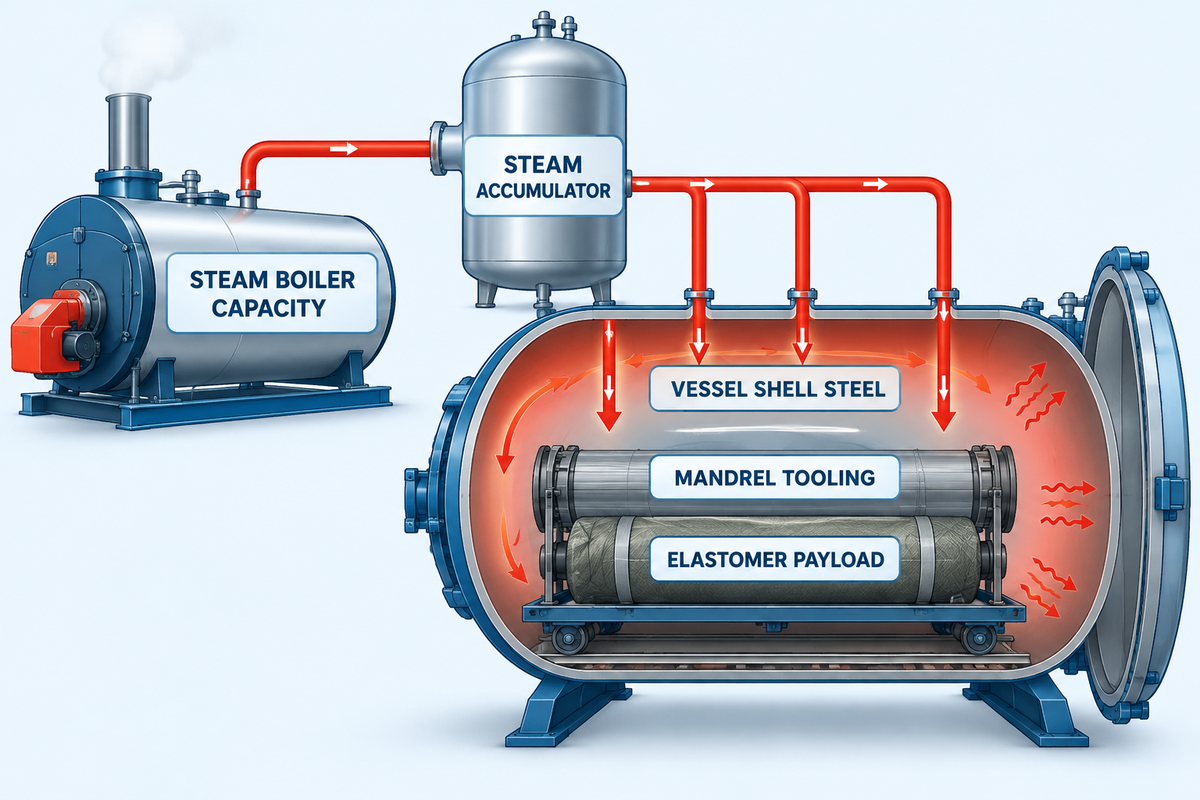
Rubber vulcanization autoclave sizing demands adding 300 to 500 mm of radial clearance around the loaded cart to ensure sufficient airflow. Simultaneously, the steam boiler must be sized to handle the peak 30-minute ramp load, where steel hardware absorbs the majority of total heat. Plants that size boilers from rubber weight alone suffer severe pressure drops and wet steam carryover during cold start-ups.
This is what we call the Parasitic Steel-to-Rubber Thermal Ratio. Compounded rubber has a higher specific heat capacity than carbon steel. However, the pressure shell, forged door, rail trolley, and steel mandrels outweigh the rubber batch several times over. According to Autotherm Equipment vulcanizing autoclave specifications, empty vessels made from 16 to 30 mm steel plates weigh between 5,000 and 15,000 kg.
Worked Engineering Calculation: Peak Ramp vs. Holding Steam Consumption for a Φ2.0 m × 6.0 m Autoclave
1. Assumed Design Inputs:
- Active heated steel shell and door mass equals 6,800 kg (within the 5,000–15,000 kg Autotherm vessel range).
- Uncured rubber compounds batch equals 800 kg. Steel mandrels and rail trolley weigh 2,400 kg (total heated steel = 9,200 kg).
- Cold start at 25 °C ramps to 165 °C (ΔT = 140 K) in 30 minutes (0.5 h). Saturated steam at 0.60 MPa g provides latent heat hfg = 2,066 kJ/kg (around 2,100 kJ/kg per Spirax Sarco tables).
- Carbon steel cp = 0.49 kJ/kg·K and rubber cp = 1.65 kJ/kg·K. The shell is insulated by 80 mm rockwool.
2. Step-by-Step Thermal Balance (30-Minute Ramp Phase):
- Heat absorbed by rubber (Qrubber): 800 kg × 1.65 kJ/kg·K × 140 K = 184,800 kJ (184.8 MJ).
- Heat absorbed by mandrels and trolley (Qtooling): 2,400 kg × 0.49 kJ/kg·K × 140 K = 164,640 kJ (164.6 MJ).
- Heat absorbed by autoclave shell and door (Qshell): 6,800 kg × 0.49 kJ/kg·K × 140 K = 466,480 kJ (466.5 MJ).
- Chamber fill and purge loss (Q purge ): filling the 18.85 m³ chamber at 0.60 MPa g plus air-purge sweep consumes 31,500 kJ (31.5 MJ).
- Total ramp thermal demand (Qtotal): 184.8 + 164.6 + 466.5 + 31.5 = 847.4 MJ (847,400 kJ). Steel hardware absorbs nearly three-quarters of the total ramp energy as per the Parasitic Steel-to-Rubber Thermal Ratio.
3. Required Steam Boiler Flow Rate (Peak Ramp vs. Steady Hold):
- Ramp steam mass: 847,400 kJ ÷ 2,066 kJ/kg = 410.2 kg of steam condensed during the 30-minute ramp.
- Average vs. peak ramp flow rate: 410.2 kg ÷ 0.5 h = 820.4 kg/h average flow. Initial valve opening condensation peaks at 1,150 to 1,400 kg/h (1,272 kg/h nominal).
- Steady-state cure hold flow (90-min dwell): shell radiation loss plus continuous steam trap bleed requires 115 to 145 kg/h (180 kg over 1.5 hours). Total batch steam is 590.2 kg.
- Boiler selection rule: one Φ2.0 m × 6.0 m steam heating rubber vulcanizing autoclave requires a dedicated 1.5 t/h (1,500 kg/h) steam boiler. Pairing it with a WNS fire-tube gas-fired steam boiler absorbs the cold-ramp surge without pressure collapse.
| Vessel Inner Diameter × Length | Internal Volume (m³) | Empty Vessel Weight (kg) | Peak Ramp Steam Draw (kg/h) | Holding Steam Flow (kg/h) | Recommended Steam Boiler Capacity |
|---|---|---|---|---|---|
| Φ1.2 m × 3.0 m | 3.4 m³ | 5,000 kg | 420–550 kg/h | 45–65 kg/h | 1.0 t/h (1,000 kg/h) |
| Φ1.5 m × 4.0 m | 7.1 m³ | 6,000 kg | 750–920 kg/h | 75–100 kg/h | 1.0–1.5 t/h (1,000–1,500 kg/h) |
| Φ2.0 m × 6.0 m | 18.8 m³ | 6,800 kg | 1,150–1,400 kg/h | 115–145 kg/h | 1.5–2.0 t/h (1,500–2,000 kg/h) |
| Φ2.5 m × 9.0 m | 44.2 m³ | 12,500 kg | 2,100–2,650 kg/h | 190–250 kg/h | 3.0 t/h (or 2.0 t/h + steam accumulator) |
| Φ3.0 m × 12.0 m | 84.8 m³ | 15,000 kg | 3,400–4,200 kg/h | 310–400 kg/h | 4.0–6.0 t/h WNS fire-tube boiler |
Quick-Opening Door Interlocks and Pressure Vessel Code Compliance (ASME, PED, GB/T 150)
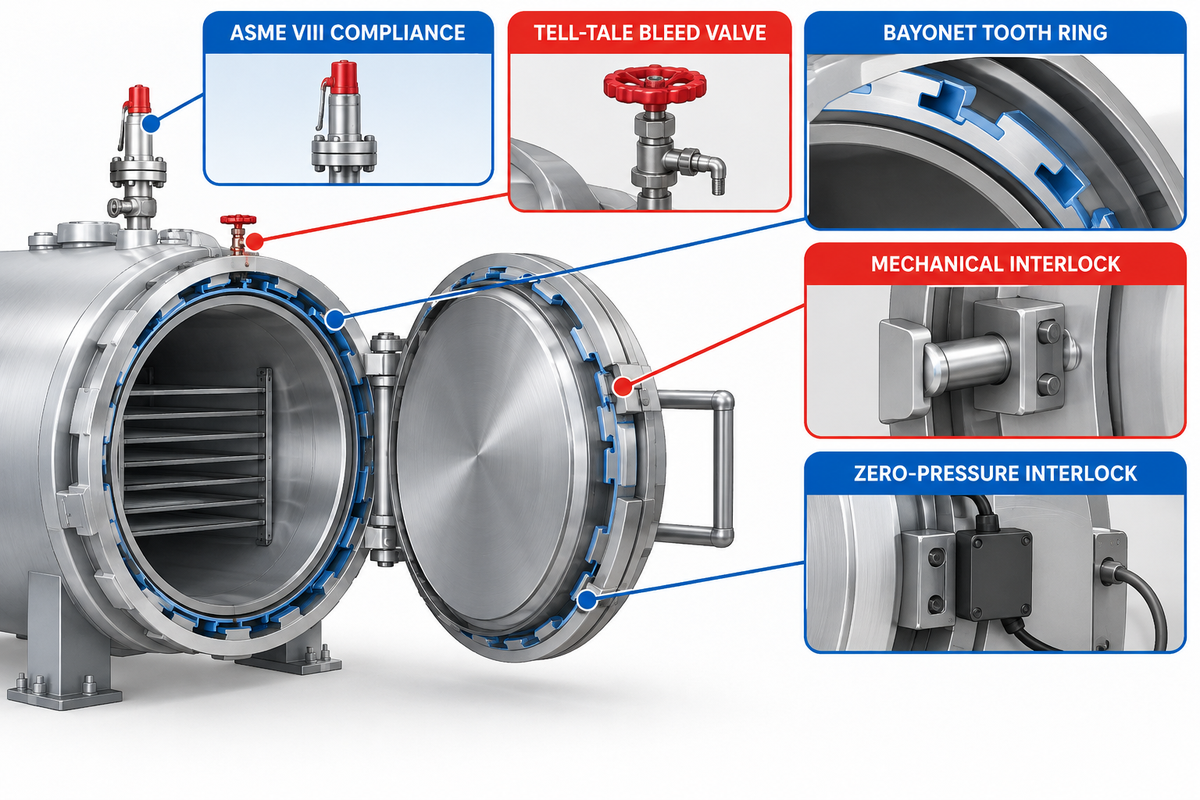
Every quick-opening rubber vulcanization autoclave must comply with ASME Section VIII Division 1 (Paragraph UG-35.2), EU PED 2014/68/EU, or GB/T 150 + TSG 21. A three-tier mechanical and electrical interlock chain must physically block bayonet door rotation whenever internal pressure exceeds 0.005 MPa (0.7 psi). Residual pressure behind a large door generates several metric tons of axial thrust. Relying on a single PLC sensor without a direct mechanical zero-pressure pin creates a severe safety hazard.
Modern vulcanizers have replaced slow swing-bolt flanges with a bayonet tooth-ring closure mechanism. This mechanism was pioneered over 100 years of engineering by Scholz bayonet quick-closing autoclave systems and heavy industrial high-pressure steam autoclave vessels. The door flange and shell ring carry interrupted shear teeth. A hydraulic or pneumatic cylinder rotates the locking ring to engage the full tooth area, which locks the flange face seal pressure-tight. A dovetail lip-type silicone seals the flange face.
Per ASME Boiler and Pressure Vessel Certification standards (covering more than 6,800 global certificate holders) and European Commission Pressure Equipment Directive (PED 2014/68/EU) technical rules, quick-actuating closures must pass rigorous material, weld radiography, and hydrostatic proof tests:
| Engineering Parameter | ASME BPVC Sec. VIII Div. 1 (U-Stamp) | EU PED 2014/68/EU (CE Cat. III / IV) | China GB/T 150 & TSG 21 |
|---|---|---|---|
| Primary Pressure Plate Steel | SA-516 Grade 70 normalized carbon steel | P265GH or P355GH pressure vessel steel | Q345R boiler & pressure vessel steel |
| Quick-Opening Closure Clause | Mandatory Paragraph UG-35.2 (multi-element holding & audible telltale) | Annex I Section 2.3 (safe opening & depressurization interlock) | TSG 21 quick-opening door triple safety interlock mandate |
| Hydrostatic Proof Test Pressure | 1.3 × MAWP × stress ratio per UG-99 | 1.43 × design pressure (or 1.25 × stress-adjusted) | 1.25 × design pressure × stress ratio |
| Weld Seam Radiography (RT / UT) | Full radiography (UW-11a) or spot NDE per joint efficiency | Volumetric NDE per PED Category III/IV hazard module | Full ultrasonic or radiographic butt-weld examination |
Are rubber vulcanization autoclaves safe to operate under high-frequency batch cycles?
Yes, rubber vulcanization autoclaves operate safely under multi-shift daily batch cycles when engineered for cyclic fatigue and fitted with three-tier ASME UG-35.2 interlocks. High-frequency cycling subjects the shell-to-flange weld neck to repeated thermal expansion and pressure reversal. Reputable builders verify door ring forgings via finite-element fatigue analysis and volumetric ultrasonic or radiographic weld inspection during manufacture.
On the shop floor, three independent physical barriers must clear before the door actuator can move.
- A manual DN25 ball bleed valve on the door head vents steam right in front of the operator. The valve handle is linked to a steel pin that blocks bayonet rotation, and allows the valve to be opened only in the fully open position.
- A mechanical (zero pressure) plunger stays extended in the bayonet ring slot when chamber pressure is greater than 0.005 MPa.
- The steam inlet valve is locked in the closed position by two pressure transmitters, and will only open if dual channel inductive proximity switches, placed downstream of the valve, verify that full engagement of the teeth has occurred.
Airflow Architecture, PLC Cure-Cycle Controls, and Chamber Temperature Uniformity
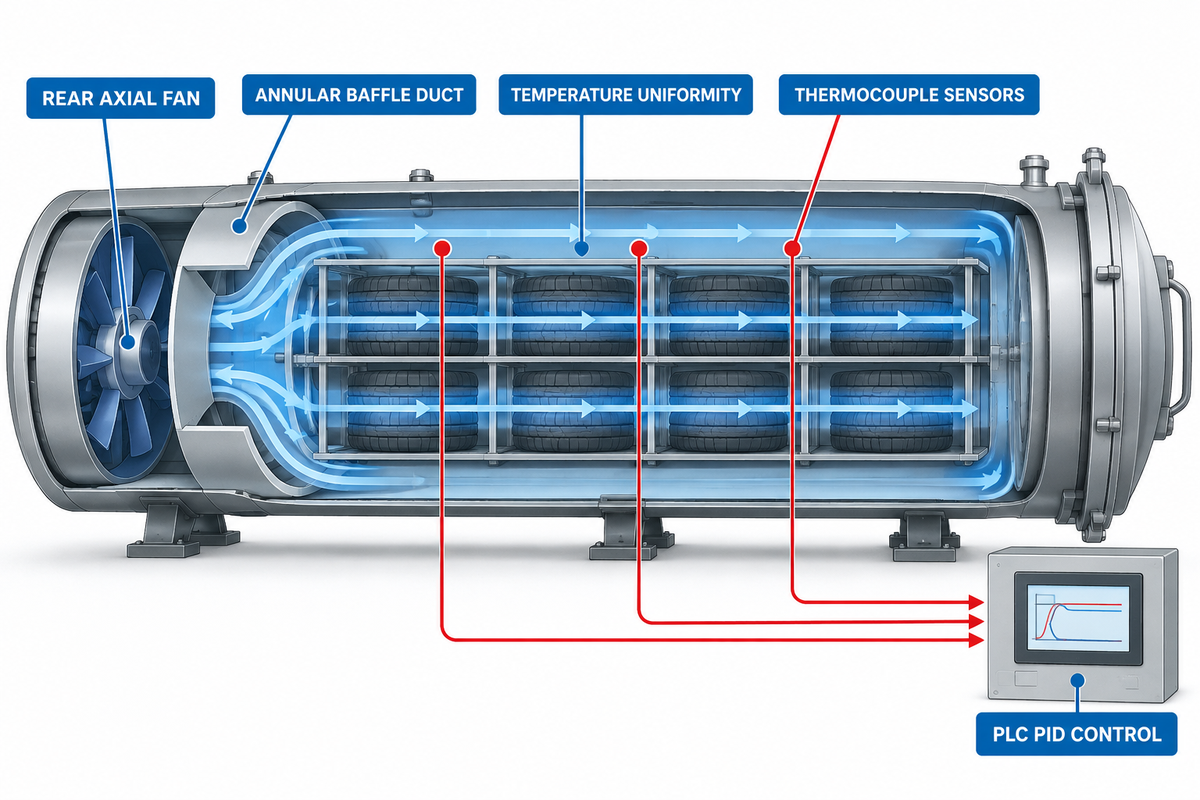
Holding ±1.0 °C to ±2.0 °C temperature uniformity across a horizontal vulcanizer requires complete initial air purging, full-length annular baffle ducting, and independent PID control loops. In the absence of forced gas velocity of 3 to 6 m/s or bottom air venting, top-to-bottom stratification leads to batch consistency issues over long lengths of conveyor rollers and aerospace seals.
In direct live-steam chambers, trapped air is the major cause of cold spots. As shown in TLV vulcanizing autoclave initial air-removal engineering studies, steam-air mixtures follow Dalton’s law of partial pressures. Residual air in the chamber results in an effective steam partial pressure that is lower than the supply steam temperature, preventing internal temperatures from reaching the supply steam temperature. What’s worse, air acts as a thermal insulator against rubber.
To release air pockets, Akarmak autoclave purging process studies describe three proven purging techniques. Bottom-up gravity steam sweeping is used by plants that have large mandrel bundles to purge. Alternatively, pulsed pressure-vacuum purging and vacuum pre-cycle evacuation techniques are employed for smaller bundles. Float-and-thermostatic steam traps discharge bottom condensate continuously, therefore water does not collect around lower carts.
In indirect hot-air or nitrogen autoclaves, natural convection cannot move heavy heat through dense carts. Uniformity composite and rubber vessels use a shroud in the form of a cylindrical sheet-metal shell that is co-axial with the pressure shell. In the rear of the vessel, a VFD centrifugal fan (typically 10-30 kW, according to Autotherm specifications) draws gas through the finned heater bank and pushes it through the annular space between the bank and the vessel. The airflow warms the heavy front door flange and sweeps backward at 3 to 6 m/s through the loaded cart.
An automatic plc control system uses distributed Class A PT100 sensors along the shell length to control this loop. Trailing thermocouples are plugged into the thickest rubber section to monitor heat core. During cooling, automatic control valves maintain 0.55 to 0.70 MPa backpressure on the air, and water circulation at 1.5 to 3.0 °C/min.
Troubleshooting Autoclave Vulcanization Defects: Blistering, Water Spots, and Core Undercure
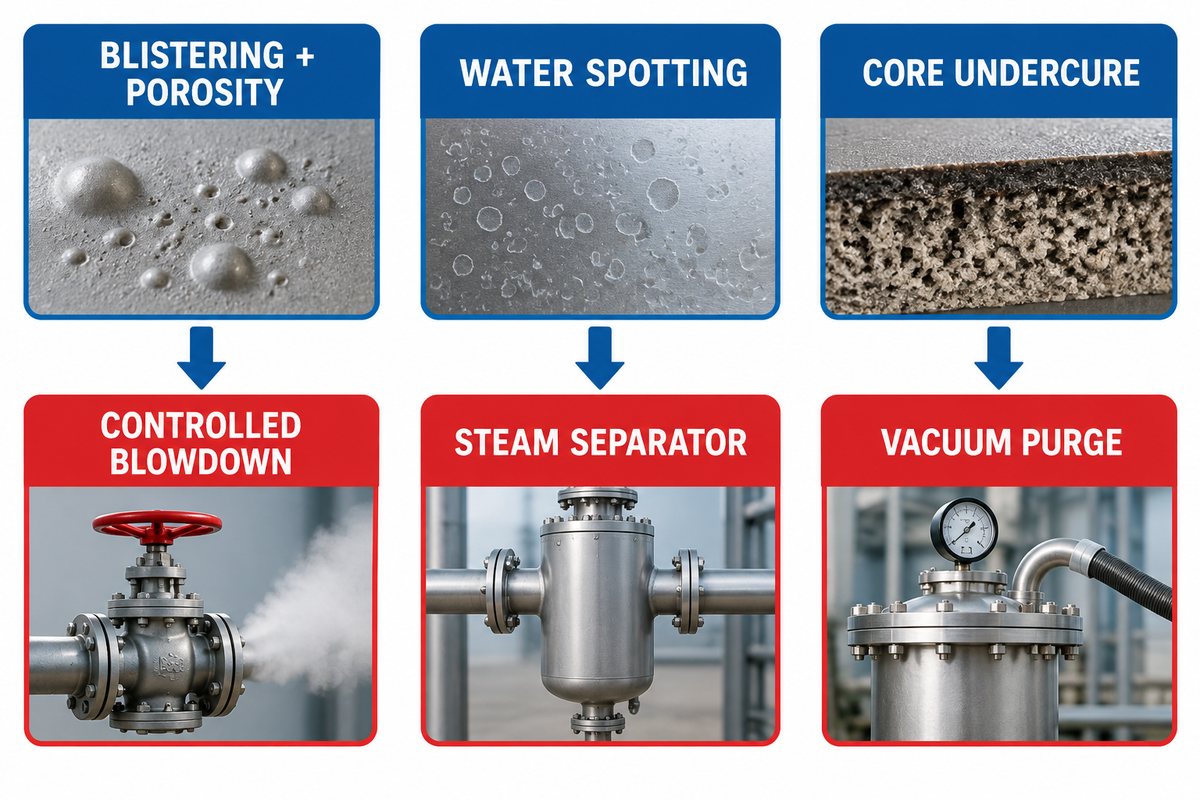
A common misunderstanding is assuming that bad compounding is the cause of vulcanized exiting an autoclave with sponge blisters, white water stains, tacky skin, or crushed profiles. Mistakes in cycle control are usually the root cause. Venting pressures above 90 °C, incomplete air purging, or clogged steam traps can ruin a good compound. As noted in Consteril autoclave operational failure analyses, overloading a chamber cart can also block steam flow and create cold zones.
Prior to pointing the finger at upstream mixing in the mill or changing curatives, Quality engineers must check the batch record against Table 6.
| Observed Defect Symptom | Thermodynamic / Mechanical Root Cause | Immediate Hardware or PLC Recipe Fix |
|---|---|---|
| Internal Sponge Porosity & Surface Blistering | Chamber pressure fell below water vapor pressure during cure, or the vessel vented while core temperature exceeded 90 °C. | Raise cure pressure above saturation; hold air overpressure during cooling until the core PT100 probe reads below 85 °C. |
| Whitish Water Spots & Swollen Surface Patches | Wet boiler steam carryover or roof condensate dripped onto unwrapped rubber products. | Install a centrifugal steam separator on the inlet header; mount an internal top drip shield; switch to indirect hot air. |
| Tacky, Uncured Outer Skin (Peroxide EPDM / Silicone) | Molecular oxygen (O₂) in compressed air quenched peroxide free radicals at the exposed surface. | Purge chamber with inert nitrogen before heating, or apply tight wet nylon barrier tape around the part. |
| Core Undercure with Brittle / Reverted Outer Skin | Fast single-step heating on thick natural rubber rollers caused outer reversion before the core reached vulcanizing temperature. | Program a pre-cure dwell below 110 °C for thermal equalization before ramping to final cure; terminate via core cure integral. |
| Crushed Hose ID or Oval Roller Eccentricity | Chamber pressure crushed a plugged hollow mandrel, or a heavy roller softened at 100 °C without rotation. | Drill pressure-equalization holes in mandrel ends; run the 2–6 RPM carriage rotation drive from start-up through cool-down. |
| Pitting Corrosion on Bottom Shell & Rail Track | Sulfur compounds and organic acids leached from rubber dissolve into stagnant bottom condensate. | Replace blocked float steam traps for continuous drainage; weld a 316L stainless steel corrosion belly plate along the bottom arc. |
| Bond-Line Delamination at Steel Roller Core | Condensate moisture or oil contaminated the grit-blasted steel core primer before compound building. | Preheat bare steel cores above dew point before calender wrapping; hold pre-cure pressure dwell below 110 °C to wet out adhesive. |
| Deep Nylon Tape Wrap Marks or Ridges | Excessive wrap tension or over-softening during a rapid initial temperature spike squeezed out surface rubber. | Calibrate spiral wrapper brake tension; use finer-denier woven nylon cure tape and moderate the initial heating ramp rate. |
| Hardness Gradient Between Front Door & Rear Head | Uninsulated quick-opening door flange acted as a heat sink or residual air pocket pooled at the dead end. | Install an auxiliary door-neck steam coil; verify annular fan baffle seal and open top/bottom air vent traps during purge. |
High-pressure devulcanization vessels (often paired with tire recycling machine to produce reclaimed rubber) intentionally run at extremely high temperatures and pressures with softening oils to cleave crosslinks. Standard rubber curing autoclaves should never operate at levels approaching those thermal cleavage, since excessive heat can destroy ozone resistance and tensile strength.
2026 Equipment Cost Tiers, 5-Year Steam TCO, and Global Manufacturer Landscape
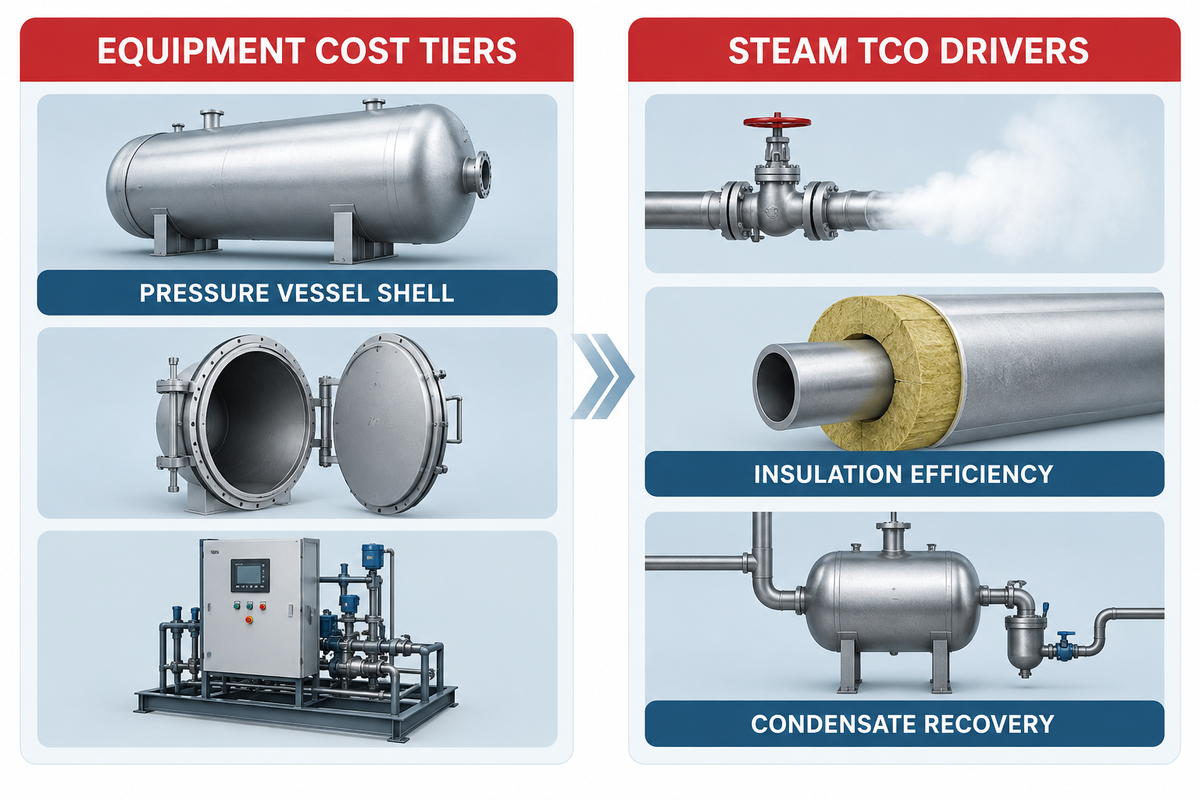
In 2026, evaluating a rubber vulcanization autoclave will require an audit of three structural cost drivers: pressure vessel code certification, the 2.15 m outer-diameter limit for container shipping and multi-year steam consumption. In multi-shift operations, cumulative boiler fuel energy commonly exceeds the initial purchase cost of the pressure vessel. Custom shell thickness (16 to 30 mm per Autotherm specifications) requires project specific RFQ engineering quotes.
To avoid major freight overruns, Procurement teams should verify outer diameter (OD) of vessels against container door clearance as early as possible. The physical door opening of a 40-foot High Cube (40HQ) container is 2.34 m width and 2.58 m height. Once an autoclave’s shell, stiffening rings, rockwool insulation, and cladding exceed 2.15 m OD (which happens above ID = 1.80 m), it cannot fit inside a standard container. Moving from a Φ1.8 m vessel to a Φ2.0 m or Φ2.5 m vessel forces the cargo onto an Out-of-Gauge (OOG) 40ft Flat Rack, multiplying ocean freight and inland trucking costs.
| Inner Diameter × Length Tier | Typical Shell Thickness & Mass | Applicable Vessel Codes | Ocean Shipping & Container Boundary | Commercial Quotation Basis |
|---|---|---|---|---|
| Compact Batch Tier: Φ1.2 m – Φ1.5 m × 3–6 m | 16–20 mm steel; 5,000–6,500 kg | GB/T 150, PED 2014/68/EU CE, or ASME Sec. VIII Div. 1 | Fits inside standard 20GP or 40HQ container (OD ≤ 1.85 m) | Requires project-specific RFQ (specify direct steam vs. electric hot air) |
| Container-Max Tier: Φ1.8 m × 6–11.5 m | 18–22 mm steel; 6,500–9,500 kg | GB/T 150, PED CE Cat. III/IV, or ASME U-Stamp | Maximum size fitting 40HQ container door (OD ≤ 2.15 m with compact lagging) | Requires project-specific RFQ (lowest landed freight cost per m³ of cure volume) |
| Mid-Industrial Tier: Φ2.0 m – Φ2.5 m × 6–12 m | 20–26 mm steel; 6,800–12,500 kg | ASME Sec. VIII Div. 1 U-Stamp, PED CE, or DOSH/MOM | Exceeds 2.34 m door width (OD = 2.35–2.88 m); requires 40ft Flat Rack (OOG) | Requires project-specific RFQ (include Flat Rack lashings & matched steam boiler) |
| Heavy Roller / Tank Tier: Φ3.0 m – Φ3.5 m × 12–18 m | 24–30 mm steel; 15,000+ kg | ASME U-Stamp + National Board (NB) Registration | Breakbulk below-deck hold or heavy-lift Flat Rack + police/escort road transport | Requires project-specific RFQ (turnkey rotary drive, nitrogen loop & accumulator) |
Multi-Year Steam & Thermal Energy TCO Model (Φ2.0 m × 6.0 m Autoclave Running 5 Batches/Day):
- Running 5 batches per day for 300 operating days means 1,500 batches per year. That schedule totals 7,500 batches over five operating cycles.
- Our H2-4 thermal balance shows that for a direct steam vessel of 590 kg/batch, steam consumption is 885,000 kg (885 metric tons) over 1,500 batches. For 7,500 batches, total steam consumption would be 4,425 metric tons.
- Generating 885 metric tons of 0.6 MPa steam in a high-efficiency WNS gas-fired boiler burns roughly 66,375 Nm³ of natural gas per 1,500 batches. Fan and control power adds 10 to 30 kW during operation.
- Thermal Storage Plate 3 gives two ways to reduce batch steam draw to 465 kg/batch. Upgrading rockwool insulation thickness, using lightweight tubular mandrel racks, and recovering condensate heat cuts batch steam draw to 465 kg/batch. The second is to use sub-cooled condensate from heat. That upgrade saves 187.5 metric tons of steam (14,060 Nm³ of natural gas) every 1,500 batches.
When studying global autoclave manufacturers, industrial buyers distinguish two different supplier groups:
- Western specialized autoclave builders include Scholz in Germany, Olmar in Spain, Bondtech and ASC Process Systems in the U.S., and Akarmak in Turkey. They construct aerospace composite control suites, provide custom bayonet door forgings, and offer regional field service for defense contracts and site-erected vessels.
- Integrated ASME pressure vessel and industrial boiler manufacturers include the Taiguo Boiler ASME pressure vessel and steam engineering team, which holds both ASME Section I / Section VIII stamps and Class A boiler licenses. Engineering the vulcanizing autoclave, steam accumulator and WNS/SZL steam boilers together is sufficient to provide rapid vessel pressurization and eliminate the boiler drum water carryover problem.
Once your team has decided on the heating medium, vessel diameter, and boiler capacity from this guide, go to our rubber vulcanization autoclave specification and FAT/SAT validation guide. It contains a URS template, 100-point supplier score card, and FAT check lists.
2026 Industry Outlook: Flash-Steam Recovery and Real-Time Arrhenius Cure Integrals
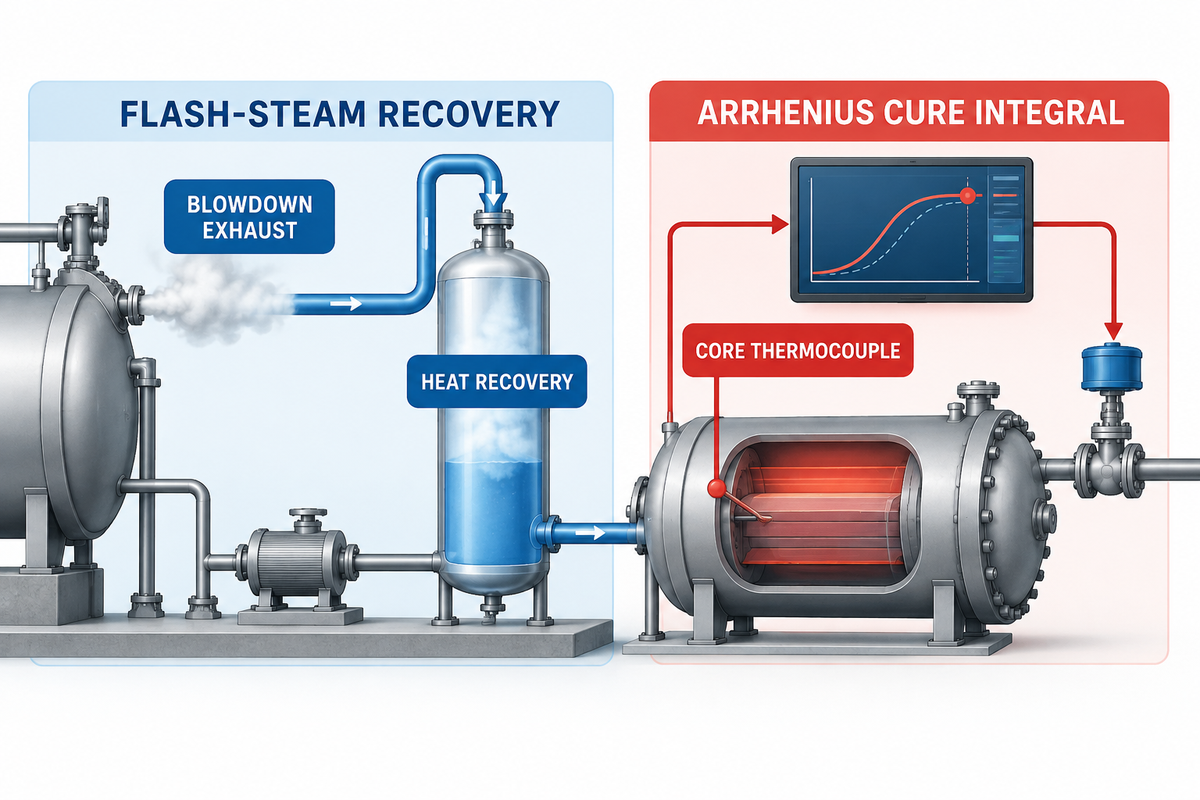
Increased fuel costs and regulations mandating plant decarbonization in 2026 are driving multi-vessel rubber plants to install two high-return process improvements. This upgrade prevents natural rubber reversion and adds extra batch capacity per shift. Staggered blowdown flash-steam cascading substantially reduces fuel consumption and dwell time for buffer tanks. Real-time PLC Arrhenius cure integration achieves the same benefits for buffer tank heating.
In a conventional direct-steam shop, venting a Φ2.0 m × 6.0 m chamber from 0.60 MPa gauge to atmosphere wastes 69 kg of high-enthalpy steam per cycle. Staggering the schedules of two or more vessels allows a cross-over header (as detailed in European Patent EP3565715B1 for vulcanization systems with steam buffer vessels) to link the exhausting chamber to a cold, loaded chamber or accumulator. Pressure equalizes within minutes and pre-heats cold steel mandrels from 25 °C to over 100 °C before the main boiler valve opens.
Modern PLC panels replace fixed dwell timers with real-time Arrhenius integration.
Cure Equivalent F eq = ∫ exp[ (E a / R) × (1 / T ref − 1 / T core (t)) ] dt
Using an activation energy Ea of 85-105 kJ/mol for sulfur-cured diene rubbers, the PLC uses a trailing PT100 probe to integrate core temperature for ramp-up and cool-down. Instead of padding every cycle with extra minutes of safety buffer, the controller starts cooling the exact second the core hits target modulus.
Engineering Pre-RFQ Data Checklist for Autoclave & Boiler Sizing
Before requesting an engineering drawing and boiler proposal, the plant should verify that these six conditions are met:
- State the elastomer and curative chemistries. Do compounds use sulfur-cured NR/SBR/NBR (direct Djuzal eligible) or peroxide-cured EPDM/Silicone/FKM (indirect Djuzal requiring hot air or nitrogen purge) chemistries?
- State the maximum workload envelope and mass. State the longest mandrel or largest roller diameter, rubber batch weight (kg), and steel mandrel or trolley weight (kg).
- State the desired cycle pressure and temperature. State maximum operating pressure (MPa g), cure temperature (°C) and decoupled air overpressure cooling.
- State internal fixture requirements. Choices include a 2-6 RPM motor drive roller, vacuum manifold for tire retreading, or trailing PT100 probes.
- Select the required pressure vessel certification code. Standard options include ASME Section VIII Div. 1 (U-Stamp and NB registration), EU PED 2014/68/EU CE mark, or GB/T 150 / DOSH / MOM.
- State your steam boiler supply status. State existing header pressure and spare capacity (kg/h), or request gas, oil, biomass, or electric steam boiler.
Frequently Asked Questions
What is the typical operating temperature and pressure of a rubber vulcanization autoclave?
Most industrial rubber vulcanization autoclaves operate at 120 °C to 190 °C (standard 140 °C to 180 °C) under a chamber pressure of 0.205 to 1.0 MPa gauge (30 to 145 psi). Natural rubber and SBR compounds typically cure at 142 °C to 155 °C under 0.4 to 0.6 MPa to avoid reversion. Conversely, EPDM, NBR, and silicone profiles run at 160 °C to 180 °C under 0.6 to 1.0 MPa of steam, hot air, or nitrogen overpressure.
Why do thick rubber rollers and tank linings require stepped heating and pressurized cooling in an autoclave?
Thick rubber rollers (25 to 80 mm cover) and tank linings require stepped heating because rubber has a low thermal diffusivity of ~0.11 mm²/s. Fast single-step heating overcures the outer skin before the steel bond line reaches vulcanizing temperature. Holding an intermediate dwell below 110 °C equalizes core heat. During cool-down, holding 0.5 to 0.7 MPa air overpressure until the core drops below 85 °C prevents dissolved moisture from flashing into blisters.
What is the purpose of applying nylon cure wrap or cotton tape before autoclave vulcanization?
Spiral-wrapping uncured hoses and rollers with wet nylon cure tape exerts radial mechanical compaction as the tape shrinks thermally above 110 °C. This radial force expels trapped inter-ply air and compacts rubber into fabric or wire reinforcement weaves. It also resists sag during the low-viscosity scorch window and protects peroxide compounds from contacting dissolved oxygen or condensate.
Can you vulcanize peroxide-cured EPDM or silicone rubber in a direct live-steam autoclave?
Unwrapped peroxide-cured EPDM and silicone extrusions should not be cured in open direct steam or hot air. Condensing water spots the surface and atmospheric oxygen quenches free-radical crosslinking, leaving a tacky skin. Instead of direct steam, instruct a nitrogen-purged indirect autoclave, or wrap the part, which has a built-in mandrel, with multiple layers of nylon barrier tape.
How often should the inflatable silicone door gasket on a quick-opening autoclave be replaced?
Replace steam- or air-inflated silicone door gaskets every 800 to 1,500 batch cycles during preventive maintenance. High-tear fluorosilicone seals prevent blow-by leaks during pressurization.
How do you match a steam boiler or steam accumulator to multiple rubber vulcanization autoclaves?
Never size a central steam boiler by multiplying the steady holding consumption across all autoclaves.Cold ramp-up draws much more steam than the cure dwell. First, stagger batch start times by 35 to 45 minutes so that the biggest steam fill valves on the largest vessels never open at the same time. Second, size the boiler to cover the peak 30-minute ramp draw of the largest vessel (1,150 to 1,400 kg/h for a Φ2.0 m × 6.0 m autoclave) plus the steady holding load (115 to 250 kg/h each) of all other vessels running in parallel. Finally, if production schedules require consecutive batch ramps, install a high-pressure steam accumulator between the boiler and autoclave header. The accumulator will absorb the flash steam and prevent boiler water from foaming over.
References & Sources
- U.S. Environmental Protection Agency (EPA). AP-42 Section 4.12: Manufacture of Rubber Products — Autoclave Curing Temperature and Pressure Ranges.
- American Society of Mechanical Engineers (ASME). ASME Boiler and Pressure Vessel Code (BPVC) Section VIII Division 1: Rules for Construction of Pressure Vessels (UG-35.2 Quick-Actuating Closures & UG-99 Hydrostatic Tests).
- European Commission. https://single-market-economy.ec.europa.eu/sectors/pressure-equipment-and-gas-appliances/pressure-equipment-sector/pressure-equipment-directive_en. Pressure Equipment Directive (PED) 2014/68/EU — Technical Safety Requirements for Autoclaves and Pressure Vessels.
- Spirax Sarco Engineering. Spirax Sarco Engineering. Steam — The Energy Fluid: Latent Heat of Evaporation, Specific Heat Capacity, and Condensing Heat Transfer Tables.
- TLV International, Inc. Vulcanizing Autoclave Initial Air Removal: Dalton’s Law of Partial Pressures and Temperature Uniformity Improvement.
- Olmar S.A. “Industrial Rubber Vulcanisation Autoclaves: Standard Pressure and Temperature Crosslinking Profiles.”
- Maschinenbau Scholz GmbH & Co. KG. https://www.scholz-autoclaves.com/en/systems/vulcanisation-systems-tyre-recapping-autoclaves. Vulcanisation Systems & Tyre Recapping Autoclaves with Scholz Bayonet Quick-Closing Door System.
- Bondtech Corporation. Custom Rubber Vulcanizing Autoclaves for Industrial Hose, Rollers, Cable Jacketing, Tank Linings, and Tire Retreading.
- Akarmak. “Purging Methods in Rubber Autoclaves and Their Effect on Process Quality.”
- Autotherm Equipments Pvt. Ltd. Rubber Vulcanizing Autoclave Technical Specifications: Shell Wall Thickness, Uniformity, and Vessel Weight.
- Rubber-Mexico. Mandrel-Formed Hoses Manufacturing Process Explained: Nylon Wrapping and Steam Autoclave Vulcanization.
- Consteril. https://consteril.com/common-autoclave-problems/. Common Autoclave Operational Problems: Chamber Overloading, Steam Flow Obstruction, and Incomplete Cycles.
- Eng-Tips Engineering Forums. https://www.eng-tips.com/threads/problem-in-epdm-based-rollers.455657/. Problem in EPDM-Based Rollers: Pre-Cure Dwell Below 110 °C, Pressure Wrapping, and Steam vs. Hot-Air Autoclave Control .
- European Patent Office (EPO). “EP3565715B1: Vulcanisation System with Steam Accumulator Buffer for Exhaust Steam Recovery.”