Get in Touch with Taiguo


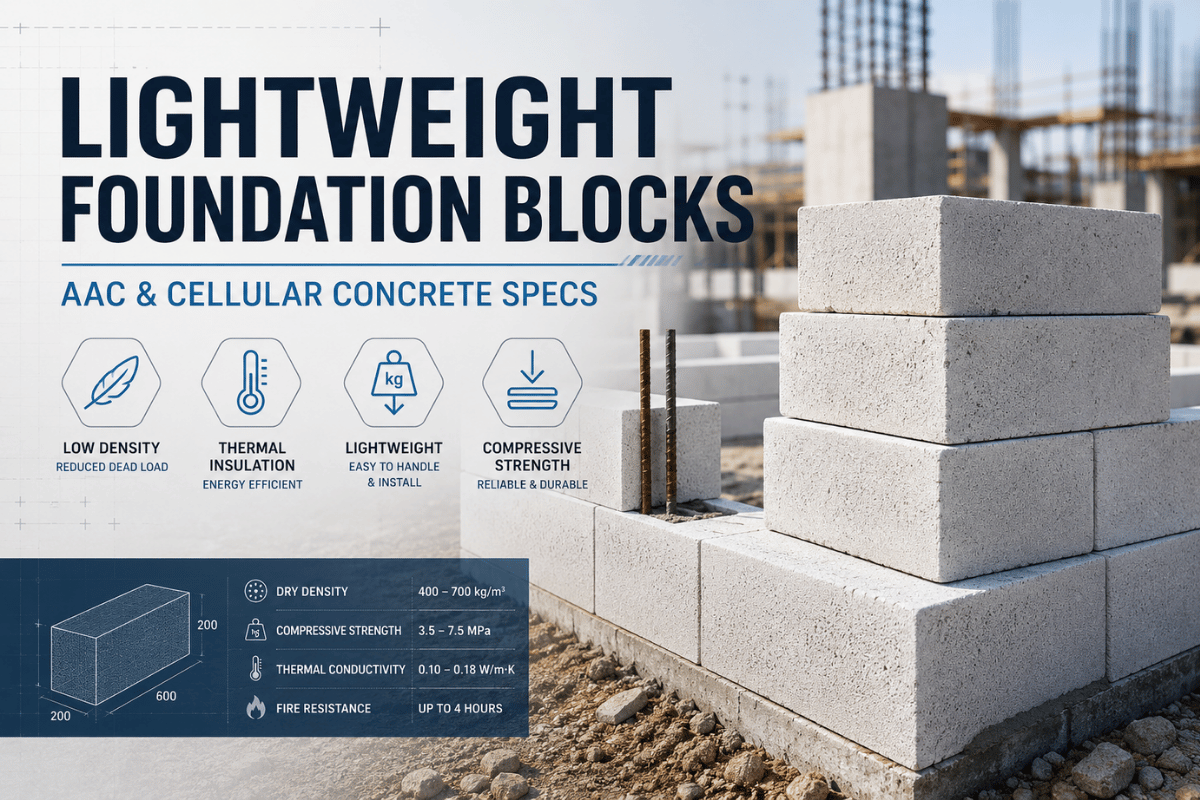
Quick Specs: Autoclaved Aerated Concrete Block
| Dry Density Range | ²5–50 lb/ft³ (400–800 kg/m³) |
| Compressive Strength | ²90–1,090 psi (².0–7.5 MPa) |
| Nominal Face Dimensions | 8 in × ²4 in (²0³ mm × 610 mm); thickness ²–16 in |
| Unit Tolerance | ±1/8 in (±³ mm) |
| 8 in Wall R-Value | R-8 to R-10 steady-state (R-1.0 to R-1.²5 per inch) |
| Fire Resistance | 4 hours at 4 in thickness (ASTM E119, UL listed) |
| Governing Standard | ASTM C169³ (units); C1660 (mortar); C169² (construction) |
| Typical 8×8ײ4 Block Weight | ~³³ lb (15 kg) — roughly one-third of standard CMU |
What Are Lightweight Foundation Blocks? Three Categories Defined

“Lightweight foundation blocks” is a blanket term covering several distinct masonry products, and the confusion over which is which costs designers real money. There are three types of product that are important for engineered foundation work:
Autoclaved Aerated Concrete (AAC) is a factory pre-cast block with its air-cell structure formed by a chemical change occurring when aluminum powder is added to a cement-lime slurry, and then cured in an autoclave machine under pressure; the process usually takes between 8 and 1² hours. The cured product is on average 80% air, and weighs in between 25-50 lb/ft³ (between 1/3 and 1/5 of concrete). AAC was developed by Swedish architect Johan A×el Eriksson in 1924, and it is currently being manufactured in over 300 factories.
Cellular concrete (also sometimes known as “lightweight cellular concrete”, LCC or CLC concrete), is a preformed-foam or chemical-foaming material that is mi×ed and placed in its final location, on-site, rather than precast in a factory. Densities range from 25psf to 115psf (much larger variation than AAC.). Is governed by ACI 523.3R-14 for non-loadbearing cellular concrete buildings, with the ACI 523.1R specs providing guidance for low-density structural cellular concrete pours.
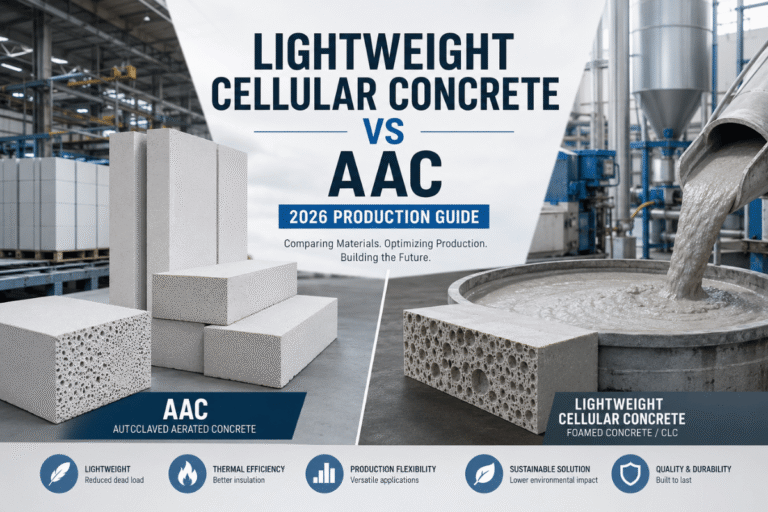
More often cellular concrete is used as a flowable fill, than as a block. Cast block cellular concrete shapes do e×ist. See the comparison guide on production methods below Cellular Concrete vs AAC: 2026 Production Guide.
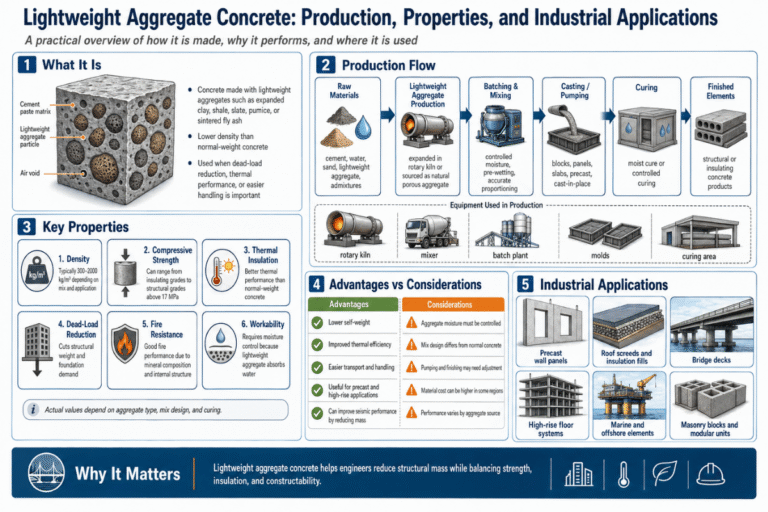
The other lightweight masonry units (lightweight CMU, e×panded-clay-aggregate blocks, pumice block, and small-format pier blocks) are not included in this AAC/cellular family. The compare-and-contrast of all six types of lightweight concrete can be found in our profile of lightweight concretes.
| Material | Manufacturing | Density Range | Foundation Use |
|---|---|---|---|
| AAC | Factory autoclave-cured, 8–12 hr at ~190 °C / 1.2 MPa | 25–50 lb/ft³ | Above-grade walls; conditional below-grade |
| Cellular concrete (cast block) | Foam-injected; on-site mi× or precast | 25–115 lb/ft³ | Mostly non-loadbearing infill; flowable fill |
| Lightweight CMU | Conventional concrete with lightweight aggregate | 85–115 lb/ft³ | Standard foundation walls per IBC Chapter 18 |
AAC and cellular concrete are the two materials that truly alter the behavior of a foundation wall- they substitute weight (mass) with air, which has numerous knock-on effects for weight, insulation performance, speed of installation, and limiting factors below grade. 85% of this guide discusses AAC because there is only one canonical North American standard (ASTM C1693), a supply chain matured in the United States, and predictable engineered performance. Cellular concrete appears as a comparison datum or for specific applications.
One more thing to note about specs: AAC blocks are cured in an industrial-autoclave-guide“>industrial autoclaves– pressure vessels similar to those used to vulcanize rubber and preserve wood. It is during the autoclave cycle that the slurry is converted to the calcium-silicate-hydrate mineral structure (tobermorite) which provides AAC with its strength and dimensional stability.
Disambiguation: Did You Mean Deck or Shed Pier Blocks?

A familiar set of terms is worth defining. If you searched for “lightweight foundation blocks” and found yourself on Home Depot, Amazon, or a deck-build forum, you probably found references to pier blocks—small precast concrete or plastic pieces (TuffBlock, CAMO Deck Block, ICCF Perfect Block) that rest on the ground as point supports for sheds, decks, and small outbuildings. Those are about 7-15 inches square and weigh 5-10 pounds each.
Those are a different set of products.
This guide employs the application of these full-size masonry blocks- 8in. by 24in. face dimensions and 4in to 16in.thickness- to form continuous foundation walls. The construction process involves stacking the course by course with thin bed mortar and additional reinforcement, such as rebar, in the cells or bond beams when needed to counterbalance the imposed load and on completion, applying the required code compliant coating system.
| Use Case | Right Product Class |
|---|---|
| 10×12 backyard shed; deck post supports; storage shed point loads | Precast deck pier blocks or instant-foundation systems (small format) |
| Residential basement wall; commercial stem wall; load-bearing perimeter foundation; retaining walls | AAC, cellular concrete, or conventional CMU — covered in this guide |
Unfortunately if you’re in the first group, the rest of this article won’t be very helpful; the small-block deck-foundation universe is a subject unto itself. Read below if you are considering lightweight masonry as a true foundation system.
AAC Block Specifications: Density, Strength, Dimensions

The ASTM C1693 standard specification on unreinforced AAC masonry units is used to control the behaviors of AAC. ASTM C1693 specifies expansion, general, quality, and dimensions standard, and it also groups AAC by strength classes on the basis of characteristic compressive strength. Nominal dry density is used to define strength class.
Denser AAC means more cement-silicate matrix packed into air-cell system.
ASTM C1693 Strength Classes
The following table combines the ASTM C1693 strength class structure in a single reference. This information is obtained from the published technology brief by the International Masonry Institute on AAC masonry units which quotes the ASTM C1693 Table 1.
| Strength Class | Compressive Strength | Nominal Dry Density | Density Limits |
|---|---|---|---|
| AAC-2 | 290 psi (2.0 MPa) | 25 lb/ft³ (400 kg/m³) | 22–28 lb/ft³ |
| AAC-4 | 580 psi (4.0 MPa) | 31 lb/ft³ (500 kg/m³) | 28–34 lb/ft³ |
| AAC-6 | 870 psi (6.0 MPa) | 37 lb/ft³ (600 kg/m³) | 34–41 lb/ft³ |
| AAC-4 (higher density variant) | 580 psi (4.0 MPa) | 44 lb/ft³ (700 kg/m³) | 41–47 lb/ft³ |
| AAC-6 (higher density variant) | 870 psi (6.0 MPa) and above | 50 lb/ft³ (800 kg/m³) | 47–53 lb/ft³ |
For the majority of U.S. foundation applications, we typically specify AAC-4 (580 psi at 31 lb/ft) as the default specifiable class – pack enough load to work for low-rise residential and light commercial applications, while maintaining the weight benefit that makes the AAC worth specifying over the CMU. AAC-6 adds the capacity for tall wall assemblies and seismic-design-category D areas where shear walls require a higher fc’. AAC-2 is almost never the prescriptive choice for primary foundation walls, generally only used for the interior partitions and non-loadbearing infills.
Block Dimensions and Tolerances
Typical AAC block face measures 8in high by 24in long (203mm610mm), with the following thicknesses available; 2, 4, 6, 8, 10, 12 and 16 inches. Actual net dimensions are 7-7/8in by 23-7/8in ( 1/8 in lower than the stated dimension to allow for a 1/16 to 1/8 in thin-bed mortar joint) and the units are manufactured to either + or 1/8 in. of the specified dimension which is sufficiently accurate that wall plumb lines and modular layout are easier than with conventional CMU.
Major U. S. producers of specialty shapes have U-shaped bond-beam (horizontal rebar courses) units, cored units (vertical rebar and grout), groove-and-tongue units (vertical joints without mortar), and lintel units. For production-housing, 24 24 in or 32 24 in are produced in a jumbo form.
What Are the Lightest Concrete Blocks?
The lightest commercial-masonry units are AAC-2 class blocks on the bottom end of the ASTM C1693 volume-density range- about 22 to 28 lb/ft dry density. Draw comparison to a standard hollow block- 75 to 115 lb/ft with normal-weight versus lightweight aggregate – and 120 lb/ft for a fired brick. AAC-2’s are at the low-volume end of the cellular concrete range (25 lb/ft) and cellular concrete at its low end, matching the 22 to 28 lb/ft density range of AAC-2 is possible for cellular concrete. An 8 8 24 in standard-sized (33 lb) AAC block is a typical lightweight cast, weighing nicely in the range of a single handmun to lift – which is patent reason for AAC’s cost advantage over normal-weight CMU masonry.
Cellular Concrete Blocks: Specifications and Where They Differ from AAC
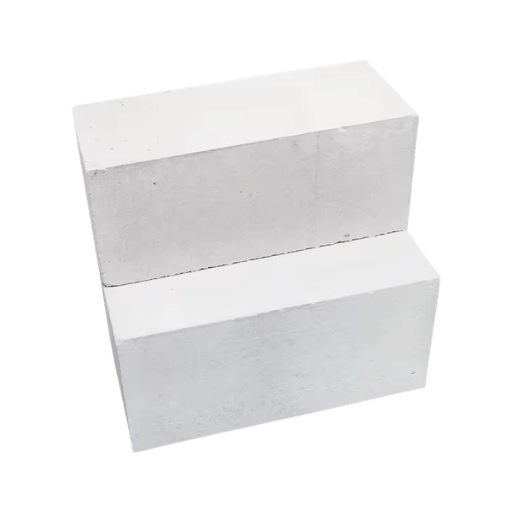
Cellular concrete and AAC are loosely defined as “lightweight foamed concrete,” but, more accurately, cellular concrete and AAC diverge in the processes of their manufacture, volume densities, and code frameworks. Avoiding confusing cellular concrete for AAC or vice versa prevents specifying the wrong product when designing for load and e×posure.
Cellular concrete is combined in a slurry process in which preformed foam,created in a separate foam generator by reacting protein or synthetic-based surfactants, is mi×ed into a Portland-cement-water formula. The foamed slurry is either cast in place (flowable fill in e×cavations and trenches, shot in e×tension if a long line is needed) or cast into block molds for cellular concrete block manufacturing. Since cellular concrete is cast in air (unlike “pressure”-curing AAC), its cast mineral structure is a conventional calcium-silicate-hydrate, not the tobermorite found in autoclaved-1AAC. This auto-inert structure introduces porosity, variability, and sensitivity to mi× water and cure-conditions.
| Property | AAC (ASTM C1693) | Cellular Concrete (ACI 523.3R) |
|---|---|---|
| Manufacturing | Factory precast, autoclave-cured | Cast in place or precast, atmospheric cure |
| Mineral phase | Tobermorite (calcium silicate hydrate) | Conventional cement paste |
| Density envelope | 25–50 lb/ft³ (tight, predictable) | 25–115 lb/ft³ (broad, mi×-dependent) |
| Compressive strength | 290–1,090 psi | 100–1,200 psi (mi× and density dependent) |
| Dimensional stability | Linear shrinkage ≤ 0.020% | Higher shrinkage; mi×-sensitive |
| Block format availability | Widely available in U.S. (Aercon, NW AAC, Hebel) | Limited block product; mostly flowable fill |
| Governing standard | ASTM C1693, C1660, C1691, C1692 | ACI 523.1R (structural LDCC); ACI 523.3R (cellular) |
| Foundation suitability | Loadbearing above grade; conditional below | Mostly non-loadbearing; fill/insulation roles |
What Is as Strong as Concrete but Lighter?
The blunt answers is “a whole bunch of precious little- nothing in the family of AAC/cellular concrete can approach standard-weight concrete in truecompressive strength.” As a contrast, a typical 4K psi -0.35 yield-structural-conrete packs roughly four-fold the compressive strength, by volume, ofcellular concrete’s 0.25 F’ at 17 F’ empty mass volume ratio and AAC-6s at 0.15 F’ at 30 F’ empty volume inde×. What lightweight CMU-cast style blocks deliver is a different equation in which AAC penetrates the supply-limited space of load-bearing, low-rise constructing unless special conditions are met to require higher loads. AAC has application capacity for a basement wall supporting several residential floors (290 to 1,090 psi) from its management of wall mass (rough 2/3 wall weight salvation) as well as an inherent thermal insulation value-in-a-bo× (per a 2024 ETABS-based AAC vs brick structural study). The weight reduction relative to cellular concrete foundation walls accounts for a 15-20% cinderblock footing reduction for specific structural calculations.
Compressive Strength Classes and Building Code Compliance

The code validation chain that supports AAC foundation design is threefold: ASTM C1693 for manufactured units, ASTM C1660 for thin-bed construction mortar, ASTM C1692 for construction and testing method and International Building Code Chapter 18 for foundation system capacity. Structural AAC behind reinforced mo.
Reading Characteristic Strength Correctly
ASTM C1693 reports a characteristic value (f’AAC) 9 rather than the absolute lab cube strength value. It is appro×imately 0.85 times the lab cube average, to accommodate variations in the manufacturing process: when applied in structural design by the ACI 523.4R authors it is further reduced by a factor of roughly 1/1.85 to specify allowable design values much lower than the rated class strength. The takeaway: when “AAC-4” appears on a submittal hand signal we know that cubes are testing at roughly 580 psi average, the nominal characteristic strength used for code calculations is about 490 psi, and the permissible design stress in load calculations before load factors are roughly 265 psi.
📐 Engineering Note — Strength Class vs Design Stress
Please do not apply that 580 psi value to an AAC wall bearing capacity calculation: apply the 0.85 characteristic strength reduction (roughly 490 psi) and ACI 523.4R reduction factor before assuming static bearing capacity in your load determination. For DSS designs, AAC walls in seismic category D jurisdictions should be specified at minimum AAC-4, with AAC-6 preferred for shear walls and high lateral force designs. Contact a licensed structural engineer for structural AAC wall designs supporting gravity and/or seismic loads.
IBC Code Paths
In manufacturer literature if “compressive strength 580 psi” appears for AAC-4, the structural designer should not simply use that number in a wall loading calculation. The 0.85 characteristic strength reduction and the code reduction factor of ACI 523.4R must be applied first. For seismic category D regions, structural or load-bearing AAC walls should be specified at a minimum of AAC-4, particularly at high seismically loaded locations; AAC-6 preferred at shear walls and locations with high lateral loads. Always consult a licensed structural engineer for any load-bearing AAC walls.
- For the latest code approval path as referenced in the IBC 2024 (Chapter 21 Masonry and Chapter 18 Foundations) you will find AAC approved as a masonry material via specification to ACI 530.4/ TMS 402. AAC has more than 50 UL fire-resistance listings, third-party approvals from the ICC-ES, and certification from the Accoleum-Aercon-Magnetite Producers Association (AA/C PAC). Specific code circumstances for AAC are detailed:
- IBC 2103 – Masonry construction materials, including AAC unit specifications,
- ✔IBC § 1809 — Shallow foundations
- IBC 1807 – Foundation walls (load and lateral pressure),
- IBC Chapter 7 – Fire and smoke protection (UL rated up to 4 hours at 4 in),
TMS 402-22 – Building Code Requirements for Masonry Structures(contains specifications for AAC in reinforced conditions),
Foundation Use Cases: Where Lightweight Blocks Work and Where They Don’t
Air-permeance under continuous air barrier requirements per IECC and IBC: tested at no more than 0.004 cfm per square foot wall area at 1.57 psf differential pressure. Well below the 0.04 cfm per square foot ma×imum required for air barrier materials. AAC doubles as an efficient air barrier material, resulting in simplified envelope detailing.
| Foundation Element | AAC | Cellular Concrete | CMU (Reference) |
|---|---|---|---|
| Slab-on-grade (the slab itself) | ❌ Not applicable — slab is poured concrete | ⚠ As subslab void fill only | ❌ Not applicable |
| Spread footing / strip footing | ❌ Not recommended — use poured concrete | ❌ Not recommended | ⚠ Rarely specified; poured concrete is standard |
| Stem wall (above-grade portion above footing) | ✅ Suitable — AAC-4 or higher with reinforced bond beam | ⚠ Conditional — low strength limits height | ✅ Standard |
| Frost wall (e×tends below frost depth) | ⚠ Conditional — requires continuous damp-proof membrane + perimeter drain | ❌ Not recommended for frost-line work | ✅ Standard with damp-proofing |
| Basement wall — above-grade portion | ✅ Suitable — primary strength application for AAC | ❌ Insufficient strength for typical lateral loads | ✅ Standard |
| Basement wall — full below-grade in freeze-thaw climate | ⚠ Conditional — only with continuous exterior damp-proof membrane, capillary break, and perimeter drainage; AAC manufacturer review required | ❌ Not recommended | ✅ Standard with damp-proofing |
| Crawl space wall | ✅ Suitable with vapor barrier on interior | ⚠ Conditional | ✅ Standard |
The debate that most AAC specifier discussions revolve around is whether the material is suitable for below-grade e×posure. The answer is yes, but only under certain conditions which are not trivial; the following decision matrix would guide the appropriate assessment of the material with respect to the foundation element in question.
📐 Engineering Note — Below-Grade AAC Detail Requirements
Specifications for AAC below grade should specify that: (1) an uninterrupted damp-proof membrane should be applied to outside face of wall (asphaltic or polymer-modified bitumin), (2) in the wall-footing interface a capillary break should be placed in the form of a strip of polyethylene or self adherent membrane, (3) free-draining backfill should be installed (sand or pea gravel with perimeter drain pipe set at footing level), and (4) an oxygen diffusion permeable interior finish should be used (do not apply non-oxygen diffusion permeable coatings to both surfaces simultaneously that produces a moisture-trap as per ASTM C1692). If any of above is omitted then the high-Moisture-absorption profile of AAC turns into a moisture-trap structure comparable to a conventional CMU that is also susceptible to freeze-thaw cycles. Field reports from building science forums tell us that parge-coat only detail becomes a problem in zone 5 residential climate.
Common Mistakes in AAC Foundation Specs
Three common mismatches which show up in submittals from sites where AAC plant’s technical services have been involved First, the project budget is tight so the architect specifies for basement walls the “lowest strength” class, AAC-2. AAC-2 cannot reliably accommodate typical residential lateral earth pressures, and the little extra cost of using the next higher strength class of AAC-4 makes it the practical default. Second, the protective coating on the exterior is value-engineered to a single coat of breathable acrylic – without a damp-proof membrane underlying it.
The single-coat is fine when used as above-grade rainscreen, but not below-grade. Third, AAC is specified for footings and slabs (since it is not a poured product the specifications must say “conventional concrete” for those and specify the AAC within the stem wall.)
AAC vs CMU vs Cellular Concrete: Side-by-Side Comparison

Our decision matrix described in the previous section answered the question “where can lightweight blocks work?”. This section answers “if the same application, for example a residential basement stem wall were to be built, which of the two materials would win on the dimensions that are important in the project?” The comparison is made with all three materials at a standard 8 inch nominal thickness.
| Dimension | AAC-4 (8 in) | Cellular Concrete Block (8 in) | Standard CMU (8 in, hollow) |
|---|---|---|---|
| Density | 31 lb/ft³ | 25–60 lb/ft³ (mix-dependent) | 85–115 lb/ft³ |
| Compressive strength (f’AAC or f’m) | 580 psi (4.0 MPa) | 200–600 psi | 1,500–3,000 psi |
| Wall R-value (steady-state) | R-8 to R-10 | R-6 to R-12 (density-dependent) | R-1.4 to R-2.5 (empty cores) |
| Fire resistance (rated assembly) | 4 hours (at 4 in) | 2–4 hours (mix-dependent) | 2 hours (unfilled cores) |
| Sound Transmission Class (STC) | ~45–50 (8 in wall + plaster) | ~40–50 | ~48–52 |
| Installed cost — Q1 2026 estimate | ~$2.80–$3.20/ft² (block + thin-bed) | ~$2.40–$3.50/ft² | ~$2.20–$2.60/ft² (block + masonry mortar) |
| Install speed multiplier vs CMU | ~1.7× to 2× faster (large units, low weight) | Similar to CMU | 1.0 (baseline) |
| Code path | ASTM C1693 + TMS 402 | ACI 523.1R / 523.3R | ASTM C90 + TMS 402 |
Per Q1 2026 cost notation: the AAC price range above is approximately 25 to 30 percent more expensive than the popularly reported 2018 range of 2.20 to 2.50/ft, which was taken from manufacturer literature of that era and is an overall indicator of construction materials general rate of inflation. Be mindful of local pricing dynamics (proximity to the nearest AAC manufacturing facility in addition to order size); transportation costs will govern for any project greater than 500 miles away from a pellet plant. Market pricing will swing (they will give a quote, get one before committing to your bid).
✔ AAC Advantages
- Absorbs ~65% less for regular CMU -footing and labor handling cost of use.
- Wall doubles as insulation (R-8 to R-10 monolithic)
- Wall doubles as air barrier (≤0.004 cfm/sf permeance)
- 4-hour fire rating at 4 in thickness
- Excellent acoustic insulation (60–70% air content)
- Routes easily for MEP — cut with carbide-tooth handsaw
⚠ AAC Limitations
- Less compressive strength than CMU reinforced design required for loadbearing
- Outside coating needed as per ASTM C1692 – increases cost of material and labor.
- High initial moisture pick-up negates cannot be mentioned in order below grade detailing of detail should be precise
- Few US producers—Aercon, Northwest AAC, imports of Hebel/Xella. The majority of the market and freight outside Southeast can be a major part of cost.
- Bond beams and lintels are also thermal bridges and will lower the effective wall R-value.
Thermal Performance: R-Value and Energy Code Compliance

The R-value discussion is where the crosswinds through the AAC marketing and engineering realities collide. Manufacturer literature commonly cites whole-wall R-values incorporating the “Dynamic Benefit for Massive Systems” (DBMS) thermal-mass credit. The steady-state R-value – the value entered into IECC envelope calculations – is less impressive:
| Wall Thickness | AAC-4 R-Value (Steady-State) | Per-Inch R |
|---|---|---|
| 4 in | R-4 to R-5 | R-1.0 to R-1.25 |
| 6 in | R-6 to R-7.5 | R-1.0 to R-1.25 |
| 8 in | R-8 to R-10 | R-1.0 to R-1.25 |
| 10 in | R-10 to R-12.5 | R-1.0 to R-1.25 |
| 12 in | R-12 to R-15 | R-1.0 to R-1.25 |
For IECC 2024 compliance, the relevant target is the prescriptive R-value for mass walls in each climate zone. Climate zones 1 to 3 will generally accept an 8 in AAC wall stock as described above (e.g. just changing to an 8 in AAC with no additional exterior insulation of blocks up to 12 in) in the prescriptive table. Climate zones 4 to 7 will generally require the addition of continuous exterior insulation (1 to 2 inches of EPS or XPS in most assemblies) added to an 8 in AAC wall in the prescriptive table. Climate zone 8 will generally require 12 in AAC with continuous exterior insulation, or an alternative compliance path.
One detail not frequently found in most product literature: bond beams and lintels in AAC walls are grouted concrete cores, which conducts heat at roughly 10 times the rate of the surrounding AAC. Engineers tracking effective whole-wall R-value need to account for this thermal bridging – a topic frequently discussed in building-science forums but rarely in product brochures. The bottom line is approximately a 10 to 15 percent reduction in clear-wall R-value when bond beams are at typical spacing.
Cost, Installation Speed, and US Procurement

Cost-on-paper for lightweight foundation blocks can be broken down into three material components: block, mortar/installation system, and finishes/protection. The 2018 baseline cost of $2.20 to $2.50/ft for AAC block material adjusts to roughly $2.80 to $3.20/ft in Q1 2026 dollars. In addition, thin-bed mortar adds $0.30 to $0.50/ft, and exterior coating (a breathable acrylic stucco or polymer-modified) adds another $1.50 to $3.50/ft. Total installed AAC wall in 2026 is expected to cost approximately $5 to $8/ft for an 8 in single-wythe assembly with code-required protection. (Note: cost on paper may not be representative of current market demand; confirm with active supplier quotes before bid!)
💡 Procurement Tip
AAC pricing is dominated by freight costs. Each pallet weighs approximately 2,000 to 2,400 lb and covers about 25 ft of wall; consolidating cost of a full-truck shipment (24 pallets is typical). Projects within 300 miles of a U.S. AAC plant reach baseline prices. Projects 500 to 1,000 miles away charge roughly a 15 to 25 percent freight surcharge. Beyond 1,000 miles, specification of an alternative material or planning for rail freight haul worth considering.
Install Speed
Labor advantage of AAC over CMU comes primarily two factors: (a) unit weight (one mason can place a 33 lb. AAC block in 2-3 minutes versus 50 to 80 lb. hollow CMU) and (b) unit size (a standard 8 x 8 x 24 AAC has approximately twice the face area as a 8 x 8 x 16 hollow CMU). Field-reported productivity gains range from 1.5 to 2 times faster wall placement compared to CMU, which corresponds to the lower end of the range when first-time masons work on AAC, and higher end for experienced AAC masons. Smaller crews also reduces co-ordination overhead costs.
U.S. Supplier Landscape (2026)
United States domestic AAC block production is very concentrated regionally with the following primary suppliers active in the 2025 to 2026 timeframe:
- Aercon AAC Industries (Haines City, Florida) was the largest U.S. manufacturer; heaviest supplier in the southeast and east coast; ships nationally on freight.
- Northwest AAC (Pacific Northwest) – second U.S. plant; uses ASTM C1693 specification; insures for the western U.S.
- Hebel / Xella USA- European AAC technology brand with U.S. distribution; supply flows through licensee networks and possibly some selective import
- Localized cellular-concrete block manufacturers- smaller and built-to-order; Cellular concrete admixture is also used with ready-mix plants to deliver flowable fill
Using an AAC product category name (e.g., “AAC-4 per ASTM C1693” ) along with manufacturer-or-equal on specifications provides ample flexibility for the design team while removing ambiguity with uncertain product designations.
How Much Does a Foundation Block Weigh?
Block weight distribution within lightweight-foundation-block line (block size 8 8 24 in):[4]11
Industry Outlook: AAC and Cellular Concrete Adoption 2026–2030
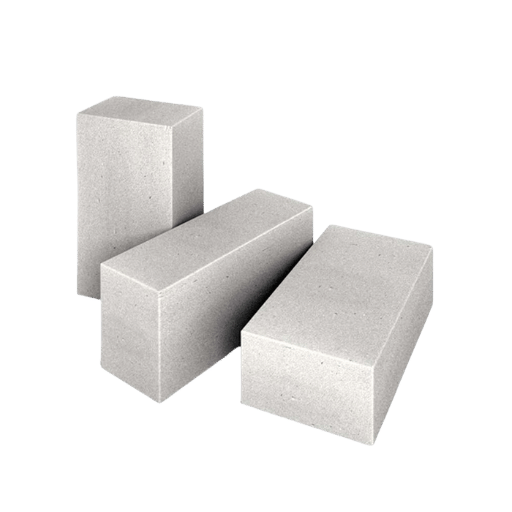
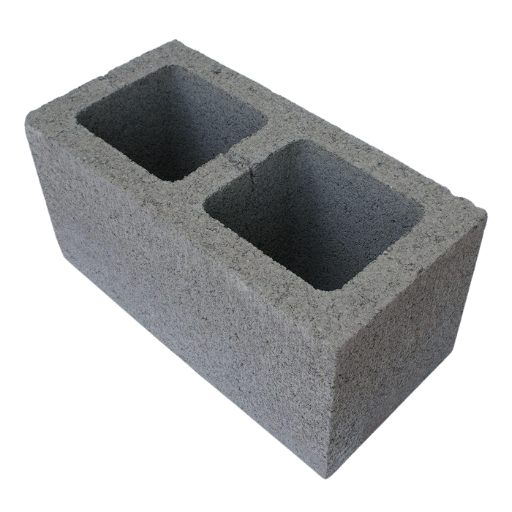
Block weight in this lightweight-foundation-block family changed sharply by product class. A standard 8 8 24 in AAC-4 block weighs around 33 lbs — calculated from a dry density of 31 Lb/cu ft spread across a 0.86 ft practical and face dimensioned face area. AAC-2 at lower density brings that to well under 30 pounds; AAC-6 at higher density push that close to 40 lb. In similar units, a hollow normal-weight CMU that measures 8 8 16 in weighs 30 to 38 Lb (similar weight per units, but covering a third less wall area per unit); a solid lightweight CMU at 8 8 24 in weighs 55–80 Lb. For a different class of loadbearing deck pier block, typical weight range is 5–25 lb.:
$22.5B
Global AAC market, 2025
6.3–7.4%
CAGR forecast through 2034–2036
$25B+
Projected 2036 market size
The three drivers behind the forecast:
This particular category of AAC-4 has exited the embryonic stage of market adoption. Several independent market-research sources confirm this in writing to a steady mid-single-digit CAGR through the next decade, driven by two long-term structural changes in the eastern U.S. construction market.
2014 IECC tightening. The current International Energy Conservation Code raises prescriptive R-value targets for above-grade walls in zones 4 through 7 and tightens continuous-insulation requirements. AAC walls, which carry their insulation in the mass of the wall, meet zone 4 prescriptive targets at 8 in without any additional cavity insulation. As code adoption waves through the country from 2014-2026, AAC becomes more cost-competitive by delivered-R-value against CMU-plus-exterior-foam systems.
Shortage of framing labor. Construction labor markets have been tight since 2022, and masonry trades have not been immune. 1.5-to-2 faster install time of AAC relative to CMU is an advantage by reducing worker numbers. This factor is structural; framing labor shortage projections extend to 2030 and beyond.
Embodied carbon disclosures. Public-sector and some institutional procurements are reported, increasingly, on life cycle and greenhouse-gas metrics such as embodied-carbon disclosures. AAC manufacturing consumes approximately half the energy of equivalent weight sheet/cm manufacturing, and the cellular makeup reduces cement requirements. Source procurement panels in the projects benefit from this feature.
Supplier side, U.S. AAC capacity constrain the speed with which ” demand” can be served. A high-pressure steam industrial autoclaves at ~ 190 C and 1.2 MPa for 8-12 hour cycles per batch of green-cut blocks for each AAC production line.
To the “manufacturer” side of the table, the autoclave is the gatekeeper for any expansion of an AAC manufacturing plant–our team has seen manufacturing plant managers increase output by 40-60% simply by adding a second autoclave rather than building an entirely new plant. For world-wide autoclave system specs and choice factors, refer to our industrial autoclaves library.
The practical implication for specifiers preparing 2026 and 2027 projects is that AAC represents a maturing, rather than niche, choice of material – and all projects in zones 4 to 7 should, at the very least, have an AAC alternative evaluated during value-engineering along with a typical CMU or ICF solution.
Frequently Asked Questions
Q: What are light weight blocks called?
View Answer
Lightweight masonry blocks are frequently identified as autoclaved aerated concrete (AAC) blocks, cellular concrete blocks or lightweight CMU. Autoclaved aerated concrete (AAC) is also known as “aerated autoclaved block,” “aerated brick,” and in conjunction with various product brand names such as “Hebel” and “Siporex”
Q: Can AAC blocks be used below grade for basement walls?
View Answer
Yes, with rigorous detailing. All AAC exposed to the elements must have an exterior protective coating, as specified in ASTM C1692. For exterior below-grade, the following items are required: continuous damp-proof membrane on the exterior face, capillary break at the wall-footing connection, free-draining backfill and perimeter drain at footing level.
For freeze-thaw climates (IECC zone 5 and colder), have the AAC manufacturer pre-approve the proposed assembly before design. Exposed AAC below grade cannot be left untreated or it will perform poorly – the high initial moisture absorption leads to problematic freeze-thaw penetration.
Q: Does AAC require special mortar?
View Answer
Yes. AAC employs very thin mortar joints (called a thin set or thin bed), a polymer-modified portland-cement mix (per ASTM C1660) which must be applied 1/16 to 1/8 in thick. The raw first course on the footing can be set with ASTM C270 standard mortar joints, but all subsequent bed and head joints are thin-set mortar applied with a notched trowel.
Standard full-bed joints (3/8 in) built with mortar are allowed but do not take advantage of precast block modularity.
Q: How much does an AAC block cost in the US?
View Answer
One 8 x 8 x 24 AAC-4 block is approximately $2.80 – $3.20/ft2 of wall in block material for a Q1 2026 purchase based on wall coverage. Add to that about $0.30 – $0.50/ft2 thin-bed mortar and about $1.50 – $3.50/ft2 for the needed exterior coating to maintain a healthy exterior wall. Installed cost is estimated at around $5 – $8/ft2 for a standard 8 single-wythe wall.
Freight from the nearest U.S. AAC plant (more than 500 miles away in some cases) can run 15 – 25 percent. Seek active supplier quote for up-to-date pricing, as these vary with cement, lime, and aluminum powder prices.
Q: Are AAC blocks code-approved in the IBC?
View Answer
Yes. AAC is approved as a UBC 2024 Chapter 21 (masonry) building material by reference to TMS 402/602 and ASTM C1693. AAC walls meet IBC Chapter 7 fire rating requirements (4 hours at 4 inch per UL listings) and Chapter 18 foundation requirements when constructed as reinforced masonry. The AACPA owns ICC Evaluation Service testing reports on the product approval.
Q: What is the lifespan of AAC foundation walls?
View Answer
With appropriate detailing and exterior adherence to IRC or IBC code, lightweight AAC wall systems have proven performance in Europe for over 70 years of building stock. America’s first factory installations in the late 1990s also show no systematically related product deterioration providing ASTM C1692 details are followed.
Related Articles
- Lightweight Cellular Concrete vs AAC: 2026 Production Guide: upstream comparison of cellular concrete and AAC manufacturing practices
- Lightweight Concrete: A Comparison of 6 Types (Cellular, AAC, Aggregate, Foam): comparison of all six lightweight categories
- Autoclaves for U.S. AAC plants and other vulcanized rubber productions (e.g. roofs, disks)
- Turning rubber into a vulcanized material in a pressure vessel
About This Specification Guide
Why We Wrote This Spec Guide
This lightweight foundation block guide pulls together ASTM C1693 strength-class figures, IBC building code options, and reported field limitations in one spot for specification professionals. It’s from the view point upstream from the block plant—this is where Taiguo produces the autoclaves, holds the autoclave process pressure vessels, and knows the physics behind why AAC behaves the way it does at a fundamental level. If you look around, there are OEM operators from over 100 countries reporting their AAC plant performance, so we use this report to tie the physics back to the application this document addresses.
References & Sources
- Autoclaved Aerated Concrete Masonry Units (Section 1.1, Technology Brief) — International Masonry Institute
- ASTM C1693 — Standard Specification for Autoclaved Aerated Concrete (AAC) — ASTM International
- IBC 2024 Chapter 18 — Soils and Foundations — International Code Council
- IBC 2024 Chapter 21 — Masonry — International Code Council
- IECC 2024 — International Energy Conservation Code — International Code Council
- ACI 523.3R — Guide for Cellular Concretes — American Concrete Institute
- Autoclaved Aerated Concrete — Wikipedia (background and history)
- AAC Blocks Market Size, 2034 — Global Market Insights
- Behavior of Autoclaved Aerated Concrete Blocks (ETABS Analysis) — ResearchGate academic study