Get in Touch with Taiguo


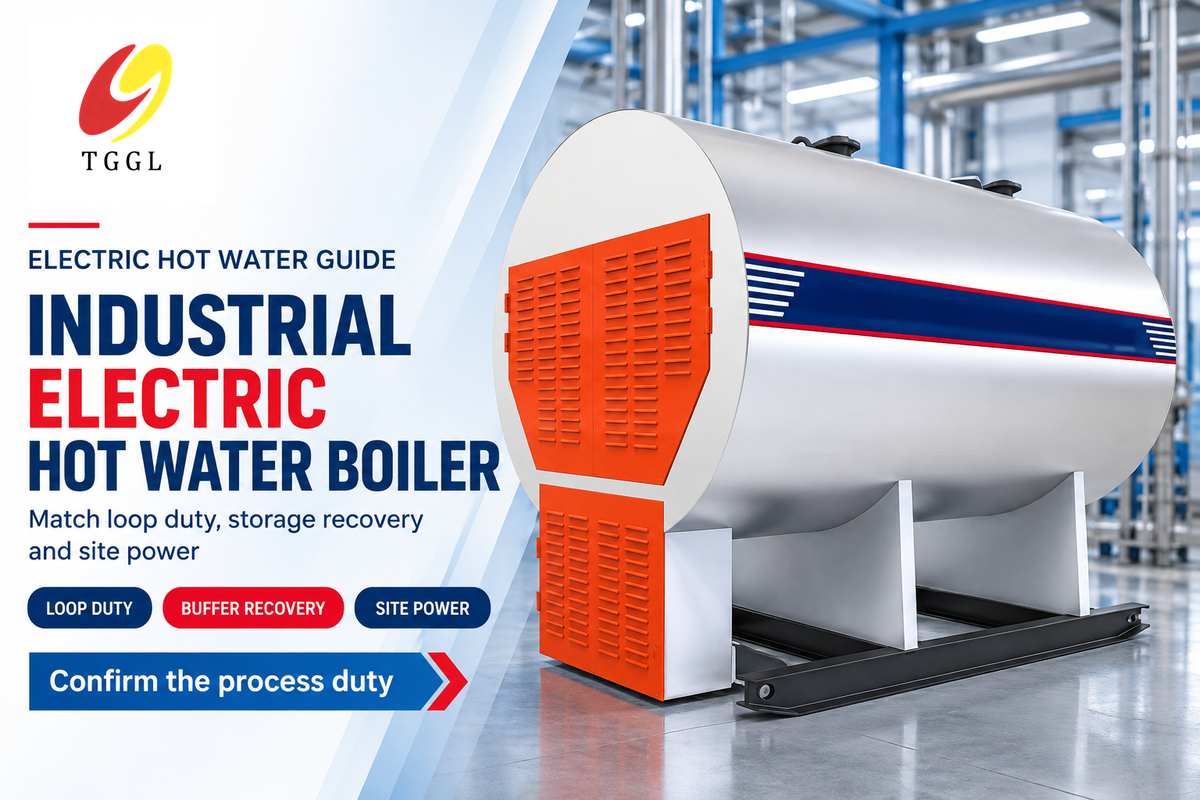
An industrial electric hot water boiler heats liquid water for a process or heat loop using electrical power. Selection starts with the heat required at the point of use, the timing of that demand and the electrical capacity available on site. Nameplate kilowatts alone leave too much unanswered.
A circulation loop returning warm water can need a lot less power than a wash line heating the same flow of cold makeup water. Storage adds another decision: A tank that covers one production peak may run short before the next.
Start with these measurements: water flow in m³/h, supply and return temperatures in °C, peak duration in minutes, time between peaks, and spare electrical capacity in kW. The worked examples below show how those inputs change the purchase.
What an industrial electric hot water boiler actually supplies
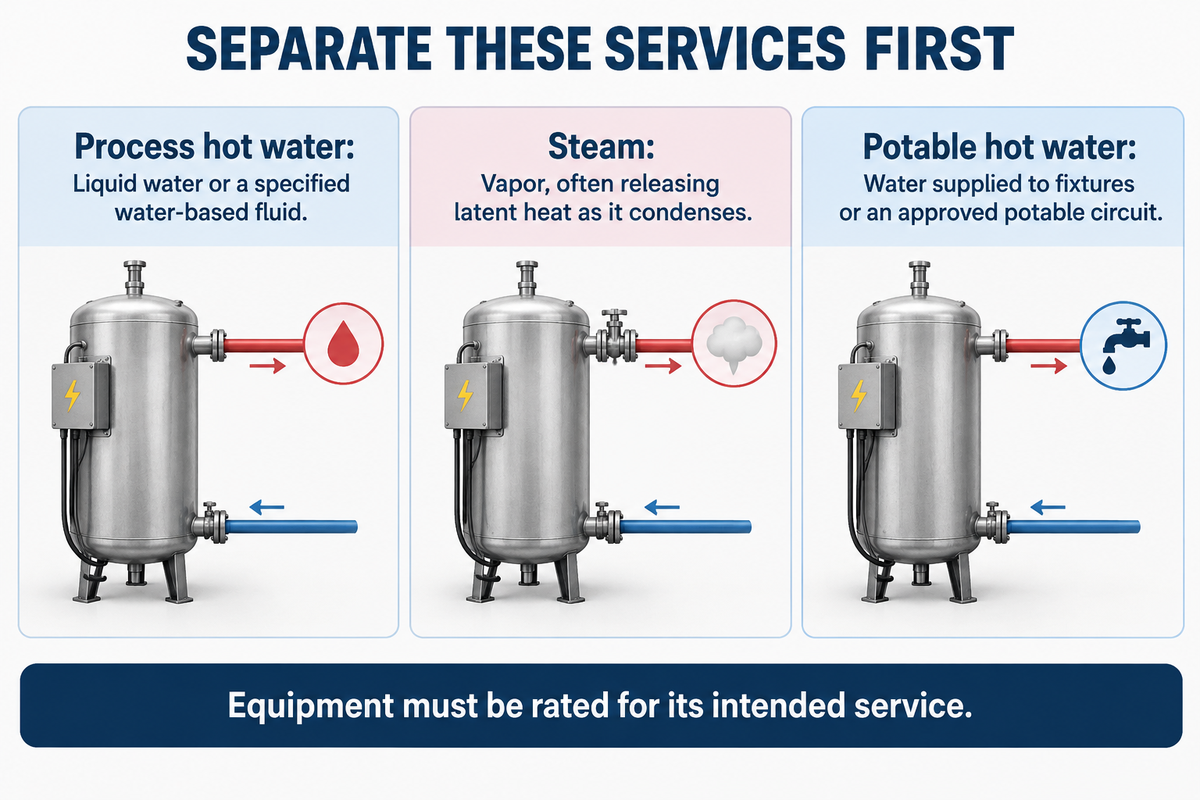
An industrial hot water boiler supplies heat in the form of liquid water, usually to a recirculating loop or to an intermediate heat exchanger. A steam boiler supplies vapor. A potable water heater supplies water for human use. The service boundaries, ratings, and the desired protection features will influence the final design of the heat system.
Commercial defines the market served, rather than a separate heating principle. A commercial water heater typically serves the building’s hot water draws, while an industrial process specification defines the fluid, temperature and pressure. In either case, the equipment must be rated for its intended service.
| Service | What carries the heat? | Useful purchase specification |
|---|---|---|
| Process hot water | Liquid water or a specified water-based fluid | Thermal kW, flow, supply/return temperatures and pressure |
| Steam | Vapor, often releasing latent heat as it condenses | Steam mass rate, pressure and feedwater conditions |
| Potable hot water | Water supplied to fixtures or an approved potable circuit | Draw profile, delivery temperature, materials and hygiene requirements |
ASME Section IV’s public scope distinguishes hot-water heating, hot-water supply and potable-water equipment. A catalog covering steam and hot water should define the service of each offered product.
How do electric boilers work?
In electric boilers, electrical energy is converted into heat. A resistance design uses electrical current to heat resistance elements that transfer heat to water; an electrode design uses the water’s electrical resistance between the electrodes. Controls adjust output to demand, while protective devices limit unsafe conditions. The selected design determines the water chemistry and the electrical installation.
A more complete technology comparison is in our industrial electric boiler guide. If the process actually requires vapor, use the large industrial electric steam boilers guide to define steam duty instead of converting steam kg/h directly into a hot-water rating.
Match the hot-water loop to the application
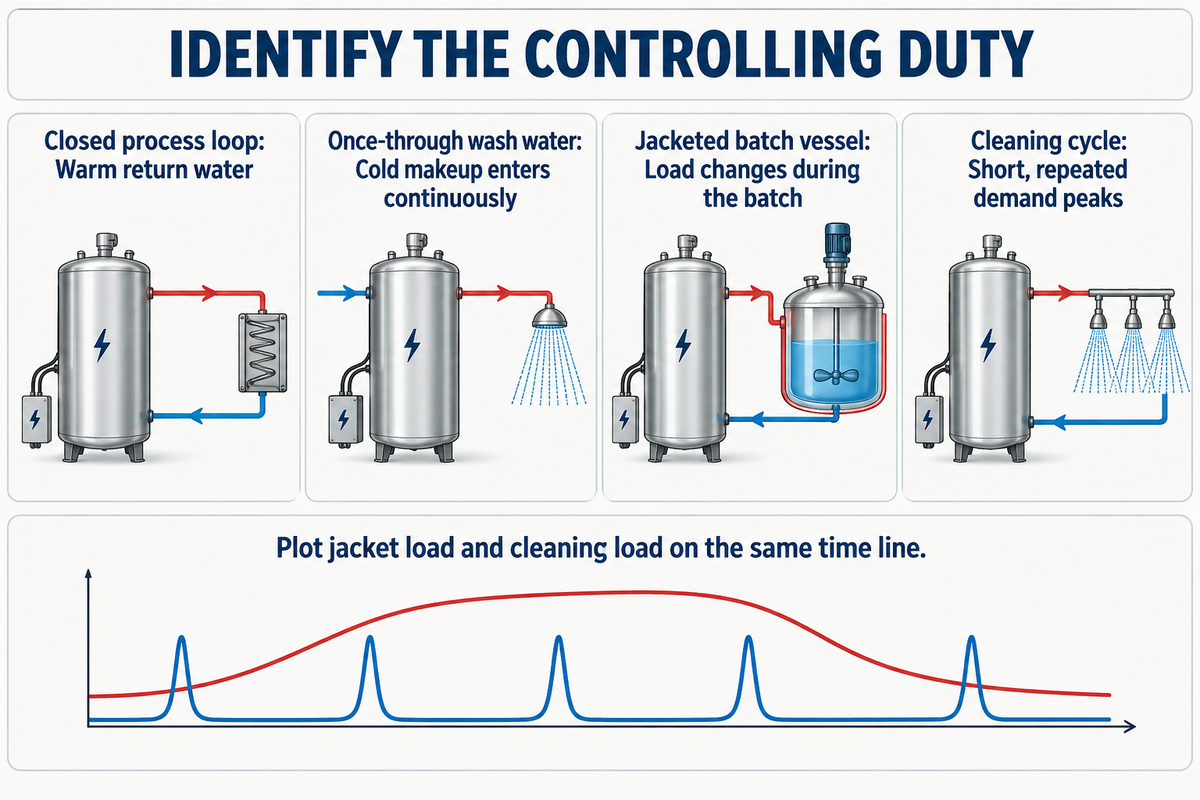
A hot water loop is designed to match the process. If the process recirculates, consumes or receives heat through an exchanger, match the loop accordingly. In commercial and industrial applications, the same boiler may face steady state heating, or it may face washdown peaks or a cold start batch. Each requires a different load profile and control sequence.
Industrial and commercial heating applications also vary based on the consequences of an interruption. A cooling batch may be rejected while an adjacent occupied space remains comfortable.
| Application or duty | Circuit characteristic | Input that changes selection |
|---|---|---|
| Closed process loop | Warm return water | Measured flow and operating temperature drop |
| Once-through wash water | Cold makeup enters continuously | Lowest inlet temperature and simultaneous draw |
| Jacketed batch vessel | Load changes during the batch | Product mass, starting temperature and heat-up time |
| Cleaning cycle | Short, repeated demand peaks | Peak duration and interval before the next cycle |
| Space heating | Weather-dependent load | Design heat loss and minimum active zone |
| Heat-exchanger secondary loop | Separated process fluid | Both-side temperatures, flow and exchanger duty |
| Glycol loop | Different fluid properties | Concentration, density, specific heat and viscosity |
| Potable-water service | Hygiene and scald-control boundary | Approved materials, water-management plan and draw profile |
| Standby or rental duty | Intermittent operation | Available connection, startup time and backup auxiliaries |
Consider adding a hot-water jacket to a mixing vessel in a food-processing plant. The vessel may require a brief warm-up followed by a smaller holding load, while a nearby cleaning line draws hot water after each batch. Sizing from average shift consumption can hide that overlap. Plot jacket load and cleaning load on the same time line, and see what can be scheduled apart.
If a process exchanger separates treated boiler water from the process, show the process-side temperature and the boiler outlet temperature. Using a higher temperature of boiler water doesn’t address the issue of lack of adequate exchanger area or restricted flow.
Electric hot water boiler sizing: flow, temperature and time
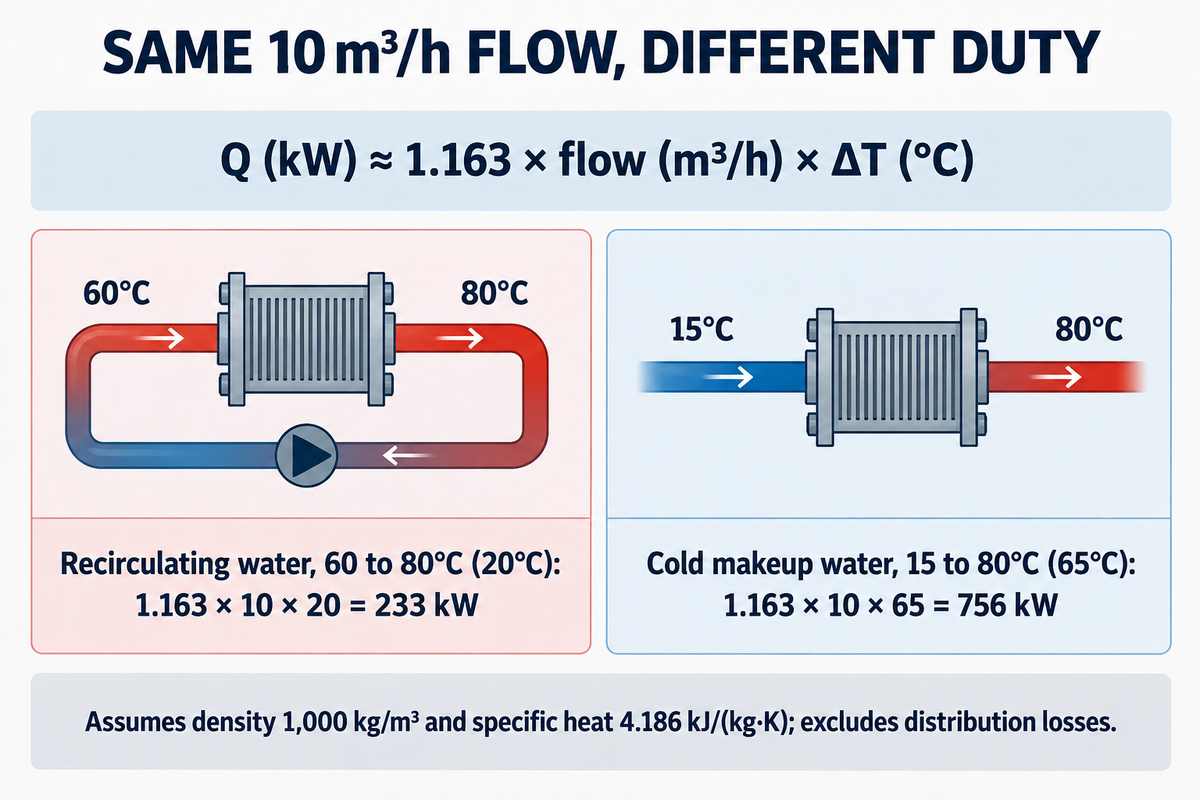
Electric hot water boiler sizing begins by determining the amount of heat added to the process fluid. For a preliminary pure-water calculation, thermal duty in kW is approximately 1.163 multiplied by flow in m³/h and temperature rise in °C. Steady-state thermal duty and startup timing require different load profiles and control sequences.
Heat balance
Thermal power = mass flow × specific heat × temperature rise.
For the examples here: Q (kW) ≈ 1.163 × flow (m³/h) × ΔT (°C). The assumed water density is 1,000 kg/m³ and specific heat is 4.186 kJ/(kg·K). Use actual properties at the design temperature for final sizing, especially with glycol.
| Hypothetical duty | Temperature rise | Calculation | Approximate useful heat |
|---|---|---|---|
| Recirculating water, 60 to 80°C | 20°C | 1.163 × 10 × 20 | 233 kW |
| Cold makeup water, 15 to 80°C | 65°C | 1.163 × 10 × 65 | 756 kW |
The ASHRAE hydronic systems handbook sets out the flow, fluid-property and temperature relationship. Rounded examples shown here exclude distribution losses. These examples don’t reflect the TAIGUO model ratings.
How are electric boilers sized?
Sizing of electric boilers is based on the required heat output and the load duration and permitted recovery time, and is checked against electrical and site capacity. For process duties, take the worst case combination. Add process startup, system, and standby losses. Avoid adding an unexplained percentage to a conservative estimate of the load.
A cold-start batch also heats the vessel, piping and contents. The required energy divided by the allowed warm-up time gives the average startup duty. The exchanger must still transfer that heat as temperatures converge. Ask your supplier to state thermal output and electrical input separately. One kilowatt of rated input doesn’t mean one kilowatt is delivered to the process.
Electrical power and control: check the site before the boiler
Electrical power may limit an electric boiler project even before the heating equipment is chosen. Look at the site’s existing peak load, usable connection capacity and proposed boiler input, together. The control sequence must also handle simultaneous power demand when large electrical loads, production equipment and storage charging all need power at the same time.
- Confirm supply voltage, frequency, phases and usable capacity at the proposed connection.
- Identify the control panel, isolation, protection, grounding and required accessory supply.
- Compare minimum output and modulation stage size with the smallest operating load.
- Include circulation pumps and controls in the backup plan.
Say a factory has only 200 kW of confirmed spare capacity, but asks for a 250 kW package. A low average load factor doesn’t permit full output at all times. Increasing the connection, modifying the operating schedule or limiting the input with adequate storage and recovery are the options. A demand cap that interrupts heat during production needs agreement from the plant manager before finance counts the savings.
A commercial electric boiler quote may account for a 3-phase supply but not for connection upgrades. The 2025 industrial heat report by the IEA lists connection to the grid among the barriers to electrification. Place the utility commitment on the project schedule before evaluating delivery date commitments.
Electric boiler buffer tank: prove the recovery window
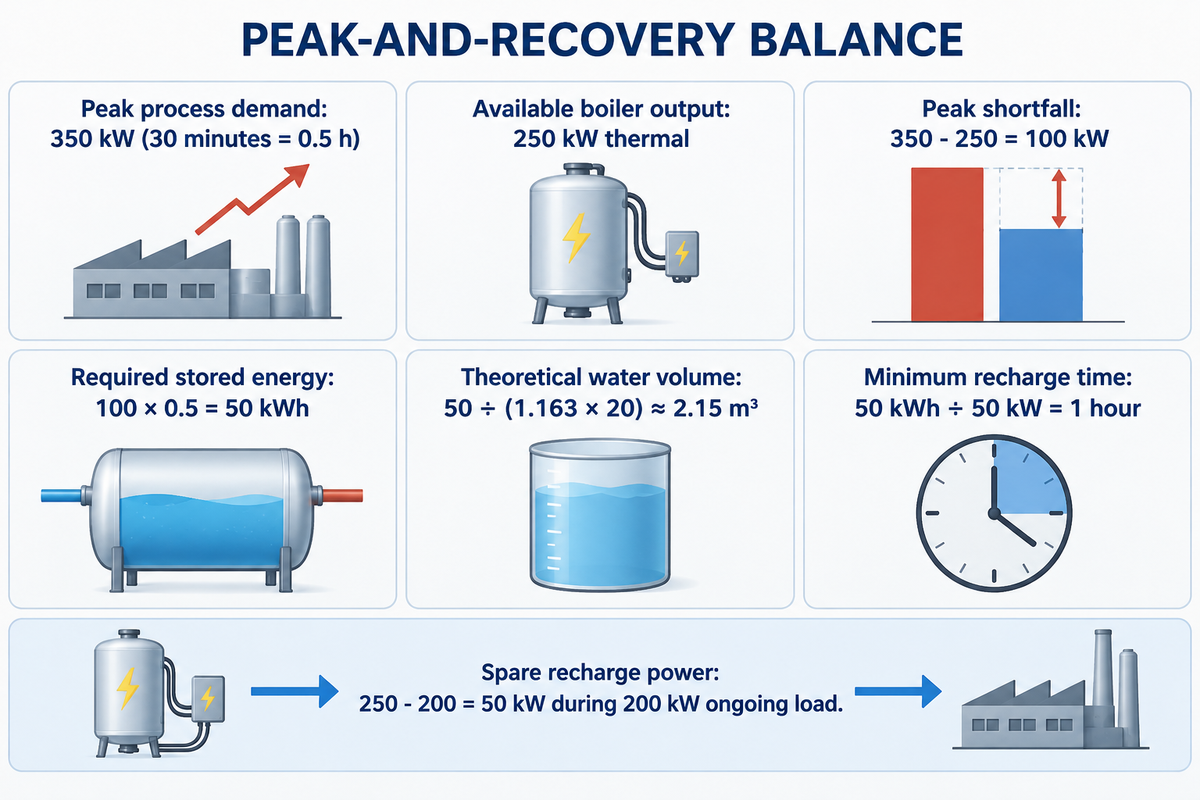
A tank can reduce cycling, but peak-load storage must contain usable heat and recover in time for the next production demand. Test both conditions with the Peak-and-Recovery Balance. First, determine the heat deficit for the period, and divide this by the spare electrical heating capacity during the recovery interval.
Ensure the demand and exchanger duty are coupled to the stored energy. The tank must be sized to provide process delivery temperature throughout the peak. Stored energy can’t make up for a lack of a discharge path or exchanger.
| Step | Example input or result | Decision |
|---|---|---|
| Peak process demand | 350 kW | Use simultaneous duty, not a shift average |
| Available boiler output | 250 kW thermal | Confirm output under the input cap |
| Peak shortfall | 350 − 250 = 100 kW | Storage supplies the difference |
| Peak duration | 30 minutes = 0.5 h | Capture the full draw period |
| Required stored energy | 100 × 0.5 = 50 kWh | Before heat losses and reserve |
| Usable tank temperature swing | 20°C assumed | Must still meet delivery temperature |
| Theoretical water volume | 50 ÷ (1.163 × 20) ≈ 2.15 m³ | Before mixing and unusable volume |
| Load during recharge | 200 kW | Production continues consuming heat |
| Spare recharge power | 250 − 200 = 50 kW | Only spare output refills storage |
| Minimum recharge time | 50 kWh ÷ 50 kW = 1 hour | A 30-minute gap cannot restore the store |
ASHRAE’s service-water sizing method relates heating capacity and storage to the demand profile. The industrial example above applies an energy balance to its batch schedule; it doesn’t adopt the building’s daily energy recovery.
Picture two cleaning cycles, the first successful because the tank starts fully charged, and the second not successful because the recovery between cycles doesn’t completely replenish the withdrawn energy. Buying a larger tank could give a longer operating time with a fully charged start, but repeated operation requires a sufficient long term energy balance. Production can lengthen the gap between cycles, reduce the overlapping peak demands, or provide more charging capacity; procurement should assess these before deciding on volume.
Measure usable storage at required outlet conditions. A tank’s hottest sensor doesn’t show how much water is available for delivery. Temperature gradients can distort stored-energy estimates, as shown in a NIST study of residential electric water heaters. In acceptance testing, include sensor locations and repeat a draw-and-recovery test.
Electric boiler operating cost: useful heat to billed demand
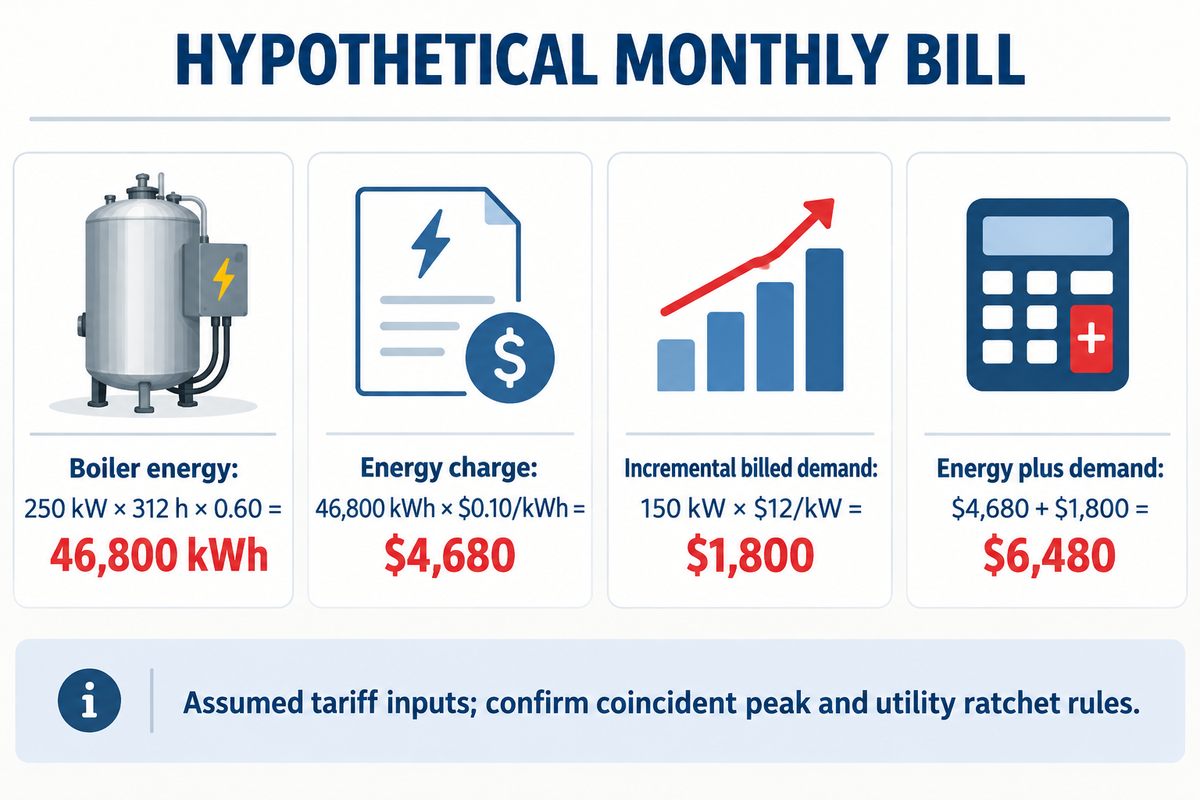
The electric boiler operating costs include electricity consumption and any applicable demand charges, as well as auxiliaries, maintenance, and fixed costs. A high-efficiency heater can still be expensive with a poor tariff. Calculate billed energy from the operating profile and billed demand from the measurement rules of the utility, rather than charging the full nameplate against every hour.
| Item | Assumptions and calculation | Result |
|---|---|---|
| Boiler energy | 250 kW × 312 h × 0.60 | 46,800 kWh |
| Energy charge | 46,800 kWh × $0.10/kWh | $4,680 |
| Incremental billed demand | Assumed 150 kW × $12/kW per month | $1,800 |
| Energy plus demand | $4,680 + $1,800 | $6,480 |
The assumed 150 kW billed increment is independent from the 250 kW boiler rating. Confirm it with the site’s coincident load and tariff, including the demand interval, historical-demand ratchet, and other relevant information from the US Department of Energy’s utility-rate guidance.
Financially, a storage proposal that reduces the billed peak, but has capital cost and insulation losses, needs to be evaluated with a net comparison. In a hypothetical project, $20,000 of installed storage that saves $400 per month in demand charges but adds $100 per month in energy and maintenance has $3,600 of annual net savings. Simple payback is about 5.6 years, before financing, tax and replacement costs. If the utility’s ratchet preserves the old peak, the monthly savings assumed in the analysis may not occur.
Keep pumps, water treatment and standby power in the comparison, and insulate the hot water distribution. Use our industrial electric boiler cost guide for the broader installed-cost breakdown. Heat can still be lost between the boiler and the process even with a claimed “nearly 100%” point-of-use conversion.
Heat pump, electric boiler or a hybrid system?
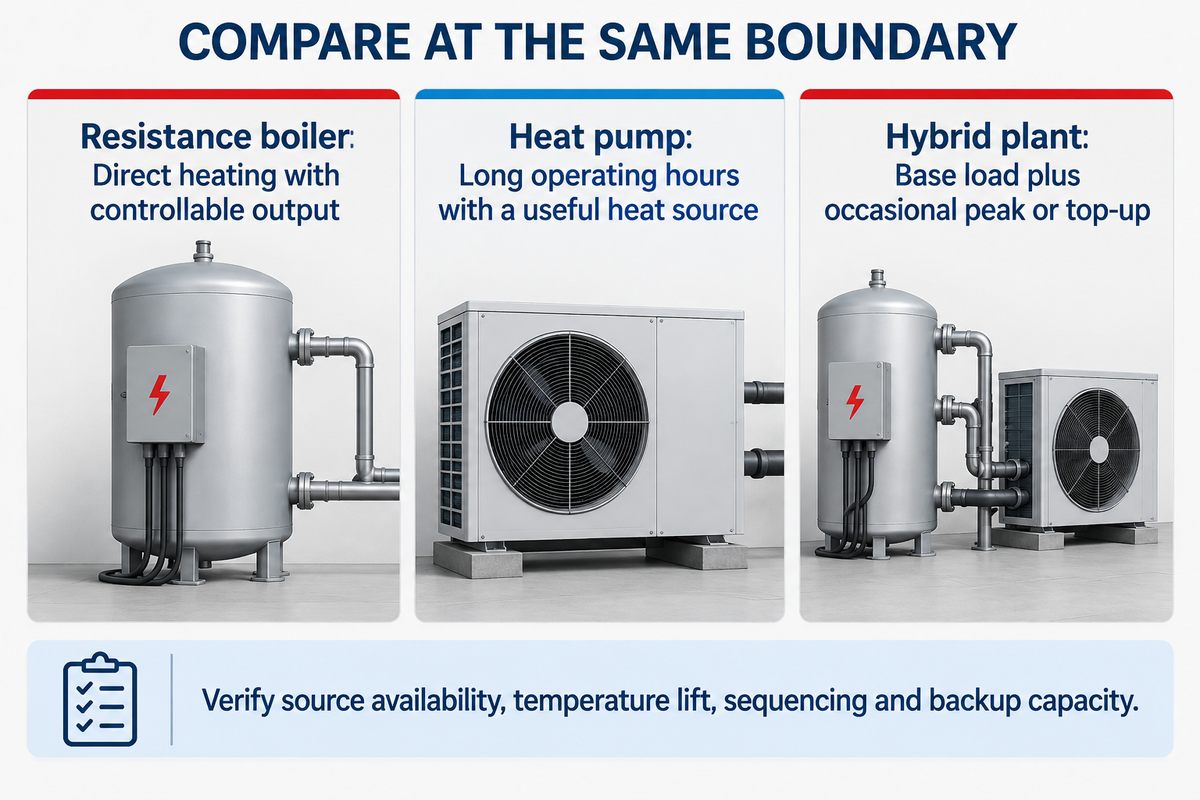
A heat pump is worth considering if a heat source and delivery temperature allow it to move heat efficiently. An electric boiler can supply direct heat, top-up duty or backup. A hybrid solution divides the load between them, but its worth depends on the actual operating hours and guaranteed performance at required conditions.
| Option | Strong application | Constraint to resolve |
|---|---|---|
| Resistance boiler | Direct heating with controllable output | Electrical capacity and energy price |
| Heat pump | Long operating hours with a useful heat source | Source availability, temperature lift and part-load performance |
| Hybrid plant | Base load plus occasional peak or top-up | Sequencing, backup capacity and coincident electrical demand |
The EECA industrial heat-pump guide starts with process conditions and available heat sources. Avoid a blanket 100°C technology cutoff: the IEA’s 2025 assessment describes established industrial heat-pump applications up to 150°C. A particular machine still needs a guarantee at its source and sink conditions.
An annual useful output of 600 MWh of heat assumes a seasonal coefficient of performance of 3, meaning 200 MWh of heat-pump electricity is required. Resistance heating at an assumed 98% efficiency requires about 612 MWh of energy at the same boundary. At an assumed cost of $100/MWh, the energy-only difference is about $41,200 a year. Additional costs of capital, maintenance, backup, and demand determine how much of the difference is an economic benefit.
Indicate which source runs first, what unit addresses cold startup, and the plant response to absence of heat. Using electric equipment reduces combustion at the boiler; however total carbon emissions still depend on electricity and system performance. For the heating-method difference, see electrode boiler versus resistance boiler.
Water quality, maintenance and safe operation
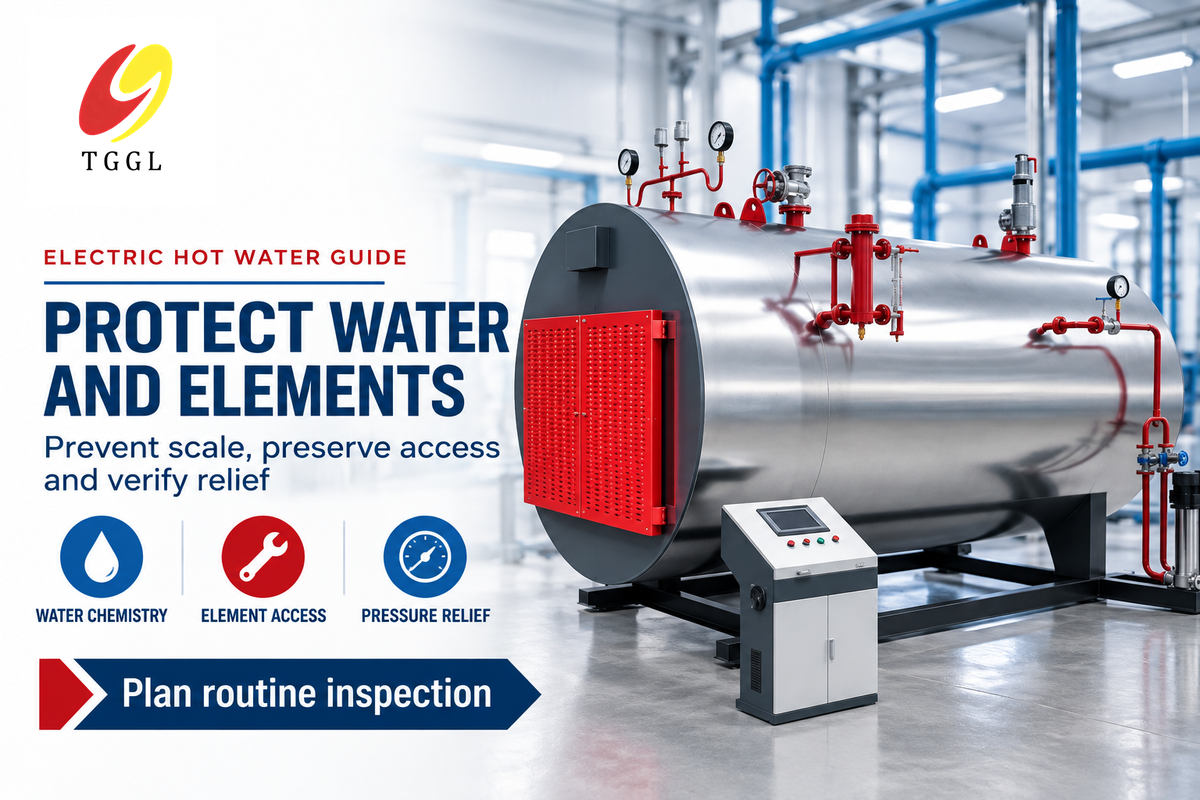
Electric hot water boilers still require water treatment, inspection and protection against electrical and pressure hazards. Removing a burner reduces equipment, but other problems (e.g. scale, corrosion, control) still remain. The maintenance plan should be based on the selected boiler, circuit materials, and the local situation, including the potable water side, if any.
“The mud, sediment, and scale that accumulate in boilers are insidious and preventable.”
Burns outlines extreme deterioration in a 10-year-old electric boiler at a dry-cleaning facility. Electric heating elements and their controls remain vulnerable to deposits and neglected service.
- Water chemistry: obtain the manufacturer’s limits for the exact equipment and fluid. Stainless steel alone doesn’t settle compatibility.
- Heating elements and controls: plan qualified inspection, cleaning and replacement access.
- Pressure system: include expansion provision, relief devices and the pressure limits of every connected component.
- Records: trend operating temperatures, water-treatment results and recurring trips against commissioning values.
The ASHRAE water-treatment handbook states that some electrode hot-water boilers require water conductivity in the range specified by the manufacturer. Treating all electric water heaters and boilers with the same chemistry target can potentially create wrong operating conditions.
Code selection also requires the actual service. The public ASME BPVC I-2025 scope includes high-temperature water boilers above 160 psig and/or 250°F. Verify the applicable section and locally adopted edition with the responsible designer and authority; liquid water alone doesn’t classify the service.
For a potable circuit, scald protection and hygiene must be addressed together. The CDC potable-water toolkit discusses stagnation, temperature and other Legionella controls. These requirements must be addressed in the design of a potable water system, rather than being built into a closed industrial heating loop.
Specify the system and compare supplier offers
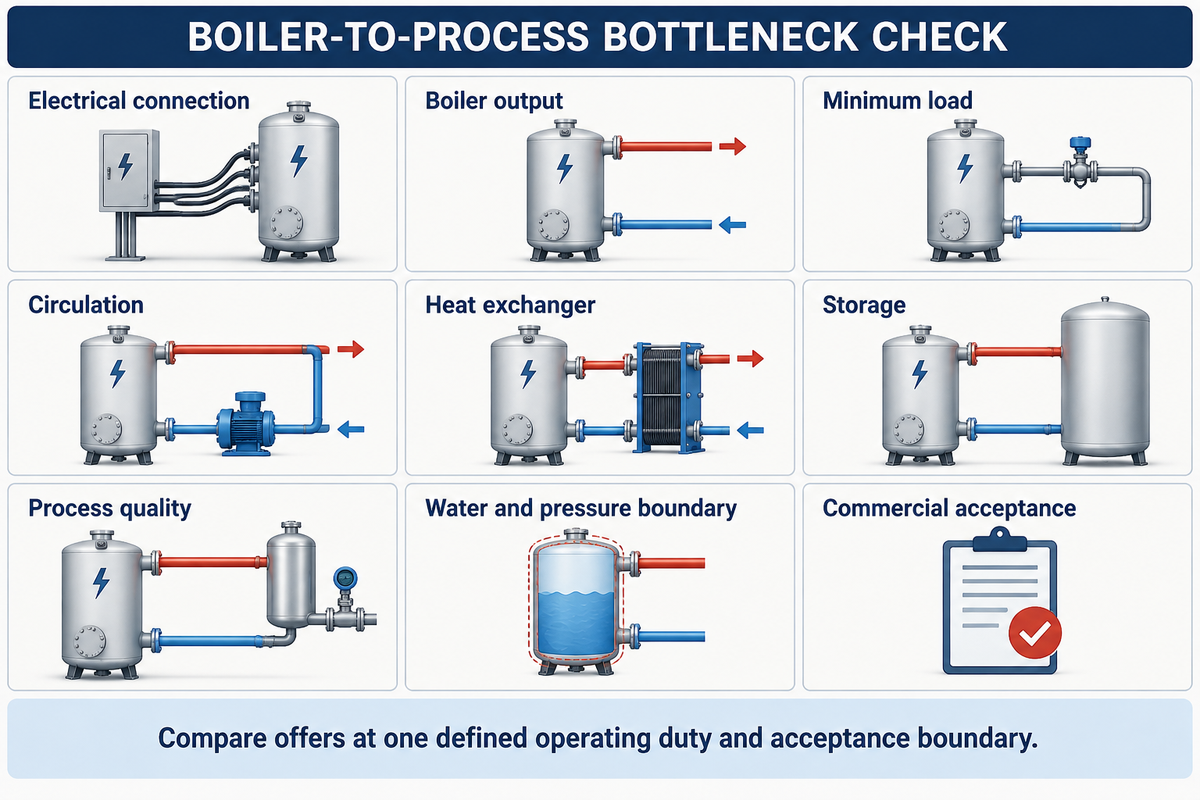
Comparison of offers should be made at one defined operating duty, with the same delivery and acceptance boundaries. The Boiler-to-Process Bottleneck Check that follows addresses heat from the electrical connection to the process and assigns each unreconciled constraint to the team that can verify it prior to issuance of a purchase order.
| Handoff | Put in the specification | Evidence and owner |
|---|---|---|
| Electrical connection | Available kW, voltage and phases | Connection assessment; electrical designer |
| Boiler output | Thermal kW at stated conditions | Guaranteed duty sheet; supplier |
| Minimum load | Smallest active duty and output step | Control sequence; plant engineer |
| Circulation | Required m³/h and pressure loss | Pump duty and measured flow; mechanical designer |
| Heat exchanger | Both-side temperatures and heat duty | Selection calculation; exchanger supplier |
| Storage | Usable kWh and recharge interval | Repeated peak test; production team |
| Process quality | Minimum delivery temperature and allowable deviation | Agreed operating test; quality team |
| Water and pressure boundary | Fluid specification and component ratings | Approved design documents; responsible engineer |
| Commercial acceptance | Included scope, exclusions and utility assumptions | Normalized offer; procurement and finance |
A compact vertical vessel could possibly fit through the door, but would obstruct removal of the heating elements. For a horizontal package, verify the access direction, mounting details, maintenance clearance and footprint. Have the manufacturer demonstrate those clearances on the drawing before deciding the location to install the unit.
Heavy-duty construction and a durable finish are of little value in the absence of a competent design and defined duty. Reliable operation requires the availability of replacements and competent service. Insist on the hot-water model, materials, control functions, inspection documentation, warranties and commissioning scope in the same offer.
Indicate any desired permit or regulation options on a jurisdiction by jurisdiction basis. Keep optional accessories separate to ensure comparability of prices.
TAIGUO manufactures industrial boiler equipment for steam and hot-water applications. Send your flow, temperatures, peak schedule and available power through Request a hot-water boiler proposal, then compare the offered duty against the TAIGUO industrial electric boiler range. For a supplier short list, use our industrial electric boiler manufacturers guide.
Frequently asked questions
Why would a company use an electric boiler?
A company may choose an electric boiler for controllable heat without onsite fuel combustion.
The purchase case can include limited fuel access, intermittent duty, available electrical capacity or a plan to electrify industrial heating. Compare the full electricity tariff, connection work and required backup against the process schedule. High conversion efficiency by itself doesn’t establish the lowest operating cost.
What temperature should the boiler be for hot water?
There’s no single correct boiler setpoint for every industrial hot-water system; the required process temperature, distribution losses and heat exchanger determine it.
The operating setpoint must remain within equipment limits and account for return temperature, transfer losses and control behavior. Potable-water systems add hygiene and scald-protection requirements. The calculation example assumes a nominal 80°C process temperature.
Why is my industrial electric hot water boiler not working?
Loss of heat can result from power, controls, circulation, protective trips or damaged heating components.
Record the alarm, operating temperatures and circumstances for a qualified service technician. Follow the approved shutdown procedure when an unsafe condition is suspected. Don’t bypass an interlock, repeatedly reset a protective trip or open energized equipment to diagnose the fault; those actions can make an equipment problem dangerous.
Can hot water be electric?
Yes. Electricity can heat water directly or power a heat pump.
The equipment choice follows the required temperature, flow and service. A process boiler, commercial water heater and heat-pump water-heating system have different ratings and installation requirements.
Which industrial electric hot water boiler is best?
Choose a boiler whose guaranteed output and minimum load cover the process duty throughout the load cycle, whose electrical input fits the available supply, and whose installation allows maintenance at an acceptable lifecycle cost.
Compare guaranteed output, minimum load, delivery temperature, storage recovery and service access before choosing a brand. For your application needs, compare each model’s minimum controllable output as well as its maximum capacity. Ask every supplier to price the same duty and acceptance test.
Does an industrial electric hot water boiler have a warranty?
Yes, if the supplier’s written terms include warranty coverage.
Check the duration, covered components, exclusions, labor and transport responsibilities, water-quality conditions and commissioning requirements in the offer. Confirm which party handles service locally before accepting the equipment.
Can electric boilers explode?
Yes. Even without a burner, electric boilers can present serious pressure and electrical hazards, so safe operation requires appropriate design, protective devices, inspection and maintenance.
Relief protection, temperature limits and applicable low-water safeguards must remain functional. Never energize equipment outside its approved operating conditions. If pressure, temperature, leakage or alarms indicate an unsafe condition, follow the site’s emergency procedure and obtain qualified assistance; a lack of combustion doesn’t make the vessel harmless.
References & Sources
- ASHRAE, Hydronic Heating and Cooling, 2024 heat-transfer relationships and system integration.
- ASHRAE, Service Water Heating, 2023 heating-rate and storage methods.
- ASHRAE, Water Treatment, 2023 fluid chemistry and equipment boundaries.
- US Department of Energy, Evaluating Your Utility Rate Options energy, demand and ratchets.
- IEA, Renewables for Industry, 2025 industrial heat electrification.
- EECA, Industrial Heat Pumps for Process Heat project screening.
- NIST, Temperature Stratification and Stored-Energy Measurement, 2008 residential test limitations.
- National Board, Internal Inspections for Electric Boilers, Summer 2026 signed inspection account.
- ASME BPVC Section IV, 2025 public scope and ASME BPVC Section I, 2025 public scope service classification.
- CDC, Controlling Legionella in Potable Water Systems, 2025 potable-side considerations.