Get in Touch with Taiguo

How to Specify and Validate a Rubber Vulcanization Autoclave

Contents
show
ENGINEERING PROCUREMENT GUIDE
A rubber vulcanization autoclave should only be purchased against a verified product requirement, not against a copied temperature and time recipe. For automatic rubber vulcanization systems producing vulcanized rubber, the relevant question is whether the equipment, systems, and controls can reproduce and document the required thermal history at the slowest heating point; thermoplastic processing and the broader search intent vulcanization rubber are outside this specification.
This document is intended for engineers writing a user requirement specification (URS), request for quotation (RFQ) or acceptance test. For rubber chemistry and the general cure process, see our rubber vulcanization process guide; the scope here is equipment specification and validation.
Quick specification path
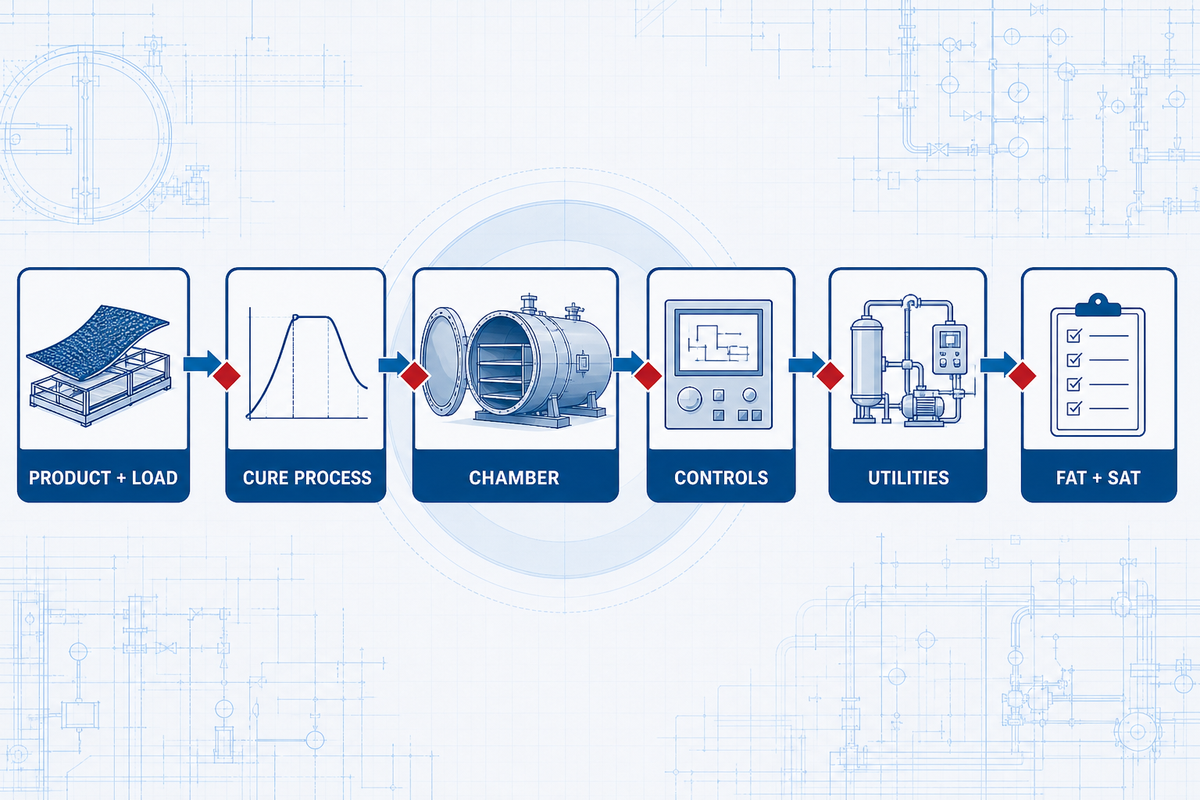
- Freeze the product and representative load.
- Translate cure evidence into process requirements.
- Select the heating medium and circulation concept.
- Size the usable load envelope, not only the shell.
- Define controls, records, safeguards, and utilities.
- Agree the FAT and SAT before issuing the purchase order.
When an Autoclave Is the Right Vulcanization Platform
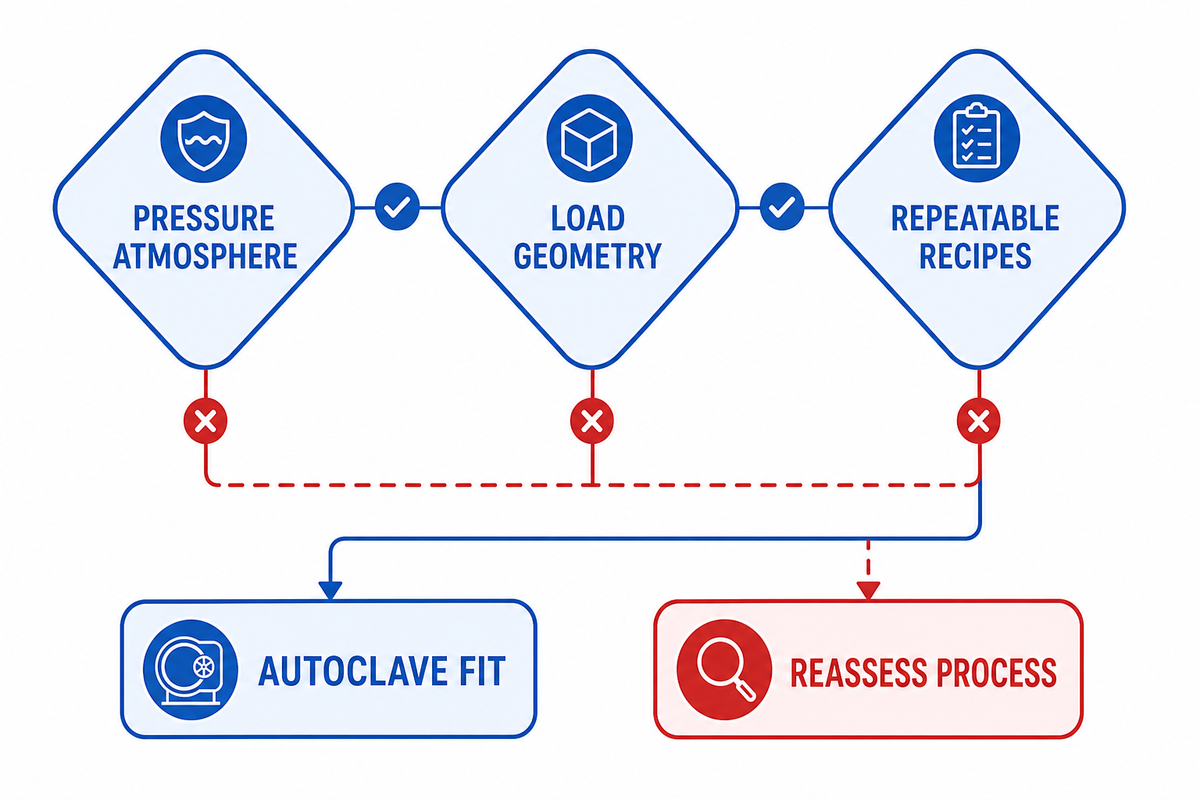
An autoclave is applicable when a batch requires a controlled pressure environment and a repeatable heating medium around assembled products, tooling or long components; an autoclave price comparison with a vulcanizing press is meaningful when it states the working pressure, load, and acceptance scope. Examples may include hoses, rollers, linings, anti-corrosion lining rubber, cables and molded assemblies, but the product name alone doesn’t describe the process.
Begin with three boundaries: what the compound evidence requires, what the product can tolerate, and what the plant can supply. If a product can’t tolerate condensate then direct steam is probably not acceptable. If a load blocks circulation, an impressive high-pressure reading from an empty curing chamber may have little value; across the rubber industry, an autoclave cycle may convert natural rubber into cured rubber, but acceptance must come from product evidence, while impregnation duties remain outside this specification. If an unnecessary pressure vessel is ruled out, then a different curing platform may be more applicable.
Taiguo’s industrial autoclave range covers other equipment contexts. This specification process determines if any of the equipment configurations warrant a quotation.
Convert Product and Compound Data Into a User Requirement Specification
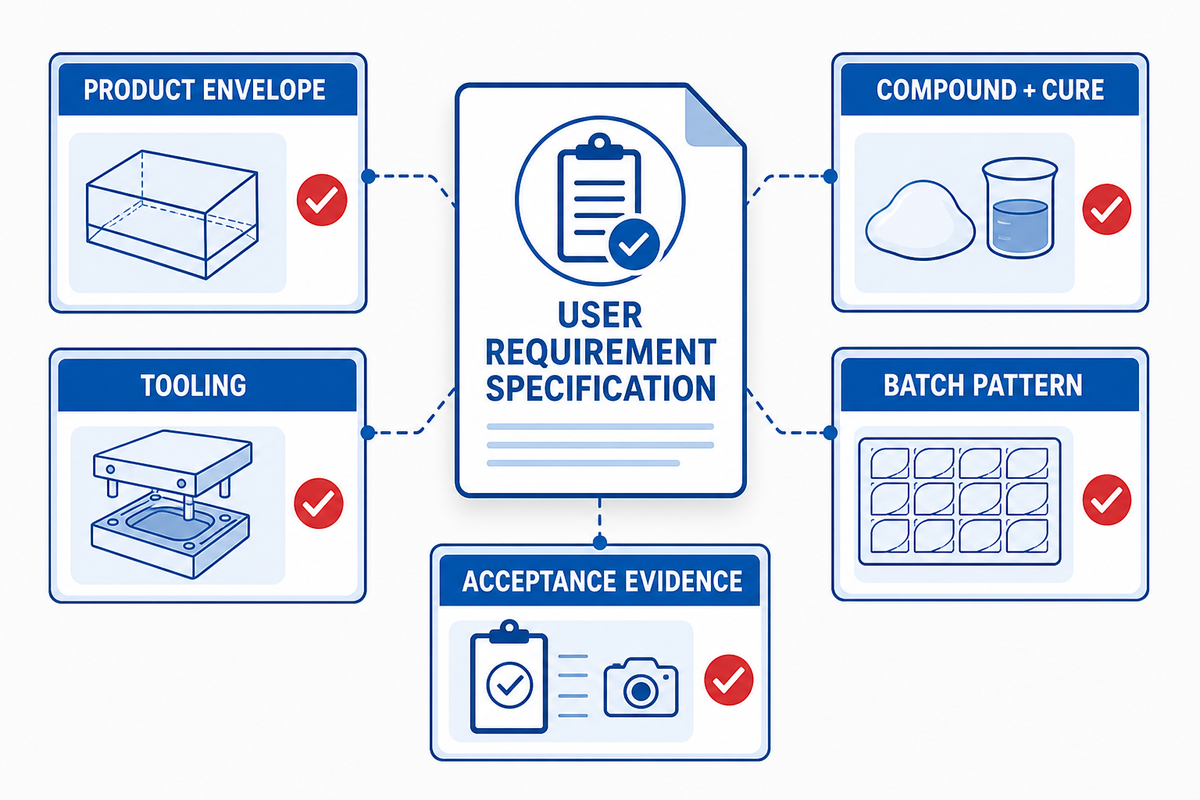
The first output is a completed Controlled Input Sheet, not a machine drawing. ASTM D5289 describes tests for vulcanization characteristics that employ rotorless cure-metering technology. Lab results for a conveyor belt are not an automated plant recipe. ASTM correlation applies to the instrument, test condition, and compound; part geometry, tooling, and representative-load heat transfer require separate production validation before acceptance.
The Compound-to-URS Ladder
| Input level | Buyer records | Equipment requirement produced |
|---|---|---|
| Compound evidence | Cure test method, batch identity, acceptable state, restrictions | Required controllable range; no universal setpoint assumed |
| Product | Material stack, minimum/maximum section, mass, tooling, sensitive surfaces | Heating medium, atmosphere, sensor access, cooling constraints |
| Load | Quantity, orientation, spacing, trolley pattern, maximum batch mass | Usable chamber envelope, circulation path, representative test load |
| Production | Shifts, batches per day, loading time, changeovers, record retention | Door arrangement, recipe controls, data export, service factors |
| Acceptance | Critical locations, tolerance, repeat count, witnesses, deviation rules | FAT/SAT protocol and contractual pass criteria |
Indicate each value as confirmed, supplier-proposed, or trial-dependent. Making this distinction prevents an estimate from becoming a guarantee. It also allows for a clean trail of change control during product trials to refine the final recipe.
Select the Heating Medium and Process Atmosphere
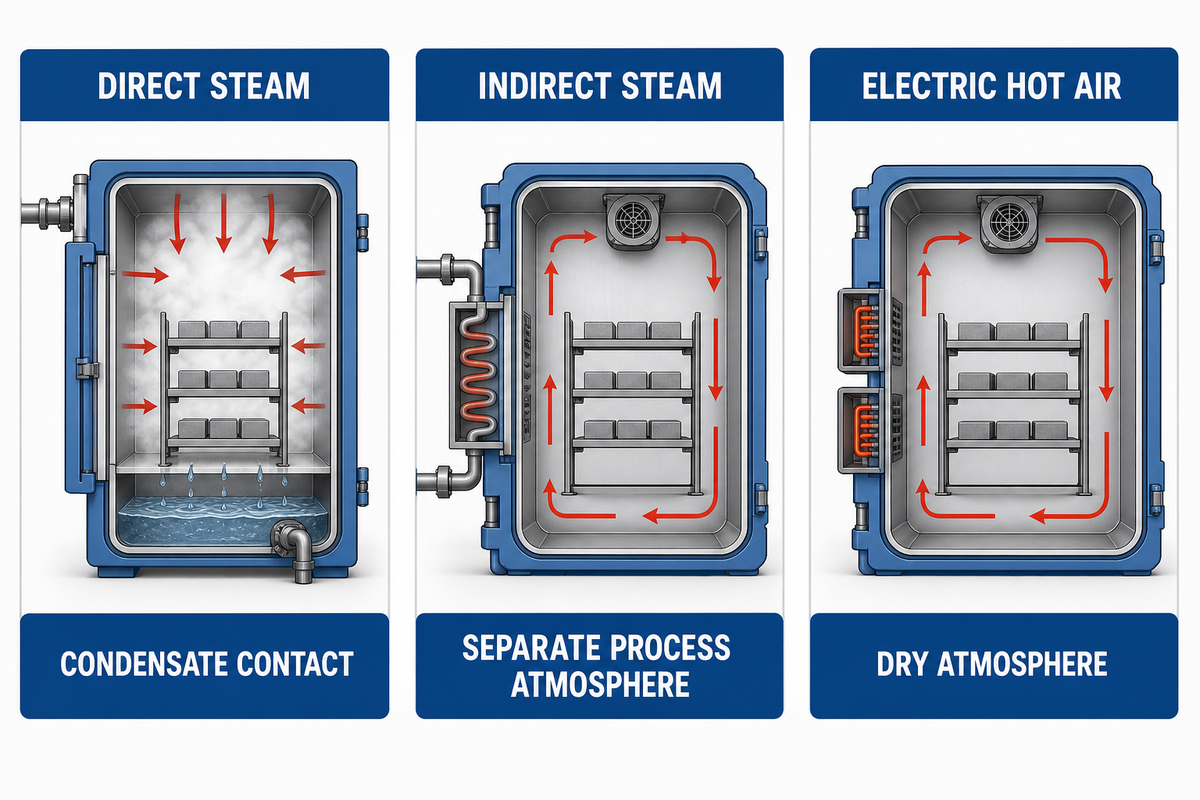
There are several designs of autoclave for rubber vulcanization, including direct steam, indirect steam heating, electric heating, and circulated hot air or hot-air service for rubber lined products. Several of these designs are described in supplier literature from Bondtech and Akarmak. Suitability of these designs must be analyzed based on the actual product and load; this formulation-specific latex study does not establish equipment suitability.
| Heating-system type | Potential fit | Questions for the URS |
|---|---|---|
| Direct steam | Products that tolerate steam and condensate and benefit from direct heat transfer | Steam quality, drainage, condensate contact, venting, corrosion, pressure control |
| Indirect steam | Sites with steam available but a need to separate process atmosphere from plant steam | Heat exchanger duty, circulation, warm-up behavior, condensate removal |
| Electric hot air | Loads needing a dry atmosphere or sites without suitable steam | Installed power, airflow distribution, fan redundancy, surface temperature limits |
| Hybrid arrangement | Products requiring staged atmosphere or site-specific flexibility | Transition logic, controls, utilities, cleaning, validation complexity |
| Steam with forced circulation | Loads whose geometry creates shielded or slow-heating zones | Fan proof, circulation direction, condensate behavior, loaded test method |
| Hot air with steam injection | Processes that need controlled humidity or staged heat transfer | Injection logic, moisture limits, drainage, atmosphere records |
| Nitrogen-assisted system | Special rubber product requirements that restrict oxygen exposure | Gas quality, purge verification, venting, operating cost, site safety |
| Oil-heated indirect system | Sites using a thermal-fluid utility for indirect heating | Fluid temperature, exchanger duty, leak detection, maintenance access |
| Trial-defined configuration | Composite or unusual vulcanized assemblies without a proven production route | Pilot load, acceptance boundary, scale-up evidence, change control |
Ask the vulcanizer or autoclave manufacturer to define the proposed path of heat transfer, direction of circulation, control-sensor location, drain behavior, and expected differences between empty and loaded operation; supplier documents may call the same process vulcanisation or vulcanising. “Uniform temperature” is inadequate without specifying the sensor placement and tolerance, load, and the phase of the cycle. The same review is valid whether the rubber vulcanizer handles a rubber roller, rubber hose, different rubber compounds, or other vulcanized composite products.
Size the Working Chamber, Trolley, Door, and Load Envelope
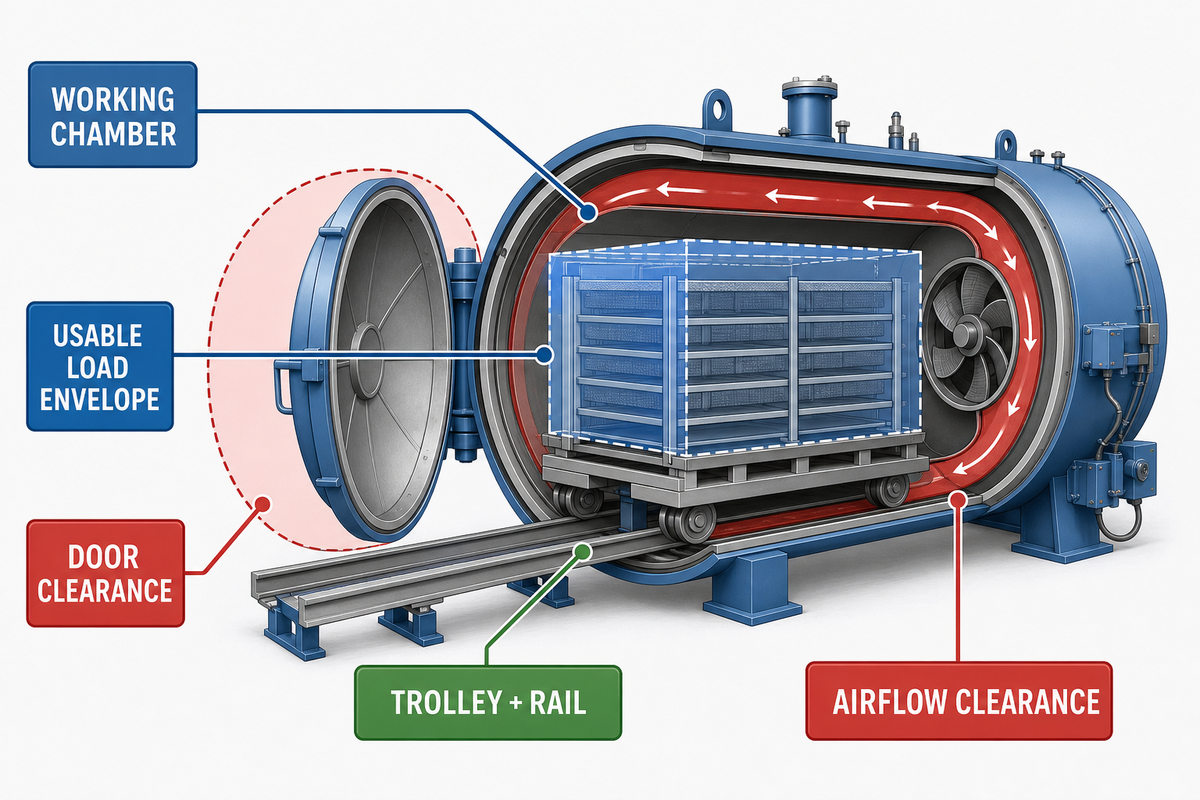
The dimensions of a shell don’t always indicate the space available for production. You must account for rails, trolleys, internal piping, fan/duct zones, doors, and sensor clearances. Also, check the largest product, the densest batch, and the most difficult orientation for loading.
Document five envelopes: product, tooling, trolley, circulation clearance and service access. Provide a drawing showing minimum clearances at doors and the internal obstruction closest to the load. Show support points and bend restrictions for products that are long hoses or cables. For tooling that’s rollers or heavy, provide axle loads, floor loads and handling equipment.
Door selection is operational and safety-critical. This includes specifying the opening direction, available floor space, loading height, rail alignment, locking indication and seal access, and the condition that prevents opening under pressure. The final safeguarding package depends on the destination’s pressure-vessel rules and risk assessment, not a marketing label.
Define Recipe-Control and Cycle-Recording Capabilities
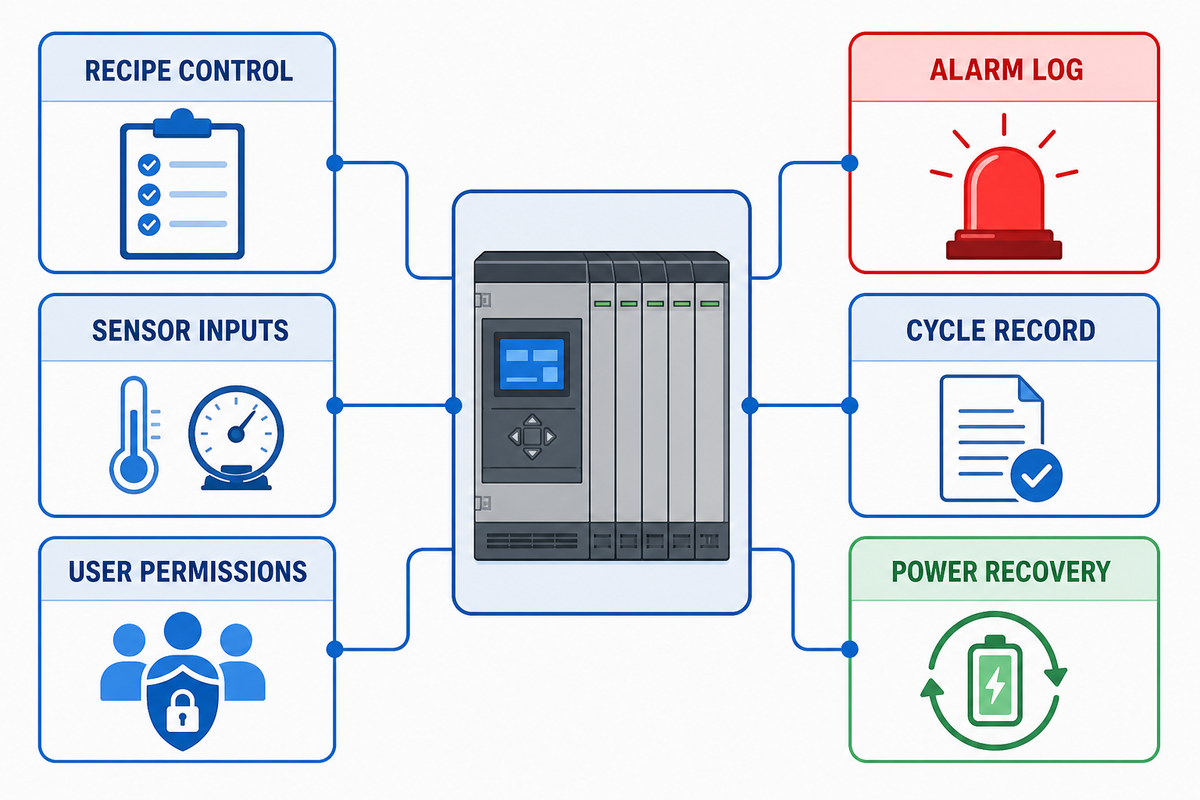
The controller should reproduce authorized recipes while showing what actually happened. A helpful specification distinguishes commanded values from measured values. Document chamber pressure and controlling temperature, product- or load-sensor values, stage transitions, alarms, and cycle activity at an agreed sampling interval; this preserves the context needed to interpret compound cure evidence.
Define permissions for creating, approving, editing, and running recipes. How is a revision identified? How is an operator prevented from running an obsolete recipe? Specify time synchronization, export format, storage period, backup method, and system behavior after power or sensor failure.
Minimum cycle record
- Machine, recipe revision, product, batch, trolley, operator, and timestamps
- Pressure and temperature trends with engineering units
- Product-sensor identities and locations
- Ramp, soak, cooling, and depressurization transitions
- Alarm, acknowledgement, abort, and restart events
- Pass/fail result plus deviation authorization
Prove Temperature Uniformity With a Representative Load
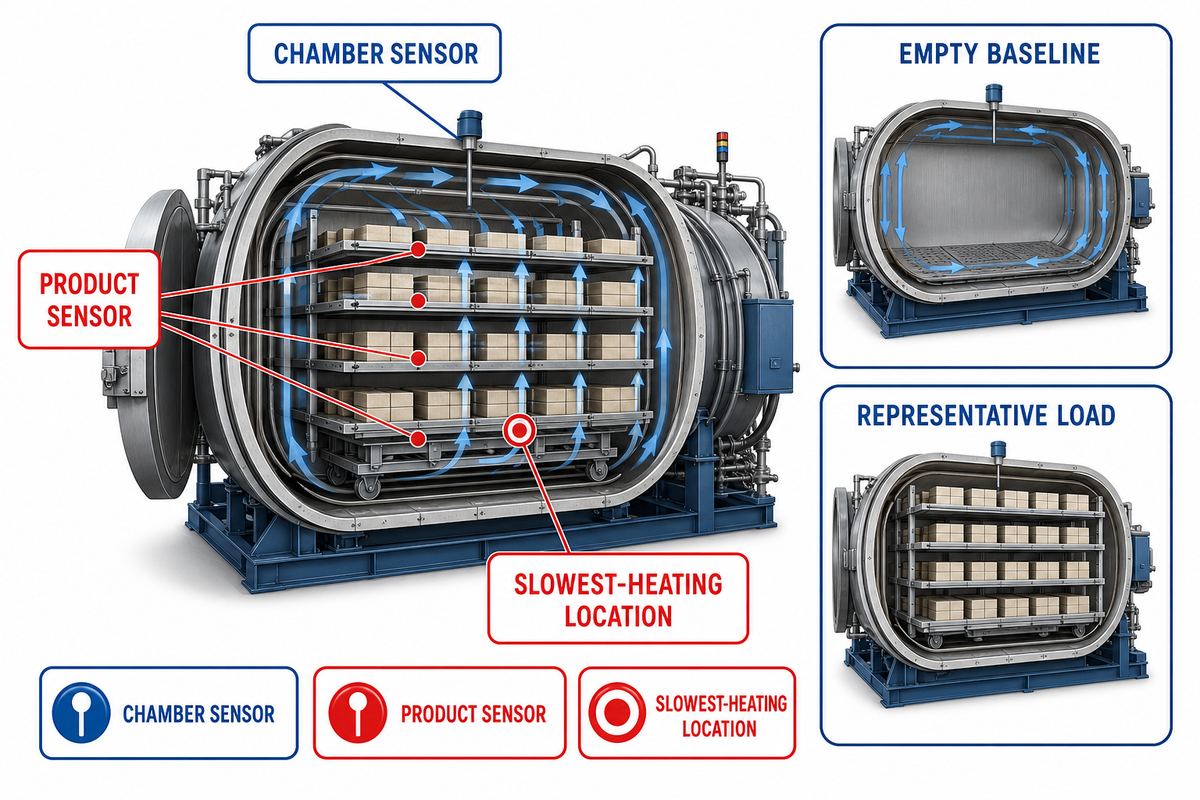
An empty chamber test can reveal basic equipment behavior, but it cannot prove that a dense production load heats uniformly; temperature-uniformity mapping must therefore be defined around the representative load. Define a representative load that challenges the proposed system without exceeding normal production. Its materials, mass, spacing, tooling, trolley, and sensor attachment method should be recorded.
The 9-Zone Load-Uniformity Map
A practical starting configuration has three planes (front, middle, and rear) and uses upper, center and lower positions. Place sensors at the product core, known thermal bottlenecks, thick sections, and shielded surfaces. Nine zones are a planning guideline, not a code requirement, and the final configuration should follow load risk and acceptance objectives.
| Test definition | What must be agreed before FAT |
|---|---|
| Load | Mass, arrangement, tooling, spacing, and substitution rules |
| Sensors | Calibration status, attachment, location drawing, sampling interval |
| Window | When uniformity is evaluated and which transients are excluded |
| Criteria | Permitted deviation, cold-point requirement, repeatability, missing-data rule |
| Evidence | Raw files, plots, calculations, deviations, signatures, and retest record |
One repeat may be valid, while another result should be investigated before the criterion is relaxed. Investigate loading repeatability, circulation and drainage, attachment of sensors, and control logic. Averages can hide a product location that never reaches the validated condition.
Temperature mapping helps confirm equipment-and-load thermal fields; it does not by itself confirm cure state through a thick rubber section. Product validation may also require product quality checks such as section-specific hardness tests, cross-link density tests, mechanical-property tests, or other qualified tests chosen by the rubber technologist. Keep the resultant product acceptance tests related to the specific load map and recipe. Don’t make them a universal autoclave tolerance.
Specify Instruments, Alarms, Interlocks, and Safety Documentation
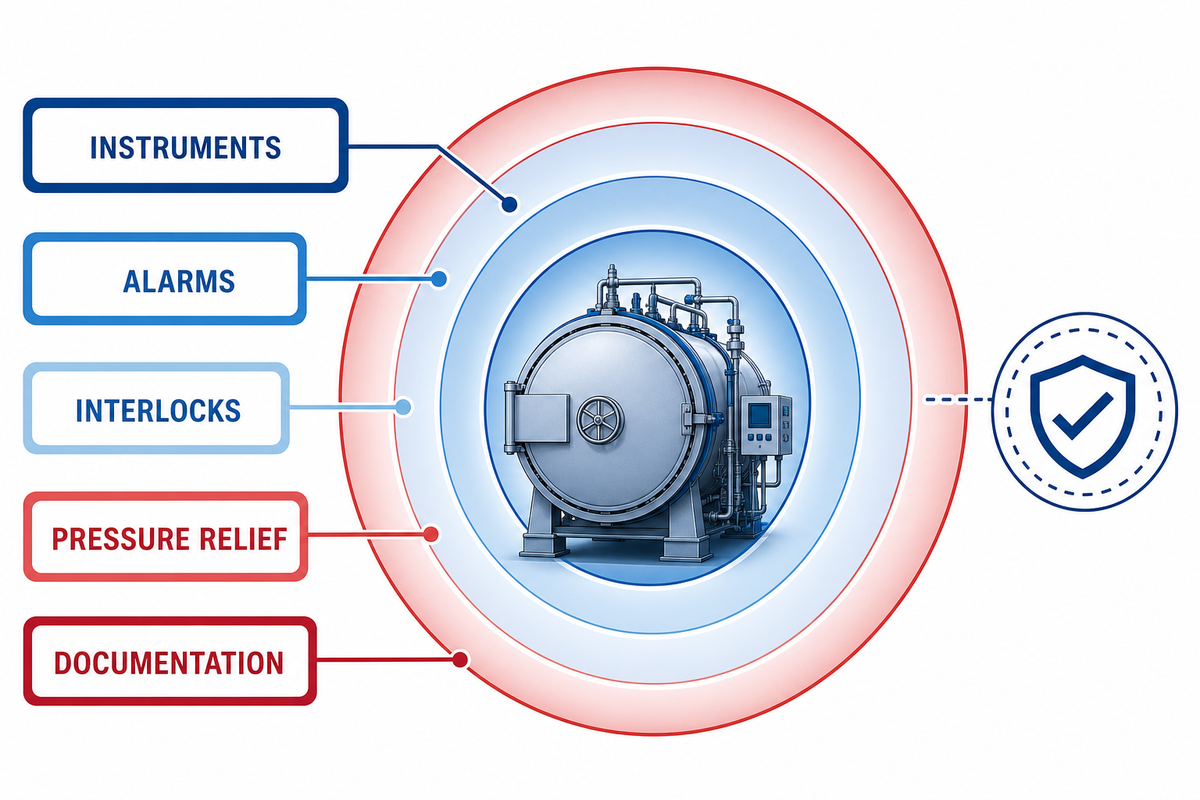
A rubber autoclave is also a pressure system. ASME BPVC Section VIII Division 1 is one recognized construction route, but the purchase specification must name the governing jurisdiction, required edition, registration, inspection, and documentation. Don’t treat an ASME-style statement or logo as proof for every destination.
The URS should identify which protective functions must remain independent under the applicable code and risk assessment. The URS should address pressure indication, temperature measurement, relief protection, overpressure response, door-lock status, pressure-before-open prevention, emergency-stop behavior, sensor-failure response, fan proof where relevant, and loss-of-utility behavior. The supplier should identify process and product functions that are independent and how they’ll be challenged during FAT.
The documentation pack may include design data, material traceability, weld and examination data, pressure testing, calibration of sensors, relief devices, electronic drawings, software and alarm descriptions, manuals, spares, and the legally required vessel dossier. The requirements will vary by jurisdiction.
Define Utilities, Installation, and Site Constraints
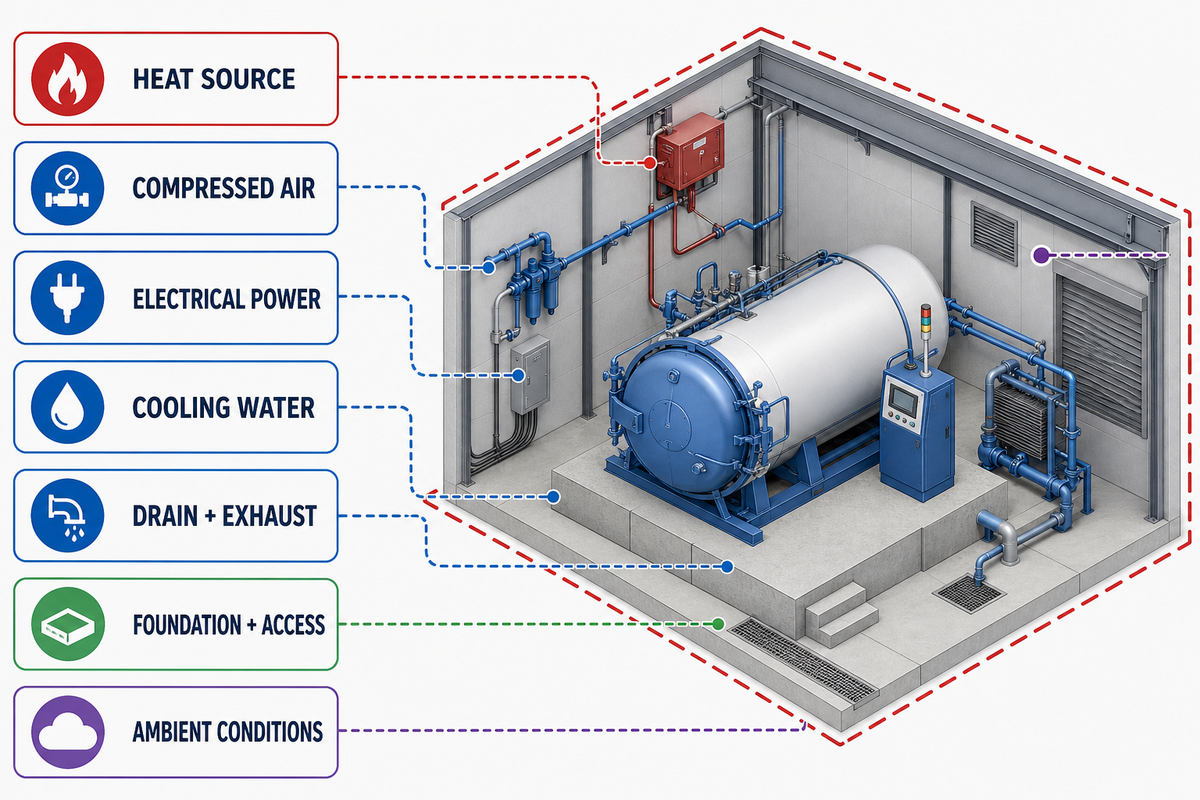
State utility conditions at the battery limit (e.g., steam pressure and quality, electric supply and short-circuit conditions, compressed air, cooling water, drainage and ventilation conditions, and communications and control networks). Indicate not only nominal conditions, but also maximum and minimum. Elevation and ambient conditions at the site may impact the pressure, cooling, and electric design.
The unloading and cooling areas of the site should also be included. The UK Health and Safety Executive lists autoclave doors and storage racks among locations where local exhaust may be required in rubber processing. Buyers should assess equivalent controls under the destination’s own rules and risk assessment. A passed vessel cycle and a door interlock don’t, in and of themselves, demonstrate control of fumes when rubber leaves the chamber.
Installation data should address foundation and floor loads, transport routes, lifting locations, door-swing space, trolley travel, maintenance withdrawal areas, exhaust routing, noise, and heat rejection, and safe access to the equipment. Identify who provides valves, cables, rails, platforms, and drain connections, and insulation sections and consumables used during commissioning.
Build the Factory Acceptance Test and Site Acceptance Test
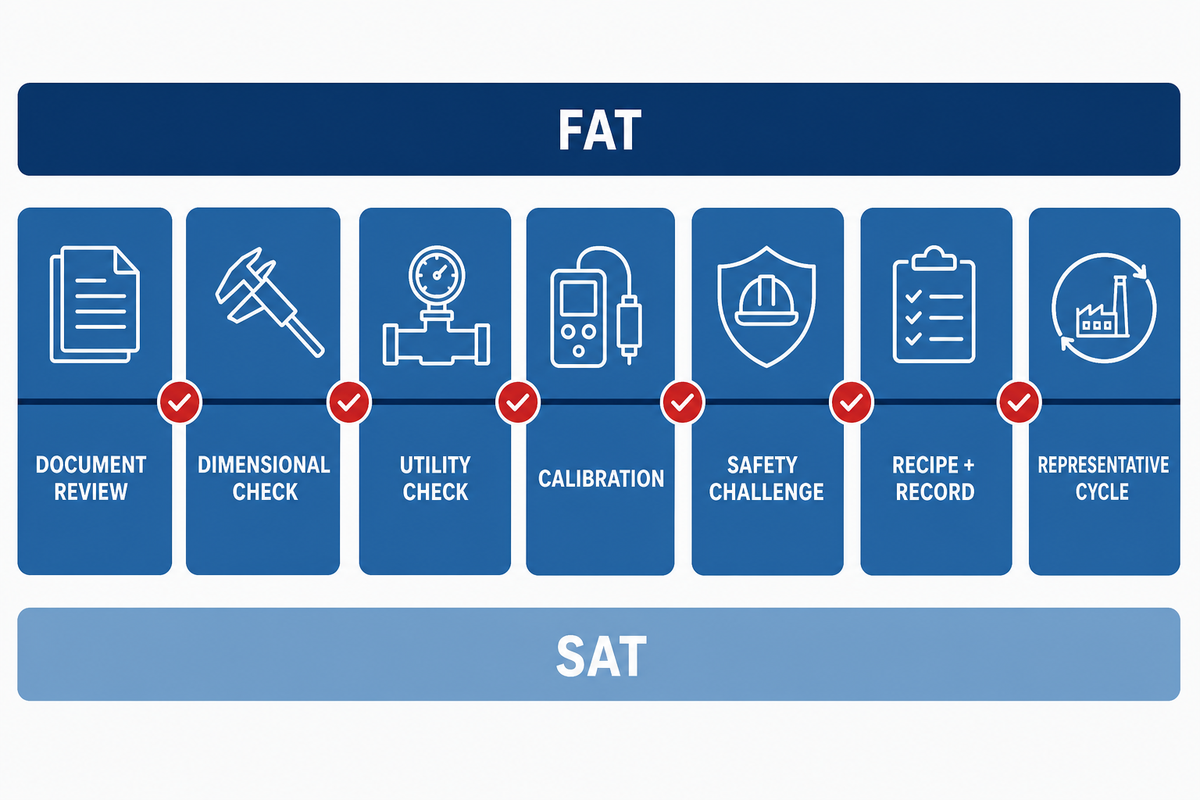
The FAT verifies operation of the contracted machine prior to shipment; the SAT verifies machine operation and performance at the customer site. Neither should be a fabrication demonstration. Arrange for the protocol to be attached to the purchase order, and define the roles and responsibilities of the stakeholders involved.
FAT Evidence Pack
- Document review: approved drawings, code documents, certificates, manuals, and open deviations.
- Static inspection: dimensions, tags, materials where specified, access, trolley, utilities, and maintainability.
- Safety challenges: door, pressure, alarm, emergency, sensor-failure, and relief-related tests within the approved protocol.
- Control tests: permissions, recipe revisions, trend records, exports, power recovery, and audit events.
- Performance tests: empty-chamber baseline where useful, then representative-load mapping and agreed repeat cycles.
- Closeout: raw files, signed results, punch list, deviation disposition, retest evidence, and shipment release.
The SAT should confirm installation, utility connections, instrument calibration, site safety interfaces, recipe transfer, and agreed loaded performance. When production material is unavailable during FAT, reserve final performance acceptance for SAT. If production material is unavailable during FAT, define the surrogate’s thermal properties and limitations for the FAT.
Keep acceptance of equipment separate from legal obligations of an owner after equipment is installed. For instance, the UK Pressure Systems Safety Regulations 2000 (PSSR) may require a written scheme of examination and an examination before use in applicable cases. Other jurisdictions may have other regimes. The procurement dossier should identify who ensures local commissioning, inspection, operator training, ventilation performance, and continuing examination. A supplier’s FAT certificate does not replace the owner’s applicable legal duties.
Compare Supplier Proposals With a Weighted Scorecard
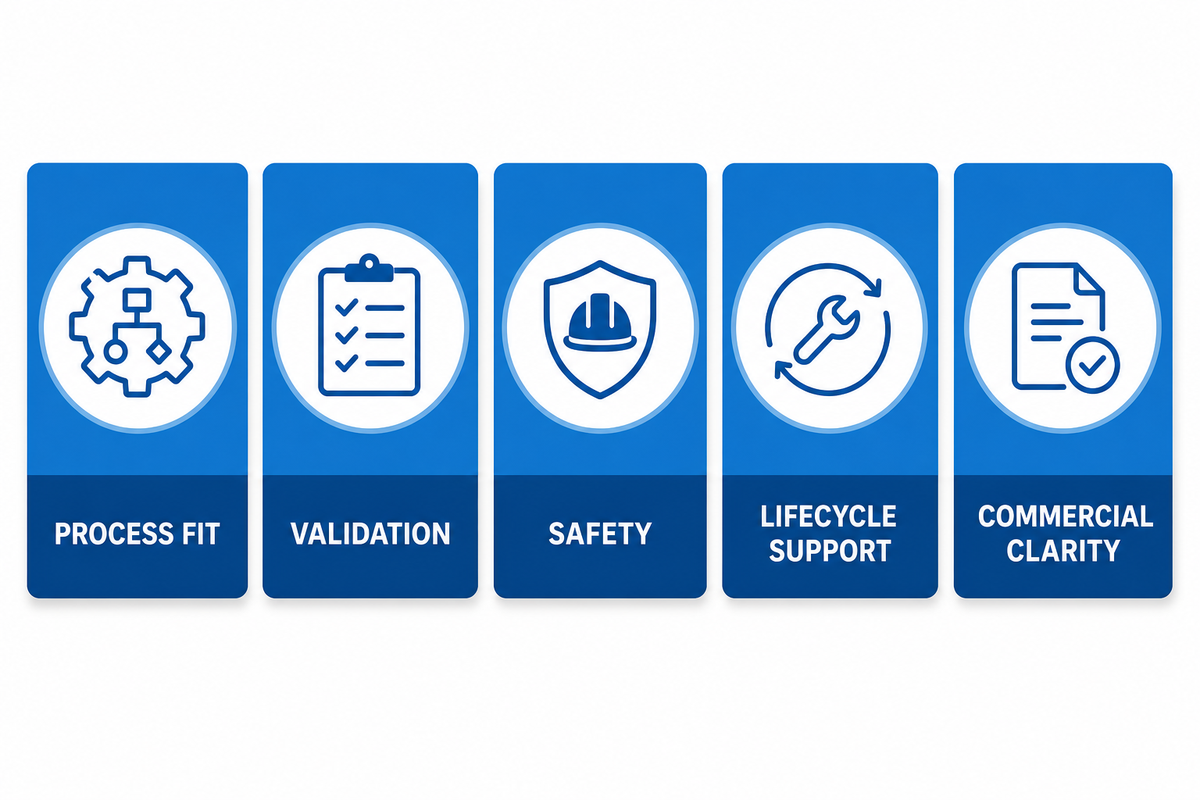
Normalize bids before comparison. Put exceptions next to each requirement. Score evidence, including the applicable pressure-vessel code basis, rather than promises. A suggested 100-point structure is below; buyers should adjust weights to their risk.
| Category | Suggested points | Evidence to compare |
|---|---|---|
| Process fit | 20 | Heating concept, load model, trials, stated assumptions |
| Uniformity and acceptance | 15 | Sensor plan, representative load, tolerances, repeat tests |
| Safety and code | 15 | Jurisdiction, design route, safeguards, dossier scope |
| Controls and records | 12 | Recipes, permissions, trends, export, recovery behavior |
| Load handling | 8 | Trolley, rails, support points, ergonomics, floor loads |
| Utilities | 8 | Steam, power, air, water, drainage, ventilation, demand limits |
| Documentation | 8 | Drawings, calculations, certificates, manuals, calibration records |
| Lifecycle support | 7 | Spares, training, diagnostics, service response, obsolescence |
| Commercial clarity | 7 | Scope, exclusions, delivery, warranty, retest responsibility |
A lower-priced bid may carry costly assumptions: empty-chamber acceptance, excluded loading equipment, buyer-supplied instruments, unspecified code documentation, or no commitment to repeatability. Price the exceptions before ranking suppliers.
Prepare a Decision-Ready Request for Quotation
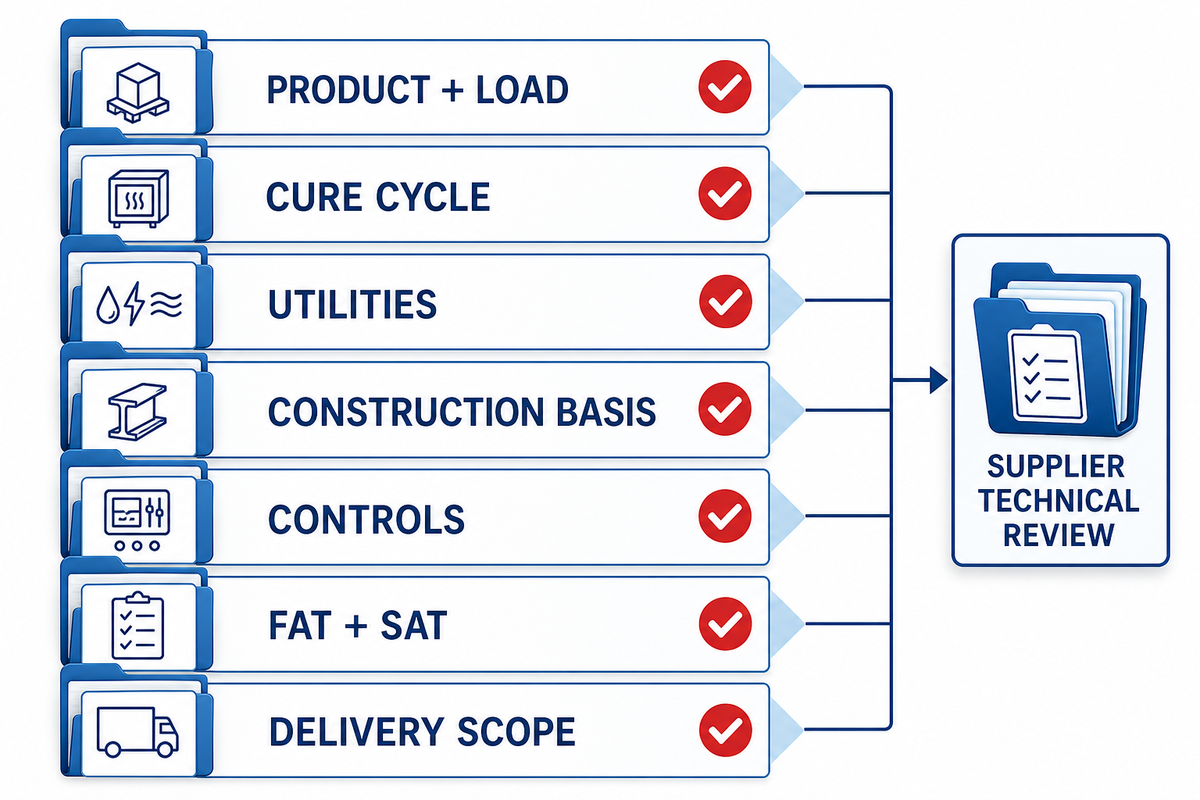
Use the RFQ Completeness Check prior to issuance. Attach the listed product, load, utility, control, test, and documentation deliverables to the RFQ. Ask suppliers to provide a clause-by-clause response, including the selected pressure-vessel construction basis, to the RFQ.
- Product range, compounds, tooling, batch mass, and load arrangement
- Validated cure evidence and trial-dependent values
- Heating medium, atmosphere, circulation, cooling, and drainage constraints
- Usable chamber, trolley, rails, door, and handling interfaces
- Controls, instruments, data, alarms, permissions, and integrations
- Pressure-vessel jurisdiction, safety functions, inspection, and dossier
- Utilities, installation conditions, training, spares, and lifecycle support
- FAT/SAT load, sensors, criteria, witnesses, deviations, and retests
Assumptions are inevitable in an RFQ; however, an RFQ based on the same requirements provided to suppliers makes acceptance a contractual test.
Frequently Asked Questions
What information should I give a rubber autoclave supplier?
State the anticipated product range, compound-specific cure data, maximum allowable dimensions and mass, tooling, batch arrangement, expected production requirements, atmospheric constraints, available utilities, site conditions, governing jurisdiction for pressure-vessel Code, controls and data, and acceptance criteria. Label each of the above as confirmed, supplier proposed, or dependent on field trials. The expectation is that the supplier will be able to discuss the heat-transfer path, usable load envelope, safety case, and validation, based on the information provided, as opposed to using chamber size to determine these.
How should temperature uniformity be verified during acceptance testing?
Use calibrated sensors at agreed hot- and cold-risk positions in a documented representative load. Define and document the sensor drawing and attachment method. State the sampling interval, evaluation window, permitted deviation, cold-point requirement, and repeat count, prior to testing. Describe the rule to be applied for missing data, and retain all raw data, logs, calculations, and experiment records. Empty-chamber displays or average chamber temperatures don’t validate product thermal history.
Should I choose direct steam or indirect heating?
Weigh product tolerance against the demands of atmosphere, condensate exposure, heat-transfer needs, utilities, corrosion, circulation, cooling, and validation. Direct saturated steam can be used for loads that can accept steam and condensate. Other atmospheres and arrangements can be achieved by indirect steam or hot air ovens. What’s best varies, and the real product and load must be validated.
What belongs in a factory acceptance test?
Traceability records, dimensional and utility checks, instrument calibration, safety and interlock challenges, recipe and permission tests, power recovery, data export, representative-load mapping, repeat cycles, deviation handling, witnesses, tolerances, and retest responsibility should be defined in the purchase order.
Is the vessel setpoint enough to define a rubber cure cycle?
No. Cure evidence starts with compound requirements; this procurement method then verifies them at the slowest-heating product location. Geometry, tooling, loading density, heating medium, circulation, condensate behavior, sensor placement, and cooling affect product heating and acceptability. Use setpoints for control, not for verification.
Send a load definition, not just a chamber size
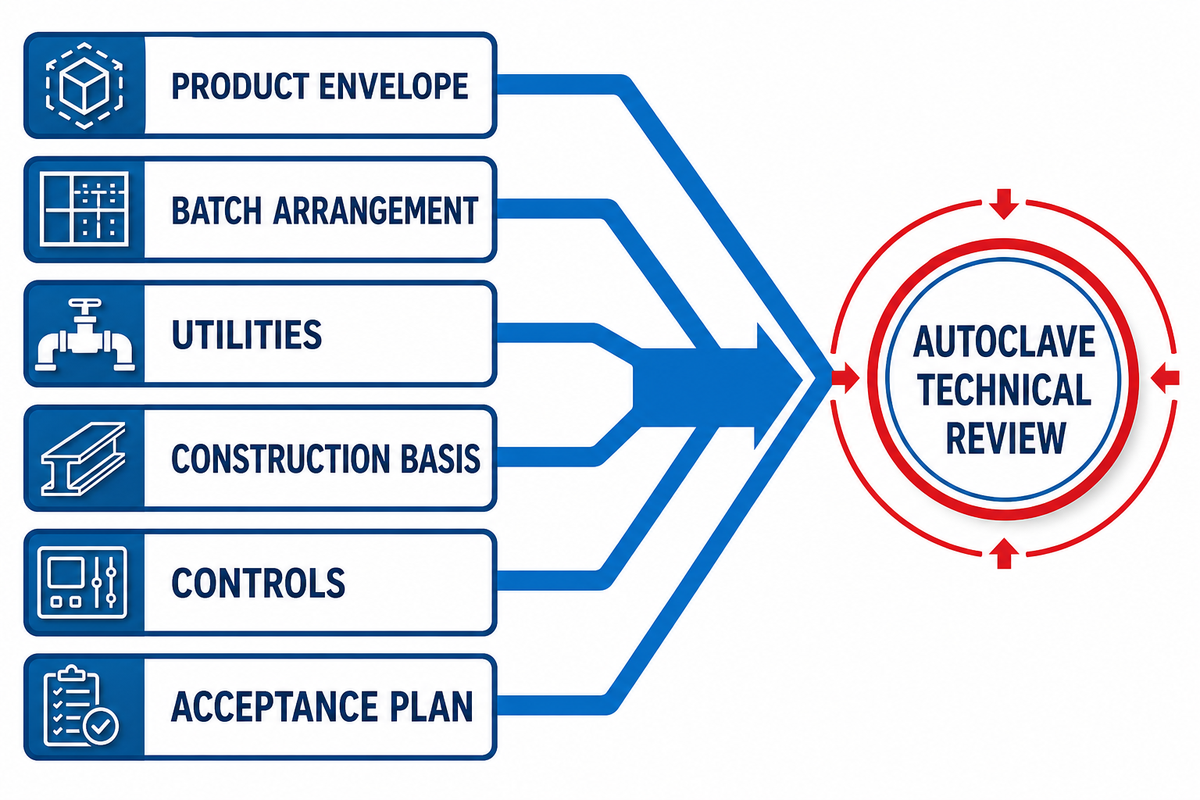
Ask Taiguo to review your product envelope, batch arrangement, utilities, destination code, control needs, and proposed acceptance test against the stated pressure-vessel construction basis before preparing an autoclave quotation.