Get in Touch with Taiguo


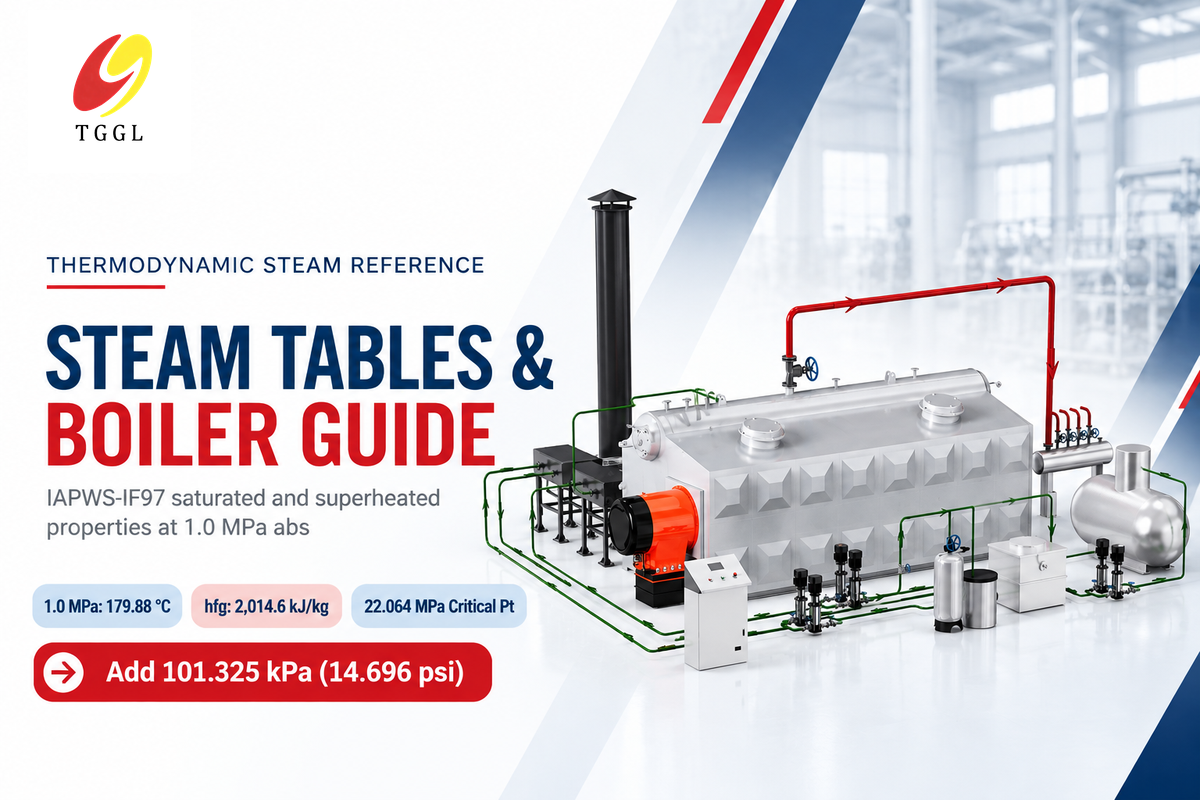
Updated November 2026 · Industrial Steam & Boiler Engineering Reference
In mechanical and process engineering, steam tables list the measured thermodynamic properties of pure water and steam over pressure and temperature grids. Commercial kitchens employ the identical phrase for electric buffet food warmers – nevertheless, engineering steam tables are purely thermodynamic reference charts. Compiled under the IAPWS Industrial Formulation 1997 (IAPWS-IF97), they tabulate saturation temperature, specific volume, internal energy, specific enthalpy, and entropy.
Boiler engineers use these charts daily to size steam generators, check heat exchangers, and audit flash-steam loops.
Absolute Pressure Rule: Pabs = Pgauge + Patm. Add 101.325 kPa (14.696 psi) at sea level before lookup.
1.0 MPa abs (145.04 psia) Benchmark: Tsat = 179.88 °C (355.8 °F), hf = 762.5 kJ/kg, hfg = 2,014.6 kJ/kg, hg = 2,777.1 kJ/kg, vg = 0.1944 m³/kg.
IAPWS-IF97 Saturation Dome: Runs from the 0.01 °C (611.657 Pa) triple point to the 373.946 °C (22.064 MPa) critical point.
A table row appears simple until gauge pressure or wet carryover wrecks your plant heat balance. Entering raw boiler gauge pressure into an absolute psia column under-predicts boiling temperature and distorts header pipe sizing. Graphical turbine expansion paths belong on enthalpy-entropy coordinate diagrams, while horsepower nameplate constants follow separate rules.
We discuss a few tools: tabular property lookup, bilinear interpolation, steady-flow boiler heat equations, IAPWS guidelines, and matching steam states to boiler hardware.
What Are Thermodynamic Steam Tables? Phase Regimes and the Absolute Pressure Rule
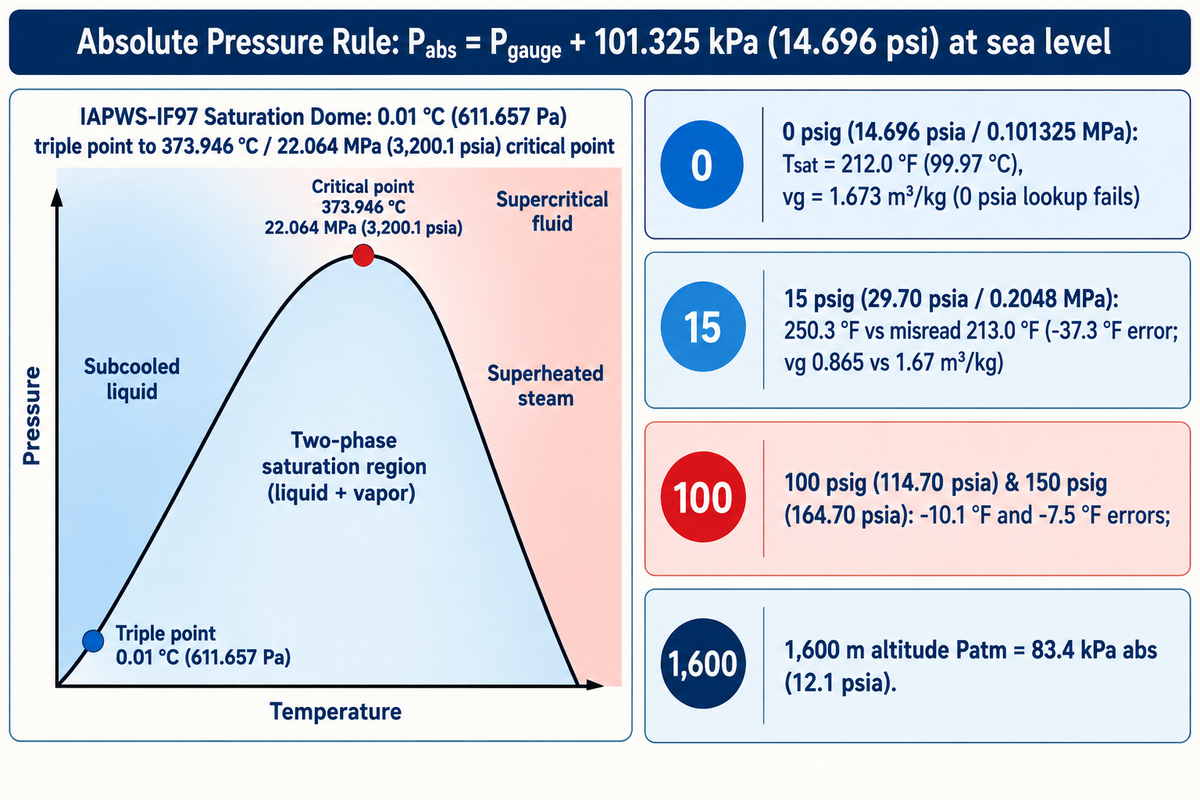
Standard thermodynamic steam tables index the properties of water and steam against absolute pressure. Operators at sea level must add 101.325 kPa (14.696 psi) to any boiler gauge reading first. Entering 15 psig directly as 15 psia under-reads boiling temperature by 37.3 °F and nearly doubles vapor specific volume from 0.865 to 1.67 m³/kg.
Charts of the thermodynamic properties of steam divide pure water into four physical regimes around the saturation dome. Subcooled liquid occupies states where water temperature sits below the boiling point at local pressure. Along the saturation curve, vapor and liquid coexist in thermal equilibrium at locked pressure and temperature pairs. Heating dry vapor past its boiling point produces single-phase superheated steam where pressure and temperature vary independently. Above 373.946 °C (705.1 °F) and 22.064 MPa (3,200.1 psia) in the NIST Chemistry WebBook fluid database, liquid and vapor merge into supercritical fluid.
Stable liquid flow in heated plant piping requires holding local static pressure above the water boiling curve. For example, U.S. Patent US9791170B2 on direct steam injection keeps nozzle backpressure above 462 kPa abs. That backpressure prevents violent vapor flashing inside heated slurry lines. In boiler rooms, crossing 15 psig (0.205 MPa abs) separates low-pressure heating units from power boilers, as detailed in our guide to industrial boiler definitions and ASME code boundaries.
| Boiler Gauge Reading | True Absolute Pressure | True Tsat & vg (Correct psia Entry) | Misread Tsat & vg (Raw psig Entered as psia) | Engineering Sizing Distortion |
|---|---|---|---|---|
| 0 psig (0 kPag) | 14.696 psia (0.101325 MPa) | 212.0 °F (99.97 °C); 1.673 m³/kg | Undefined (below 0.0887 psia triple point) | Table lookup fails completely at atmospheric vent |
| 15 psig (103.4 kPag) | 29.70 psia (0.2048 MPa) | 250.3 °F (121.0 °C); 0.865 m³/kg | 213.0 °F (100.6 °C); 1.67 m³/kg | -37.3 °F (-20.4 °C) temperature error; nearly doubles pipe volume |
| 100 psig (689.5 kPag) | 114.70 psia (0.7908 MPa) | 337.9 °F (169.9 °C); 0.2428 m³/kg | 327.8 °F (164.3 °C); 0.2768 m³/kg | -10.1 °F (-5.6 °C) temperature error; oversizes header diameter |
| 150 psig (1,034.2 kPag) | 164.70 psia (1.1356 MPa) | 365.9 °F (185.5 °C); 0.1719 m³/kg | 358.4 °F (181.3 °C); 0.1878 m³/kg | -7.5 °F (-4.2 °C) temperature error; skews orifice flow metering |
Do steam tables use absolute pressure or gauge pressure?
Scientific and ASME thermodynamic steam tables use absolute pressure (psia, kPa abs, bar a, or MPa abs) referenced to a perfect vacuum. Water phase equations depend strictly on total molecular pressure. Some valve and trap vendors print quick charts in gauge pressure (psig or barg) by assuming a sea-level atmosphere of 14.696 psi (101.325 kPa).
High-altitude plants must never apply sea-level gauge tables directly. At 1,600 m (5,250 ft) elevation, ambient barometric pressure drops to roughly 83.4 kPa abs (12.1 psia). Adding 14.7 psi instead of 12.1 psi to a 5 psig deaerator gauge over-states absolute pressure by 2.6 psi. That mistake shifts expected boiling temperature by over 6 °F and leaves dissolved oxygen in the feedwater.
How to Read Steam Table Columns: Specific Volume, Enthalpy (hf, hfg, hg), Entropy, and Dryness Fraction
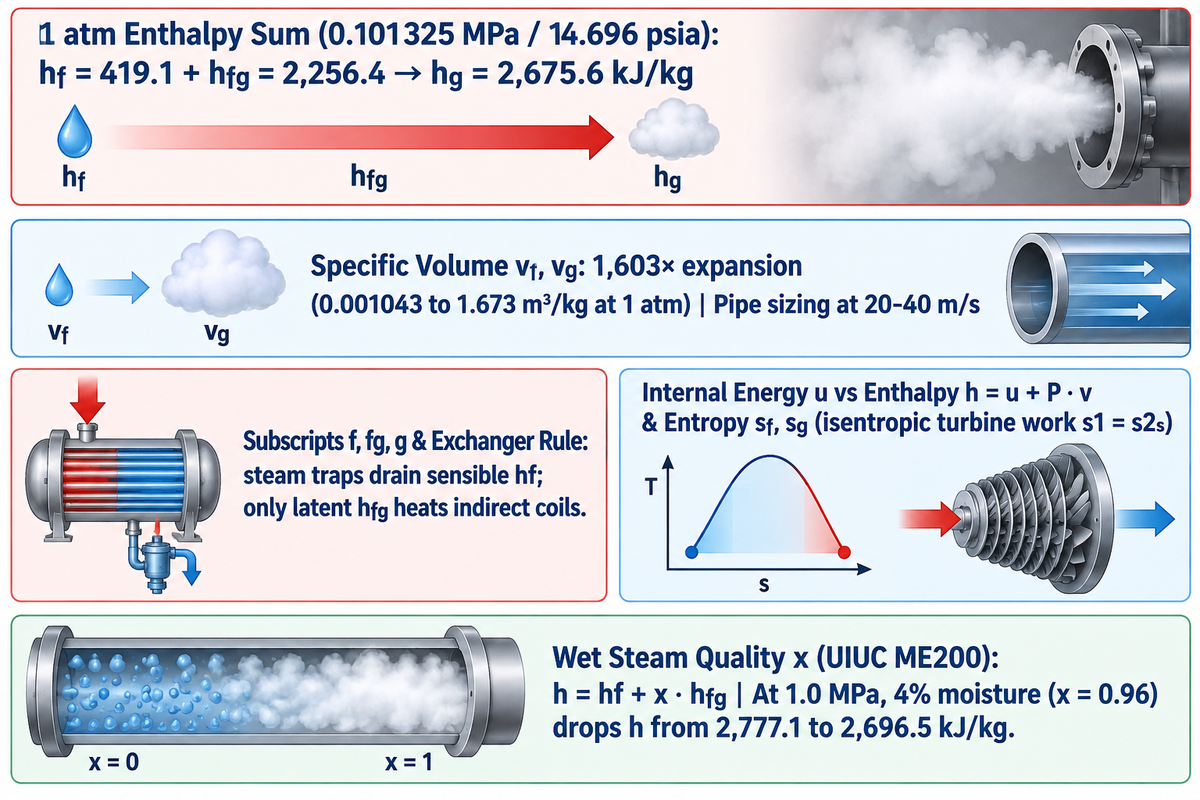
At standard atmospheric pressure (0.101325 MPa or 14.696 psia), saturated liquid water carries hf = 419.1 kJ/kg and latent heat adds hfg = 2,256.4 kJ/kg to yield total dry vapor enthalpy hg. Meanwhile, specific volume expands 1,603 times from 0.001043 m³/kg liquid to 1.673 m³/kg vapor.
Every column header pairs a physical state property with a phase subscript from classical steam research. Subscript f marks saturated liquid at the bubble point, while subscript g marks dry saturated vapor at the dew point. Subscript fg represents the evaporation jump between liquid and vapor.
Reference editions cover the thermodynamic properties of water alongside thermodynamic and transport properties like specific heat capacity, viscosity, and thermal conductivity.
| Column Symbol | SI & Imperial Unit | Thermodynamic Definition | Primary Boiler & Plant Application |
|---|---|---|---|
| vf, vg | m³/kg (ft³/lb) | Specific volume (inverse of fluid density ρ = 1/v) for saturated liquid and dry vapor | Sizing steam headers, flowmeters, and safety relief valve orifices at target velocities (20–40 m/s) |
| uf, ug | kJ/kg (Btu/lb) | Specific internal molecular thermal energy excluding flow work (P · v) | Closed-volume rigid vessel heat balances and accumulator transient analysis |
| hf | kJ/kg (Btu/lb) | Specific enthalpy of saturated liquid water (hf = uf + P · vf) | Evaluating boiler feedwater heat input, blowdown energy, and condensate flash tanks |
| hfg | kJ/kg (Btu/lb) | Latent heat of vaporization absorbed during constant-temperature boiling (hg − hf) | Calculating usable condensing heat transfer in indirect shell-and-tube or plate exchangers |
| hg | kJ/kg (Btu/lb) | Total specific enthalpy of dry saturated steam (hf + hfg) | Computing total boiler steam outlet enthalpy and isenthalpic valve throttling states |
| sf, sg | kJ/(kg·K) (Btu/lb·°R) | Specific entropy of saturated liquid and dry vapor relative to the 0.01 °C triple point | Evaluating ideal isentropic steam turbine work (s1 = s2s) |
| x (Quality) | Dimensionless (0 to 1) | Dryness fraction: mass of dry vapor divided by total wet mixture mass | Correcting boiler heat output and exchanger duty for entrained moisture carryover |
Don’t assume that the total vapor enthalpy hg is 100 percent usable coil heat. Steam traps drain saturated liquid carrying sensible enthalpy hf out of the heater. Only the latent heat column hfg passes through the indirect exchanger tubes during condensation.
What is x in steam tables and how does wet steam affect heat duty?
In thermodynamic steam tables, x (dryness fraction or steam quality) defines the mass fraction of dry vapor in a wet two-phase mixture from 0 to 1.0. Drum turbulence entrains tiny liquid droplets into the exiting steam flow.
According to the University of Illinois ME200 five-case steam lookup guide, the wet mixture enthalpy is h = hf + x · hfg. Mixture specific volume follows v = vf + x · (vg − vf). At 1.0 MPa abs, 4 percent moisture carryover (x = 0.96) lowers total enthalpy from 2,777.1 kJ/kg to 2,696.5 kJ/kg.
Saturated Steam Tables: Temperature-Entry vs. Pressure-Entry Lookup and Reference Chart
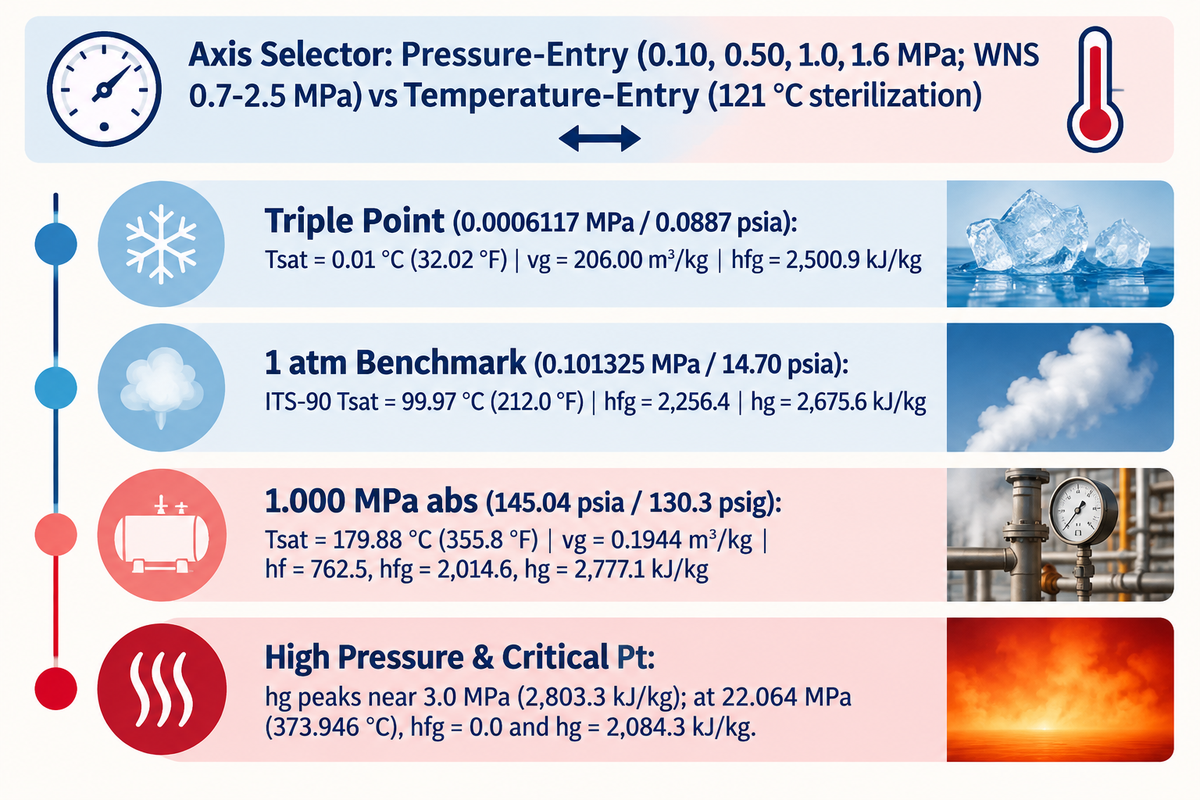
At 1.0 MPa abs (145.04 psia), IAPWS-IF97 saturated steam boils at 179.88 °C (355.8 °F) with liquid enthalpy hf = 762.5 kJ/kg and latent heat hfg = 2,014.6 kJ/kg. Total vapor enthalpy reaches 2,777.1 kJ/kg at specific volume 0.1944 m³/kg. Temperature-entry and pressure-entry saturated tables present this exact same equilibrium data and information sorted along opposite axes.
Select the matching entry axis to avoid interpolation. Select the pressure-entry table if boiler drum pressure, header regulator setpoint, or trap inlet pressure is your known reading. Its rows step in even pressure increments (0.10, 0.50, 1.0, and 1.6 MPa). Select the temperature-entry table if a reactor requires a fixed product temperature (121 °C sterilization, for example) or for vacuum condenser sizing. Industrial steam systems operating between 0.7 MPa and 2.5 MPa along this curve represent WNS horizontal wet-back saturated steam boilers.
| Abs. Pressure (MPa) | Abs. / Sea-Level Gauge (psi) | Tsat (°C / °F) | vg (m³/kg) | hf (kJ/kg) | hfg (kJ/kg) | hg (kJ/kg) |
|---|---|---|---|---|---|---|
| 0.0006117 (Triple Pt) | 0.0887 psia (Vacuum) | 0.01 °C / 32.02 °F | 206.00 | 0.00061 | 2,500.9 | 2,500.9 |
| 0.010 (Condenser) | 1.45 psia (Vacuum) | 45.81 °C / 114.5 °F | 14.670 | 191.8 | 2,392.1 | 2,583.9 |
| 0.101325 (1 atm) | 14.70 psia / 0 psig | 99.97 °C / 212.0 °F | 1.6730 | 419.1 | 2,256.4 | 2,675.6 |
| 0.200 (~1 bar g) | 29.01 psia / 14.3 psig | 120.21 °C / 248.4 °F | 0.8858 | 504.7 | 2,201.6 | 2,706.2 |
| 0.500 | 72.52 psia / 57.8 psig | 151.83 °C / 305.3 °F | 0.3748 | 640.1 | 2,108.0 | 2,748.1 |
| 0.800 (~101 psig) | 116.03 psia / 101.3 psig | 170.41 °C / 338.7 °F | 0.2403 | 720.9 | 2,047.5 | 2,768.3 |
| 1.000 | 145.04 psia / 130.3 psig | 179.88 °C / 355.8 °F | 0.1944 | 762.5 | 2,014.6 | 2,777.1 |
| 1.350 (~1.25 MPag) | 195.80 psia / 181.1 psig | 193.35 °C / 380.0 °F | 0.1458 | 822.7 | 1,964.7 | 2,787.4 |
| 1.700 (~1.6 MPag) | 246.56 psia / 231.9 psig | 204.31 °C / 399.8 °F | 0.1166 | 871.8 | 1,921.9 | 2,793.7 |
| 2.600 (~2.5 MPag) | 377.10 psia / 362.4 psig | 226.04 °C / 438.9 °F | 0.0769 | 971.7 | 1,831.0 | 2,802.7 |
| 4.000 | 580.15 psia / 565.5 psig | 250.35 °C / 482.6 °F | 0.04978 | 1,087.4 | 1,713.5 | 2,800.9 |
| 22.064 (Critical Pt) | 3,200.1 psia / 3,185.4 psig | 373.946 °C / 705.1 °F | 0.003106 | 2,084.3 | 0.0 | 2,084.3 |
Note two physical details inside the benchmark chart above. Older textbooks on the 1968 temperature scale round 1 atm latent heat to 2,257 kJ/kg at 100.0 °C. Modern ITS-90 and IAPWS-IF97 fix 0.101325 MPa boiling at 99.97 °C and 2,256.4 kJ/kg. Also notice that dry vapor enthalpy hg peaks near 3.0 MPa (2,803.3 kJ/kg) before dropping to 2,084.3 kJ/kg at the critical point.
Superheated Steam Tables and Double Linear Interpolation: Step-by-Step Engineering Lookup
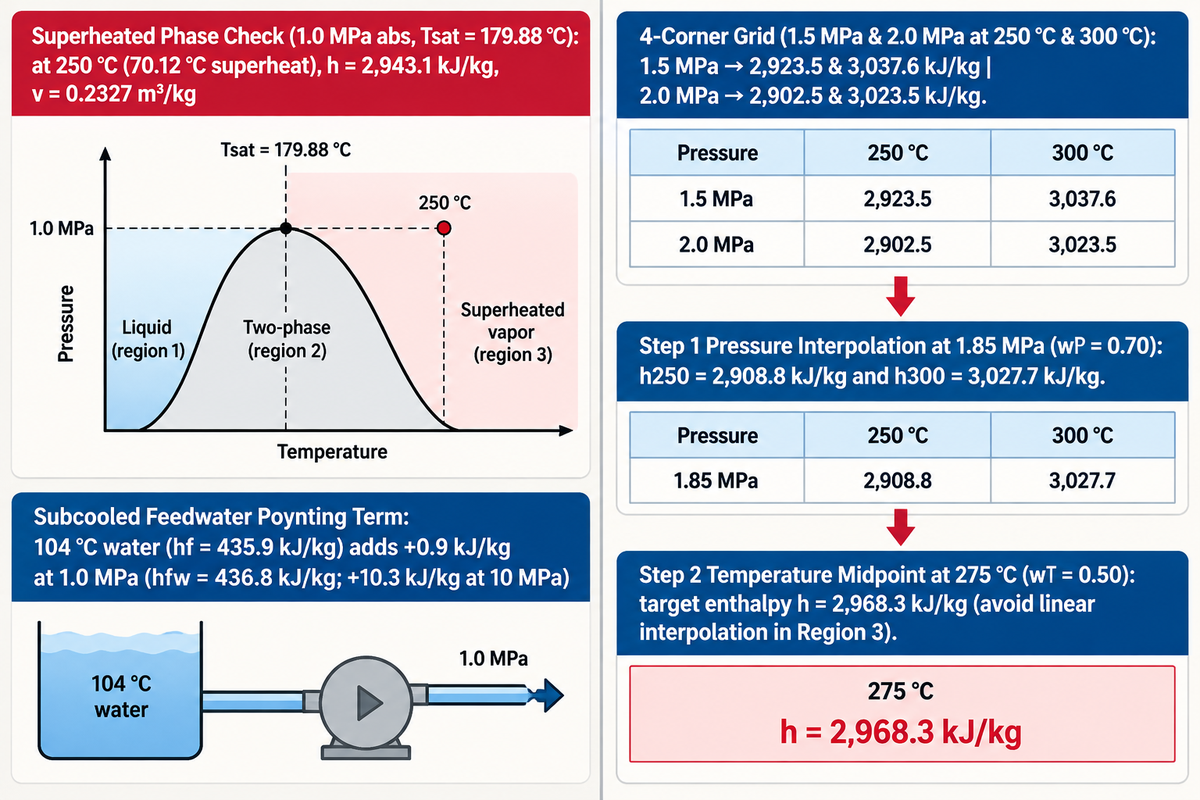
At 1.0 MPa abs and 250 °C (70.12 °C of superheat above the 179.88 °C boiling point), superheated steam holds enthalpy h = 2,943.1 kJ/kg and specific volume 0.2327 m³/kg. Above the saturation curve, pressure and temperature act independently and require two-variable superheated steam tables.
Run a basic phase check before opening any superheated sub-table. Look up Tsat at your operating absolute pressure first. When line temperature exceeds Tsat, the difference ΔTsh = T − Tsat gives degrees of superheat. Never enter a saturated temperature table at 250 °C, because that lookup returns a false 3.976 MPa boiling state instead of 1.0 MPa vapor! Power turbines admit high-superheat steam (such as 90 bar a at 450 °C) so expanding vapor stays dry across low-pressure blades. IAPWS-IF97 also supplies a metastable vapor equation up to 10 MPa for fast nozzle expansions.
What if your measured water temperature falls below Tsat (as it does for pumped boiler feedwater)? Pressurized subcooled liquid follows hfw ≈ hf(Tfw) + vf · [P − Psat(Tfw)].
For 104 °C deaerated feedwater (h f = 435.9 kJ/kg) pumped into a 1.0 MPa boiler, pressure work adds only +0.9 kJ/kg (giving h fw = 436.8 kJ/kg). At 10 MPa utility feedwater pressures, that Poynting term adds +10.3 kJ/kg and requires Region 1 compressed-liquid tables.
How do you interpolate values in saturated and superheated steam tables?
One-variable saturated tables use a single linear weight fraction w = (X − X1) / (X2 − X1) between adjacent rows to find Y = Y1 + w · (Y2 − Y1). Two-variable superheated steam tables need to do a double, sequential, linear interpolation with the four neighboring pressure and temperature grid corners.
Consider a header at P = 1.85 MPa abs and T = 275 °C. At 1.5 MPa, grid enthalpies are h250 = 2,923.5 and h300 = 3,037.6 kJ/kg. At 2.0 MPa, grid enthalpies are h250 = 2,902.5 and h300 = 3,023.5 kJ/kg. First, interpolate 70 percent of the way in pressure (wP = 0.70) to get 2,908.8 kJ/kg at 250 °C and 3,027.7 kJ/kg at 300 °C. Second, take the midpoint at 275 °C (wT = 0.50) to find single target value h = 2,968.3 kJ/kg. Avoid linear interpolation inside near-critical Region 3 (0.0019 to 0.0069 m³/kg below 30 MPa), where heat capacity curves sharply. Instead, query exact isobaric fluid grids directly in the NIST Chemistry WebBook fluid property system.
Why Low-Pressure Steam Has Higher Latent Heat: Process Heating vs. Superheated Steam and Thermal Oil
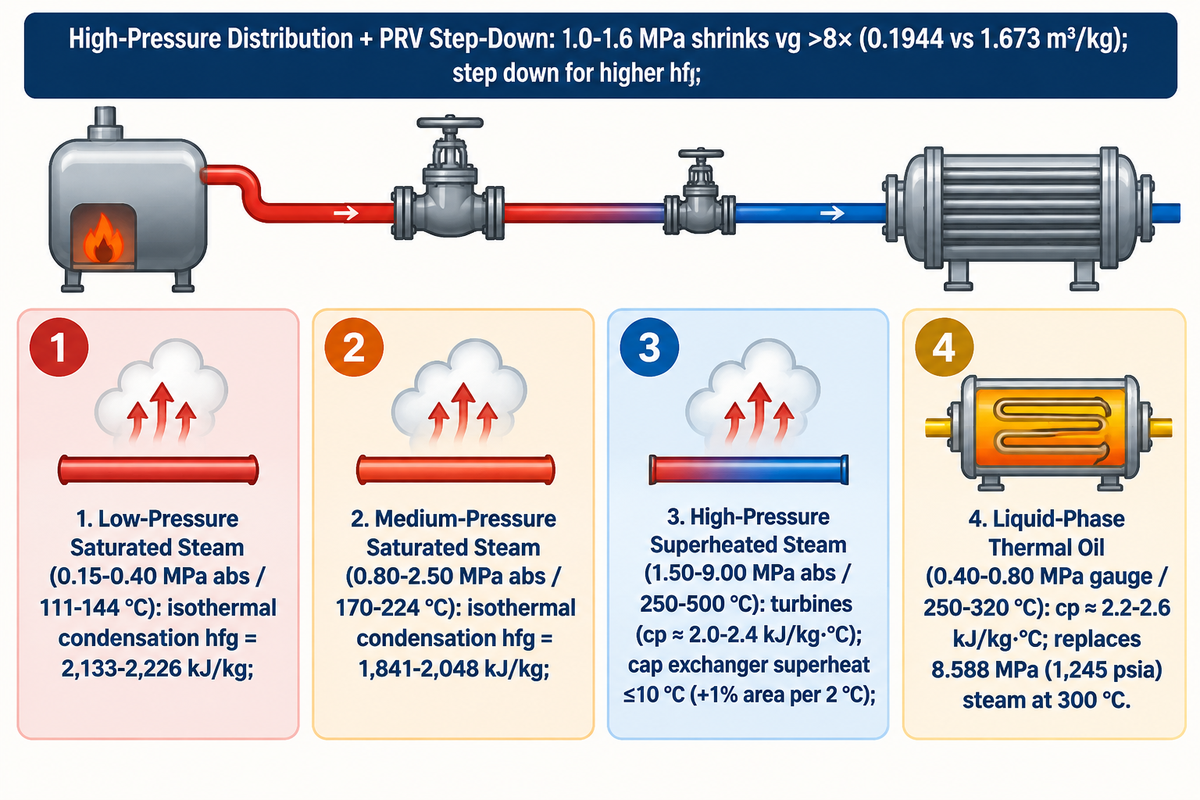
Latent heat of vaporization (hfg) declines as steam pressure rises, dropping from 2,256.4 kJ/kg at 0.101325 MPa to 2,014.6 kJ/kg at 1.0 MPa and 1,713.5 kJ/kg at 4.0 MPa. It reaches zero at 22.064 MPa. Every kilogram of low-pressure saturated steam releases more condensing heat than high-pressure steam.
Imagine high-pressure distribution as shipped, dense palletized freight, before unpacking at the point of use. Generating header steam at 1.0 to 1.6 MPa shrinks vapor specific volume more than eight-fold relative to atmospheric steam (0.1944 vs. 1.673 m³/kg). Smaller specific volume reduces header pipe diameter, flange weight, and line radiation loss.
Upstream of jacketed kettles, or shell and tube heaters, pressure reducing stations step steam down to the lowest pressure that retains a 15 to 25 °C temperature approach. Stepping down unlocks higher hfg and lowers trap flash loss.
Sending superheated steam into an indirect condensing exchanger penalizes heat transfer. Dry superheated vapor cools like a gas with a low film coefficient until it desuperheats to Tsat. Practical coil design rules cap exchanger inlet superheat at 10 °C. Above that limit, coils need roughly 1 percent extra surface area per 2 °C of superheat. Moreover, reaching 300 °C with saturated steam requires an extreme 8.588 MPa (1,245 psia) vessel, whereas liquid-phase industrial thermal oil boiler systems deliver 250 to 320 °C at just 0.4 to 0.8 MPa.
| Heating Medium Regime | Typical Pressure & Temp Band | Usable Heat Release Mechanism | Best-Fit Duty & Key Limitation |
|---|---|---|---|
| Low-Pressure Saturated Steam | 0.15–0.40 MPa abs (111–144 °C) | Isothermal condensation (hfg = 2,133–2,226 kJ/kg) | Ideal for food evaporators, sterilizers, and HVAC coils; large vg limits long-distance piping |
| Medium-Pressure Saturated Steam | 0.80–2.50 MPa abs (170–224 °C) | Isothermal condensation (hfg = 1,841–2,048 kJ/kg) | Compact plant distribution headers, corrugators, and AAC autoclaves; higher condensate flash loss |
| High-Pressure Superheated Steam | 1.50–9.00 MPa abs (250–500 °C) | Isentropic expansion work (cp ≈ 2.0–2.4 kJ/kg·°C) | Required for steam turbines and long chemical mains; poor dry-gas film coefficient in indirect heaters |
| Liquid-Phase Organic Thermal Oil | 0.40–0.80 MPa gauge (250–320 °C) | Sensible liquid cooling (cp ≈ 2.2–2.6 kJ/kg·°C) | Replaces 4.0–8.6 MPa steam above 250 °C; requires pumped circulation and temperature glide allowance |
Applied Industrial Boiler Calculations Using Steam Tables: Heat Duty, Flash Steam, and PRV Throttling
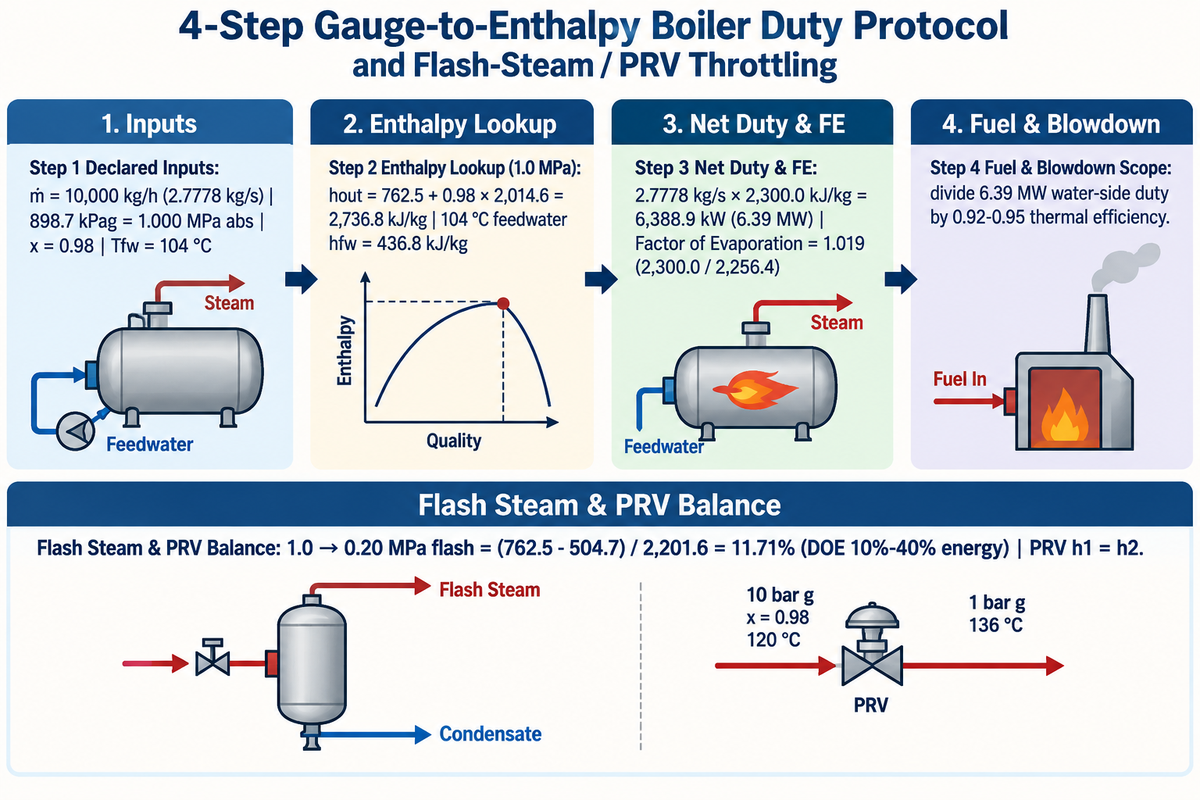
Generating 10,000 kg/h (2.778 kg/s) of 98-percent-dry steam at 1.0 MPa abs from 104 °C deaerated feedwater requires 6.39 MW (21.80 MMBtu/h) of net water-side thermal duty. Flashing 1.0 MPa condensate to 0.20 MPa abs recovers 11.71 percent low-pressure flash steam by mass.
Boiler catalog tons-per-hour ratings are based on 100 °C feedwater boiling into 100 °C atmospheric steam (2,256.4 kJ/kg). Actual boiler systems operate at increased pressures with hot deaerator water and minor droplet carryover. Apply our 4-Step Gauge-to-Enthalpy Boiler Duty Protocol below to calculate exact output, and verify sizing options in our interactive industrial boiler sizing calculator.
- Declare assumed inputs before solving. Take steady continuous flow ṁ = 10,000 kg/h (2.7778 kg/s) at sea-level gauge pressure 898.7 kPag (1.000 MPa abs). Assume steam quality x = 0.98, deaerator water Tfw = 104 °C, and zero blowdown in the base water-side step.
- Read outlet and feedwater enthalpies from the saturation columns. At 1.0 MPa abs, hf = 762.5 kJ/kg and hfg = 2,014.6 kJ/kg. Wet outlet enthalpy equals hout = 762.5 + 0.98 × 2,014.6 = 2,736.8 kJ/kg, while 104 °C feedwater at 1.0 MPa holds hfw = 436.8 kJ/kg.
- Multiplying that net enthalpy gain (hout − hfw) by 2.7778 kg/s gives 6,388.9 kW (6.39 MW), with a Factor of Evaporation of 1.019 (2,300.0 / 2,256.4).
- Use fuel and blowdown scope limits. The 6.39 MW number is water-side heat absorption only.
Divide by actual measured boiler thermal efficiency (0.92 to 0.95) and factor in blowdown heat loss.
Two downstream plant balances use the same saturation columns. When 1.0 MPa abs condensate (hf1 = 762.5 kJ/kg) enters a 0.20 MPa abs flash tank (hf2 = 504.7 kJ/kg, hfg2 = 2,201.6 kJ/kg), mass flash fraction is (762.5 − 504.7) / 2,201.6 = 11.71%. Per U.S. Department of Energy Steam Tip Sheet #13, flash vapor holds 10 to 40 percent of original condensate energy. Every 500 lb/hr (227 kg/h) of recovered flash steam also yields 1 gpm of distilled water.
Adiabatic expansion across a pressure reducing valve (PRV) conserves total enthalpy (h1 = h2). Below 30 bar g, throttling dry saturated steam produces downstream superheat. Upstream moisture alters that path: throttling 10 bar g steam at x = 0.98 to 1 bar g leaves 35 kJ/kg above the 1 bar g dry saturated enthalpy of 2 706.7 kJ/kg and warms exit steam from 120 °C to 136 °C. Throttling 6 bar g steam at x = 0.95 to 1 bar g leaves the downstream steam wet! Power plant engineers apply steam temperature-split checks in POWER Magazine HP-IP turbine leakage diagnostics, recovering roughly 40 Btu/kWh in heat rate.
IAPWS-IF97 vs. IAPWS-95 and Legacy IFC-67: Formulations, Reference Datums, and Digital Calculators
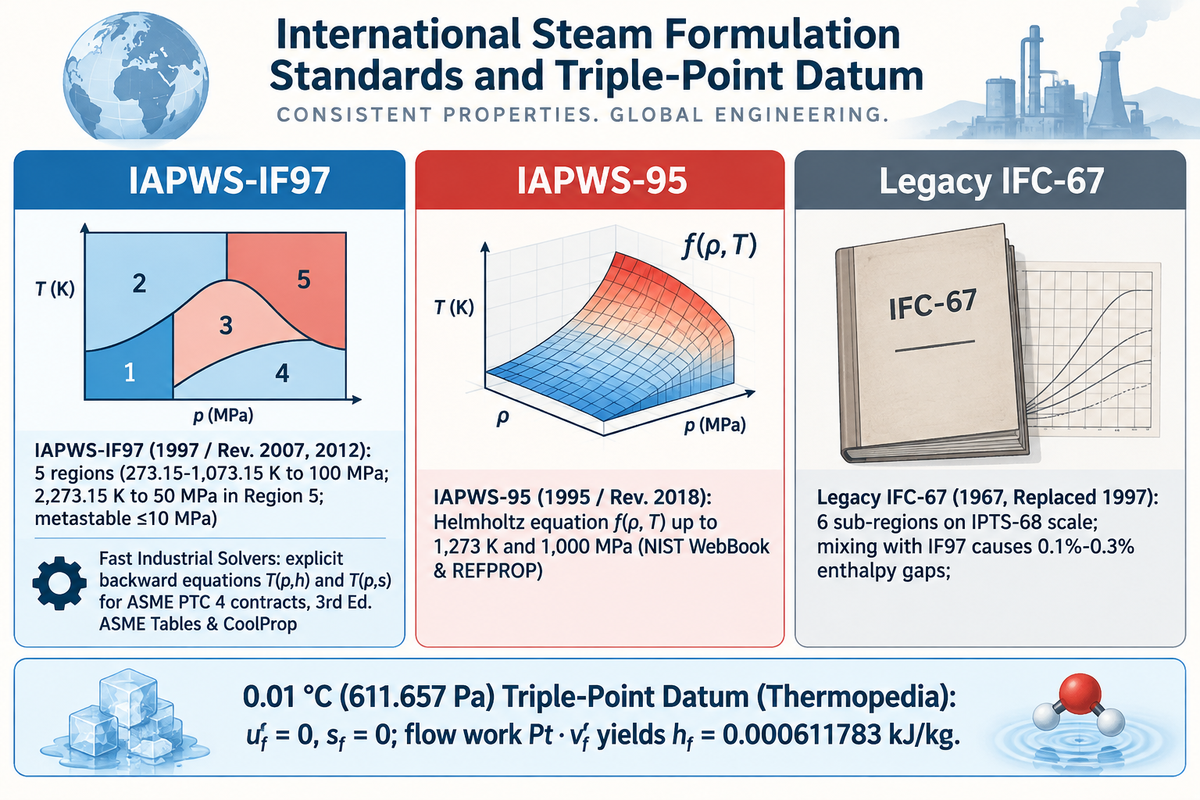
Modern industrial steam tables and boiler acceptance codes standardize on IAPWS-IF97, covering 5 computational regions from 273.15 K to 1,073.15 K up to 100 MPa. High-temperature Region 5 extends to 2,273.15 K at 50 MPa. At the 0.01 °C (611.657 Pa) triple point, liquid internal energy and entropy equal zero.
There is also a separate equation for metastable steam at pressures up to 10 MPa.
Why maintain both scientific IAPWS-95 and industrial IAPWS-IF97 standards? As Allan H. Harvey and James C. Bellows note in ASME’s centennial history of steam tables, IAPWS-95 remains the definitive scientific reference up to 1,273 K and 1,000 MPa, yet its Helmholtz equation requires slow numerical iteration for pressure-enthalpy inputs. Per the NIST publication record for the 3rd Edition ASME International Steam Tables, IAPWS-IF97 supplies explicit backward equations T(p,h) and T(p,s) that run hundreds of times faster inside boiler heat-balance models.
Triple-point rows also hold a classic surprise: liquid enthalpy at 0.01 °C reads 0.000611783 kJ/kg rather than exact zero. Per the Thermopedia steam tables reference (DOI 10.1615/AtoZ.s.steam_tables), the reference state sets liquid specific internal energy and specific entropy to zero at the triple point. Adding the flow-work product Pt · vf yields 0.000611783 kJ/kg. For daily calculations, engineers combine printed ASME tables or a temperature-entropy diagram with verified digital tools. Trusted options include the online NIST Chemistry WebBook calculator, CoolProp, or an IAPWS-IF97 Excel spreadsheet toolbox.
| Formulation Standard | Adopted / Revised | Valid P, T Range & Structure | Verified Software, Books & Contractual Role |
|---|---|---|---|
| IAPWS-IF97 (R7-97) | 1997 (Rev. 2007, 2012) | 5 regions; 273.15–1,073.15 K to 100 MPa (2,273.15 K to 50 MPa in Region 5) | ASME Steam Tables 3rd Ed., ASME PTC 4 contracts, CoolProp IF97, Excel/Python IF97 libraries |
| IAPWS-95 | 1995 (Rev. 2018) | Single Helmholtz equation f(ρ, T) up to 1,273 K and 1,000 MPa | NIST Chemistry WebBook online fluid calculator, NIST REFPROP, scientific metrology |
| Legacy IFC-67 | 1967 (Replaced 1997) | 6 sub-regions on IPTS-68 temperature scale | 1967–1993 ASME Steam Tables; retired due to slow iteration and inter-region step jumps |
Have steam tables changed between 1967 IFC-67 and modern IAPWS-IF97 editions?
Yes. IAPWS adopted IAPWS-IF97 in 1997 (and extended Region 5 to 50 MPa in 2007/2012) to replace the 1967 IFC-67 standard. Low-pressure saturation enthalpies shifted by less than 0.1 percent, yet IF97 removed inter-region step jumps, adopted the ITS-90 temperature scale, and accelerated computer solvers more than five-fold.
Commercial boiler acceptance tests under ASME PTC 4 must name one formulation in the purchase contract. Mixing an old IFC-67 macro with an IAPWS-IF97 PLC historian near high-pressure Region 1/3 boundaries creates artificial 0.1 to 0.3 percent enthalpy gaps. Remember too that all IAPWS tables describe pure water. Elevated dissolved solids in boiler drum water raise actual boiling temperature slightly above tabular Tsat.
Steam-State-to-Boiler Selection Matrix and 8-Point Steam Specification RFQ Checklist
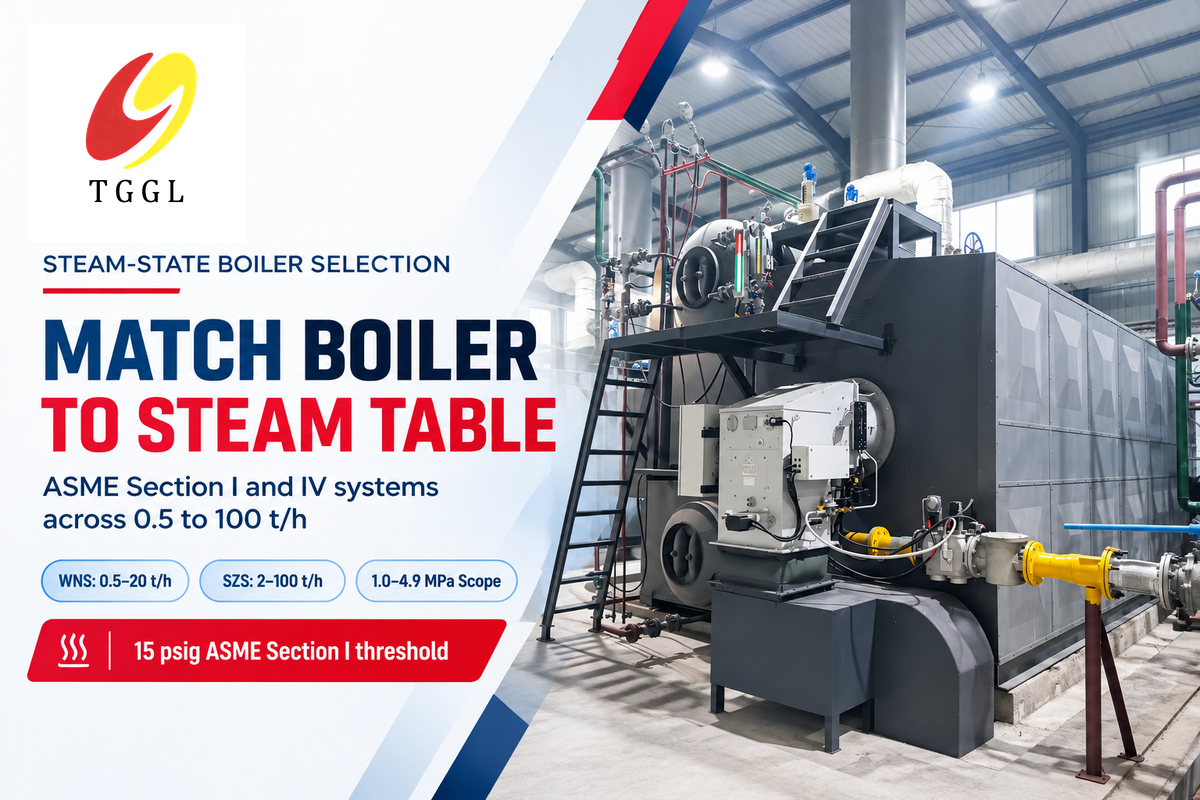
Crossing 15 psig (0.205 MPa abs, 121.0 °C Tsat) shifts steam boilers from ASME Section IV heating code into Section I power code. Above 2.5 MPa (226.0 °C Tsat) or 20 t/h, vessel design transitions from WNS fire-tube shells to 1.0–4.9 MPa SZS D-type water-tube boilers.
Above the 15 psig statutory threshold in Washington Administrative Code WAC 296-104-010, 2025 ASME Boiler and Pressure Vessel Code rules raise required shell thickness directly with design pressure. Stepping a water-tube boiler design pressure from 1.25 MPa to 2.45 MPa adds 8 to 12 percent to boiler body cost. Conversely, returning 80 °C condensate improves fuel efficiency by 2 to 3 percent (model your savings in our steam boiler operating cost calculator). Keeping deaerated feedwater oxygen below 7 ppb protects tube walls beyond 18 years of continuous service.
Founded in 1976 as a Grade A industrial boiler manufacturer, Taiguo Boiler builds industrial steam and thermal fluid systems matched to your steam-table operating point. Use the 9-row matrix below to match pressure, temperature, and dryness targets to hardware, including LDR point-of-use electric steam boilers, DZL chain-grate biomass steam boilers, and SZS D-type water-tube superheated steam boilers.
| Thermodynamic Regime & Table Band | Abs. Pressure & Temp Range | Governing Code Basis | Matched Boiler / Equipment Family | Not Suitable / Operating Limitation |
|---|---|---|---|---|
| 1A. Sub-Atmospheric Vacuum Steam | 0.01–0.09 MPa abs (45.8–96.7 °C) | Vacuum condenser / evaporator design | Turbine surface condensers & vacuum evaporators | Huge vg (1.9–14.7 m³/kg); air in-leakage stalls condensing heat transfer |
| 1B. Low-Pressure Heating Steam | 0.101–0.205 MPa abs (≤15 psig; 100–121 °C) | ASME BPVC Section IV (H-stamp) | Low-pressure CWNS / cast or steel heating boilers | Cannot drive medium-temp industrial reactors or high-pressure autoclaves |
| 2A. Point-of-Use Clean Saturated Steam | 0.50–1.70 MPa abs (0.4–1.6 MPag; 152–204 °C) | ASME BPVC Section I / CE-PED | Taiguo LDR / WDR Electric Steam Boiler (0.05–4 t/h) | Electricity tariff governs OPEX above 4 t/h continuous base load |
| 2B. Packaged Gas/Oil Saturated Steam | 0.80–2.60 MPa abs (0.7–2.5 MPag; 170–226 °C) | ASME BPVC Section I / CE-PED | Taiguo WNS 3-Pass Wet-Back Fire-Tube (0.5–20 t/h) | Cylindrical outer-shell hoop stress caps practical fire-tube design near 2.5 MPa |
| 2C. Solid-Fuel / Biomass Saturated Steam | 0.80–2.60 MPa abs (0.7–2.5 MPag; 170–226 °C) | ASME BPVC Section I / CE-PED | Taiguo DZL / SZL Chain-Grate Biomass Boiler (1–35 t/h) | Requires balanced-draft FD/ID fans, fuel storage yard, and baghouse dust collection |
| 3. Direct Curing Saturated Autoclave Steam | 1.10–1.70 MPa abs (184–204 °C) | ASME Section VIII Div. 1 + Section I | WNS / SZS Steam Boiler + AAC / Wood Autoclave | Requires air-venting purge so partial air pressure does not depress chamber Tsat |
| 4. High-Pressure & Superheated Steam | 1.10–5.00 MPa abs (1.0–4.9 MPag; 250–450 °C) | ASME BPVC Section I / CE-PED | Taiguo SZS D-Type Water-Tube Boiler (2–100 t/h) with superheater | Demands strict demineralized feedwater and dissolved O2 below 7 ppb |
| 5. Utility Subcritical / Supercritical Power | >10.0 to >22.064 MPa abs (540–620 °C) | Utility ASME Section I field-erected | Once-through utility supercritical steam generators | Zero phase boundary (hfg = 0 above 22.064 MPa); steam drums cannot separate phases |
| 6. High-Temperature Low-Pressure Process | 250–320 °C at 0.4–0.8 MPa gauge | ASME Section VIII / Liquid Heater Rules | Taiguo YYQW / YGL Thermal Oil Heater (avoiding 4.0–8.6 MPa steam) | Sensible liquid heat transfer requires expansion tank and nitrogen blanket protection |
Steam-Condition & Boiler Datum Verification Lock Sheet
- Lock pressure datum and site elevation: label working pressure and MAWP as gauge (MPag / psig) or absolute (MPa abs / psia), and declare site elevation above 300 m (83.4 kPa abs at 1,600 m).
- State actual steam flow and feedwater temperature: list continuous output in kg/h or t/h with feedwater temperature, starting at 104 °C deaerated water (O2 below 7 ppb) or 80 °C condensate return.
- Define dryness fraction or superheat target: require x ≥ 0.98 for saturated process headers, or specify exact outlet steam temperature (300 °C to 450 °C) for turbine drives.
- Pin performance contracts to IAPWS-IF97: mandate IAPWS-IF97 (R7-97, 2012 revision) and ASME PTC 4 in bids so every vendor calculates enthalpy from identical reference tables.
- Balance design pressure against PRV step-down: generate at 1.0 to 1.6 MPa for compact mains rather than overspecifying 2.45 MPa when terminal Tsat stays below 195 °C.
- Size flash-steam and flue economizers: add a flash vessel and vent condenser where condensate drops from ≥0.8 MPa to ≤0.2 MPa (recovering 10% to 40% flash energy per U.S. DOE Steam Tip Sheet #13).
- Check the 250 °C thermal oil crossover: switch to a YYQW/YGL thermal oil heater (250 to 320 °C at 0.4 to 0.8 MPa) whenever indirect process heating exceeds 250 °C.
- Verify vessel code stamping: specify ASME Section I (S-stamp) above 15 psig, Section IV (H-stamp) at or below 15 psig, or CE-PED 2014/68/EU for European plants.
Looking for an Enthalpy-Matched Steam or Thermal Oil Boiler Proposal?
Share your operating pressure (MPa or psig), target steam temperature, feedwater temperature, and fuel type with Taiguo Boiler’s engineering team. We’ll prepare an itemized factory quotation and full cost breakdown for you in 2 to 3 working days.
Frequently Asked Questions
What are steam tables used for in industrial engineering?
Mechanical and process engineers read the saturation temperature, pressure, specific volume, internal energy, enthalpy, and entropy of water and steam using thermodynamic steam tables.
Plant teams apply those verified numbers to size steam boilers, rate condensing heat exchangers, set pipe velocities, calculate flash-steam recovery, and audit steam turbine expansion work.
What is the difference between saturated steam tables and superheated steam tables?
Saturated steam tables list liquid and vapor properties along the boiling curve where pressure and temperature lock together. Use a single input (pressure or temperature) to read the entire row.
Superheated steam tables cover dry single-phase vapor heated above its local boiling point. As pressure and temperature work independently here, you should enter both readings simultaneously.
Can enthalpy or entropy values in steam tables be negative?
Yes. Liquid water enthalpy and entropy turn slightly negative below the 0.01 °C (32.02 °F) triple-point datum because zero internal energy and zero entropy are defined arbitrarily there.
Real boiler and turbine balances depend only on enthalpy differences (Δh) and entropy differences (Δs). Small negative numbers below 0.01 °C cause zero calculation error.
How do you convert steam table enthalpy from kJ/kg to Btu/lb?
To convert specific enthalpy in kJ/kg to Btu/lb divide by 2.326 (or multiply by 0.429923). Stay within one unit system to avoid minor 0.04 Btu/lb datum offsets.
Why does autoclave chamber temperature sometimes lag below the steam table saturation temperature?
Trapped air inside an autoclave splits measured vessel pressure between steam partial pressure and air partial pressure under Dalton’s Law (Ptotal = Psteam + Pair).
Condensing steam temperature follows only steam partial pressure rather than total gauge pressure. A 10-15% air pocket causes chamber temperature to fall several degrees Celsius until the vessel can be purged by thermostatic air vents.
No. A restaurant steam table is a heated water bath holding buffet food pans above 140 °F.
Thermodynamic steam tables are engineering water-vapor property charts.
References & Sources
- IAPWS R7-97(2012) Revised Release on the IAPWS Industrial Formulation 1997 for Water and Steam (5 regions up to 100 MPa).
- NIST: ASME International Steam Tables for Industrial Use, 3rd Edition Official IAPWS-IF97 reference tables (Harvey et al., 2014).
- NIST Chemistry WebBook (SRD 69) Reference IAPWS-95 pure-water saturation and isobaric property database.
- ASME: A Century of ASME Steam Tables Harvey and Bellows on IFC-67, IAPWS-95 (1,273 K, 1,000 MPa), and IAPWS-IF97 speedups.
- Thermopedia (DOI 10.1615/AtoZ.s.steam_tables) Steam table nomenclature and 0.01 °C triple-point datum (uf = 0, sf = 0).
- University of Illinois (ME200): Five Basic Cases Phase lookup rules for superheated vapor, compressed liquid, and wet quality x.
- U.S. DOE Steam Tip Sheet #13 Flash steam energy fraction (10%–40%) and vent condenser recovery (500 lb/hr = 1 gpm).
- Washington Administrative Code WAC 296-104-010 Statutory 15 psig steam boundary between heating boilers and power boilers.
- ASME 2025 Boiler and Pressure Vessel Code (BPVC) Section I power boiler and Section IV heating boiler construction standards.
- POWER Magazine: Combined HP-IP Steam Turbine Leakage Enthalpy-temperature throttling diagnostics and 40 Btu/kWh heat-rate gain.
- U.S. Patent US9791170B2 Direct steam injection heating and 462 kPa abs subcooling backpressure control.
Method & Scope Note: All pure-water values follow IAPWS-IF97 and NIST formulations. Site barometric elevation, boiler-water dissolved solids, and local ASME or PED inspections govern final equipment sizing. Reviewed by the Taiguo Boiler technical team.