Get in Touch with Taiguo


Updated September 2026
Steam retort processing is often the first concept considered for conventional metal cans, while water-based processing is often considered when the package needs controlled overpressure. That is a useful starting distinction, but it is not a machine-selection rule. Process choice depends on the sealed package, product heating behavior, load arrangement, utilities, cooling method, and the evidence needed to establish the scheduled process.
Key takeaway
Choose the medium after defining the product-package-load combination. Saturated steam is a practical trial candidate for many rigid cans. Water-based or steam-air overpressure systems may advance when package pressure control, support, or circulation makes them necessary. Confirm the choice through product-specific validation.
Quick Answer: Medium Choice Starts with Package
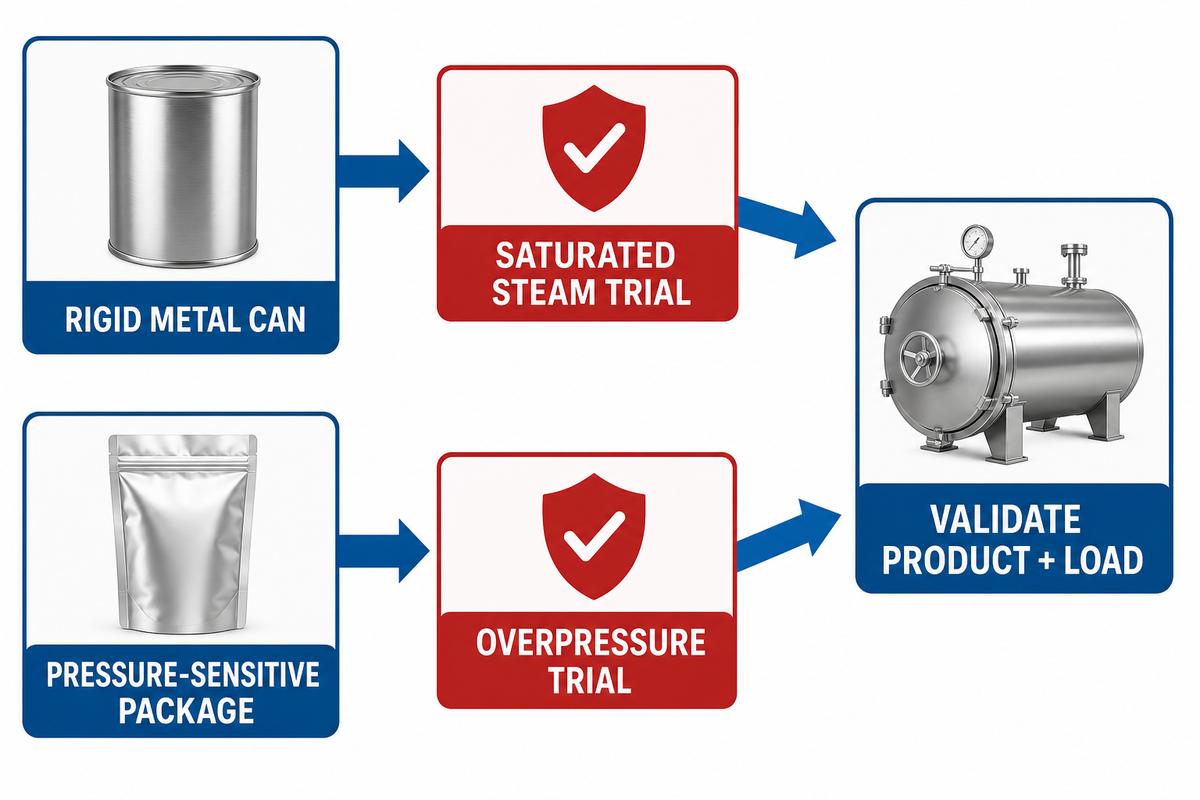
For a rigid metal can that tolerates the heating and cooling pressure profile, a saturated-steam retort is a sensible concept to test. For glass, flexible pouches, semi-rigid trays, and other pressure-sensitive packs, an overpressure-capable water or steam-air system may be a better trial candidate. Neither answer is final until the product, closure, load, utilities, and validation route are known. For a buyer, selecting from the package label alone creates a process-mismatch risk; a qualified review of the intended production load closes that gap.
Use the package to eliminate unsuitable concepts, not to approve a machine. A can with an unusual closure, a viscous product, an oriented load, or an agitation requirement may need a different configuration from a conventional static can process. Likewise, a pouch does not automatically require full-water immersion; spray, cascade, steam-air, support trays, and cooling control may all be relevant. Current federal equipment rules distinguish these systems because their critical controls differ. Review 21 CFR 113.40.
Set the Trial Boundary Before Comparing Proposals
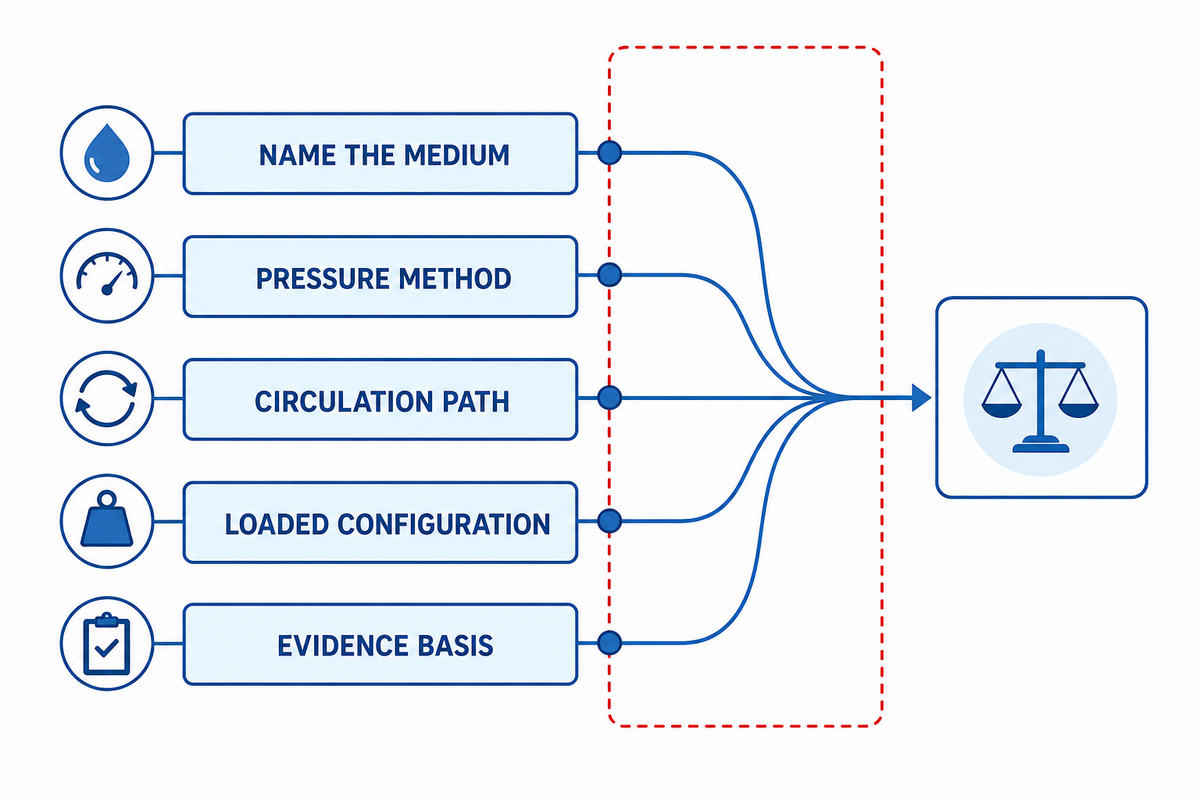
This article does not inventory every retort machine type. It answers a narrower procurement question: for an already defined canned product, should a saturated-steam or water-based concept advance to a matched trial? Saturated steam is not the same as steam-air overpressure, and full-water immersion is not the same as water spray or cascade. A quotation must therefore name the proposed medium, pressure method, circulation path, loaded configuration, and evidence basis before it enters the comparison.
Steam-or-Water Trial Boundary
- Advance a saturated-steam concept only when the proposal defines air removal, direct steam distribution, timing, instruments, condensate handling, loading, and cooling for the intended can and load.
- Advance a water-based concept only when the proposal distinguishes immersion from spray or cascade and defines water level or coverage, circulation, heating, overpressure, and cooling.
- Route steam-air separately when controlled overpressure and mixing are part of the proposal; it is not evidence for saturated-steam performance.
FDA inspection guidance treats steam-air and spray/cascade designs as system-specific “other systems” rather than copies of saturated-steam or full-water still retorts. See FDA Guide 38 for spray and cascade systems and FDA Guide 39 for steam-air systems.
Package Pressure Window: The First Trial Gate
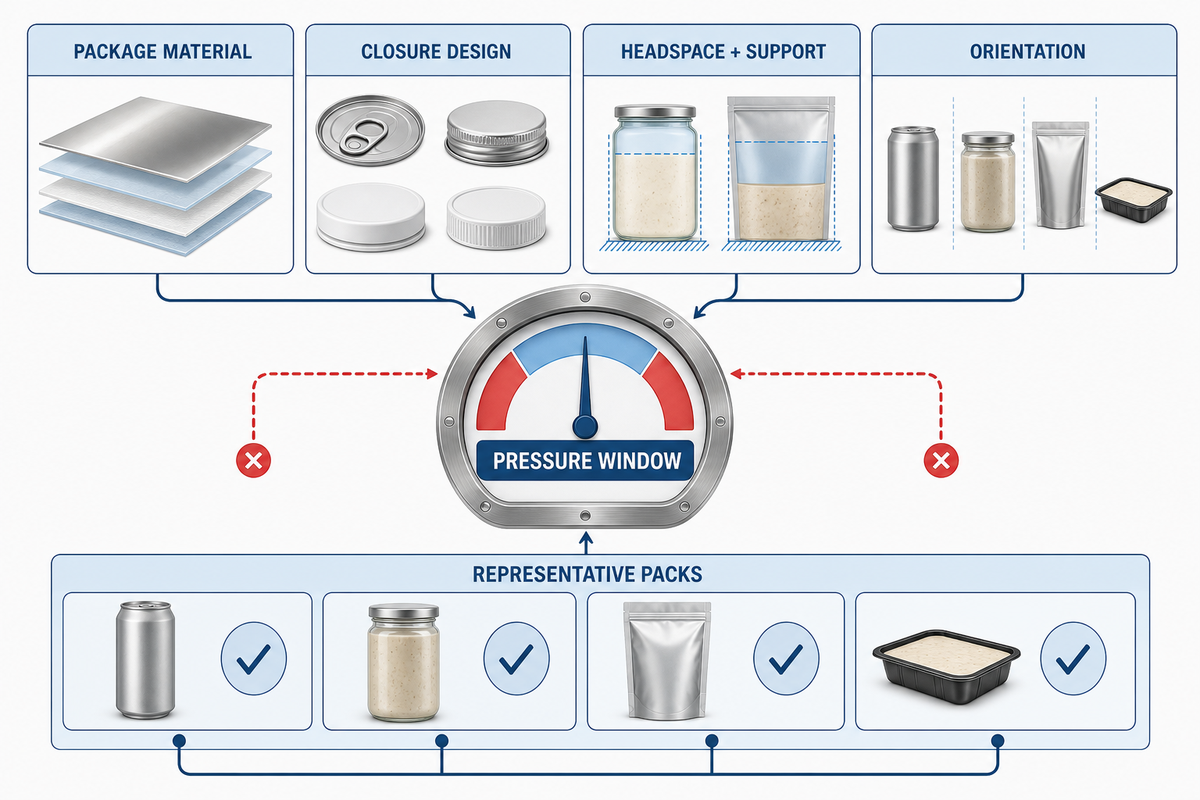
Package compatibility is the first decision gate because the vessel pressure and the pressure inside a sealed pack change at different rates during heating and cooling. Material stiffness, closure design, headspace, fill, orientation, and support determine how much differential pressure the package can tolerate. Ask the container supplier for applicable limits, then verify them with representative packs.
| Package | Provisional trial direction | Evidence needed before selection |
|---|---|---|
| Conventional metal can | Saturated steam can be an efficient first candidate; water remains possible. | Can and seam specification, orientation, load resistance, vent schedule, cooling profile. |
| Glass jar | Investigate controlled overpressure and restrained heating/cooling rates. | Finish and closure data, thermal-shock limits, headspace, vacuum, breakage criteria. |
| Flexible pouch | Investigate water spray, immersion, or steam-air with managed overpressure. | Laminate, seals, residual air, racks, thickness control, deformation and leak criteria. |
| Semi-rigid tray | Investigate a supported overpressure process matched to the lid and body. | Material, flange and seal geometry, support, nesting risk, pressure window, cooling endpoint. |
Why Pouch Pressure Sensitivity Changes the Trial Route
Pouches fall outside the rigid-can shortcut because seal contamination, residual air, rack support, abrasion, overexpansion, and cooling pressure can alter package integrity. This article does not duplicate that failure analysis; use the separate guide to pouch pressure-and-seal controls before admitting a pouch to a steam-or-water trial.
Product Heating Evidence Before Either Trial
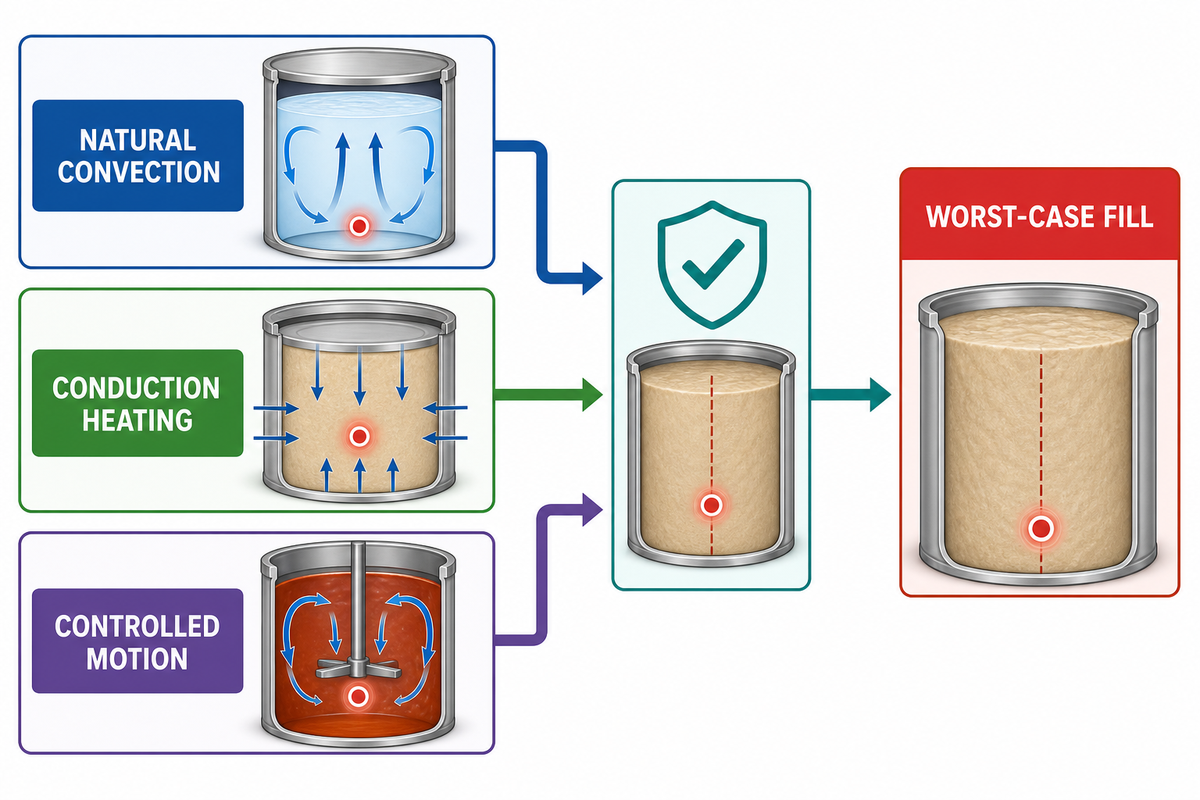
Once the package screen is complete, define how the food heats. A liquid that circulates by natural convection behaves differently from a dense conduction-heated product. Viscosity, particle size, particle concentration, formulation, fill weight, initial temperature, container geometry, and orientation can shift the slowest-heating location and the time needed to deliver the scheduled process.
Agitation may change internal product movement and heat transfer, but it also adds a motion variable that must be established and reproduced. Do not accept a cycle-time promise based on the word “soup,” “beans,” or “sauce.” Send the actual formulation range, particulate limits, fill tolerances, and proposed motion mode to the processing authority and equipment supplier. New Mexico State University’s commercial process-review guidance likewise asks for preparation, formulation, packaging, and procedure details rather than a machine name alone. Review the process-submission inputs.
Do
- Define the real formulation range.
- Identify worst-case fill and initial temperature.
- Test the intended motion and loading pattern.
Don’t
- Transfer a cycle from a similar food.
- Assume thinner packaging fixes a cold spot.
- Claim a universal agitation time saving.
What a Saturated-Steam Trial Must Prove
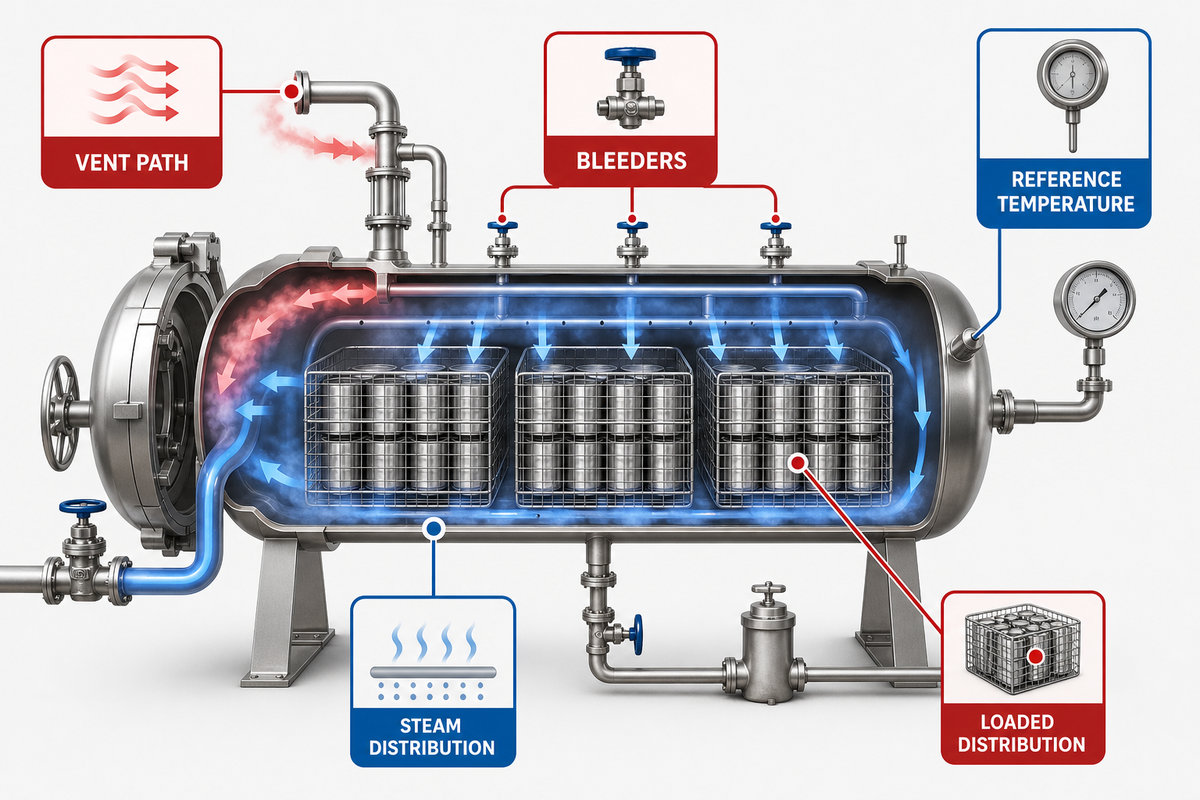
Saturated-steam processing relies on direct contact between steam and the load after air has been removed. Accordingly, the proposal should show how the loaded vessel vents, how bleeders remain effective, how steam reaches every required area, when process timing starts, which temperature instrument governs, and how the operator records critical factors. Current federal rules detail these saturated-steam controls in 21 CFR 113.40.
- Venting basis. State the tested valve arrangement, time, temperature, load, and basket configuration.
- Air removal. Identify the vent path, bleeder locations, condensate removal, and checks for blocked flow.
- Steam distribution. Define inlet and spreader arrangements against the tested heat-distribution configuration.
- Instrumentation. Identify the reference temperature instrument, recorder, controller, pressure indication, and calibration plan.
- Timing and records. Tie process timing to the established vent and operating conditions, then retain readable batch records.
“Scheduled processes … shall be established by qualified persons.”
Quotations should not reduce this control chain to a maximum vessel temperature and pressure. Installed venting, steam distribution, instrumentation, loading, and record systems must match the established process. Even a simple steam vessel needs application-specific distribution work and operating discipline.
For a static retort, loaded temperature distribution work should document steam flow, venting of air from the retort, and conditions inside the retort vessel. Pressure indication confirms pressure behavior but does not replace the reference temperature instrument or loaded distribution evidence.
What a Water-Based Trial Must Prove
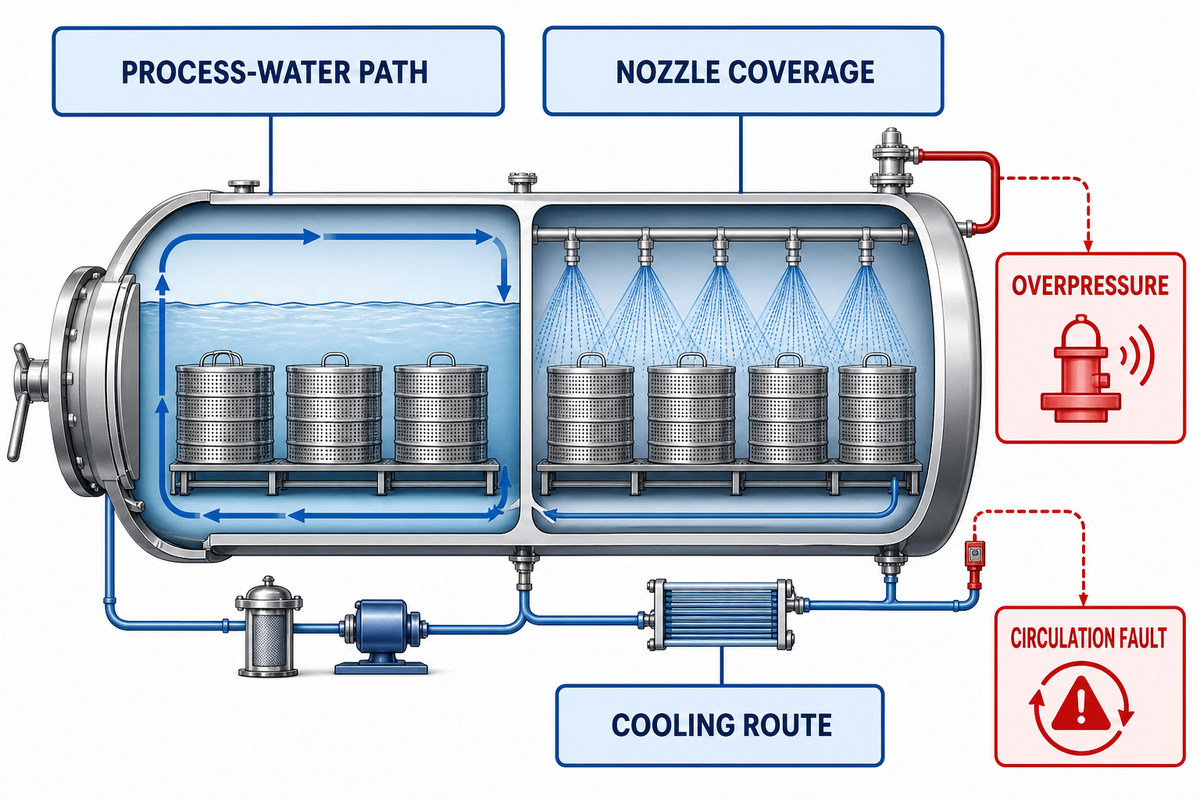
Water-based systems add a circulating thermal medium and, in many designs, separate pressure control. Full-water immersion, spray, and cascade systems do not share one universal control diagram. Buyers should compare the process-water path, pump duty, heat-exchanger basis, air supply, water level or nozzle coverage, cooling route, and response to a circulation fault. For a water spray retort, nozzle and filter condition are part of that chain; different spray retorts still need design-specific evidence.
FDA inspection guidance likewise treats spray-water and cascading-water retorts as system-specific designs.
| Control point | Full-water immersion | Water spray or cascade |
|---|---|---|
| Medium coverage | Verified water level around the load. | Verified distribution through nozzles, headers, or cascade paths. |
| Circulation | Pump flow and vessel return path for the loaded basket pattern. | Pump, filters, nozzle condition, spray pattern, and return path. |
| Heating | Direct steam or external heat exchange, as validated. | Commonly heat exchange or direct heating in a defined water loop. |
| Pressure | Air and water pressure profile matched to the package. | Air overpressure profile matched to package temperature and internal pressure. |
| Cooling | Controlled pressure reduction, cooling-water quality, and endpoint. | Controlled pressure, hygienic water loop, coverage, and seal protection. |
Why is overpressure so important?
Overpressure helps control the difference between vessel pressure and the pressure developing inside a heated sealed package. That difference can deform a tray, stress a pouch seal, disturb a jar closure, or damage another pressure-sensitive pack. Pressure must also be managed during cooling, when package contents can remain hot while vessel temperature and pressure fall. Cooling-water hygiene, closure integrity, and recontamination prevention belong in the acceptance plan, not in a post-installation footnote.
During acceptance, record the pressure ramp, cooling-water condition, package temperature, closure response, and endpoint against the tested load. A stable heating hold does not by itself show that depressurization and cooling protect the sealed package.
In a water immersion process, water circulation and water flow around the retort load need loaded evidence. The water spray process instead requires documented nozzle or cascade coverage, return flow, filtration, and spray cooling. These controls belong to the tested configuration; they are not interchangeable labels for one generic immersion process.
Steam-or-Water Trial Stoplight
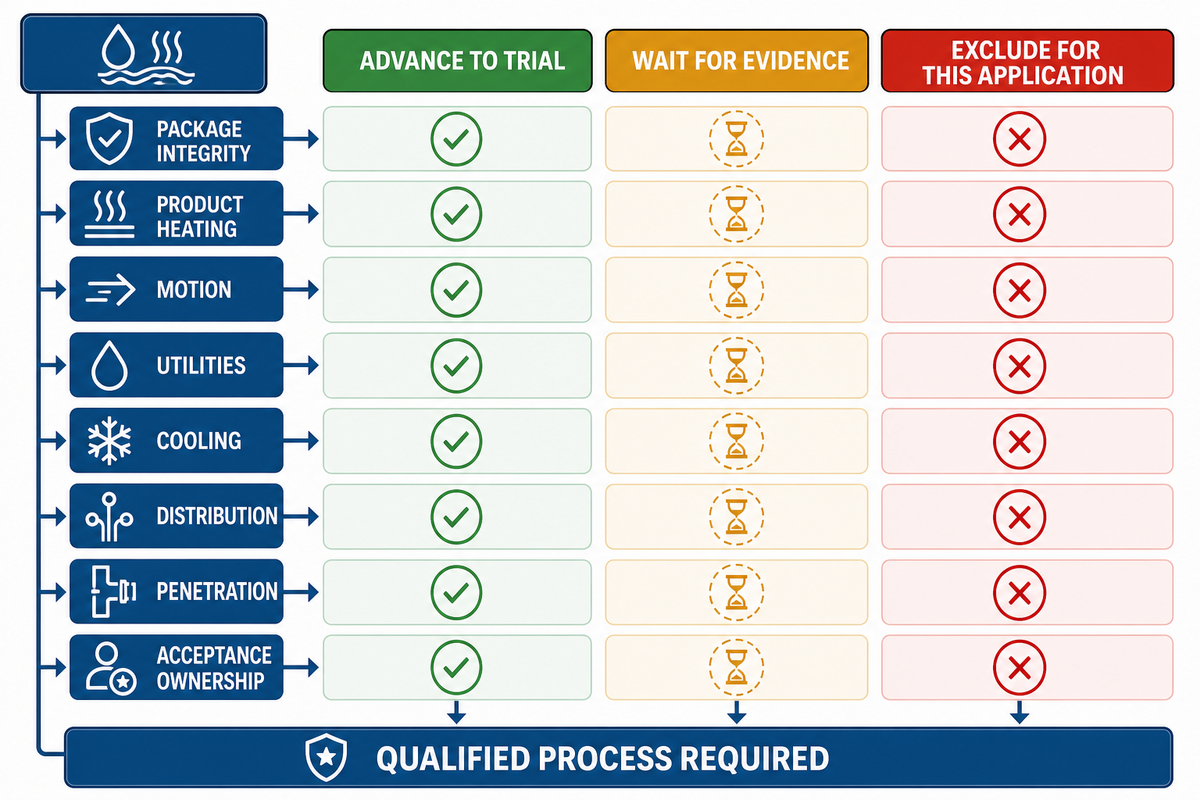
Steam-or-Water Trial Stoplight: use the following gates to record one of three outcomes—advance the concept to a matched trial, wait for missing evidence, or exclude it for the stated application. It never produces a safety guarantee; the final scheduled process must still be established by qualified persons under 21 CFR 113.83 where that rule applies.
Advance saturated steam to trials when
- Package and closure can tolerate the defined pressure profile.
- Direct steam exposure and condensate management suit the load.
- Venting and distribution can be demonstrated in the production configuration.
- No separate overpressure function is required for package integrity.
- Plant steam supply can meet peak demand on the stated basis.
Advance a water-based concept to trials when
- The package needs a defined overpressure profile.
- Immersion, spray, or cascade coverage suits the supported load.
- The water loop, pumps, heat exchange, air, and cooling are available.
- System-specific circulation and distribution evidence can be produced.
- Water quality and post-process package integrity can be controlled.
| Matched-trial evidence | Advance | Wait | Exclude |
|---|---|---|---|
| Package pressure window | Limits are documented and reproduced. | Supplier limits or representative packs are missing. | Testing shows damage to the package or closure. |
| Closure or seam response | Acceptance checks remain within the agreed specification. | Criteria or inspection records are incomplete. | A repeatable closure defect appears. |
| Product heating behavior | Actual formulation and heating mode are represented. | Worst-case formulation or fill is undefined. | The concept cannot reproduce the required heat path. |
| Production load | Baskets, dividers, orientation, and density match production. | Only an empty-vessel or partial-load check exists. | The required load blocks repeatable distribution. |
| Motion requirement | The defined static or agitated condition is controlled. | Speed, direction, or motion basis is unsettled. | The offered machine cannot deliver the required motion. |
| Heating utilities | Steam, water, air, and electrical bases are measured alike. | Peak demand or boundary conditions are unverified. | The plant cannot support the tested demand. |
| Cooling and depressurization | The cooling route protects package integrity to endpoint. | Water condition, endpoint, or pressure ramp is missing. | Cooling creates a repeatable package-integrity failure. |
| Distribution and penetration | Responsibilities and loaded studies are defined. | Only chamber temperature or supplier claims are available. | The concept cannot support the required validation route. |
| Acceptance ownership | Documents, deviations, and decision owners are named. | A party or deliverable remains unassigned. | No qualified route exists to establish the scheduled process. |
5-Gate Steam-or-Water Trial Framework
- Package integrity: Can the container, closure, support, and headspace tolerate the entire heat-pressure-cooling profile?
- Product heating: Is heating dominated by conduction, convection, a changing combination, or controlled motion?
- Motion need: Is the process static, rotary, rocking, or otherwise agitated, and what evidence supports that choice?
- Control and utility fit: Can the plant supply the tested steam, water, air, cooling, drainage, electrical, and handling conditions?
- Validation and acceptance: Who establishes the scheduled process, and what distribution, penetration, package, and record evidence closes the purchase?
What are the differences between water immersion retorts and steam retorts?
A saturated-steam retort heats the load through direct steam after effective air removal. A water-immersion retort surrounds the load with circulating process water and can combine that water circuit with controlled air pressure. The practical differences include venting, water level, pump and circulation duty, overpressure capability, heat exchange, cooling, utility demand, and the evidence needed for the tested load. Neither description predicts the final cycle for a specific food.
The Limits of Common Rules of Thumb
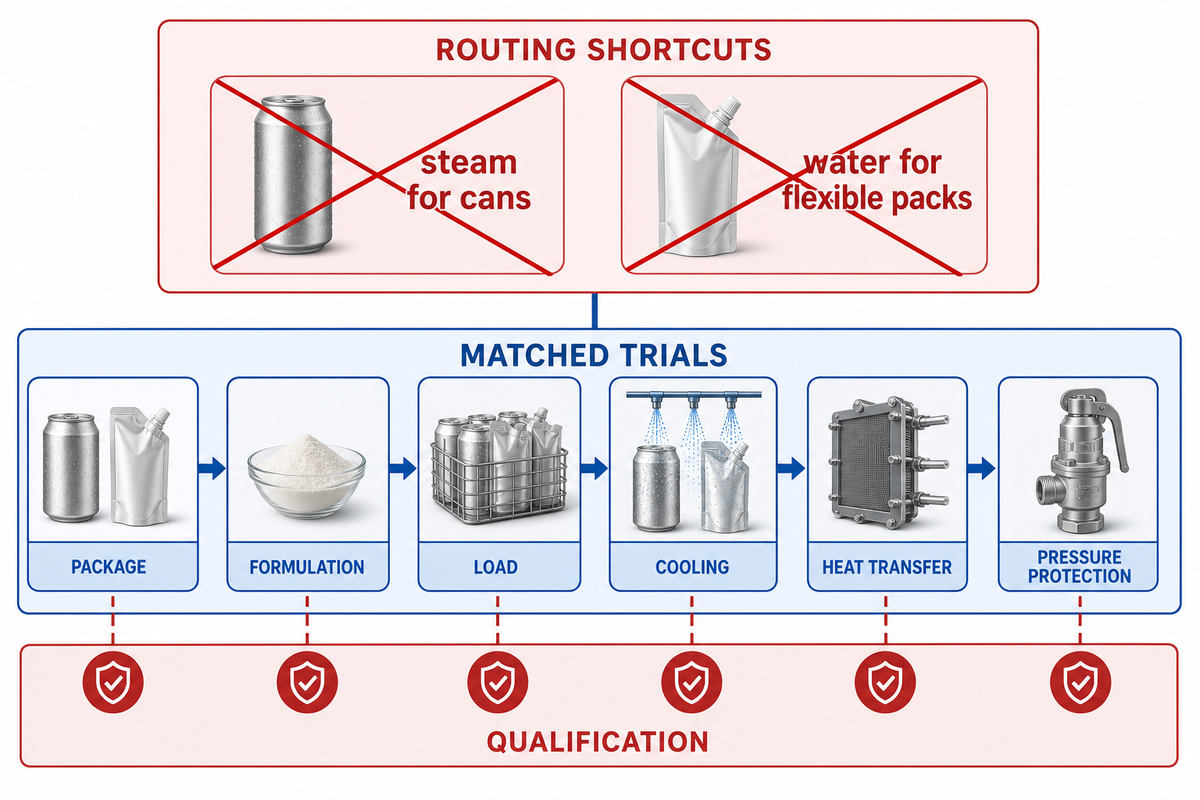
“Steam for cans” and “water for flexible packs” are routing shortcuts, not engineering conclusions. They fail when the package, formulation, closure, agitation, load, cooling, or governing process requirements depart from the assumed case. Thin pouches can heat quickly but demand careful pressure control. Metal cans may tolerate saturated steam yet still need a different motion or loading solution because of product heating behavior.
One peer-reviewed milkfish study reported shorter come-up and total process time for steam-air application than water immersion in the studied flexible pouches and formulations. That result shows why matched trials matter; it does not prove that steam-air is faster for every pouch or that saturated steam is appropriate for that package. Read the product-specific comparison.
Counterintuitive point: Faster heating can make package control harder rather than easier. Packages may develop internal pressure rapidly and retain it during early cooling. Evaluate heat transfer and pressure protection as two connected acceptance questions.
Validation of the Exact Product-Package-Load Combination
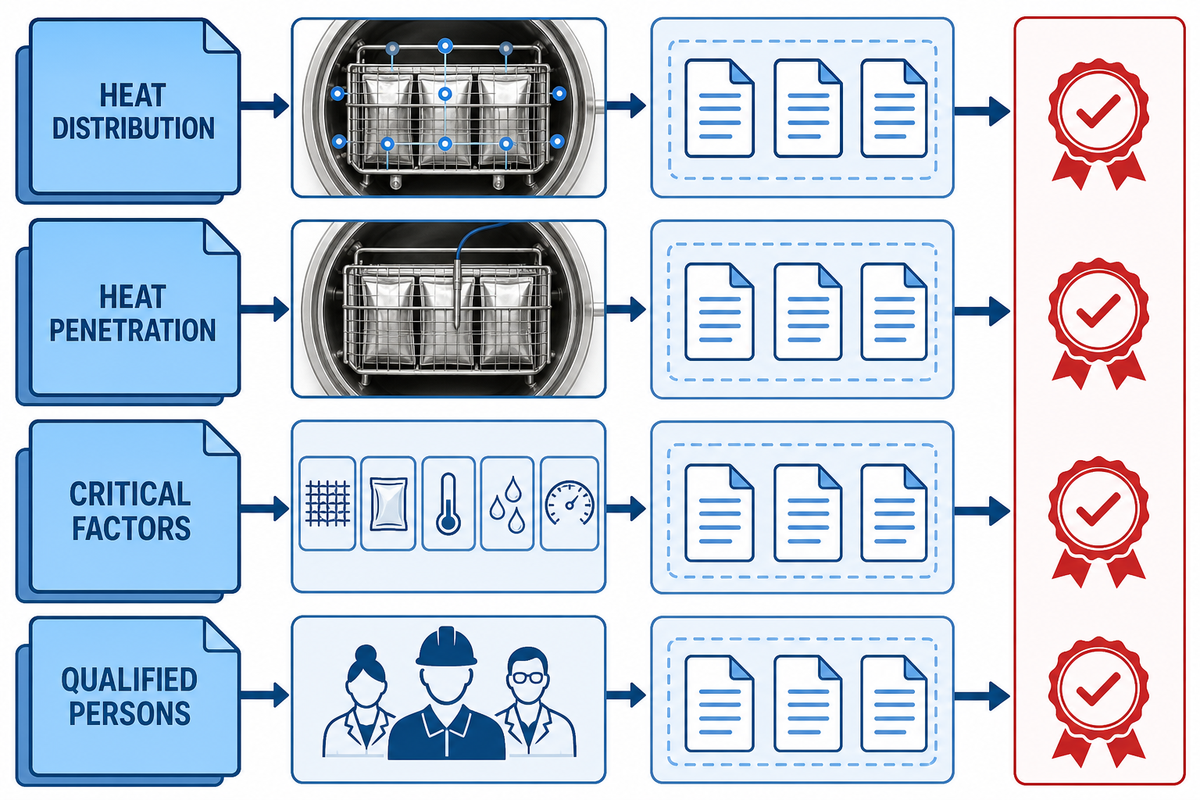
Equipment capability is not the scheduled process. For low-acid foods covered by Part 113, the scheduled process must be established by qualified persons using recognized scientific methods and must account for critical factors and production variation. Validation evidence normally distinguishes heat distribution in the loaded retort from heat penetration into the slowest-heating part of the product. In that context, the food sterilization process is a controlled product-package-load instruction, not a maximum-temperature claim.
For this retort sterilization comparison, the processing authority determines whether the tested retort temperatures and supporting evidence can sterilize the defined canned food under the applicable scheduled process. Neither a chamber setpoint nor an equipment brochure makes that determination.
- Define the application: product formula and range, package, closure, fill, initial temperature, orientation, basket, dividers, and load.
- Establish distribution: show that the process medium reaches the loaded vessel as required for the tested configuration.
- Establish penetration: measure heating behavior at the product location and condition selected by the qualified authority.
- List critical factors: state limits, monitoring method, record frequency, deviation procedure, and change control.
- Protect cooling: control pressure, water condition, package handling, closure integrity, and release criteria.
Changing the formulation, fill weight, container size, material, closure, initial temperature, load pattern, circulation, agitation, or another scheduled critical factor can require review. For acidified foods, USDA-regulated meat or poultry products, or another destination market, identify the applicable framework before using the United States low-acid-food examples in this article. Read the current scheduled-process requirement.
Normalize Utilities for Matched Trial Quotations
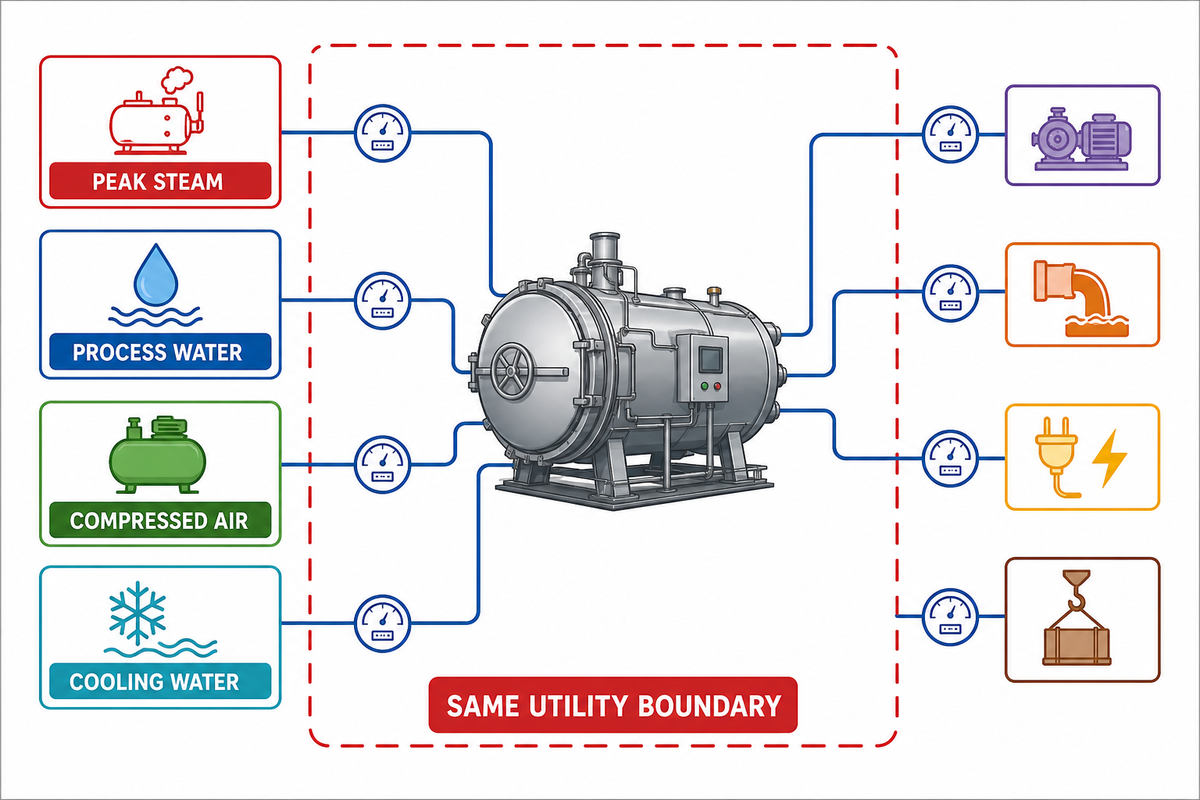
Normalize every quotation on the same plant conditions. A steam retort may have a simpler process-medium circuit than a water system, but it still depends on sufficient steam pressure, quality, peak flow, distribution, condensate handling, cooling, drainage, controls, and load handling. Water retorts add process-water inventory, circulation pumps, heat exchange or direct heating, compressed air, filters or nozzles, and a defined cooling-water route.
Comparing batch retorts on process efficiency also requires the same load and utility boundary. Any retort equipment claim based on an easier package, lighter basket, different cooling endpoint, or omitted auxiliary demand does not close the matched-trial comparison.
| Bid input category | Supplier to state | Buyer to verify |
|---|---|---|
| Steam | Pressure, quality, peak and average demand, connection basis. | Simultaneous plant demand and delivery at the retort inlet. |
| Water and cooling | Quality, starting temperature, flow, volume, heat rejection, endpoint. | Seasonal supply, treatment, hygiene, discharge, and reuse limits. |
| Compressed air | Pressure, flow, quality, and failure response. | Capacity during peak demand and pressure-managed cooling. |
| Power and controls | Connected load, motor duty, records, access, alarms, interfaces. | Plant service, recovery after interruption, data retention, access control. |
| Handling and space | Basket mass, loading path, door clearance, maintenance envelope. | Floor, drainage, safety zones, upstream and downstream capacity. |
| Drainage and discharge | Peak discharge, temperature basis, connection, and sequence. | Drain capacity, treatment limits, backflow protection, and safe routing. |
| Instrumentation | Reference devices, recorder, controller, calibration, and data format. | Traceability, verification access, retention, and discrepancy procedure. |
| Sanitation | Cleanable surfaces, water-loop care, access, and maintenance method. | Plant program, cooling-water hygiene, closure protection, and recontamination controls. |
| Production load | Pack, basket, divider, orientation, loading density, and changeover basis. | Representative worst-case load and compatibility with adjacent equipment. |
For the plant-side steam basis, use this guide to retort peak-steam utility planning. Keep the retort request tied to peak mass flow, pressure, quality, concurrency, and the tested production cycle rather than a boiler-size label alone.
Evidence to Hand Off for a Matched Trial
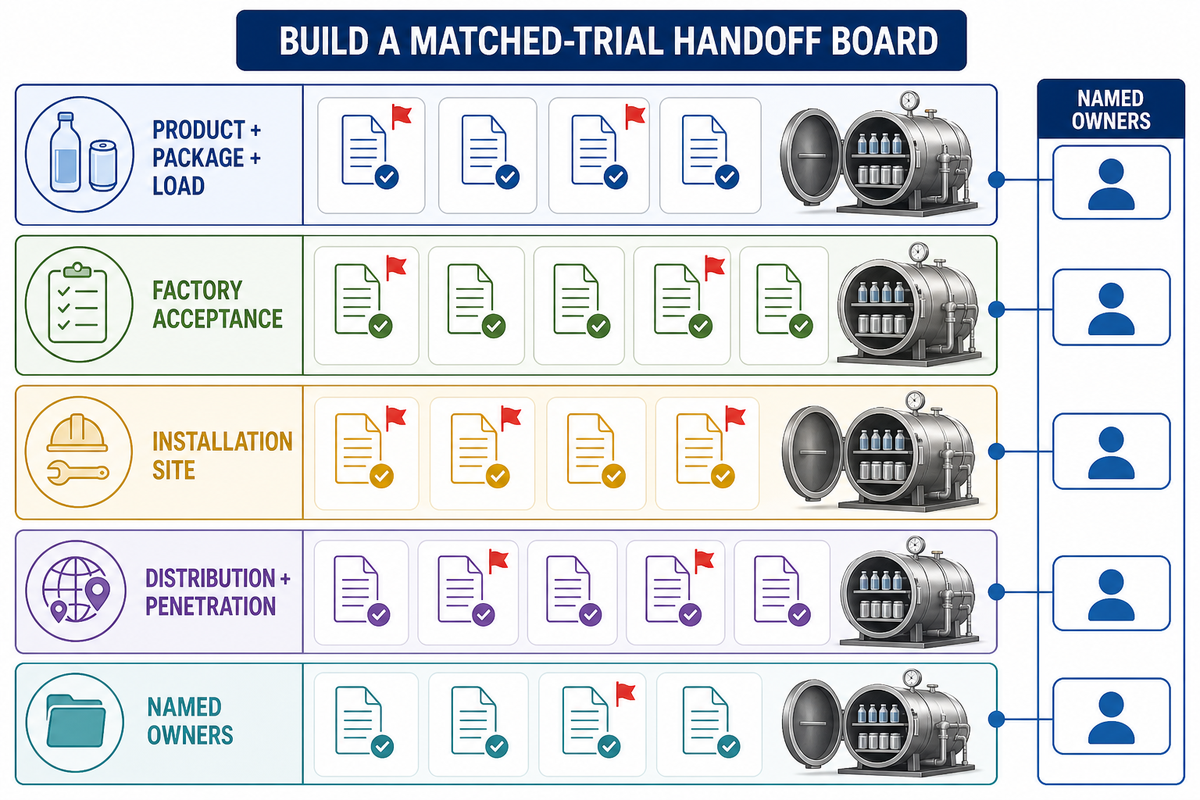
A useful request for quotation makes assumptions visible before the vessel and control package are frozen. Ask each supplier to answer the same questions and name the document, calculation, drawing, or test record that will close each point. New Mexico State University’s commercial process-review guidance shows why the buyer must supply complete product, formulation, package, and procedure inputs.
- Which exact medium and circulation method is proposed: saturated steam, steam-air, immersion, spray, or cascade?
- Which products, packages, closures, orientations, baskets, and loading densities does the proposal specify?
- How are venting, medium distribution, circulation, pressure, and cooling demonstrated for the loaded configuration?
- Which utilities are assumed at the machine inlet, and what happens when one falls outside that basis?
- Who performs heat-distribution and product heat-penetration work, and who establishes the scheduled process?
- What representative package-integrity tests cover heating, pressure reduction, cooling, handling, and storage?
- Which instruments govern the process, how are they calibrated, and how are discrepancies handled?
- Which alarm, interlock, access-control, data-retention, and power-recovery tests are included?
- How are deviations evaluated, documented, segregated, and assigned to an authorized decision owner?
- Which drawings, recipes, studies, records, training materials, maintenance plans, and spare-parts lists are handed over?
Factory acceptance can confirm construction, controls, sequences, and selected challenge tests. It may not reproduce the buyer’s final formulation, utilities, production load, and operating environment. Define what will be repeated or completed at the installation site. An empty-vessel temperature check is not a substitute for loaded distribution evidence, and a chamber record is not product heat-penetration evidence.
Frequently Asked Questions
Should a Rigid Can Automatically Go to Saturated Steam?
No. Conventional rigid cans often make saturated steam a sensible first trial candidate, but the package label does not approve the process. The closure, product heating pattern, orientation, loading, motion, steam supply, venting, cooling profile, and validation route must all fit the defined product-package-load combination before that concept advances.
Use the can construction and documented pressure window to admit or exclude a concept, then compare the intended production load. An unusual closure, viscous formulation, agitation requirement, basket pattern, or plant-utility constraint can change the result. The proposal should identify venting, steam distribution, condensate removal, timing, instruments, cooling, and the party responsible for product-specific validation.
When Should a Water-Based Retort Advance to a Trial?
Advance a water-based concept when the defined package or cooling profile needs controlled overpressure, physical support, or a specified circulating-water path. The proposed immersion, spray, or cascade system must demonstrate that function with the intended baskets, orientation, loading density, heating utilities, cooling conditions, and package acceptance criteria rather than on an empty vessel.
Name immersion, spray, or cascade explicitly rather than accepting “water retort” as a complete description. Record water level or nozzle coverage, pump duty, heating method, air-pressure control, cooling route, package response, filter or nozzle checks, and fault actions on the same basis used for the steam candidate. Match the baskets, dividers, orientation, loading density, and representative packs so the comparison does not reward an easier test load.
Can Trial Results Transfer to Another Product or Load?
Not automatically. Changes in formulation, fill, initial temperature, container, closure, orientation, basket, divider, loading density, circulation, or motion can alter heat distribution, heat penetration, and package response. Treat the revised combination as a controlled change, define its worst case, and let the qualified processing authority determine what additional evidence is required.
Route the changed combination to the qualified processing authority before treating the original result as applicable. Compare the formulation range, particle limits, fill weight, initial temperature, package geometry, closure, orientation, basket, dividers, loading density, circulation, and motion against the tested basis. A change may affect the slowest-heating location, distribution through the vessel, internal package pressure, or cooling response. The purpose of the comparison is to select evidence for the exact application, not to turn one favorable run into a universal machine claim or an unauthorized scheduled process.
What Closes a Steam-Versus-Water Decision?
A closed decision connects the defined product-package-load combination to matched utility assumptions, loaded heat-distribution evidence, product heat-penetration work, package-integrity results, cooling controls, deviations, records, and named acceptance responsibilities. It also states which evidence is produced by the equipment supplier, buyer, package supplier, processing authority, and installation team before product release.
Close the comparison with a documented technical basis, not with the medium name alone. Record the exact product-package-load combination, operating configuration, motion, utility boundary, heat-distribution work, product heat-penetration work, package-integrity results, cooling controls, alarms, deviations, data retention, and acceptance limits. Assign every drawing, study, test, record, corrective action, and approval to the equipment supplier, buyer, package supplier, processing authority, or installation team. A brochure label, empty-vessel temperature check, or fastest-cycle claim cannot replace that chain. Suppliers can document equipment capability, but qualified parties must establish the scheduled process and authorize product release under the applicable framework. If the two candidates were tested with different loads, utility boundaries, cooling endpoints, or package criteria, normalize those conditions or repeat the work before ranking them.
About Taiguo Boiler
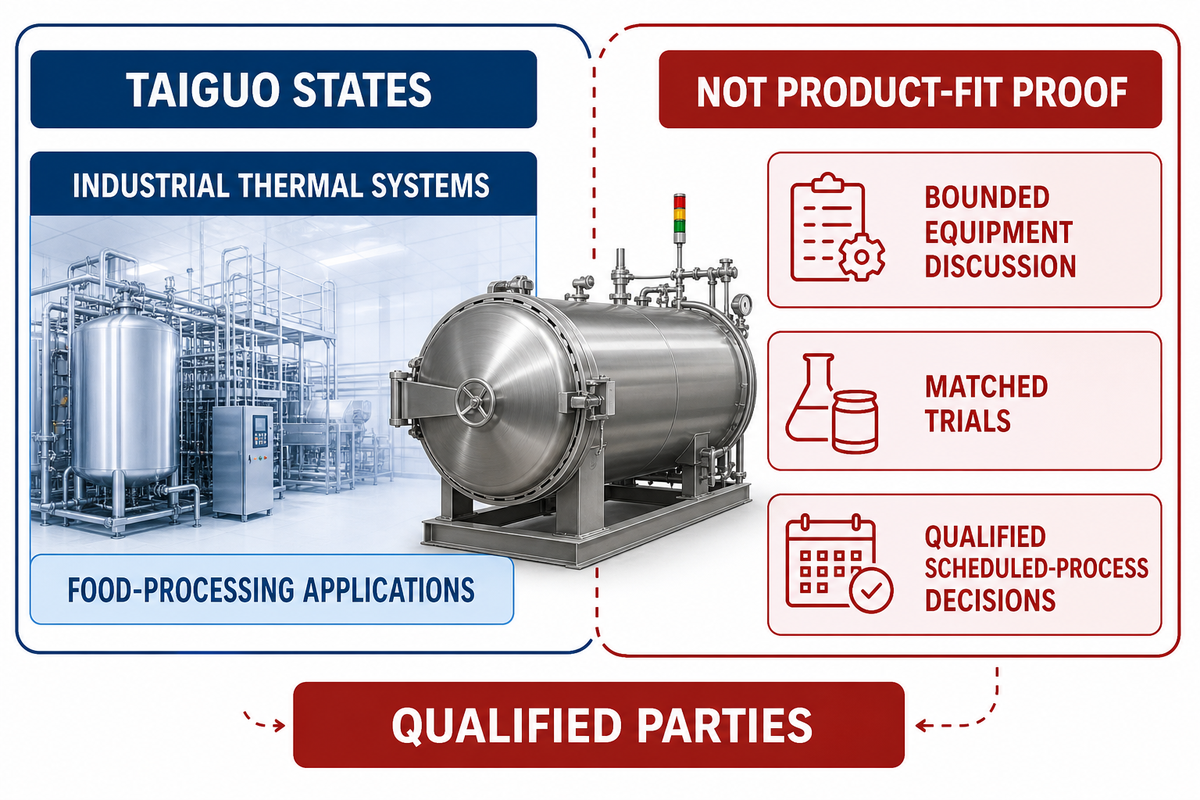
Taiguo states that it was founded in 1976 and manufactures industrial thermal systems for food-processing applications. These are first-party company statements, not evidence that a particular retort configuration fits your product. Use the trial stoplight to prepare a bounded equipment discussion, then assign scheduled-process decisions and validation to qualified parties. See Taiguo Boiler’s manufacturing background.
Prepare Your Retort Comparison Brief
Bring the product range, package drawing and closure data, load pattern, motion requirement, plant utilities, destination market, and proposed acceptance responsibilities. Taiguo can then discuss an equipment direction without treating a generic steam or water label as a finished process.
Related Articles
- Retort Pouch Sterilization: cycle, pressure, seal, and validation details
- Steam Boiler for Food Processing: plant steam planning
- Food-Package Retort Configuration Route
References & Sources
- Electronic Code of Federal Regulations, 21 CFR 113.40, Equipment and procedures
- Electronic Code of Federal Regulations, 21 CFR 113.83, Establishing scheduled processes
- Food and Drug Administration, Spray water and water cascade retorts
- Food and Drug Administration, Steam-air retorts
- Peer-reviewed review of retort thermal-processing systems, PubMed Central
- Peer-reviewed steam-air and water-immersion study for milkfish in flexible pouches, PubMed Central
- New Mexico State University, Submitting a commercial process for review
Prepared by DD from the cited regulatory, government, university, and peer-reviewed sources. A qualified processing authority must establish the scheduled process for the exact product, package, equipment, load, and operating conditions.