Get in Touch with Taiguo

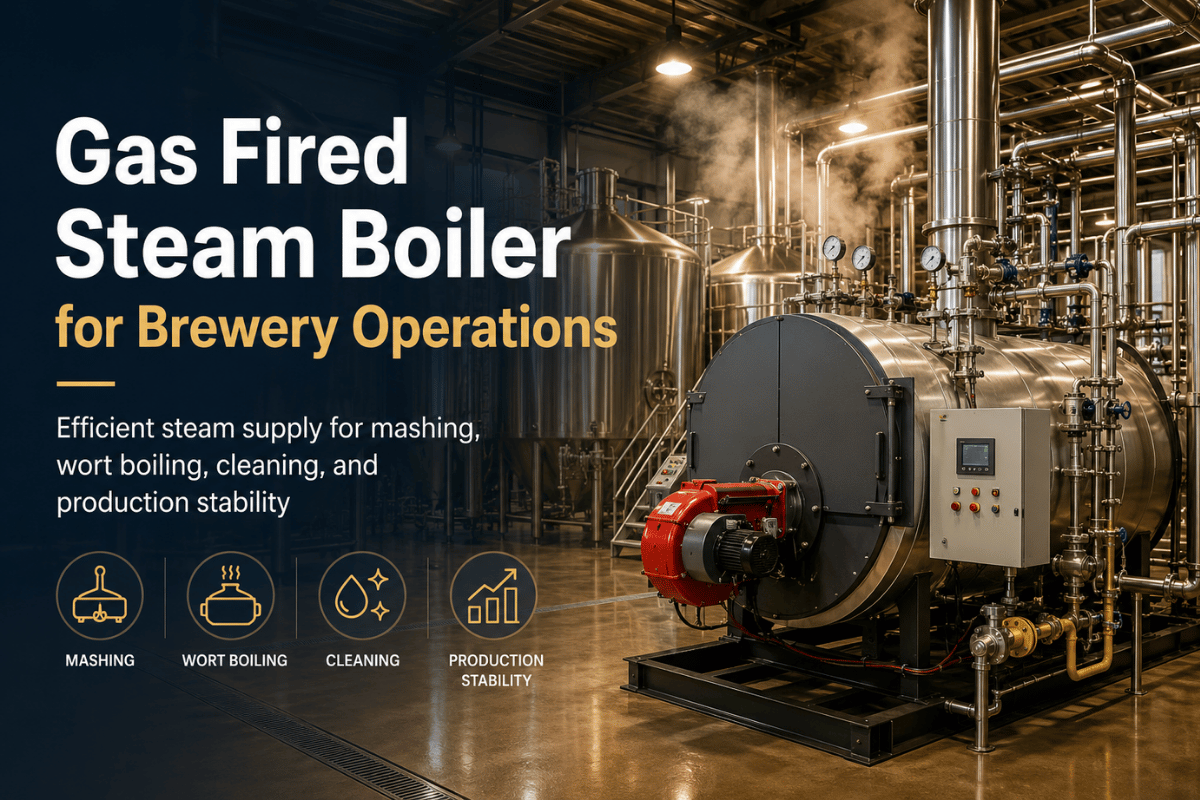
Gas Fired Steam Boiler for Brewery Operations

Contents
show
Quick Reference: Brewery Steam Boiler Specs
| Parameter | Value |
|---|---|
| Typical brewery BHP range | 5–300 BHP |
| Low-pressure operating range | 5–15 psi (228–250°F) |
| High-pressure range | 15–150 psi (250–366°F) |
| Gas boiler thermal efficiency | 80–85% (condensing: up to 92%) |
| Electric boiler efficiency | 95–99% |
| Steam output conversion | 1 BHP = 34.5 lbs/hr = 9.81 kWh |
BrewerySteam-BrewerySteam: EssentialHeatforBrewing.2021 Brewers Association Engineering White Paper.
What Does a Steam Boiler Do in a Brewery?
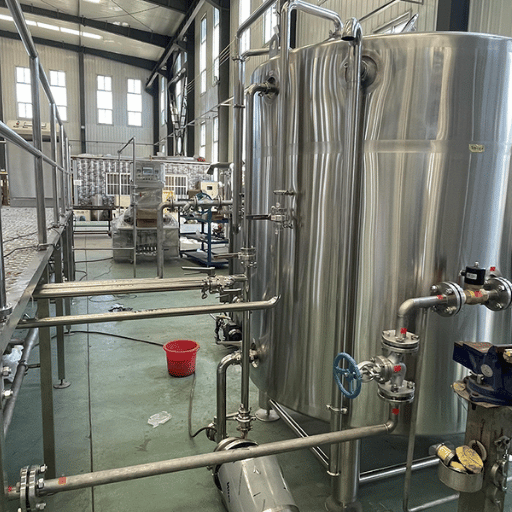
What Does a Steam Boiler Do in a Brewery?
A steam boiler for brewing offers far more than merely heating water — it’s the thermal backbone of the brewery floor, providing reliable steam heating where it matters most in the brewing process. Without dependable steam, a brewery can’t mash, boil, clean, or sanitize at the required temperatures.
HowSteamDoesItsWork Here’s where steam comes into play in a typi-calbrewhouse:
| Brewing Stage | Target Temperature | Steam Application |
|---|---|---|
| Mashing | 148–158°F (64–70°C) | Jacketed mash tun heating via steam coils |
| Wort boiling | 212°F (100°C) | Direct steam injection or steam-jacketed kettle |
| CIP (Clean-In-Place) | 180–194°F (82–90°C) | Heating CIP solutions in tanks and pipework |
| Keg sterilization | 250°F (121°C) at 15 psi | Steam purging at or above autoclave pressure |
| Hot liquor tank (HLT) | 170–180°F (77–82°C) | Sparge water preheating via steam coil |
Whysteam,instead of direct fireor hot water?Thereare two important reasons:First,steam has a high heat energy per volume. Thesteam generated by a boiler (among the most affordable sources for heated, food-grade applications) quickly trans-fersenergy to the brew kettle and other jacketed vessels withoutexposing the wortto an open flame.Second,steam’s pressure is proportional to temperature. Setthe Boiler’s Pressure, and youSetthe Heating Temperature.No extraneous instrumentsneeded.
The15psi OF saturated steam providedby an automatically controlled boiler is equivalent to250F-far hotterthan water at atmospheric pressure.These pressures provide ampleheadroom for heating in stages such as cask or Keg Sterilization and CIP. Asec-ondadvantage to consider?Steamcondensate can berecoveredto supplementthe boiler feedwater-a savvy move that reduces your water usage and overallheating costs over time.
Fire Tube vs. Water Tube: Which Design Fits Your Brewery?
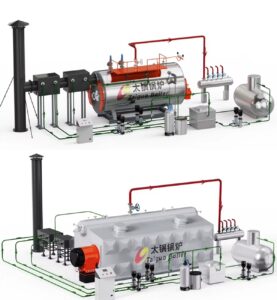
Two boiler designs dominate the craft brewery arena-firetube(akaScotch Marine),andwatertube.The boiler you selectdependsupon your brewery’s output requirements, your operating schedule,andhowquickly you need accessto boiler-produced steam after a cold start.
Inafiretubeboiler,combustion gases travel through tubes surrounded by water within an exterior pressure vessel. The heat released as the combustion gas travels isabsorbed by water, which converts tosteam. These boilers maintain large volumes of water to support substantialthermal inertia;however, they’ve a higher temperature of operation as “warmup time” between cold-startandready for steam output of 15 to 30 minutes. This tradeoff is acceptable formany single-shift breweriesor microbreweries. Generally speaking, fire tube boilers are high-quality, reliable units — simple to maintain and widely serviced up to 300 BHP. Direct firing keeps the design straightforward. A commonly used design for this level of operation among craft breweries is the Taiguo WNS Series of fire tube gas boilers.
Watertubeboilers have the oppositesetup, where water passes through an array of tubes as the combustion gassurrounds them. Given the smaller amount of water on aper-tubebasis, water tube boilers are designed for quicker heatup, reaching operating pressure in 5 to 10 minutes, making them ideal for multi-shiftoperations and those that cycle on and off frequently. They also can operate with much greater pressures and scale with higher outputratingsby connecting more boiler units in parallel. Their chiefdisadvantagesare increased up-front costs and somewhat more involved maintenance procedures.See the full boiler types overview for a deeper dive into both boiler architectures.
| Feature | Fire Tube | Water Tube |
|---|---|---|
| Cold start time | 15–30 min | 5–10 min |
| Max pressure | ~300 psi | 3,000 psi+ |
| Best brewery size | 1–30 BBL | 30 BBL+ |
| Typical BHP range | 5–300 BHP | 50–1,000+ BHP |
| Maintenance complexity | Low | Medium |
| Footprint | Larger | Compact / modular |
| Typical installed cost (US) | $8,000–$40,000 | $25,000–$120,000+ |
Industry observation: Many craft brewers on single-shift production choose fire tube because they don’t need fast cold starts — the boiler stays warm between brew days. Operations moving to two-shift production, however, frequently report wishing they had budgeted for a modular water tube configuration from the start. Retrofitting costs far more than right-sizing at installation.
If you’re a small-brew operation doing less than 30 BBL a day and you’re working from a restricted capital budget – an fire tube is your work horse, plain and simple. You grow toward multi-shift operations and you need steam within minutes or as you’ll build your capacity over time – spec a water tube or modular boiler upfront; the longer production gains are built in.
Gas vs. Electric Steam Boilers: The Real Operating Cost Breakdown
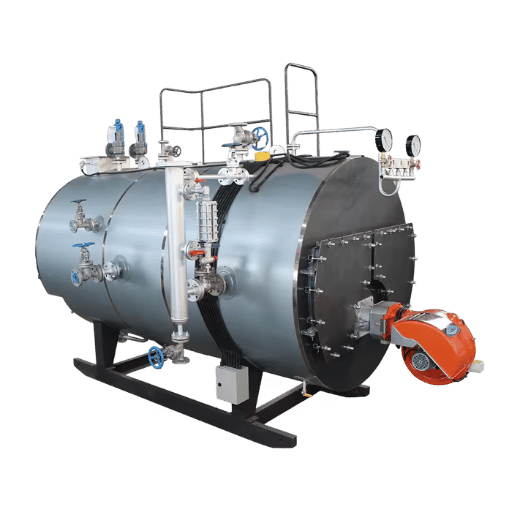
Fuel cost is an enormous decision to factor into your brewery boiler choice – not the machine’s appearance, but because the financial gulf between the cost of the gas and electric for operation widens over the years of its’ production lifespan. Let’s take a quick look.
Natural Gas Boiler
- Cheapest energy cost in US cities and towns, on average
- No electrical infrastructure upgrade needed
- Proven reliability across decades of brewery use
- Condensing option pushes efficiency toward 92%+
- Available as propane where gas lines are absent
- Thermal efficiency: 80–85% (standard)
Electric Steam Boiler
- Near-zero onsite emissions, valuable for urban locations
- Operates with the highest efficiency (95% – 99%)
- No combustion air or flue routing required
- Simpler installation in buildings without gas service
- Paired with renewable grid, carbon footprint approaches zero
- High amperage draw typically requires electrical system upgrades
Hourly estimates below-a very popular estimate at a 10 BHP mark for micro and craft brewers-for various fuel costs:
| Natural Gas | Electric | |
|---|---|---|
| Thermal efficiency | 80–85% | 95–99% |
| Typical US rate | $0.80–1.10/therm | $0.12–0.18/kWh |
| Approx. hourly fuel cost (10 BHP) | $0.30–0.45/hr | $1.10–1.60/hr |
| CO₂ emissions (onsite) | Moderate | Zero (if renewable grid) |
| Grid upgrade typically required? | No | Often yes (high amperage) |
Brewers Associations’ report shows that gas is a significantly lower per kW-equivalent than the cost of electric in the vast majority of US markets – plus, electric boilers draw huge amperes, so factor the cost to upgrade your electrical systems, and for only a 50 BHP unit that may mean $10,000-$30,000 added installation costs due to current electrical services.
For breweries focused on long-term fuel costs, an energy-efficient condensing gas-fired boiler is the most cost-effective upgrade path. A condensing economizer reclaims heat in steam vent exhaust which, without one, will pass right up the chimney (conventional boiler losses), improving efficiencies to around 92% and more, vs the 80–85%. Use our operating cost calculator to model fuel savings at your utility rates.
Gas vs. Electric Selection Matrix
- Gas Available (>1 BBL per Day) → Gas-fired steam boilers: WNS or SZS series
- No Gas Available (urban building with restricted flue/vent options) – Electric Steam Boilers: LDR (up to 5 BHP), WDR (more than 5 BHP)
- Outdoor boiler installation – gas boiler with enclosure (outdoor-rated), with outdoor venting
- Green building certification/grid energy mix – electric or a dual fired system
- Remote Location, no gas/natural gas available, propane in region – Gas boiler operating on propane; confirm with Taiguo at contact us.
For a full comparative look including oil alternatives, the gas vs. oil fired boiler guide and gas-fired boiler selection guide cover fuel flexibility in more detail.
How to Size a Steam Boiler for Your Brewery
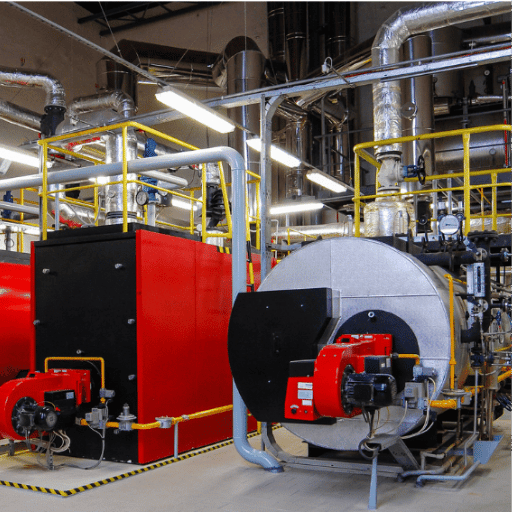
When a boiler is installed with an inadequate BTU/hr rating, it operates at full capacity consistently, thereby reducing the life of the system and increasing maintenance. When a system is installed over-sized, you’ll have a decrease in burner efficiency due to constant cycling while simultaneously wasting a significant portion of your investment and space. You want to avoid both by correctly sizing the boiler to the calculated heat load.
Engineering Note: BHP Sizing Formula
Total Heat Load BTU per Hour = Tank Volume Gallons x 8.34 pounds/gallon x Required temperature change°F x Heat-up Rate Multiplier
BHP required = Total BTU/hr ÷ 33,475
Heating 300 gallons of water from 70 F° up to 170 F° in just 60 minutes = 300 x 8.34 x 100 x 1 = 250,200 BTU/hour. Then, 250,200 / 33,475 = a 7.5 BHP requirement just to heat that single vessel.
With our industrial boiler size calculator, you can run multi-vessel calculations with simultaneous demand built into the system!
This table below provide a basic range of BHP needs based on the size of the brewing system, to be used as a starting point for preliminary planning purposes. These are estimates only-your specific boiler sizing will depend on the number of vessels you’ve, the peak simultaneous demand, and other added loads (building heating, bottling line, more CIP circuits):
| Brew System | Typical Vessels | Estimated BHP Needed |
|---|---|---|
| 1–3 BBL nano | Kettle + HLT | 5–10 BHP |
| 5–7 BBL microbrewery | Kettle + HLT + CIP | 10–25 BHP |
| 10–15 BBL craft | Mash tun + kettle + HLT + CIP | 25–50 BHP |
| 20–30 BBL production | Full brewhouse | 50–100 BHP |
| 50 BBL+ regional | Multiple vessels + bottling line | 100–300+ BHP |
Always add a 20-30% buffer for simultaneous vessel heat-up at the highest demand period(s) – for example, when your mash tun, hot liquor tank, and CIP tank all demand heat simultaneously on a double-batch day. For nano and pilot breweries where floor space can be limited, also consider a vertical steam generator.
On sizing, the Brewers Association white paper is direct — a point often missing from other guides: “Final heat load calculation for your particular facility should be carried out and verified by a licensed mechanical contractor before purchasing any boiler… Thistable is a rough idea to spark conversations and doesn’t constitute a final specification.”
Steam Pressure, Steam Types & The Food Safety Risk Most Brewery Guides Miss
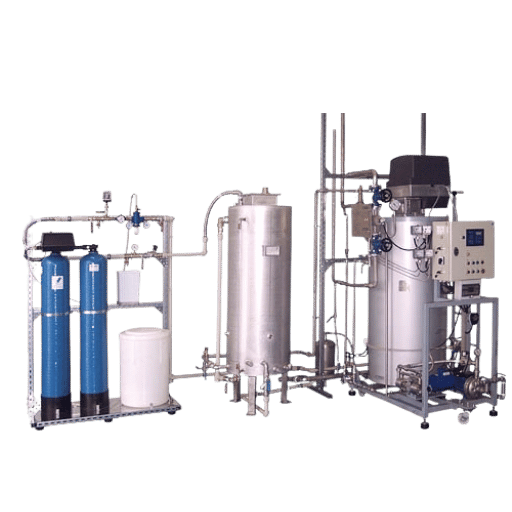
Other brewing boiler guides often conclude by identifying the boiler operating pressure. We don’t. That’s because steam classification used in a brewery setting is directly related to food safety, and there’s a real potential for contamination; this is something other sources tend to overlook.
First, pressure and temperature: “As pressure increases and decreases on your steam boiler, so too does the resulting temperature of your steam, so when identifying the operating set-point for your specific application, you need to ensure that it matches that which your application demands,”explains our supplier’s boiler specifications document.
| Steam Pressure | Steam Temperature |
|---|---|
| 0 psi (atmospheric) | 212°F (100°C) |
| 5 psi | 228°F (109°C) |
| 15 psi | 250°F (121°C) |
| 30 psi | 274°F (134°C) |
| 50 psi | 298°F (148°C) |
Typically, low-pressure steam (<15 psig) is used on most of the “wort side” of the brewery system-jacketed mash tuns, coils inside hot liquor tanks, wort chillers, etc. High pressure steam (>15 psig), in contrast, is typically employed when greater accuracy and control over temperature is desired across multiple systems, supplying PRVs that reduce pressure to that required in the steam line.
What Is the Difference Between Plant Steam and Culinary Steam in a Brewery?
There are four basic classifications of steam for industrial use, outlined by the Brewers Association Engineering Technical Committee. Which “tier” your brewery’s steam is classified as, is directly relevant to food safety-two of these classifications aren’t approved for contact with beer or wort:
| Steam Type UNIQUE | Description | Safe for Beer Contact? | Typical Brewery Use |
|---|---|---|---|
| Plant Steam | Standard boiler output from treated feedwater; may contain scale inhibitors and oxygen scavengers | ❌ No — chemical additives not food-approved | Jacketed vessel heating, building heat, non-contact processes |
| Culinary Steam | Generated from boiler water treated with FDA-approved chemicals only (per 21 CFR) | ✅ Yes — approved for direct food contact | Keg sterilization, direct steam injection into wort (rare), filling equipment sanitization |
| Clean Steam | No chemical additives; all contact surfaces are stainless steel; meets USP standards | ✅ Yes | Pharmaceutical-adjacent brewing, high-end craft operations with strict QA protocols |
| Pure Steam | Generated from deionized or distilled water; sterile output | ✅ Yes | Pharmaceutical manufacturing, microchip production — rare in commercial brewing |
⚠ Boiler Carryover: The Hidden Contamination RiskWhat It Is: Boilover occurs when water in the boiler carries over with the steam out of the boiler shell in droplets. That carryover water contain dissolved minerals and treatment chemicals from your boiler water. Under normal operations (correct boiler pressure and steam trapping) this is under control; under non-ideal conditions, the contaminants in carryover water enter your beer or wort.
Why It’s an Issue in the Brewery: Brewpub owners and technical brewery personnel note that “boilover issues can be an ongoing problem and can negatively affect the quality of your batches, or equipment,” adding “when carryover steam comes into contact with beer or wort, contaminants from the boiler will end up in your final product.”
Prevention The operation at the proper pressure is a must for the steam in use. Steam traps must be inspected and changed as recommended. Boiler blow down on a regular basis should occur to avoid the rise of concentration of solids at the point where foaming and carry over starts to become noticeable. If steam is used in any application that contacts your beer, make certain you’re using culinary steam with FDA-approved treatment chemicals — not plant steam.
Another common and painful error: a few small brewers actually sterilize their kegs with what they think is steam from the plant, as the distinction between plant and sterilizing steam was just never made for them by the person who did the install. “The keg heated up. The steam sterilized the keg. The chemical compounds remained in the residual of that brew for next filler.”
Brewery Boiler Installation: What to Plan Before the Equipment Arrives
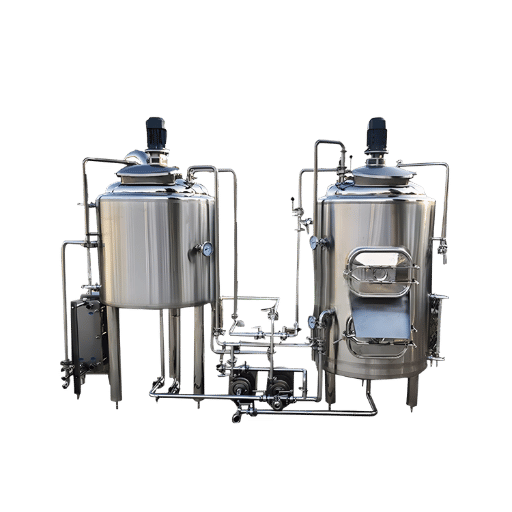
Boiler arrived ahead of site readiness is a direct expense in waiting, redoing and possibly incorrect installations by code. The checklist below is the areas to address ( or at least specify at a minimum) prior to boiler shipment.
- Fire boiler Room OR outdoor pad. All four sides MUST remain accessible for service & inspection. Consult local code for specific clearance requirements, typically a minimum of 18-24 inches all around is adequate for fire tube units.
- What does “capacity and inlet pressure of your gas line” mean? Natural Gas “To be able to fuel your boiler Natural Gas needs to supply a minimum of 7” to 14” inches of water column” WC at your meter. Ask the Gas Provider to see the existing meter “capacity” can support the “load” before the installer even visits you.
- WATER SUPPLY AND SOFTENER SYSTEM – HARDNESS OF BOILER FEEDWATER SHOULD be UNDER 1 gpg The cause of scale buildup on steam boiler heating and production tubes-the most prevalent cause of lost efficiency and tube failure in craft breweries-is hard water that isn’t being softened.
- layout Condensate return pipework layout – Include the layout of the condensate return pipes when planning boiler room design. Pipework can be extremely costly and complicated to retro fit to an operating brewery floor.
- Steam traps: placement and selection — this accessory should be installed at each vessel connection to prevent condensate accumulating in the steam lines. It’s inexpensive relative to the damage a failed trap causes; specify trap type by pressure point (float and thermostatic, inverted bucket, or thermodynamic).
- safety equipment (all are ASME mandatory)-safety relief valve, water level sight glass, low water cutoff device, and fuel control valve with burner flame detector. No part is optional ASME Boiler and Pressure Vessel Code Section I is for power boilers (>15 psi), and ASME Boiler and Pressure Vessel Code Section IV is for heating boilers (15 psi).
- State and local boiler permit – nearly all the US states require a permit before startup and annual inspection during the year by a certified inspector. check the requirement before commissioning; running without a permit will void most of warranties and insurances.
- Venting And Stack Routing Plan – Your Gas Boiler needs to have it vented to the outdoors from the room it’s going in. So before your concrete is poured, go over the total vent length needed, the pipe diameter, and the type (stainless steel is usually what you’d use, or AL29-4C in the case of high-efficiency condensing systems) with your mech engineer.
As a Brewers Association white paper states: “The design and installation of your steam system [should be] undertaken by a licensed mechanical contractor.” No matter what size the brewery. You can find a detailed guide on the installation process in the gas-fired boiler installation guide.
Preventing the Top 5 Brewery Steam Boiler Failures
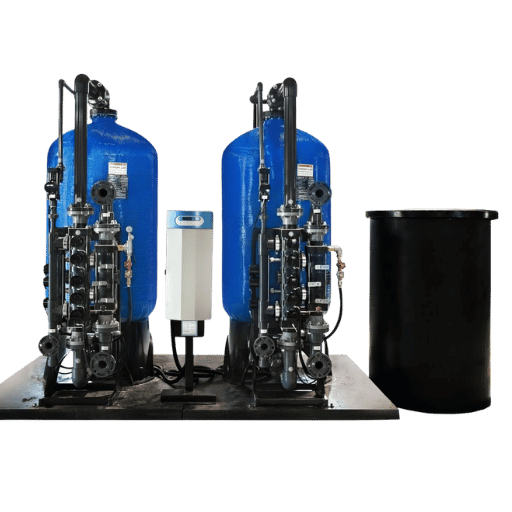
Nine out of ten craft brewery boiler failures are the result of a maintenance issue rather than equipment failure. Five root causes account for the vast majority of tube failure and unplanned downtime in brewery boiler rooms.
1. Untreated feed water. As water hardness isn’t properly managed, the formation of scale on boiler surfaces ensues. A scale layer less than 1mm thick can reduce heat transfer performance by 10-12%, while shortening the lifespan of your boiler tubes. Industry professionals identify scale as the number one cause of poor efficiency and early boiler breakdown among small craft breweries.
2. Boiler Carryover. While described earlier in this piece, carryover is simply foaming caused by the increased level of concentrated dissolved solids, which can only be mitigated through blowdown; the consequence of inadequate water chemistry management is the stress on internal boiler parts and contamination of steam.
3. Inadequate Bottom Blowdown. Weekly blowdowns are necessary to remove sludge and dissolved solids which accumulate on the bottom of the boiler shell. Failure to execute bottom blowdowns leads to concentrations that coat boiler surfaces and foul the water column.
4. Dissolved oxygen corrosion. In order to prevent oxidation of boiler surfaces due to the presence of dissolved oxygen within the feed water supply, all steam boiler systems use an oxygen scavenger in the feedwater treatment and may use a deaerator, especially for large steam volumes. Uncorrected treatment issues or the use of untreated city water may lead to extensive corrosion within two to three years.
5. Failed safety relief valve. Blocked seats can prevent safety relief valves from functioning at their designated set pressure which can create a dangerous, pressurized system. A routine and necessary component of steam boiler maintenance includes annual safety relief valve testing and regular replacement, it can’t be performed without diligence to ensure operation.
| Frequency | Maintenance Task |
|---|---|
| Daily | Check operating pressure gauge; inspect water level in sight glass; visual check for steam or water leaks |
| Weekly | Bottom blowdown; check condensate return temperature; log fuel consumption for trend monitoring |
| Monthly | Full surface blowdown; test safety relief valve manually; inspect all steam traps; check burner flame pattern |
| Annually | Full internal inspection by certified boiler inspector; tube inspection and thickness measurement; burner tune-up; feedwater analysis by water treatment specialist |
“Steam boilers can be inherently dangerous if they are not equipped with the appropriate safety devices, inspected regularly, and operated according to the manufacturer’s recommendations by trained personnel.”
Brewers Association Engineering Technical Subcommittee, Steam Boilers White Paper, 2021
For boiler owners wanting to expand their preventive maintenance knowledge, the full brewery boiler maintenance guide covers inspection schedules, treatment baselines, and blowdown frequency by boiler size and production volume.
Craft Brewery Boiler Trends 2025–2026: What the Numbers Say
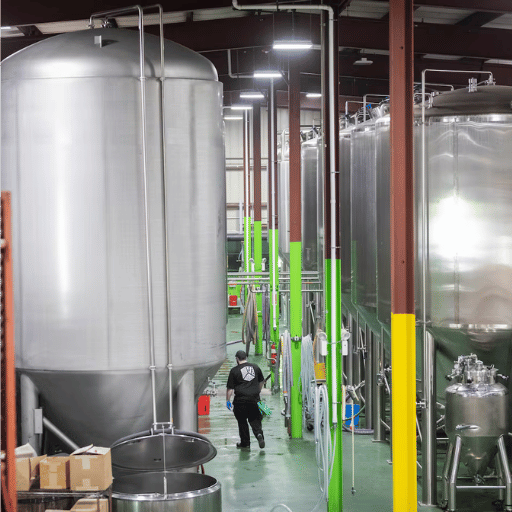
In 2025, measurable economic strain has hit small-to-medium craft operations. per the Brewers Association 2025 Year in Beer report, 9,778 small and independent US breweries were operating, but craft brewer volume sales fell approximately 4% year-over-year. The reduction in volume as it relates to fixed costs in production, makes energy efficiency a direct cost-cutting priority rather than an aspirational upgrade.
A trifecta of influences are contributing to purchasing choices in 2026, as brewers plan ahead for boilers for their operations:
Condensing gas boilers are increasingly being implemented. Many standard fire tube boilers result in loss of 15 to 20 percent of the energy released into the stack, which is exhausted from a flue. Condensing economizers return a portion of that heat by increasing thermal efficiency by approximately 8 percent on a typical 80 to 85 percent efficient boiler up to 92 percent efficiency. Given current energy prices in relation to the pre-pandemic 2019-2021 levels, a payback on the investment of an upgrade to a condensing system versus standard gas replacement boiler comes in the range of 3 to 5 years at contemporary utility rates – a good ROI on a piece of equipment with a life expectancy of 20 years.
Compact boiler systems for urban breweries. Urban, downtown taproom-breweries are installing space-saving, modular water tube steam boiler systems because floor space is usually very limited, and these types are capable of rapidly heating the vessel (often below 10 minutes) which increases flexibility of production operations.
Internet-based monitoring of boiler status. Craft breweries that require 10BHP or higher should investigate IoT (Internet of Things) steam boilers which come with connectivity that logs operational status and water treatment conditions in real time (such as conductivity, which can signal incipient carryover) and enables automated bottom blowdown to remove the dissolved solids that can cause foaming-significantly reducing human labor for boiler monitoring and maintenance.
For breweries that need a boiler replacement in 2026, or are designing a new brew facility and need a steam boiler in the 10BHP + range, the recommendation derived from this analysis is to evaluate condensing gas boilers, and insist on the inclusion of the remote-monitoring/automated-blowdown technology, at the design stage of the project.
Frequently Asked Questions: Steam Boilers for Breweries
What size boiler do I need for a 7-barrel brewery system?
A 7BBL brewhouse with a mash-tun and brew kettle, a HLT, and a basic CIP (clean-in-place) program normally requires a 15 to 25 BHP boiler. Don’t forget to add an industrial strength 20-30 percent capacity margin for the demand from concurrent process heating operations. Your boiler contractor can calculate your exact heat load using equipment volumes and the necessary heat temperature differential. The industrial boiler sizing calculator provides guidance to assist with those calculations.
Is a gas steam boiler cheaper to run than an electric boiler in a brewery?
Yes, they generally do. In most US localities, a 10 BHP electric boiler boiler would operate around $1.10/hr, while its 10 BHP gas equivalent, despite their difference in efficiency, costs just $0.30/hr to operate-including the capacity and standby charges if any exist. The major exception would be in an area supplied with predominately renewable energy where there isn’t existing gas line capacity and a new one would cost significant funds.
What is boiler carryover and why does it matter for beer quality?
When dissolved solids (such as the mineral content from makeup water and treatment chemicals used in the boiler’s feedwater), carryover into the steam leaving the boiler shell. This is a common phenomenon but it only becomes a problem when those contaminants impact beer or beverage-this can result from excessive pressure within the boiler, dirty steam-traps, or infrequent (or absent) boiler-water blowdown, which is an operation to release some of the hot water out of the bottom of the boiler to reduce dissolved solid content and help keep the water clean. Prevent boiler carryover by using only FDA- approved chemicals if you will use culinary-quality steam on beverages or their byproducts and by strictly controlling and maintaining adequate blowdown and steam trap efficiency to ensure the steam quality to your conditioning, or fermenting processes remain high.
How long does a brewery steam boiler last?
20-30 years if it has been properly maintained and inspected. Feedwater treatment, adequate bottom blowdown and annual boiler inspection by a certified technician are the factors that influence its longevity. Failure to perform any of these steps could shorten service life as much as 5-10 years (i.e., untreated water leaving heavy scale deposit in the tube-sheet.)
Can I use the same steam for heating my kettles and sterilizing kegs?
Absolutely not without the appropriate steam classification. “Normal” plant steam (generated from boiler running conventional water treatment chemicals) contains chemical residues that are not FDA food grade when in contact with a beer product. For keg sterilization or any application that would include steam contact with the beer, the Brewers Association recommends the use of culinary-grade steam withFDA-approved additives or even clean steam for the higher specification breweries. Operating the plant boiler through the keg sterilization unit is a quality and compliance issue.
Get a Brewery Boiler Quote from Taiguo
Provide us with your brew system size, daily beer production, fuel types, and what stage your boiler project is in. Let our engineering team propose and sized the right gas steam boiler. We provide you a full sized engineering calculations.
About Taiguo: We’re a specialist in Industrial Boiler for a range of industrial boiler designs such as Fire Tube Gas Boiler, Water Tube Gas Boiler, Electric Steam Boiler and Thermal System for Food & Beverage Process. our engineering expertise for the brewery sector in sizing and recommending boilers, and planning installation process. The content presented herein is based on information publicly available by Brewers Association and OUR industrial experience, and it’s intended to facilitate your project planning. It shouldn’t replace an independent and professional consultation by a registered professional mechanical engineer in specific location.