Get in Touch with Taiguo


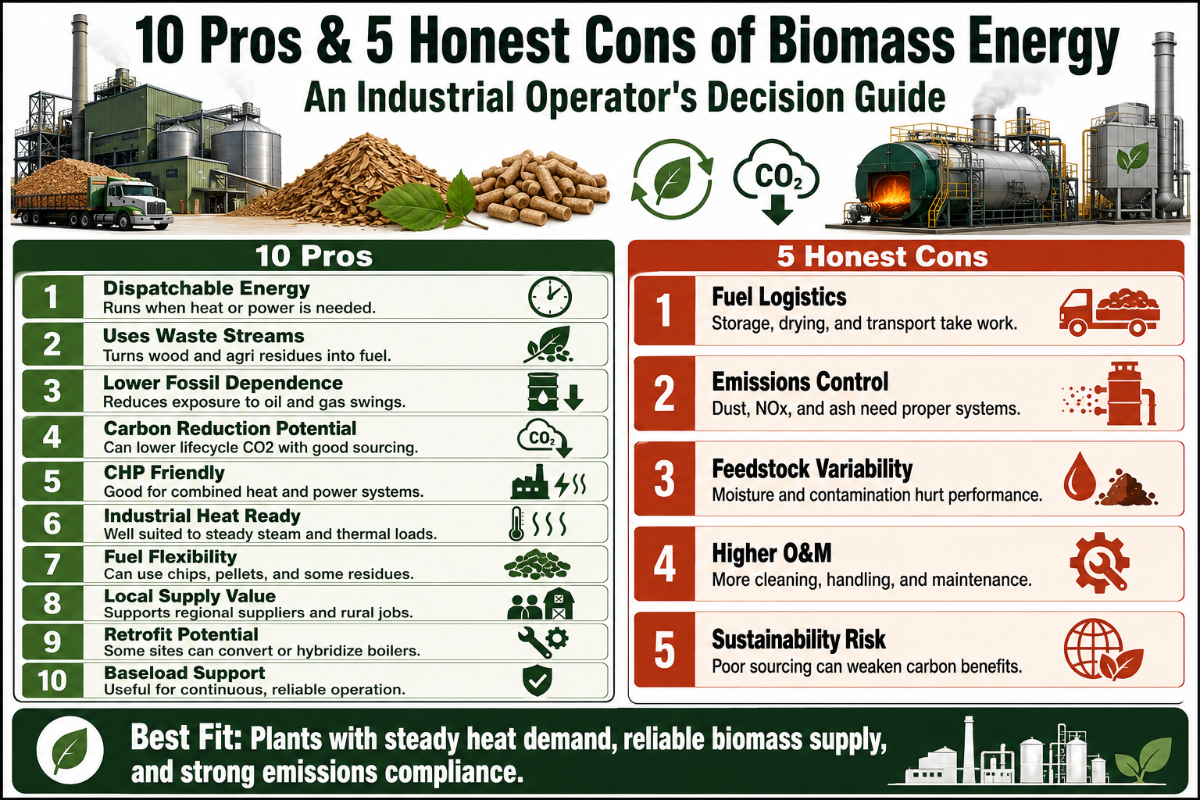
10 Pros and 5 Honest Cons of Biomass Energy: An Industrial Operator’s Decision Guide
This guide reviews 10 biomass pros and 5 honest cons of biomass energy from an industrial operator’s perspective — with capex benchmarks, efficiency numbers, and emissions data instead of marketing slogans. By the end you will know whether biomass economics work for your site, or whether natural gas, solar, or grid power is the smarter buy.
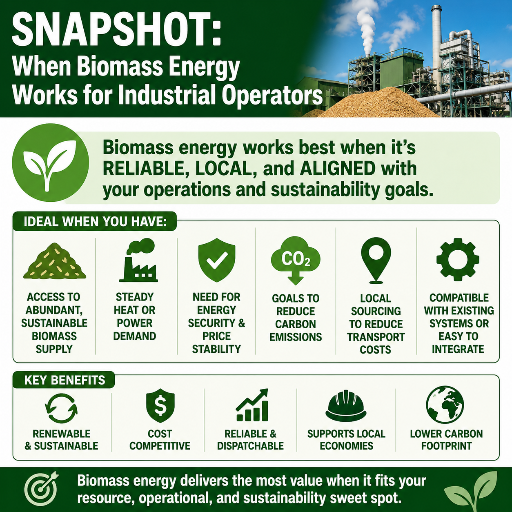
Snapshot: When Biomass Energy Works for Industrial Operators
Quick Specs
| Best fit | Industrial site with year-round steam/heat load + 1–30 MWe demand |
| Worst fit | Power-only application without a host heat load |
| Capex range | $3,000–$5,000 per kW (DOE/FEMP small-scale direct combustion) |
| Levelized cost of electricity | $0.08–$0.15/kWh |
| Typical efficiency | 20–25% standalone electric; 70–85% with cogeneration heat recovery |
| Lifecycle GHG | ~230 g CO₂e/kWh vs coal 820 / natural gas 490 / wind-solar 10–50 |
Bottom line up front: if your site has a year-round host heat load, fuel within 50 miles, and at least 3,000 operating hours per year, biomass economics work. Without all three, choose natural gas. The rest of this guide explains why each pro and each con matters — and how to weigh them honestly. For the full process flow behind these economics, see how a biomass power plant works.
10 Pros of Biomass Energy
Each advantage of biomass below is paired with the data point that makes it real, so you can decide whether the case applies to your industrial site.
1. A Genuinely Renewable Resource
Biomass regrows in years to decades; fossil fuel reserves take hundreds of millions of years to replenish. Wood pellets, agricultural residue, and short-rotation crops provide a renewable energy source that can be harvested annually as long as land management practices keep pace. According to the U.S. Energy Information Administration, biomass has supplied a meaningful share of global energy since long before fossil fuels existed, and remains the only renewable source that can be physically stored and dispatched on demand.
2. Dispatchable Power, Not Weather-Dependent
Solar runs at roughly a 20–25% capacity factor; wind energy hovers around 30–40%. Biomass plants run 80–90% capacity factor and can be turned up or down on demand. Per DOE-supported WBDG guidance, this dispatchability puts biomass closer to gas peakers than to intermittent renewables — a critical property when biomass serves as the primary source of energy for industrial sites that cannot tolerate drop-outs.
3. Waste Reduction at Scale
The U.S. generates roughly 60 million tons of food waste annually, plus enormous volumes of agricultural residue and sawmill by-products. Routing those streams to a biomass facility instead of a landfill cuts methane release — landfill methane is one of the most potent greenhouse gases, roughly 28× stronger than carbon dioxide. Diverting waste to bioenergy is therefore a double win: less landfill volume plus less fossil fuel burned.
4. CHP Cogeneration Doubles Fuel Utilization
A power-only biomass plant converts only 20–25% of fuel energy to electricity; the rest leaves the stack or cooling tower as low-grade heat. Adding combined heat and power (CHP) cogeneration recovers another 50–60% as useful thermal output, lifting total fuel utilization to 70–85%. That is the single most consequential design decision for industrial operators. For technical detail, study the biomass boiler efficiency factors guide.
5. Fuel Cost Stability vs. Natural Gas Volatility
Henry Hub natural gas prices roughly doubled in 2022 then collapsed in 2023 — typical of global commodity behavior. Wood chip and agricultural-residue prices track regional forestry and farming markets, which move on different cycles. An industrial biomass boiler running on local feedstock insulates a plant from gas price spikes. For a side-by-side breakdown, read the biomass vs natural gas comparison.
6. Job Creation in Rural Supply Chains
Biomass supports roughly 50,000 U.S. jobs across logging, fuel transport, plant operations, and ash disposal. Most of those jobs cluster in rural counties near forestry and agricultural production zones, where alternative renewable energy sources like solar farms employ far fewer people per megawatt. Procurement teams sourcing locally also strengthen community relationships, which tend to ease permit approvals down the road.
7. Carbon-Neutral Potential When Sustainably Sourced
Biomass releases carbon dioxide that was recently absorbed from the atmosphere, so net atmospheric carbon stays flat as long as regrowth matches harvest. IPCC AR6 confirms this works for short-rotation coppice and agricultural residues, where parity is reached in roughly 1–3 years. Sustainability certifications such as SBP and FSC help separate truly renewable supply from problematic forest sourcing — see Con #2 for the timing nuance.
8. Multi-Fuel Flexibility
One well-specified biomass boiler can switch between wood chips, wood pellets, agricultural residue, biofuel pellets, and refuse-derived fuel with adjustable air staging and grate speed. Procurement teams gain real bargaining power during fuel price spikes — an advantage natural gas plants simply do not have. The biomass fuel types overview covers heating values and ash chemistry by feedstock family.
9. Behind-the-Meter Resilience
An industrial biomass CHP plant keeps producing steam and electricity during grid outages — same logic as a backup generator, but with renewable-energy classification and continuous-duty rating. Food processors, hospitals, and data centers requiring uninterrupted process steam treat resilience as a hard requirement, and biomass CHP handles it with no fuel-storage tank refill cycle to manage.
10. Coal Plant Retrofit Pathway
Existing pulverized-coal boilers can co-fire 5–15% biomass with modest grinding and burner modifications, and a full conversion is feasible at scale: Drax in the UK converted four of its six 660 MW units from coal to wood pellets, producing roughly 2,580 MWe of dedicated biomass capacity. Biomass boilers built for industrial loads let owners capture stranded coal capex rather than write it off.
5 Honest Cons of Biomass Energy
1. High Capital Cost vs. Solar and Gas
Direct combustion biomass plants run $3,000–$5,000 per kW installed for small-scale (5–25 MWe) projects, and gasification systems push $5,000–$8,000 per kW. Compare that to utility-scale solar PV at roughly $1,000/kW or combined-cycle natural gas at $1,000–$2,000/kW. Levelized cost of electricity sits at $0.08–$0.15/kWh — competitive against gas only when fuel prices spike, and rarely competitive against solar and wind when storage is not required. The industrial biomass boiler cost guide breaks out the boiler-island components, and the biomass boiler installation process walks through site preparation costs.
2. Forest Biomass Carbon Payback Takes Decades
Forest biomass breaks the biogenic-carbon claim. According to IPCC AR6 Working Group III, Chapter 6 and Spatial Informatics Group lifecycle assessments, a typical forest biomass supply chain reaches atmospheric carbon parity over 6–100 years depending on species and silviculture. A tree grows for 60 years; it burns in one hour. Unsustainable forest sourcing also drives deforestation, with downstream biodiversity loss. Massachusetts removed biomass-fired electricity from its Renewable Portfolio Standard in 2012 because state officials concluded the greenhouse gas benefit was not clear at policy timescales. Short-rotation coppice and agricultural residues remain the genuinely fast-payback options.
3. Air Pollution: Particulate Matter, NOx, and CO
Burning biomass releases particulate matter, nitrogen oxides, carbon monoxide, and SO₂ into the stack — even with controls. A peer-reviewed 2021 ACS Energy & Fuels study estimated biomass smoke contributes to roughly 40,000 premature deaths per year in Europe. Mitigation requires cyclones plus baghouse fabric filters, electrostatic precipitators, and SCR/SNCR for NOx — a control train that adds $0.3–0.6 million to small-plant capex and ongoing operating cost. Plants near population centers face permit complexity under US EPA Boiler MACT rules.
4. Resource Intensity: Water, Fertilizer, and Land
Energy crops grown for biomass need irrigation, fertilizer, and arable land. WBDG estimates a biomass plant burns roughly one dry ton of wood per MWh of electricity, which translates to large supply-chain footprints. Land-use competition with food production is documented in peer-reviewed work — Nature Food’s 2021 review highlighted bioenergy crop expansion as a non-trivial factor in regional food security. Drought years cut biomass yields sharply, which means a plant’s economics are exposed to climate variability in ways gas and solar are not.
5. Policy and Certification Uncertainty
Policy sustains the renewable label. Europe is phasing out coal co-firing post-2030, even when biomass is the blend. U.S. state Renewable Portfolio Standards treat biomass differently by jurisdiction — Massachusetts dropped it in 2012, while California still counts biomass toward its renewable goals. SBP and FSC sustainability certifications add audit overhead, and a buyer who skips certification risks future regulatory changes that strand the investment. Build the project knowing the policy landscape can move under you.
When Biomass Wins: The Industrial Biomass Litmus Test
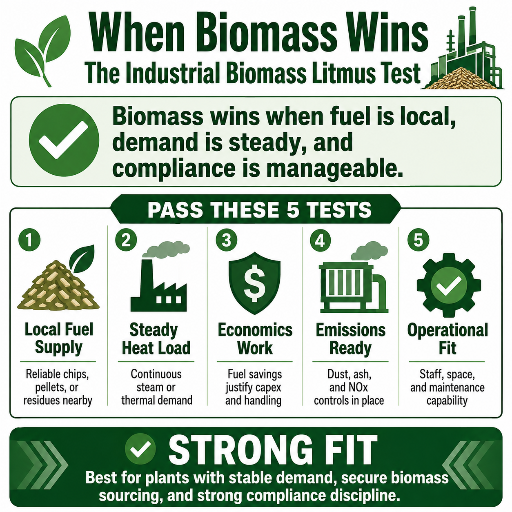
Biomass economics only work when several conditions hold simultaneously. Treat the matrix below as a litmus test: if any one condition fails, choose natural gas, grid power, or solar instead — depending on which alternative best matches your load profile.
Decision Framework — The Industrial Biomass Litmus Test
| Condition | Threshold | If FAIL → choose |
|---|---|---|
| 1. Year-round host heat load | ≥4,000 hours/year demand | Combined-cycle natural gas |
| 2. Fuel sourcing radius | Wood chip / agri-residue within 50 mi | Natural gas |
| 3. Annual operating hours | ≥3,000 hours | Solar PV (peaking) |
| 4. Permit-friendly site | Outside dense PM2.5 attainment zone | Grid power or natural gas |
Pass all four → biomass CHP delivers a 3–7 year payback in our modeling, with strong fuel-cost insulation and dispatchable renewable status. Pass three of four → conditional decision that hinges on the regional gas-vs-biomass fuel cost spread. Pass two or fewer → biomass is the wrong tool; investing capex elsewhere yields better risk-adjusted returns. For a fuel-by-fuel side comparison, see the biomass vs natural gas guide.
📐 Engineering Note
Biomass CHP power-to-heat ratios typically sit between 1:3 and 1:5 for steam-turbine designs. A 5 MWe plant therefore generates 15–25 MWth of recoverable heat — useful at a sawmill, paper mill, or food processor with year-round steam demand, but stranded at a remote site. Size CHP for average heat load, not peak; sizing for peak strands capacity for nine months out of twelve.
Industry Outlook: Where Biomass Energy Is Headed (2026–2030)
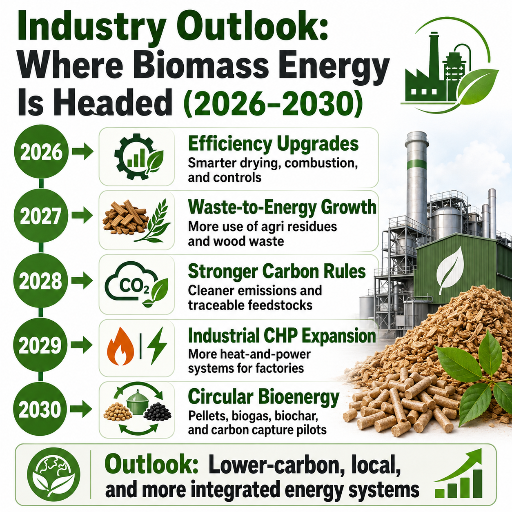
Per IRENA’s Renewable Capacity Statistics 2024, global bioenergy capacity reached roughly 148 GW at end-2023, up from about 115 GW in 2015 — a steady but unspectacular trajectory next to wind or solar. Three trends matter for industrial buyers through 2030.
BECCS retrofits. Drax in the UK is targeting bioenergy with carbon capture and storage (BECCS) capable of capturing about 8 Mt CO₂ per year. If delivered at full scale, that single project would be the largest engineered carbon-removal facility on the planet. Industrial CHP operators with stable feedstock supply may follow with smaller BECCS retrofits late this decade.
Pellet supply chain transparency. SBP and FSC certifications are becoming buyer prerequisites in EU and Japanese markets. Plant operators who lock in certified supply early protect against future regulatory tightening — and against negative press cycles around forest sourcing.
Distributed industrial CHP. The growth zone is sub-30 MWe behind-the-meter installations at sawmills, food processors, district heating utilities, and chemical plants seeking dispatchable decarbonization. For procurement teams scoping vendors, the leading biomass boiler manufacturers roundup covers active suppliers in this segment.
Frequently Asked Questions
Q: Do the pros of biomass energy outweigh the cons for industrial operators?
View Answer
It depends entirely on host heat load, fuel proximity, operating hours, and site permit landscape. Run the four-condition Industrial Biomass Litmus Test above. Sites that satisfy all four typically see 3–7 year payback on biomass CHP. Sites that satisfy two or fewer should pick natural gas, grid power, or solar instead. For deeper buyer guidance, see the biomass-fired boiler buyer’s guide.
Q: Why does biomass cost so much more than solar or wind?
View Answer
Three reasons. First, biomass needs an active fuel supply chain — handling, storage, drying, and combustion equipment add 30–50% to capex versus solar PV. Second, biomass plants are smaller, so they capture less of the manufacturing learning-curve benefit that drives solar costs down each year. Third, biomass faces emissions controls (cyclones, baghouses, SCR/SNCR) that solar simply does not require. The trade-off: biomass dispatches on demand at 80–90% capacity factor; solar runs 20–25% without storage.
Q: Is biomass really renewable?
View Answer
Yes by classification, but the timing depends on feedstock. Short-rotation coppice and agricultural residues reach atmospheric carbon parity in 1–3 years. Forest biomass takes 6–100 years per IPCC AR6, depending on species and silviculture. Treat the renewable label as feedstock-specific, not blanket — and verify supply through SBP or FSC certification.
Q: What is the biggest problem with biomass?
View Answer
Forest carbon payback timing. Burning a 60-year-old tree releases its full carbon stock in one hour, and the replacement tree takes decades to absorb the same amount back. That mismatch fails the IPCC 1.5°C pathway timing test. Short-rotation crops and agricultural residues do not have this problem.
Q: Is biomass energy good for the environment?
View Answer
Better than coal and oil on net greenhouse gas emissions when sustainably sourced; worse than wind or solar across most lifecycle metrics. Stack-level air pollution remains the biggest disadvantage, especially near population centers. Particulate matter and NOx stack emissions stay a real public-health concern even with full control trains in place. Plant siting, fuel sourcing, and emissions-control design determine whether biomass is a net environmental positive at any specific facility.
Why We Wrote This
Most “pros and cons of biomass” articles soft-pedal the cons or skip the numbers. This guide grew out of fielding the same buyer questions across 80+ countries: is biomass actually a good investment for my plant? The Industrial Biomass Litmus Test is our compressed answer, drawing on 50+ years of biomass boiler design experience at Taiguo and on data from the U.S. EIA, DOE/FEMP, IRENA, and IPCC AR6. Reviewed by the Taiguo Boiler engineering team.
References & Sources
- Biomass Explained — U.S. Energy Information Administration (EIA)
- Biomass for Electricity Generation — Whole Building Design Guide (DOE/FEMP)
- Renewable Capacity Statistics 2024 — International Renewable Energy Agency (IRENA)
- AR6 Climate Change 2022: Mitigation, Chapter 6 — Energy Systems — Intergovernmental Panel on Climate Change
- Boiler MACT Rules — U.S. Environmental Protection Agency
- Health Impacts of Residential Biomass Combustion — ACS Energy & Fuels (2021)
- Bioenergy and Food Security — Nature Food (2021)
Related Articles
- Biomass-Fired Boiler: Industrial Buyer’s Guide — equipment selection deep dive
- Industrial Biomass Boilers — overview of boiler families and applications
- Biomass Fuel Types Guide — heating values and ash chemistry by feedstock
- Top 15 Biomass Boiler Manufacturers in the World — vendor landscape