Get in Touch with Taiguo


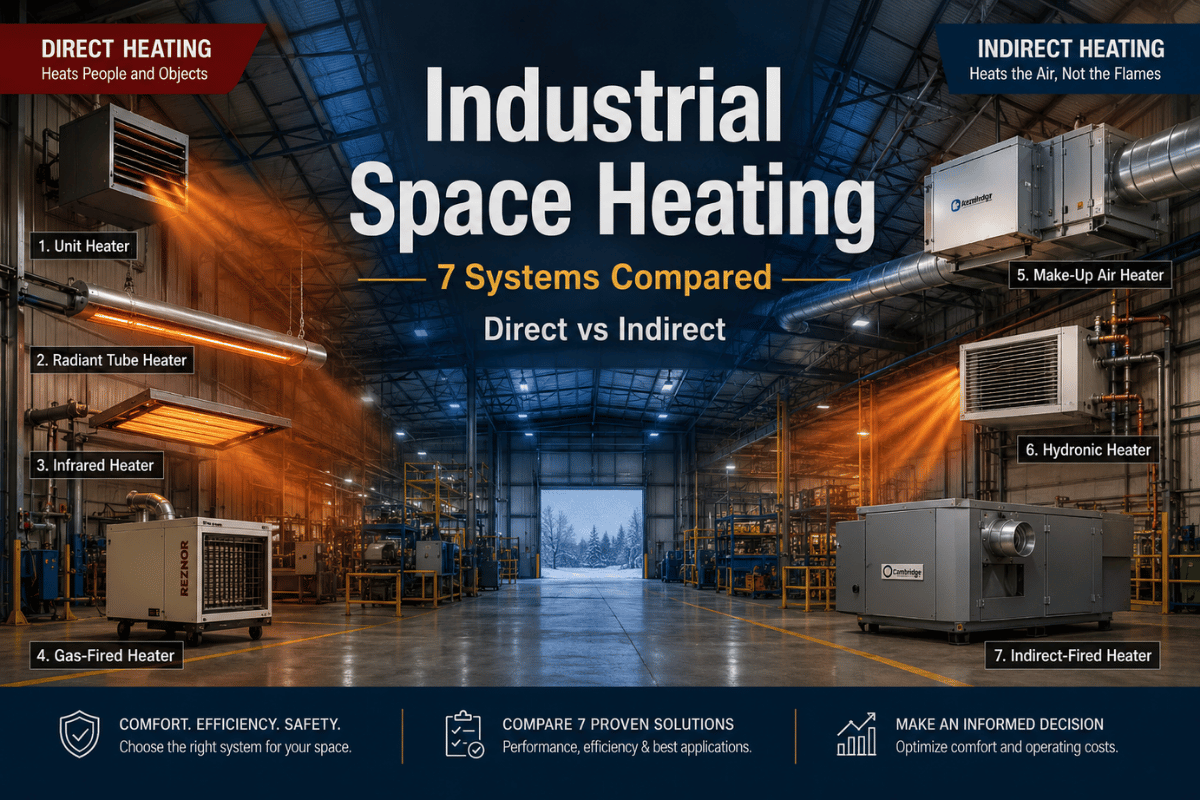
Industrial space heating means heating large work environments — warehouses, manufacturing floors, fabrication shops, distribution centers — where equipment is sized in hundreds of thousands of BTUs per hour and must contend with high ceilings, dock-door cycling, and indoor air quality codes. This guide compares the seven gas-fired industrial space heating systems used across U.S. facilities, walks through BTU sizing and fuel choice, and ends with a five-step framework you can run before you call a vendor. The direct-fired versus indirect-fired split is one axis of the decision; it is not the whole decision.
Quick Specs — Industrial Space Heating at a Glance
| Typical capacity range | 50,000 – 7,000,000 BTU/hr per unit |
| Typical ceiling height served | 10 – 40+ ft |
| Fuels | Natural gas, propane, diesel, electricity |
| Combustion approach | Direct-fired (3 system types) or indirect-fired (4 system types) |
| Key safety codes | OSHA 29 CFR 1926.154 (temporary heating), ASHRAE 62.1 (IAQ ventilation), NFPA 87 (fluid heaters) |
| Equipment standards | ANSI Z83.4-2017/CSA 3.7-2017 (non-recirculating direct), ANSI Z83.18 (recirculating direct, 80/20) |
How Big a Heater Do You Need? BTU and CFM Sizing for Your Space

The first size-up question is rarely the right one. Most facilities managers begin with “How many BTUs do I need to heat 10,000 square feet?” – but for something like a 10,000-square-foot warehouse with 14-foot ceilings, three loading-dock doors, and uninsulated metal walls, that is a completely different load problem from a 10,000-square-foot insulated, light-color, 10-foot-ceiling production floor with no doors cycling open. Volume, design temperature rise, infiltration and use pattern all change the answer.
Industry rules of thumb go by cubic feet rather than square feet:
📐 Engineering Note — BTU Sizing Formula
Required BTU/hr ≈ Length × Width × Ceiling Height × Temperature Rise (°F) × Insulation Factor / 1.6
Insulation factor: 0.5 (modern, well-insulated) | 1.0 (moderate) | 1.5 (poorly insulated metal buildings) | 2.0 (uninsulated, drafty)
Worked example: a 10,000 square foot warehouse with a 20-foot ceiling, 60°F target rise (10°F outside to 70°F inside), moderate insulation (factor 1.0): 100 ft × 100 ft × 20 ft × 60 × 1.0 / 1.6 = 7,500,000 BTU/hr. Halve that for tight insulation and a modest temperature rise; double the number for an uninsulated cold-storage conversion with frequent door openings.
Note that the resulting number is what you buy, not what your actual installation will be. 7.5 million BTUs an hour for a single unit is unusual, and most warehouse operators use two or three mid-sized units along a perimeter strip of framing to keep even heating and provide redundancy. CFM (cubic feet per minute of air movement) is just as relevant as BTU/hr; stratification – hot ceiling air hanging out of reach of on-floor users – loses between 20% and 40% of delivered heat in tall spaces unless destratification fans are included in the system design or the hot air discharge pattern is designed to push hot air down and away. Industry load calculators from Heat Wagon and Industrial Fans Direct each use versions of the same cubic-foot calculations. Within 15% of the above estimate is feasible with a space load calculation that takes into account interior build-in and natural load factors as well as infiltration, which can be reliably measured at design wind speed and dock-door open-time fractions.
Direct-Fired vs Indirect-Fired — The Combustion Approach

Each gas-fired industrial space heater belongs to one of two combustion families. A direct-fired heater keeps the flame inside the air stream: combustion products — water vapor, carbon dioxide, trace nitrogen oxides, trace carbon monoxide — enter the heated air stream and are delivered to the space along with the warm air. An indirect-fired heater encloses the flame within a sealed combustion chamber and conveys heat to the delivered air through a heat exchanger and a flue, so none of the combustion products enter the air stream.
| Dimension | Direct-Fired | Indirect-Fired |
|---|---|---|
| Combustion path | Open flame in air stream | Sealed chamber, flue-vented |
| Byproducts in heated air | Yes — H₂O, CO₂, trace CO/NOₓ | None |
| Thermal efficiency | 92 – 100% | ~80% |
| When to use | Open-air sites, well-ventilated warehouses | Sealed buildings, occupied spaces, food/pharma |
The 12-to-20-percentage-point efficiency gap reflects heat losses through the heat exchanger walls and the flue in an indirect-fired unit. The trade-off is not academic: OSHA 29 CFR 1926.154 requires fresh-air ventilation when heaters operate in confined spaces, and the OSHA permissible exposure limit for carbon monoxide is 50 ppm averaged over an 8-hour shift; OSHA standard interpretation 1988-05-26 requires shutting off the heater above 50 ppm at worker breathing level. ASHRAE 62.1 recommends a stricter 9 ppm IAQ target in occupied buildings. For mechanism details, our full direct-fired vs indirect-fired heater breakdown walks through the burner physics, ventilation math, and application-specific safety calls.
The 7 Industrial Space Heating Systems Compared

Indirect-fired vs direct-fired describes one element: the combustion path. The actual purchase decision sits one level below that. The Cambridge Engineering whitepaper How to Select the BEST Space Heater classifies all gas-fired commercial and industrial space heating equipment into seven system types — four indirect-fired, three direct-fired. Every catalog you’ll read maps to one of these seven. We call this layout the Cambridge 7-System Map.
Indirect-Fired System Types
1. Boiler Systems (Steam and Hot Water)
A central boiler heats water or steam and pipes the heat through unit ventilators, fan coils, and radiant floors on the warehouse floor. Boiler space heating remains the rule for large multi-zone facilities and where process steam is already on site. Cambridge notes that overall efficiency falls when a boiler is dedicated to space heating only — additional pipe losses, circulating-pump load, and cold-start cycling drag the system below boiler nameplate efficiency. Strong fit when a facility already runs steam for production. See our oil and gas fired boiler guide for boiler selection logic, and our thermal oil heater overview for thermal-fluid alternatives.
2. Unit Heaters
Ceiling-suspended packages — a gas burner, heat exchanger, blower, and flue — installed in arrays around the perimeter of small to mid-sized open spaces. Cambridge cites typical unit heater overall efficiency at 60% to 75%; a noticeable share of combustion energy goes up the flue. Contractors favor them because they are stocked items with quick lead times and offer redundancy if a single unit fails. Limitation: throw distance is short, so they lose effectiveness above roughly 14 to 16 feet of mounting height, and large warehouses need many of them.
3. Air-Turnover (Air Rotation) Systems
Tall floor-mounted units that suck cold air in near the ground, heat indirectly in a furnace section and exhaust hot air at high velocity across the ceiling, turning the building air once to twice hourly. Cambridge claims 70% to 80% efficiency. Air-turnover units require space for floors and racking, blower fans run continuously and there is little room to control zones they are best for one-step warehouses where wall-to wall temperature uniformity matters more than the tuning of zones.
4. Tube-Style Infrared (Radiant) Heaters
A burner burns gas directly inside a long ceramic coated steel tube; the tube surface radiates heat down through a polished reflector. Tube infrared heats surfaces – floors, equipment, personnel – rather than air. Cambridge cites published efficiency of 80% to 92% with a moderate tube length and mountings of 15 to 18 feet high; mount higher or neglect to clean reflectors and effective efficiency drops below 70%. Appropriate for lot spot heating, high bay structures and locations of rolling dock doors where the exhaused air becomes heating air which leaves in the next forklift’s wake.
Direct-Fired System Types
5. Blow-Thru High-Efficiency Space Heaters
The burner sits downstream of the blower, which pushes cold outside air through the flame at high velocity. ANSI Z83.4-2017/CSA 3.7-2017 caps outlet air temperature at 160°F (71°C). All combustion energy ends up in the air stream — Cambridge cites 92% sensible efficiency, with the remaining 8% as latent heat in the water vapor produced. The architecture pairs naturally with make-up air duty in industrial buildings that exhaust large volumes of process air. Best fit for facilities over roughly 15,000 square feet that need both space heat and engineered ventilation in one package.
6. Draw-Thru Make-Up Air (MUA) Heaters
The blower is installed after the burner, which pulls air through it. Make-up air blowers transmit large quantities of air at a low temperature gain, designed to replace the air pulled out of a space by hoods, spray booths and process fans. They may seem similar to blow-thru units but are not interchangeable – operated as primary space heaters, make-up air concentrators incur higher operating costs in gas and electricity because they must push a far greater volume of air at lower temperature to produce the same BTUs. Use them as designed.
7. Air Recirculation Heaters (ANSI Z83.18 / 80/20)
A direct-fired burner heats a blend of outside and return air, modulating the outside-air fraction (typically between 20% and 100%) to maintain a fixed positive building pressure. ANSI introduced Z83.18 in 2003 specifically for recirculating direct-fired equipment because reheating indoor air with an open flame raises IAQ concerns the non-recirculating standard does not address. Useful when both space heat and modest make-up air are needed without two separate systems, but power consumption is high — large blowers run continuously — and any leaky building or open dock door collapses the 80/20 ratio toward 100% outside air.
“We see most project errors when operators select a piece of equipment by browsing or from a catalogue before establishing the building’s classification. Start with the seven-system map – boiler, unit heater, air-turnover, tube infrared, blow-thru, MUA, recirculation – and four of the seven categories will be eliminated before shopping for a price.”
Fuel Selection — Natural Gas, Propane, Diesel, or Electric?
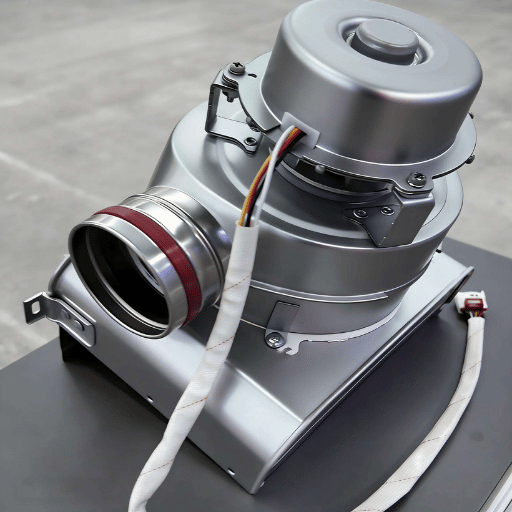
Fuel choice usually narrows itself before equipment shopping starts. If a natural gas line is at the property, gas wins on running cost in nearly every U.S. region. The U.S. Energy Information Administration reports Henry Hub natural gas spot prices ranged from $2.65 to $9.86 per MMBtu in 2025. Propane delivered to commercial sites typically prices 50% to 70% higher per delivered BTU, and electric resistance heating is higher still on a per-BTU basis except where electricity is unusually inexpensive.
| Fuel | When it makes sense | Tradeoff |
|---|---|---|
| Natural gas | Gas line on site, year-round operation | Pipeline tap fee can be $5K-$50K |
| Propane / LP | Remote sites, no gas service, dual-fuel rentals | Higher $/MMBtu, on-site tank required |
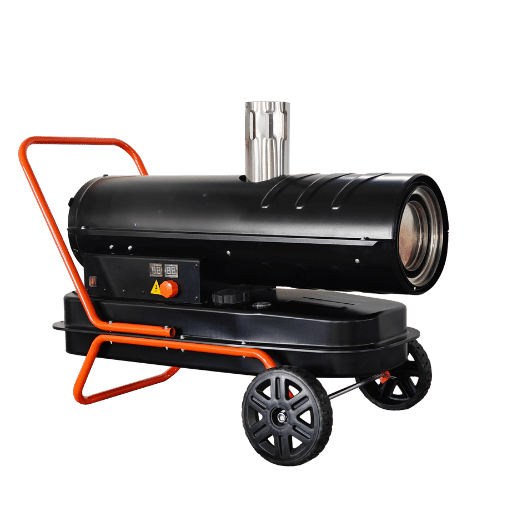
| Diesel / oil | Construction, emergency, mobile heaters | Highest fuel cost, soot management |
| Electric (resistance) | Spot heating, no combustion allowed, very small loads | Highest run cost; service capacity required |
💡 When electric heat pumps change the math
Industrial heat pumps are now reaching cost-parity with natural gas boilers at low-temperature heating duty in some regions, according to a 2024 industrial electrification analysis from CAELP and E3. If you are scoping a new build with a low-supply-temperature requirement (under 175°F process heat or simple space heat), pricing a heat pump alongside the gas option is no longer an academic exercise — see also our biomass vs natural gas boiler comparison for context on the broader fuel-cost landscape.
Forced-Air vs Radiant Distribution and Where to Mount the Equipment
Two questions decide how heat reaches the people and product on the floor: how it travels, and where the equipment lives.
Forced-Air vs Radiant Distribution
Forced-air heats the air, then all the stuff it touches gets hot, too. Radiant heats surfaces directly – floors, equipment, bodies – then the air stays cooler. The right choice depends on ceiling height and room use pattern. Under 20 to 25 feet ceiling heights, forced air is probably acceptable. Above that, hot air rises, stratifies, and never reaches the people on the floor; tube infrared heats surfaces regardless of ceiling height and avoids the you-heating-the-roof problem. Spaces with dock doors opening frequently also favor infrared- heated air leaves with each cycle, but warmed concrete and steel slabs stick around.
Mounting and Form Factor
| Mounting style | When to specify |
|---|---|
| Roof-mounted | No floor space available; large make-up air units; structural roof can carry the load |
| Suspended ceiling unit heater | Small to mid-size open spaces; quick contractor installs; rated for ceiling height under 16 ft |
| Through-wall | Roof loading constraint; equipment maintenance access from outside is easier |
| Ground-mounted vertical | Want to keep roof free; easier service access; industrial hot air furnace applications often spec this |
Tube infrared has its own mounting rule. Cambridge cites optimal effectiveness at 15 to 18 feet — high enough that the radiant fan-out covers usable floor area, low enough that the inverse-square law has not yet halved intensity. Mount it at 30 feet over a 14-foot work zone and you are heating the floor between you and the worker, not the worker. Our hot air generator efficiency overview covers the related mounting decisions for indirect hot-air systems.
Total Cost of Ownership — Equipment, Install, Operate, Impact
Equipment price is the smallest of four cost buckets you’ll pay on a 15-to 25-year service life. The Cambridge white paper puts total cost into four buckets that hold up well in practice:
The Four Cost Buckets — Cambridge TCO Framework
- Equipment cost- the purchase price of the heater itself. Generally represent 15 to 25% of total ten-year cost.
- Installation and start-up cost- the gas piping, electrical service, roof penetrations, structural support, downtime to install. Can equal or surpass equipment cost.
- Operating cost- the dollars per year for fuel, electricity, maintenance, replacement parts, service labor. Usually the largest bucket over the life of the equipment.
- Facility impact cost- the amount of floor space consumed, employee comfort and productivity, indoor air quality, displaced racking. Hard to model, but generally the deciding factor in practice.
Here is where the 12-to-20-percentage-point efficiency gap between direct-fired and indirect-fired equipment matters. It takes approximately 15% to 20% more gas to operate an indirect-fired unit for the same delivered heat, and those percentages get multiplied over a 20-year equipment life. However, the size of this efficiency gap may be overridden by effects of the venting hardware: if the only safe way to operate a direct-fired heater with a sealed building is to bring in fresh air with ductwork, fans, and monitoring, then that capital plus recurring electricity load can be much greater than the differences in indirect-fired efficiency lose.
Do the calculations both ways before you decide.
A 5-Step Decision Framework for Industrial Space Heating

Run these five questions in order. The first one that points to indirect-fired settles the combustion family — keep going only to narrow the system type within that family.
- ①
Is the space sealed or well-ventilated? Sealed building, tent, or any structure that fails to provide the fresh-air supply OSHA 1926.154 requires → indirect-fired only. Open-air construction sites and warehouses with active dock-door ventilation → either family is on the table.
- ②
Are there air-purity requirements? Food processing, pharmaceutical production, paint booths, indoor sports facilities, hospitals, museums → indirect-fired only. Combustion byproducts in the heated air violate IAQ codes and contaminate process input.
- ③
Continuous duty or intermittent / spot heating? Eight-plus hours a day all winter → blow-thru direct or boiler indirect. Spot heating people in a high bay during forklift operations → tube infrared. Intermittent shop work → unit heaters.
- ④
Ceiling height above 25 feet? Forced-air units lose effectiveness as warm air stratifies near the roof. Tube infrared keeps efficiency because it heats surfaces, not air.
- ⑤
What does the total budget look like — capital plus infrastructure? Direct-fired equipment is cheaper to buy but may require ventilation upgrades to operate safely. Indirect-fired costs more upfront but often skips the infrastructure addition. The decision is rarely about which heater is cheaper; it is about which total system is cheaper.
Q: What is the cheapest way to heat a large warehouse?
For a well-insulated, well-ventilated warehouse with a natural gas service, a blow-thru direct-fired unit at 92% efficiency on natural gas at 2025 Henry Hub pricing is the lowest operating-cost option in most U.S. regions. Add ventilation requirements or air-purity rules and the answer flips to a high-efficiency indirect unit, where the 15% to 20% fuel penalty is the cheaper path compared to building out fresh-air infrastructure. For tall spaces with frequent dock-door cycling, tube infrared often wins because the heat does not leave with the next forklift. Cheapest is local—fuel price, building envelope, and use pattern decide.
Industry Outlook — Standards, Electrification, and Heat Pumps
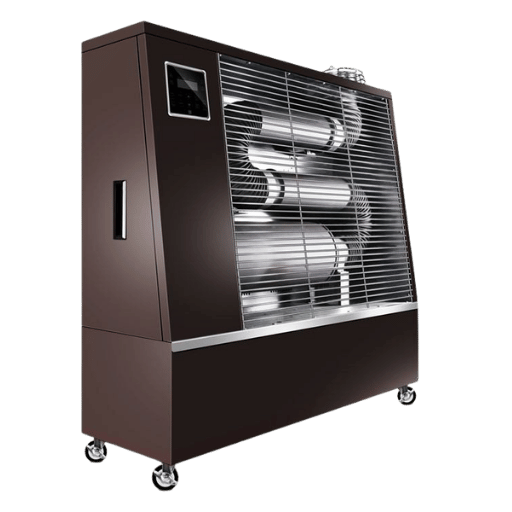
Two ANSI/CSA processes are having impact on what is specified for industrial space heating. State regulation: ANSI Z83.4-2017/CSA 3.7-2017 is still current for a non-recirculating direct gas fired heater (reaffirmed 2022); ANSI Z83.18 is the current standard for the recirculating 80/20. There are currently no federal efficiency standards for industrial gas-fired air heaters. (DOE’s October 2026 deadline applies to water heaters, not air heaters.) Equipment standards, like everything else, are a function of ANSI/CSA updates over time, not an arbitrary deadline.
The second shift is electrification economics. The CAELP/E3 industrial electrification analysis published October 2024 identifies that industrial heat pumps have nearly parity costs with natural gas boilers at low-temperature heat duty (below about 175F supply). The Inflation Reduction Act Section 48 investment tax credit applies to qualifying industrial heat pump installations, bringing the breakeven to yet another level.
The three explicit reader actions are:
- If scoping a new build for 2026 commissioning, ask for a heat-pump comparison in addition to the gas baseline— even if you turn it down, the document insulates you from any population based electrification enforcement.
- If your present system is a boiler generating steam for combined process & space heating,—audit which loads are less than 175 F. Those are heat-pump candidates now.
- If you replace gas-fired appliances in 2026, ensure the unit you select is shipped to meet the current ANSI Z83 revision, not the one prior to 2017, which still can be found in some older surplus supplies.
Frequently Asked Questions
Q: How many BTUs do I need to heat a 10,000 square foot warehouse?
View Answer
A typical 10,000 sq ft warehouse with a 20-foot ceiling, 60°F target temperature rise, and moderate insulation needs roughly 7.5 million BTU/hr by the cubic-foot rule of thumb. Cut that figure in half for tight modern insulation and a small temperature rise; double it for an uninsulated metal building with frequent dock-door cycling. Always run a load calculation before purchasing.
Q: Are direct-fired heaters safe to use indoors?
View Answer
No indoor use of direct-fired equipment is safe unless enough fresh-air ventilation is maintained automatically and continuously so that
carbon monoxide, at workers breathing height, remains less than 50 ppm, in accordance with OSHA 1926.154. In airtight buildings, or in any building that cannot assure such ventilation, indirect-fired units must be used exclusively, since their combustion products are never released into the space being heated.
carbon monoxide, at workers breathing height, remains less than 50 ppm, in accordance with OSHA 1926.154. In airtight buildings, or in any building that cannot assure such ventilation, indirect-fired units must be used exclusively, since their combustion products are never released into the space being heated.
Q: What is the difference between a unit heater and a make-up air heater?
View Answer
A unit heater circulates conditioned (indoors) air, and heats it using an indirect-fired heat exchanger, before blowing it back into the same space; several units can be used for a whole building. A make-up air heater aspirates external air, and heats it (generally using direct-fired heat) before pushing it into the building to makeup for air expelled by exhaust hoods or process fans. The two pieces of equipment are the same size physically, but address different issues – failure to distinguish them usually results in 2x the operating expense because an MUA unit running as a space heater moves far to much air for the B.T.U. output.
Q: Do industrial space heaters raise my electricity bill?
View Answer
Gas fired industrial heater use electric for blowers, controls, and ignition (generally 1 to 5 HP per unit). Electric resistance heating burns many times more, and high-CFM systems such as air-turnover or 80/20 recirculation operate blowers constantly and add significant kWh load.
Q: What is an 80/20 air recirculation heater?
View Answer
An 80/20 system is a recirculating direct-fired heater that blends roughly 80% return air with 20% outside air, heats the mixture with an open flame, and modulates the outside-air share to maintain positive building pressure. ANSI introduced standard Z83.18 in 2003 specifically for these units, since reheating indoor air with an open flame raises IAQ concerns the non-recirculating standard does not cover.
Q: Which is better for a sealed pharmaceutical plant — direct or indirect?
View Answer
Indirect-fired, full stop. Environments regulated by FGI/ASHRAE 170, NFPA 87, and IAQ codes can’t tolerate combustion emissions in the production air path – which means direct-fired units are disqualified.
Need an Indirect-Fired Industrial Hot Air Furnace?
Taiguo supplies indirect-fired hot air furnaces for the pharmaceutical, food, chemical, and any other manufacturing environment that can’t accept contamination in the process heat stream.
How We Built This Industrial Space Heating Comparison
This guide combines the seven-system framework used by Cambridge Engineering with the latest OSHA, ASHRAE, NFPA, and ANSI Z83 standards. The efficiency categories, mounting heights, and ANSI standard references were verified against the published whitepaper and the current 2017 (R2022) code text. Natural gas pricing information is referenced from the U.S. EIA Henry Hub 2025 charts; the heat pump cost-parity data was made available by the October 2024 CAELP/E3 electrification cost study. The guide portrays the real-world perspective of the Taiguo Boiler engineering team – a Grade A industrial boiler manufacturer in business since 1976 and exporting equipment to food, chemical, textile, and power generation plants in over 100 countries worldwide.
References & Sources
- 29 CFR 1926.154 — Temporary Heating Devices — U.S. Occupational Safety and Health Administration
- OSHA Standard Interpretation 1988-05-26 — Carbon Monoxide 50 ppm Threshold — U.S. Occupational Safety and Health Administration
- ASHRAE Standard 62.1 — Ventilation for Acceptable Indoor Air Quality — American Society of Heating, Refrigerating and Air-Conditioning Engineers
- ANSI Z83.4-2017/CSA 3.7-2017 (R2022) — Non-Recirculating Direct Gas-Fired Industrial Air Heaters — American National Standards Institute
- U.S. Natural Gas Spot Prices in 2025 — U.S. Energy Information Administration
- Decarbonizing Industrial Heat: Measuring Economic Potential and Investment Opportunities (October 2024) — California Electrification Coalition (CAELP) and Energy + Environmental Economics (E3)
- How to Select the BEST Space Heater (whitepaper) — Cambridge Engineering