Get in Touch with Taiguo

Tire Retreading Autoclave Guide: Specify the Load, Cycle, and Proof

Contents
show
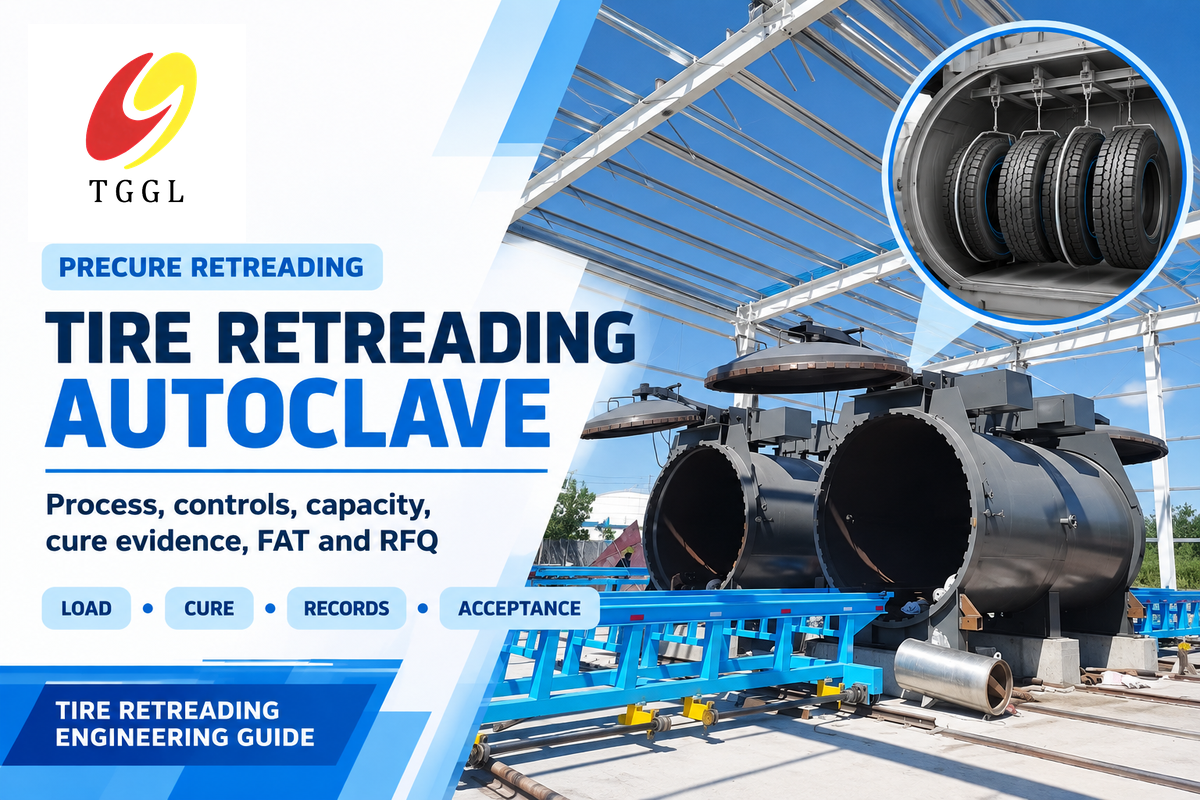
A tire retreading autoclave is the pressure curing chamber used mainly in pre-cure retreading to bond precured tread and cushion gum to a prepared casing. Acquiring a chamber is just the first step. An adequate system also requires a released casing, compatible curing assembly, representative load, approved material cure window, traceable cycle data, and an acceptance test that demonstrates the overall system.
Short answer: choose the retreading route first, then size the autoclave from the enveloped load, not a nominal tire count. Require the supplier to show how the chamber will heat, pressurize, record, alarm, and safely recover with a load that represents your real truck or OTR production mix.
This guide is intended for plant managers, process engineers, and sourcing teams. It doesn’t repeat our broad industrial autoclave selection guide or the chemistry covered in our rubber vulcanization guide. Here, the subject is narrower: The focus is on the casing-to-cure controls that allow for a testable specification of a tire retreading chamber.
In the retreading business, the same process may be described as used tire retreading, cold retreading, or a recap operation. This article uses tire in its main terminology while retaining tyre where international buyers or source titles use it. It isn’t a tire recycling guide. Here the subject is controlled remanufacture of a suitable casing, not size reduction or material recovery.
Place the Autoclave in the Right Retreading Route
Casing-to-Cure Evidence Chain
Where does the autoclave sit in a pre-cure production line?
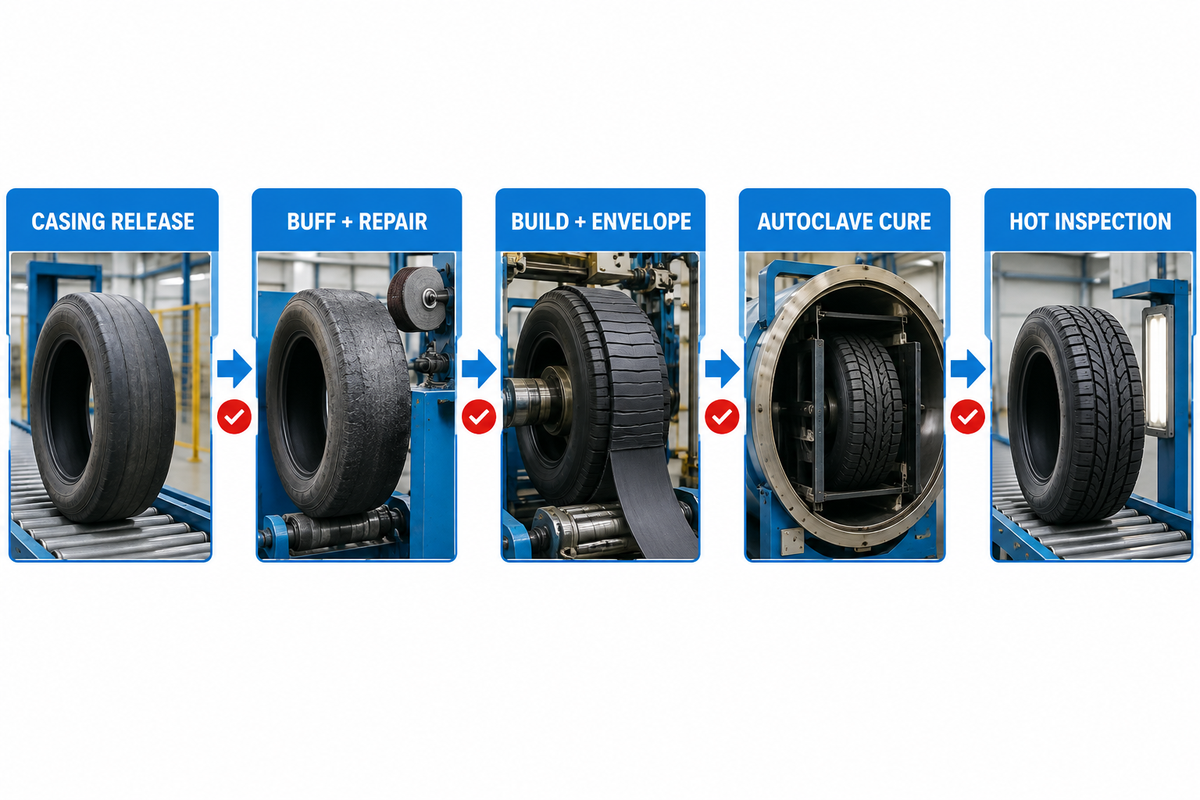
The chamber is primarily in the pre-cure route. The worn casing is inspected, buffed, repaired where permitted, coated with the specified cement or cushion system, built with precured tread, enveloped and connected, cured, and finally inspected. The Tire Industry Association recommended practice separates these stages and describes more than one curing arrangement.
In a complete tire retreading production line, a tire buffing machine removes the old tread and restores the specified casing surface. A repair machine supports permitted tire repair work; a building machine or cushion gum extruder may then apply material before the new tread is centered. These tire retreading equipment stages have separate release criteria. The vulcanizing autoclave should never become a substitute for them.
Which casing decisions must be complete before cure?
Using a buffing machine doesn’t automatically release the old tire for building. The casing inspection and repair limits still govern. Once released, precured tread rubber and the specified cushion system are applied; sources may spell the product as pre-cured tread or call it pre-vulcanized tread. Those labels must be tied to the exact material data sheet.
That order matters because the autoclave can’t rescue an unsuitable casing, contaminated surface, inadequate repair, off-center tread, trapped air, or incompatible material. The chamber should receive an identified assembly that has already passed the plant’s release checks. It should return a cured tire plus a cycle record that can be linked to the casing, materials, load position, recipe, operator, alarms and final disposition.
1. Inspect
Release the casing
Release the casing
2. Prepare
Buff and repair
Buff and repair
3. Build
Cushion and tread
Cushion and tread
4. Assemble
Envelope and connect
Envelope and connect
5. Cure
Control and record
Control and record
6. Inspect
Release or hold
Release or hold
How does pre-cure differ from mold cure?
| Decision point | Pre-cure / autoclave route | Mold-cure route |
|---|---|---|
| Tread entering cure | Pattern is already cured; cushion layer remains to be bonded | Uncured tread is shaped and cured in the mold |
| Primary tooling | Envelope plus the selected rim, tube, or rimless arrangement | Size- and pattern-related mold system |
| Product flexibility | Driven by chamber envelope, loading, assembly, and available precured treads | Driven by mold availability and fit |
| Proof required | Loaded heat study, pressure relationships, leak control, recipe, and records | Mold fit, heat and pressure control, recipe, and product acceptance |
Neither route is always best. Size of the tire, tread system, casing mix, available tooling, plant capability, target output and local needs determine best fit. For large OTR work, industry practice distinguishes autoclave and matrix curing, and suggests a different fit for diameters. Address that distinction as a route-screening question, not as permission to skip a tire and process-specific engineering analysis.
Build a Compatible Tire Assembly Before Cure
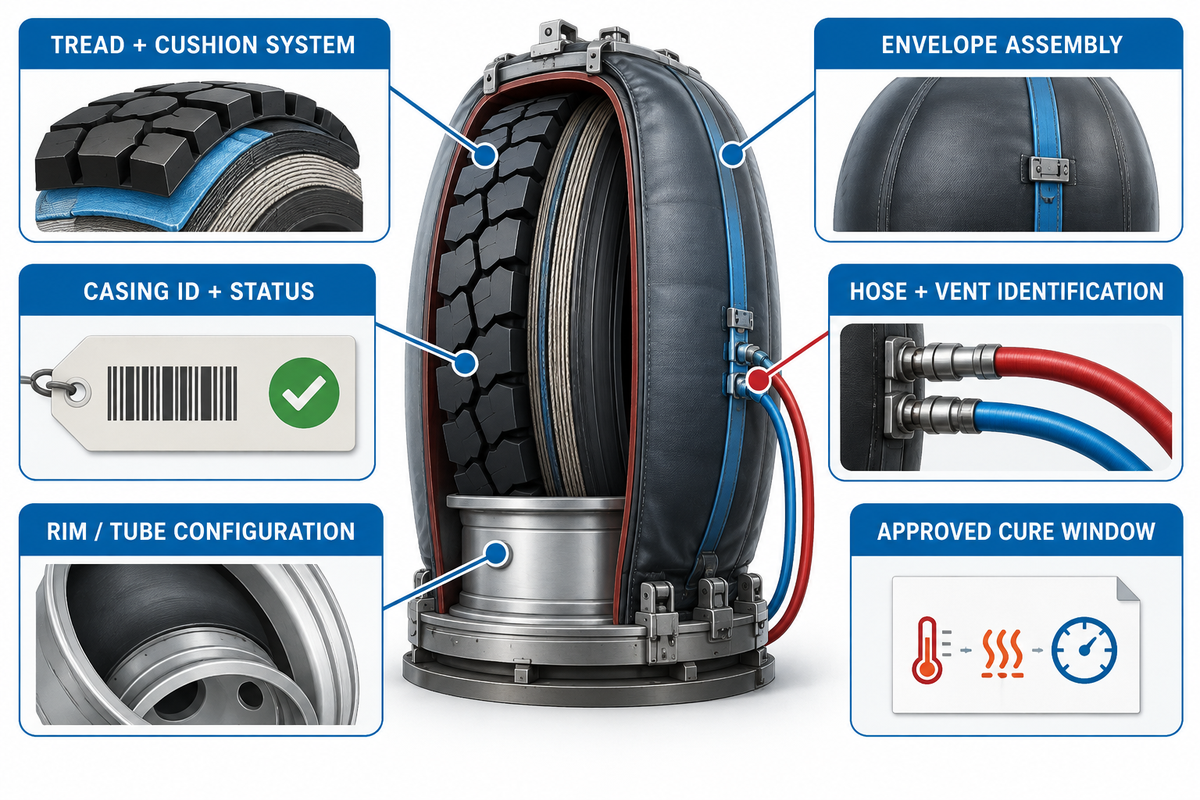
What do the envelope, curing tube, rim, and vent path do?
The chamber, tire, envelope, rim or tube, hoses, vent path, cushion gum, cement, and precured tread combine to form a curing system. The TIA practice states that four basic curing methods are described and advises retreaders to follow the recommendations of the equipment and material manufacturers for time, temperature, pressure and proper use of envelopes, tubes and rims. Therefore, a recipe found on the Internet isn’t a specification.
Some catalogs use terms such as tyre curing chamber, curing machine, retread machine, or vulcanizing tank. Verify the physical process instead of purchasing by the label. A listing of a cold retreading machine may describe only one item in a larger retreading equipment production line, not the complete set needed to inspect, buff, build, envelop, cure, demount, and release a tyre retread.
The special equipment around the chamber is part of the interface review. Ask how the machine uses each vacuum, vent, pressure and data connection. If a catalog markets a cold tire retreading machine or a generic tire retreading machine, require the supplier to separate the included equipment from plant supplied utilities and upstream machines.
The outer envelope helps apply pressure around the built tire and isolates the bond area. Depending on the method, an inner curing tube and approved rim may support and pressurize the tire. Other arrangements use different relationships to provide pressure. Connections must be identified and routed so the intended vacuum, venting, or pressure sequence can occur without cross-connection.
Why must the material cure windows stay compatible?
Cure Assembly Compatibility Card
- Tire and casing size range, condition, repair status, and unique ID.
- Precured tread, cushion gum, cement, and material lot/revision
- Envelope type, size, condition, seal, and assembly ID
- A rim, tube, rimless, or module configuration, as approved for the method.
- Hose, valve, coupler, vent, exhaust, and pressure-channel identification
- Compatible material cure windows and the authority that approved the recipe.
How should envelope leaks and connections be checked?
Inspect the envelope for damage, fit and sealing condition. Confirm the continuity of the vents and use the approved leak test method for the system. Record the tire, assembly, hose, and rack position before the door closes. A leak found after cure wastes more than cycle time; it brings the team to review what connections, material lots and assemblies were used.
Don’t try to determine defect cause by appearance alone. Air at a bonding interface may be related to many factors including casing condition, surface preparation, material handling, stitching, envelope sealing, venting, pressure control, or process variables. The purpose of the record is to refine the search without promoting one symptom to the status of an unsupported diagnosis.
Size Capacity From the Load, Not the Shell Label
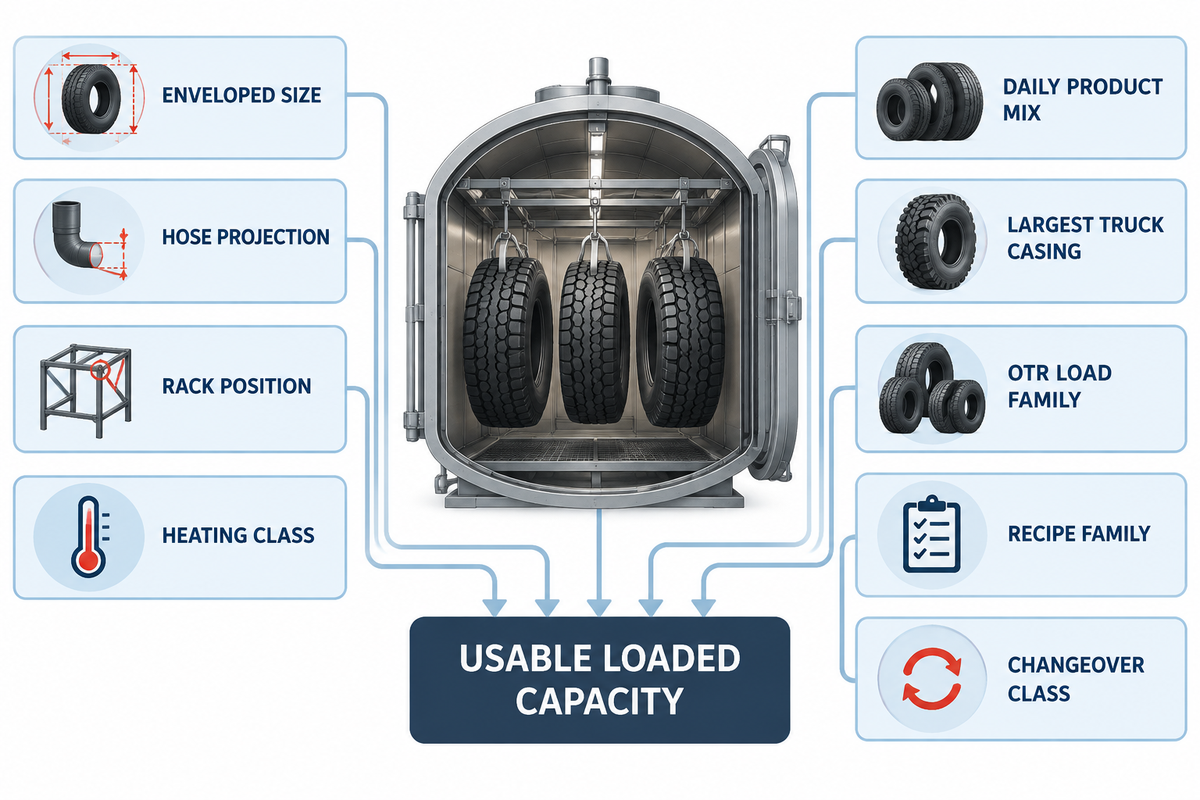
Load-to-Chamber Capacity Worksheet
Which tire dimensions control usable chamber capacity?
The internal diameter and length of the chamber are key inputs, but don’t directly correlate to usable capacity. A tire assembly grows into a curing assembly: The envelope defines the geometry, and valves and connections project from the side. Racks and monorails occupy space, and circulation requires clear paths. Door clearance, allowable loading mass, connection access, and the plant’s handling method reduce the theoretical packing volume.
Start with the largest and most frequent products and build a worksheet representative of a mixed load. Ask “How many assemblies fit?” and “In what position do the assemblies fit?” and “Which combinations share a validated recipe?” and “How was the slowest-heating position established?”
How should mixed truck and OTR loads be planned?
| ID | Load category | Why it changes capacity | Evidence to request |
|---|---|---|---|
| 1 | Enveloped OD and width | Defines the real load envelope | Measured representative assembly |
| 2 | Valve and hose projection | Requires clearance and service access | Connection drawing and load photo |
| 3 | Rack or monorail position | Controls spacing, handling, and airflow | Numbered load map |
| 4 | Material and heating class | May prevent unlike products sharing a recipe | Material supplier approval |
| 5 | Daily product mix | Determines changeovers and partial loads | SKU and demand table |
| 6 | Largest used truck casing | Sets a truck tire retreading boundary | Measured assembly and handling trial |
| 7 | OTR load family | May need distinct spacing and handling | Separate load map and heat study |
| 8 | Recipe family | Prevents incompatible materials sharing a load | Approved material matrix |
| 9 | Changeover class | Adds connection, rack, or setup time | Observed changeover study |
How do warm-up, handling, and changeover affect daily output?
A planning model may state: The number of tires accepted per shift = number of tires per load validated × number of completed loads per shift × first pass yield. To estimate daily accepted output, multiply that result by the scheduled shifts per day. To calculate completed loads, consider the total occupied cycle: loading, warm-up, effective cure hold, controlled depressurization or cooling, unloading, inspection transfer, and changeover; do not divide shift minutes by cure hold alone.
This formula is a worksheet, not a capacity guarantee. Inputs must be from your product mix, material system, utilities, handling study, heat study, approved recipe, and acceptance results. If truck and OTR assemblies have significantly different sizes or cure windows, model them as separate load families before considering a shared chamber.
Nominal counts for tire retread machines aren’t interchangeable for retreading production. Retreaded tires can differ in envelope geometry despite having a similar rim description. A long service life claim for an envelope or chamber component also does not increase validated load capacity; maintenance condition and the demonstrated load still control.
Control and Record the Cure Cycle
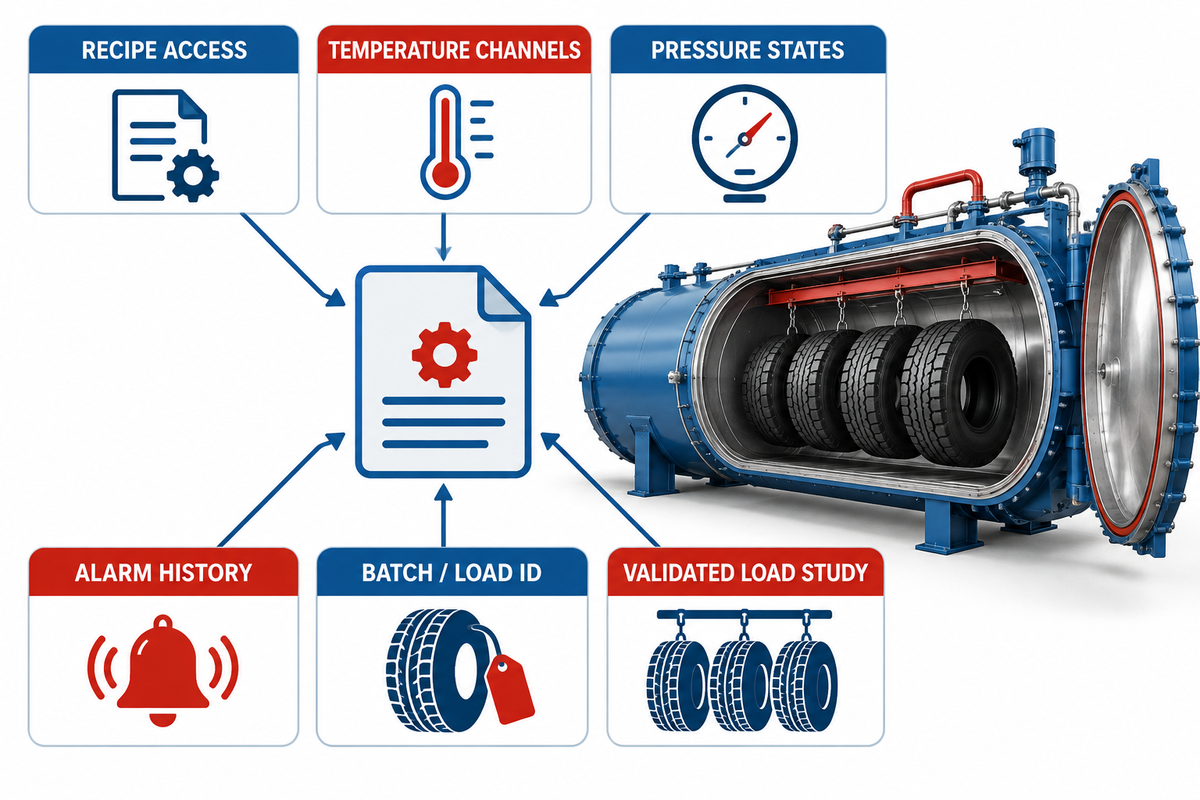
Cure Evidence Pack
Why separate warm-up from effective cure time?
A display of chamber temperature can be air temperature and the tire assembly may still be warming up. For that reason, “cycle time” should not be treated as one undifferentiated number. Set conditions for the end of loading and the start of warm up. Define what starts the effective cure hold, how the hold is measured, and what allows depressurization and unloading.
Tire curing alters the uncured bonding layer to the vulcanized state, but the word vulcanizing doesn’t define a recipe. Likewise, “high efficiency autoclave” is a marketing phrase until the supplier states the load basis, utility boundary, measurement method, and accepted result. Compare energy and throughput only for the same pre-cured assembly and production duty.
TIA’s retread heat and thermocouple guidance calls for a chamber heat study and thermocouple test, and identifies equipment or process changes that can require new testing. Copying a time and temperature from a supplier page and pasting it on a purchase order isn’t as strong a basis.
Which heating medium fits the facility and assembly?
Heating with steam and electrical/indirect heating can both be engineered for tire retreading service. Compare the two options based on the site’s actual steam quality, condensate system, electrical supply, circulation design, control response, maintenance capability, energy metering and validation. A universal efficiency winner can’t be established without these parameters.
A high-temperature capability doesn’t mean a material can or should be run at higher temperatures. Temperature range, working setpoint, uniformity, ramp behavior, and the approved cure window are different facts. The equipment for measurement must be calibrated and identified, and the loaded study should show where the slowest heating assembly is located.
Cure Evidence Pack
Record the batch/load ID; tire and casing IDs; material lots; assembly method; recipe and revision; chamber and representative-load temperature channels; chamber and tire/envelope pressure states where applicable; warm-up, hold, depressurization, and cooling events; alarms; operator interventions; deviations; final inspection; and disposition. Modify the list to the approved process and jurisdiction.
Which channels and events belong in a defensible record?
Recipe access should be controlled. The record should show who selected or changed the recipe and which revision ran. Sensor calibration status, time synchronization, alarm history, and data export matter because a graph without channel identity or load context is difficult to investigate later.
Trace Defects Back to Process Evidence
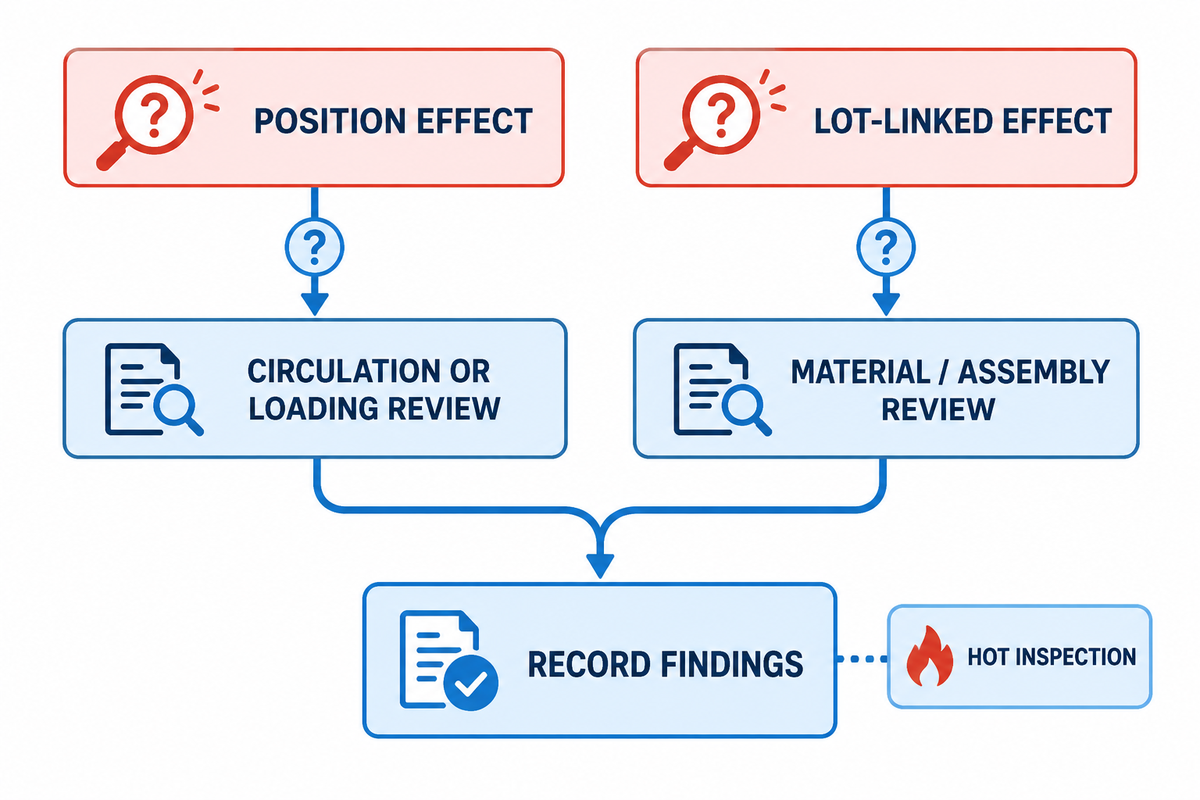
Defect-to-Record Trace
Which checks happen while the tire is still hot?
Final inspection completes the Casing-to-Cure Evidence Chain. The TIA practice calls for checking the tire and chamber after cure and includes inspection while the tire is still hot. Your exact acceptance criteria are to be determined from the approved retreading system, material suppliers, customer requirements, and applicable regulations.
| Observation | Records to review | Do not assume |
|---|---|---|
| Irregular cushion flow or tread edge | Build record, material lots, stitching, assembly, load position, heat and pressure trace | That chamber temperature alone caused it |
| Suspected trapped air | Casing inspection, repair, surface preparation, envelope leak test, vent path, connections, pressure sequence | That one visible blister identifies the root cause |
| Adhesion concern | Material compatibility, storage, preparation, recipe revision, loaded temperature evidence, deviations | That more time or temperature is automatically corrective |
What can cushion flow and tread-edge appearance tell you?
Cushion flow and tread-edge appearance are inspection observations and not stand-alone diagnoses. Consider build record, material lots, stitching, assembly conditions, load position, heat trace and pressure records before arriving at any conclusion.
How should trapped air or adhesion issues be investigated?
Trend findings by load family, rack position, material lot, operator and recipe revision are to be considered. A repeated position effect points the investigation toward circulation or loading. A lot-linked effect points elsewhere. Record findings don’t replace expert judgment and maintain a facts first approach to the investigation.
Prove the Machine at FAT and in the RFQ
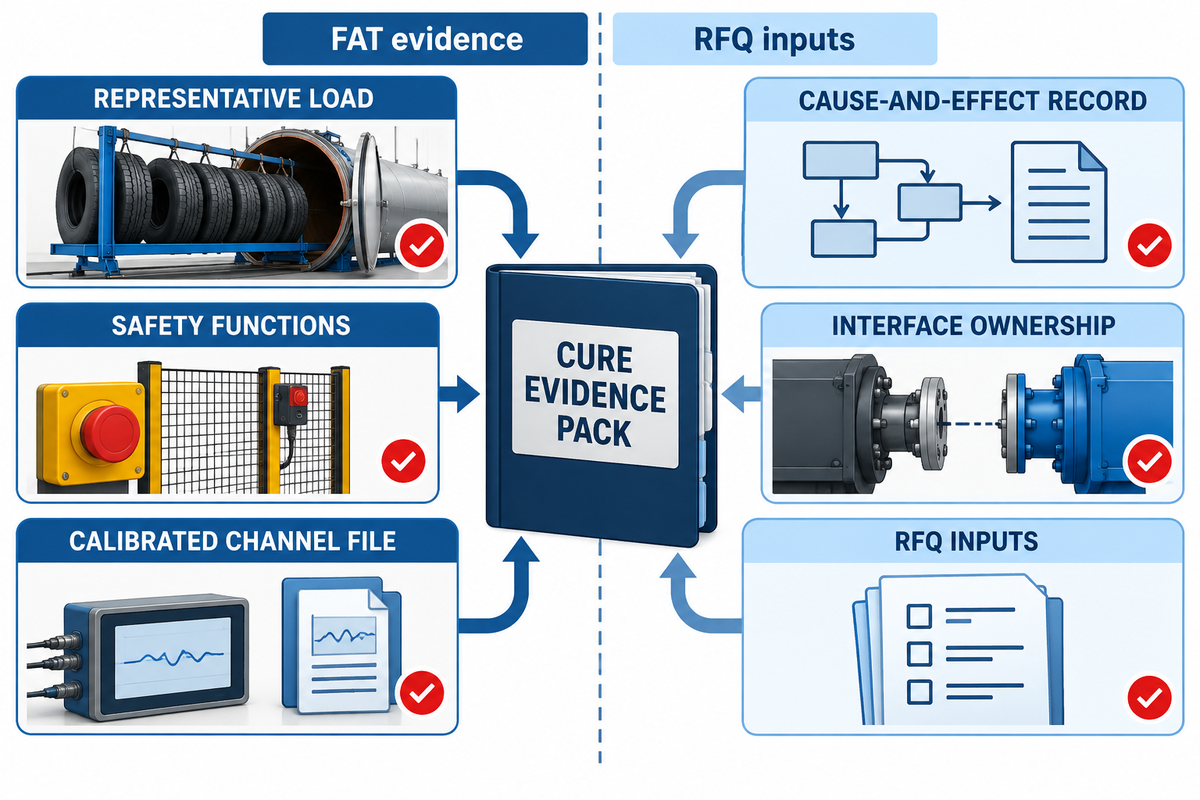
What should a representative FAT load contain?
A no-load run can demonstrate basic controls and interlocks, but it cannot prove the chamber’s behavior with your tire assemblies. Define a representative FAT load before the order is placed. The FAT load should include the largest assembly, the most common mixed load, critical connections, and all product families that create a distinct heating or handling challenge.
| FAT area | Demonstration | Acceptance evidence |
|---|---|---|
| Representative load | Agreed assemblies fit, connect, load, and unload safely | Numbered load map, photos, dimensions, mass |
| Thermal behavior | Defined sensor plan captures heating across critical positions | Calibrated channel file and reviewed trace |
| Pressure and connections | Required chamber and assembly states follow the approved sequence | Channel IDs, sequence, alarms, leak-test record |
| Safety | Door, residual pressure, overpressure, overtemperature, emergency stop, and controlled recovery | Cause-and-effect record and signed exceptions |
| Data integrity | Recipe, users, alarms, trends, export, and time stamps remain traceable | Exported sample batch and access matrix |
Which safety functions must be demonstrated?
Demonstrate the agreed door, residual pressure, over pressure, over temperature, emergency stop, alarm and controlled recovery functions as described in the approved test plan. For each exception describe the initiating event, expected response, observed response, reset authority, and disposition.
What belongs in the RFQ and document pack?
Send the tire and casing mix, enveloped dimensions, batch combinations, target accepted output, curing assembly method, material supplier requirements, utility limits, plant elevation and ambient basis where relevant, loading layout, pressure-vessel code basis, electrical requirements, control and data expectations, FAT/SAT scope, document language, calibration records, manuals, spares, training, and service boundary.
Also indicate equipment provided by others, tyre buffing machine, tread building Station, extruder machine, envelope expander, monorail, pressure connections, or hydraulic Handling equipment. A truck tyre retreading machine package may use several suppliers. Interface ownership is more relevant than whether a catalog classifies the package as a tire retreading machine, tyre retread machine or curing chamber autoclave machine.
Review the scope of 49 CFR 571.117 for U.S. projects with retreaded pneumatic passenger-car tires. Also, independently assess if the identification and recordkeeping provisions of 49 CFR Part 574 apply to the operation. These are scoped checkpoints and not a complete compliance opinion for truck or OTR production. Confirm the applicable tire, vehicle, labeling, recordkeeping, pressure vessel, electrical, and workplace rules for the destination and date of supply.
Turn your tire mix into a testable chamber specification
Send Taiguo Boiler your enveloped tire dimensions, daily product mix, curing assembly, material cure requirements, utilities, destination code basis, and required cycle records. The team can use these to review a chamber configuration and define the questions that must be resolved to provide a quotation.
Frequently Asked Questions
Is an autoclave required for every tire retreading process?
No. A pressure curing chamber is mainly associated with the pre-cure route, where already-patterned tread is bonded to a prepared casing through an uncured cushion layer. Mold-cure retreading uses a different tooling and curing route. Decide the process, material system, tire range, and required tooling before selecting the chamber; the presence of an autoclave doesn’t make the two routes interchangeable.
What temperature and pressure should a tire retreading autoclave use?
There’s no safe universal setting. The approved values and sequence depend on the tread and cushion system, cement, casing and repairs, envelope/rim or tube arrangement, tire size, load, equipment limits, and validated heat study. Follow the material and equipment manufacturers’ instructions, then document the loaded recipe and acceptance basis. Don’t convert an online example into a plant recipe.
How many tires fit in one curing chamber?
Count only after defining the enveloped outside diameter and width, valve and hose projections, minimum spacing, loading rack, door clearance, allowable mass, circulation path, and compatible mixed-load recipe. Two chambers with similar shell dimensions can have different usable loads. Require a numbered load drawing and demonstrate the representative arrangement during acceptance testing.
Can truck and OTR tires share one autoclave?
They may share a chamber only when the usable geometry, handling system, pressure arrangement, heating and circulation, material windows, control recipes, and validation plan cover both families. Large OTR assemblies can create different access and heating challenges. Treat truck and OTR products as separate load families first; combine them only after compatibility and loaded evidence have been reviewed. Ask the supplier to mark the largest assembly, connection clearance, rack position, sensor plan, and recipe family on separate drawings. If the products can’t share a validated cure window, plan independent loads even when both fit inside the shell. The FAT should demonstrate the agreed representative load for each family rather than extrapolate from an empty run or a smaller truck-tire batch.
What should a buyer send for an accurate quotation?
Provide the tire size and daily mix, enveloped assembly dimensions, loading method, curing arrangement, material supplier requirements, approved cure windows, target accepted output, utilities, plant conditions, destination code basis, data-record needs, and FAT/SAT expectations. A supplier can evaluate configuration more reliably when the request describes the real load and proof obligations instead of only a chamber diameter.