Get in Touch with Taiguo

Biomass Fired Boiler: Industrial Buyer’s Guide


Contents
show
Biomass Fired Boiler: What Every Industrial Buyer Needs to Know
Last updated: April 2026 | Reviewed by Taiguo boiler Engineering Team
When a biomass fired boiler is installed in an industrial facility, this is often a capital investment that impacts fuel costs, emission compliance and operating flexibility for many years. In 2024 the global $13.4 billion biomass boiler industry grew at 8.4% CAGR and more manufacturers are swapping out fossil fuel systems for biomass combustion technology. This guide directs industrial buyers through combustion technologies, fuel choice and costs, emission regulations and sizing methodology so the procurement decision is based on engineering data – not a brochure from the sales team.
Quick Specs
| Steam Capacity | 0.5 – 120 t/h |
| Hot Water Output | 0.7 – 28 MW |
| Thermal Efficiency | 82 – 92% |
| Working Pressure | 0.7 – 9.8 MPa |
| Accepted Fuels | Wood chips, pellets, rice husk, bagasse, sawdust, palm kernel shell, agricultural residues |
| Emission Control | Cyclone, baghouse filter, SCR/SNCR, electrostatic precipitator |
| Certifications | ASME, CE, ISO 9001 |
What Is a Biomass Fired Boiler and How Does It Work?
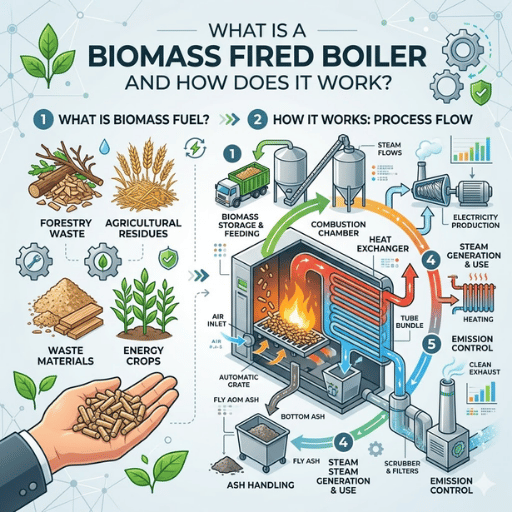
A biomass fired boiler is a thermal system that burns organic matter — wood chips, pellets, agricultural waste and other plant-based fuels — to produce heat that is used to generate steam or hot water. Unlike fossil fuel boilers that run on limited stocks of coal, petrol or natural gas a biomass boiler is fuel-neutral as the energy source renewable energy is either regrown, harvested or cultivated by humans.
There are four distinct phases that form the combustion cycle. During the first phase, fuel transfers into the combustion chamber via a mechanical supply system – screw conveyors for pellets and hydraulic pushers for larger wood chips. Second, the fuel ignites on the grate or in a fluidized bed where biomass is burned at specific temperatures. Third, hot gases pass through a fire tube or water tube heat exchanger to transfer heat energy to the boiler water. Fourth, the boiler water has achieved its appropriate operating temperature in to the outlet as steam or hot water and whatever other plant systems are required to take this energy and use it for productive means.
📐 Engineering Note
combustion working temperatures are as a function of technology, grate fired boilers range from 800-1,000 C whilst fluidised bed systems operate at a lower temperature of 800-900 C and have a uniform temperature profile to prevent high ash fusion associated with rice husk. In addition, the lower operating temperature minimizes NOx creation.
As biomass energy is regarded as self-absorbing – the CO2 released during combustion is offset by the CO2 absorbed during regrowth – these systems are functioning adequately with respect to the industry’s decarbonisation directives. If you wish to research more about the combustion process, then read our article on how a biomass fired boiler works. Alternatively, examine the prominent components of a biomass boiler in terms of hardware.
Biomass Boiler Combustion Technologies Compared

Choosing a biomass combustion technology influences efficiency, fuel versatility and running demands of the system for its working life. There are three well-recognised biomass combustion options in the industrial production environment according to capacity and fuel characteristics.
| Parameter | Grate Combustion | Fluidized Bed (BFB/CFB) | Gasification |
|---|---|---|---|
| Capacity Range | 0.5 – 30 t/h | 10 – 300+ t/h | 0.5 – 10 t/h |
| Efficiency | 80 – 88% | 85 – 92% | 80 – 90% |
| Fuel Flexibility | Moderate — works best with uniform chip/pellet sizes | High — tolerates mixed fuels, high-ash, and high-moisture | Low — requires dry, uniform feedstock |
| Ash Handling | Bottom ash removal (manual or automatic) | Continuous bed ash + fly ash collection | Minimal ash production |
| Best Application | Small-to-medium industrial steam | Large-scale power + CHP | Combined heat and power (CHP) below 10 MW |
Grate combustion (chain grate, Moving grate, fixed grate) accounts the most significant level of installations for ratings up to 30 t/h. biomass fuel transfers through the grate and thus provides primary and secondary air distribution that results in complete combustion. The quality of modern biomass grate produced by 1st tier manufacturers is defined as high efficiency (OSU scores 80-88%) with a clean track record of performance.
Fluidized bed combustion (BFB and CFB) suspends fuel particles in a bed of hot sand or limestone. Be even better at mixing to give improved combustion uniformity. This technology has the advantage in dealing with challenging fuels – high ash rice husk, wet bark, mixed agricultural residue -and can be scaled to utility level capacity (> 100 t/h). IEA Bioenergy Task 32 reported lowest emission levels in CFB fires in conjunction with SNCR or SCR systems.
Gasification converts biomass into syngas before the burner stage ignites it to generate heat. This approach is economically feasible when combined with combined heat and power systems that produce steam and electricity simultaneously.
“The fuel handling system – not the combustion chamber – is typically the component that determines long-term reliability. I have seen well-designed fireboxes undermined by conveyors that jam on oversized chips or bridging in wet-fuel storage silos.”
— Senior biomass process engineer, 14 years of boiler system design experience
How Does a Biomass Fired Boiler Compare to Traditional Fossil Fuel Boilers?
There are fundamental differences. A biomass fired boiler will be using renewable feedstock which is priced on the basis of local supply rather than global markets, insulating it from the serious price fluctuation that affect natural gas and diesel. emissions are biogenic CO2 — carbon taken up as part of the natural carbon cycle while fossil fuels will be releasing sequestered carbon contributing to the net greenhouse gases in the atmosphere. One compromise is that biomass systems need greater fuel storage space and dedicated feedstock handling and conveyor systems and ash handling systems that fossil fuel boilers do not.
Biomass Fuel Types and Their Impact on Boiler Performance
The fuel you choose affects its efficiency, frequency of maintenance, and emission production directly. Getting to know your biomass fuel before production begins can avoid unwanted problems.
| Fuel Type | GCV (MJ/kg) | Moisture (%) | Ash (%) | Bulk Density (kg/m³) | Best Application |
|---|---|---|---|---|---|
| Wood Pellets | 17–20 | 6–10 | 0.5–1.5 | 600–700 | Fully automated systems |
| Wood Chips | 8–16 | 20–50 | 1–3 | 200–350 | Large grate boilers |
| Rice Husk | 13–15 | 8–12 | 15–20 | 100–150 | Rice mill CHP |
| Bagasse | 7–10 | 45–55 | 1–3 | 120–150 | Sugar mill CHP |
| Sawdust | 10–18 | 10–50 | 0.5–2 | 150–250 | Wood processing industry |
| Palm Kernel Shell | 16–18 | 10–15 | 3–5 | 500–600 | Palm oil mills |
| Agricultural Straw | 14–17 | 10–20 | 5–10 | 60–120 | Farm operations |
| Sewage Sludge | 4–10 | 60–80 | 30–50 | 700–1,000 | Waste treatment plants |
Information from Penn State Extension study on fuel properties as well as IEA Bioenergy Task 32 reports.
Many operators grossly underestimate the impact of moisture content on real world efficiency. Industry practitioners report that even 10 percentage points greater moisture can have a 4-6 point impact on boiler efficiency, dropping the actual from 88% to 82%. Extra energy must be used to evaporate the water before all combustion can occur and reduced the flame temperature in a combustion chamber.
📐 Engineering Note
When selecting fuel sources ask for both proximate (moisture, volatile, fixed carbon, ash) and ultimate (C, H, O, N, S) analyses from your vendor. Both tests should be less than a two-hundred dollar expenditure. Biomass with high sulfur and/or high chlorine (some types of agricultural straw) can also result in superheater tube corrosion if the boiler has not been selected with appropriate alloys.
Wood pellets represent the most energy dense and lowest ash props of any fuels and are ideal for high capacity fully automated biomass boiler systems at implementation in city centers or space constrained facilities. wood chips and sawdust are the most affordable types of wood industry waste. Rice husk and bagasse are typically free resources at mills that produce them. Read more about matching fuels to equipment in our guides on biomass fuel types, properties and specifications, wood chip boiler regrind systems, and palm kernel shell boiler systems.
Industrial Applications — Matching Biomass Boilers to Your Industry

biomass boilers power plants in food processing, paper, textiles and wood manufacturing – yet each industry has different steam properties, fuel handling needs and automation levels. Here is a table of suggested boiler configurations used in various industries.
| Industry | Steam Need | Pressure | Recommended Fuel | Boiler Type |
|---|---|---|---|---|
| Food & Beverage | Sterilization, cooking | 0.7–1.25 MPa | Wood pellets, chips | DZL / SZL |
| Paper & Pulp | Process steam | 1.6–3.8 MPa | Wood waste, bark | SZL |
| Textile | Dyeing, finishing | 0.7–1.25 MPa | Wood pellets | DZL |
| Wood Products | Kiln drying | 0.7–1.0 MPa | Own sawdust/waste | DZH / DZL |
| Sugar Mills | CHP cogeneration | 2.5–4.5 MPa | Bagasse | SZL / CFB |
| District Heating | Hot water supply | 0.7–1.6 MPa | Chips, pellets | SZL |
| Power Generation | Electricity via turbine | 2.5–9.8 MPa | Various | CFB / SZL |
Scenario: Furniture factory in Southeast Asia. An 80 worker cabinetmaker in Vietnam produces 8 tpd of sawdust and wood offcuts. The factory avoided disposal costs and installed a 6 t/h DZL grate-fired biomass boiler that burns its own fuel in order to produce process steam for pressing kitchen veneers and kiln drying. The fuel cost dropped to near zero, and the payback was less than three years. This “waste-to-steam” example is one of the most compelling economic reasons to use biomass with wood industry clients.
“Industry specialists say that standing idle, a biomass boiler produces clinker as well as higher thermal cycling stress. Running two small models at partial load than one large one with running standby typically yields savings in both operating expense and in maintenance over 10-year periods.”
— Biomass plant operations advisor, pulp & paper sector
For industry specific recommendations, see our guides to steam boilers for food processing, steam boilers for textile dyeing, and choosing a biomass steam boiler for a textile mill.
Biomass Boiler Cost, ROI, and Financial Incentives
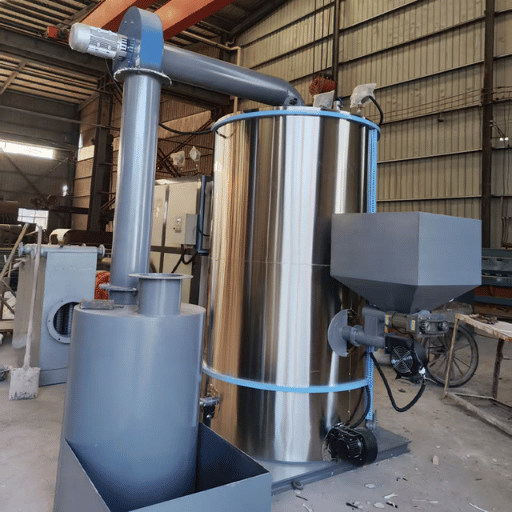
Uncontrolled capital costs for industrial biomass boilers can range extensively, depending on cubic capacities, combustion technology, emission control needs and degree of automation desired. As a rapidly growing market that will be worth an expected $26 billion (USD) by 2032, and experiencing an 8.4 % CAGR, biomass boiler technology is a hot emerging industry.
What Are the Costs Associated with Installing a Biomass Fired Boiler?
Refurbished system capital cost includes the boiler unit itself, other handling infrastructure, emission control equipment, civil infrastructure, installation and commissioning. For a typical 10 t/h grate-fired system, the boiler will count for 50-60 % of total project cost, with fuel handling and storage comprising 15-25 %, and emission control one-fifth. Buyers who pre finance only the boiler are often upset by subsequent costs.
| Cost Factor | Biomass Boiler | Natural Gas Boiler | Diesel Boiler |
|---|---|---|---|
| Initial Capital Cost | Higher (1.5–3× gas) | Baseline | Low–Medium |
| Fuel Cost per GJ | $2–6 | $6–14 | $12–22 |
| Fuel Price Volatility | Low (local supply) | High (global commodity) | High (oil markets) |
| Maintenance Costs | Higher (ash, fuel handling) | Lower | Medium |
| Carbon Tax Exposure | None (biogenic CO2) | Increasing | Increasing |
Recycling from fossil fuel to biomass has a 4-7 year payback period, depending on fuel cost savings, incentive programs and climate credit revenue. Mills producing their own biomass waste (sawmills, rice mills, sugar mills) typically have a 2-3 year payback as their fuel cost approaches zero.
Financial incentives also speed up ROI. Installation of renewable energy equipment is financially supported by the US Investment Tax Credit (ITC). EU incentives include the Renewable Heat Incentive, and the emissions Trading System. Duty free import of biomass energy production equipment is supported by many developing countries. Our team recommends consulting with local energy agencies before finalizing your budget – incentives for renewable energy included, can make your project cost effective, reducing costs (15–30%).
💡 Pro Tip
Factor fuel storage and logistics infrastructure into your budget from the start. For wood chips and agricultural biomass, covered storage with a moving-floor discharge system can add significantly to the cost of the project (15–25%) but prevent moisture-related reduction in fuel calorific value which would otherwise decrease the efficiency of you boiler.
For specific project costs based on capacity and configuration, refer to our industrial biomass boiler cost guide, or use the boiler operating cost calculator to project savings for your specific scenario.
Emission Standards and Environmental Compliance

Operational considerations for an industrial biomass boiler include navigating emission regulations that vary by country, by state or province, and even by facility size. Having your plant in compliance with emission policies is critical, as penalties and loss of operation permits can be assessed if you do not!
How Do I Ensure Compliance with Emissions Regulations When Operating a Biomass Fired Boiler?
Start by determining which regulatory environment applies to your installation. In the United States, federal emission regulation is centered on the EPA’s boiler MACT rule. Major sources fall in 40 CFR 63 Subpart DDDDD, and smaller area sources (such as forests and farms) are held to standards in 40 CFR 63 Subpart JJJJJJ. In the European Union, the Industrial Emissions Directive 2010/75/EU sets technical standards for plants.
| Parameter | US EPA (Major Source) | EU IED BAT-AEL | Typical Developing Market |
|---|---|---|---|
| PM (mg/Nm³) | 25–80 | 5–20 | 50–150 |
| NOx (mg/Nm³) | Varies by subcategory | 150–300 | 200–400 |
| SO2 (mg/Nm³) | Fuel-dependent limits | 35–200 | 100–400 |
| CO (mg/Nm³) | Tune-up requirement | 150–250 | Often unregulated |
Based on the pollutant to control (select from as shown below), and your regulatory environment, controls are selected based on efficiency and cost:
- Multi-cyclone separators remove 75-85% of particulate pollutants at low cost. Standard on most industrial biomass boilers, and are partnered with a secondary burner stage.
- Fabric filters and baghouses remove >99% of particulate pollutants. A necessary control to meet stringent EU BAT-AEL limits. Accordingly, requires replacement when full of particulates.
- Electrostatic precipitators (ESP)deliver efficiency, especially on high-volume power plants and large industrial utilities. Generally higher capital cost, but lower lifetime operating costs.
- Control of Nitrogen Oxides may be achieved via the electrostatic precipitators outlined above, with the addition of SCR or SNCR flue-gas removal systems. SNCR systems (which require injection of Urea) are generally simpler, and cheaper, while SCR systems require catalyst management, but can result in even lower emission levels.
Consider the argument for carbon neutrality. biomass combustion releases CO2, but the biomass resources used as fuel were grown using recent photosynthesis. This means the biogenic carbon has already cycled through the atmosphere, and burning biomass adds no net greenhouse gases. One important catch: this carbon-neutral credit can only be claimed if the fuel comes from sustainably harvested biomass resources, verified by a chain-of-custody process.
✔ Compliance checklist for biomass boiler operators:
- Identify your regulatory jurisdiction and applicable emission limits
- Commission stack emission testing during commissioning and annually thereafter
- Install continuous emission monitoring systems (CEMS) if applicable to your permit.
- Keep fuel-quality records (moisture, ash content, source) for regulation audits.
- Trace biomass fuel sources to justify claimed reduced emissions.
- Schedule emission control equipment maintenance per manufacturer recommendations
For a more detailed breakdown of LD regulations by area and boiler class, see our guidelines on industrial boiler emission standards.
How to Choose the Right Biomass Fired Boiler for Your Operation

Drawing on the engineering data from the previous sections, the selection proceeds through a logical five step process. Each step reduces the possible number of choices until you determine one boiler model and configuration.
Step 1: Quantify your transfer value. Find the maximum and mean tonnage/h of steam or MW of hotwater of the loads. Consider seasonal affects -a district heating scheme will show significant differences between summer and winter loads, while a food processing plant will operate 24/7 with little change.
Step 2. Determine the availability of your local biomass fuel. Question fuel sources around 50-100 km away.
The distance of your initial supplier needs to be less than this because transportation costs would negates the economic benefits in biomass in relation to natural gas. Seek alternatives for your fuel should your primary source not be available, seasonally.
Step 3. combustion technology to the fuel: reference the comparison table in the combustion technologies section above: single fuel (chips, pellets, shells) and clean, uniform fuel will suit grate technologies, while mixed fuel or high ash will lean towards fluidized bed.
4. What is your automation level?
Manual stoking is feasible for very small batch set-ups (< 1 t/h). Semi-automatic with mechanical grates can work 1-6 t/h. PLC-controlled fully automatic with automatic fuel feed, ash removal and combustion optimization is the norm above 6 t/h and obligatory for unattended operation.
Step 5: Emission compliance checks. Compare the emission control package with applicable limits listed in the emission section above. Over-specification wastes capital; under-specification risks permit denial.
⚠️ The Biomass Boiler Selection Matrix
Use this decision tree to narrow your search:
- batch operation DZH manual or semi-automatic grate or LHG vertical boiler
- 4-30 t/h, operation continue DZL chain grate (single drum, proven workhorse)
- >30 t/h, heavy duty or CHP SZL double-drum water tube or CFB for difficult fuels
Each route assumes standard biomass fuels. Non-standard feedstocks (sewage, sludge, fine emissions, mixed municipal waste) require in depth engineering perspective for each project.
For a detailed walk-through of each of these aspects, please see our articles on biomass boiler selection criteria and the biomass boiler sizing guide.
Frequently Asked Questions
Q: What is a biomass fired boiler?
View Answer
A biomass fired boiler is an industrial heating system burning organic or carbon based compounds like the wood chips, pellets, agricultural waste to produce steam or hot water for process heating, power generation or space heating.
Q: How do biomass boilers work?
View Answer
Biomass fuel is fed into a combustion chamber where it is burned under controlled air supply. The heat from combustion passes through a heat exchanger, where it transfers thermal energy to water. Depending on the system design, the water is converted to produce steam at a specified pressure or heated as hot water. The combustion process is managed by automatic controls that regulate fuel feed rate, air-to-fuel ratio, and operating temperature to maintain target efficiency.
Q: What types of biomass fuel can be used in industrial biomass boilers?
View Answer
Common fuel types include wood pellets, wood chips, sawdust, rice husk, bagasse (sugarcane residue), palm kernel shell, agricultural straw, and dedicated energy crops. The best fuel choice depends on local availability, moisture content, ash characteristics, and your boiler’s combustion technology.
Q: What are the maintenance requirements for biomass fired boilers?
View Answer
Basic operation routines include daily ash removal (manual or automatic), weekly visual inspection of grate condition and fuel feed components, monthly cleaning of heat exchanger surfaces to clean soot deposits, and annual testing of tube wall thickness and calibration of safety relays. biomass boilers demand more maintenance than gas fired units since the solid fuel combustion deposits ash and particulate residue on heat transfer surfaces and in emission control equipment.
Q: Can biomass boilers be integrated with existing heating systems?
View Answer
Yes. biomass boilers can be integrated into existing steam headers or hot water distribution loops. Often a facilities install a biomass as lead boiler and retain a legacy gas or diesel boiler for peak demand backup.
Q: How do I determine the right size biomass boiler for my industrial operation?
View Answer
Begin by performing a thermal load audit: determine maximum steam demand in t/h or hot water demand in MW as well as your typical running load. Allow for a 10-15% increase to account for future growth. Select a boiler series that on the basis of heat load capacity, i.e., a DZH or LHG unit under 4 t/h, DZL from 4-30 t/h, SZL use over 30 t/h.
About This Guide
This was compiled and validated by the Taiguo Boiler engineering team which has fifty years of experience designing and manufacturing industrial boiler and has executed more than 5,000 installations in well over 100 countries. Our goal is to establish a technical knowledge perspective for industrial consumers seeking an objective basis for comparing biomass combustion and alternate fuels, not a recommendation of any specific product line. References to Taiguo models are made solely as specific illustrations of broad equipment classifications.
References & Sources
- 40 CFR 63 Subpart DDDDD — U.S. EPA National Emission Standards for Industrial Boilers
- Characteristics of Biomass as a Heating Fuel — Penn State Extension
- Low Emission Biomass Combustion Report (2024) — IEA Bioenergy Task 32
- Biomass Boiler Market Size Report (2025) — GM Insights
- EU Industrial Emissions Directive 2010/75/EU — European Parliament
Related Articles
Reviewed by the Taiguo Boiler engineering team from fifty years of experience designing and manufacturing industrial boiler in over 100 countries.