
Get in Touch with Taiguo


Updated July 2026.
An aerospace autoclave is a pressure-vessel heated-enclosure that cures lightweight composite aircraft parts using a specific thermal and pressure profile. Visually it may resemble the big steel cylinders you might associate with surgical sterile processing (in fact they have nearly no overlap).
Key Takeaways
- The pressure-vessel code stamp (ASME) is not the same thing as process certification (AS9100 + Nadcap) that qualifies a supplier for processing parts – buyer’s literature (and manufacturer marketing pages) often miss this distinction.
- Common temperature and pressure operating range for aerospace composite processing is 120 to 180C and 70 to 300 psi, up to 390C for certain thermoplastic systems.
- Autoclave chambers range from ~1 meter up to 8 meters+ in diameter across the available equipment- some aircraft parts already exceed even the largest of the standard units available on the market.
- Out-of-autoclave (OOA) processing is an available process alternative to the autoclave, at times it is even the required solution.
While the majority of autoclaves sold globally go to the aerospace sector for curing composite components — the autoclave for composite parts is, in that market, the dominant equipment class — other applications in aerospace, automotive, and motorsports all run similar high-pressure, high-temperature processing for composite parts. In this guide to autoclave composite processing, we will walk through how autoclaves work, common ranges for pressure and temperature, the criteria that buyers use to size their equipment for specific parts, and-crucially, and a point most competitor pages skip-the two separate sets of requirements: pressure vessel certification and process certification.
Quick Specs
| Typical pressure range | 70–300 psi (5–20× atmospheric) |
| CFRP cure temperature | 120–180°C (thermoplastic CFRTP systems up to 390°C) |
| Chamber diameter range (market) | ~1 m for small R&D units up to 8+ m for large aerostructure production |
| Vessel code | ASME BPVC Section VIII, Division 1 (2025 edition current) |
| Process qualification | AS9100 (supplier QMS) + Nadcap composites accreditation (process/equipment) |
What Is an Aerospace Composite Autoclave?
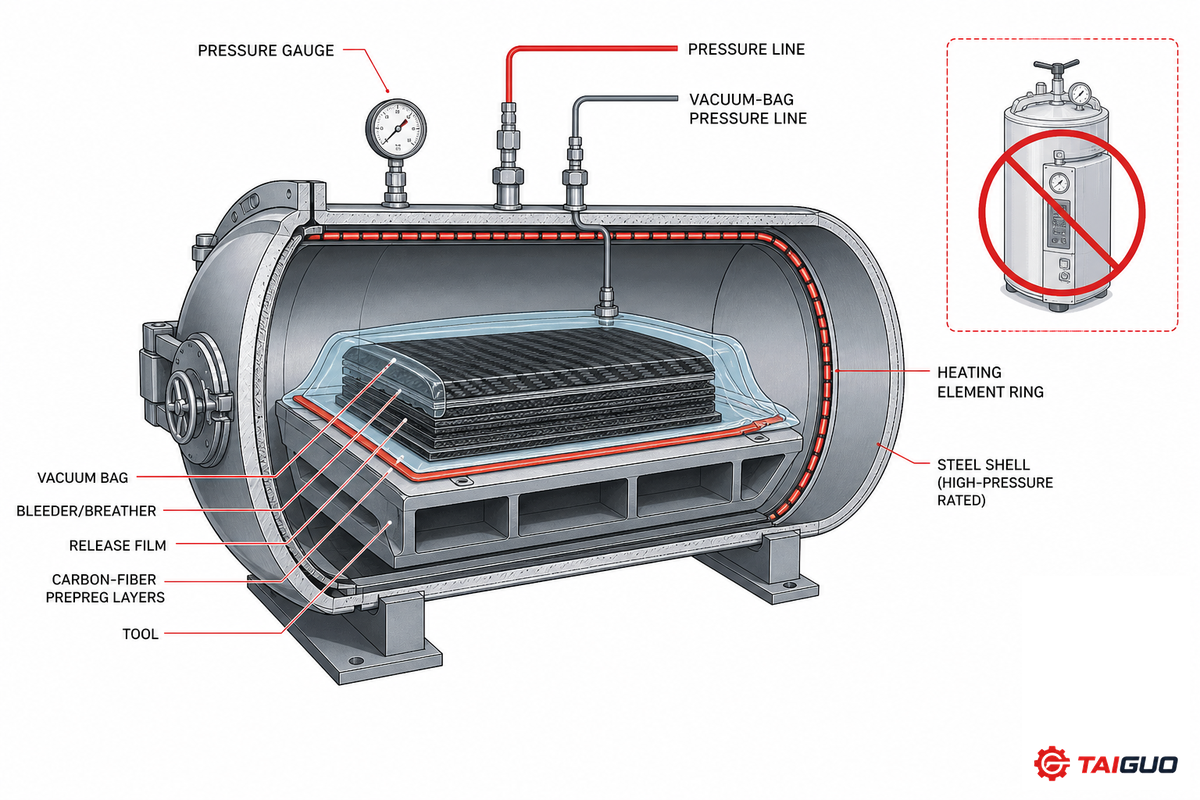
An aerospace autoclave is simply a specialized pressure vessel used to manufacture composite structures, particularly laminates formed from carbon-fiber pre-impregnated materials (prepreg), by exposing the assembly to carefully controlled heat and pressure conditions. Within the sealed chamber, high pressure compacts the carbon-fiber layers and forces any entrained air from the assembly.
Simultaneously, elevated temperature hardens the epoxy resin binder, permanently chemically bonding the fibers and resin to form a solid, void-free composite component with the desired final shape. Evaluating an aerospace composite autoclave system for either a new composite processing operation or as part of a production line overhaul starts from this description. This is the full scope of an autoclave process, but since it’s an industry term, it is worthwhile clarifying that this process description pertains specifically to industrial autoclave machinery, and that other autoclave definitions may refer to completely different processes such as medical sterilization, wood treatment or rubber vulcanization.
Among the most capital-intensive steps of aerospace manufacturing is the cure stage, and even the more basic composite curing autoclaves differ significantly in design from the autoclaves used in wood treating or for molding rubber products. Regulators and manufacturers alike treat aerospace and aircraft structural parts as a distinct manufacturing category. “Indispensable equipment for processing high quality composite aerospace/aircraft structural components” is the way India’s National Aerospace Laboratories (NAL) describes autoclaves; the national laboratory has operated dedicated aerospace autoclave facilities since 1985 and routinely produces structural composite parts for thermoset and thermoplastic material systems of “varying contours and complex shapes.” That aerospace-grade autoclaves have been a fundamental part of the national aerospace lab infrastructure since the 1980s is a key data point to bear in mind: autoclaving is the well-established method for producing primary structure on virtually all aircraft, and this choice is based upon the superior durability and structural integrity of autoclave-cured composites compared to other manufacturing methods. Confusing this aerospace-qualified equipment class with a general-purpose industrial autoclave is a costly mistake buyers make more often than manufacturers like Taiguo Boiler would prefer — the reason is structural: the pressure vessel itself can look nearly identical across categories, but the process qualification layered on top of it is not interchangeable, a distinction the Certification sections below unpack in full.
How the Cure Cycle Works: Lay-Up to Cool-Down
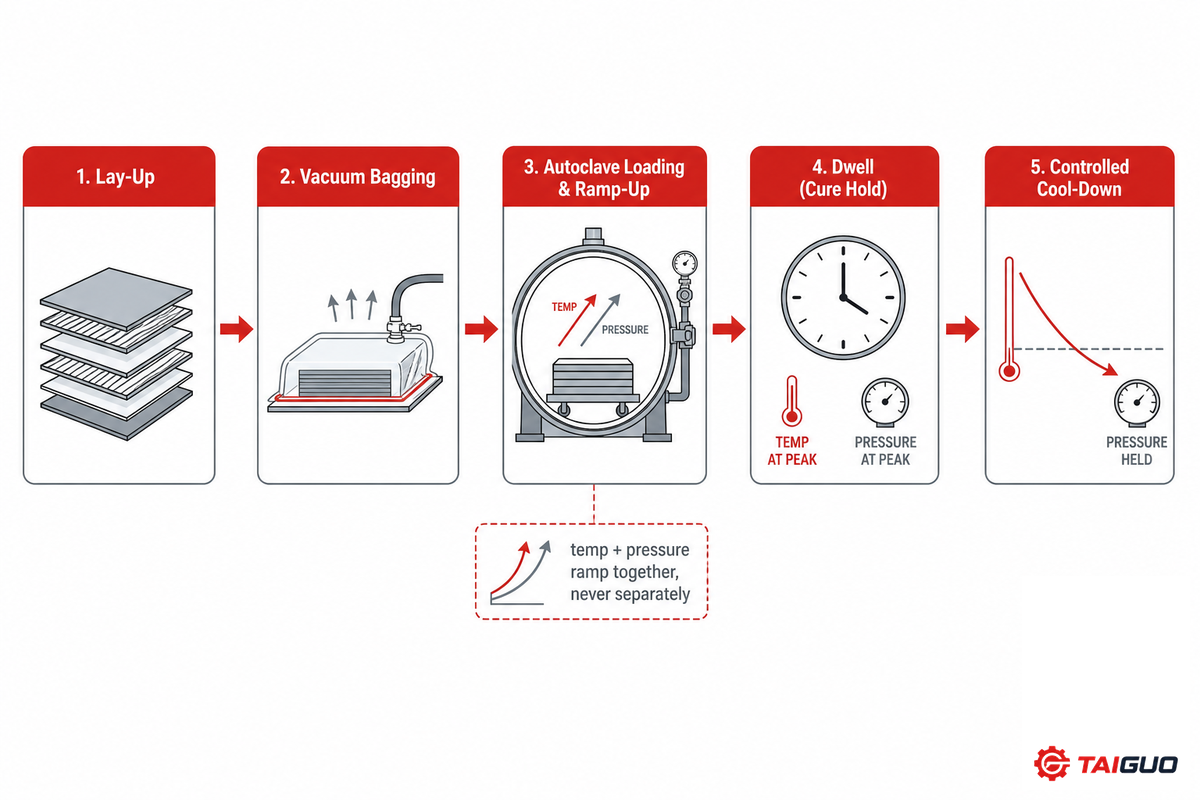
The cure cycle moves a composite part from raw prepreg layup to a finished, void-free laminate in five controlled stages: layup, vacuum-bagging, autoclave loading, a temperature-and-pressure dwell, and a controlled cool-down. Each stage runs under a specific ramp rate and hold time set by the resin system, not a single universal recipe.
How Does a Composite Autoclave Work?
Five discrete steps make up the cycle. Step 1: Layers of carbon-fiber prepreg-that is, preimpregnated with a polymer-resin system-are layered over a tool in the orientations dictated by the part’s stress case. Step 2: The assembly is enclosed in a vacuum bag, a seal that removes trapped air and draws the resin evenly through the stack.
Step 3: The bagged bundle goes into the autoclave and the internal chamber is slowly ramped up to temperature and pressure in parallel rather than just cranked all at once, ensuring even heat distribution across the load and avoiding the risk of incomplete curing in thicker sections, so internal stress does not build in the laminate. Step 4: At the prescribed temperature and pressure levels the assembly is allowed to sit at a “dwell time” for the resin to cure. Step 5: the assembly is brought down to room temperature, while pressure is still being maintained, to prevent deformation in the laminate. Technicians who do this work in the field say the vacuum-bagging step is the easiest one to get wrong.
“A vacuum-bag is not a vacuum chamber… a volatile is not a gas but a liquid” — two of the distinctions that trip up crews new to the process.
Manufacturers have published cure cycles that give an idea of the numbers, but note that these are only examples and not the definitive guide-cures are tailored to the resin system, tool shape and layup complexity. One composite-tooling manufacturer study funded by the Department of Energy’s Office of Science (OSTI.gov) references a 2.71°C/min (5°F/min) ramp to 177°C (350°F) for one hour. Another study by a manufacturer published by the National Institutes of Health (PMC archive 2023) uses a cycle of 2.1°C/min ramp to 125°C. In short, there is no such thing as “the” aerospace cure cycle-they are specific to the resin system and not transferable across materials. The gap between the two peak temperatures alone-350°F versus 257°F-is itself the point, and the exact profile impacts stress in the laminate; a part made with one set of parameters could delaminate if processed using a cure schedule designed for a different resin system. Likewise, the thickness of a part affects how heat penetrates; a schedule that works fine for a test panel may not be suitable for a thick spar cap.
📐 Engineering Note
In a cure cycle there are two values of pressure to consider: external chamber pressure and the internal vacuum-bag pressure. They must be monitored separately since the differential pressure between them, which is what causes the resin to be squeezed to its final distribution within the laminate, should ideally be consistent through the part’s volume via a high-precision control loop, even as chamber pressure is set independently.
Quick Specs & Process Parameters
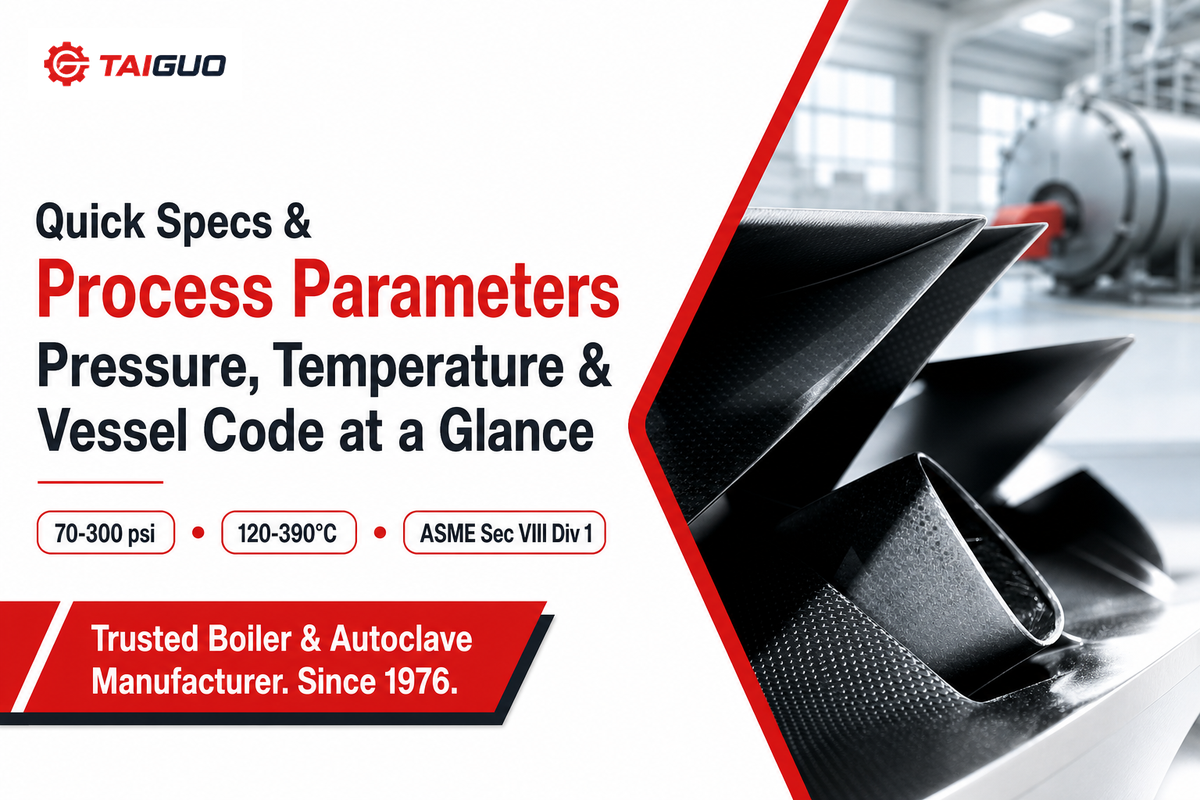
Each material system will have different pressure and temperature ranges, but documented values give a workable reference band. Autoclave pressures for CFRP composites typically range between 70-300psi (5-20atm) for Piran Advanced Composites, a UK-based aerostructures manufacturer that cites two distinct pressure parameters – ambient chamber pressure and internally applied bag pressure – that can be separately tuned depending on the desired result. For conventional CFRP composites with epoxy matrices, temperatures typically sit between 120°C and 180°C, which is the chemical trigger point for the epoxy’s hardeners, while a broader literature reference range for all aerospace composite materials systems, including those utilizing bismaleimide and polyimide, span between 200-450°C and 10-20 bar (145-290 psi), according to a 2018 autoclave equipment reference chapter written by Fernlund, Mobuchon and Zobeiry. Higher up the temperature scale, thermoplastic CFRP composites systems, like some of those based on a polyether ether ketone (PEEK) matrix, can operate as high as 390°C because they operate by melting and resolidifying a plastic matrix as opposed to inducing a chemical reaction that hardens the composite material.
| Parameter | Aerospace composite autoclave | General industrial autoclave |
|---|---|---|
| Pressure | 70–300 psi (5–20× atm) | Up to 2.5 MPa (~360 psi) — e.g. Taiguo’s general autoclave line |
| Temperature | 120–180°C (CFRP); up to 390°C (CFRTP) | Up to 250°C — e.g. Taiguo’s general autoclave line |
| Vessel construction basis | ASME Section VIII Div 1 | ASME U Stamp + CE PED (Taiguo’s real certs) |
| Process qualification | AS9100 + Nadcap composites accreditation required | Not required for AAC, wood-preservation, or general industrial curing |
That last row is often the point where prospective buyers go wrong, which is why it’s featured in the Certification section below. Having a capacity for the range of pressures and temperatures typically associated with aerospace components is not a sufficient requirement to manufacture those components.
Sizing an Aerospace Composite Autoclave
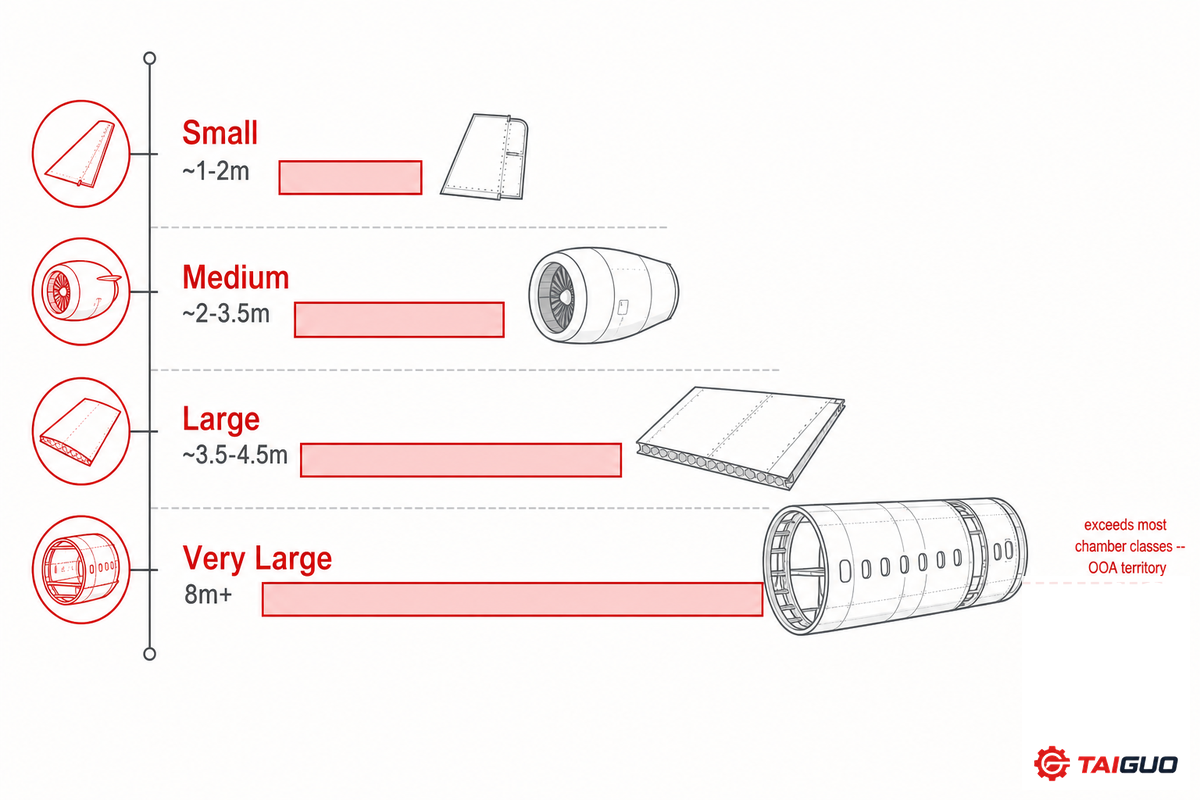
Size is the next question, starting with the biggest part, or the largest assembly requiring a tool, that you anticipate processing, and adding room for the tool, caul plates, and air to flow around the parts. Published values range significantly in the market; TRG Supply, an equipment supplier in the U.S., offers chambers ranging “from 3 feet (1 meter) for small component production up to 25+ feet (8+ meters) for large- scale aerostructure work.” Based on a 2018 chapter by Fernlund, Mobuchon and Zobeiry (the latest publicly available literature, though there may have been larger units built since), ASC Process Systems delivered a 37-m long, 8.5-m-diameter composite autoclave to the Boeing 777X Wing Center in Everett, Wash. designed to process the aircraft’s wing assembly. In another, earlier work from 2011 published in the International Journal of Aerospace Engineering, the CSIR-National Aerospace Laboratories documented their largest unit at 4.4m in diameter and 9m in length as another point of reference between the two extremes.
Worked Example: a 3.2 m × 1.8 m envelope fuselage skin panel resting on a steel tool that requires a 15cm margin on all sides to accommodate airflow and caulk-plate hardware would require a clear usable chamber space of at least 3.5 m × 2.1 m – eliminating anything less than the ~3.5 m diameter class and strongly indicating mid-to-large sized units in the chart range above. Most suppliers customize chamber geometry and tooling fixtures to a specific load plan instead of selling just fixed-size options, and precisely-controlled automated management of the ramp schedule becomes as important as raw chamber volume, once sizing the hardware is down. While diameter and length serve as an initial filter, they do not complete the sizing picture. Usable throughput will also depend on part-tool thermal mass (a heavy steel tool will take longer to get to cure temp than the laminate itself), and how many parts can be loaded into each cycle, so a chamber that may “fit” a part on paper could be a performance drain if tool mass wasn’t considered. The trap buyers fall into is sizing to the part alone: the reason tool mass matters as much as chamber diameter is that the autoclave has to bring the entire load — steel tool included — up to cure temperature within the same ramp window, so a chamber picked purely off a part’s bounding box risks a cycle that never reaches uniform cure across the laminate.
| Component class | Typical envelope driver | Chamber class needed |
|---|---|---|
| Control surface / flap | Long, narrow, thin-section tooling | Small — ~1–2 m diameter |
| R&D / coupon test panels | Flat laminate stacks, minimal tooling | Small — ~1 m diameter (TRG Supply’s small-unit class) |
| Engine nacelle segment | Curved shell + bulky internal tooling | Medium — ~2–3.5 m diameter |
| Wing skin panel | Large flat-to-curved envelope, steel tool mass | Large — ~3.5–4.5 m diameter |
| Wing spar (single piece) | Long axis dominates, moderate cross-section | Large, long-format — length-driven, ~9–15 m class |
| Fuselage barrel section | Full-diameter cylindrical tooling | Very large — approaching or exceeding the largest facility class (4.4 m+ dia, NAL example) |
| Multi-part batch load (small parts) | Loading density, not single-part envelope | Medium-to-large, sized for throughput not just fit |
| Bonded metal-to-composite assembly | Mixed thermal mass (metal + composite) | Medium–large; control-system ramp tuning matters more than raw size |
| Full wing / large integrated structure | Exceeds available chamber envelope | Often not autoclave-feasible — see Industry Outlook below |
Certification, Part 1 — The Pressure Vessel Code
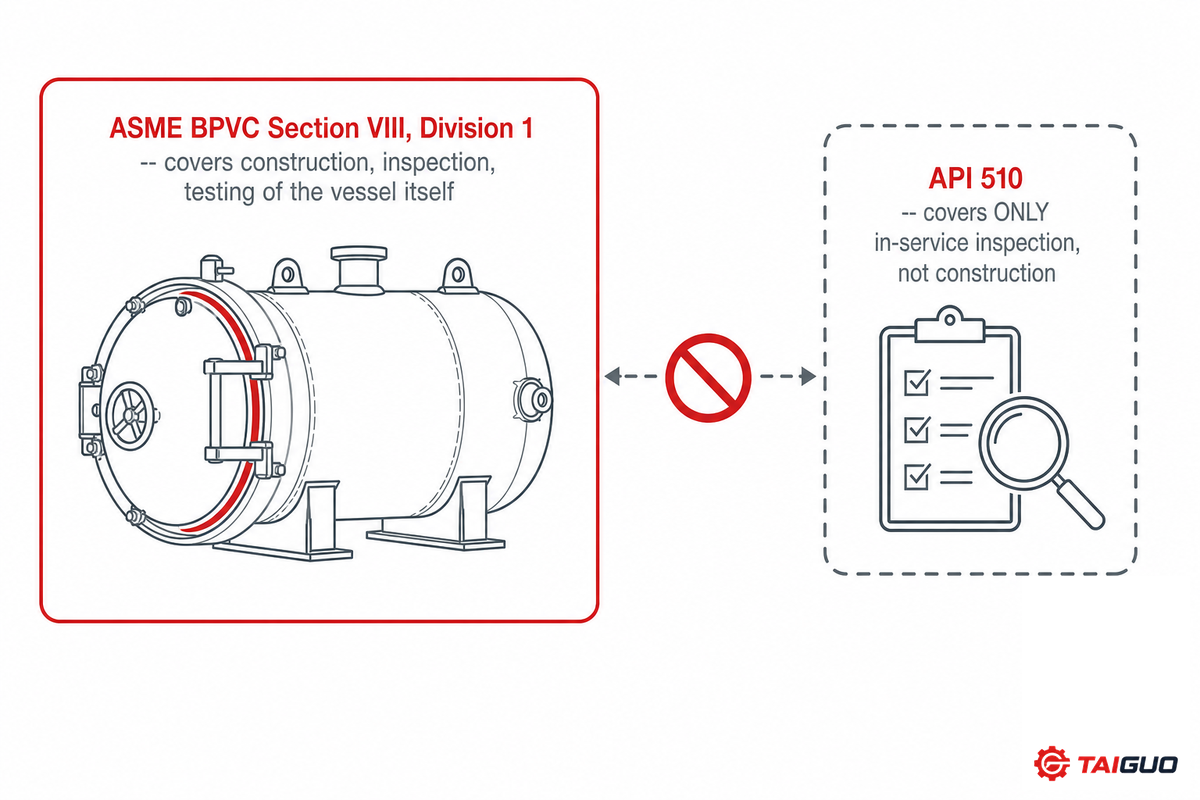
Even before aerospace-specific concerns, the autoclave has to be recognized as what it fundamentally is: a pressure vessel. In the U.S., this means it must be designed, manufactured, inspected, and tested under ASME’s Boiler and Pressure Vessel Code, Section VIII, Division 1. (The 2025 edition is the most current one.) This covers not just the tank’s shell but also its door, seals and pressure-relief system-basic structural and pressure-integrity safety features, regardless of what goes inside it. (API 510 is a separate standard governing in-service inspection, not construction; you cannot swap them.)
And pressure vessel code compliance does not stop at the door of the factory. Numerous states also maintain their own Boiler and Pressure Vessel Programs that require separate state-level installation approval and ongoing in-service inspections on top of the ASME stamp-a jurisdictional complexity easily overlooked when a purchasing strategy is “is it ASME stamped?” The risk here is hidden in plain sight: a buyer who treats the ASME stamp as the finish line can still face a costly installation delay when a state inspector asks for paperwork the vendor never mentioned — the reason is structural, since ASME certifies the vessel’s design and construction, not its in-service jurisdiction, and the two approvals run on separate tracks.
Certification, Part 2 — AS9100 and Nadcap Process Qualification
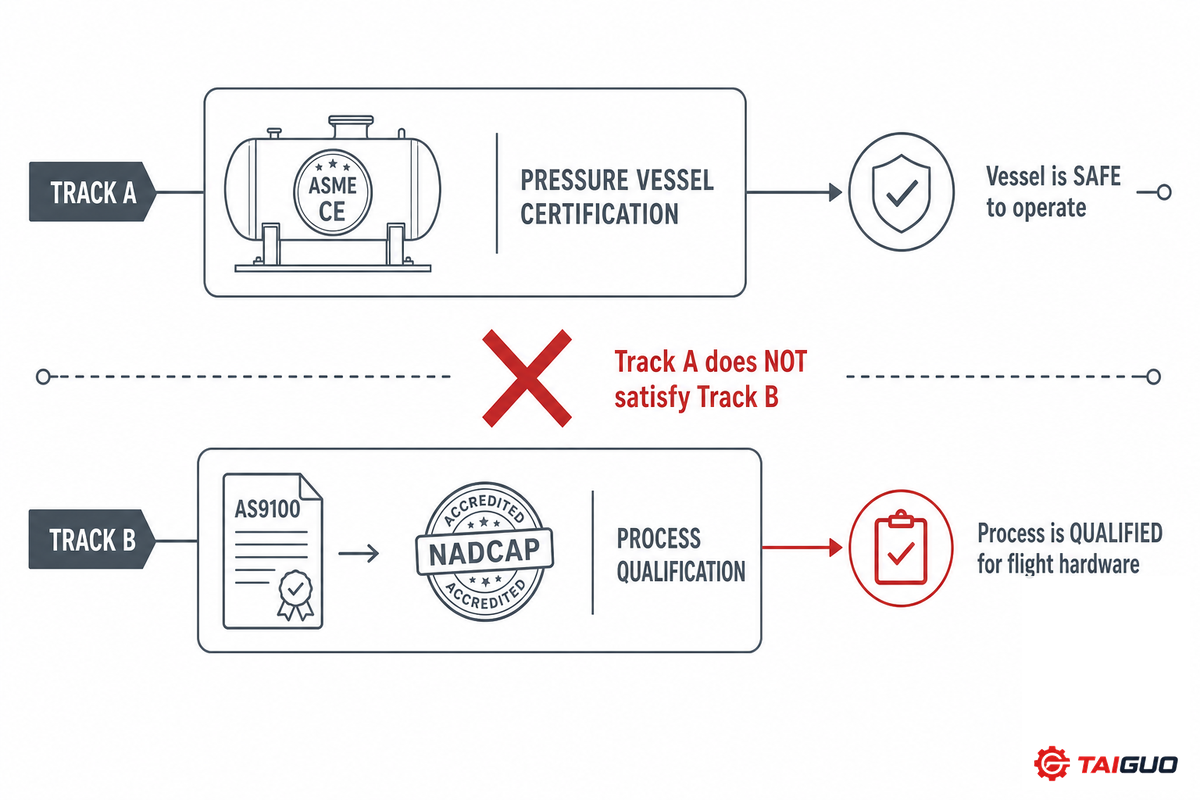
2-Certification Trap
The 2-Certification Trap: If a buyer assumes an autoclave’s ASME-stamped pressure vessel designation also covers aerospace process certifications, they’re wrong.
This is where a large number of buyers (and a fair bit of marketing literature) confusingly equate two separate certifications. AS9100 is a general aerospace quality management standard based on ISO 9001 that certifies an entire organization’s quality practices. Composites Universal is blunt about it: “Nadcap is a process-level accreditation, not a company-wide quality system.” Nadcap (run by PRI) is a more granular (and rigorous) accreditation of specific manufacturing processes-including autoclave cure for composite structures. Matric’s technical comparison explicitly clarifies: “Nadcap process accreditation requires the company’s quality system itself to be certified to AS9100 (or equivalent) before Nadcap auditing can be conducted.” One is a layering, not a replacement, for the other.
That vessel code stamp on the tank says it’s safe. It tells you nothing about whether the cure process inside has been audited to aerospace standards. Here is how easily that gets confused in practice: A manufacturer that offers “aerospace autoclaves” can list perfectly valid vessel construction accreditations – such as ASME Section VIII Division I, ASTM, American Institute of Steel Construction, and National Board “R” stamp – without ever referencing AS9100 or Nadcap anywhere on the page. Nothing there is dishonest, it’s just a different layer of certification than the one required to certify a cure process for flight hardware, and it matters to anyone reading that page from the perspective of a buyer. Valence Surface Technologies says “There is a high risk of failure if they are not strong enough” when the distinction is lost-that suppliers unable to readily differentiate these issues for a customer often fail subsequent audits.
For composites in particular, the underlying requirements were initially published by SAE as AS7118A, Nadcap Requirements for Composites (2008). SAE’s catalog notes that AS7118A is being consolidated into the PRI Audit Criteria document (AC7118); the underlying requirements are identical but AC7118 will become the single reference. A Nadcap audit reference for composites describes autoclave process criteria in item 21a of the audit checklist; update letters are released regularly, and the latest revision should be confirmed via PRI/eAuditNet rather than referencing any letter from an external source. Remember to consult the checklist identity for composites (AC7118), not the one for heat treatment (AC7102), for autoclave related processes.
Taiguo Boiler’s industrial autoclave series comes with ASME U Stamp and CE (PED 2014/68/EU) certification, which addresses the vessel certification layer previously mentioned; it does not hold AS9100 or Nadcap accreditation. Buyers should read this paragraph as industry information for this product category, not as a statement that its processes are certified to aerospace standards.
Industry Outlook: The Out-of-Autoclave Pressure
Over the past two decades, commercial aircraft have increasingly relied on composite structures. In turn, this shift toward composites has driven the growing demand for autoclave capacity. The Boeing 787 Dreamliner, for instance, is approximately 50% composite by weight, while the Airbus A350 XWB uses roughly 52-53% composite, as cited on ScienceDirect’s engineering topic page and confirmed by Hexcel’s own material data. The higher the proportion of composite materials used in an aircraft’s structure, the greater the number of components that require curing, leading to a higher overall demand for autoclaves.
That is just half the story, and the more important half is not cost, but size. NASA’s own Technical Reports Server states the constraint directly: “As the size of aerospace composite parts exceeds that of even the largest autoclaves, the development of new out-of-autoclave processes and materials is necessary to ensure quality and performance.” In other words, OOA prepreg is not so much a cheaper choice as the only physical choice once the part gets bigger than any chamber can hold. The academic literature backs this up as a live, unresolved research area rather than a settled substitution: a widely cited 2015 review notes vacuum-bag-only prepreg processing still carries its own open technical issues, and a 2025 paper on autoclave process improvement is explicit that the assumption “curing … is not always true” needs re-examination on a case-by-case basis.
Field experience backs the nuance over clean dichotomies. “We lay up all types of materials including prepreg (both out-of-autoclave and in-autoclave, and for specific part-to-part applications one process is selected over the other)” stated a composites technician in a public forum thread detailing the prep of prepregs for an autoclave operation. “High temperature service type resins, in my experience, generally demand Autoclave, though there are exceptions” noted a composite materials specialist. Therefore, a potential autoclave purchaser should, at the outset, verify if an OOA-prepregged solution can satisfy the technical requirements for the given class of part before considering the cost or dimensions of a new piece of equipment-while OOA is an increasingly capable process, it remains problematic for large, high-performance structural parts and for applications whose geometric footprint may simply outsize available chamber space.
Procurement Considerations: New, Used, and Lead Time
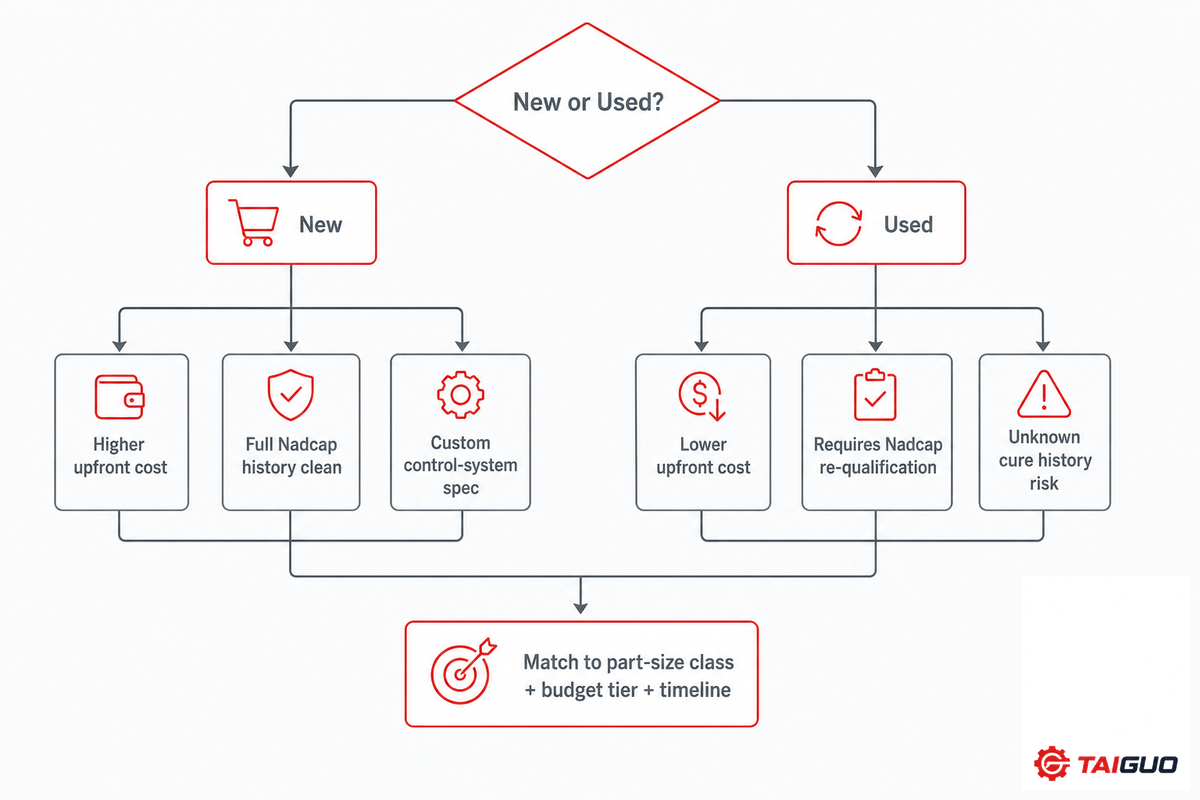
Four criteria frame a company’s choice: part size class, cost, equipment uptime schedule, and the long-term reliability of the vendor’s control system. One requirement does not move regardless of which route a buyer takes: the vessel itself must still meet ASME’s Boiler and Pressure Vessel Code, Section VIII, Division 1, whether the unit is brand-new or decades old. While price is one motivation to go with a used machine, a used autoclave lacking on-record, up-to-date Nadcap accreditation would have to undergo re-qualification prior to use with flight hardware — an often overlooked expense and time sink. One online thread discussing the topic from the composites sector estimates an “approx $30k per year” for a standalone AS9100 quality-system certification, to which one “will also have to have Nadcap for each commodity required for the contract” is added — a meaningful, if informal, reference point for total recurring compliance expenses in addition to acquisition cost.
As for the hardware, the above cited academic reference chapter suggests capital cost figures range from approximately $200,000 for a small 1 m diameter model, $500,000 for a middle-tier 2.5 m machine, and several million for large-scale machines, though all were 2018 figures and should be treated as an order-of-magnitude guideline. The typical cycle time for aerospace prepreg production is three to 10 hours, even with only primary structures in the mix, which means operating costs (chiefly the energy needed for heating) can even surpass the original capital expense.
| Part size class | Budget tier | Timeline | Recommendation |
|---|---|---|---|
| Small (≤2 m) | Constrained | Urgent | Outsource to a Nadcap-accredited job shop — avoids both capex and re-qualification lead time |
| Small (≤2 m) | Adequate | 6–12 months | Refurbished unit + fresh Nadcap audit is usually the fastest path to in-house capacity |
| Medium (2–3.5 m) | Constrained | Urgent | Outsource — medium-class refurbished units are scarce and re-qualification alone can exceed the urgent window |
| Medium (2–3.5 m) | Adequate | 12–18 months | New-build gives control over control-system specification and avoids inheriting unknown cure history |
| Large (3.5–4.5 m) | Strong | 18+ months | New-build — at this scale, custom chamber geometry usually outweighs any used-market savings |
| Large (3.5–4.5 m) | Constrained | Flexible | Outsource to an established aerostructures job shop rather than stretch capex on a large new unit |
| Very large (>4.5 m / long-format) | Any | Any | Check OOA process viability first — at this scale, availability may matter more than budget |
| Multi-part batch load | Adequate | 6–12 months | Refurbished unit sized for loading density, not single-part envelope |
| R&D / qualification testing | Constrained | Flexible | Small refurbished or lab-scale unit — full Nadcap accreditation often unnecessary at this stage |
Taiguo Boiler’s industrial autoclave line ranges from custom-designed pressure vessels from 1 m³ to more than 200 m³ and from vacuum up to 2.5 MPa and 250°C under both ASME U Stamp and CE (PED) certification. That range indicates their general industrial pressure vessel capability and provides background to a buyer deciding among options regarding build time, but it is not a substitute for the Nadcap process accreditation needed by an aerospace program. Buyers who consider the entire line of industrial autoclave equipment — including adjacent applications such as AAC block curing on the same pressure-vessel platform — should first look at current standard custom size options.
Key Factors to Consider Before Purchase
- Separate and independently verify the vessel-code certification (ASME Section VIII Div 1) and process accreditation (AS9100 plus Nadcap).
- Plan for size including any necessary tooling and support structures, not just the part size alone.
- Incorporate the thermal inertia of the part and tooling when estimating process time.
- Separate Nadcap re-qualification costs and timelines from those of the new equipment purchase if the equipment is used.
- Investigate alternative, out-of-autoclave (OOA) processes before deciding on a large capital expenditure to acquire additional autoclave capacity for your part class.
Frequently Asked Questions
Q: What is an aerospace composite autoclave, and how is it different from a medical or lab autoclave?
View Answer
An aerospace composite autoclave is designed to apply a combination of heat and pressure in a precise and controlled fashion to a vacuum-bagged part and then cure (cross-link) the matrix material of the carbon-fiber or other composite laminate into a rigid solid. This process is distinct from medical or dental autoclaves that use high-temperature, saturated steam to sterilize instruments, although all are classified as pressure vessels. This is a critically important distinction because, as a search of the term “autoclave” on the web quickly demonstrates, the overwhelming search results will be for medical and dental sterilization devices rather than aerospace curing ovens.
Q: How does the autoclave curing process work for composite parts?
View Answer
To produce a carbon fiber composite part using this type of equipment, a number of composite prepreg layers are laid up according to a specification, placed inside a sealed bag to evacuate any trapped air, and then inserted into the autoclave. the pressure and temperature are increased together following a specified ramp rate (avoiding overly rapid changes is essential for good quality); once the maximum desired levels of heat and pressure are reached, they are maintained long enough for the resin to fully cure and then are reduced in a controlled way, while the pressure is held to avoid distortion as the part solidifies. a control system monitors both autoclave and internal bag pressure since each is set separately and each contributes to the overall final part quality-the gauge reading of chamber pressure alone is insufficient.
Q: What pressure and temperature ranges do aerospace composite autoclaves operate at?
View Answer
Aerospace-industry reported values put typical maximum operating pressure at 10 to 20 bar (approximately 145-300 psi) across the full spread of material systems. The temperature used to cure the composite part varies considerably with the type of resin matrix. Typical CFRP epoxy prepreg requires between 120 and 180°C, but higher-temperature systems such as those using bismaleimide, polyimide, and thermoplastic (CFRTP) require much higher cure temperatures, some in the 390-450°C range. Always cross-reference temperature requirements with the material data sheet of the prepreg vendor, rather than relying on generic published information.
Q: How is temperature uniformity ensured inside a large aerospace autoclave?
View Answer
The programmable controller operating in automatic, semi-automatic, or manual mode, supported by computer control and a data acquisition system logging temperature and pressure at regular intervals during the cycle. This is also the basis for Nadcap process audits that scrutinize temperature uniformity survey data in qualifying the equipment for aerospace use.
Q: What is out-of-autoclave (OOA) curing, and can it replace an autoclave?
View Answer
OOA relies on custom prepreg composites cured under a vacuum-bag-only process without autoclave overpressure. It is an actual active process-and as documented by NASA research, a practical requirement beyond a given size before even an autoclave can be used at all. Whether OOA can substitute for a specific part depends on the material and the part’s function in a structure; it’s no substitute for primary structure.
Q: What certifications does an aerospace composite autoclave supplier need?
View Answer
These are two distinct requirements. AS9100 quality-management certification for the supplier and Nadcap certification for the specific process, which for composites is autoclave curing. One of Nadcap’s prerequisite conditions for process certification is having AS9100 or an equivalent QMS certification. One doesn’t replace the other, and merely having pressure vessel code certification (ASME, CE, UL) is not even in the ballpark for the two-layered requirements.
Q: What is the biggest aerospace autoclave in the world?
View Answer
ASC Process Systems’ unit for the Boeing 777X Wing Center is the largest documented academic literature mention: 37 meters long and 8.5 meters diameter, custom sized for the 777X composite wing. CSIR-NAL’s 4.4m X 9m facility serves as a useful mid-point example below this scale.
Q: How do you size an autoclave for a specific part or production volume?
View Answer
begin with the dimensions of the largest single tooled part, add clearances for tooling (molds and caul plates), then check this against the standard chamber size classes. If the primary factor is volume rather than part size, dimension for efficient loading density of the parts and tooling, but always factor part-and-tool thermal mass into your real-world cycle-time estimation to determine required chamber size (or even determine that the biggest part physically fits the chamber, but won’t give you throughput you need).
References & Sources
- Out-of-Autoclave Cure Composites — NASA Technical Reports Server, Glenn Research Center
- Cure Cycle Development and Qualification — US Department of Energy (OSTI.gov)
- Experimental Study on the Optimization of the Autoclave Cure Cycle — National Institutes of Health, PMC
- Aerospace Grade Autoclave Facility — CSIR-National Aerospace Laboratories, Government of India
- 2025 ASME Boiler and Pressure Vessel Code — American Society of Mechanical Engineers
- Boeing 787 Dreamliner — Composite Content — ScienceDirect Engineering Reference
- Polymer Matrix Composites: Fundamentals — Autoclave Equipment — Fernlund, Mobuchon & Zobeiry (2018), Elsevier
- AS7118A: Nadcap Requirements for Composites — SAE International
- What Is the Difference Between Nadcap and AS9100? — Composites Universal
- Nadcap Audit Criteria for Composites (AC7118) — published Nadcap composites audit reference
Why We Write This
Taiguo Boiler has been providing custom pressure vessels, including industrial autoclaves for various industrial applications, since 1976. Their products range from AAC block curing to rubber vulcanization and composites manufacturing. This article provides an overview of autoclave equipment class in aerospace applications from a pressure-vessel manufacturer’s perspective, for the educational benefit of engineers and buyers considering these systems; it is not a claim of process certification. Reviewed by Taiguo Boiler Technical Team.
Related Articles
- Industrial Autoclave Product Range — full specs and custom sizing options
- Autoclave for AAC Blocks — a different curing application on the same pressure-vessel platform
- Autoclave for Wood Preservation — steam-impregnation curing, a third application of the same equipment category
- AAC Block Manufacturing Plant: Equipment Checklist
- AAC Bricks vs. Clay and Fly-Ash Bricks
![AAC Block Manufacturing Plant Setup Guide [2026]](https://taiguo-steamboiler.com/wp-content/uploads/2026/07/aac-block-manufacturing-plant-featured-768x512.png)

![AAC Block Manufacturing Plant Setup Guide [2026]](https://taiguo-steamboiler.com/wp-content/uploads/2026/07/aac-block-manufacturing-plant-featured-150x150.png)