Get in Touch with Taiguo


Updated September 2026
Commercial retort processing is the controlled sequence used to deliver a scheduled thermal process to sealed containers. In that sequence, the retort process in canning starts with a defined product, package, closure, load and set of critical factors. Plant personnel prepare and close the cans, verify initial conditions, follow the approved venting and heating sequence, accumulate the required lethality, cool without compromising the container, and reconcile the records before release. F0 describes delivered lethality on a stated calculation basis; it doesn’t choose the target or release the batch.
Key takeaway
Treat the seven steps as an evidence chain for one defined scheduled process. Never transfer a time-temperature cycle, cold-spot assumption or F0 target to another product-package combination.
What the Retort Process Controls
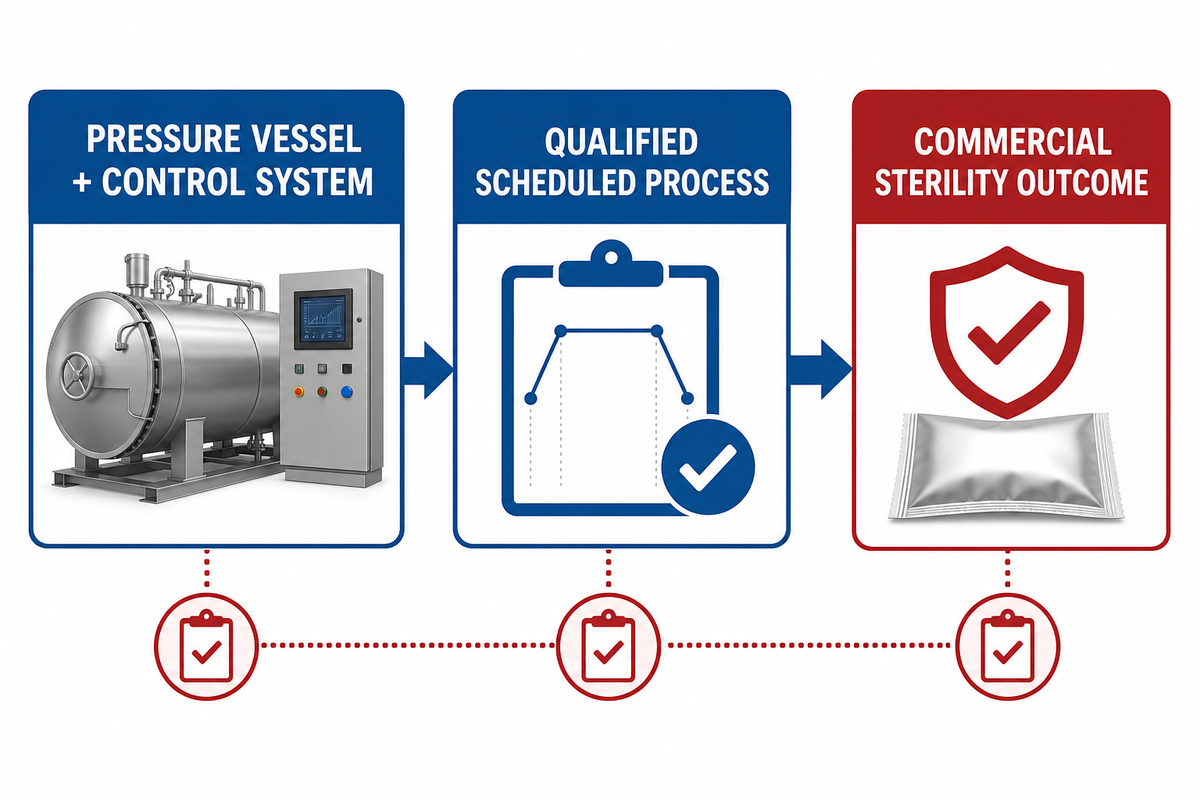
A retort is the pressure vessel and control system that delivers heat under defined conditions. A scheduled process is the qualified instruction for a given product, container and manufacturing condition. Commercial sterility is the required outcome within the applicable framework. Batch release is the plant decision made after evidence shows that the specified conditions, closure controls and reviews were satisfied.
In practice, the objective may be to sterilize a shelf-stable food for a defined shelf life, or to achieve pasteurization under a different validated basis. Food safety, product quality and package integrity depend on the specified temperature and pressure history. The package may be metal cans, glass jars, a tray or a pouch; commercial sterilization and water spray conditions must match the approved product-package process.
Terminology in plant specifications
Buyers may see different labels for the same control discussion. A specification can identify the type of retort as a static retort, continuous retort, water immersion system or water spray retort, and may describe the retort technology, retort chamber, retort capacity or retort or autoclave interface. Product documents may use retort food, packaged food, food packaging, packaging materials, types of containers, food types and food industry categories, including food and beverages, food and beverage products, pet food, baby food and military rations.
The thermal scope may be called thermal food processing, processing technology, processing techniques, batch processing, a food sterilization process, retort sterilization or a commercial sterilization method; those labels are not interchangeable with aseptic processing. For the defined product, record water activity, desired temperature, pressure and temperature, temperature and pressure inside the vessel, independent control of temperature and control of temperature and pressure. Review the applicable thermal processes, food quality, temperature of the food, thermal process calculations, commercial closed vessel and temperature control requirements with the qualified process owner. Those records help the team sterilize food, ensure food safety, achieve commercial sterility, protect a long shelf life and reduce food waste without assuming that longer processing times are automatically safer.
| Concept | What it answers | Primary owner | Typical evidence |
|---|---|---|---|
| Scheduled process | What process and critical factors apply? | Qualified process authority or qualified organization | Approved schedule and supporting scientific work |
| Retort capability | Can the installed system deliver and document the required conditions? | Plant and equipment supplier within defined scopes | Drawings, controls, calibration and distribution evidence |
| Process execution | Did this load follow the schedule? | Trained plant personnel | Contemporaneous batch and closure records |
| Release decision | May the affected lot enter distribution? | Qualified plant management and, for deviations, competent evaluation | Complete records, deviation disposition and signed review |
This removes one more error mode: a controller can show a completed cycle while the wrong recipe, fill level, headspace, load pattern or closure condition sits outside its data. Here, retort canning means the commercial control chain for sealed rigid cans; it doesn’t mean that one schedule applies to every product or target microorganism. Flexible packaging raises separate construction and overpressure questions, which belong in the retort pouch sterilization guide.
Step 1 — Freeze the Scheduled Process and Critical Factors
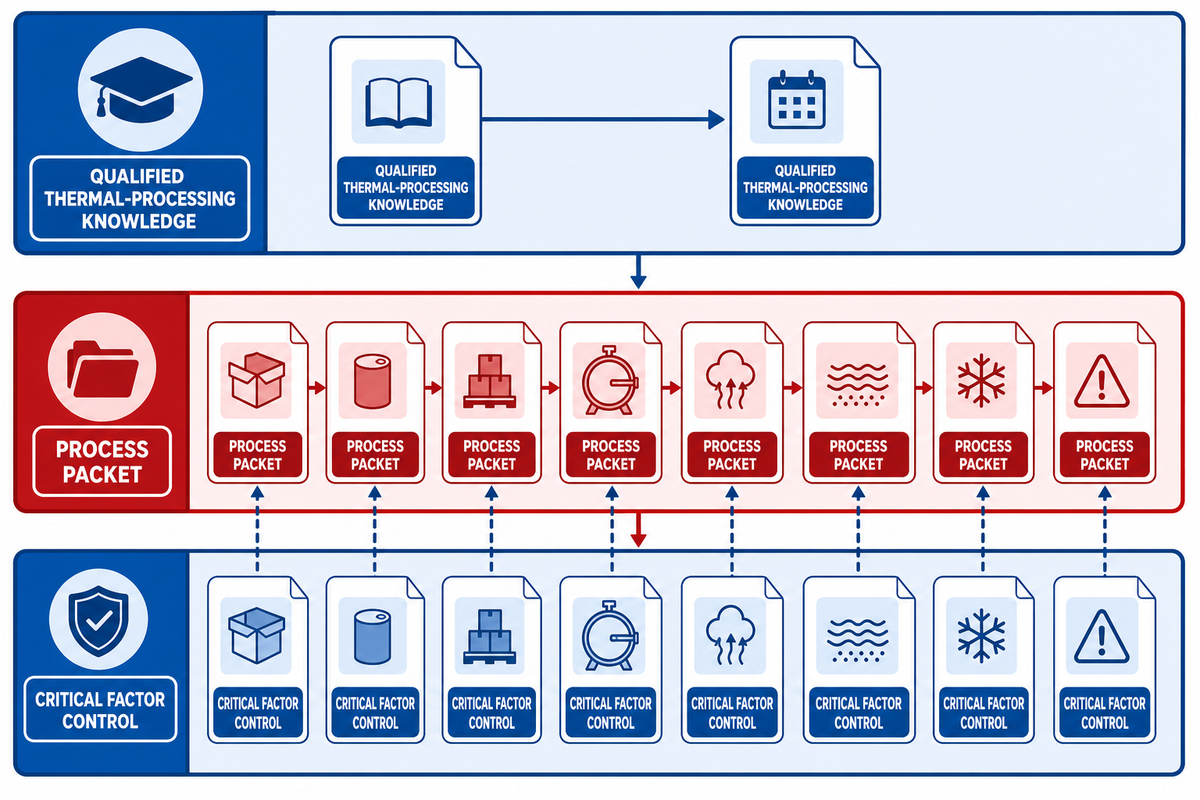
Start with the process packet, not the retort touchscreen. Current Part 113 assigns scheduled-process establishment for low-acid foods to qualified persons with expert thermal-processing knowledge. That schedule must address the variations expected in commercial production and identify the critical factors that can affect delivery.
The packet should identify the product and formulation limits, container and closure, fill or drained weight where relevant, headspace, initial product temperature, preparation method, consistency or particle characteristics, load pattern, retort system, venting or come-up procedure, processing conditions, cooling conditions and deviation instructions. Its exact content is product-specific. A factor belongs in operating control when the approved schedule or applicable rule treats it as critical.
| Party | Provides | Does not automatically approve |
|---|---|---|
| Process authority | Scientific basis, schedule, critical factors and qualified deviation instructions | Plant readiness or supplier contract performance |
| Plant | Actual product, utilities, line controls, trained operators and records | A new thermal target by operator judgment |
| Package supplier | Container and closure specifications, drawings and handling limits | The food’s scheduled process |
| Equipment supplier | Vessel, utilities interface, controls, documentation and agreed tests | Product-specific commercial sterility unless separately qualified and contracted |
New Mexico State University’s commercial process-review guidance also places process-schedule design with a process authority. That’s why a buyer should ask who owns the schedule, who owns the installation test and who approves release as three separate questions.
Step 2 — Fill, Exhaust and Close the Cans
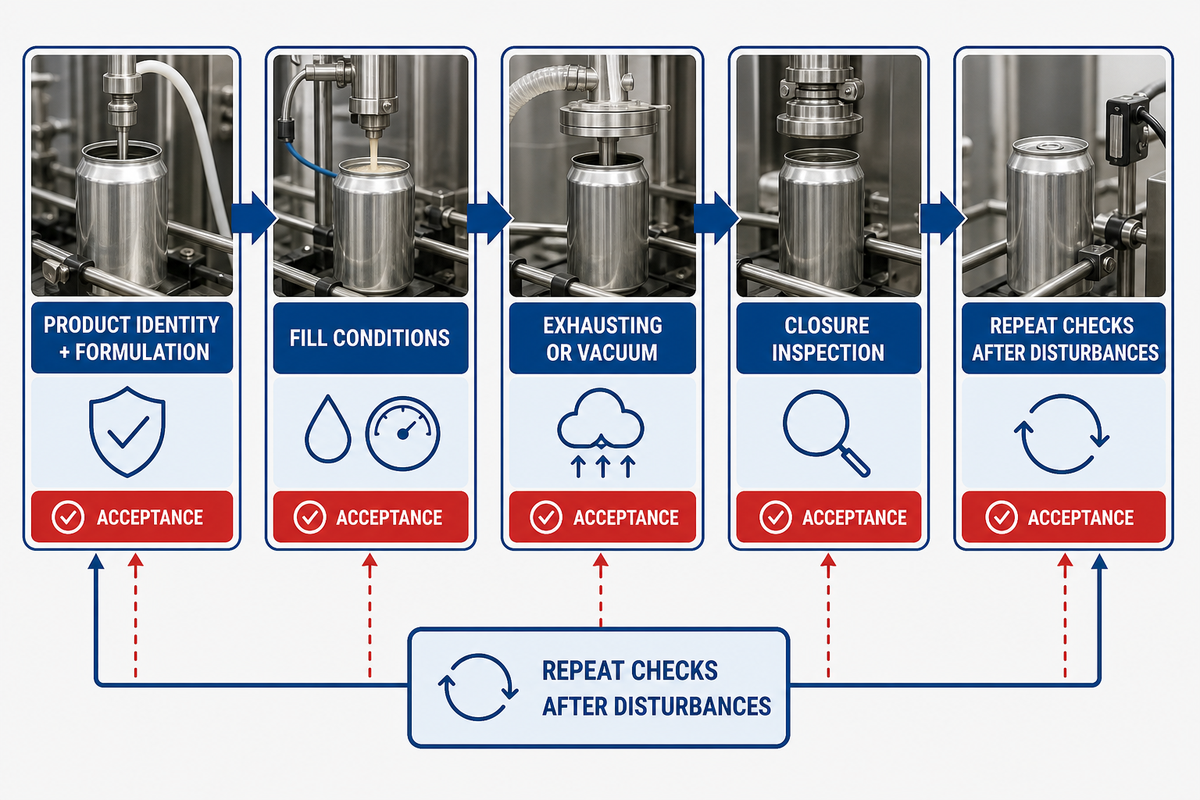
The critical limits defined in Step 1 become the acceptance criteria for filling and closing. Even before a basket reaches the retort, changes in the filled container can affect thermal performance. A heavier fill, lower initial temperature, different viscosity, larger particle, altered headspace or changed container geometry can slow heating. Exhausting or vacuum conditions can change internal pressure and closure behavior. A hermetic closure must then survive heating, pressure change, cooling and handling.
- Confirm product identity and formulation: use the approved revision and verify any scheduled-process limits.
- Measure fill conditions: capture fill or drained weight, headspace and initial temperature when specified.
- Control exhausting or vacuum: apply the documented method rather than a generic setting.
- Inspect closure formation during production: distinguish external observations from teardown measurements or glass-closure checks.
- Repeat checks after disturbances: follow the applicable program after seamer jams, adjustments, prolonged stops or other events that can change closure formation.
Closure control isn’t a single post-retort inspection. It starts during production. Current 21 CFR 113.60 requires regular closure observations during production, examination of a randomly selected can from each seaming head at sufficient frequency, and additional visual inspections after a closing-machine jam or adjustment and after startup following a prolonged shutdown. Plant records must preserve the actual observations, measurements and corrective actions.
Step 3 — Load the Retort and Confirm Initial Conditions
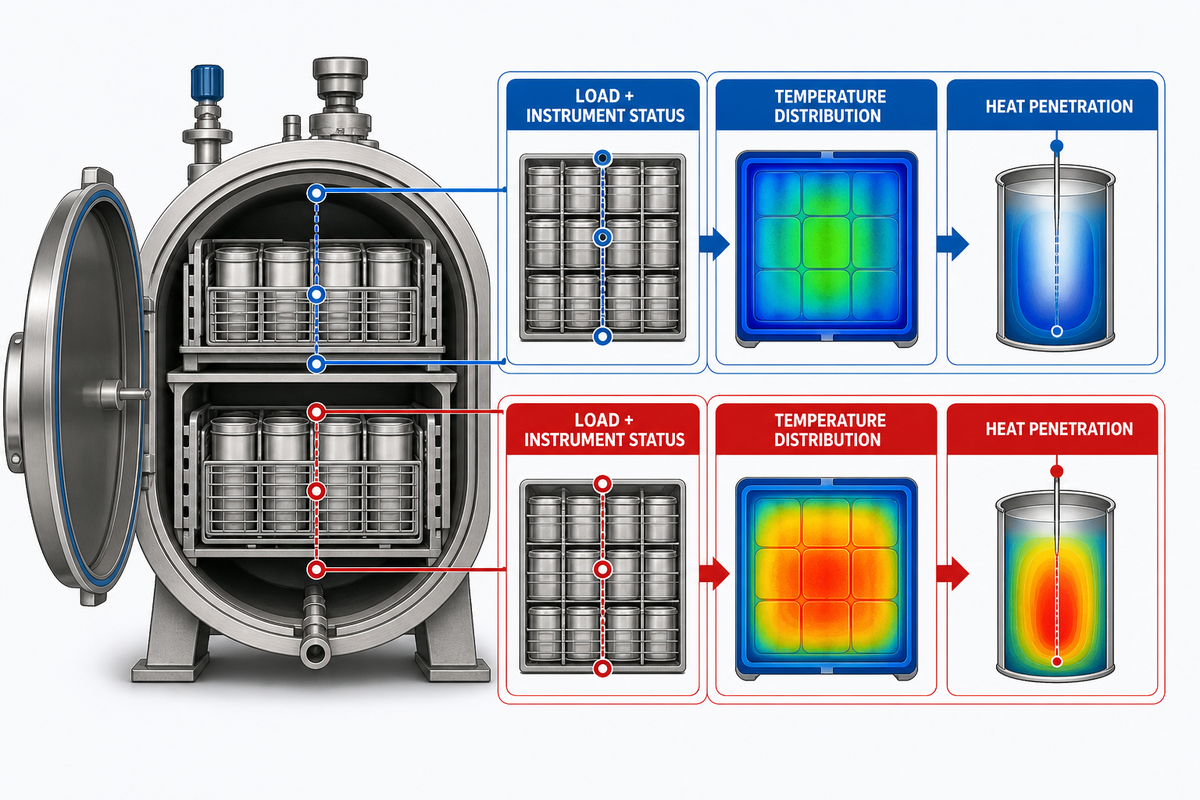
Before steam or process water enters, confirm that the physical load matches the schedule and the validated study conditions. Record the retort, basket or crate layout, container code and orientation, approximate load, initial product temperature, recipe revision and instrument status. Verify line clearance and the valve positions that define venting, circulation and cooling. For the product-side checks, compare the record against FDA heat-penetration guidance.
That match is a production risk control: a hidden load mismatch can invalidate the study assumptions even when the operator sees an apparently normal cycle.
These studies are related but not interchangeable. FDA inspection guidance distinguishes product heat penetration from retort temperature distribution. A uniform empty chamber does not prove that the food cold spot received the scheduled process, and a product probe does not prove that every location in the production retort has adequate distribution. Validate the cold spot rather than assuming it is the geometric center.
Step 4 — Vent, Reach Process Temperature and Start the Clock
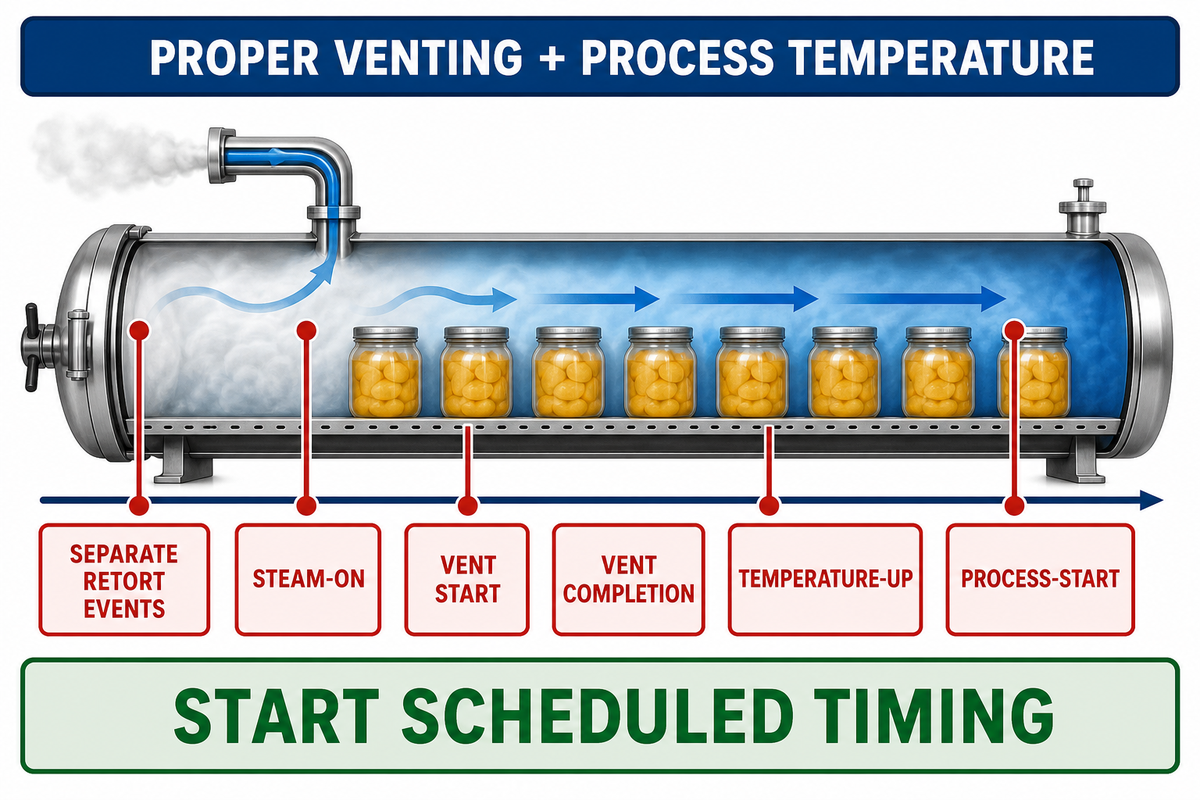
For a still-steam retort under 21 CFR 113.40, scheduled process timing begins only after the retort has been properly vented and the processing temperature has been reached. Steam-on, vent start, vent completion, temperature-up and process-start are separate events. Other retort systems, including steam-air systems, follow their specified procedures and the applicable scheduled process.
A premature timer is a production risk because it can hide a failed start condition from the operator and inspector. Under FDA 21 CFR 113.40, the qualified scheduled process, not a generic target, governs. Use the temperature-indicating, recording and timing requirements that apply to the specific retort and filed process, and keep the interlock and review trail that demonstrates the defined start condition.
“Timing shall not begin until the retort has been properly vented and the processing temperature has been reached.”
- Admit steam — record steam-on and confirm that the approved flow path is available.
- Vent the vessel — keep the documented vent path open for the retort-specific procedure so air is removed.
- Confirm vent completion and temperature-up — verify both conditions with the specified indicating and recording instruments.
- Start scheduled timing — begin only at the defined point and capture the event on the batch record.
Pressure alone doesn’t prove a pure saturated-steam environment. Residual air can change heat transfer and create a different temperature-pressure relationship. In the same way, starting a cycle timer early isn’t acceptable if the established scheduled-process start conditions haven’t been met. The interlock and record design should clearly display the separate events before a “cycle started” signal, so each condition required for scheduled-process timing is accounted for individually.
When does retort process timing actually begin?
In the still-steam example, timing begins after proper venting and after the retort reaches the scheduled processing temperature. Steam-on and come-up time aren’t automatically scheduled process time. Other systems use the operating procedure and start condition established for their design, product, container and load.
Step 5 — Deliver the Scheduled Process and Track F0
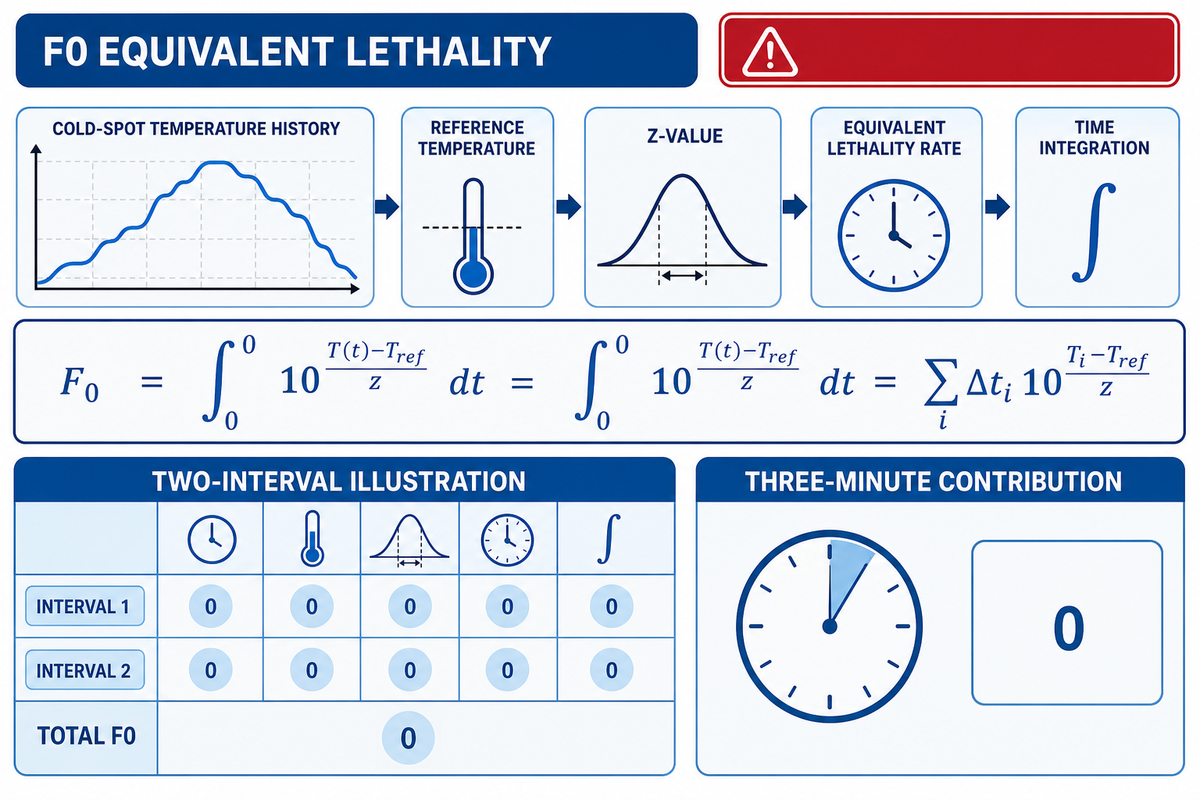
F0 is accumulated equivalent lethality on a stated reference-temperature and z-value basis. It converts a changing cold-spot temperature history into equivalent minutes at the selected reference condition. The Virginia Tech thermal-processing chapter presents the calculation as:
F0 = ∫ 10((T − Tref) / z) dt
| Variable | Meaning | Evidence question |
|---|---|---|
| T | Measured food temperature over time | Was the sensor at the validated slowest-heating location? |
| Tref | Stated reference temperature | Is the basis recorded with the result? |
| z | Temperature change associated with a tenfold change in thermal resistance | Who selected it for the organism and purpose? |
| dt | Each time interval in the temperature history | Is the sampling interval adequate and complete? |
| Target | Required lethality from the scheduled process | Does it apply to this exact product, container and process? |
Worked F0 arithmetic illustration
Assume a process authority has already specified the calculation basis. If the food cold spot stays exactly at the stated reference temperature, the exponent is zero, so the lethality rate is 100 = 1 equivalent minute per elapsed minute. Three constant minutes at that condition contribute 3.0 equivalent minutes.
If a separate four-minute interval is exactly one z-value below the same reference temperature, the exponent is −1, so the rate is 10−1 = 0.1 equivalent minute per elapsed minute. That interval contributes 4 × 0.1 = 0.4 equivalent minute. In this simplified two-interval illustration, the subtotal is 3.0 + 0.4 = 3.4 equivalent minutes on the stated basis.
How is F0 value calculated in a retort?
Measure the validated food cold-spot temperature at defined intervals, calculate the lethality rate for each point from the stated reference temperature and z-value, and integrate those contributions over time. Use the numerical method specified for the calculation. Preserve the raw temperature series, sensor identity and location, sampling interval, formula basis and software revision. The result is delivered lethality on that basis for every measured point in sequence; compare it only with the applicable scheduled-process target and deviation rules.
Can one F0 target be used for every canned food?
No. Product formulation, organism of concern, container geometry, closure, fill, headspace, initial temperature, heat-transfer behavior, retort conditions and jurisdiction can all matter. Even the apparent cold spot may move with product behavior or entrapped air. A process authority evaluates those variables, the microbial objective and supporting studies for the defined product-package combination. An approved schedule documents the resulting target and critical factors. A familiar number on a controller is therefore not a portable release criterion.
Step 6 — Cool Without Losing Container Integrity
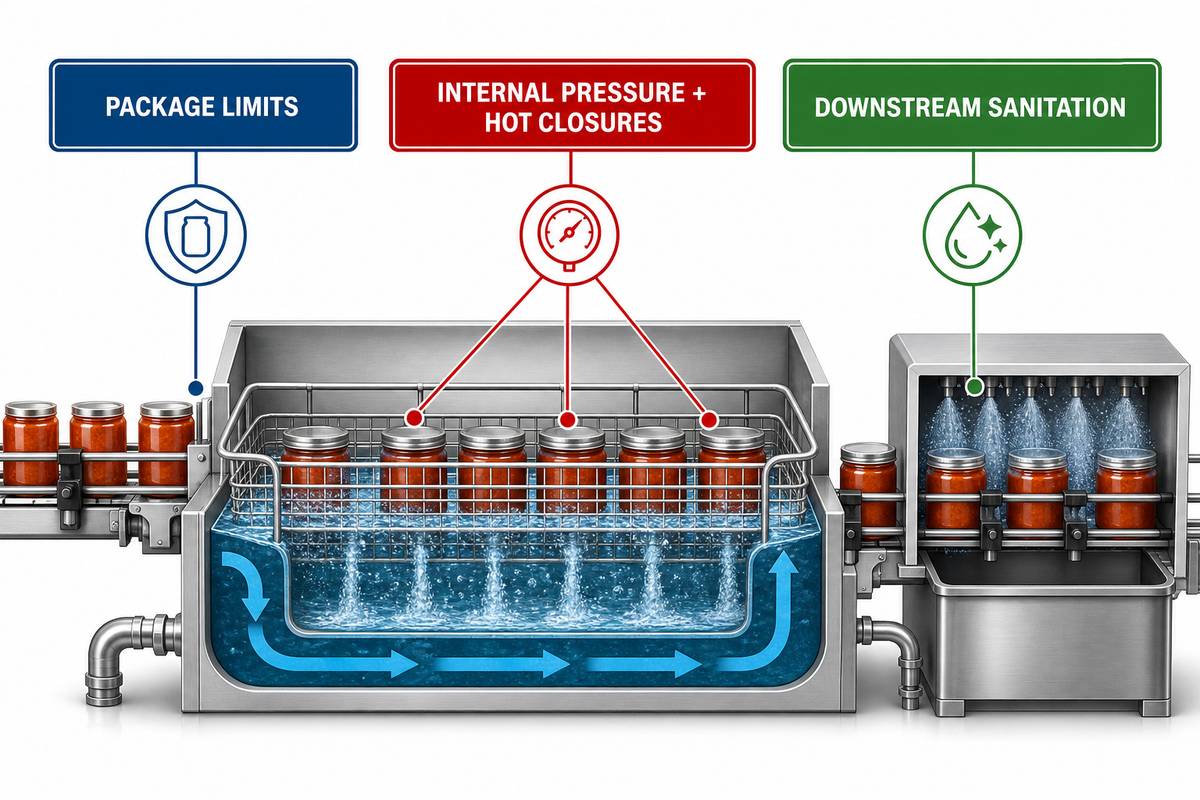
Heating ends, but process control doesn’t. Containers remain vulnerable while internal pressure changes, closures are hot and cooling water contacts the load. Cooling must follow the scheduled process and package limits so it reduces temperature without distorting the can, damaging a glass closure, pulling contamination through a compromised seam or creating rough handling damage.
| Risk | Control question | Evidence to retain |
|---|---|---|
| Pressure damage | Does the pressure profile protect the specified can or jar as internal pressure falls? | Recorded pressure, valve sequence and container observations |
| Water contamination | Is the cooling-water source and treatment controlled for the applicable system? | Water-control records and corrective actions |
| Thermal shock | Does the cooling path respect the package supplier’s limits? | Container specification, cooling curve and breakage record |
| Post-cooling handling | Are wet containers protected from impact, dirty conveyors and manual damage? | Line inspection, sanitation and defect disposition |
FDA’s post-cooling inspection guidance warns that contamination can develop on wet and soiled equipment even when cooling water is controlled. Keep container handling and downstream sanitation inside the release evidence chain.
Step 7 — Inspect Closures and Review Records Before Release
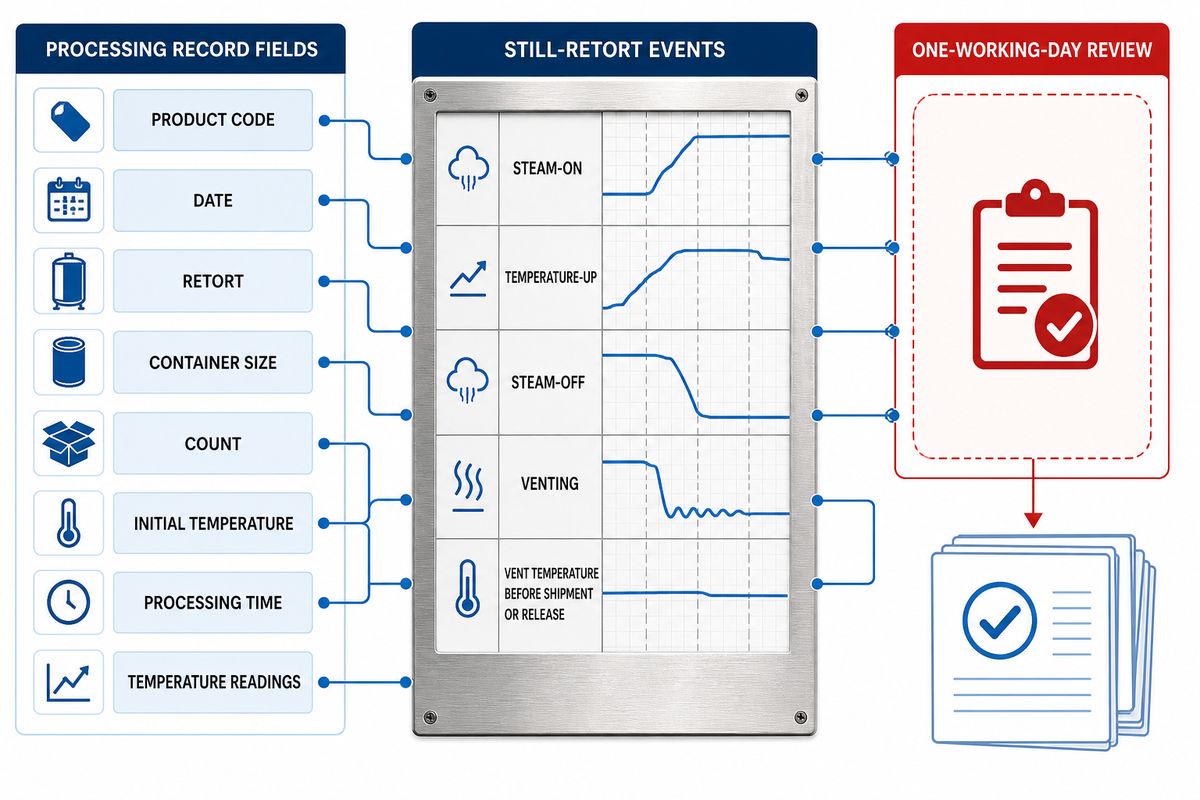
Step 7 is reconciliation, not the first time anyone looks at the closure. Bring together the production closure observations and measurements from Step 2, post-process container condition, the retort record, instrument records and every deviation or corrective action. Check that the product code, schedule identity, retort and load can be traced across systems, then reconcile the initial-condition record with the applicable Part 113 record requirements.
For the Part 113 example, processing records include product, code, date, retort or system, container size, approximate count, initial temperature, actual processing time and temperature readings. Still-retort records also capture steam-on, temperature-up, steam-off, venting time and vent temperature. Critical factors named by the schedule must be recorded at sufficient frequency.
Current 21 CFR 113.100 requires processing and production records to be reviewed no later than one working day after the actual process and before shipment or release for distribution. Closure records have their own inspection events and management-review frequency. Don’t assign the one-working-day language to every closure examination. A “complete” status from the retort controller is one input, not the release decision. Where electronic records are used, confirm that the system has been reviewed for the applicable record requirements and keep the indicating-device, calibration and review trail that supports the batch evidence.
Release review should
- Match the schedule, product code, container and load.
- Reconcile indicating and recording data.
- Confirm closure records and corrective actions.
- Resolve every deviation before distribution.
Release review should not
- Rely on an average F0 alone.
- Treat a controller flag as management approval.
- Ignore a missing critical-factor entry.
- Backfill observations from memory after the batch.
When a Critical Factor Deviates
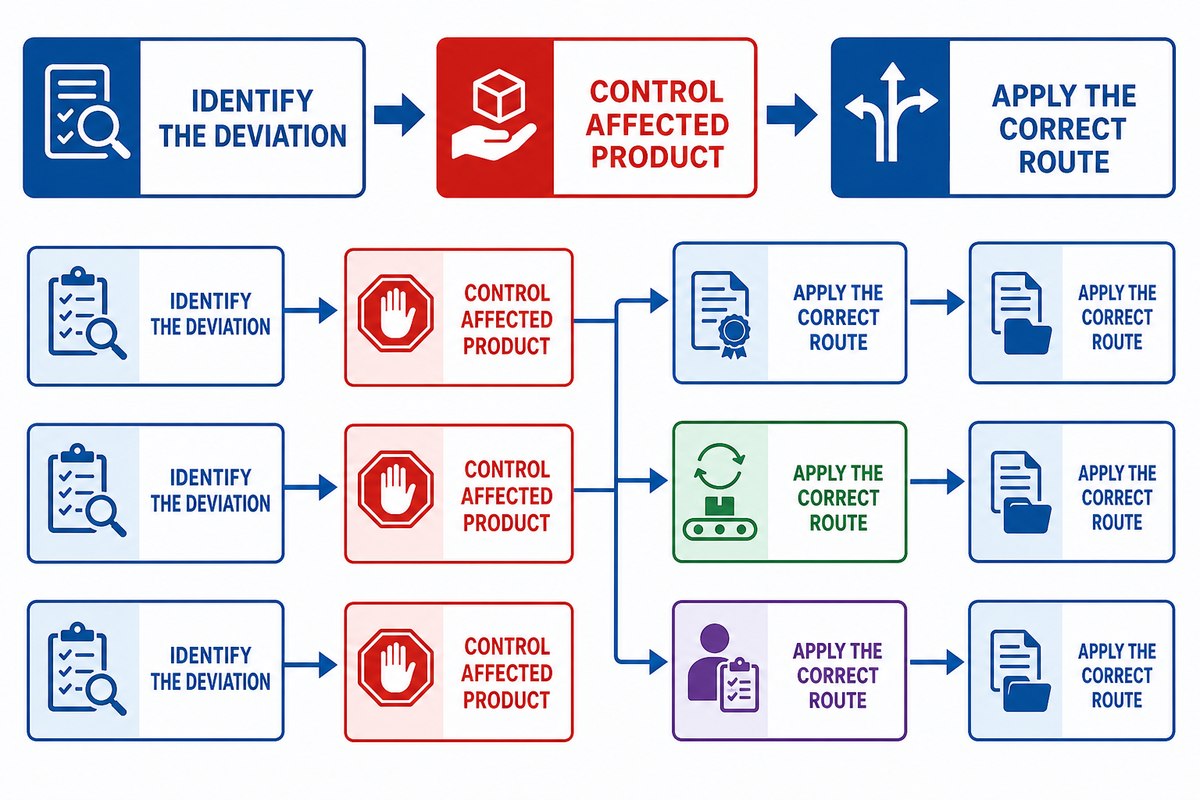
A deviation can’t be fixed with “most favorable” interpretation. Stop any unauthorized release path and identify affected production. If a qualified written instruction provides for handling a correction to a batch “in-progress,” follow and document it as written. Otherwise the Part 113 path involves complete reprocessing with full records, or the affected portion should be segregated for a qualified process authority’s decision. Use the applicable FDA deviation guidance when classifying the disposition.
- Identify the deviation: record the missed condition, actual readings, time, code, load and equipment state.
- Control the affected product: prevent shipment or release while the authorized route is determined.
- Apply the correct route: use qualified correction instructions, documented full reprocessing, or competent evaluation as applicable.
- Verify reprocessing suitability: do not assume the original schedule applies to already processed product; heating or storage may have changed its behavior.
- Document disposition: link the evaluation, results, reprocess record, release authorization or destruction record to the affected code.
This is the Schedule-to-Release Decision Path: meet the schedule and complete the evidence, then route to qualified review; if a condition is missed, prohibit informal release and use the documented disposition route. The path doesn’t replace the governing regulation or a competent process authority.
The 8-Record Batch Evidence Ladder
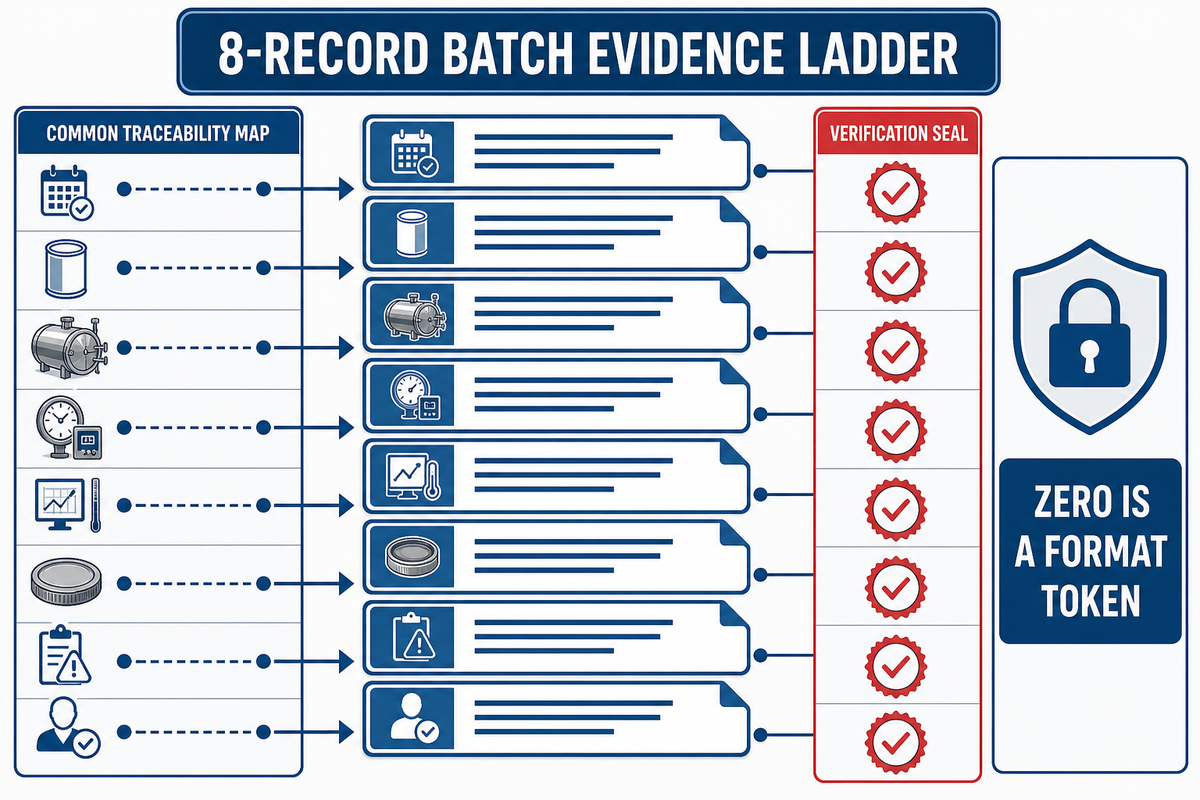
The 8-Record Batch Evidence Ladder is a non-exhaustive organizing framework created for this article. It isn’t a regulatory classification, a substitute for required records or a Taiguo-owned validation package. Its purpose is to give engineering, production, quality, the package supplier and the equipment supplier a common traceability map. The FDA cooling and post-process guidance provides a record-level cross-check.
| Group | What it connects | Release question |
|---|---|---|
| 1. Schedule identity and approval | Product, container, revision, authority and effective status | Was the correct approved process available? |
| 2. Product and initial conditions | Formulation, preparation and initial temperature | Were product-side critical factors within limits? |
| 3. Container, fill and headspace | Container code, fill, weight, headspace and exhausting | Did the package match the schedule? |
| 4. Closure inspection | Observations, measurements, disturbances and corrections | Was hermetic closure control demonstrated? |
| 5. Retort, load and recipe identity | Vessel, baskets, arrangement, quantity and program revision | Can the record be tied to the tested configuration? |
| 6. Vent, process and cooling record | Time, temperature, pressure, venting, critical factors and cooling | Did the load receive the scheduled process? |
| 7. Deviation and disposition | Affected codes, hold control, evaluation, reprocess or destruction | Was every exception resolved by an authorized route? |
| 8. Qualified review and release | Reviewer, date, completeness check and distribution status | Who made the documented release decision? |
9-Type Measurement Notation Map
The table below standardizes how an equipment brief can label recorded quantities. Every zero is a format placeholder, not a process value, acceptance limit or recommended instrument resolution. Replace each field only with the units, precision and limits approved for the project.
| Record type | Schedule-field template | Actual-field template | Reconciliation question |
|---|---|---|---|
| Temperature | 000.0 °C or 000.0 °F | 000.0 °C or 000.0 °F | Do the unit, location and sensor identity match? |
| Time | 000 min or 000 sec | 000 min or 000 sec | Are start, stop and sampling bases explicit? |
| Pressure | 0.00 bar, 0.00 MPa or 000 PSI | 0.00 bar, 0.00 MPa or 000 PSI | Is gauge or absolute pressure defined? |
| Mass | 0.000 kg or 000 lbs | 0.000 kg or 000 lbs | Is this fill, drained weight or total load? |
| Container geometry | 000 mm or 00.0 cm | 000 mm or 00.0 cm | Are diameter, height and orientation identified? |
| Steam flow | 000 kg/h or 0.0 t/h | 000 kg/h or 0.0 t/h | Does the field identify demand or available capacity? |
| Water flow | 0.0 m³/h | 0.0 m³/h | Is the stated condition supply, circulation or return? |
| Electrical load | 000 kW or 000 kWh | 000 kW or 000 kWh | Is power distinguished from energy? |
| Control signal | 0.0 %, 000 rpm or 00 Hz | 0.0 %, 000 rpm or 00 Hz | Is the tag, range and time basis preserved? |
Planning Retort Equipment Around the Process
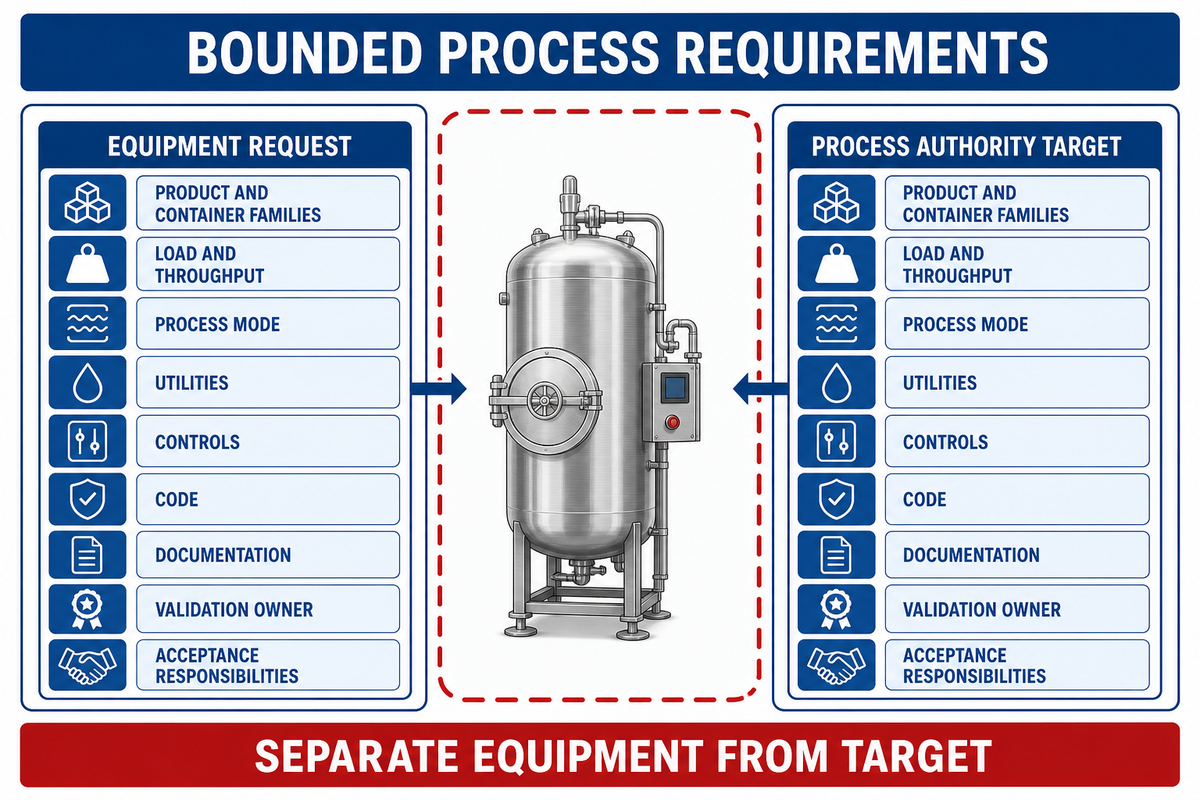
Equipment planning starts after the process requirements are bounded. Give the supplier the product and container families, intended load and throughput, required process mode, utility conditions, controls interfaces, applicable market and code, documentation scope, validation owner and acceptance responsibilities. Keep the equipment request separate from the process authority’s target. Treat a change to piping, loading pattern, fill, container, installation or control logic as a change-control question; it may require additional distribution or penetration work before prior evidence is reused.
You can copy the table below into an inquiry. Each “range” is a project input to be supplied or confirmed; it isn’t a universal recommendation.
RFQ checklist — copy these into your quote request:
| Parameter | Recommended range | Why it matters | How to verify |
|---|---|---|---|
| Product and formulation | Project-defined min/max critical factors | Sets the heat-penetration boundary | Approved process packet |
| Container dimensions | List every diameter/height in mm | Affects loading and heating behavior | Package drawings and samples |
| Batch load | Min/max containers and kg per load | Defines basket and utility demand | Loading drawing and witnessed trial |
| Process conditions | Scheduled-process temperature, time and pressure basis | Defines control and instrument scope | Authority-approved requirements |
| Utilities | Available steam kg/h, water m³/h, air and power | Constrains come-up and cooling design | Plant utility survey |
| Data and records | Required sample interval and retention period | Supports traceability and review | Controls specification and export test |
| Acceptance evidence | Project-defined study loads and pass criteria | Prevents empty-vessel acceptance | Witnessed protocol and signed report |
Taiguo presents industrial autoclave systems for food-processing discussions. Its industrial autoclave guide provides broader equipment context. Share the bounded request above to discuss configuration and documentation. These company pages establish product scope only; they don’t prove a product-specific scheduled process or release result.
Frequently Asked Questions
What is retorting in canning?
Retorting is the controlled thermal processing of sealed containers under an established scheduled process. In commercial canning, it joins product preparation, container closure, retort operation, cooling, records and release review. The applicable process depends on food classification, package and jurisdiction; it isn’t a home-canning recipe.
What is the F0 value in retort processing?
F0 is accumulated equivalent lethality calculated from a food cold-spot temperature history using a stated reference temperature and z-value. It describes what a measured thermal history delivered on that basis. The required target and release decision still come from the scheduled process and applicable authority.
When does retort processing time start?
For a still-steam retort in the Part 113 example, process timing starts after proper venting and after the retort reaches the scheduled processing temperature. Steam admission alone does not establish that start condition. Other systems use the start condition specified for their design and scheduled process.
Is a retort the same as a pressure canner?
No. This article concerns commercial processing equipment, validation, records and regulatory controls. A commercial retort is engineered and documented for defined production loads. Household pressure-canning equipment and published home recipes have a different use context; don’t transfer schedules between them.
What records should be checked before a batch is released?
Check the approved schedule; product, initial-condition, fill and headspace records; container and closure observations; retort, load and recipe identity; vent, time, temperature, pressure and cooling data; and every deviation and disposition. Confirm that common product and code identifiers join the evidence, that instrument accuracy and distribution traceability are documented, that the list is not exhaustive, and that a qualified reviewer completes the required review before distribution.
Can a retort equipment supplier set the F0 target?
An equipment supplier doesn’t automatically own that decision. A competent organization may provide both equipment and process-authority services only when qualifications, scope, data, responsibility and approval are explicit. The project record should identify the product-package basis, supporting studies, applicable jurisdiction, qualified reviewer and approval boundary. Otherwise, keep product-process approval separate from vessel supply and acceptance testing, and document who has authority to approve the target. Keep that approval with the controlled schedule and revision record.
References & Sources
- Electronic Code of Federal Regulations, 21 CFR Part 113 current definitions, equipment, closure, process, deviation and record requirements.
- FDA Guide to Inspections of Low Acid Canned Food 13 processing deviations and qualified reprocessing context.
- FDA Guide to Inspections of Low Acid Canned Food 22 temperature distribution and heat-penetration distinction.
- FDA Guide to Inspections of Low Acid Canned Food 45 cooling water and post-cooling handling.
- New Mexico State University, How to Submit a Commercial Food Product for Process Review process-authority role.
- Purdue Extension, Canning Foods: The Retort Process commercial thermal-processing and heat-penetration context.
- Virginia Tech open thermal-processing chapter F0 equation and variables; its generic minimum isn’t adopted here.
- Jimenez et al., Understanding retort processing: A review peer-reviewed engineering context and process variability.
- USDA FSIS Thermal Processing, Commercially Sterile Training Course jurisdiction and post-process failure context.
Turn the Scheduled Process Into an Equipment Brief
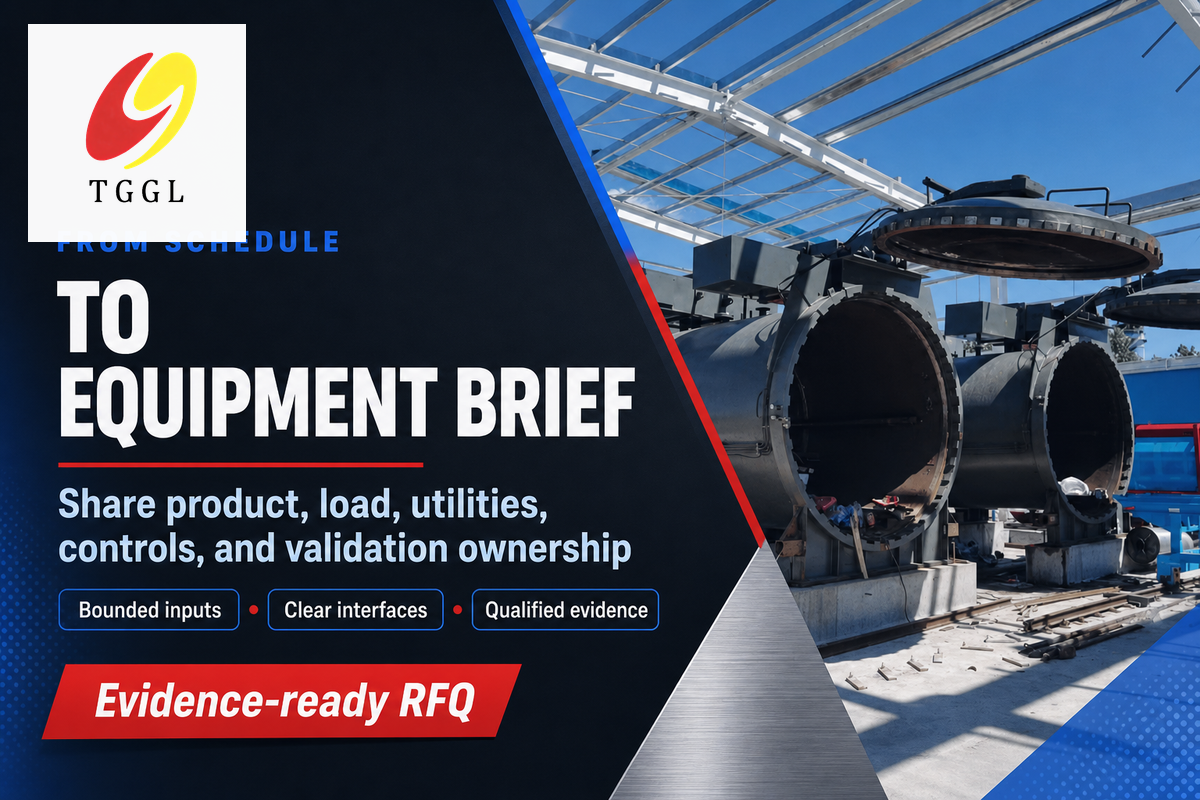
Send Taiguo your product and container families, load basis, process requirements, utilities, control interfaces, documentation scope and validation responsibilities. The result should be a configuration discussion tied to evidence, not a generic cycle promise.