Get in Touch with Taiguo


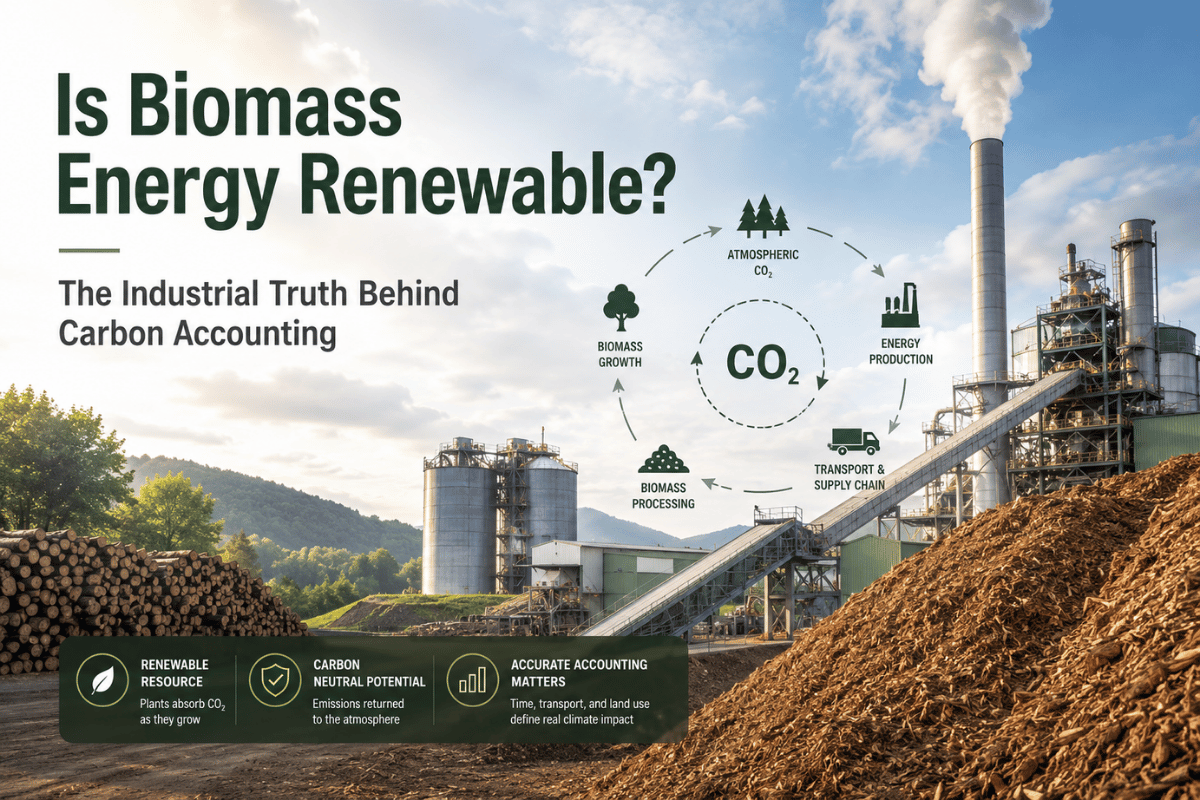
Yes — is biomass renewable is officially answered “yes” by the U.S. Energy Information Administration, the EU Renewable Energy Directive, the IEA, and the USDA. Yet the regulatory yes hides a physics question: when wood pellets release more CO₂ at the smokestack than coal, in what sense is that fuel actually clean? This guide separates the two questions — regulatory renewability versus carbon-neutrality — so industrial buyers can make procurement decisions that survive both audit and conscience.
Quick Specs: Biomass at a Glance
| Renewable Status (US) | Yes — EIA-classified renewable; 5% of US 2023 primary energy |
| Renewable Status (EU) | Yes under RED III, but with 70%/80% lifecycle GHG savings thresholds |
| Carbon-Neutral Status | Conditional — depends on feedstock origin and carbon debt window |
| CO₂ at Combustion | Wood emits 30–50% more CO₂ per MJ than coal |
| Industrial Boiler Range | 1–50 MWth typical for SME industrial; up to 740 MWe for utility |
| Pellet Calorific Value | ~17 MJ/kg (vs. bituminous coal ~25–30 MJ/kg) |
What Is Biomass Energy? Sources, Feedstocks, and Types

Biomass energy is energy released when organic material from plants and animals is burned, gasified, fermented, or chemically converted. Among recognised classifications, the U.S. Energy Information Administration names four feedstock categories — and the distinction between them is where most of the carbon-accounting argument lives. Knowing which type of biomass fuels your facility is step one in answering whether your specific biomass purchase is genuinely clean.
Per the EIA Biomass Explained reference, biomass supplied 4,978 trillion British thermal units (TBtu) — about 5% of US primary energy — in 2023. Inside that share, biofuels held 53%, wood and wood waste 39%, and municipal solid waste, manure, and sewage 8%. Industrial use consumed 45% of all biomass energy that year, more than any other sector.
The four feedstock categories:
- ✔
Wood and wood waste — firewood, wood pellets, wood chips, sawmill waste, and black liquor from pulp and paper mills. Largest single source of biomass energy outside transportation fuels. - ✔
Agricultural crops and waste — corn, soybeans, sugarcane, switchgrass, woody plants, algae, and crop and food processing residues. Mostly converted to biofuels via fermentation or transesterification. - ✔
Biogenic municipal solid waste (MSW) — paper products, cotton and wool, food waste, yard waste. Burned in waste-to-energy plants or sent to landfills where methane is captured. - ✔
Animal manure and sewage — anaerobic digestion produces biogas (also called biomethane or renewable natural gas), which can replace fossil natural gas in turbines, boilers, and pipelines.
Why “organic” matters: every form of biomass contains carbon that came from atmospheric carbon dioxide via photosynthesis. Renewable status rests on the idea that burning biomass simply returns that carbon to the atmosphere, where new plant growth will absorb it again. That logic works — but only on time scales and supply chains that match the growth cycle. That assumption is where the renewable-versus-carbon-neutral split begins.
Yes, Biomass Is Officially a Renewable Energy Source — Here’s Who Says So
If a procurement officer needs to put “renewable” in a contract, biomass as a source of energy passes the official test in every major energy jurisdiction. Four authoritative classifications agree, even though they apply different sustainability conditions on top of the renewable label.
| Authority | Classification | Conditions Attached |
|---|---|---|
| U.S. EIA | Renewable | None at federal classification level; state RPS rules vary |
| EU RED III (2024) | Renewable | ≥80% lifecycle GHG savings for new installations; ≥70% for existing |
| IEA Bioenergy | Renewable | Categorised under modern bioenergy (~10% of world primary energy supply) |
| USDA Climate Hubs | Renewable | No additional conditions at classification level |
A 2024 IEA Bioenergy EU27 implementation update adds a striking number to the regulatory picture: bioenergy supplied roughly 60% of the EU’s 22% renewable share in final energy consumption — meaning biomass is the single largest contributor to the bloc’s renewable mix. Take it away, and the EU’s 2030 target of 42.5% renewable share becomes mathematically far harder to reach.
“Biogenic carbon neutrality is not automatic. Whether bioenergy delivers a climate benefit depends on the temporal scale, the source feedstock, and the counterfactual land use that would have occurred otherwise.”
So why the gap between “officially renewable” and “actually clean”? Because the regulators answer one question — does the fuel come from a stock that can regrow? — while climate physics answers a different question: what does the molecule do once it leaves the smokestack? Below, we walk through the gap.
The Carbon Accounting Loophole — Why “Renewable” Doesn’t Mean “Carbon Neutral”

Treating renewable status as if it means zero net carbon is the most consequential mistake in industrial procurement. They are different claims, governed by different rulebooks. A pellet purchased from a sustainably managed forest is genuinely renewable — yet the same pellet, burned in your boiler tomorrow, may not become carbon-neutral for fifty years or more. Behind the gap sits a named mechanism: the carbon debt window.
The Carbon Debt Window — Three Tests Industrial Buyers Run Before Calling Biomass Carbon-Neutral
Used here as a procurement-grade framework, the Carbon Debt Window separates the two claims. It rests on three tests, each independently failable:
- Combustion test: Does the fuel release LESS CO₂ per MJ than the fossil baseline at the smokestack? For wood, the answer is almost always no. Research from the Partnership for Policy Integrity shows wood-burning power plants emit roughly 150% the CO₂ of coal per unit energy produced, while more conservative figures put the gap at 30–50%. Either way, the smokestack number runs against, not with, the renewable narrative.
- Regrowth window test: Will the burned biomass be re-sequestered within a procurement-relevant horizon? A 25-year contract assumes carbon balance within 25 years. Mature temperate forest regrowth typically takes 50 to 100 years. Math fails for roundwood from old-growth or undocumented forest sources.
- Supply-chain leakage test: Are upstream emissions from harvest, drying, pelletising, and transoceanic shipping accounted for, and do they preserve the EU RED III ≥70% lifecycle GHG savings threshold? Pellets shipped from the US Southeast to UK power stations spend significant fossil energy in the journey alone.
Is biomass 100% renewable?
No, and this distinction matters in procurement contracts. Renewable status applies to feedstock categories — wood, agricultural waste, MSW organic fraction, manure — which can in principle replenish through biological cycles. But specific biomass purchases vary widely in how cleanly they execute that cycle. A waste-stream pellet from sawmill residue is close to genuinely renewable in net carbon terms; a roundwood pellet from a clearcut and unreplanted forest is renewable in name only. Documentation by the International Council on Clean Transportation walks through the gap in detail. Field practitioners distinguishing the two cases are increasingly common — the cultural shift since 2020 has been to treat the renewable label as a starting question, not an ending one.
⚠️ Important
Greenhouse gas inventories under the Kyoto Protocol record biomass combustion emissions in the land-use sector rather than the energy sector — a rule designed to avoid “double counting.” An unintended consequence: if forest loss is undercounted on the land-use side, the energy-side accounting can show clean numbers while atmospheric CO₂ is still rising.
Sustainable vs. Unsustainable Biomass — A Decision Framework

If renewable status alone does not guarantee climate benefit, what does? A decision framework that filters feedstock origin first, then applies the GHG savings test the regulators care about, then flags whether the use respects emerging cascading-use principles. Three steps, used in order.
Sustainable Biomass Decision Tree (3 Steps)
- Step 1 — Feedstock origin filter. Pass: agricultural or forestry waste residues; landfill gas or MSW organic fraction; sustainably managed forest with FSC, SBP, or PEFC certification and a documented replanting plan; energy crops grown on marginal or degraded land that does not displace food production. Fail: roundwood from undocumented sources; land cleared specifically for biomass plantations.
- Step 2 — RED III GHG savings test. New installation: lifecycle GHG savings must be ≥80% versus the fossil baseline. Existing installation: ≥70%. Below the threshold means non-compliant under RED III rules, regardless of regulatory renewable status.
- Step 3 — Cascading-use check. Is the feedstock being used for materials (lumber, pulp, panels) before energy where physically viable? RED III explicitly prefers cascading use; direct-to-energy combustion of construction-grade timber is increasingly disfavoured and faces probable regulatory tightening.
Can biomass fuel ever run out?
Biomass is renewable in stock terms — meaning the underlying resource pool can regenerate — but it is finite in flow terms over any given year. Global sustainable supply has hard ceilings set by available land, water, fertiliser, and competing uses (food, materials, biodiversity). UK’s 2023 Biomass Strategy treats supply as bounded enough that priority-of-use rules are now central policy. For procurement specifically: a buyer can absolutely face local or seasonal shortages of compliant feedstock, even though the global resource never “runs out” in the geological sense fossil fuels do.
Certification standards FSC (Forest Stewardship Council), SBP (Sustainable Biomass Program), and PEFC (Programme for the Endorsement of Forest Certification) are the practical anchors for Step 1 filtering. They differ in scope — FSC and PEFC certify forest management broadly; SBP is purpose-built for biomass supply chains and adds chain-of-custody requirements specific to pellets and chips. For boiler operators procuring multi-year fuel contracts, SBP-certified feedstock plus a RED III lifecycle assessment is the most defensible combination.
Industrial Forms of Biomass Fuel and Biofuel — Pellets, Chips, Briquettes, Liquids

The physical form a feedstock takes — solid pellet, briquette, chip, or liquid biofuel — determines which equipment can burn it, what storage volume the site needs, and how much pre-processing energy was already spent before the fuel arrived. Below, a reference table matches feedstock form to combustion or conversion equipment for industrial-scale buyers.
| Form | Calorific Value | Moisture | Ash | Typical Industrial Use |
|---|---|---|---|---|
| Wood pellets | ~17 MJ/kg | ≤10% | ≤1.5% | Boilers, co-firing in coal plants |
| Wood chips | ~10–15 MJ/kg | 25–55% | 1–3% | Stoker boilers, gasifiers |
| Briquettes | ~16–18 MJ/kg | 8–12% | 2–4% | Boilers, kilns |
| Pyrolysis bio-oil | ~16–19 MJ/kg | 15–25% | <0.1% | Industrial burners, refining feedstock |
| Biodiesel (FAME) | ~37 MJ/kg | <500 ppm | ~0% | Diesel engines, burners |
One often-missed implication: wood pellets at ~17 MJ/kg deliver roughly 60% of the energy density of bituminous coal at ~25–30 MJ/kg. A boiler retrofitted from coal to pellets without storage and conveyor upgrades will run out of fuel before the shift ends. Sites switching feedstocks should plan for fuel storage volume to roughly double, screw-conveyor torque to increase, and pellet feed redundancy to protect against bridging in the silo.
Liquid biofuels follow different conversion routes. Ethanol comes from fermentation of sugars and starches — corn in the US, sugarcane in Brazil. Biodiesel uses transesterification of vegetable oils, animal fats, and used cooking oils into fatty acid methyl esters. Pyrolysis bio-oil — produced by heating biomass to 800–900°F (400–500°C) in near-absence of oxygen — is currently more upgrade feedstock than direct fuel, but renewable diesel and renewable jet fuel produced via hydrotreating are gaining commercial traction. For an operator-level walkthrough of solid forms, see this reference on industrial biomass fuel types and pellet specifications.
Where Biomass Energy Is Used — Boilers, Power Plants, and Co-Firing

At industrial scale, biomass energy travels through three main combustion routes. Each suits different capacity ranges, fuel mixes, and decarbonisation goals — and each carries its own trade-off profile on efficiency, emissions, and feedstock flexibility.
Industrial biomass boilers (1–50 MWth). Direct combustion to produce heat is the workhorse mode for SME industrial process applications. Capacity scales from small dairy and food processing units in the low single digits MWth up to dedicated industrial steam generators in the tens of MWth, with operators choosing how to use biomass at facility scale based on feedstock availability. IEA Bioenergy 2024 case studies document a Nordex Food installation in Denmark running a 2.6 MWth biomass boiler producing 3.8 tonnes per hour of steam at roughly 30 bar — a profile typical for small to mid food, paper, and textile facilities. New Zealand’s Synlait Pokeno milk processing plant, profiled by the country’s Energy Efficiency and Conservation Authority, runs a 43 MWth wood pellet boiler continuously through milk processing season. For procurement-grade detail on equipment selection, see this guide on how a biomass-fired boiler converts feedstock to steam.
Standalone biomass power plants (5–740 MWe). Utility-scale plants generate electricity, often coupled with combined heat and power (CHP) for district heating. Ironbridge in the UK is the world’s largest biomass plant at 740 MWe; Drax power station has converted four of its six generating units from coal to biomass, making it Europe’s largest biomass-fuelled power source. UK aggregate sat at 78 biomass power plants in 2023 totalling 4,158 MW capacity, generating roughly 12.9% of the country’s 2021 electricity supply.
Co-firing in coal plants (typically 10–20% biomass share). Existing coal infrastructure can co-fire biomass to meet renewable mandates without full retrofit. Co-firing keeps capital costs low but caps biomass share — and more importantly, perpetuates coal-plant operation rather than displacing it. Climate-strict frameworks increasingly view co-firing as a transitional rather than terminal pathway.
📐 Engineering Note
Industrial biomass boiler procurement requires verifying ash-fusion temperature compatibility with feedstock alkali content. Pellets from agricultural residue (straw, husks) carry potassium and chlorine concentrations that drive slagging at lower temperatures than woody-pellet boilers can tolerate — typically slag fusion below 1,200°C is the warning threshold. Boiler datasheets should specify fuel ash classification per ISO 17225 series; feedstock contracts should require ash-content lab certificates per shipment. For typical industrial applications, source biomass-fired boiler systems for industrial steam generation with documented ash-fusion compatibility for your specific feedstock.
Advantages and Disadvantages of Biomass — When It Makes Industrial Sense

Biomass earns or loses its case in industrial procurement on a small set of measurable trade-offs. Below, an advantages-versus-limitations card collects the ones procurement officers actually weigh, with specific numbers wherever the data permits.
✔ Advantages
- Fuel cost stability: wood pellets ~3.1 p/kWh in UK vs. mains gas 4.9 p/kWh and grid electricity 15 p/kWh (UK Forestry Commission baseline)
- Decouples energy spend from oil and gas commodity cycles
- Counts toward most national renewable energy targets and certificates (RIN, ROC, GoO, etc.)
- Closes industrial waste streams when feedstock is mill residue, sawdust, or MSW organic fraction
- Provides dispatchable baseload — unlike intermittent solar or wind, biomass generates on demand
⚠ Limitations
- Higher CO₂ at smokestack — 30–50% more per MJ than coal for wood
- Particulate pollution (PM2.5) and NOx emissions higher than natural gas combustion
- Pellet supply price volatility: seasonal spikes of 25–40% during cold-snap procurement windows
- Fuel storage volume roughly doubles vs. coal at equivalent thermal output
- Sustainability certification adds compliance overhead (FSC/SBP audits, lifecycle assessments)
- US biomass share of renewable electricity declining — 2.44% (2023) to projected 2.04% (2025)
What are three disadvantages of biomass?
Three disadvantages dominate industrial decision-making. First, point-of-combustion CO₂ exceeds coal by 30–50% per MJ for wood, and renewable status by itself does not erase that smokestack number. Defence of the climate claim rests entirely on regrowth and supply-chain accounting, both of which require active verification. Second, fuel supply is more vulnerable to disruption than fossil alternatives — pellet mills depend on roundwood markets that swing with construction cycles, and sustainability certification can take a manufacturer offline mid-contract if compliance lapses. Industrial buyers procuring biomass commonly check pellet origin certificates (FSC/SBP) before signing fuel contracts longer than twelve months because pellet price volatility tied to roundwood markets is the single largest supply-chain risk. Third, particulate emissions — PM2.5, NOx, formaldehyde, polycyclic aromatic hydrocarbons — are typically higher than from natural gas combustion. Communities sited near biomass plants report respiratory health concerns at rates comparable to those near coal plants, even though sulfur and mercury emissions are lower. Procurement specialists pricing biomass should factor in this industrial biomass boiler cost guide for 2026 data alongside emission permits.
Procurement question is not “is biomass good or bad?” but “for which application, with which feedstock, under which regulatory horizon?” Industrial heat generation from waste-stream pellets in a region with strong sustainability enforcement looks very different from utility electricity from imported roundwood. Where high-efficiency design pays back, see this primer on biomass boiler efficiency factors.
Regulatory Outlook — RED III, EPA, and the Tightening Definition of Renewable

The next five to seven years will reshape what counts as renewable biomass in practice. Three regulatory trajectories matter for buyers signing 2026-and-onward procurement contracts.
EU RED III in force from 2024. Third iteration of the Renewable Energy Directive replaced RED II with stricter sustainability and GHG savings rules. New installations starting after January 2024 must achieve ≥80% lifecycle greenhouse gas savings; existing installations must achieve ≥70%. RED III also caps food and feed crop-based biofuels at 7% of transport sector consumption and introduces the cascading-use principle preferring biomass for materials before energy where physically possible.
EPA RFS biomass classification under review. US Renewable Fuel Standard programme periodically reassesses which biomass categories qualify for RIN credits, and the Power Sector Evolution work tracks biomass generation share decline. Buyers signing multi-year procurement contracts should expect classification rules to tighten rather than loosen.
EU 2030 target: 42.5% renewable share. Political math requires biomass to remain a major contributor — removing it disrupts the trajectory — but it also means oversight will intensify. Sustainability audits, lifecycle assessment requirements, and chain-of-custody documentation will all weigh more heavily on biomass than on solar or wind, where the carbon claim is simpler.
For an operator signing a 2026 procurement contract, the practical implication is concrete: include lifecycle GHG assessment language, require Cat A/B/C land documentation per RED III, and price in the option that EPA RFS may reclassify some biomass categories before contract end. Long-dated (5+ year) commitments without sustainability re-audit clauses carry the most regulatory risk.
Frequently Asked Questions
Q: Why is biomass considered renewable?
View Answer
Biomass is classed renewable because plants and animals regenerate on biological time scales, drawing carbon from the atmosphere via photosynthesis as they grow. Classification reflects feedstock replenishment, not lifecycle carbon balance.
Q: Does replacing coal with wood actually lower CO₂ emissions?
View Answer
Not at the smokestack — wood emits 30–50% more CO₂ per MJ than coal at point of combustion. Net climate benefit only appears once forest regrowth re-absorbs the burned carbon, which can take decades depending on feedstock origin. Waste-stream pellets from mill residues approach near-zero net carbon faster than roundwood pellets from clearcut forests, which may carry a decades-long carbon debt window.
Q: Is biomass renewable in the EU under RED III?
View Answer
Yes, but with conditions. RED III in force since 2024 requires lifecycle GHG savings of ≥80% for new installations and ≥70% for existing installations versus the fossil baseline. Below that threshold, the biomass purchase fails RED III compliance regardless of its renewable label.
Q: How is biomass renewable if you cut down forests?
View Answer
A renewable case rests on three conditions: forests must be replanted, growth must keep pace with harvest, and the carbon debt window must fall within a climate-relevant horizon. Where any of those fails — undocumented sourcing, monoculture plantations, or 50-to-100-year regrowth periods on mature temperate forest — the renewable label survives but the carbon-neutrality claim does not. RED III’s Category A/B/C land rules and FSC/SBP certifications exist specifically to filter the gap.
Q: What’s the difference between biomass and biofuel?
View Answer
Biomass is the raw feedstock — wood, crops, MSW, manure. Biofuel is the processed liquid or gaseous derivative used in engines or boilers — ethanol, biodiesel, renewable diesel, biogas. Every biofuel comes from biomass, but most biomass is burned directly as solid fuel rather than converted to biofuel.
Q: How much does biomass energy cost?
View Answer
Wood pellet fuel runs around 3.1 p/kWh in UK markets (UK Forestry Commission), undercutting mains gas at 4.9 p/kWh, with wide variation by region and feedstock contract. Equipment cost runs from low five-figures for small commercial boilers up to multi-million for industrial systems.
Q: Is biomass cheaper than natural gas?
View Answer
Per kWh, wood pellets often beat regulated gas markets, particularly in Europe. Per MMBtu, the ranking flips when shale gas is abundant — US natural gas spot prices in 2025 ran $2.65–$9.86/MMBtu.
Specifying a biomass boiler for your facility?
Get matched fuel-form, capacity, and ash-compatibility specs reviewed by an industrial boiler engineer.
About This Analysis
This guide separates regulatory renewability from carbon-neutrality because procurement and emissions accounting have grown apart over the last decade. Figures cited are drawn from EIA 2023 data, IEA Bioenergy’s 2024 EU27 update, RED III thresholds in force from January 2024, and IPCC Working Group III Chapter 2 on bioenergy. Reviewed by Taiguo Steam Boiler engineering team for industrial boiler capacity and feedstock-handling claims.
References & Sources
- Biomass Explained — Renewable Energy from Plants and Animals — U.S. Energy Information Administration
- Implementation of Bioenergy in the European Union — 2024 Update — IEA Bioenergy
- Renewable Energy Directive III (RED III) — GHG Threshold — International Energy Agency
- IPCC Special Report on Renewable Energy — Chapter 2 Bioenergy — Intergovernmental Panel on Climate Change
- Demystifying the Carbon Neutrality of Biomass — International Council on Clean Transportation
- Carbon Emissions from Burning Biomass for Energy — Partnership for Policy Integrity
- Biomass Boilers for Industrial Process Heat — Synlait Pokeno Case — Energy Efficiency and Conservation Authority of New Zealand
- Sustainability Criteria for Biomass — RED III Cascading Use — European Bioplastics 2025